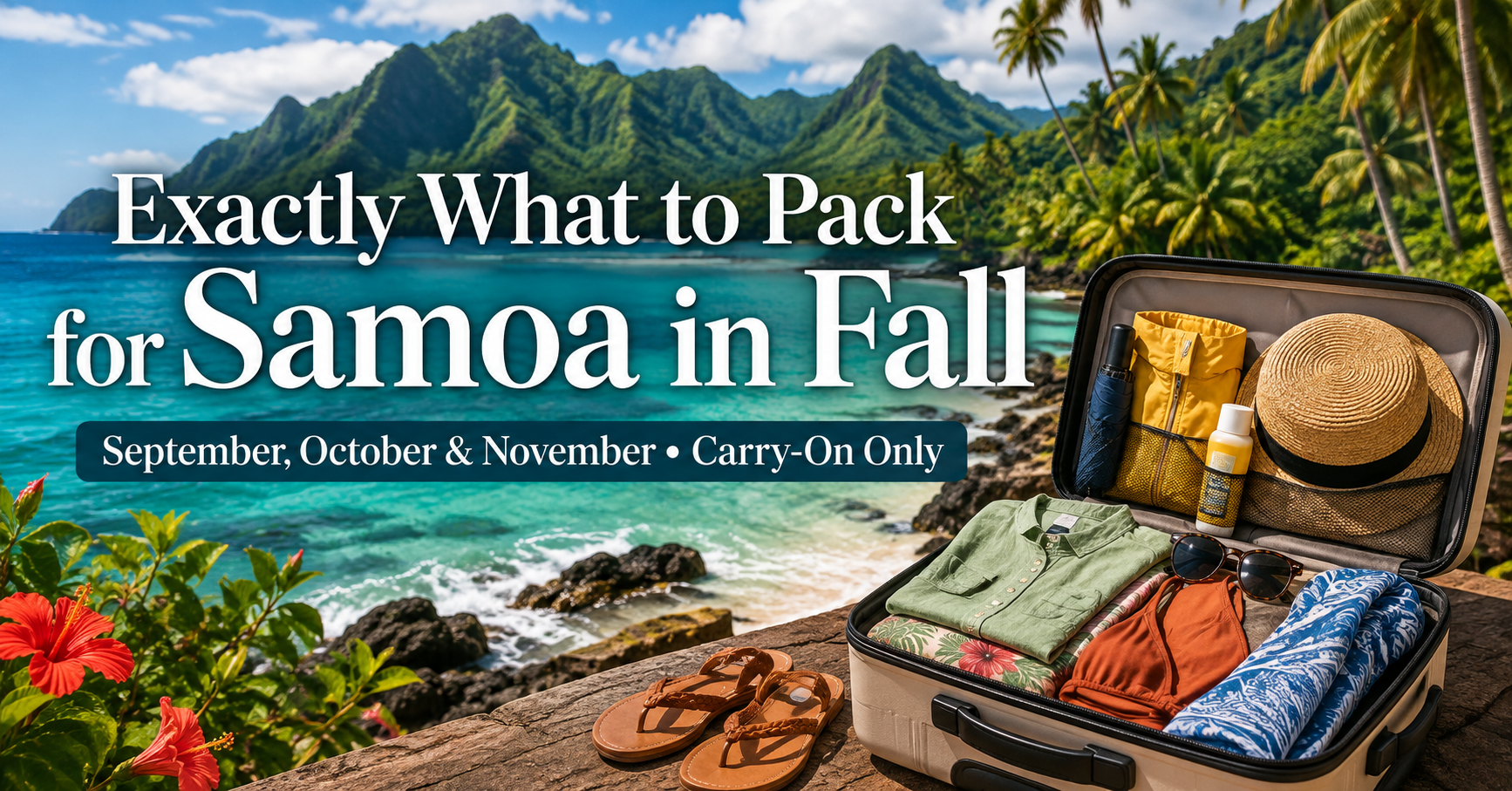
Turquoise lagoons shimmer beneath coconut palms, waterfalls tumble into rainforest swimming holes, and volcanic coastlines frame some of the most beautiful beaches in the South Pacific.
Across Upolu and Savaiʻi, colorful villages line the roads, traditional beach fales sit only steps from the water, and warm Samoan hospitality remains at the heart of the journey.
September, October, and November can all be wonderful months to visit Samoa, but they do not require exactly the same planning.
September and October fall within Samoa’s drier season, while November marks the beginning of the wetter season. Temperatures remain warm throughout all three months, but November travelers should prepare for increasingly frequent tropical rain and greater humidity. Samoa is warm and humid year-round, with the dry season running from May through October and the wet season beginning in November.
Although travelers from the United States, Canada, Europe, and other Northern Hemisphere destinations may think of September through November as fall, these months are spring in Samoa.
You do not need a traditional autumn wardrobe.
You need lightweight clothing, two swimsuits, culturally respectful cover-ups, secure walking shoes, dependable sun protection, insect protection, a packable rain layer, and pieces that can handle beaches, reefs, waterfalls, villages, ferries, rainforest paths, volcanic landscapes, casual restaurants, and long days exploring the islands.
This Samoa fall packing list is designed for travelers visiting during September, October, or November while still packing carry-on only.
What Samoa Is Like in Fall
Samoa offers far more than one type of tropical island vacation.
A single trip might include exploring Apia, swimming at To-Sua Ocean Trench, snorkeling at Palolo Deep Marine Reserve, visiting the waterfalls and beaches of southern Upolu, sleeping in a traditional beach fale, taking the ferry to Savaiʻi, walking through the Saleaula Lava Fields, watching the Alofaaga Blowholes, swimming beneath Afu Aau Waterfall, and spending time in villages where traditional Samoan customs remain part of everyday life.
For most travelers, Samoa fall packing means preparing for:
- Warm tropical weather
- High humidity
- Strong South Pacific sunshine
- Warm ocean and lagoon swimming
- Generally drier conditions during September and October
- The beginning of the wetter season in November
- Short but intense tropical downpours
- Regional differences between the coast and wetter inland areas
- Slippery rocks, ladders, paths, docks, and waterfall areas
- Coral, shells, rocks, and uneven entries at some swimming locations
- Mosquitoes and other biting insects
- Damp swimsuits and clothing that may dry slowly
- Boat spray and breezy ferry crossings
- Air-conditioned airports, restaurants, vehicles, and hotel rooms
- Clothing that covers swimwear when entering villages
- Modest pieces suitable for villages, cultural experiences, and church
- Cash payments at markets, taxis, beaches, waterfalls, and village-owned attractions
- Clothing that can be washed, reworn, and dried as quickly as possible
Fall does not mean cool autumn weather in Samoa.
September, October, and November remain warm enough for breathable tops, shorts, lightweight skirts, airy dresses, swimwear, sandals, sun hats, and other tropical clothing.
One lightweight layer is useful for flights, air conditioning, rainy evenings, ferry crossings, windy boat rides, and early departures.
November travelers should place slightly more emphasis on quick-dry clothing, waterproof organization, and dependable rain protection, but they still do not need sweaters, thick jeans, boots, or heavy jackets.
The goal is not to create separate wardrobes for Apia, Lalomanu, Manono, Savaiʻi, beach resorts, rainforest waterfalls, village visits, and every possible excursion.
The goal is to build one lightweight tropical wardrobe that can move comfortably between water, sunshine, rain, humidity, cultural experiences, casual meals, island transportation, and outdoor attractions.

Who This Samoa Fall Packing List Is For
This packing list is for travelers going to Samoa in September, October, or November who want to travel with a carry-on and personal item only without feeling underpacked.
- Fall travel during September, October, or November
- Carry-on + personal item only
- Travelers comfortable repeating outfits
- Travelers willing to do light laundry
- Trips lasting approximately two weeks
- Longer trips of up to about one month with regular laundry
- Beach and resort stays on Upolu or Savaiʻi
- Traditional beach fale stays
- Apia city stays
- Snorkeling, swimming, kayaking, diving, or boat excursions
- Waterfalls, rainforest walks, volcanic attractions, caves, and blowholes
- Ferry travel between Upolu and Savaiʻi
- Visits to villages, cultural attractions, markets, and churches
- Hot weather, humidity, rain, insects, saltwater, sand, and strong sun
- Travelers who need clothing suitable for both water activities and respectful village visits
- Travelers who do not want to bring a large suitcase filled with clothing they will not use
The clothing quantities in this guide are suitable for approximately two weeks of travel with light laundry.
They can also work for trips of up to about one month when you wash clothing regularly, repeat outfits, and avoid packing something different for every day.
Travelers planning technical diving, multi-day mountain trekking, serious surfing, camping, cycling tours, or other specialized activities will need additional activity-specific equipment.
Universal Essentials
Travel Documents and Money

- Passport
- Visa or other entry documents required for your nationality and travel dates
- Digital and printed copies of your passport
- Digital and printed copies of any visa or entry approval
- Wallet
- Credit card
- Debit card
- Samoan tala
- Driver’s license
- Temporary Samoan driver’s license if renting and driving a vehicle
- Travel insurance information
- Flight confirmations
- Hotel and beach fale confirmations
- Ferry, transfer, rental car, or tour confirmations
- Reservation screenshots available offline
- Accommodation names, addresses, and phone numbers saved on your phone
- Prescription medication list
- Emergency contact information
- Writing pen for travel forms and other paperwork
The local currency is the Samoan tala.
Always carry cash because taxis, public transportation, markets, local restaurants, some accommodation providers, beaches, and village-owned attractions may require it. ATMs are primarily found in more populated areas, so travelers heading around rural Upolu or Savaiʻi should withdraw enough cash before leaving town.
Small denominations are particularly useful for buses, markets, roadside stops, entrance fees, and other small purchases.
Keep your passport, medication, valuables, travel documents, chargers, and one complete change of clothing inside your personal item during flights, ferries, and long transportation days.
Luggage and Organization

- Carry-on suitcase
- Personal item that fits beneath the airplane seat
- Compression packing cubes
- Small jewelry or accessory organizer
- Reusable shopping bag
- Luggage tag
- Wet bag for damp or messy items
- Lightweight shoe bags
- Small zippered pouch for tickets, receipts, and loose travel documents
Choose luggage that is easy to lift, carry, and move.
Ferries, small boats, shared transfers, beach fale steps, unpaved parking areas, gravel paths, and accommodations without elevators can make a large rigid suitcase inconvenient.
The passenger and vehicle ferry between Upolu and Savaiʻi generally takes approximately 60 to 90 minutes. Travelers carrying their own luggage will be much more comfortable with a manageable suitcase or flexible travel bag than with an oversized case.
Leave some room for locally made clothing, a lavalava, woven goods, handicrafts, jewelry, art, coconut products, or other souvenirs purchased during the trip.
Tech & Power
Samoa uses Type I electrical outlets and operates on approximately 230V electricity with a frequency of 50Hz. Type I is the outlet style commonly associated with Australia and New Zealand.
Travelers from the United States, Canada, Mexico, Japan, and other countries using different plugs will need an adapter.
Travelers from 110–127V countries must also check the voltage printed on every appliance.

Pack:
- Universal power adapter
- Multi-port USB charger
- Camera
- Portable power bank
- Travel Power Strip
- Extra charger cables
- Earbuds or headphones for planes, trains, and long transit days
- Tech Organizer Case
- Cell Phone (set up an international plan with your provider before you go, or buy a SIM/eSIM for Samoa)
- If you’re packing single-voltage electronics like heating pads, hair styling tools, or an electric kettle you’ll need a step-up voltage converter if you’re traveling from a lower voltage country
- Optional: Laptop or Chromebook or Tablet (for work if you must and/or easy entertainment in your own language)
- Optional: Kindle or other e-reader (not sure if Kindle is good for you? Check out my full article about how it’s a perfect travel companion)
Most modern phones, tablets, laptops, cameras, and USB chargers are dual voltage and display an input range such as 100–240V.
A plug adapter changes only the shape of the plug.
It does not change Samoa’s 230V electricity into 120V electricity.
Travelers bringing a single-voltage 120V appliance from the United States, Canada, or another lower-voltage country require a suitable step-down voltage converter. Do not plug a 120V-only heat-producing appliance directly into a Samoan outlet.
Whenever possible, leave single-voltage hair tools and other high-wattage appliances at home and use dual-voltage products or appliances supplied by your accommodation.
A dependable power bank is particularly useful during island road trips, ferry crossings, boat excursions, waterfall visits, beach days, and stays away from Apia.
Download maps, ferry information, accommodation details, activity instructions, and reservation screenshots before leaving your hotel or resort.
Toiletries & Health
Pack the products you already know you use rather than spending part of your trip searching for an exact medication, formula, shade, brand, or active ingredient.

- Shampoo + Conditioner + Hair masks and /or Olaplex (these are easiest transported in cadence capsules or as solids)
- Toothbrush + toothpaste + mouthwash + floss (travel solids are easiest for these I still pack them in cadence capsules) It’s also a good idea to bring a couple of on the go toothbrushes for long travel days/flights and/or day trips to stay feeling fresh
- Body wash and face wash as well as any other regularly used shower/bath accessories like salt scrubs, bath soaks, and mud in cadence capsules
- Skincare basics for body, hands, face, and feet as well as any daily facial routines like anti-aging serums in cadence capsules
- Deodorant (body deodorant is also recommended for long flights)
- Disposable shavers are easiest to use and leave behind instead of repacking, but be sure to bring at least 1 shaver
- Personal medications with labels
- Pain relievers and any other common OTC medications you use like ant-acids, anti-diarrhea and/or constipation relief, allergy pills, and common cold medicine
- Deep blue, salon-pas, and lidocaine patches are always helpful for unexpected pain from excessive walking, sitting or other activities done while traveling and especially helpful if you’re traveling with older ones
- Blister prevention (bandages or blister pads) and a simple first aid kit
- Sunscreen
- Lip balm
- After-sun lotion
- Hand sanitizer
- Compact wet wipes
- Toiletry Case
- Feminine products, even if you only might need them
- Electrolyte packets
- Insect repellent
- Bug bite relief
- Antifungal cream or powder if you are prone to irritation in humid weather
- Any preferred seasickness bands or remedies
- Optional earplugs
- Optional sleep mask
Sunscreen remains essential throughout September, October, and November.
Cloud cover does not eliminate ultraviolet exposure, especially when you are swimming, snorkeling, riding in a boat, walking beside reflective water, or spending most of the day outdoors.
A rash guard, sun hat, and lightweight cover-up can reduce how often you need to expose large areas of skin directly to the sun, but they do not replace sunscreen on uncovered skin.
Keep sunscreen, insect repellent, bug-bite relief, motion-sickness medication, and daily medication somewhere easy to reach.
Laundry Kit

Pack:
- Travel-size laundry detergent sheets or liquid in a cadence capsule
- Sink stopper (optional, but helpful in older hotels) or mini travel washer
- A few clothespins or a lightweight travel clothesline
- Clothes refresher spray can be used daily to refresh your clothing between washes
- Small stain-removal pen or wipes
- Separate wet bag for damp clothing or swimsuits
What Makes This Easier
- Quick-dry fabrics
- Lightweight clothing
- Pieces that can be reworn comfortably
- A coordinated color palette
- Darker clothing for transportation days
- Wrinkle-friendly fabrics
- Washing small loads before everything becomes dirty
- Rotating between at least two swimsuits
- Booking accommodation with laundry access during longer trips
- Allowing extra drying time during humid or rainy weather
Humidity can make clothing take longer to dry than expected.
A swimsuit rinsed in the evening may still be damp the following morning, especially when it is hung in a bathroom, inside an air-conditioned room, or somewhere without strong airflow.
Heavy cotton, thick denim, padded swimwear, and bulky fabrics are more difficult to wash and dry than lightweight travel clothing.
Do not place wet swimwear directly inside a packing cube filled with clean clothing.
Use a dedicated wet bag and hang damp items as soon as you return to your accommodation.
Do not wait until the final night of a stay to wash everything you brought.
Wash smaller loads while you still have enough time for them to dry completely.
Day Bag Essentials

- Lightweight backpack or secure crossbody bag
- Reusable water bottle
- Sunglasses
- Sun hat with real coverage
- Sunscreen
- Lip balm
- Insect repellent
- Anti-itch treatment
- Compact rain jacket, rain poncho, or small umbrella
- Packable quick-dry towel
- Lavalava, sarong, or lightweight cover-up
- Lightweight shirt or dress to place over swimwear
- Waterproof phone pouch
- Small dry bag
- Small wet bag
- Power bank
- Tissues or handkerchief
- Wet wipes
- Hand sanitizer
- Small snack
- Motion-sickness medication for boat excursions
- Lightweight cardigan, overshirt, or long-sleeve layer
- Optional snorkeling mask
- Optional reef shoes or water shoes
- Optional binoculars
- Optional handheld or neck fan
- Optional small flashlight
Move your power bank, sunscreen, insect repellent, rain protection, cash, and any medication you may need from your suitcase into your day bag every morning.
Carry a sarong, lavalava, dress, t-shirt, or other cover-up whenever a beach or swimming stop is followed by travel through a village.
Samoa is culturally modest. Swimwear is appropriate while swimming or sunbathing but should not be worn while walking through villages. Wear modest clothing when visiting villages, and always put a cover-up or regular clothing over your swimsuit before leaving the beach.
For ferry and boat trips, separate everything that must remain completely dry from towels, swimwear, snorkeling equipment, and water shoes.
For waterfalls, lava fields, rainforest paths, blowholes, or coastal walks, carry only what you can manage comfortably over wet, rocky, steep, or uneven ground.
Leave enough room inside your day bag for a rain jacket, damp towel, light layer, or other item you remove during the day.
Clothing Packing Lists
Best Fabrics
- Lightweight cotton
- Cotton blends
- Linen blends
- Rayon
- Gauze
- Bamboo
- Modal
- Breathable performance fabrics
- Quick-dry fabrics
- Wrinkle-friendly fabrics
- Lightweight water-resistant outerwear
- Fabrics that remain comfortable in humidity
- Fabrics that can be washed and reworn easily
- Lightweight pieces that provide coverage without trapping excessive heat
Choose Carefully
- Heavy denim
- Thick cotton sweatshirts
- Bulky sweaters
- Heavy jackets
- Fabrics that remain wet for a long time
- Suede shoes or bags
- Shoes with completely smooth soles
- Loose shoes that may come off during active excursions
- Overly delicate clothing
- Clothing you would be devastated to stain
- Pieces that only work with one outfit
- Very revealing pieces that cannot be covered easily in villages
- Shoes that have not already been broken in
Samoa fall packing is about tropical clothing, cultural respect, and practical rain protection—not a traditional cold-weather fall wardrobe.
September and October travelers should prioritize sun protection, breathable clothing, swimsuits, and pieces suitable for the dry season.
November travelers should give additional priority to quick-dry clothing, rain protection, wet bags, and waterproof organization as Samoa begins moving into its wetter season.
Jump to the Packing List You Need
Women

Clothing
- 4–5 breathable tops
- 1–2 lightweight long-sleeve tops
- 2–3 pairs of shorts or lightweight skirts
- 1 pair of lightweight pants
- 1–2 airy dresses
- 1 lightweight cardigan, overshirt, or wrap
- 1 packable rain jacket, or rain poncho
- 2 swimsuits
- 1 swimsuit cover-up
- 1 sarong
- 1 rash guard
- 1–2 sleep sets or nightgowns
- 6–7 pairs of underwear
- 2 bras
- 3-4 pairs of socks
At least one outfit should cover the shoulders and knees comfortably without being heavy.
This will be useful for villages, cultural experiences, church services, Sunday activities, and any occasion when additional coverage feels respectful.
A lavalava or sarong is one of the most useful pieces you can bring to Samoa. It can serve as a beach cover-up, lightweight skirt, towel substitute, privacy layer, shoulder wrap, ferry blanket, or respectful covering when passing through a village.
A rash guard is particularly useful for snorkeling, swimming, kayaking, boat excursions, and travelers whose skin burns easily.
Choose one coordinated color palette so every top works with every bottom and the same dress, layer, and shoes can be reworn in several ways.
Shoes
- 1 pair of comfortable walking sneakers
- 1 pair of supportive walking sandals
- 1 pair of flip-flops or slides
- 1 pair of water shoes or reef shoes
Water shoes are more useful in Samoa than they are on a vacation centered entirely around a soft sandy resort beach.
Some swimming locations may involve rocks, coral pieces, shells, slippery surfaces, uneven shorelines, or hot ground.
Samoa can also involve waterfall paths, wet grass, lava fields, village roads, boat docks, steep steps, and rainforest areas.
Choose dependable traction rather than relying exclusively on smooth-soled fashion sandals.
Shoes should already be broken in.
Wear the bulkiest pair during the flight and pack the lighter pairs inside shoe bags.
Accessories
- Compact crossbody bag
- Travel make-up stack, eyeliner and mascara
- Makeup remover
- Regular facial skincare
- Small hair brush
- Hair ties or clips
- Simple jewelry
- Sun hat
- Sunglasses
Bring jewelry you would not be devastated to lose.
Swimming, ferry travel, boat trips, accommodation changes, sunscreen, saltwater, wet clothing, and outdoor excursions create many opportunities for small items to disappear.
Men

Clothing
- 4–5 breathable shirts
- 1 long-sleeve shirts
- 1 linen or lightweight button-down shirt
- 2–3 pairs of shorts
- 1 pair of lightweight pants or travel trousers
- 1 light sweater, hoodie, or overshirt
- 1 packable rain jacket or poncho
- 2 pairs of swim trunks
- 1 rash guard
- 1 lavalava
- 1–2 sleep sets
- 6–7 pairs of underwear
- 4–5 pairs of socks
A collared linen or performance shirt can work for sun coverage, transportation days, village visits, cultural experiences, and casual dinners without requiring a separate dress wardrobe.
At least one pair of pants should be suitable for flights, ferry travel, insects, cultural visits, churches, evening meals, and cooler air-conditioned interiors.
Samoa is culturally modest, and men should also avoid walking through villages shirtless or wearing only swim trunks.
Bring a t-shirt, shirt, shorts, trousers, or lavalava that can be placed over swimwear before leaving a beach.
Choose lightweight clothing that can be washed, reworn, and combined easily.
Shoes
- 1 pair of comfortable walking sneakers
- 1 pair of secure supportive sandals
- 1 pair of flip-flops or slides
- 1 pair of water shoes or reef shoes
Loose slides are useful around a resort, pool, beach fale, shower, or sandy beach.
They are not a replacement for proper footwear on rainforest paths, volcanic terrain, waterfall approaches, slippery steps, boats, or uneven coastal areas.
Avoid bringing several pairs of bulky shoes.
Wear the heaviest pair during the flight.
Accessories
Girls

Clothing
- 4–5 lightweight short-sleeve tops
- 1–2 breathable long-sleeve tops
- 3–4 pairs of shorts, or skirts
- 1 pair of pants
- 1–2 breathable dresses
- 1 light cardigan, hoodie, or overshirt
- 1 packable rain jacket or poncho
- 2 swimsuits
- 1 swimsuit cover-up
- 1 rash guard
- 1–2 sleep sets
- 6–7 pairs of underwear
- 3–4 pairs of socks
Choose washable clothing that can handle sunscreen, insect repellent, food spills, transportation days, beaches, rain, sand, village visits, boat rides, and active sightseeing.
A second swimsuit is particularly useful for children because the first may still be damp the following morning.
A cover-up, dress, t-shirt, or lavalava should always be available when leaving a beach and entering a village.
Children riding in air-conditioned vehicles, ferry lounges, planes, or shaded boats may feel cooler than adults who are actively walking.
Keep one lightweight layer easy to reach.
Shoes
- 1 pair of comfortable walking sneakers
- 1 pair of secure sandals
- 1 pair of flip-flops or slides
- 1 pair of water shoes
Avoid bringing only open-toe shoes when the itinerary includes lava fields, waterfalls, rainforest paths, coastal walks, caves, or other outdoor attractions.
Choose shoes that can be wiped clean and continue being worn after rain, sand, saltwater, or mud.
Extras
Bring one complete change of clothing in the child’s personal item during flights, ferry crossings, boat transfers, and long road journeys.
Boys

Clothing
- 4–5 lightweight short-sleeve tops
- 1–2 breathable long-sleeve tops
- 3–4 pairs of shorts
- 1–2 pairs of lightweight pants or joggers
- 1 light hoodie or overshirt
- 1 packable rain jacket or poncho
- 2 pairs of swim trunks
- 1 rash guard
- 1–2 sleep sets
- 6–7 pairs of underwear
- 3–4 pairs of socks
Choose clothing that washes easily and remains comfortable during flights, ferry crossings, beach days, village visits, rainforest walks, waterfalls, boat trips, restaurants, rain, and active sightseeing.
A lightweight long-sleeve shirt can provide additional protection from sun and insects without requiring a heavy layer.
Pack clothing that can handle sand, mud, sunscreen, food spills, saltwater, and repeated washing without creating stress over stains.
Boys should wear a t-shirt or other top when leaving the beach and entering villages rather than walking through in swim trunks alone.
Shoes
- 1 pair of comfortable walking sneakers
- 1 pair of secure sandals
- 1 pair of flip-flops or slides
- 1 pair of water shoes
Avoid packing only loose slides or flip-flops for children visiting waterfalls, lava fields, rainforest paths, caves, coastal walks, or rocky swimming areas.
Shoes should remain securely on the feet and provide usable traction.
Extras
Keep children’s packing simple.
Dependable shoes, washable clothing, two swimsuits, a removable layer, culturally appropriate cover-ups, and suitable rain protection matter more than bringing many different outfits.
Keep one complete replacement outfit inside the child’s personal item.
Things Nobody Tells You About Samoa in Fall

September Through November Is Spring in Samoa
Travelers from the Northern Hemisphere may search for Samoa fall packing because they are traveling during their own autumn.
In Samoa, September, October, and November are spring months.
That does not mean you need a traditional spring wardrobe either.
Samoa remains tropical, warm, and humid.
Pack for sunshine, swimming, humidity, rain, and cultural experiences—not for cool seasonal weather.
November Changes the Packing List Slightly
September and October remain within Samoa’s drier season.
November begins the official wet season, although that does not mean it rains continuously or that every day will be wet.
Tropical rain can be sudden, intense, and highly localized. Inland areas may also receive different conditions from the coast.
November travelers should prioritize:
- Quick-dry clothing
- A dependable rain jacket or poncho
- Waterproof phone protection
- Wet bags
- A small umbrella
- Shoes with traction
- Extra time for clothing and swimwear to dry
You still need sunscreen and tropical clothing throughout November.
Swimwear Is Not Village Clothing
A swimsuit may be completely appropriate while swimming and still be inappropriate once you leave the beach.
Samoan villages are culturally modest.
Cover your swimsuit before walking through a village, entering a shop away from a resort, visiting a family, attending a cultural experience, or continuing to another attraction.
Women should have a dress, skirt, shorts, trousers, t-shirt, or lavalava available that provides appropriate coverage.
Men should put on a shirt and shorts, trousers, or lavalava rather than walking through villages shirtless or in swim trunks alone.
Do not to wear swimwear while walking through villages.
A Lavalava Is Genuinely Useful
A lavalava is not merely a souvenir.
It can become one of the most frequently used items in your suitcase.
Use it as:
- A beach cover-up
- A lightweight skirt
- A shoulder covering
- A towel substitute
- A picnic layer
- A ferry blanket
- A privacy screen
- A modest covering for villages
- A church-appropriate layer
- A barrier between yourself and a sandy or damp surface
You can pack a sarong from home or purchase a lavalava after arriving in Samoa.
Sundays Are Different
Sunday is traditionally reserved for church, family, and rest.
Many resorts and restaurants continue operating, but attractions, activities, fuel stations, shops, and other businesses may close or operate reduced hours.
Visitors traveling through villages on Sunday are expected to behave quietly and respectfully.
Anyone attending church should dress modestly. Women are encouraged to cover their knees and shoulders, often with a dress, skirt, or lavalava.
Keep one respectful outfit clean and available rather than packing only beachwear.
You should also plan Sunday transportation, fuel, meals, and activities before the day arrives.
Villages May Observe an Evening Prayer Curfew

Many villages observe a brief evening prayer period known as Sa.
It commonly occurs sometime between approximately 6:00 and 7:00 p.m. and may be announced by bells or a conch shell.
Visitors should avoid walking or driving through the village during the observance and wait until it has ended.
This is not a packing problem, but it is one reason to keep your day bag organized and allow extra time when returning from an excursion.
Cash Is Needed More Often Than You May Expect
Do not assume every beach, waterfall, taxi, bus, fale, market, or small restaurant accepts cards.
Many natural attractions and beaches are located on village or family-owned land, and visitors may pay a small entrance or access fee.
Carry Samoan tala in small denominations rather than relying entirely on a credit card or a large bill.
Cash is commonly needed for village-owned beaches and attractions.
Keep cash in a dry interior pocket rather than loose in a beach bag.
Ask Before Entering Some Beaches and Lagoons
Not every beautiful stretch of coast should be treated as an unregulated public beach.
Villages or families may hold customary rights over a beach, lagoon, bay, waterfall, or natural attraction.
Look for an entrance fale, speak with a local, ask permission when appropriate, and pay the requested fee.
This is another reason to carry small cash and avoid arriving at every swimming location wearing only a swimsuit.
The Ferry Can Feel Very Different From the Beach
The ferry between Upolu and Savaiʻi generally takes approximately 60 to 90 minutes.
A hot, still day on land can feel breezy once the ferry begins moving.
Wind, shade, spray, rain, and air conditioning in an upgraded lounge can all make damp travelers feel cooler than expected.
Keep a lightweight long-sleeve shirt, wrap, cardigan, or overshirt within reach.
Do not bury motion-sickness medication at the bottom of your suitcase.
Keep your phone, camera, documents, and chargers inside waterproof pouches, even when you expect to remain in a covered area.
Walk-On Ferry Tickets May Require Cash
Travelers crossing between Upolu and Savaiʻi without a vehicle may purchase tickets at the ferry terminals.
Walk-on passenger tickets are purchased with cash, while vehicles generally require advance arrangements.
Keep enough cash available for both directions rather than assuming you can use a card at the wharf.
Beach Fales Are Not All the Same
Some beach fales are fully enclosed and resemble simple cabins.
Others are traditional open-sided structures positioned directly beside the ocean, with woven blinds, a mattress, sheets, pillows, and a mosquito net.
Facilities may be shared, and the amount of privacy, electricity, storage, air conditioning, and weather protection varies considerably.
Before your stay, confirm whether the accommodation provides:
- Bed linens
- Towels
- Mosquito net
- Fan
- Electrical outlet
- Lockable storage
- Private or shared bathroom
- Hot water
- Toiletries
- Meals
- Drinking water
- Laundry service
Earplugs, a sleep mask, a flashlight, insect repellent, and a small waterproof pouch can be especially useful during a traditional fale stay.
Do not assume an open-air beach fale will feel or function exactly like a resort room.
That is part of the experience, but it should not be a surprise.
Wet Clothing May Not Dry Overnight
Humidity, rain, limited airflow, and air-conditioned rooms can all slow drying.
A swimsuit rinsed at night may still be damp the following morning.
Bring at least two swimsuits, quick-dry clothing, a wet bag, clothespins, and a travel clothesline.
Do not depend on one thick or heavily padded swimsuit for the entire trip.
When possible, hang wet items somewhere with good airflow and move them before evening rain begins.
Water Shoes Are More Useful Than They Look

Not every swimming location has a perfectly smooth sandy entry.
You may encounter rocks, shells, coral fragments, hot ground, slippery steps, waterfall pools, uneven coastal areas, or volcanic surfaces.
Reef shoes are optional at some snorkeling areas, including Palolo Deep Marine Reserve, but many travelers will appreciate having them available.
Choose shoes that fit securely and do not float off easily.
Do not use footwear to stand on living coral.
Flip-Flops Cannot Handle Every Samoan Attraction
Flip-flops are useful around a resort, beach fale, pool, shower, or sandy beach.
They are not suitable for every activity.
Waterfall areas, caves, lava fields, coastal paths, wet village roads, steep approaches, and rainforest trails may involve slippery or uneven surfaces.
Bring at least one secure walking shoe and one water-friendly option with usable traction.
Your best shoes do not need to be technical hiking boots unless your actual itinerary includes serious hiking.
They simply need to remain on your feet and grip the ground.
Your Shoes May Become Wet, Dusty, or Muddy
A tropical downpour can quickly change a dry path into a muddy one.
Waterfall spray, wet grass, beach sand, unpaved roads, lava dust, and boat docks can also leave shoes messy.
Do not bring only pristine footwear you are afraid to stain.
Choose shoes that can be wiped clean, dried, and worn again.
Keep lightweight shoe bags available so dirty soles do not touch clean clothing.
Some Swimming Locations Have No Lifeguard
Natural swimming holes, waterfalls, lagoons, and beaches may not have lifeguards or the safety infrastructure travelers expect at a major resort.
Visitors should take extra care at natural swimming locations, including waterfall pools.
Pack appropriate flotation equipment for children who need it, but do not let equipment replace active supervision or local advice.
Ask about currents, tides, depth, recent rain, and safe entry points before getting into unfamiliar water.
Tour Operators May Have Specific Footwear or Clothing Rules
Snorkeling, diving, surfing, kayaking, cycling, hiking, village visits, and cultural activities do not all have the same requirements.
Some operators may require closed-toe shoes, secure sandals, water shoes, modest clothing, or specific protective equipment.
Read every activity description and confirmation before leaving home.
Add specialized items only when your actual itinerary requires them.
Sun Protection Still Matters on Cloudy Days
Clouds and tropical rain may make the sun feel less intense.
You may still spend hours beside reflective water, on an exposed boat, walking around a natural attraction, or swimming without much shade.
Keep sunscreen, sunglasses, a sun hat, lip balm, a rash guard, and protective clothing easy to reach even when the sky looks gray.
Reapply sunscreen according to its directions, especially after swimming or sweating.
Insects Are Not Limited to the Rainforest

Mosquitoes and other biting insects may appear around beaches, gardens, standing water, outdoor dining areas, coastal vegetation, villages, and accommodation grounds.
Do not bury insect repellent at the bottom of your suitcase.
Keep it in your day bag and reapply according to the product instructions.
Lightweight long sleeves and pants can provide additional coverage around sunrise, sunset, and heavily vegetated areas.
Your Exact Toiletry Brand May Be Hard to Find
Apia has shops, pharmacies, and supermarkets, but travelers staying elsewhere on Upolu or traveling around Savaiʻi may have fewer options.
Bring enough prescription medication, preferred skincare, contact lens supplies, feminine products, allergy medication, and other essentials for the entire trip.
Do not assume you can replace a specific product immediately once you leave Apia.
Air Conditioning Can Feel Surprisingly Cold
A cardigan or overshirt may sound unnecessary on a tropical island.
Then you spend several hours inside an airport, ferry lounge, restaurant, hotel room, or vehicle with strong air conditioning while wearing damp clothing.
One lightweight layer is enough.
You do not need a cold-weather wardrobe.
Saltwater and Humidity Are Hard on Electronics
Saltwater spray, sand, humidity, sunscreen, and wet towels can damage phones, cameras, charging ports, cables, and power banks.
Use waterproof pouches rather than placing electronics loosely in a beach tote.
Dry your hands before handling charging equipment.
Do not place a wet swimsuit beside your passport, phone, or camera.
Smaller Flights and Other Transportation May Have Different Baggage Limits
Your international airline’s carry-on allowance may not match the luggage rules used by a smaller regional flight, tour company, or transfer provider.
Check every transportation company before choosing your suitcase and final packed weight.
A carefully packed carry-on or flexible travel bag may be easier to manage than a large rigid suitcase.
Do Not Put Everything Important in the Overhead Bag
Keep one complete outfit, underwear, basic toiletries, essential medication, chargers, documents, valuables, and anything needed during the first day inside your personal item.
A delayed or misplaced bag is especially inconvenient when you are immediately continuing to a ferry, beach fale, rural accommodation, or another island.
Samoa Is Casual but Not Careless
You do not need formal eveningwear, uncomfortable dress shoes, elaborate accessories, or a separate outfit for every restaurant.
A breathable dress, collared shirt, lightweight trousers, polished shorts, skirt, lavalava, or neat sandals will work for most casual meals and resort evenings.
However, casual does not mean wearing swimwear everywhere.
Bring one clean, culturally respectful outfit that remains separate from muddy shoes, excursion clothing, and wet swimsuits.
Your Exact Itinerary Should Make the Final Decisions
A traveler spending one week at an enclosed Upolu resort does not need exactly the same gear as someone sleeping in open beach fales, taking the ferry to Savaiʻi, swimming beneath waterfalls, exploring lava fields, visiting villages, and snorkeling from several beaches.
Review every confirmed accommodation and activity before closing your suitcase.
Add specialized items only when the itinerary genuinely requires them.
Final Thoughts
Samoa in September, October, and November is warm, colorful, welcoming, and filled with opportunities to experience both extraordinary nature and living Polynesian culture.
You may spend one morning snorkeling above a reef, the afternoon swimming beneath a rainforest waterfall, the evening watching the light change from a beachfront fale, and the following day crossing between Upolu and Savaiʻi.
The smartest Samoa fall suitcase includes breathable clothing, two swimsuits, a modest cover-up, a lavalava or sarong, dependable sun protection, insect protection, a lightweight rain layer, secure walking shoes, water-friendly footwear, waterproof organization, and a small laundry kit.
You do not need traditional fall clothing.
You do not need a different outfit for every beach, island, waterfall, village, and restaurant.
You do not need a giant suitcase.
You need clothing that can be washed, reworn, covered respectfully, layered lightly, and used across beaches, ferries, villages, reefs, waterfalls, rainforests, restaurants, and transportation days.
Pack for tropical warmth.
Prepare for rain.
Carry something respectful to place over your swimwear.
Protect everything that must remain dry.
Then leave enough room in your plans to slow down, embrace island time, and experience the beauty of Samoa.