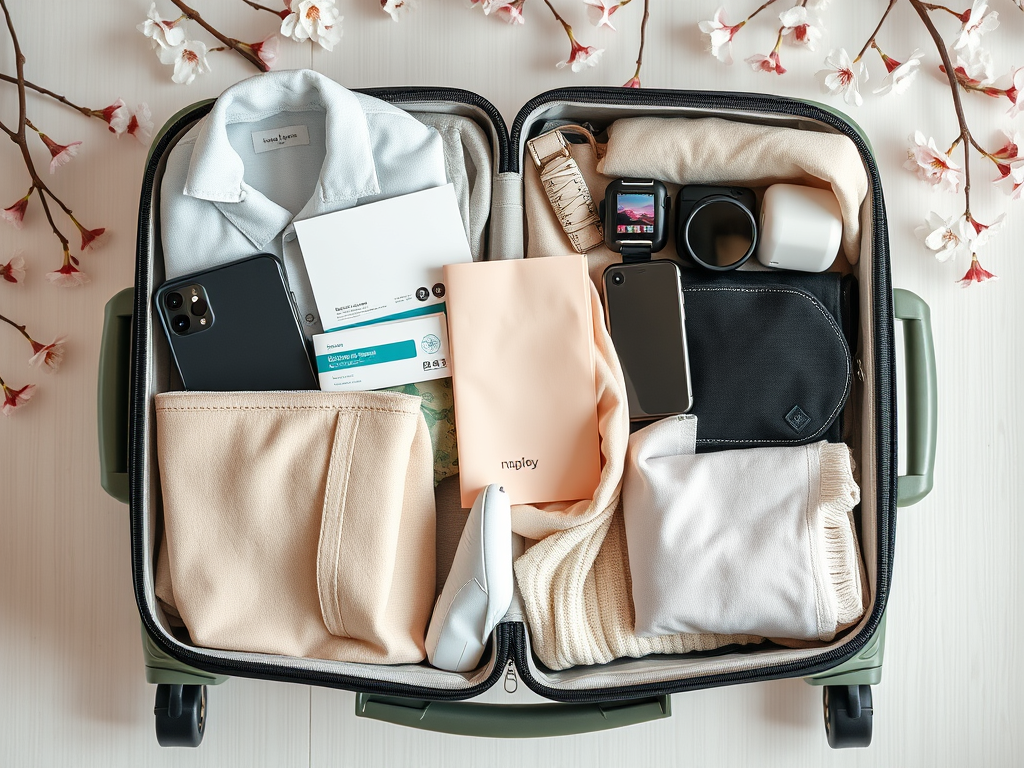
(2 Weeks, Carry-On Only – Full List, No Guesswork)
Spring is one of the best times to visit Japan — cherry blossoms in full bloom, crisp mornings, mild afternoons, and endless days of walking through cities like Tokyo, Kyoto, Osaka, and beyond, with the occasional onsen visit or ryokan stay woven in.
This is a no-fluff, no-overpacking guide. If you want to travel carry-on only for two weeks in Japan and pack exactly what you need — nothing more, nothing less — this list is for you.
Who This Packing List Is For
This list assumes:
- Spring travel (March–May for Northern Hemisphere)
- Urban-focused travel (Tokyo, Kyoto, Osaka, with day trips)
- Carry-on + personal item only
- Comfortable with simple sink laundry using travel detergent, or with having laundry access during the trip
- A lot of walking (neighborhoods, train stations, temples, gardens)
- A preference for practical, comfortable, and culturally appropriate clothing that works for both cities and quieter spaces like shrines, ryokan, or onsens
Universal Packing List (All Travelers)
These items apply to everyone, regardless of age or gender.
Documents & Essentials
- Passport
- Travel insurance information
- Documented itinerary with the names of your hotels/ryokan (or cruise ship), locations, and dates
- Credit/debit cards + a small amount of cash (Japanese yen + a little of your home currency and any countries you’re transiting through)
- Copies or photos of important documents like your passport (stored on your phone and in the cloud)
- Optional: Shinkansen / rail passes or reservations (digital or printed, depending on how you booked) Not everyone needs a rail pass — they make the most sense if you’re traveling between multiple cities. If your itinerary is mostly within one region, individual tickets are often cheaper and easier.
💡 Japan is still more cash-friendly than many countries, especially outside major cities, so having some yen on hand is helpful. You can usually order foreign currency from your bank about a week before departure.

Tech & Power (Very Important for Japan)
Japan uses:
- Voltage: 100V
- Frequency: 50Hz (eastern Japan incl. Tokyo) / 60Hz (western Japan incl. Osaka, Kyoto)
- Plug type: Type A (same shape as U.S. plugs, no ground pin)
What to Pack:
- Universal power adapter (Type A compatible; grounding support is a plus)
- Cell Phone (set up an international plan with your provider before you go, or buy a SIM/eSIM for Japan)
- USB charging block (multi-port is ideal)
- Travel Power Strip
- Phone charging cable
- Portable power bank (absolutely essential)
- Earbuds or headphones for trains and long transit days
- Electronics travel organizer (keeps cords easy to access)
- Dual-voltage small appliances like hair dryer, curling iron, hair straightener or heating pad OR a step up voltage converter if your device is not compatible with 100V
- Translation headphones and/or app or picture book unless you speak Japanese fluently
- Optional: Laptop or Chromebook or Tablet (for work if you must and/or easy entertainment in your own language)
- Optional: Kindle or other e-reader (not sure if Kindle is good for you? Check out my full article about how it’s a perfect travel companion)
🚨 Essential Phone plan tip: Your own provider is usually the most reliable and easiest option, but often more expensive. SIM/eSIM plans can be cheaper, but some are data-only or calling/text-only — double-check that you’re getting data and the calling/texting features you need.
💡 Japan is extremely tech-friendly, but outlets can be scarce on trains, in stations, and in cafés. A fully charged power bank should always be in your day bag.

Toiletries & Health
- Shampoo + Conditioner + Hair masks and /or Olaplex (these are easiest transported in cadence capsules or as solids)
- Toothbrush + toothpaste + mouthwash + floss (travel solids are easiest for these I still pack them in cadence capsules) It’s also a good idea to bring a couple of on the go toothbrushes for long travel days/flights and/or day trips to stay feeling fresh
- Body wash and face wash as well as any other regularly used shower/bath accessories like salt scrubs, bath soaks, and mud in cadence capsules
- Skincare basics for body, hands, face, and feet as well as any daily facial routines like anti-aging serums in cadence capsules
- Deodorant (body deodorant is also recommended for long flights)
- Disposable shavers are easiest to use and leave behind instead of repacking, but be sure to bring at least 1 shaver
- Personal medications with labels
- Pain relievers and any other common OTC medications you use like ant-acids, anti-diarrhea and/or constipation relief, allergy pills, and common cold medicine
- Deep blue, salon-pas, and lidocaine patches are always helpful for unexpected pain from excessive walking, sitting or other activities done while traveling and especially helpful if you’re traveling with older ones
- Blister prevention (bandages or blister pads) and a simple first aid kit
- Hand sanitizer
- Compact wet wipes
- Toiletry Case
💡 If you need tips for your toiletries check out my TSA-size toiletries (or refillable containers post

Laundry Kit (Carry-On Friendly)
You don’t need full laundry facilities to travel carry-on only in Japan. This list assumes you’re comfortable doing simple sink laundry, with the option to use a washer if you happen to have access.
Pack:
- Travel-size laundry detergent sheets or liquid
- Sink stopper (optional, but helpful in older hotels) or mini travel washer
- A few clothespins or a lightweight travel clothesline
- Clothes refresher spray can be used daily to refresh your clothing between washes
What to know:
- Quick-dry fabrics make this easy and stress-free.
- Wash small items (underwear, socks, tops) as needed — not everything at once.
- Coin laundries are common in Japan, but dryers can be gentler or slower than expected, so air-drying overnight is often the most reliable option.
💡 If you prefer not to do sink laundry at all, simply pack one extra top and one extra underwear set — everything else can stay the same.
Day Bag Essentials
- Lightweight crossbody or backpack (easy to wear all day and on trains)
- Reusable water bottle (vending machines are everywhere, but having your own is convenient)
- A small hand towel necessary in Japan for bathroom breaks
- Compact umbrella (spring showers are common)
- Sunglasses
- Small pouch for trash (public bins can be surprisingly hard to find)

Clothing Packing Lists (Jump to Your Section)
All clothing lists below are designed around capsule outfits — everything mixes and matches.
💡 Fabric matters. Wool, rayon, and silk pack small, resist odor, and re-wear well. Limit heavy cotton, thick denim, and stiff synthetics — they’re bulky, slow to dry, and uncomfortable for long walking days.
👩 Women’s Packing List (Spring)
Clothing
- 2 lightweight wool long-sleeve tops
- 2 short-sleeve or breathable rayon tops
- 1 light sweater or cardigan (100% cashmere is ideal for warmth without bulk)
- 1 packable jacket or trench-style layer (March–early April often still need a warmer coat for freezing temps; by May, a raincoat or lighter layer is usually sufficient)
- 2 pairs of pants (one lighter, one slightly warmer)
- 1 wool skirt or dress
- 1 sleep set or nightgown
- 6–7 underwear
- 2 bras
- 4–5 pairs of socks
Shoes
- 1 comfortable walking sneaker (you’ll walk more than you expect)
- 1 dressier but walkable shoe (loafers, flats, or low-profile sneakers)
Accessories
- Neutral scarf (excellent for layering, warmth, and modesty when needed)
- Compact crossbody bag
- Travel make-up stack, eyeliner and mascara
- Facial skincare routine
- Make-up remover wipes
💡 Japanese style tends to be modest, neat, and polished, even casually. Layers matter more than skin exposure, and comfortable, well-coordinated outfits help you blend in effortlessly.
👨 Men’s Packing List (Spring)
Clothing
- 3–4 wool tops (mix of short and long sleeve)
- 1 light sweater or hoodie
- 1 lightweight jacket
- 2 pairs of pants (one lighter, one slightly warmer)
- 1 optional casual button-down (useful for nicer dinners or evenings out)
- 1 sleep set
- 6–7 underwear
- 4–5 pairs of socks
Shoes
- 1 comfortable walking sneaker (you’ll easily log 15–25k steps a day)
- 1 cleaner casual shoe for evenings (minimal sneakers or loafers work well)
Accessories
- Shaving kit or beard grooming kit
- Travel sling or backpack (easy on trains and in crowded areas)
👧 Girls’ Packing List
- 4–5 lightweight wool or breathable tops
- 2 bottoms (leggings, pants, or skirts suitable for lots of walking)
- 1 warmer layer (sweater or hoodie)
- 1 light jacket (rain-friendly is ideal)
- 1 sleep set
- Underwear + socks for 6–7 days
- Comfortable walking shoes (already broken in)
Accessories:
- Small backpack (easy for day trips and trains)
- Handheld game console and/or Kindle
- Snacks
👦 Boys’ Packing List
- 4–5 wool tops
- 2 bottoms (pants or joggers suitable for lots of walking)
- 1 warmer layer (sweater or hoodie)
- 1 light jacket (rain-friendly if possible)
- 1 sleep set
- Underwear + socks for 6–7 days
- Comfortable sneakers (already broken in)
Accessories:
- Handheld game console and/or Kindle (great for trains and downtime)
- Backpack (small and easy to manage on transit)
- Snacks
🇯🇵 Things No One Tells You About Packing for Japan
This is where first-time travelers often get caught off guard.
- Bring a small hand towel. Public bathrooms are plentiful and clean, but paper towels or hand dryers aren’t standard in Japan. Locals always carry their own towel.
- Trash bins are scarce. You may carry your trash for hours — a small foldable tote bag you can use to carry your trash.
- You’ll walk more than you expect. Even with excellent trains, stations are large and neighborhoods are best explored on foot.
- Layers matter more than seasons. Spring mornings and evenings can be chilly, while afternoons warm up quickly. Even in Tokyo in April it was literally 32°F freezing outside at midday with wind. In Kochi we were in sundresses in the afternoon, with cashmere sweaters in the morning.
- Modest, polished clothing blends in best. Japan favors neat, understated outfits over revealing or overly casual looks.
- Laundry is easy — drying can be slow. Coin laundries are common, but dryers may be gentle or time-limited. Quick-dry fabrics are your best friend.
- Convenience stores are outstanding. You don’t need to pack many snacks — you’ll find great food everywhere.
- Outlets can be limited on the go. Trains, stations, and cafés don’t always have accessible plugs, so a power bank is more useful than a laptop most days.
🍵 Fun Japan detail: Many restaurants and accommodations provide slippers — but often only one size. Bringing socks you’re happy to be seen in is a small but smart choice.

🧻 Toilets & Bathroom Reality in Japan
Japan is known for its high-tech toilets, and Western-style built-in bidet toilets are extremely common, especially in hotels, train stations, and cities. However, traditional squat-style toilets do still exist, most often in:
- Older buildings
- Public parks
- Some transit areas
- Rural locations
- Smaller or older rest stops
If squat toilets are difficult or uncomfortable for you, this is worth knowing ahead of time.
What helps:
- Seek out larger, newer buildings (shopping malls, department stores, major train stations)
- Look for accessible / multipurpose restroom signage, which almost always indicates Western-style toilets
- Carry a small quick-dry hand towel — most public bathrooms do not have paper towels or hand dryers, and locals typically carry their own
- Carry disposable toilet seat covers for peace of mind
- Keep a small pack of tissues or wipes on hand (not all restrooms provide paper towels)
💡 If mobility, balance, or joint issues are a concern, it’s wise to plan restroom breaks around modern facilities rather than relying on smaller public restrooms.
These are the little things that make a huge difference once you’re there.
💴 Cash, ATMs & Taxis: What Actually Works in Japan
Japan is modern, safe, and efficient — but cash is still essential, and the banking system does not work the way most travelers expect.
Some taxis are cash-only, especially:
- Late at night
- Outside major city centers
- Older or independent taxis
Do not assume tap-to-pay or cards will always be accepted.
🏧 Japanese ATMs Are NOT Universal
Not all ATMs in Japan accept foreign cards — and this is normal, not a bank error.
Many travelers get stuck because they assume any ATM will work. It won’t.
Use THESE ATMs for foreign cards:
- 7-Eleven / Seven Bank ATMs (most reliable)
- Japan Post / JP Bank ATMs
- Airport ATMs
- If you see Seven Bank or Japan Post, you’re in the right place.
💳 The Part No One Explains: ATM PINs Matter More Than Your Bank
This is the detail most guides miss.
Even if your card is:
- International
- Visa or Mastercard
- Foreign-transaction-fee free
…it may still fail at Japanese ATMs if it does not have an ATM PIN enabled.
Real-world example:
- A major U.S. bank Visa card
- Worked fine for normal card purchases
- Did not work at any ATMs in Japan
- A smaller credit union card
- Worked immediately for cash withdrawals
The difference was not the bank, the card brand, or international status —
it was PIN-enabled ATM access.
Some cards work only for purchases, not for cash.
it was PIN-enabled ATM access. Some cards work only for purchases, not for cash.
✔️ What to Do Before You Leave (No Stress Setup)
Bring:
- 1 debit card with an ATM PIN (PLUS or Cirrus logo)
- 1 backup debit or credit card from a different bank
- A small amount of cash for arrival day
Check:
- That your credit card has a PIN set up
- That the PIN works for international ATM withdrawals
Do not assume this is automatic — many cards are not enabled by default.
✨ Bottom Line
Japan doesn’t bend to Western banking assumptions.
Once you understand how cash and ATMs work, everything is easy —
but cash access = freedom, especially for taxis and local spots.
Plan for it once, carry on, and enjoy Japan without friction.
Optional Add-Ons by Travel Style
- Cherry blossom viewing (hanami): light scarf, camera strap, selfie stick
- Temple & shrine visits: modest layers that cover shoulders and knees comfortably
- Rainy days: water-resistant shoes or lightweight shoe covers
- Mountain or countryside trips (Hakone, Nikko, Fuji Five Lakes, etc.): windbreaker, and a slightly warmer layer
- Onsen or ryokan stays: extra socks, small pouch for toiletries, hair ties if needed
Final Thoughts
💛 Personal note: Japan takes food seriously — in a way that’s hard to fully explain until you experience it. Ingredients are carefully grown, tended, and respected; farmers nurture produce for months, artisans refine techniques for decades, and yes, wagyu cattle are famously cared for with extraordinary attention. It shows in every bite. It’s no accident that Tokyo has more Michelin-starred restaurants than anywhere else in the world — excellence is part of daily life here, not just fine dining.
Beyond the food, Japan rewards slowing down. Make time to see Mount Fuji if you can, visit at least one traditional garden (they are deeply treasured spaces of balance and reflection), and experience an onsen at least once. Hot springs aren’t just about bathing — they’re about rest, ritual, and presence.
Packing for Japan doesn’t have to be stressful. Once you understand how people actually live, move, and dress day to day, it becomes much easier to pack smart and travel light.
This list is designed so you can:
- Carry everything on
- Walk comfortably
- Feel appropriately dressed
- Avoid common surprises
Pack once, adjust nothing, and enjoy the trip.