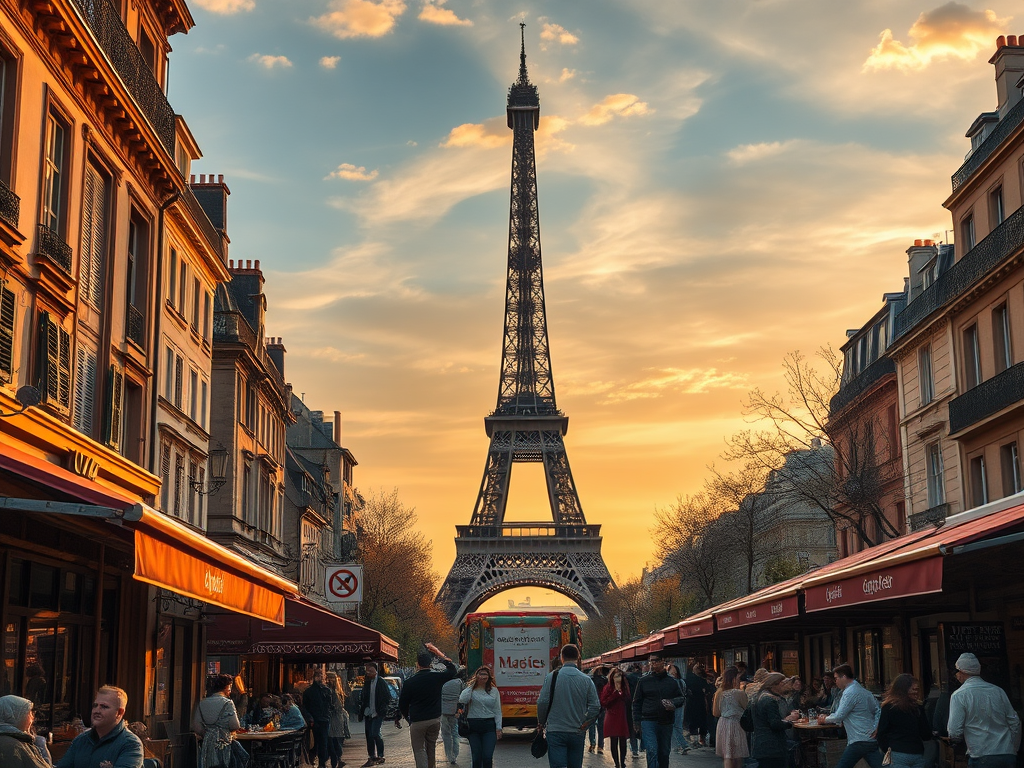
Paris is one of those cities that people think they know before they arrive — and then discover they were imagining a postcard, not a place.
Paris isn’t just about famous buildings or famous paintings. It’s about rhythm, confidence, history, food, language, and the quiet expectation that you’ll engage with the city on your own terms. Paris does not reward box-checking. It rewards curiosity and self-awareness.
This guide is built around that idea: do what actually interests you, understand the culture you’re stepping into, and skip anything that feels like suffering just because you think you’re “supposed” to do it.

Start with a Private Golf Cart Tour (Always My #1 Move)
The very first thing I recommend in any city that offers it — including Paris — is a private, guided golf cart tour.
Paris offers eco-friendly golf cart tours for 1–3 people, led by local guides, and they are one of the best ways to get oriented quickly without exhausting yourself. You see major landmarks, neighborhoods, and street life while learning how the city actually fits together.
These tours often pass by places like the Eiffel Tower, Louvre, Montmartre, and key districts, and they can usually be customized. Think of it less as a tour and more as a living map — you finish knowing what you want to come back to and what you’re happy to skip.
If a city offers this kind of tour, I always do it first. It sets the tone for the entire trip.
Key Paris Sights (Choose What Fits You)
Paris has an enormous number of iconic sights — but none of them are mandatory. The city works best when you pick what actually resonates with you instead of forcing yourself through everything.

🗼 Eiffel Tower
The Eiffel Tower is iconic for a reason. If you’re going to do it, do it properly — book a meal at the top. It turns the experience from “tourist checkbox” into something genuinely memorable and atmospheric.
If heights or crowds aren’t your thing, seeing it from the ground, from the Seine, or lit up at night is more than enough.
🖼 The Louvre (Honest Take)
The Louvre is one of the greatest museums in the world — if you care about art.
If you love art, it belongs at the top of your list.
If you’re moderately interested, do the highlights only — there is no need to stay all day.
If art museums drain you completely, skip it without guilt and spend that time on food, wine, or neighborhoods instead.
French culture is far more about history, food, language, and revolution than standing in front of paintings all day — especially when many of the Louvre’s masterpieces come from all over the world, not just France.
🌿 Luxembourg Palace & Gardens
One of the most pleasant places in Paris to slow down.
The gardens are elegant, relaxed, and very lived-in — locals read, walk, sit, and exist here. This is a great place to feel Paris instead of performing it.
🏛 Notre-Dame & Île de la Cité
Even when interior access is limited, Notre-Dame and its surroundings are absolutely worth seeing.
Île de la Cité is the historical heart of Paris, and walking here gives context to how the city began and evolved. Pair it with a slow walk along the Seine.
🏰 Panthéon (Paris vs Rome Moment)
Paris has its own Panthéon — and it tells you everything about French values.
Where Rome’s Pantheon honors gods and engineering brilliance, Paris’s Panthéon honors thinkers, writers, scientists, and revolutionaries. It’s less about worship and more about ideas — a deeply French distinction.
🎨 Montmartre & Sacré-Cœur
Montmartre still carries an artistic, slightly rebellious energy.
Yes, it’s popular — but early morning or evening visits are quieter and more atmospheric. Sacré-Cœur offers one of the best views in the city, and wandering the surrounding streets gives a glimpse of a more bohemian Paris.
🛍 Champs-Élysées & Luxury Paris
Walking the Champs-Élysées is worth doing at least once — but for fashion lovers, the real draw is the flagship luxury stores.
Paris is where brands like Louis Vuitton, Dior, Chanel, Hermès, Céline, and Longchamp mean something. Even without buying anything, these spaces reflect craftsmanship, heritage, and global influence.

🚤 The Seine (From Every Angle)
Walking along the Seine, crossing its bridges, and seeing the city reflected in the water is one of the most consistent pleasures in Paris.
A boat cruise adds another layer — especially in the evening — and lets you see how the city fits together without exhaustion.
🏙 Neighborhood Wandering (Underrated, Always)
Some of the best Paris experiences aren’t monuments at all.
Choose a neighborhood and walk without a plan. Browse bakeries. Watch people. Sit at a café. Paris rewards observation more than itinerary perfection.nd locals actually using the space — this is everyday Paris at its best.
Paris for Fashion Lovers (Where Fashion Began)
Paris doesn’t just participate in fashion — it created the modern fashion industry.
This isn’t about shopping bags. It’s about heritage, craftsmanship, and the way French fashion evolved alongside power, travel, and culture.
👜 Goyard: The Oldest Luxury House Still in Operation
Founded as a trunk and luggage maker, Goyard is the oldest luxury house still operating in the world — predating modern fashion as we know it.
Goyard was built around travel, movement, and durability long before luxury became seasonal or trend-driven. This was heritage luxury for people who crossed borders: diplomats, aristocrats, explorers. Its quiet presence in Paris is intentional — Goyard has never needed spectacle to assert relevance.
If you care about the history of travel itself, Goyard matters.
👗 Lanvin: The Oldest Fashion House in the World
Lanvin holds a different distinction: it’s widely regarded as the oldest fashion house still operating, founded specifically around clothing.
Lanvin represents the moment fashion became an art form, not just utility. Paris didn’t just dress people — it taught the world how to dress.
🧳 Louis Vuitton: The Most Powerful Luxury Brand on Earth
Louis Vuitton began with travel trunks — not handbags — and grew into the most recognizable luxury brand in the world.
Seeing Louis Vuitton in Paris hits differently. It’s not a logo here; it’s part of the city’s DNA. Through LVMH, Vuitton sits at the center of a luxury ecosystem that shapes global fashion, beauty, wine, and culture.
For fashion lovers, visiting the Paris flagship isn’t shopping — it’s context.

🧡 Hermès: Craft, Scarcity, and the Ultimate “I’ve Made It” Bag
Hermès represents the apex of craftsmanship and restraint in Parisian luxury.
Originally founded as a harness and saddlery workshop, Hermès has always been about function perfected into art. Nothing here is rushed, trend-driven, or mass-produced — and that philosophy is exactly why the brand carries the cultural weight it does.
The Birkin bag isn’t famous because it’s flashy. It’s famous because it’s scarce, handmade, and intentionally difficult to obtain. In the fashion world, owning a Birkin is widely understood as a quiet declaration of arrival — not just wealth, but access, patience, and credibility.
Seeing Hermès in Paris matters. This is where the brand’s values make the most sense: discretion over spectacle, craft over hype, legacy over logos.
🌸 Dior: Elegance, Legacy, and Cultural Memory
Dior is inseparable from Parisian elegance.
From redefining postwar femininity to becoming Princess Diana’s most beloved fashion house — a legacy that still resonates today — Dior represents romance, restraint, and quiet power. It remains deeply woven into Paris’s identity and continues to matter culturally, not just commercially.
🖤 Chanel: Parisian Independence, Power, and Modern Style
Chanel is not just a fashion house — it’s a cultural reset.
Founded by Coco Chanel, Chanel permanently changed how women dressed by prioritizing freedom, movement, and confidence over restriction and ornamentation. This wasn’t just aesthetic; it was social.
Rue Cambon — Chanel’s historic Paris address — is one of the most meaningful fashion locations in the world. This is where Chanel built a vision of elegance that rejected excess, embraced simplicity, and redefined luxury as something lived in, not performed.
The iconic tweed jacket, the little black dress, quilted handbags — these weren’t trends. They were declarations that style could be powerful without being loud.
Chanel’s influence is inseparable from Paris itself: independent, self-possessed, and uninterested in explaining itself.

🛍 Fashion as Culture, Not Consumption
You don’t need to buy anything.
Walking past these houses, stepping into their spaces, and understanding why they exist gives Paris a different texture. Fashion here isn’t trend-chasing — it’s history, craft, and confidence passed down over centuries.
Paris doesn’t sell fashion.
It authored it.
Paris Is About Culture More Than Checklists
French culture is deeply tied to:
- Food and shared meals
- Wine and regional identity
- Language and tone
- History, power, and revolution
This is the Paris that stays with people — not just the landmarks.
Experience France Through Food (This Is Essential)
One of the best ways to understand France is through culinary tours, wine tastings, and cheese experiences with local guides.
These aren’t gimmicks when done well — they’re cultural immersion. France treats food as heritage, and guided experiences help explain why meals take time, why quality matters, and why tradition is fiercely protected.
And yes: the French have the best cheese in the world.
Do not miss it. Do not play it safe.

Easy Half-Day & Day Trips from Paris (France Opens Up Fast)
Paris is an exceptional base for exploring the country thanks to fast trains and regional connections.
🌿 Versailles (Gardens First, Palace Optional)
Versailles was originally built outside Paris by design — a power move — but today it’s seamlessly connected and feels like part of the Paris experience.
The gardens are the real highlight. They’re vast, dramatic, and beautifully designed.
Insider tip: rent a golf cart to explore the grounds. It’s fun, practical, and lets you enjoy the scale without exhausting yourself.
🌸 Monet’s Garden (Half Day, Maximum Impact)
Outside Paris and ideal for a half-day trip, Monet’s garden in Giverny feels like stepping into a living painting.
This is where Monet designed his water lily ponds, bridges, and color palettes — and the experience is immersive even if you’re not an art obsessive. The scale is manageable, the setting is peaceful, and it’s one of those rare places that feels restorative rather than overwhelming.
Logistics:
- Roughly 45–60 minutes by train from Paris, plus a short shuttle or taxi
- Easy to pair with a relaxed Paris itinerary
- Best visited in spring or summer when the gardens are in bloom
This is a gentle escape that adds beauty without exhausting you.

🏰 Loire Valley (Châteaux, Gardens, Fairytale France)
The Loire Valley is famous for its châteaux, and yes — they live up to the fantasy.
This region is all about castles, landscaped gardens, and the quieter side of French royal history. Even if you don’t tour every interior, the grounds alone are worth it. Seeing these estates in their natural settings gives you a strong sense of how power, beauty, and landscape were intertwined in France.
What many visitors don’t realize is that the Loire Valley is also one of France’s most celebratory regions.
🎉 Festivals & Seasonal Events
Throughout the year, towns across the Loire host:
- historical reenactments
- music and cultural festivals
- garden and flower festivals
- local food and wine celebrations
Many events are tied to château grounds or historic town centers, which makes them feel immersive rather than touristy. If your trip coincides with one, it’s an easy way to experience the region beyond sightseeing.
🎈 Hot Air Balloon Rides
Hot air balloon rides over the Loire Valley are surprisingly common — and for good reason.
Floating above rivers, vineyards, and château rooftops at sunrise or sunset is one of the most memorable ways to see the region. You don’t need to be a thrill-seeker; these rides are slow, quiet, and focused on views.
If you’ve ever thought about doing a balloon ride, this is one of the best places in Europe to do it.
🏰 Château de Chenonceau — The Château Over the Water
If you’ve ever imagined a fairytale French château literally spanning a river, you’re thinking of Chenonceau.
Built directly over the River Cher, Chenonceau is one of the most visually striking castles in France — elegant, romantic, and instantly cinematic. It’s been used and referenced across films, documentaries, and visual storytelling for decades because it looks impossibly storybook in real life.
Logistics:
- About 1.5–2 hours from Paris by train, depending on the château
- Often done as a full-day trip
- Great for travelers who love history, architecture, or just romantic scenery
Who doesn’t love a château, even if it’s just from the outside?

🥂 Champagne (Even If You’re Not a Wine Person)
Champagne isn’t just a drink — it’s a place, a method, and a fiercely protected cultural identity.
Visiting Champagne helps you understand how seriously France takes tradition, craftsmanship, and regional pride. You’ll see vineyards, historic cellars, and production methods that have shaped how the entire world celebrates.
Logistics:
- About 45–90 minutes by train from Paris (Reims or Épernay)
- Easy full-day trip
- Works well with guided tastings or cellar tours
Even if champagne isn’t your personal passion, this experience is deeply French and surprisingly meaningful.
🌊 Mont-Saint-Michel (Plan the Tides)
Mont-Saint-Michel is one of the most dramatic sights in France and absolutely worth the effort.
Rising from tidal flats, it looks almost unreal — part monastery, part fortress, part legend. This isn’t a casual add-on; it’s a statement experience.
Important:
- Check tide times in advance — the surrounding area floods at high tide
- Timing matters here more than almost anywhere else
Logistics:
- Typically a long day trip from Paris
- Often easiest with a guided tour or early start
If you go, go prepared — and it will be unforgettable.

🇫🇷 Normandy (History That Still Feels Close)
For many travelers, Normandy is a deeply meaningful visit.
The beaches, memorials, and countryside carry enormous historical weight. This is where modern history feels close and human — not abstract or distant.
Logistics:
- Roughly 2–3 hours from Paris depending on destination
- Best as a full-day trip
- Particularly powerful for those interested in 20th-century history
Normandy offers perspective and reflection — a striking contrast to Paris’s elegance.
🌿 Provence (Long Day Trip, Big Payoff)
Provence feels like a different country — lavender fields, Roman ruins, sun-washed towns, and a slower rhythm that contrasts sharply with Paris.
While Provence isn’t close geographically, France’s high-speed trains make it possible as a long but realistic day trip if you plan it well.
Most travelers base a Provence day trip around Avignon or Aix-en-Provence, both of which are well connected by TGV. I recommend Avignon as it’s an hour less train time than Aix-en-Provence.
Why it’s worth it:
- Roman history (the Palais des Papes in Avignon is striking)
- Old town streets, markets, and cafés
- Easy access to classic Provençal scenery
- Lavender fields blooming in the summer
- A completely different atmosphere from Paris

Logistics (important):
- ~2.5–3 hours each way by high-speed train
- Best as an early start / late return day
- Works best if you focus on one town, not multiple stops
This isn’t a casual add-on — it’s a commitment — but for the right traveler, Provence delivers one of the most memorable contrasts you can experience from a Paris base.
Who should do this:
Travelers who don’t mind a long day and want to see rural, sunlit southern France without changing hotels.
🍷 Bordeaux (Why It’s Worth the Distance)
Bordeaux is farther than most Paris day trips, but for the right traveler, it’s worth it.
Wine culture, elegant architecture, nearby castles, and a slower pace give Bordeaux a completely different feel from Paris. It’s a reminder of how regionally diverse France really is.
Logistics:
- About 2–3 hours by high-speed train
- Best as an early start / late return day
- Ideal for travelers who enjoy wine, architecture, and regional identity
Bordeaux shows you a different France — refined, grounded, and deeply rooted in place.

Things Nobody Tells You About Paris
🗣 Language, Attitude & the Biggest Paris Myth
France has a deep revolutionary streak. Confidence and self-possession go a long way here. You don’t need to be loud or aggressive — but shrinking yourself or over-apologizing won’t help either.
If you try to speak French and someone replies to you in English, they are not insulting you. They’re usually being kind.
Responding in English is often their way of:
- Making things easier for you
- Keeping the interaction efficient
- Offering help, not judgment
There is no test. You don’t need to impress anyone.
If you want to keep practicing your French, simply continue in French. If you feel more comfortable switching to English when it’s offered, that’s completely fine too. Both are normal. Both are acceptable.
Parisians speak French with a distinct, sometimes sing-song cadence, and yes — some people may pretend they only speak French even if they understand you. Don’t take it personally. Match the energy in front of you. If they’re polite, be polite back. If they’re warm, lean into it. If someone is being difficult on purpose, calmly acknowledging it often earns more respect than excessive apologizing.
Paris has a reputation for being unwelcoming, but like most stereotypes, it’s lazy. The reality is much simpler: Paris isn’t judging you — it’s just living its life.
Kind Parisians absolutely exist, just like in any major city. The biggest mistake visitors make is starting out defensive or overly self-conscious. Be polite, be calm, don’t overthink it, and don’t assume bad intent where there usually isn’t any.
💧 Water Is Free — and It’s Excellent

Paris has clean, drinkable water, and there are public drinking fountains scattered throughout the city. Some even offer both still and sparkling water. Bring a reusable bottle — it’s normal, practical, and encouraged.
At restaurants, a few small language choices make things smoother:
- if you order “water” without specifying, you will usually be served sparkling water
- if you want still water, ask for flat water
→ “de l’eau plate” (duh loh plaht) - if you want sparkling water, ask for sparkling water
→ “de l’eau pétillante” (duh loh pay-tee-yahnt) - ice is not served by default — if you want ice, ask for your water with ice
→ “avec des glaçons” (ah-vek day glah-sohn)
Using even a few French words when ordering goes a long way. You don’t need perfect pronunciation — just the effort. Even if the server switches to English, ordering this way often helps you get exactly what you want more quickly and comfortably.
Tap water is safe and commonly served when requested. None of this is about rules or rigidity — it’s just the local rhythm.
🚻 About Toilets (Plan Ahead)
Public toilets are not as abundant or free as many visitors expect.
- some public restrooms require payment
- cafés may expect you to be a customer
- museums, department stores, and major train stations are your safest options
Once you’re in, seated toilets are standard in France — you’re unlikely to encounter the seatless situations common in some other countries.
Squat toilets exist in France, but they’re rare and usually limited to older highway rest stops or very utilitarian facilities. These are true squat-style toilets, not the seatless Western toilets sometimes encountered in Italy. In everyday use, seated toilets are the norm.
Bidets are French in origin, but they’re not universal in modern accommodations. Older apartments may have them; newer hotels often don’t. If you’re used to using a bidet, consider packing a travel bidet or wet wipes as an alternative.
It’s also smart to carry tissues or wipes simply because public facilities don’t always provide extras — not because of poor standards, but because of different expectations around personal preparedness.
This isn’t rudeness — it’s just how things are structured.
🕰 Service Is Different (Not Worse)
Service in Paris isn’t performative. Servers won’t hover or rush you, and that’s intentional.
Meals are meant to be enjoyed slowly. Lingering isn’t rude. When you need something, make eye contact or politely signal — that’s normal and expected.

💶 Tipping in Paris (Keep It Simple)
Tipping is not expected in Paris the way it is in the U.S.
Service is already included in restaurant prices, and staff are paid a living wage. You’re not being rude if you don’t tip — you’re just following local norms.
That said:
- rounding up the bill
- leaving a few coins
- or saying a genuine merci
is appreciated for good service, but never required.
You don’t need to calculate percentages, and no one is watching to see what you leave. Tip if you want to — not because you feel obligated.
The same generally applies to cafés, taxis, and hotel staff. Small gestures are fine. Big tips aren’t necessary.
👗 Blending In Is About Effort, Not Perfection
You don’t need to dress expensively. You do need to look intentional.
Comfortable shoes, simple layers, and clean, well-fitting clothes go a long way. Trying matters more than trendiness.
🎒 Pickpockets, Scams & “Shady” Areas (Real Talk)
Paris is generally safe, but like any major city, pickpocketing is a thing, especially in crowded, tourist-heavy areas.
Be extra aware in:
- busy metro lines and stations
- tourist hotspots and crowded attractions
- areas with heavy foot traffic where people are distracted
You don’t need special gear — just basic awareness:
- use a secure, zippered bag worn close to your body
- don’t leave phones or wallets in open pockets
- be mindful when someone bumps into you or creates a distraction
If something feels off, trust that instinct and move on. You don’t owe anyone engagement.
As for “shady” areas: Paris has neighborhoods that feel less comfortable at night, especially if you’re unfamiliar with the city. This doesn’t mean Paris is dangerous — it means it’s a real city.
- stick to well-lit streets at night
- don’t wander aimlessly late if you’re unsure of the area
- use common sense the same way you would in New York, London, or Rome
None of this is about fear. It’s about urban awareness, which makes travel smoother and more relaxed.
The Bottom Line
Paris doesn’t require paranoia — just attentiveness.
If you’re aware of your surroundings and move with confidence, you’re unlikely to have issues, and far more likely to enjoy the city without unnecessary stress.

The Big Takeaway
You don’t need to perform for Paris.
Meet the city halfway, interact like a normal human, and let things unfold. When you do, Paris tends to open up — quietly, generously, and entirely on its own terms.
What to Pack for Paris
- Comfortable walking shoes (already broken in) Paris is a walking city. Cobblestones, long days, and stairs add up fast. Avoid white socks unless you want to be instantly clocked as a tourist.
- A secure anti-theft crossbody or small bag Hands-free, close to the body, and easy to keep an eye on in busy areas. Like most of Europe, Paris has pickpockets.
- Layers Paris weather changes quickly, and indoor/outdoor temperatures can vary. Highly recommend a cashmere cardigan for this.
- A lightweight scarf Useful year-round — adds warmth, sun protection, or polish to a simple outfit. My personal favorites are sheer cashmere (warmth without weight) and luxury silk scarves.
- A compact umbrella or lightweight rain jacket Rain happens, often without much warning.
- Neutral, mix-and-match clothing Fewer pieces that work together will serve you better than trendy statement outfits. Wool, silk and rayon travel best.
- Comfortable but intentional outfits You don’t need to dress expensively — just look put together. Clean lines and simple layers go a long way.
- Reusable water bottle Paris has excellent drinking water and public fountains, including still and sparkling.
- Phone charger + portable battery Navigation, photos, and transit apps drain batteries quickly.
- Minimal jewelry or accessories Less to worry about, easier to pack, still polished.
- Travel-sized toiletries and OTC medications. Pharmacies are excellent in Paris, but having your usual basics on hand saves time and trying to decipher labels in French.
Packing Tip
Paris rewards effort, not excess. Pack lighter than you think, choose pieces you actually like wearing, and prioritize comfort without sacrificing intention.
🔌 Power Adapters & Voltage (Quick Paris Guide)
France uses Type C and Type E plugs and operates on 230V / 50Hz electricity.
What that means for travelers:
- Most US electronics are not dual-voltage
- Phones, tablets, laptops, and camera chargers usually are dual-voltage
- Hair tools and heat appliances often are not unless clearly labeled
What to Pack
- A European plug adapter (Type C/E compatible)
- A voltage converter only if you plan to bring non-dual-voltage devices
- A portable powerbank so you don’t end up out and about with no phone juice
Before you go, check your device:
- Look for “100–240V” on the plug or charger
- If it says that, you only need an adapter
- If it doesn’t, leave it at home or bring a converter
Pro Tip
Most hotels and short-term rentals in Paris have limited outlets. A compact power strip with a European plug adapter lets you charge multiple devices at once without fighting over sockets.
Travel How You Travel
The best trips happen when you do things that genuinely interest you.
If you love art, spend time in museums.
If you love food, wine-hop instead.
If you love history, follow Napoleon and the Revolution.
Every culture has overlap — food, community, beauty, daily life — and you’ll find what you love anywhere if you let yourself. Why spend all that money just to suffer through things you don’t enjoy?
Paris doesn’t ask you to prove anything.
It asks you to engage.
And if you do, it tends to give something back.