Planning a trip to the Cayman Islands? You are headed for a beautiful Caribbean destination where turquoise waters meet powdery white beaches, colorful coral reefs surround tropical islands, and peaceful coastal communities offer everything from luxury resorts to unforgettable underwater adventures.
You might be arriving through Owen Roberts International Airport on Grand Cayman, visiting during a Caribbean cruise, heading to Cayman Brac for diving and dramatic coastal scenery, or escaping to Little Cayman for quiet beaches and extraordinary marine life.
Your days could include relaxing along famous Seven Mile Beach, swimming with stingrays at Stingray City, snorkeling among vibrant coral reefs, exploring George Town, discovering the Cayman Crystal Caves, visiting the Cayman Turtle Centre, admiring the limestone cliffs of Cayman Brac, or diving the spectacular Bloody Bay Wall near Little Cayman.
Your phone and camera may be working hard throughout the trip — for boarding passes, hotel check-ins, cruise excursions, boat tours, diving reservations, navigation, restaurant searches, underwater photography, weather updates, and staying connected while exploring the islands.
That makes having the right charging setup especially important.
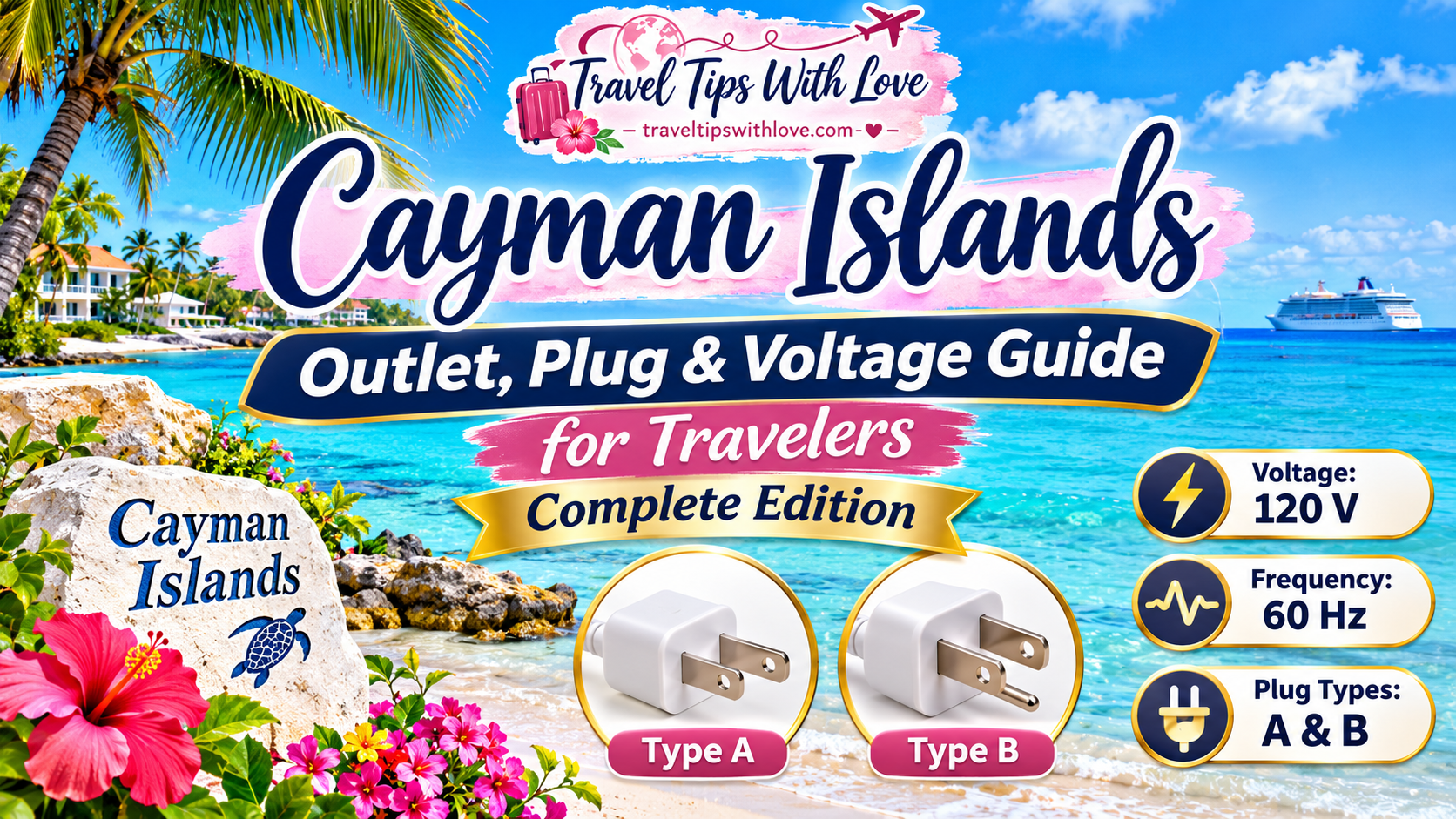
The Cayman Islands use Type A and Type B electrical outlets, with 120V electricity and a frequency of 60Hz. These are the same standard plug types and electrical specifications commonly used in the United States and Canada.
Travelers arriving from the United States and Canada generally will not need a plug adapter or voltage converter for their usual electronics and appliances.
For travelers arriving from the United Kingdom, Ireland, mainland Europe, Australia, New Zealand, and other destinations using different plug configurations, a suitable plug adapter will generally be necessary.
Voltage is another important consideration.
Many countries use 220–240V electricity, while the Cayman Islands operate on 120V. Travelers bringing single-voltage appliances designed only for higher-voltage electrical systems need to check compatibility before plugging them in.
Modern dual-voltage electronics, including most phone chargers, laptops, tablets, cameras, and other devices labeled 100–240V, 50/60Hz, generally work safely with the correct plug adapter.
One particularly useful detail is that all three Cayman Islands — Grand Cayman, Cayman Brac, and Little Cayman — use the same electrical standards.
Whether you are staying in a beachfront resort on Seven Mile Beach, a vacation rental near Rum Point, a diving accommodation on Cayman Brac, or a secluded retreat on Little Cayman, you will not need different adapters when traveling between the islands.
A plug adapter fixes the shape.
It does not make the power safe for the wrong device.
That is why checking the outlet, voltage, and frequency matters before plugging in your electronics.
This is a complete, no-nonsense Cayman Islands outlet, plug, and voltage guide with clear explanations and practical packing advice for travelers from around the world. Scroll to your country below for exactly what you need — no guessing, no surprises.

Quick Overview: What You Need for the Cayman Islands
✔ Plug Adapter
The Cayman Islands use Type A and Type B outlets, featuring two flat parallel pins (Type A) or two flat parallel pins with a round grounding pin (Type B), just like the plugs commonly used in the United States and Canada.
If your home country uses Type A or Type B plugs, you generally will not need a plug adapter for the Cayman Islands.
If your home country uses Type C, D, E, F, G, I, J, K, L, M, N, or another incompatible plug type, you will need a plug adapter for the Cayman Islands.
A universal adapter that supports Type A and Type B outlets is particularly useful for travelers visiting the Cayman Islands as part of a larger Caribbean or international trip.
All three islands — Grand Cayman, Cayman Brac, and Little Cayman — use the same outlet types, so you will not need different adapters when traveling between them.
Remember that a plug adapter only changes the shape of the plug. It does not convert voltage or frequency.
✔ Dual-Voltage Electronics
Phones, laptops, tablets, cameras, power banks, Kindles, and most modern chargers labeled 100–240V, 50/60Hz are usually fine in the Cayman Islands with the correct plug adapter.
For those devices, you usually do not need a voltage converter.
The label on the charger is what matters.
Dual-voltage electronics are especially useful for international travelers because a device labeled 100–240V, 50/60Hz can safely handle the Cayman Islands’ 120V / 60Hz electricity as well as the higher-voltage systems used in the United Kingdom, Ireland, most of Europe, Australia, New Zealand, and many other countries.
✔ Single-Voltage Small Appliances (Converter Needed for Incompatible 220–240V Devices)
The Cayman Islands use 120V electricity. If you are coming from a country using 220–240V electricity and your appliance is labeled only for 220V, 230V, or 240V, do not assume it will work properly in the Cayman Islands with only a plug adapter.
Hair dryers, curling irons, straighteners, steamers, electric kettles, heating pads, and other heat tools are the usual troublemakers.
For those items, you may need a step-up voltage converter designed to increase the Cayman Islands’ 120V electricity to the voltage required by your appliance.
The converter must be rated for the appliance’s power requirements, including its wattage.
For many travelers, bringing a dual-voltage travel version of the appliance or using appliances provided by the accommodation is a more practical solution.
A standard voltage converter does not change the Cayman Islands’ 60Hz frequency, so check frequency compatibility as well. Some high-powered appliances are unsuitable for ordinary travel converters.
Travelers coming from countries already using 110–120V electricity generally do not need a voltage converter for compatible single-voltage appliances in the Cayman Islands. However, the appliance must also support 60Hz operation.
✔ Multi-Port USB Charger
A good charging setup can make travel much easier. If you are charging a phone, watch, earbuds, power bank, camera batteries, and perhaps a tablet or Kindle too, a multi-port USB charger is worth packing.
Choose one labeled 100–240V, 50/60Hz so it works safely with the Cayman Islands’ electrical system and can continue working on future trips to countries with different voltages and frequencies.
✔ Travel Power Strip
A compact travel power strip can be useful in the Cayman Islands, especially if you are staying in hotels, beachfront resorts, apartments, vacation rentals, or accommodations where outlets may be limited or inconveniently located.
Choose one specifically rated for 120V electricity and 60Hz operation, or a properly rated international travel power strip that supports the local electrical supply, with an appropriate plug adapter if necessary.
Do not bring an ordinary 230V-only power strip and assume that connecting it to a Type A or Type B adapter makes it suitable for the Cayman Islands.
Avoid overloading outlets, remember that a power strip does not convert voltage, and check your accommodation’s rules before using one.
✔ Power Bank
A power bank is extremely useful for long beach days, boat excursions, sightseeing, snorkeling trips, cruise port visits, island adventures, and any time you are relying on your phone for photos, maps, tickets, bookings, weather, or communication.
It can be particularly helpful when exploring Seven Mile Beach, visiting Stingray City, taking a boat trip to Starfish Point, discovering the Cayman Crystal Caves, exploring George Town, enjoying the coastal scenery of Cayman Brac, or spending time around Little Cayman’s peaceful beaches and nature reserves.
If the Cayman Islands are a stop on your Caribbean cruise, a fully charged power bank can also help keep your phone working throughout your time ashore without needing to find somewhere to recharge.
✔ Electronics Organizer
Keeps your adapters, charging bricks, cords, camera batteries, memory cards, and small tech pieces from becoming a tangled mess in your bag.
Travel Hack:
A universal adapter with Type A and Type B support + a 120V-compatible travel power strip + a multi-port USB charger = an instant charging hub almost anywhere in the provided everything is compatible with the local electrical supply.
Cayman Islands’ Electrical Basics
Plug Types Used:
Type A – Two flat parallel pins (commonly used in the United States, Canada, and several Caribbean destinations)
Type B – Two flat parallel pins with a round grounding pin (the grounded version commonly used in North America)
The Cayman Islands use 120V electricity with 60Hz frequency.
✔ Safe With Only an Adapter
These are usually fine if the charger or device is labeled 100–240V, 50/60Hz:
Phones
Laptops
Tablets
Cameras
Power banks
E-readers / Kindles
Bluetooth headphones / earbuds
Most modern USB chargers
Not Always Safe
Be careful with:
Hair dryers
Curling irons
Straighteners
Steamers
Heating pads
Electric kettles
Cheap or older chargers
Any device labeled for only one voltage that does not match the Cayman Islands’ electrical supply, or an appliance that does not support 60Hz operation.
Because the Cayman Islands use 120V power, travelers from countries using 220–240V electricity need to check single-voltage appliances carefully.
A plug adapter only changes the plug shape. It does not convert electricity.
The Cayman Islands’ 60Hz frequency also deserves attention. Appliances designed exclusively for 50Hz operation may not function correctly, even when their voltage requirements are otherwise compatible.
Check the Voltage Label Before You Pack
Look at the small print on each charger or device:
“110V” or “120V only” → Generally suitable for the Cayman Islands’ 120V electricity, provided the manufacturer’s permitted voltage range covers the local supply and the device supports 60Hz operation. You only need a plug adapter if the plug shape does not match Type A or Type B outlets.
“220–240V” or “230V only” → Not suitable for normal operation on the Cayman Islands’ 120V electricity with only a plug adapter. You need a properly rated step-up voltage converter or a compatible dual-voltage travel version of the appliance. A standard voltage converter will not change the frequency.
“100–240V, 50/60Hz” → Usually safe in the Cayman Islands. You only need the correct plug adapter.
Frequency Note:
The Cayman Islands’ 60Hz frequency is the same as that used in the United States, Canada, and several other countries throughout North America, Central America, and the Caribbean.
However, it differs from the 50Hz used in the United Kingdom, Ireland, most of Europe, Australia, New Zealand, and many other countries.
This difference is usually not a problem for modern phones, laptops, tablets, cameras, and similar electronics with chargers labeled 50/60Hz.
However, it can matter for motor-based appliances, clocks that use electrical frequency for timing, and certain other electrical devices.
Some appliances designed only for 50Hz may operate differently, overheat, or be unsuitable for use on the Cayman Islands’ electrical system.
Always check the complete voltage and frequency rating rather than relying on plug compatibility alone.
Consistency:
The Cayman Islands are particularly straightforward for travelers because Type A and Type B outlets are used throughout Grand Cayman, Cayman Brac, and Little Cayman, with the same electrical standards commonly found in the United States and Canada.
Travelers coming from the United States, Canada, and other countries using compatible Type A or Type B plugs with 110–120V / 60Hz electricity generally will not need additional electrical equipment for normal charging.
Unlike destinations where different islands use different electrical systems, the Cayman Islands maintain the same standard across all three islands.
However, travelers combining the Cayman Islands with other Caribbean destinations need to remember that electrical standards vary throughout the region. Jamaica and the Bahamas also commonly use Type A and Type B outlets, while destinations such as Barbados use Type A and Type B plugs with different voltage and frequency specifications.
Travelers from the United Kingdom, Ireland, continental Europe, Australia, New Zealand, and many parts of Asia, Africa, and South America will generally need a Type A/Type B-compatible or universal plug adapter for the Cayman Islands, unless their devices already have compatible plugs.
If you are staying in hotels, beachfront resorts, apartments, vacation rentals, or moving between Grand Cayman, Cayman Brac, and Little Cayman, it is still smart to bring a flexible charging setup.
A Cayman Islands-compatible plug adapter, a dual-voltage multi-port USB charger rated for 50/60Hz, and a power bank will cover most normal traveler needs.
If the Cayman Islands are part of a larger Caribbean or international trip, check each country on your itinerary before you leave. Although the Cayman Islands use the same standard electrical system as the United States and Canada, other Caribbean destinations may use different outlet types, voltages, or frequencies.
Quick Jump to Your Region
🌎 North America
🌎 Central America & Caribbean
🌎 South America
🌏 Oceania
🌍 Europe
🌏 Asia
🌍 Africa
🧳 Universal Packing Checklist
⚡ Final Tips for the Cayman Islands
North America

The Cayman Islands use Type A and Type B outlets with 120V electricity and 60Hz frequency. Travelers from the United States and Canada will find the electrical system almost identical to home, so plug adapters and voltage converters are generally unnecessary.
Mexico uses similar outlets and the same frequency, although its standard voltage is slightly higher. Greenland uses different outlets, voltage, and frequency, so travelers from Greenland will need to check their electrical equipment more carefully.
🇺🇸 United States
Home: 120V, 60 Hz, Type A/B.
Vs. Cayman Islands: The Cayman Islands use Type A and Type B outlets with 120V electricity and 60Hz frequency, exactly matching the standard electrical system used in the United States.
American travelers generally will not need a plug adapter or voltage converter.
Phones, laptops, tablets, cameras, USB chargers, and power banks should work normally, whether they are designed for 120V electricity or support 100–240V, 50/60Hz.
Most American hair dryers, curling irons, straighteners, steamers, and other 120V appliances will also work normally, provided they are in good condition and compatible with standard 120V / 60Hz electricity.
The main consideration is having enough charging outlets for multiple devices, particularly when staying in hotels, beachfront resorts, or vacation rentals.
What to pack:
- Travel power strip rated for 120V use
- Power bank
- Multi-port USB charger
- Electronics organizer
🇨🇦 Canada
Home: 120V, 60 Hz, Type A/B.
Vs. Cayman Islands: The Cayman Islands use Type A and Type B outlets with 120V electricity and 60Hz frequency, the same electrical standards used throughout Canada.
Canadian travelers generally will not need a plug adapter or voltage converter.
Phones, laptops, tablets, cameras, e-readers, power banks, and most modern USB chargers should work normally without any electrical adjustments.
Canadian appliances designed for 120V / 60Hz electricity, including hair dryers, curling irons, straighteners, steamers, and heating appliances, are also compatible with the Cayman Islands’ electrical system.
This makes packing particularly straightforward, as travelers can generally bring their usual electronics and small appliances without purchasing special electrical equipment.
What to pack:
- Travel power strip rated for 120V use
- Power bank
- Multi-port USB charger
- Electronics organizer
🇲🇽 Mexico
Home: 127V, 60 Hz, Type A/B; Type C may appear in limited cases.
Vs. Cayman Islands: The Cayman Islands use Type A and Type B outlets with 120V electricity and 60Hz frequency. Mexico uses the same primary plug types and frequency, although its nominal voltage is slightly higher at 127V.
Mexican travelers using standard Type A or Type B plugs generally will not need a plug adapter.
Most modern phones, laptops, tablets, cameras, USB chargers, and power banks will work normally if their chargers support 100–240V, 50/60Hz.
For appliances designed specifically for 127V electricity, check the manufacturer’s voltage rating before using them with the Cayman Islands’ 120V supply.
Many ordinary household appliances tolerate this small voltage difference, but devices requiring a precise 127V supply may not operate as intended.
Hair dryers, curling irons, straighteners, and other heating appliances should be checked individually, particularly if they have narrow voltage requirements.
Because both destinations use 60Hz electricity, frequency compatibility is generally not a concern for standard Mexican appliances.
What to pack:
- Travel power strip rated for 120V use
- Power bank
- Multi-port USB charger
- Electronics organizer
🇬🇱 Greenland
Home: 230V, 50 Hz, Type C/E/F/K.
Vs. Cayman Islands: The Cayman Islands use Type A and Type B outlets with 120V electricity and 60Hz frequency. Greenland’s electrical system uses different plug types, higher voltage, and a lower frequency.
Greenland travelers will need a plug adapter compatible with the Cayman Islands’ Type A and Type B outlets.
Phones, laptops, cameras, tablets, USB chargers, e-readers, and power banks labeled 100–240V, 50/60Hz should work normally with the correct plug adapter.
However, appliances designed exclusively for Greenland’s 230V electricity are not directly compatible with the Cayman Islands’ 120V supply.
Single-voltage hair dryers, curling irons, straighteners, steamers, and other heating appliances may require a properly rated step-up voltage converter that increases 120V to the appliance’s required voltage.
The converter must support the appliance’s wattage, and not all high-powered appliances are suitable for travel converters.
Greenland’s 50Hz frequency also differs from the Cayman Islands’ 60Hz system, which can affect appliances containing motors or frequency-sensitive components.
A standard voltage converter does not automatically correct this frequency difference.
For most travelers, using dual-voltage travel appliances or equipment provided by the accommodation is the simpler solution.
What to pack:
- Plug adapter
- Travel power strip rated for 120V use
- Power bank
- Properly rated step-up voltage converter for compatible 230V-only appliances, if necessary
- Multi-port USB charger
- Electronics organizer
Central America & Caribbean

The Cayman Islands use Type A and Type B outlets, 120V electricity, and 60Hz frequency.
110–127V / 50–60 Hz Countries
✔ Plug Adapter & Voltage Converter Generally Not Needed
The Cayman Islands use Type A and Type B outlets with 120V electricity and 60Hz frequency.
Travelers from these countries generally use similar electrical systems.
- Type A/B plugs fit Cayman Islands outlets without an adapter.
- Dual-voltage electronics labeled 100–240V, 50/60Hz work normally.
- Most appliances rated for 110–120V and 60Hz are compatible.
- Appliances designed exclusively for 50Hz operation require additional checking.
- Belize and Cuba also have 220V electrical systems in some locations, so check individual appliance labels.
🇧🇿 Belize
Home: 110V / 220V mix, 60 Hz, Type A/B/G.
Vs. Cayman Islands: Belize and the Cayman Islands both use Type A/B outlets and 60Hz electricity. Type A/B plugs generally fit without an adapter, while Type G plugs require a plug adapter.
Appliances rated for 110–120V / 60Hz should work normally. However, 220V-only appliances may require a step-up voltage converter or replacement.
What to pack:
- Plug adapter for Type G plugs
- Travel power strip rated for 120V
- Power bank
- Step-up voltage converter for compatible 220V-only appliances, if needed
- Multi-port USB charger
- Electronics organizer
🇵🇦 Panama
Home: 120V, 60 Hz, Type A/B.
Vs. Cayman Islands: Panama and the Cayman Islands use the same voltage, frequency, and plug types.
Panamanian travelers generally need neither a plug adapter nor a voltage converter. Standard 120V appliances and modern dual-voltage electronics should work normally.
What to pack:
🇸🇻 El Salvador
Home: 115V, 60 Hz, Type A/B.
Vs. Cayman Islands: El Salvador uses the same plug types and frequency as the Cayman Islands, with a slightly lower nominal voltage.
Travelers generally do not need an adapter or converter for appliances rated for 115–120V operation. Most standard chargers and electronics should work normally.
What to pack:
🇬🇹 Guatemala
Home: 120V, 60 Hz, Type A/B.
Vs. Cayman Islands: Guatemala’s electrical system matches the Cayman Islands’ standard Type A/B outlets, 120V electricity, and 60Hz frequency.
Guatemalan travelers generally need neither a plug adapter nor a voltage converter for their normal electronics and compatible small appliances.
What to pack:
🇭🇳 Honduras
Home: 120V, 60 Hz, Type A/B.
Vs. Cayman Islands: Honduras and the Cayman Islands use the same electrical standards.
Honduran travelers can generally use their Type A/B plugs directly in Cayman Islands outlets without an adapter. Standard 120V / 60Hz appliances also work without a converter.
What to pack:
🇳🇮 Nicaragua
Home: 120V, 60 Hz, Type A/B.
Vs. Cayman Islands: Nicaragua and the Cayman Islands share identical standard plug types, voltage, and frequency.
Nicaraguan travelers generally will not need a plug adapter or voltage converter. Chargers, electronics, and appliances designed for 120V / 60Hz electricity should work normally.
What to pack:
🇧🇸 Bahamas
Home: 120V, 60 Hz, Type A/B.
Vs. Cayman Islands: The Bahamas and the Cayman Islands use the same electrical system.
Bahamian travelers generally need neither a plug adapter nor a converter. Standard 120V appliances and modern electronics are compatible with Cayman Islands electricity.
What to pack:
🇧🇧 Barbados
Home: 115V, 50 Hz, Type A/B.
Vs. Cayman Islands: Barbados and the Cayman Islands use the same plug types and similar voltages, but their electrical frequencies differ.
Barbadian travelers generally do not need a plug adapter. Modern electronics labeled 100–240V, 50/60Hz work normally.
Appliances designed specifically for 115V / 50Hz need checking to ensure compatibility with the Cayman Islands’ 120V / 60Hz system. Frequency-sensitive and motor-powered equipment deserves particular attention.
What to pack:
🇨🇺 Cuba
Home: 110V / 220V mix, 60 Hz, Type A/B/C/L.
Vs. Cayman Islands: Cuba and the Cayman Islands commonly use Type A/B outlets with 60Hz frequency. Cuban travelers using Type A/B plugs generally will not need an adapter.
Type C and Type L plugs require a plug adapter.
Appliances rated for 110–120V electricity should work normally, while equipment designed exclusively for 220V may need a suitable step-up voltage converter or replacement.
What to pack:
- Plug adapter for Type C/L plugs
- Travel power strip
- Power bank
- Step-up voltage converter for compatible 220V-only appliances, if needed
- Multi-port USB charger
- Electronics organizer
🇩🇴 Dominican Republic
Home: 120V, 60 Hz, Type A/B/C.
Vs. Cayman Islands: The Dominican Republic and the Cayman Islands share the same voltage and frequency, with Type A/B outlets common to both destinations.
Travelers using Type A/B plugs do not need an adapter. Type C plugs require a plug adapter.
Most 120V appliances and dual-voltage electronics work without a converter.
What to pack:
- Plug adapter for Type C plugs
- Travel power strip
- Power bank
- Multi-port USB charger
- Electronics organizer
🇭🇹 Haiti
Home: 110V, 60 Hz, Type A/B.
Vs. Cayman Islands: Haiti and the Cayman Islands use the same Type A/B plug configurations and 60Hz frequency, with similar voltages.
Haitian travelers generally will not need an adapter or converter for appliances rated for 110–120V operation. Most modern electronics should work normally.
What to pack:
🇯🇲 Jamaica
Home: 110V, 50 Hz, Type A/B.
Vs. Cayman Islands: Jamaica and the Cayman Islands use the same Type A/B outlets, but their electrical frequencies differ.
Jamaican travelers generally will not need a plug adapter. Electronics labeled 100–240V, 50/60Hz work normally.
Appliances rated for 110–120V operation should be checked for 60Hz compatibility. Motor-powered equipment designed exclusively for Jamaica’s 50Hz system may not function correctly.
What to pack:
🇨🇷 Costa Rica
Home: 120V, 60 Hz, Type A/B.
Vs. Cayman Islands: Costa Rica and the Cayman Islands use the same voltage, frequency, and plug types.
Costa Rican travelers generally will not need an adapter or voltage converter. Standard 120V appliances, chargers, and electronics should work normally.
What to pack:
🇹🇹 Trinidad and Tobago
Home: 115V, 60 Hz, Type A/B.
Vs. Cayman Islands: Trinidad and Tobago uses the same plug types and frequency as the Cayman Islands, with a slightly lower nominal voltage.
Travelers generally will not need an adapter or converter for appliances rated for 115–120V electricity.
Modern electronics and chargers should work normally.
What to pack:
220–240V / 50–60 Hz Countries
⚠️ Plug Adapter & Step-Up Voltage Converter May Be Needed
Travelers from these countries generally use higher-voltage electricity than the Cayman Islands’ 120V / 60Hz system.
- Type A/B plugs fit Cayman Islands outlets, but matching plug shapes do not guarantee voltage compatibility.
- Type G and Type D plugs require a suitable adapter.
- Dual-voltage electronics labeled 100–240V, 50/60Hz work with the correct adapter.
- Single-voltage 220–240V appliances may require a properly rated step-up voltage converter or replacement.
- Travelers from 50Hz countries should check frequency-sensitive appliances.
- A standard voltage converter does not automatically change frequency.
🇦🇬 Antigua and Barbuda
Home: 230V, 60 Hz, Type A/B.
Vs. Cayman Islands: Antigua and Barbuda and the Cayman Islands use the same Type A/B outlets and 60Hz frequency, but different voltages.
Travelers generally do not need a plug adapter. Modern dual-voltage electronics work normally.
However, appliances designed exclusively for 230V electricity may require a step-up voltage converter or replacement. Check the voltage label even when the plug fits directly.
What to pack:
- Travel power strip rated for 120V
- Power bank
- Step-up voltage converter for compatible 230V-only appliances, if needed
- Multi-port USB charger
- Electronics organizer
🇩🇲 Dominica
Home: 230V, 50 Hz, Type D/G.
Vs. Cayman Islands: Dominica uses different outlets, higher voltage, and lower frequency than the Cayman Islands.
Travelers from Dominica need a plug adapter suitable for their plug type and Cayman Islands Type A/B outlets.
Modern dual-voltage electronics work normally with the correct adapter. Single-voltage 230V appliances may require a step-up converter, while 50Hz-only equipment requires additional checking.
What to pack:
- Plug adapter compatible with the appliance’s plug type
- Travel power strip rated for 120V
- Power bank
- Step-up voltage converter for compatible 230V-only appliances, if needed
- Multi-port USB charger
- Electronics organizer
🇬🇩 Grenada
Home: 230V, 50 Hz, Type G.
Vs. Cayman Islands: Grenada’s Type G outlets, 230V voltage, and 50Hz frequency differ from the Cayman Islands’ Type A/B, 120V / 60Hz system.
Grenadian travelers need a plug adapter.
Modern chargers labeled 100–240V, 50/60Hz work normally. Single-voltage 230V appliances may require a step-up converter, and frequency-sensitive equipment must support 60Hz operation.
What to pack:
- Plug adapter compatible with the appliance’s plug type
- Travel power strip rated for 120V
- Power bank
- Step-up voltage converter for compatible 230V-only appliances, if needed
- Multi-port USB charger
- Electronics organizer
🇰🇳 Saint Kitts and Nevis
Home: 230V, 60 Hz, Type A/B/G/D.
Vs. Cayman Islands: Saint Kitts and Nevis and the Cayman Islands use the same frequency, but their voltages differ.
Type A/B plugs fit Cayman Islands outlets. Type G and Type D plugs require a plug adapter.
Dual-voltage electronics work normally. However, 230V-only appliances may require a step-up converter or replacement, even when their plugs physically fit.
What to pack:
- Plug adapter for Type G/D plugs
- Travel power strip rated for 120V
- Power bank
- Step-up voltage converter for compatible 230V-only appliances, if needed
- Multi-port USB charger
- Electronics organizer
🇱🇨 Saint Lucia
Home: 240V, 50 Hz, Type G (Type A/B may occur in some properties).
Vs. Cayman Islands: Saint Lucia uses higher voltage and lower frequency than the Cayman Islands.
Type A/B plugs fit Cayman Islands outlets, while Type G plugs require a plug adapter.
Modern dual-voltage electronics should work normally. Single-voltage 240V appliances may require a step-up voltage converter, while appliances designed exclusively for 50Hz operation require checking.
What to pack:
- Plug adapter for Type G plugs
- Travel power strip rated for 120V
- Power bank
- Step-up voltage converter for compatible 230V-only appliances, if needed
- Multi-port USB charger
- Electronics organizer
🇻🇨 Saint Vincent and the Grenadines
Home: 230V, 50 Hz, Type A/B/G (electrical arrangements may vary by property).
Vs. Cayman Islands: Saint Vincent and the Grenadines uses higher voltage and lower frequency than the Cayman Islands.
Type A/B plugs fit Cayman Islands outlets, while Type G plugs require a plug adapter.
Modern dual-voltage electronics work normally with compatible plugs or adapters.
Single-voltage 230V appliances may require a step-up voltage converter, and devices designed exclusively for 50Hz electricity need checking before use.
What to pack:
- Plug adapter for Type G plugs
- Travel power strip rated for 120V
- Power bank
- Step-up voltage converter for compatible 230V-only appliances, if needed
- Multi-port USB charger
- Electronics organizer
South America

220–240V / 50–60 Hz Countries
⚠️ Plug Adapter & Step-Up Voltage Converter May Be Needed
The Cayman Islands use Type A and Type B outlets with 120V electricity and 60Hz frequency.
Travelers from these countries generally use higher-voltage electricity than the Cayman Islands.
- Most South American plug types require an adapter for the Cayman Islands’ Type A/B outlets.
- Type A/B plugs fit directly, but voltage compatibility must still be checked.
- Modern electronics labeled 100–240V, 50/60Hz work with the correct adapter.
- Single-voltage 220–240V appliances may require a suitable step-up voltage converter or replacement.
- Travelers from 50Hz countries should check frequency-sensitive appliances.
- A standard voltage converter does not automatically change frequency.
🇦🇷 Argentina
Home: 220V, 50 Hz, Type C/I.
Vs. Cayman Islands: Argentina uses higher voltage, lower frequency, and different plug types than the Cayman Islands’ 120V / 60Hz Type A/B system.
Argentinian travelers need a plug adapter compatible with Type A/B outlets.
Phones, laptops, cameras, tablets, and chargers labeled 100–240V, 50/60Hz should work normally with the correct adapter.
However, appliances designed exclusively for 220V electricity may require a properly rated step-up voltage converter or replacement.
Argentina’s 50Hz frequency also differs from the Cayman Islands’ 60Hz system, so check motor-powered and frequency-sensitive appliances.
What to pack:
- Travel power strip rated for 120V
- Plug adapter
- Power bank
- Step-up voltage converter for compatible 220V-only appliances, if needed
- Multi-port USB charger
- Electronics organizer
🇧🇴 Bolivia
Home: 230V, 50 Hz, Type A/C.
Vs. Cayman Islands: Bolivia uses higher voltage and a lower frequency than the Cayman Islands.
Bolivian travelers with Type A plugs generally will not need an adapter, while Type C plugs require a plug adapter.
Modern dual-voltage electronics labeled 100–240V, 50/60Hz should work normally.
However, single-voltage appliances designed for Bolivia’s 230V supply may require a suitable step-up converter or replacement.
Because Bolivia uses 50Hz electricity, appliances designed exclusively for that frequency should also be checked before connecting them to the Cayman Islands’ 60Hz supply.
What to pack:
- Travel power strip rated for 120V
- Plug adapter
- Power bank
- Step-up voltage converter for compatible 220V-only appliances, if needed
- Multi-port USB charger
- Electronics organizer
🇨🇱 Chile
Home: 220–230V, 50 Hz, Type C/L.
Vs. Cayman Islands: Chile and the Cayman Islands use different plug types, voltages, and frequencies.
Chilean Type C and Type L plugs require a plug adapter for the Cayman Islands’ Type A/B outlets.
Modern phones, laptops, tablets, cameras, and other electronics labeled 100–240V, 50/60Hz work normally with the correct adapter.
Single-voltage 220–230V appliances may require a properly rated step-up voltage converter or a compatible travel version.
Chile’s 50Hz frequency also differs from the Cayman Islands’ 60Hz electricity, which can affect motor-powered and frequency-sensitive appliances.
What to pack:
- Travel power strip rated for 120V
- Plug adapter
- Power bank
- Step-up voltage converter for compatible 220V-only appliances, if needed
- Multi-port USB charger
- Electronics organizer
🇵🇾 Paraguay
Home: 220V, 50 Hz, Type C.
Vs. Cayman Islands: Paraguay uses higher voltage, lower frequency, and different outlets than the Cayman Islands.
Paraguayan travelers need a plug adapter for Type C plugs.
Modern dual-voltage electronics should work normally with the correct adapter.
However, 220V-only appliances may require a suitable step-up voltage converter or replacement. Appliances designed exclusively for 50Hz should also be checked for compatibility with 60Hz operation.
What to pack:
- Travel power strip rated for 120V
- Plug adapter
- Power bank
- Step-up voltage converter for compatible 220V-only appliances, if needed
- Multi-port USB charger
- Electronics organizer
🇵🇪 Peru
Home: 220V, 60 Hz, Type A/B/C.
Vs. Cayman Islands: Peru and the Cayman Islands use the same 60Hz frequency and share Type A/B outlet configurations, but their standard voltages differ significantly.
Peruvian travelers with Type A/B plugs generally will not need an adapter. Type C plugs require a plug adapter.
Phones, laptops, tablets, and other dual-voltage electronics labeled 100–240V, 50/60Hz should work normally.
However, single-voltage 220V appliances may require a step-up voltage converter or replacement.
Even when a Peruvian Type A/B plug fits directly into the outlet, check its voltage rating before connecting the appliance.
What to pack:
- Travel power strip rated for 120V
- Plug adapter
- Power bank
- Step-up voltage converter for compatible 220V-only appliances, if needed
- Multi-port USB charger
- Electronics organizer
🇺🇾 Uruguay
Home: 220–230V, 50 Hz, Type C/F/I/L.
Vs. Cayman Islands: Uruguay uses higher voltage, lower frequency, and different plug types than the Cayman Islands.
Uruguayan travelers need a plug adapter compatible with Type A/B outlets.
Modern dual-voltage electronics should work normally with the correct adapter.
Single-voltage 220–230V appliances may require a properly rated step-up voltage converter or replacement. Appliances designed only for 50Hz operation also require checking before use.
What to pack:
- Travel power strip rated for 120V
- Plug adapter
- Power bank
- Step-up voltage converter for compatible 220V-only appliances, if needed
- Multi-port USB charger
- Electronics organizer
110–127V / 60 Hz or Mixed-Voltage Countries
⚠️ Plug Adapter & Step-Up Converter May Be Needed
The Cayman Islands’ 120V / 60Hz electricity is compatible with many lower-voltage electrical systems found throughout South America.
- Type A/B plugs fit Cayman Islands outlets.
- Type C/N/D/G plugs generally require an adapter.
- Modern electronics labeled 100–240V, 50/60Hz work with compatible plugs or the correct adapter.
- Single-voltage 110–120V appliances generally do not need a converter if rated for 120V / 60Hz operation.
- Appliances designed exclusively for 220–240V may require a suitable step-up voltage converter or replacement.
- Travelers from mixed-voltage countries should check whether their appliances are designed for 120V, 127V, 220V, or 240V.
🇧🇷 Brazil
Home: 127V / 220V mix, varies by region, 60 Hz, Type C/N.
Vs. Cayman Islands: Brazil and the Cayman Islands use the same 60Hz frequency, but Brazil has mixed-voltage electrical systems and different plug types.
Brazilian travelers need a plug adapter compatible with the Cayman Islands’ Type A/B outlets.
Most modern electronics labeled 100–240V, 50/60Hz should work normally.
Appliances designed for 127V may also work on 120V if the manufacturer’s permitted voltage range includes the local supply.
However, appliances designed exclusively for Brazil’s 220V system may require a properly rated step-up voltage converter or a compatible replacement.
What to pack:
- Travel power strip rated for 120V
- Plug adapter
- Power bank
- Step-up voltage converter for compatible 220V-only appliances, if needed
- Multi-port USB charger
- Electronics organizer
🇨🇴 Colombia
Home: 110V, 60 Hz, Type A/B.
Vs. Cayman Islands: Colombia and the Cayman Islands use the same Type A/B outlets and 60Hz frequency, with similar voltages.
Colombian travelers generally do not need a plug adapter.
Modern dual-voltage electronics work normally. Most appliances rated for 110–120V operation should also be compatible, provided their permitted voltage range includes 120V.
A voltage converter is generally unnecessary for these devices.
What to pack:
- Travel power strip rated for 120V
- Power bank
- Multi-port USB charger
- Electronics organizer
🇪🇨 Ecuador
Home: 120–127V, 60 Hz, Type A/B.
Vs. Cayman Islands: Ecuador uses the same Type A/B outlets and 60Hz frequency as the Cayman Islands, with very similar voltage.
Ecuadorian travelers generally do not need a plug adapter or voltage converter.
Phones, laptops, tablets, cameras, USB chargers, and appliances rated for 120V / 60Hz operation should work normally.
For equipment specifically labeled 127V only, check the manufacturer’s permitted voltage range before use.
What to pack:
- Travel power strip rated for 120V
- Power bank
- Multi-port USB charger
- Electronics organizer
🇬🇾 Guyana
Home: 120V / 240V mix, 60 Hz, Type A/B/D/G.
Vs. Cayman Islands: Guyana and the Cayman Islands use the same 60Hz frequency, but Guyana has mixed-voltage electrical systems and several plug types.
Guyanese travelers with Type A/B plugs generally will not need an adapter. Type D and Type G plugs require a plug adapter suitable for their plug and Cayman Islands outlets.
Appliances rated for 120V / 60Hz should work normally.
However, appliances designed exclusively for Guyana’s 240V electricity may require a properly rated step-up voltage converter or replacement.
Modern dual-voltage electronics labeled 100–240V, 50/60Hz work with compatible plugs or adapters.
What to pack:
- Travel power strip rated for 120V
- Plug adapter
- Power bank
- Step-up voltage converter for compatible 220V-only appliances, if needed
- Multi-port USB charger
- Electronics organizer
🇸🇷 Suriname
Home: 127V / 220V systems, 60 Hz, Type A/B/C/F.
Vs. Cayman Islands: Suriname and the Cayman Islands both use 60Hz electricity, but Suriname has different plug configurations and electrical voltages that can vary by installation.
Surinamese travelers with Type A/B plugs generally will not need an adapter. Type C and Type F plugs require a plug adapter.
Modern electronics labeled 100–240V, 50/60Hz should work normally with the correct plug connection.
Appliances designed for 127V electricity should be checked to ensure they accept the Cayman Islands’ 120V supply.
However, appliances designed exclusively for 220V electricity may require a suitable step-up voltage converter or replacement.
What to pack:
- Travel power strip rated for 120V
- Plug adapter
- Power bank
- Step-up voltage converter for compatible 220V-only appliances, if needed
- Multi-port USB charger
- Electronics organizer
🇻🇪 Venezuela
Home: 120V, 60 Hz, Type A/B.
Vs. Cayman Islands: Venezuela and the Cayman Islands use the same standard voltage, frequency, and plug types.
Venezuelan travelers generally do not need a plug adapter or voltage converter.
Standard 120V / 60Hz appliances and modern dual-voltage electronics should work normally, making electrical preparation particularly straightforward.
What to pack:
Oceania

220–240V / 50 Hz Countries
⚠️ Plug Adapter & Step-Up Voltage Converter May Be Needed
The Cayman Islands use Type A and Type B outlets with 120V electricity and 60Hz frequency.
Travelers from most Oceania countries use higher-voltage electrical systems and different plug types.
- Type I plugs require a Cayman Islands-compatible adapter.
- Type G plugs also require an adapter.
- Modern electronics labeled 100–240V, 50/60Hz work with the correct adapter.
- Single-voltage 220–240V appliances may require a suitable step-up voltage converter or replacement.
- The Cayman Islands’ 60Hz frequency differs from the 50Hz used throughout much of Oceania.
- Always check individual appliance ratings, particularly for heat tools and motor-powered devices.
🇦🇺 Australia
Home: 230V, often 240V in practice, 50 Hz, Type I.
Vs. Cayman Islands: Australia uses higher voltage, lower frequency, and different plug types than the Cayman Islands’ 120V / 60Hz Type A/B system.
Australian travelers need a plug adapter compatible with Type A/B outlets.
Phones, laptops, tablets, cameras, and modern chargers labeled 100–240V, 50/60Hz should work normally with the correct adapter.
However, appliances designed exclusively for Australia’s 230–240V supply may require a properly rated step-up voltage converter or replacement.
Australia’s 50Hz frequency also differs from the Cayman Islands’ 60Hz system, which can affect motor-powered and frequency-sensitive appliances.
What to pack:
- Plug adapter
- Travel power strip rated for 120V / 60Hz
- Power bank
- Step-up voltage converter for compatible 230–240V-only appliances, if needed
- Multi-port USB charger
- Electronics organizer
🇫🇯 Fiji
Home: 240V, 50 Hz, Type I.
Vs. Cayman Islands: Fiji uses Type I plugs with 240V electricity and 50Hz frequency, while the Cayman Islands use Type A/B outlets with 120V electricity and 60Hz frequency.
Fijian travelers need a plug adapter.
Modern dual-voltage electronics should work normally with the correct adapter.
However, 240V-only appliances may require a properly rated step-up voltage converter or replacement. Appliances designed exclusively for 50Hz operation also require checking.
What to pack:
- Plug adapter
- Travel power strip rated for 120V / 60Hz
- Power bank
- Step-up voltage converter for compatible 230–240V-only appliances, if needed
- Multi-port USB charger
- Electronics organizer
🇳🇿 New Zealand
Home: 230V, 50 Hz, Type I.
Vs. Cayman Islands: New Zealand uses higher voltage, a different frequency, and Type I plugs, making its electrical system different from the Cayman Islands.
New Zealand travelers will need a plug adapter for Type A/B outlets.
Modern electronics labeled 100–240V, 50/60Hz should work normally with the correct adapter.
Single-voltage 230V appliances may require a suitable step-up voltage converter or replacement. Check frequency-sensitive devices because the Cayman Islands use 60Hz rather than New Zealand’s 50Hz.
What to pack:
- Plug adapter
- Travel power strip rated for 120V / 60Hz
- Power bank
- Step-up voltage converter for compatible 230–240V-only appliances, if needed
- Multi-port USB charger
- Electronics organizer
🇵🇬 Papua New Guinea
Home: 240V, 50 Hz, Type I.
Vs. Cayman Islands: Papua New Guinea uses Type I outlets, 240V electricity, and 50Hz frequency. All three specifications differ from the Cayman Islands’ standard electrical system.
Travelers need a plug adapter.
Dual-voltage electronics labeled 100–240V, 50/60Hz work normally with the correct adapter, but 240V-only appliances may require a step-up voltage converter or replacement.
Devices designed exclusively for 50Hz operation should also be checked.
What to pack:
- Plug adapter
- Travel power strip rated for 120V / 60Hz
- Power bank
- Step-up voltage converter for compatible 230–240V-only appliances, if needed
- Multi-port USB charger
- Electronics organizer
🇸🇧 Solomon Islands
Home: 220–230V, 50 Hz, Type I; some Type G.
Vs. Cayman Islands: The Solomon Islands use higher voltage, lower frequency, and different plug types than the Cayman Islands.
Both Type I and Type G plugs require a plug adapter compatible with Cayman Islands Type A/B outlets.
Modern dual-voltage electronics should work normally with the appropriate adapter.
Single-voltage 220–230V appliances may require a step-up voltage converter or replacement. Travelers should also check 60Hz compatibility for appliances designed specifically for 50Hz operation.
What to pack:
- Plug adapter
- Travel power strip rated for 120V / 60Hz
- Power bank
- Step-up voltage converter for compatible 230–240V-only appliances, if needed
- Multi-port USB charger
- Electronics organizer
🇹🇴 Tonga
Home: 240V, 50 Hz, Type I.
Vs. Cayman Islands: Tonga’s Type I plugs, 240V electricity, and 50Hz frequency differ from the Cayman Islands’ Type A/B, 120V / 60Hz system.
Tongan travelers need a plug adapter.
Phones, laptops, tablets, and other dual-voltage electronics should work normally with the correct adapter.
However, 240V-only appliances may require a properly rated step-up voltage converter or replacement. Frequency-sensitive equipment must also support 60Hz operation.
What to pack:
- Plug adapter
- Travel power strip rated for 120V / 60Hz
- Power bank
- Step-up voltage converter for compatible 230–240V-only appliances, if needed
- Multi-port USB charger
- Electronics organizer
🇼🇸 Samoa
Home: 230V, 50 Hz, Type I.
Vs. Cayman Islands: Samoa uses higher voltage, lower frequency, and Type I outlets, unlike the Cayman Islands’ Type A/B electrical system.
Samoan travelers need a plug adapter.
Modern dual-voltage electronics should work normally with the correct adapter.
Single-voltage 230V appliances may require a step-up voltage converter or replacement, while 50Hz-only appliances should be checked before connecting them to 60Hz electricity.
What to pack:
- Plug adapter
- Travel power strip rated for 120V / 60Hz
- Power bank
- Step-up voltage converter for compatible 230–240V-only appliances, if needed
- Multi-port USB charger
- Electronics organizer
🇹🇻 Tuvalu
Home: 230V, 50 Hz, Type I.
Vs. Cayman Islands: Tuvalu uses Type I plugs, 230V electricity, and 50Hz frequency, all of which differ from the Cayman Islands’ electrical system.
Travelers need a plug adapter.
Dual-voltage electronics labeled 100–240V, 50/60Hz should work normally with the correct adapter.
Single-voltage 230V appliances may require a suitable step-up voltage converter or replacement. Devices designed exclusively for 50Hz operation need checking.
What to pack:
- Plug adapter
- Travel power strip rated for 120V / 60Hz
- Power bank
- Step-up voltage converter for compatible 230–240V-only appliances, if needed
- Multi-port USB charger
- Electronics organizer
🇻🇺 Vanuatu
Home: 220V, 50 Hz, Type I.
Vs. Cayman Islands: Vanuatu uses higher voltage, lower frequency, and different plugs than the Cayman Islands.
Travelers need a plug adapter for Type A/B outlets.
Modern dual-voltage electronics work normally with the correct adapter.
However, appliances designed exclusively for 220V electricity may require a properly rated step-up voltage converter or replacement. Appliances designed only for 50Hz operation require checking.
What to pack:
- Plug adapter
- Travel power strip rated for 120V / 60Hz
- Power bank
- Step-up voltage converter for compatible 230–240V-only appliances, if needed
- Multi-port USB charger
- Electronics organizer
🇰🇮 Kiribati
Home: 240V, 50 Hz, Type I.
Vs. Cayman Islands: Kiribati uses Type I plugs with higher voltage and lower frequency than the Cayman Islands.
Kiribati travelers need a plug adapter.
Modern dual-voltage electronics should work normally with the correct adapter.
However, single-voltage 240V appliances may require a properly rated step-up voltage converter or replacement. Devices designed exclusively for 50Hz electricity also need checking.
What to pack:
- Plug adapter
- Travel power strip rated for 120V / 60Hz
- Power bank
- Step-up voltage converter for compatible 230–240V-only appliances, if needed
- Multi-port USB charger
- Electronics organizer
🇳🇷 Nauru
Home: 240V, 50 Hz, Type I.
Vs. Cayman Islands: Nauru uses higher voltage and lower frequency than the Cayman Islands, with Type I plugs rather than Type A/B.
Nauruan travelers need a plug adapter.
Modern electronics labeled 100–240V, 50/60Hz work normally with the correct adapter.
However, 240V-only appliances may require a step-up voltage converter or replacement, and 50Hz-only equipment must be checked for compatibility.
What to pack:
- Plug adapter
- Travel power strip rated for 120V / 60Hz
- Power bank
- Step-up voltage converter for compatible 230–240V-only appliances, if needed
- Multi-port USB charger
- Electronics organizer
🇵🇫 French Polynesia
Home: 110V / 220V mix, primarily 60 Hz, with 50Hz in some areas; Type A/B/E.
Vs. Cayman Islands: French Polynesia has mixed electrical arrangements, while the Cayman Islands use Type A/B outlets with 120V electricity and 60Hz frequency.
Travelers using Type A/B plugs generally will not need an adapter. Type E plugs require a plug adapter.
Modern electronics labeled 100–240V, 50/60Hz should work normally with compatible plugs or adapters.
Appliances rated for 110–120V / 60Hz are generally compatible, while 220V-only appliances may require a suitable step-up voltage converter or replacement.
Because French Polynesia has varying electrical systems, travelers should check the voltage and frequency labels on individual appliances rather than relying on the outlet shape alone. Wise+1
What to pack:
- Plug adapter
- Travel power strip rated for 120V / 60Hz
- Power bank
- Step-up voltage converter for compatible 230–240V-only appliances, if needed
- Multi-port USB charger
- Electronics organizer
120V / 60 Hz Countries
✔ Plug Adapter & Voltage Converter Generally Not Needed
Travelers from these Oceania destinations use the same standard voltage and frequency as the Cayman Islands.
- Type A/B plugs fit Cayman Islands outlets without an adapter.
- Modern electronics labeled 100–240V, 50/60Hz work normally.
- Single-voltage 120V / 60Hz appliances generally do not need a voltage converter.
- American Samoa also uses Type F/I plugs in some locations, which require an adapter.
- Travelers should still check individual appliance labels, especially when using equipment designed for an alternative electrical system.
🇲🇭 Marshall Islands
Home: 120V, 60 Hz, Type A/B.
Vs. Cayman Islands: The Marshall Islands and the Cayman Islands use the same Type A/B outlets, 120V electricity, and 60Hz frequency.
Travelers generally need neither a plug adapter nor a voltage converter.
Phones, laptops, tablets, cameras, chargers, and standard 120V appliances should work normally.
What to pack:
- Travel power strip rated for 120V / 60Hz
- Power bank
- Multi-port USB charger
- Electronics organizer
🇫🇲 Micronesia
Home: 120V, 60 Hz, Type A/B.
Vs. Cayman Islands: Micronesia and the Cayman Islands use identical standard plug types, voltage, and frequency.
Micronesian travelers generally will not need an adapter or voltage converter.
Standard 120V appliances and modern dual-voltage electronics should work normally, making electrical preparation straightforward.
What to pack:
- Travel power strip rated for 120V / 60Hz
- Power bank
- Multi-port USB charger
- Electronics organizer
🇵🇼 Palau
Home: 120V, 60 Hz, Type A/B.
Vs. Cayman Islands: Palau uses the same Type A/B outlets, 120V electricity, and 60Hz frequency as the Cayman Islands.
Palauan travelers generally need neither a plug adapter nor a voltage converter.
Standard 120V appliances, chargers, and modern electronics should work normally.
What to pack:
- Travel power strip rated for 120V / 60Hz
- Power bank
- Multi-port USB charger
- Electronics organizer
🇦🇸 American Samoa
Home: 120V, 60 Hz, Type A/B/F/I.
Vs. Cayman Islands: American Samoa and the Cayman Islands use the same standard voltage and frequency, although American Samoa has additional plug configurations.
Type A/B plugs fit Cayman Islands outlets without an adapter. Type F/I plugs require a plug adapter.
Modern dual-voltage electronics work normally, while standard 120V / 60Hz appliances generally do not need a converter.
However, travelers bringing equipment with Type F or Type I plugs should check voltage ratings individually, since the plug shape alone does not establish electrical compatibility.
What to pack:
- Plug adapter for Type F/I plugs
- Travel power strip rated for 120V / 60Hz
- Power bank
- Multi-port USB charger
- Electronics organizer
Europe

230V / 50 Hz Countries
⚠️ Plug Adapter & Step-Up Voltage Converter May Be Needed
Most European countries use 230V / 50Hz electricity, while the Cayman Islands use 120V / 60Hz electricity with Type A and Type B outlets.
Travelers from Europe will generally need to check both plug compatibility and appliance voltage before visiting the Cayman Islands.
- Most European Type C/E/F/G and other continental plugs require a Type A/B-compatible adapter.
- Modern electronics labeled 100–240V, 50/60Hz work with the correct adapter.
- Single-voltage 220–240V appliances may require a properly rated step-up voltage converter or replacement.
- The Cayman Islands’ 60Hz frequency differs from Europe’s standard 50Hz electricity.
- Standard voltage converters do not automatically change frequency.
- Travelers bringing hair dryers, curling irons, straighteners, steamers, or other heating appliances should check their exact voltage and wattage requirements.
🇦🇱 Albania
Home: 230V, 50 Hz, Type C/F.
Vs. Cayman Islands: Albania uses higher voltage, lower frequency, and different plug types than the Cayman Islands.
Albanian travelers need a plug adapter for Type A/B outlets. Modern dual-voltage electronics work normally with the correct adapter, but 230V-only appliances may require a step-up voltage converter or replacement. Check 60Hz compatibility.
What to pack:
- Plug adapter
- Travel power strip rated for 120V / 60Hz
- Power bank
- Step-up voltage converter for compatible 230V-only appliances, if needed
- Multi-port USB charger
- Electronics organizer
🇦🇩 Andorra
Home: 230V, 50 Hz, Type C/F.
Vs. Cayman Islands: Andorra uses 230V / 50Hz electricity with Type C/F plugs, unlike the Cayman Islands’ 120V / 60Hz Type A/B system.
Andorran travelers need a plug adapter. Dual-voltage electronics are compatible, while 230V-only appliances may require a step-up converter. Frequency-sensitive devices must support 60Hz.
What to pack:
- Plug adapter
- Travel power strip rated for 120V / 60Hz
- Power bank
- Step-up voltage converter for compatible 230V-only appliances, if needed
- Multi-port USB charger
- Electronics organizer
🇦🇹 Austria
Home: 230V, 50 Hz, Type C/F.
Vs. Cayman Islands: Austria’s Type C/F plugs require an adapter for the Cayman Islands’ Type A/B outlets.
Modern electronics labeled 100–240V, 50/60Hz work with the correct adapter. Austrian 230V-only appliances may require a step-up voltage converter or replacement, and appliances designed only for 50Hz need checking.
What to pack:
- Plug adapter
- Travel power strip rated for 120V / 60Hz
- Power bank
- Step-up voltage converter for compatible 230V-only appliances, if needed
- Multi-port USB charger
- Electronics organizer
🇧🇪 Belgium
Home: 230V, 50 Hz, Type C/E.
Vs. Cayman Islands: Belgium uses Type C/E plugs with higher voltage and lower frequency than the Cayman Islands.
Belgian travelers need a plug adapter. Dual-voltage electronics work normally, but 230V-only appliances may require a step-up converter. Check 60Hz compatibility for motor-powered equipment.
What to pack:
- Plug adapter
- Travel power strip rated for 120V / 60Hz
- Power bank
- Step-up voltage converter for compatible 230V-only appliances, if needed
- Multi-port USB charger
- Electronics organizer
🇧🇦 Bosnia and Herzegovina
Home: 230V, 50 Hz, Type C/F.
Vs. Cayman Islands: Bosnia and Herzegovina uses Type C/F plugs and 230V / 50Hz electricity, so travelers need a plug adapter for Cayman Islands outlets.
Modern dual-voltage electronics work with the correct adapter. Single-voltage 230V appliances may require a step-up converter or replacement, and frequency-sensitive appliances must support 60Hz.
What to pack:
- Plug adapter
- Travel power strip rated for 120V / 60Hz
- Power bank
- Step-up voltage converter for compatible 230V-only appliances, if needed
- Multi-port USB charger
- Electronics organizer
🇧🇬 Bulgaria
Home: 230V, 50 Hz, Type C/F.
Vs. Cayman Islands: Bulgarian Type C/F plugs require an adapter for Cayman Islands Type A/B outlets.
Modern chargers labeled 100–240V, 50/60Hz are compatible. Appliances designed exclusively for 230V may require a step-up voltage converter, while 50Hz-only devices need additional checking.
What to pack:
- Plug adapter
- Travel power strip rated for 120V / 60Hz
- Power bank
- Step-up voltage converter for compatible 230V-only appliances, if needed
- Multi-port USB charger
- Electronics organizer
🇭🇷 Croatia
Home: 230V, 50 Hz, Type C/F.
Vs. Cayman Islands: Croatia uses higher voltage and lower frequency than the Cayman Islands, along with different plug types.
Croatian travelers need a plug adapter. Dual-voltage electronics work normally with an adapter, but 230V-only appliances may require a step-up converter or replacement. Check frequency compatibility.
What to pack:
- Plug adapter
- Travel power strip rated for 120V / 60Hz
- Power bank
- Step-up voltage converter for compatible 230V-only appliances, if needed
- Multi-port USB charger
- Electronics organizer
🇨🇿 Czechia
Home: 230V, 50 Hz, Type C/E/F.
Vs. Cayman Islands: Czech Type C/E/F plugs require an adapter for the Cayman Islands’ Type A/B outlets.
Modern dual-voltage electronics are compatible with the correct adapter. Appliances designed exclusively for 230V may need a step-up voltage converter or replacement, and devices rated only for 50Hz require checking.
What to pack:
- Plug adapter
- Travel power strip rated for 120V / 60Hz
- Power bank
- Step-up voltage converter for compatible 230V-only appliances, if needed
- Multi-port USB charger
- Electronics organizer
🇩🇰 Denmark
Home: 230V, 50 Hz, Type C/E/F/K.
Vs. Cayman Islands: Denmark’s Type C/E/F/K plugs require an adapter for Cayman Islands Type A/B outlets.
The Cayman Islands use 120V / 60Hz rather than Denmark’s 230V / 50Hz electricity. Modern dual-voltage electronics work normally, but single-voltage 230V appliances may require a step-up converter. Check frequency-sensitive equipment.
What to pack:
- Plug adapter
- Travel power strip rated for 120V / 60Hz
- Power bank
- Step-up voltage converter for compatible 230V-only appliances, if needed
- Multi-port USB charger
- Electronics organizer
🇪🇪 Estonia
Home: 230V, 50 Hz, Type C/F.
Vs. Cayman Islands: Estonia and the Cayman Islands use different voltages, frequencies, and plug types.
Estonian travelers need a plug adapter. Dual-voltage electronics work normally, while 230V-only appliances may require a step-up converter or replacement. Devices designed only for 50Hz should be checked.
What to pack:
- Plug adapter
- Travel power strip rated for 120V / 60Hz
- Power bank
- Step-up voltage converter for compatible 230V-only appliances, if needed
- Multi-port USB charger
- Electronics organizer
🇫🇮 Finland
Home: 230V, 50 Hz, Type C/F.
Vs. Cayman Islands: Finland uses higher voltage, lower frequency, and different plugs than the Cayman Islands.
Finnish travelers need a plug adapter. Modern dual-voltage electronics work normally, but 230V-only appliances may require a step-up converter or replacement. Check 60Hz compatibility.
What to pack:
- Plug adapter
- Travel power strip rated for 120V / 60Hz
- Power bank
- Step-up voltage converter for compatible 230V-only appliances, if needed
- Multi-port USB charger
- Electronics organizer
🇫🇷 France
Home: 230V, 50 Hz, Type C/E.
Vs. Cayman Islands: French Type C/E plugs require an adapter for Cayman Islands Type A/B outlets.
France uses 230V / 50Hz electricity, while the Cayman Islands use 120V / 60Hz. Modern dual-voltage electronics work with the correct adapter, but 230V-only appliances may require a step-up converter or replacement. Check frequency-sensitive equipment.
What to pack:
- Plug adapter
- Travel power strip rated for 120V / 60Hz
- Power bank
- Step-up voltage converter for compatible 230V-only appliances, if needed
- Multi-port USB charger
- Electronics organizer
🇩🇪 Germany
Home: 230V, 50 Hz, Type C/F.
Vs. Cayman Islands: German Type C/F plugs require a plug adapter for Cayman Islands outlets.
Modern electronics labeled 100–240V, 50/60Hz work normally with the correct adapter. German 230V-only appliances may require a step-up voltage converter, while 50Hz-only appliances should be checked before use.
What to pack:
- Plug adapter
- Travel power strip rated for 120V / 60Hz
- Power bank
- Step-up voltage converter for compatible 230V-only appliances, if needed
- Multi-port USB charger
- Electronics organizer
🇬🇷 Greece
Home: 230V, 50 Hz, Type C/F.
Vs. Cayman Islands: Greece uses Type C/F plugs with higher voltage and lower frequency than the Cayman Islands.
Greek travelers need a plug adapter. Dual-voltage electronics work normally, while 230V-only appliances may require a step-up converter or replacement. Check frequency-sensitive devices.
What to pack:
- Plug adapter
- Travel power strip rated for 120V / 60Hz
- Power bank
- Step-up voltage converter for compatible 230V-only appliances, if needed
- Multi-port USB charger
- Electronics organizer
🇭🇺 Hungary
Home: 230V, 50 Hz, Type C/F.
Vs. Cayman Islands: Hungarian Type C/F plugs require an adapter for the Cayman Islands’ Type A/B outlets.
Modern dual-voltage electronics work normally with an adapter, while single-voltage 230V appliances may require a step-up converter. Devices designed exclusively for 50Hz need checking.
What to pack:
- Plug adapter
- Travel power strip rated for 120V / 60Hz
- Power bank
- Step-up voltage converter for compatible 230V-only appliances, if needed
- Multi-port USB charger
- Electronics organizer
🇮🇸 Iceland
Home: 230V, 50 Hz, Type C/F.
Vs. Cayman Islands: Iceland’s Type C/F plugs require an adapter for the Cayman Islands’ Type A/B outlets.
Icelandic travelers can use dual-voltage electronics normally with an adapter. However, appliances designed exclusively for Iceland’s 230V / 50Hz electricity may require a step-up voltage converter or replacement. Check 60Hz compatibility.
What to pack:
- Plug adapter
- Travel power strip rated for 120V / 60Hz
- Power bank
- Step-up voltage converter for compatible 230V-only appliances, if needed
- Multi-port USB charger
- Electronics organizer
🇮🇪 Ireland
Home: 230V, 50 Hz, Type G.
Vs. Cayman Islands: Ireland and the Cayman Islands use different plugs, voltages, and frequencies.
Irish travelers need a plug adapter for Type G plugs.
Modern electronics labeled 100–240V, 50/60Hz work normally with the correct adapter. Irish 230V-only appliances may require a step-up voltage converter or a dual-voltage replacement. Check 60Hz compatibility.
What to pack:
- Plug adapter
- Travel power strip rated for 120V / 60Hz
- Power bank
- Step-up voltage converter for compatible 230V-only appliances, if needed
- Multi-port USB charger
- Electronics organizer
🇮🇹 Italy
Home: 230V, 50 Hz, Type C/F/L.
Vs. Cayman Islands: Italian Type C/F/L plugs require an adapter for the Cayman Islands’ Type A/B outlets.
Dual-voltage electronics work normally with the correct adapter. However, appliances designed exclusively for 230V electricity may require a step-up converter or replacement. Frequency-sensitive equipment must support 60Hz.
What to pack:
- Plug adapter
- Travel power strip rated for 120V / 60Hz
- Power bank
- Step-up voltage converter for compatible 230V-only appliances, if needed
- Multi-port USB charger
- Electronics organizer
🇱🇻 Latvia
Home: 230V, 50 Hz, Type C/F.
Vs. Cayman Islands: Latvia uses Type C/F plugs and 230V / 50Hz electricity, while the Cayman Islands use Type A/B outlets and 120V / 60Hz electricity.
Latvian travelers need a plug adapter. Dual-voltage electronics work normally, while 230V-only appliances may need a step-up converter. Check frequency-sensitive devices.
What to pack:
- Plug adapter
- Travel power strip rated for 120V / 60Hz
- Power bank
- Step-up voltage converter for compatible 230V-only appliances, if needed
- Multi-port USB charger
- Electronics organizer
🇱🇹 Lithuania
Home: 230V, 50 Hz, Type C/F.
Vs. Cayman Islands: Lithuania’s Type C/F plugs require an adapter for Cayman Islands Type A/B outlets.
The voltage and frequency also differ. Modern dual-voltage electronics are compatible with the correct adapter, while single-voltage 230V appliances may require a step-up converter or replacement. Check 60Hz compatibility.
What to pack:
- Plug adapter
- Travel power strip rated for 120V / 60Hz
- Power bank
- Step-up voltage converter for compatible 230V-only appliances, if needed
- Multi-port USB charger
- Electronics organizer
🇱🇺 Luxembourg
Home: 230V, 50 Hz, Type C/F.
Vs. Cayman Islands: Luxembourg uses higher voltage, lower frequency, and different plugs than the Cayman Islands.
Luxembourg travelers need a plug adapter. Modern dual-voltage electronics work normally, but 230V-only appliances may require a step-up voltage converter. Check frequency compatibility.
What to pack:
- Plug adapter
- Travel power strip rated for 120V / 60Hz
- Power bank
- Step-up voltage converter for compatible 230V-only appliances, if needed
- Multi-port USB charger
- Electronics organizer
🇲🇹 Malta
Home: 230V, 50 Hz, Type G.
Vs. Cayman Islands: Malta’s Type G plugs do not fit the Cayman Islands’ Type A/B outlets without an adapter.
Maltese travelers need a plug adapter. Modern dual-voltage electronics work with the correct adapter, while 230V-only appliances may require a step-up converter or replacement. Check 60Hz compatibility.
What to pack:
- Plug adapter
- Travel power strip rated for 120V / 60Hz
- Power bank
- Step-up voltage converter for compatible 230V-only appliances, if needed
- Multi-port USB charger
- Electronics organizer
🇲🇩 Moldova
Home: 230V, 50 Hz, Type C/F.
Vs. Cayman Islands: Moldovan Type C/F plugs require an adapter for the Cayman Islands.
Dual-voltage electronics are compatible with the correct adapter, while appliances designed exclusively for 230V may require a step-up voltage converter or replacement. Frequency-sensitive equipment should support 60Hz.
What to pack:
- Plug adapter
- Travel power strip rated for 120V / 60Hz
- Power bank
- Step-up voltage converter for compatible 230V-only appliances, if needed
- Multi-port USB charger
- Electronics organizer
🇲🇨 Monaco
Home: 230V, 50 Hz, Type C/E/F.
Vs. Cayman Islands: Monaco uses higher voltage, lower frequency, and different plug types than the Cayman Islands.
Travelers need a plug adapter. Modern dual-voltage electronics work normally, while 230V-only appliances may require a step-up converter. Check frequency-sensitive devices.
What to pack:
- Plug adapter
- Travel power strip rated for 120V / 60Hz
- Power bank
- Step-up voltage converter for compatible 230V-only appliances, if needed
- Multi-port USB charger
- Electronics organizer
🇲🇪 Montenegro
Home: 230V, 50 Hz, Type C/F.
Vs. Cayman Islands: Montenegrin Type C/F plugs require an adapter for the Cayman Islands’ Type A/B outlets.
Modern dual-voltage electronics work normally with the correct adapter. However, 230V-only appliances may require a step-up voltage converter or replacement. Check 60Hz compatibility.
What to pack:
- Plug adapter
- Travel power strip rated for 120V / 60Hz
- Power bank
- Step-up voltage converter for compatible 230V-only appliances, if needed
- Multi-port USB charger
- Electronics organizer
🇳🇱 Netherlands
Home: 230V, 50 Hz, Type C/F.
Vs. Cayman Islands: Dutch Type C/F plugs require an adapter for the Cayman Islands’ Type A/B outlets.
The Netherlands uses 230V / 50Hz electricity, compared with the Cayman Islands’ 120V / 60Hz system. Modern dual-voltage electronics work normally, but 230V-only appliances may require a step-up converter. Frequency-sensitive devices need checking.
What to pack:
- Plug adapter
- Travel power strip rated for 120V / 60Hz
- Power bank
- Step-up voltage converter for compatible 230V-only appliances, if needed
- Multi-port USB charger
- Electronics organizer
🇲🇰 North Macedonia
Home: 230V, 50 Hz, Type C/F.
Vs. Cayman Islands: North Macedonia and the Cayman Islands use different plug types, voltages, and frequencies.
Travelers need a plug adapter. Dual-voltage electronics work normally, but 230V-only appliances may require a step-up converter or replacement. Check 60Hz compatibility.
What to pack:
- Plug adapter
- Travel power strip rated for 120V / 60Hz
- Power bank
- Step-up voltage converter for compatible 230V-only appliances, if needed
- Multi-port USB charger
- Electronics organizer
🇳🇴 Norway
Home: 230V, 50 Hz, Type C/F.
Vs. Cayman Islands: Norwegian Type C/F plugs require an adapter for the Cayman Islands’ Type A/B outlets.
Modern electronics labeled 100–240V, 50/60Hz work normally with the correct adapter. Single-voltage 230V appliances may require a step-up converter, while devices designed exclusively for 50Hz need checking.
What to pack:
- Plug adapter
- Travel power strip rated for 120V / 60Hz
- Power bank
- Step-up voltage converter for compatible 230V-only appliances, if needed
- Multi-port USB charger
- Electronics organizer
🇵🇱 Poland
Home: 230V, 50 Hz, Type C/E.
Vs. Cayman Islands: Polish Type C/E plugs require an adapter for the Cayman Islands’ Type A/B outlets.
Dual-voltage electronics work normally with the correct adapter. However, appliances designed exclusively for 230V electricity may require a step-up converter or replacement. Check frequency-sensitive devices.
What to pack:
- Plug adapter
- Travel power strip rated for 120V / 60Hz
- Power bank
- Step-up voltage converter for compatible 230V-only appliances, if needed
- Multi-port USB charger
- Electronics organizer
🇵🇹 Portugal
Home: 230V, 50 Hz, Type C/F.
Vs. Cayman Islands: Portugal uses higher voltage, lower frequency, and different plugs than the Cayman Islands.
Portuguese travelers need a plug adapter. Modern dual-voltage electronics work normally, but 230V-only appliances may require a step-up converter. Check 60Hz compatibility.
What to pack:
- Plug adapter
- Travel power strip rated for 120V / 60Hz
- Power bank
- Step-up voltage converter for compatible 230V-only appliances, if needed
- Multi-port USB charger
- Electronics organizer
🇷🇴 Romania
Home: 230V, 50 Hz, Type C/F.
Vs. Cayman Islands: Romanian Type C/F plugs require an adapter for Cayman Islands Type A/B outlets.
The Cayman Islands’ voltage and frequency also differ from Romania’s. Modern dual-voltage electronics work normally, while 230V-only appliances may require a step-up converter or replacement. Check frequency-sensitive equipment.
What to pack:
- Plug adapter
- Travel power strip rated for 120V / 60Hz
- Power bank
- Step-up voltage converter for compatible 230V-only appliances, if needed
- Multi-port USB charger
- Electronics organizer
🇷🇸 Serbia
Home: 230V, 50 Hz, Type C/F.
Vs. Cayman Islands: Serbian Type C/F plugs require an adapter for the Cayman Islands.
Dual-voltage electronics work normally with the correct adapter, but single-voltage 230V appliances may require a step-up converter. Devices designed exclusively for 50Hz operation also need checking.
What to pack:
- Plug adapter
- Travel power strip rated for 120V / 60Hz
- Power bank
- Step-up voltage converter for compatible 230V-only appliances, if needed
- Multi-port USB charger
- Electronics organizer
🇸🇰 Slovakia
Home: 230V, 50 Hz, Type C/E.
Vs. Cayman Islands: Slovak Type C/E plugs require an adapter for Cayman Islands Type A/B outlets.
Modern dual-voltage electronics are compatible with the correct adapter. Appliances designed exclusively for 230V may require a step-up converter, and 50Hz-only appliances should be checked.
What to pack:
- Plug adapter
- Travel power strip rated for 120V / 60Hz
- Power bank
- Step-up voltage converter for compatible 230V-only appliances, if needed
- Multi-port USB charger
- Electronics organizer
🇸🇮 Slovenia
Home: 230V, 50 Hz, Type C/F.
Vs. Cayman Islands: Slovenian Type C/F plugs need an adapter for Cayman Islands Type A/B outlets.
Modern dual-voltage electronics work with the correct adapter. However, appliances designed exclusively for 230V may require a step-up converter or replacement. Check 60Hz compatibility.
What to pack:
- Plug adapter
- Travel power strip rated for 120V / 60Hz
- Power bank
- Step-up voltage converter for compatible 230V-only appliances, if needed
- Multi-port USB charger
- Electronics organizer
🇪🇸 Spain
Home: 230V, 50 Hz, Type C/F.
Vs. Cayman Islands: Spain and the Cayman Islands use different plug types, voltages, and frequencies.
Spanish Type C/F plugs require a plug adapter for Cayman Islands Type A/B outlets.
Modern electronics labeled 100–240V, 50/60Hz work normally with the correct adapter. However, Spanish appliances designed exclusively for 230V electricity may require a step-up voltage converter or replacement.
Spain’s 50Hz frequency also differs from the Cayman Islands’ 60Hz electricity, so motor-powered and frequency-sensitive appliances need checking.
What to pack:
- Plug adapter
- Travel power strip rated for 120V / 60Hz
- Power bank
- Step-up voltage converter for compatible 230V-only appliances, if needed
- Multi-port USB charger
- Electronics organizer
🇸🇪 Sweden
Home: 230V, 50 Hz, Type C/F.
Vs. Cayman Islands: Swedish Type C/F plugs require an adapter for Cayman Islands Type A/B outlets.
Modern dual-voltage electronics work normally with the correct adapter. Single-voltage 230V appliances may require a step-up converter or replacement, and 50Hz-only devices need checking.
What to pack:
- Plug adapter
- Travel power strip rated for 120V / 60Hz
- Power bank
- Step-up voltage converter for compatible 230V-only appliances, if needed
- Multi-port USB charger
- Electronics organizer
🇨🇭 Switzerland
Home: 230V, 50 Hz, Type C/J.
Vs. Cayman Islands: Switzerland uses Type C/J plugs with 230V electricity and 50Hz frequency, unlike the Cayman Islands’ Type A/B, 120V / 60Hz electrical system.
Swiss travelers need a plug adapter.
Modern dual-voltage electronics work normally with the correct adapter. Appliances designed exclusively for 230V may require a step-up converter, while frequency-sensitive devices must support 60Hz.
What to pack:
- Plug adapter
- Travel power strip rated for 120V / 60Hz
- Power bank
- Step-up voltage converter for compatible 230V-only appliances, if needed
- Multi-port USB charger
- Electronics organizer
🇺🇦 Ukraine
Home: 230V, 50 Hz, Type C/F.
Vs. Cayman Islands: Ukrainian Type C/F plugs require an adapter for Cayman Islands Type A/B outlets.
Modern dual-voltage electronics work normally with the correct adapter. Single-voltage 230V appliances may require a step-up converter or replacement, and 50Hz-only equipment requires checking.
What to pack:
- Plug adapter
- Travel power strip rated for 120V / 60Hz
- Power bank
- Step-up voltage converter for compatible 230V-only appliances, if needed
- Multi-port USB charger
- Electronics organizer
🇬🇧 United Kingdom
Home: 230V, 50 Hz, Type G.
Vs. Cayman Islands: The United Kingdom uses Type G outlets with 230V electricity and 50Hz frequency, while the Cayman Islands use Type A/B outlets with 120V electricity and 60Hz frequency.
British travelers need a plug adapter compatible with Type A/B outlets.
Most phones, laptops, tablets, cameras, and other electronics labeled 100–240V, 50/60Hz will work normally with the correct adapter.
However, UK hair dryers, curling irons, straighteners, steamers, and other appliances designed exclusively for 230V electricity may require a properly rated step-up voltage converter or a compatible dual-voltage replacement.
Some high-wattage appliances are unsuitable for ordinary travel converters. The Cayman Islands’ 60Hz frequency also differs from the UK’s 50Hz system, so check appliances containing motors or frequency-sensitive components.
What to pack:
- Plug adapter
- Travel power strip rated for 120V / 60Hz
- Power bank
- Step-up voltage converter for compatible 230V-only appliances, if needed
- Multi-port USB charger
- Electronics organizer
🇻🇦 Vatican City
Home: 230V, 50 Hz, Type C/F/L.
Vs. Cayman Islands: Vatican City’s Type C/F/L plugs require an adapter for Cayman Islands Type A/B outlets.
Modern dual-voltage electronics work normally with the correct adapter. Single-voltage 230V appliances may require a step-up voltage converter or replacement, and appliances designed only for 50Hz operation should be checked.
What to pack:
- Plug adapter
- Travel power strip rated for 120V / 60Hz
- Power bank
- Step-up voltage converter for compatible 230V-only appliances, if needed
- Multi-port USB charger
- Electronics organizer
Asia

220–240V / 50–60 Hz Countries
⚠️ Plug Adapter & Step-Up Voltage Converter May Be Needed
The Cayman Islands use Type A and Type B outlets with 120V electricity and 60Hz frequency.
Most countries in this section use higher-voltage electricity, making voltage compatibility an important consideration.
- Type A/B plugs fit Cayman Islands outlets directly, but voltage compatibility must still be checked.
- Type C/D/E/F/G/I and other incompatible plugs require a Type A/B-compatible adapter.
- Modern electronics labeled 100–240V, 50/60Hz work with the correct adapter.
- Single-voltage 220–240V appliances may require a suitable step-up voltage converter or replacement.
- Travelers from 50Hz countries should check frequency-sensitive appliances.
- A voltage converter does not automatically change frequency, and high-wattage appliances may be unsuitable for ordinary travel converters.
🇦🇫 Afghanistan
Home: 220V, 50 Hz, Type C/F.
Vs. Cayman Islands: Afghanistan uses higher voltage, lower frequency, and different plugs than the Cayman Islands. Afghan travelers need a plug adapter for Type A/B outlets.
Modern dual-voltage electronics work with the correct adapter. Single-voltage 220V appliances may require a step-up voltage converter or replacement. Check 60Hz compatibility.
What to pack:
- Plug adapter
- Travel power strip rated for 120V / 60Hz
- Power bank
- Step-up voltage converter for compatible 220V-only appliances, if needed
- Multi-port USB charger
- Electronics organizer
🇦🇲 Armenia
Home: 220V, 50 Hz, Type C/F.
Vs. Cayman Islands: Armenia’s Type C/F plugs require an adapter for Cayman Islands Type A/B outlets. The Cayman Islands also use lower voltage and higher frequency.
Dual-voltage electronics work normally with an adapter. Appliances designed exclusively for 220V may require a step-up converter, and 50Hz-only devices need checking.
What to pack:
- Plug adapter
- Travel power strip rated for 120V / 60Hz
- Power bank
- Step-up voltage converter for compatible 220V-only appliances, if needed
- Multi-port USB charger
- Electronics organizer
🇦🇿 Azerbaijan
Home: 220V, 50 Hz, Type C/F.
Vs. Cayman Islands: Azerbaijan and the Cayman Islands use different plug types, voltages, and frequencies. Azerbaijani travelers need a Type A/B-compatible plug adapter.
Modern electronics labeled 100–240V, 50/60Hz work normally with the correct adapter. Single-voltage 220V appliances may require a step-up converter or replacement, while frequency-sensitive devices must support 60Hz.
What to pack:
- Plug adapter
- Travel power strip rated for 120V / 60Hz
- Power bank
- Step-up voltage converter for compatible 220V-only appliances, if needed
- Multi-port USB charger
- Electronics organizer
🇧🇭 Bahrain
Home: 230V, 50 Hz, Type G.
Vs. Cayman Islands: Bahrain uses Type G plugs with 230V electricity and 50Hz frequency, all different from the Cayman Islands’ electrical system.
Bahraini travelers need a plug adapter. Modern dual-voltage electronics work normally, while 230V-only appliances may require a step-up converter or replacement. Devices designed exclusively for 50Hz need checking.
What to pack:
- Plug adapter
- Travel power strip rated for 120V / 60Hz
- Power bank
- Step-up voltage converter for compatible 220V-only appliances, if needed
- Multi-port USB charger
- Electronics organizer
🇧🇩 Bangladesh
Home: 220–230V, 50 Hz, Type C/D/G/K.
Vs. Cayman Islands: Bangladesh uses several plug types, none of which directly match the Cayman Islands’ Type A/B outlets.
Bangladeshi travelers need an adapter suitable for their particular plug. Modern dual-voltage electronics work normally, while 220–230V-only appliances may require a step-up converter or replacement. Check 60Hz compatibility.
What to pack:
- Plug adapter
- Travel power strip rated for 120V / 60Hz
- Power bank
- Step-up voltage converter for compatible 220V-only appliances, if needed
- Multi-port USB charger
- Electronics organizer
🇧🇹 Bhutan
Home: 230V, 50 Hz, Type C/D/G/M.
Vs. Cayman Islands: Bhutan uses higher-voltage electricity and different plugs than the Cayman Islands. Bhutanese travelers require an adapter compatible with Type A/B outlets.
Modern electronics labeled 100–240V, 50/60Hz work normally. Single-voltage 230V appliances may require a step-up converter or replacement, while 50Hz-only equipment needs checking.
What to pack:
- Plug adapter
- Travel power strip rated for 120V / 60Hz
- Power bank
- Step-up voltage converter for compatible 220V-only appliances, if needed
- Multi-port USB charger
- Electronics organizer
🇧🇳 Brunei
Home: 240V, 50 Hz, Type G.
Vs. Cayman Islands: Brunei’s Type G plugs require an adapter for Cayman Islands Type A/B outlets. Its 240V / 50Hz system also differs from the Cayman Islands’ 120V / 60Hz supply.
Modern dual-voltage electronics work with the correct adapter. Single-voltage 240V appliances may require a step-up converter or replacement. Check frequency compatibility.
What to pack:
- Plug adapter
- Travel power strip rated for 120V / 60Hz
- Power bank
- Step-up voltage converter for compatible 220V-only appliances, if needed
- Multi-port USB charger
- Electronics organizer
🇰🇭 Cambodia
Home: 230V, 50 Hz, Type A/C/G.
Vs. Cayman Islands: Cambodia and the Cayman Islands share Type A outlets, but their voltage and frequency differ.
Cambodian Type A plugs fit directly, while Type C and Type G plugs require an adapter. Modern dual-voltage electronics work normally.
Appliances designed exclusively for Cambodia’s 230V supply may require a step-up converter or replacement. Check 60Hz compatibility even when the plug fits.
What to pack:
- Plug adapter
- Travel power strip rated for 120V / 60Hz
- Power bank
- Step-up voltage converter for compatible 220V-only appliances, if needed
- Multi-port USB charger
- Electronics organizer
🇨🇳 China
Home: 220V, 50 Hz, Type A/C/I.
Vs. Cayman Islands: China uses higher voltage and lower frequency than the Cayman Islands, although Type A plugs are compatible with Cayman Islands outlets.
Chinese travelers using Type C or Type I plugs require an adapter. Dual-voltage electronics work normally with compatible plugs or adapters.
Single-voltage 220V appliances may require a step-up converter or replacement. Check 60Hz compatibility, particularly for motor-powered appliances.
What to pack:
- Plug adapter
- Travel power strip rated for 120V / 60Hz
- Power bank
- Step-up voltage converter for compatible 220V-only appliances, if needed
- Multi-port USB charger
- Electronics organizer
🇨🇾 Cyprus
Home: 230V, 50 Hz, Type G.
Vs. Cayman Islands: Cyprus uses Type G plugs with 230V / 50Hz electricity, while the Cayman Islands use Type A/B outlets with 120V / 60Hz electricity.
Cypriot travelers require a plug adapter. Modern dual-voltage electronics work normally, while single-voltage 230V appliances may require a step-up converter or replacement. Check 60Hz compatibility.
What to pack:
- Plug adapter
- Travel power strip rated for 120V / 60Hz
- Power bank
- Step-up voltage converter for compatible 220V-only appliances, if needed
- Multi-port USB charger
- Electronics organizer
🇬🇪 Georgia
Home: 220V, 50 Hz, Type C/F.
Vs. Cayman Islands: Georgian Type C/F plugs require an adapter for the Cayman Islands’ Type A/B outlets. Georgia also uses higher voltage and lower frequency.
Modern dual-voltage electronics work normally with an adapter. Single-voltage 220V appliances may require a step-up converter or replacement, and devices designed only for 50Hz require checking.
What to pack:
- Plug adapter
- Travel power strip rated for 120V / 60Hz
- Power bank
- Step-up voltage converter for compatible 220V-only appliances, if needed
- Multi-port USB charger
- Electronics organizer
🇮🇳 India
Home: 230V, 50 Hz, Type C/D/M.
Vs. Cayman Islands: India’s Type C/D/M plugs require an adapter for Cayman Islands Type A/B outlets. India also uses higher voltage and lower frequency.
Modern dual-voltage electronics labeled 100–240V, 50/60Hz work normally with the correct adapter.
Indian appliances designed exclusively for 230V electricity may require a step-up voltage converter or replacement. Type D and Type M plugs must be matched to an adapter that explicitly supports those configurations.
What to pack:
- Plug adapter
- Travel power strip rated for 120V / 60Hz
- Power bank
- Step-up voltage converter for compatible 220V-only appliances, if needed
- Multi-port USB charger
- Electronics organizer
🇮🇩 Indonesia
Home: 220V, 50 Hz, Type C/F.
Vs. Cayman Islands: Indonesia’s Type C/F plugs require an adapter for the Cayman Islands’ Type A/B outlets.
Modern dual-voltage electronics work normally with the correct adapter. Single-voltage 220V appliances may require a step-up converter or replacement, and devices designed exclusively for 50Hz need checking.
What to pack:
- Plug adapter
- Travel power strip rated for 120V / 60Hz
- Power bank
- Step-up voltage converter for compatible 220V-only appliances, if needed
- Multi-port USB charger
- Electronics organizer
🇮🇷 Iran
Home: 220V, 50 Hz, Type C/F.
Vs. Cayman Islands: Iran uses higher voltage, lower frequency, and different plugs than the Cayman Islands.
Iranian travelers need a Type A/B-compatible plug adapter. Modern dual-voltage electronics work normally with the correct adapter, while 220V-only appliances may require a step-up converter or replacement. Check frequency-sensitive equipment.
What to pack:
- Plug adapter
- Travel power strip rated for 120V / 60Hz
- Power bank
- Step-up voltage converter for compatible 220V-only appliances, if needed
- Multi-port USB charger
- Electronics organizer
🇮🇶 Iraq
Home: 230V, 50 Hz, Type C/D/G.
Vs. Cayman Islands: Iraq’s Type C/D/G plugs require an adapter for Cayman Islands outlets.
Modern dual-voltage electronics should work normally with the correct adapter. Single-voltage 230V appliances may require a step-up converter or replacement, while 50Hz-only devices need checking.
What to pack:
- Plug adapter
- Travel power strip rated for 120V / 60Hz
- Power bank
- Step-up voltage converter for compatible 220V-only appliances, if needed
- Multi-port USB charger
- Electronics organizer
🇮🇱 Israel
Home: 230V, 50 Hz, Type C/H.
Vs. Cayman Islands: Israel uses Type C/H plugs, higher voltage, and lower frequency than the Cayman Islands.
Israeli travelers need a plug adapter that supports their particular plug configuration. Modern dual-voltage electronics work normally, while 230V-only appliances may require a step-up converter or replacement.
What to pack:
- Plug adapter
- Travel power strip rated for 120V / 60Hz
- Power bank
- Step-up voltage converter for compatible 220V-only appliances, if needed
- Multi-port USB charger
- Electronics organizer
🇯🇴 Jordan
Home: 230V, 50 Hz, Type C/F/G.
Vs. Cayman Islands: Jordan’s Type C/F/G plugs require an adapter for the Cayman Islands’ Type A/B outlets.
Modern dual-voltage electronics work normally with the correct adapter. Appliances designed exclusively for 230V may require a step-up converter or replacement. Check 60Hz compatibility.
What to pack:
- Plug adapter
- Travel power strip rated for 120V / 60Hz
- Power bank
- Step-up voltage converter for compatible 220V-only appliances, if needed
- Multi-port USB charger
- Electronics organizer
🇰🇿 Kazakhstan
Home: 220V, 50 Hz, Type C/F.
Vs. Cayman Islands: Kazakhstan uses higher voltage, lower frequency, and different plugs than the Cayman Islands.
Kazakh travelers need a plug adapter for Type A/B outlets. Modern dual-voltage electronics work normally, while 220V-only appliances may require a step-up converter or replacement. Check frequency-sensitive devices.
What to pack:
- Plug adapter
- Travel power strip rated for 120V / 60Hz
- Power bank
- Step-up voltage converter for compatible 220V-only appliances, if needed
- Multi-port USB charger
- Electronics organizer
🇰🇼 Kuwait
Home: 240V, 50 Hz, Type G.
Vs. Cayman Islands: Kuwait’s Type G plugs need an adapter for Cayman Islands Type A/B outlets.
Modern dual-voltage electronics work normally with the correct adapter. Single-voltage 240V appliances may require a step-up converter or replacement, and appliances designed exclusively for 50Hz need checking.
What to pack:
- Plug adapter
- Travel power strip rated for 120V / 60Hz
- Power bank
- Step-up voltage converter for compatible 220V-only appliances, if needed
- Multi-port USB charger
- Electronics organizer
🇰🇬 Kyrgyzstan
Home: 220V, 50 Hz, Type C/F.
Vs. Cayman Islands: Kyrgyzstan’s Type C/F plugs require an adapter for Cayman Islands outlets.
Modern dual-voltage electronics are compatible with the correct adapter. Single-voltage 220V appliances may require a step-up converter or replacement. Check devices designed only for 50Hz.
What to pack:
- Plug adapter
- Travel power strip rated for 120V / 60Hz
- Power bank
- Step-up voltage converter for compatible 220V-only appliances, if needed
- Multi-port USB charger
- Electronics organizer
🇱🇦 Laos
Home: 230V, 50 Hz, Type A/B/C/E/F.
Vs. Cayman Islands: Laos and the Cayman Islands share Type A/B outlets, but their voltage and frequency differ.
Laotian travelers with Type A/B plugs generally do not need an adapter. Type C/E/F plugs require an adapter.
Dual-voltage electronics work normally. Single-voltage 230V appliances may require a step-up converter or replacement, even when the plug fits directly.
What to pack:
- Plug adapter
- Travel power strip rated for 120V / 60Hz
- Power bank
- Step-up voltage converter for compatible 220V-only appliances, if needed
- Multi-port USB charger
- Electronics organizer
🇱🇧 Lebanon
Home: 230V, 50 Hz, Type C/F/G.
Vs. Cayman Islands: Lebanon’s Type C/F/G plugs require an adapter for Cayman Islands Type A/B outlets.
Modern dual-voltage electronics work normally with the correct adapter. Single-voltage 230V appliances may require a step-up converter or replacement, and frequency-sensitive equipment should support 60Hz.
What to pack:
- Plug adapter
- Travel power strip rated for 120V / 60Hz
- Power bank
- Step-up voltage converter for compatible 220V-only appliances, if needed
- Multi-port USB charger
- Electronics organizer
🇲🇾 Malaysia
Home: 240V, 50 Hz, Type G.
Vs. Cayman Islands: Malaysia uses Type G outlets with 240V / 50Hz electricity. Malaysian travelers need a plug adapter for the Cayman Islands’ Type A/B outlets.
Modern dual-voltage electronics work normally, while 240V-only appliances may require a step-up voltage converter or replacement. Check devices designed exclusively for 50Hz.
What to pack:
- Plug adapter
- Travel power strip rated for 120V / 60Hz
- Power bank
- Step-up voltage converter for compatible 220V-only appliances, if needed
- Multi-port USB charger
- Electronics organizer
🇲🇻 Maldives
Home: 230V, 50 Hz, Type G.
Vs. Cayman Islands: The Maldives uses higher voltage, lower frequency, and Type G plugs rather than Type A/B.
Maldivian travelers need a plug adapter. Modern dual-voltage electronics work normally, while 230V-only appliances may require a step-up converter or replacement. Check 60Hz compatibility.
What to pack:
- Plug adapter
- Travel power strip rated for 120V / 60Hz
- Power bank
- Step-up voltage converter for compatible 220V-only appliances, if needed
- Multi-port USB charger
- Electronics organizer
🇲🇳 Mongolia
Home: 220V, 50 Hz, Type C/E.
Vs. Cayman Islands: Mongolia uses different plugs, higher voltage, and lower frequency than the Cayman Islands.
Mongolian travelers need a Type A/B-compatible adapter. Modern dual-voltage electronics work normally, while 220V-only appliances may require a step-up converter or replacement. Check frequency-sensitive devices.
What to pack:
- Plug adapter
- Travel power strip rated for 120V / 60Hz
- Power bank
- Step-up voltage converter for compatible 220V-only appliances, if needed
- Multi-port USB charger
- Electronics organizer
🇲🇲 Myanmar
Home: 230V, 50 Hz, Type A/B/C/D/G.
Vs. Cayman Islands: Myanmar and the Cayman Islands share Type A/B outlets, but their standard voltages and frequencies differ.
Type A/B plugs fit directly, while Type C/D/G plugs require an adapter. Modern dual-voltage electronics work normally.
Appliances designed exclusively for 230V electricity may require a step-up converter or replacement, even when their plugs fit Cayman Islands outlets.
What to pack:
- Plug adapter
- Travel power strip rated for 120V / 60Hz
- Power bank
- Step-up voltage converter for compatible 220V-only appliances, if needed
- Multi-port USB charger
- Electronics organizer
🇳🇵 Nepal
Home: 230V, 50 Hz, Type C/D/M.
Vs. Cayman Islands: Nepal’s Type C/D/M plugs require an adapter for Cayman Islands Type A/B outlets.
Modern dual-voltage electronics work normally with the correct adapter, but single-voltage 230V appliances may require a step-up converter or replacement. Check 60Hz compatibility and ensure the adapter supports the actual Nepalese plug type.
What to pack:
- Plug adapter
- Travel power strip rated for 120V / 60Hz
- Power bank
- Step-up voltage converter for compatible 220V-only appliances, if needed
- Multi-port USB charger
- Electronics organizer
🇴🇲 Oman
Home: 240V, 50 Hz, Type G.
Vs. Cayman Islands: Oman’s Type G plugs require an adapter for Cayman Islands Type A/B outlets.
Modern dual-voltage electronics work normally with the correct adapter. Single-voltage 240V appliances may require a step-up converter or replacement. Check appliances designed exclusively for 50Hz operation.
What to pack:
- Plug adapter
- Travel power strip rated for 120V / 60Hz
- Power bank
- Step-up voltage converter for compatible 220V-only appliances, if needed
- Multi-port USB charger
- Electronics organizer
🇵🇰 Pakistan
Home: 230V, 50 Hz, Type C/D/M.
Vs. Cayman Islands: Pakistan uses higher voltage, lower frequency, and different plug types than the Cayman Islands.
Pakistani travelers require a Type A/B-compatible plug adapter. Modern electronics work normally when dual-voltage, while 230V-only appliances may require a step-up converter or replacement. Check 60Hz compatibility.
What to pack:
- Plug adapter
- Travel power strip rated for 120V / 60Hz
- Power bank
- Step-up voltage converter for compatible 220V-only appliances, if needed
- Multi-port USB charger
- Electronics organizer
🇵🇭 Philippines
Home: 220V, 60 Hz, Type A/B/C.
Vs. Cayman Islands: The Philippines and the Cayman Islands use the same 60Hz frequency and share Type A/B outlets, but their voltages differ substantially.
Filipino travelers with Type A/B plugs generally will not need an adapter, while Type C plugs require one.
Modern dual-voltage electronics work normally. However, single-voltage 220V appliances may require a step-up converter or replacement, even if the plug fits directly.
What to pack:
- Plug adapter
- Travel power strip rated for 120V / 60Hz
- Power bank
- Step-up voltage converter for compatible 220V-only appliances, if needed
- Multi-port USB charger
- Electronics organizer
🇶🇦 Qatar
Home: 240V, 50 Hz, Type G.
Vs. Cayman Islands: Qatar uses Type G outlets with 240V electricity and 50Hz frequency, unlike the Cayman Islands’ Type A/B, 120V / 60Hz system.
Qatari travelers need a plug adapter. Modern dual-voltage electronics work normally, while single-voltage 240V appliances may require a step-up converter or replacement. Check frequency-sensitive devices.
What to pack:
- Plug adapter
- Travel power strip rated for 120V / 60Hz
- Power bank
- Step-up voltage converter for compatible 220V-only appliances, if needed
- Multi-port USB charger
- Electronics organizer
🇸🇦 Saudi Arabia
Home: 220–240V, 60 Hz, Type G.
Vs. Cayman Islands: Saudi Arabia and the Cayman Islands use the same 60Hz frequency, but their standard voltages and plug types differ.
Saudi Type G plugs require an adapter. Modern dual-voltage electronics work normally with the correct adapter, while appliances designed exclusively for 220–240V may require a suitable step-up converter or replacement.
What to pack:
- Plug adapter
- Travel power strip rated for 120V / 60Hz
- Power bank
- Step-up voltage converter for compatible 220V-only appliances, if needed
- Multi-port USB charger
- Electronics organizer
🇸🇬 Singapore
Home: 230V, 50 Hz, Type G.
Vs. Cayman Islands: Singapore’s Type G plugs require an adapter for Cayman Islands Type A/B outlets.
Modern dual-voltage electronics work normally with the correct adapter. However, 230V-only appliances may require a step-up converter or replacement, and devices designed exclusively for 50Hz need checking.
What to pack:
- Plug adapter
- Travel power strip rated for 120V / 60Hz
- Power bank
- Step-up voltage converter for compatible 220V-only appliances, if needed
- Multi-port USB charger
- Electronics organizer
🇰🇷 South Korea
Home: 220V, 60 Hz, Type C/F.
Vs. Cayman Islands: South Korea and the Cayman Islands use the same frequency but different voltages and plug types.
South Korean travelers need a plug adapter for Type A/B outlets. Modern dual-voltage electronics work normally, while 220V-only appliances may require a step-up converter or replacement.
Because both use 60Hz electricity, frequency conversion is generally unnecessary for standard South Korean appliances.
What to pack:
- Plug adapter
- Travel power strip rated for 120V / 60Hz
- Power bank
- Step-up voltage converter for compatible 220V-only appliances, if needed
- Multi-port USB charger
- Electronics organizer
🇱🇰 Sri Lanka
Home: 230V, 50 Hz, Type D/G/M.
Vs. Cayman Islands: Sri Lanka uses higher voltage, lower frequency, and different plug configurations than the Cayman Islands.
Sri Lankan travelers need a plug adapter compatible with their particular Type D, G, or M plug.
Dual-voltage electronics work normally, while 230V-only appliances may require a step-up converter or replacement. Check 60Hz compatibility.
What to pack:
- Plug adapter
- Travel power strip rated for 120V / 60Hz
- Power bank
- Step-up voltage converter for compatible 220V-only appliances, if needed
- Multi-port USB charger
- Electronics organizer
🇸🇾 Syria
Home: 220V, 50 Hz, Type C/E/L.
Vs. Cayman Islands: Syrian Type C/E/L plugs require an adapter for Cayman Islands Type A/B outlets.
Modern dual-voltage electronics work normally with the correct adapter. Single-voltage 220V appliances may require a step-up converter or replacement, and 50Hz-only equipment requires checking.
What to pack:
- Plug adapter
- Travel power strip rated for 120V / 60Hz
- Power bank
- Step-up voltage converter for compatible 220V-only appliances, if needed
- Multi-port USB charger
- Electronics organizer
🇹🇯 Tajikistan
Home: 220V, 50 Hz, Type C/F.
Vs. Cayman Islands: Tajikistan uses higher voltage, lower frequency, and different plugs than the Cayman Islands.
Travelers need a Type A/B-compatible adapter. Modern dual-voltage electronics work normally, while 220V-only appliances may require a step-up converter or replacement. Check frequency-sensitive equipment.
What to pack:
- Plug adapter
- Travel power strip rated for 120V / 60Hz
- Power bank
- Step-up voltage converter for compatible 220V-only appliances, if needed
- Multi-port USB charger
- Electronics organizer
🇹🇭 Thailand
Home: 220–230V, 50 Hz, Type A/B/C/F/O.
Vs. Cayman Islands: Thailand and the Cayman Islands share Type A/B outlets, but their voltage and frequency differ.
Thai Type A/B plugs generally fit directly, while Type C/F/O plugs require an adapter.
Modern dual-voltage electronics work normally. However, Thai appliances designed exclusively for 220–230V may require a step-up converter or replacement, even when their plugs fit the outlet.
What to pack:
- Plug adapter
- Travel power strip rated for 120V / 60Hz
- Power bank
- Step-up voltage converter for compatible 220V-only appliances, if needed
- Multi-port USB charger
- Electronics organizer
🇹🇱 Timor-Leste
Home: 220V, 50 Hz, Type C/F/I.
Vs. Cayman Islands: Timor-Leste uses higher voltage, lower frequency, and different plug types than the Cayman Islands.
Travelers need a Type A/B-compatible plug adapter. Modern dual-voltage electronics work normally, but 220V-only appliances may require a step-up converter or replacement. Check 60Hz compatibility.
What to pack:
- Plug adapter
- Travel power strip rated for 120V / 60Hz
- Power bank
- Step-up voltage converter for compatible 220V-only appliances, if needed
- Multi-port USB charger
- Electronics organizer
🇹🇷 Turkey
Home: 230V, 50 Hz, Type C/F.
Vs. Cayman Islands: Turkey uses Type C/F plugs with higher voltage and lower frequency than the Cayman Islands.
Turkish travelers need a plug adapter. Modern dual-voltage electronics work normally with the correct adapter, while single-voltage 230V appliances may require a step-up converter or replacement. Check 60Hz compatibility.
What to pack:
- Plug adapter
- Travel power strip rated for 120V / 60Hz
- Power bank
- Step-up voltage converter for compatible 220V-only appliances, if needed
- Multi-port USB charger
- Electronics organizer
🇹🇲 Turkmenistan
Home: 220V, 50 Hz, Type C/F.
Vs. Cayman Islands: Turkmenistan’s Type C/F plugs require an adapter for the Cayman Islands’ Type A/B outlets.
Modern dual-voltage electronics work normally with the correct adapter. Single-voltage 220V appliances may require a step-up converter or replacement, and frequency-sensitive devices must support 60Hz.
What to pack:
- Plug adapter
- Travel power strip rated for 120V / 60Hz
- Power bank
- Step-up voltage converter for compatible 220V-only appliances, if needed
- Multi-port USB charger
- Electronics organizer
🇦🇪 United Arab Emirates
Home: 220–240V, 50 Hz, Type G.
Vs. Cayman Islands: The United Arab Emirates uses Type G plugs with higher voltage and lower frequency than the Cayman Islands.
Emirati travelers need a plug adapter. Modern dual-voltage electronics work normally with the correct adapter. Single-voltage 220–240V appliances may require a step-up converter or replacement, and 50Hz-only devices need checking.
What to pack:
- Plug adapter
- Travel power strip rated for 120V / 60Hz
- Power bank
- Step-up voltage converter for compatible 220V-only appliances, if needed
- Multi-port USB charger
- Electronics organizer
🇺🇿 Uzbekistan
Home: 220V, 50 Hz, Type C/F.
Vs. Cayman Islands: Uzbekistan’s Type C/F plugs require an adapter for Cayman Islands Type A/B outlets.
Modern dual-voltage electronics work normally with the correct adapter, but 220V-only appliances may require a step-up converter or replacement. Check frequency-sensitive equipment.
What to pack:
- Plug adapter
- Travel power strip rated for 120V / 60Hz
- Power bank
- Step-up voltage converter for compatible 220V-only appliances, if needed
- Multi-port USB charger
- Electronics organizer
🇻🇳 Vietnam
Home: 220V, 50 Hz, Type A/C/F.
Vs. Cayman Islands: Vietnam and the Cayman Islands share Type A plugs, but their electrical voltages and frequencies differ.
Vietnamese travelers with Type A plugs generally will not need an adapter. Type C/F plugs require one.
Modern dual-voltage electronics work normally. However, 220V-only appliances may require a step-up converter or replacement, even when their Type A plugs fit directly into Cayman Islands outlets.
What to pack:
- Plug adapter
- Travel power strip rated for 120V / 60Hz
- Power bank
- Step-up voltage converter for compatible 220V-only appliances, if needed
- Multi-port USB charger
- Electronics organizer
🇾🇪 Yemen
Home: 230V, 50 Hz, Type A/C/D/G.
Vs. Cayman Islands: Yemen and the Cayman Islands share Type A outlets, but their standard voltage and frequency differ.
Yemeni travelers with Type A plugs generally will not need an adapter. Type C/D/G plugs require one.
Modern dual-voltage electronics work normally. Single-voltage 230V appliances may require a step-up converter or replacement, even when their plugs fit directly.
What to pack:
- Plug adapter
- Travel power strip rated for 120V / 60Hz
- Power bank
- Step-up voltage converter for compatible 220V-only appliances, if needed
- Multi-port USB charger
- Electronics organizer
100–120V Countries
⚠️ Plug Adapter Generally Not Needed — Check Voltage Compatibility
Japan and Taiwan use lower-voltage electricity than the Cayman Islands’ 120V / 60Hz system.
- Type A/B plugs generally fit Cayman Islands outlets directly.
- Modern electronics labeled 100–240V, 50/60Hz work normally.
- Japanese 100V-only appliances must not be assumed compatible with 120V electricity.
- Taiwanese appliances labeled 110V-only also require their permitted voltage range to be checked.
- Japan uses either 50Hz or 60Hz depending on the region, while Taiwan uses 60Hz.
- A voltage converter may be necessary for devices that cannot safely accept 120V.
🇯🇵 Japan
Home: 100V, 50/60 Hz, Type A/B.
Vs. Cayman Islands: Japan and the Cayman Islands use compatible Type A/B plug configurations, so Japanese travelers generally will not need a plug adapter.
However, Japan’s standard voltage is only 100V, compared with the Cayman Islands’ 120V electricity.
Phones, laptops, tablets, cameras, and other electronics labeled 100–240V, 50/60Hz should work normally.
Appliances designed exclusively for 100V electricity should not be plugged directly into a 120V outlet unless the manufacturer confirms compatibility.
These may require a properly rated step-down voltage converter that specifically reduces 120V to 100V, or a compatible replacement. A converter providing 110–120V output is not automatically suitable for a 100V-only appliance.
Japan also uses 50Hz in eastern regions and 60Hz in western regions, so check frequency-sensitive equipment individually.
What to pack:
- Travel power strip rated for 120V / 60Hz
- Power bank
- Multi-port USB charger
- Electronics organizer
🇹🇼 Taiwan
Home: 110V, 60 Hz, Type A/B.
Vs. Cayman Islands: Taiwan and the Cayman Islands use the same Type A/B outlets and 60Hz frequency, although Taiwan’s standard voltage is slightly lower.
Taiwanese travelers generally will not need a plug adapter.
Modern electronics labeled 100–240V, 50/60Hz work normally.
Many appliances designed for 110–120V operation are also compatible, but equipment labeled strictly for 110V should be checked against the manufacturer’s permitted input range before use.
A suitable voltage converter or replacement may be necessary for appliances that cannot safely accept 120V.
Because both destinations use 60Hz electricity, frequency compatibility is generally not a concern for standard Taiwanese appliances.
What to pack:
- Travel power strip rated for 120V / 60Hz
- Power bank
- Multi-port USB charger
- Electronics organizer
Africa

220–240V / 50 Hz Countries
⚠️ Plug Adapter & Step-Up Voltage Converter May Be Needed
The Cayman Islands use Type A and Type B outlets with 120V electricity and 60Hz frequency.
Most African countries use higher-voltage electricity and a different frequency, so travelers should check their appliances before departure.
- Type A/B plugs fit Cayman Islands outlets directly.
- Type C/D/E/F/G/M and other incompatible plugs require a suitable adapter.
- Modern electronics labeled 100–240V, 50/60Hz work with the correct plug connection.
- Single-voltage 220–240V appliances may require a suitably rated step-up voltage converter or replacement.
- Appliances designed exclusively for 50Hz operation require checking because the Cayman Islands use 60Hz.
- Type D and Type M plugs are different from Type G and each other. Check that your adapter accepts the exact plug, especially the larger Type M pins.
- A standard voltage converter does not automatically change frequency.
🇩🇿 Algeria
Home: 230V, 50 Hz, Type C/F.
Vs. Cayman Islands: Algerian Type C/F plugs require an adapter for the Cayman Islands’ Type A/B outlets. Modern dual-voltage electronics work normally with the correct adapter, while 230V-only appliances may require a step-up converter or replacement. Check 60Hz compatibility.
What to pack:
- Plug adapter
- Travel power strip rated for 120V / 60Hz
- Power bank
- Step-up voltage converter for compatible 230V-only appliances, if needed
- Multi-port USB charger
- Electronics organizer
🇦🇴 Angola
Home: 220V, 50 Hz, Type C.
Vs. Cayman Islands: Angola uses different plugs, higher voltage, and lower frequency than the Cayman Islands. Type C plugs require an adapter. Dual-voltage electronics work normally, while 220V-only appliances may require a step-up converter or replacement. Check frequency-sensitive equipment.
What to pack:
- Plug adapter
- Travel power strip rated for 120V / 60Hz
- Power bank
- Step-up voltage converter for compatible 230V-only appliances, if needed
- Multi-port USB charger
- Electronics organizer
🇧🇯 Benin
Home: 220V, 50 Hz, Type C/E.
Vs. Cayman Islands: Benin’s Type C/E plugs need an adapter for Cayman Islands Type A/B outlets. Modern dual-voltage electronics are compatible, while single-voltage 220V appliances may require a step-up converter or replacement. Check 60Hz compatibility.
What to pack:
- Plug adapter
- Travel power strip rated for 120V / 60Hz
- Power bank
- Step-up voltage converter for compatible 230V-only appliances, if needed
- Multi-port USB charger
- Electronics organizer+
🇧🇼 Botswana
Home: 230V, 50 Hz, Type D/G/M.
Vs. Cayman Islands: Botswana’s Type D/G/M plugs all require an adapter for Cayman Islands Type A/B outlets. Confirm that the adapter supports the exact plug, especially Type M. Modern dual-voltage electronics work normally, while 230V-only appliances may require a step-up converter or replacement. Check 60Hz compatibility.
What to pack:
- Plug adapter
- Travel power strip rated for 120V / 60Hz
- Power bank
- Step-up voltage converter for compatible 230V-only appliances, if needed
- Multi-port USB charger
- Electronics organizer
🇧🇫 Burkina Faso
Home: 220V, 50 Hz, Type C/E.
Vs. Cayman Islands: Burkina Faso’s Type C/E plugs require an adapter for Cayman Islands outlets. Dual-voltage electronics work with the correct adapter. Appliances designed exclusively for 220V may require a step-up converter or replacement, while 50Hz-only equipment needs checking.
What to pack:
- Plug adapter
- Travel power strip rated for 120V / 60Hz
- Power bank
- Step-up voltage converter for compatible 230V-only appliances, if needed
- Multi-port USB charger
- Electronics organizer
🇧🇮 Burundi
Home: 220V, 50 Hz, Type C/E.
Vs. Cayman Islands: Burundi uses higher voltage, lower frequency, and different plugs than the Cayman Islands. Travelers need a plug adapter. Modern dual-voltage electronics are compatible, while 220V-only appliances may require a step-up converter or replacement. Check 60Hz compatibility.
What to pack:
- Plug adapter
- Travel power strip rated for 120V / 60Hz
- Power bank
- Step-up voltage converter for compatible 230V-only appliances, if needed
- Multi-port USB charger
- Electronics organizer
🇨🇲 Cameroon
Home: 220V, 50 Hz, Type C/E.
Vs. Cayman Islands: Cameroon uses Type C/E plugs with 220V / 50Hz electricity. Cameroonian travelers need an adapter for Cayman Islands Type A/B outlets. Modern electronics are compatible when dual-voltage, while 220V-only appliances may require a step-up converter or replacement. Check frequency-sensitive devices.
What to pack:
- Plug adapter
- Travel power strip rated for 120V / 60Hz
- Power bank
- Step-up voltage converter for compatible 230V-only appliances, if needed
- Multi-port USB charger
- Electronics organizer
🇨🇫 Central African Republic
Home: 220V, 50 Hz, Type C/E.
Vs. Cayman Islands: Central African Republic’s Type C/E plugs require an adapter for the Cayman Islands’ Type A/B outlets. Dual-voltage electronics work normally, while 220V-only appliances may need a step-up converter or replacement. Check 60Hz compatibility.
What to pack:
- Plug adapter
- Travel power strip rated for 120V / 60Hz
- Power bank
- Step-up voltage converter for compatible 230V-only appliances, if needed
- Multi-port USB charger
- Electronics organizer
🇹🇩 Chad
Home: 220V, 50 Hz, Type C/E/F.
Vs. Cayman Islands: Chad’s Type C/E/F plugs require a Type A/B-compatible adapter. Modern dual-voltage electronics work normally with the correct adapter. Single-voltage 220V appliances may require a step-up converter or replacement, and devices designed only for 50Hz need checking.
What to pack:
- Plug adapter
- Travel power strip rated for 120V / 60Hz
- Power bank
- Step-up voltage converter for compatible 230V-only appliances, if needed
- Multi-port USB charger
- Electronics organizer
🇰🇲 Comoros
Home: 220V, 50 Hz, Type C/E.
Vs. Cayman Islands: Comoros uses higher voltage, lower frequency, and different plug types than the Cayman Islands. Type C/E plugs need an adapter. Dual-voltage electronics work normally, while 220V-only appliances may require a step-up converter or replacement. Check frequency-sensitive equipment.
What to pack:
- Plug adapter
- Travel power strip rated for 120V / 60Hz
- Power bank
- Step-up voltage converter for compatible 230V-only appliances, if needed
- Multi-port USB charger
- Electronics organizer
🇨🇬 Congo / Republic of the Congo
Home: 230V, 50 Hz, Type C/E.
Vs. Cayman Islands: The Republic of the Congo uses Type C/E plugs with 230V / 50Hz electricity. Travelers need an adapter for the Cayman Islands. Modern dual-voltage electronics work normally, while 230V-only appliances may require a step-up converter or replacement. Check 60Hz compatibility.
What to pack:
- Plug adapter
- Travel power strip rated for 120V / 60Hz
- Power bank
- Step-up voltage converter for compatible 230V-only appliances, if needed
- Multi-port USB charger
- Electronics organizer
🇨🇩 Democratic Republic of the Congo
Home: 220V, 50 Hz, Type C.
Vs. Cayman Islands: Democratic Republic of the Congo’s Type C plugs require an adapter for Cayman Islands Type A/B outlets. Modern dual-voltage electronics work normally. Single-voltage 220V appliances may require a step-up converter or replacement, and 50Hz-only devices need checking.
What to pack:
- Plug adapter
- Travel power strip rated for 120V / 60Hz
- Power bank
- Step-up voltage converter for compatible 230V-only appliances, if needed
- Multi-port USB charger
- Electronics organizer
🇩🇯 Djibouti
Home: 220V, 50 Hz, Type C/E.
Vs. Cayman Islands: Djibouti’s Type C/E plugs require an adapter for the Cayman Islands’ Type A/B outlets. Modern dual-voltage electronics work normally, while 220V-only appliances may require a step-up converter or replacement. Check devices designed exclusively for 50Hz.
What to pack:
- Plug adapter
- Travel power strip rated for 120V / 60Hz
- Power bank
- Step-up voltage converter for compatible 230V-only appliances, if needed
- Multi-port USB charger
- Electronics organizer
🇪🇬 Egypt
Home: 220V, 50 Hz, Type C/F.
Vs. Cayman Islands: Egypt uses Type C/F plugs with higher voltage and lower frequency than the Cayman Islands. Egyptian travelers need an adapter. Dual-voltage electronics work normally, while 220V-only appliances may require a step-up converter or replacement. Check frequency-sensitive equipment.
What to pack:
- Plug adapter
- Travel power strip rated for 120V / 60Hz
- Power bank
- Step-up voltage converter for compatible 230V-only appliances, if needed
- Multi-port USB charger
- Electronics organizer
🇬🇶 Equatorial Guinea
Home: 220V, 50 Hz, Type C/E.
Vs. Cayman Islands: Equatorial Guinea’s Type C/E plugs require an adapter for Cayman Islands Type A/B outlets. Modern dual-voltage electronics work normally. Appliances designed exclusively for 220V may require a step-up converter or replacement, while 50Hz-only equipment needs checking.
What to pack:
- Plug adapter
- Travel power strip rated for 120V / 60Hz
- Power bank
- Step-up voltage converter for compatible 230V-only appliances, if needed
- Multi-port USB charger
- Electronics organizer
🇪🇷 Eritrea
Home: 220V, 50 Hz, Type C.
Vs. Cayman Islands: Eritrea uses higher voltage, lower frequency, and Type C plugs rather than the Cayman Islands’ Type A/B outlets. Travelers need an adapter. Modern dual-voltage electronics are compatible, while 220V-only appliances may require a step-up converter or replacement. Check 60Hz compatibility.
What to pack:
- Plug adapter
- Travel power strip rated for 120V / 60Hz
- Power bank
- Step-up voltage converter for compatible 230V-only appliances, if needed
- Multi-port USB charger
- Electronics organizer
🇸🇿 Eswatini
Home: 230V, 50 Hz, Type M.
Vs. Cayman Islands: Eswatini’s large three-round-pin Type M plugs require an adapter specifically designed to accept Type M plugs and connect to Cayman Islands Type A/B outlets.
Modern dual-voltage electronics work normally with a compatible adapter. Single-voltage 230V appliances may require a step-up converter or replacement. Check frequency-sensitive equipment.
What to pack:
- Plug adapter
- Travel power strip rated for 120V / 60Hz
- Power bank
- Step-up voltage converter for compatible 230V-only appliances, if needed
- Multi-port USB charger
- Electronics organizer
🇪🇹 Ethiopia
Home: 220V, 50 Hz, Type C/F/L.
Vs. Cayman Islands: Ethiopian Type C/F/L plugs require an adapter for Cayman Islands Type A/B outlets. Modern dual-voltage electronics work normally, while 220V-only appliances may require a step-up converter or replacement. Check 60Hz compatibility.
What to pack:
- Plug adapter
- Travel power strip rated for 120V / 60Hz
- Power bank
- Step-up voltage converter for compatible 230V-only appliances, if needed
- Multi-port USB charger
- Electronics organizer
🇬🇦 Gabon
Home: 220V, 50 Hz, Type C.
Vs. Cayman Islands: Gabon’s Type C plugs require an adapter for Cayman Islands Type A/B outlets. Modern dual-voltage electronics work normally with the correct adapter, while 220V-only appliances may require a step-up converter or replacement. Check 60Hz compatibility.
What to pack:
- Plug adapter
- Travel power strip rated for 120V / 60Hz
- Power bank
- Step-up voltage converter for compatible 230V-only appliances, if needed
- Multi-port USB charger
- Electronics organizer
🇬🇲 Gambia
Home: 230V, 50 Hz, Type G.
Vs. Cayman Islands: Gambia’s Type G plugs require an adapter for the Cayman Islands’ Type A/B outlets. Modern dual-voltage electronics work normally, while single-voltage 230V appliances may require a step-up converter or replacement. Check 60Hz compatibility.
What to pack:
- Plug adapter
- Travel power strip rated for 120V / 60Hz
- Power bank
- Step-up voltage converter for compatible 230V-only appliances, if needed
- Multi-port USB charger
- Electronics organizer
🇬🇭 Ghana
Home: 230V, 50 Hz, Type D/G.
Vs. Cayman Islands: Ghana uses Type D/G plugs, both of which require an adapter for the Cayman Islands’ Type A/B outlets.
Dual-voltage electronics work with the correct adapter. Single-voltage 230V appliances may require a step-up converter or replacement, while devices designed only for 50Hz need checking.
What to pack:
- Plug adapter
- Travel power strip rated for 120V / 60Hz
- Power bank
- Step-up voltage converter for compatible 230V-only appliances, if needed
- Multi-port USB charger
- Electronics organizer
🇬🇳 Guinea
Home: 220V, 50 Hz, Type C/F.
Vs. Cayman Islands: Guinea uses higher voltage, lower frequency, and different plugs than the Cayman Islands. Type C/F plugs require an adapter. Dual-voltage electronics work normally, while 220V-only appliances may require a step-up converter or replacement. Check 60Hz compatibility.
What to pack:
- Plug adapter
- Travel power strip rated for 120V / 60Hz
- Power bank
- Step-up voltage converter for compatible 230V-only appliances, if needed
- Multi-port USB charger
- Electronics organizer
🇬🇼 Guinea-Bissau
Home: 220V, 50 Hz, Type C.
Vs. Cayman Islands: Guinea-Bissau’s Type C plugs need an adapter for Cayman Islands Type A/B outlets. Modern dual-voltage electronics work normally. Single-voltage 220V appliances may require a step-up converter or replacement, while frequency-sensitive devices must support 60Hz.
What to pack:
- Plug adapter
- Travel power strip rated for 120V / 60Hz
- Power bank
- Step-up voltage converter for compatible 230V-only appliances, if needed
- Multi-port USB charger
- Electronics organizer
🇰🇪 Kenya
Home: 240V, 50 Hz, Type G.
Vs. Cayman Islands: Kenya uses Type G plugs with 240V electricity and 50Hz frequency, unlike the Cayman Islands’ Type A/B, 120V / 60Hz system.
Kenyan travelers need a plug adapter. Dual-voltage electronics work normally with the correct adapter, while 240V-only appliances may require a step-up converter or replacement. Check frequency-sensitive equipment.
What to pack:
- Plug adapter
- Travel power strip rated for 120V / 60Hz
- Power bank
- Step-up voltage converter for compatible 230V-only appliances, if needed
- Multi-port USB charger
- Electronics organizer
🇱🇸 Lesotho
Home: 220V, 50 Hz, Type M.
Vs. Cayman Islands: Lesotho’s large three-round-pin Type M plugs require an adapter specifically compatible with Type M input and Cayman Islands Type A/B outlets.
Dual-voltage electronics work normally with a suitable adapter. Appliances designed exclusively for 220V may require a step-up converter or replacement. Check 60Hz compatibility.
What to pack:
- Plug adapter
- Travel power strip rated for 120V / 60Hz
- Power bank
- Step-up voltage converter for compatible 230V-only appliances, if needed
- Multi-port USB charger
- Electronics organizer
🇱🇾 Libya
Home: 230V, 50 Hz, Type C/F/L.
Vs. Cayman Islands: Libya’s Type C/F/L plugs require an adapter for Cayman Islands Type A/B outlets. Modern dual-voltage electronics work normally, while 230V-only appliances may require a step-up converter or replacement. Check 60Hz compatibility.
What to pack:
- Plug adapter
- Travel power strip rated for 120V / 60Hz
- Power bank
- Step-up voltage converter for compatible 230V-only appliances, if needed
- Multi-port USB charger
- Electronics organizer
🇲🇼 Malawi
Home: 230V, 50 Hz, Type G.
Vs. Cayman Islands: Malawi uses Type G plugs, which require an adapter for Cayman Islands Type A/B outlets.
Modern dual-voltage electronics work normally with the correct adapter. Single-voltage 230V appliances may require a step-up converter or replacement, and 50Hz-only equipment needs checking.
What to pack:
- Plug adapter
- Travel power strip rated for 120V / 60Hz
- Power bank
- Step-up voltage converter for compatible 230V-only appliances, if needed
- Multi-port USB charger
- Electronics organizer
🇲🇱 Mali
Home: 220V, 50 Hz, Type C/E.
Vs. Cayman Islands: Mali’s Type C/E plugs require an adapter for Cayman Islands Type A/B outlets. Dual-voltage electronics work normally, while appliances designed exclusively for 220V may require a step-up converter or replacement. Check frequency-sensitive devices.
What to pack:
- Plug adapter
- Travel power strip rated for 120V / 60Hz
- Power bank
- Step-up voltage converter for compatible 230V-only appliances, if needed
- Multi-port USB charger
- Electronics organizer
🇲🇷 Mauritania
Home: 220V, 50 Hz, Type C.
Vs. Cayman Islands: Mauritania uses Type C outlets and 220V / 50Hz electricity, unlike the Cayman Islands’ Type A/B, 120V / 60Hz system.
Mauritanian travelers need a plug adapter. Modern dual-voltage electronics work normally, while 220V-only appliances may require a step-up converter or replacement. Check 60Hz compatibility.
What to pack:
- Plug adapter
- Travel power strip rated for 120V / 60Hz
- Power bank
- Step-up voltage converter for compatible 230V-only appliances, if needed
- Multi-port USB charger
- Electronics organizer
🇲🇺 Mauritius
Home: 230V, 50 Hz, Type C/E/G.
Vs. Cayman Islands: Mauritius uses Type C/E/G plugs with higher voltage and lower frequency than the Cayman Islands.
Mauritian travelers need an adapter for Type A/B outlets. Modern dual-voltage electronics work normally, while 230V-only appliances may require a step-up converter or replacement. Check frequency-sensitive equipment.
What to pack:
- Plug adapter
- Travel power strip rated for 120V / 60Hz
- Power bank
- Step-up voltage converter for compatible 230V-only appliances, if needed
- Multi-port USB charger
- Electronics organizer
🇲🇦 Morocco
Home: 220V, 50 Hz, Type C/E.
Vs. Cayman Islands: Morocco’s Type C/E plugs require an adapter for the Cayman Islands’ Type A/B outlets.
Dual-voltage electronics work normally with the correct adapter. Single-voltage 220V appliances may require a step-up converter or replacement, while devices designed exclusively for 50Hz need checking.
What to pack:
- Plug adapter
- Travel power strip rated for 120V / 60Hz
- Power bank
- Step-up voltage converter for compatible 230V-only appliances, if needed
- Multi-port USB charger
- Electronics organizer
🇲🇿 Mozambique
Home: 220V, 50 Hz, Type C/F/M.
Vs. Cayman Islands: Mozambique’s Type C/F/M plugs require an adapter for Cayman Islands Type A/B outlets. Confirm Type M compatibility if using the larger three-round-pin plug.
Modern dual-voltage electronics work normally, while 220V-only appliances may require a step-up converter or replacement. Check 60Hz compatibility.
What to pack:
- Plug adapter
- Travel power strip rated for 120V / 60Hz
- Power bank
- Step-up voltage converter for compatible 230V-only appliances, if needed
- Multi-port USB charger
- Electronics organizer
🇳🇦 Namibia
Home: 220V, 50 Hz, Type M.
Vs. Cayman Islands: Namibia’s large three-round-pin Type M plugs require a suitable adapter for Cayman Islands Type A/B outlets.
Modern dual-voltage electronics work normally with a compatible adapter. Single-voltage 220V appliances may require a step-up converter or replacement. Check 60Hz compatibility.
What to pack:
- Plug adapter — verify Type M compatibility
- Travel power strip rated for 120V / 60Hz
- Power bank
- Step-up voltage converter for compatible 230V-only appliances, if needed
- Multi-port USB charger
- Electronics organizer
🇳🇪 Niger
Home: 220V, 50 Hz, Type C/E.
Vs. Cayman Islands: Niger’s Type C/E plugs require an adapter for Cayman Islands Type A/B outlets. Modern dual-voltage electronics work normally, while 220V-only appliances may require a step-up converter or replacement. Check 60Hz compatibility.
What to pack:
- Plug adapter
- Travel power strip rated for 120V / 60Hz
- Power bank
- Step-up voltage converter for compatible 230V-only appliances, if needed
- Multi-port USB charger
- Electronics organizer
🇳🇬 Nigeria
Home: 230V, 50 Hz, Type D/G.
Vs. Cayman Islands: Nigerian Type D/G plugs require an adapter for Cayman Islands Type A/B outlets. Modern dual-voltage electronics work normally with a suitable adapter.
Single-voltage 230V appliances may require a step-up converter or replacement, and frequency-sensitive equipment needs checking.
What to pack:
- Plug adapter
- Travel power strip rated for 120V / 60Hz
- Power bank
- Step-up voltage converter for compatible 230V-only appliances, if needed
- Multi-port USB charger
- Electronics organizer
🇷🇼 Rwanda
Home: 230V, 50 Hz, Type C/J.
Vs. Cayman Islands: Rwanda’s Type C/J plugs require an adapter for Cayman Islands Type A/B outlets. Modern dual-voltage electronics work normally, while 230V-only appliances may require a step-up converter or replacement. Check 60Hz compatibility.
What to pack:
- Plug adapter
- Travel power strip rated for 120V / 60Hz
- Power bank
- Step-up voltage converter for compatible 230V-only appliances, if needed
- Multi-port USB charger
- Electronics organizer
🇸🇹 São Tomé and Príncipe
Home: 220V, 50 Hz, Type C/F.
Vs. Cayman Islands: São Tomé and Príncipe uses Type C/F plugs, higher voltage, and lower frequency than the Cayman Islands.
Travelers need a plug adapter. Dual-voltage electronics work normally, while 220V-only appliances may require a step-up converter or replacement. Check frequency-sensitive equipment.
What to pack:
- Plug adapter
- Travel power strip rated for 120V / 60Hz
- Power bank
- Step-up voltage converter for compatible 230V-only appliances, if needed
- Multi-port USB charger
- Electronics organizer
🇸🇳 Senegal
Home: 230V, 50 Hz, Type C/D/E.
Vs. Cayman Islands: Senegal’s Type C/D/E plugs require an adapter for Cayman Islands Type A/B outlets.
Modern dual-voltage electronics work normally with the correct adapter. Single-voltage 230V appliances may require a step-up converter or replacement. Check 60Hz compatibility.
What to pack:
- Plug adapter
- Travel power strip rated for 120V / 60Hz
- Power bank
- Step-up voltage converter for compatible 230V-only appliances, if needed
- Multi-port USB charger
- Electronics organizer
🇸🇨 Seychelles
Home: 240V, 50 Hz, Type G.
Vs. Cayman Islands: Seychelles uses Type G plugs with 240V / 50Hz electricity, unlike the Cayman Islands’ Type A/B, 120V / 60Hz electrical system.
Travelers need a plug adapter. Modern dual-voltage electronics work normally, while 240V-only appliances may require a step-up converter or replacement. Check 60Hz compatibility.
What to pack:
- Plug adapter
- Travel power strip rated for 120V / 60Hz
- Power bank
- Step-up voltage converter for compatible 230V-only appliances, if needed
- Multi-port USB charger
- Electronics organizer
🇸🇱 Sierra Leone
Home: 230V, 50 Hz, Type D/G.
Vs. Cayman Islands: Sierra Leone’s Type D/G plugs require an adapter for the Cayman Islands’ Type A/B outlets.
Modern dual-voltage electronics work normally with the correct adapter. Single-voltage 230V appliances may require a step-up converter or replacement. Check frequency-sensitive equipment.
What to pack:
- Plug adapter
- Travel power strip rated for 120V / 60Hz
- Power bank
- Step-up voltage converter for compatible 230V-only appliances, if needed
- Multi-port USB charger
- Electronics organizer
🇸🇴 Somalia
Home: 220V, 50 Hz, Type C/G.
Vs. Cayman Islands: Somalia uses Type C/G outlets with higher voltage and lower frequency than the Cayman Islands.
Somali travelers need a plug adapter. Modern dual-voltage electronics work normally, while 220V-only appliances may require a step-up converter or replacement. Check 60Hz compatibility.
What to pack:
- Plug adapter
- Travel power strip rated for 120V / 60Hz
- Power bank
- Step-up voltage converter for compatible 230V-only appliances, if needed
- Multi-port USB charger
- Electronics organizer
🇸🇸 South Sudan
Home: 230V, 50 Hz, Type C.
Vs. Cayman Islands: South Sudan’s Type C plugs require an adapter for Cayman Islands Type A/B outlets.
Modern dual-voltage electronics work normally. Single-voltage 230V appliances may require a step-up converter or replacement, while devices designed exclusively for 50Hz operation need checking.
What to pack:
- Plug adapter
- Travel power strip rated for 120V / 60Hz
- Power bank
- Step-up voltage converter for compatible 230V-only appliances, if needed
- Multi-port USB charger
- Electronics organizer
🇸🇩 Sudan
Home: 230V, 50 Hz, Type C/D.
Vs. Cayman Islands: Sudanese Type C/D plugs require an adapter for the Cayman Islands’ Type A/B outlets. Modern dual-voltage electronics work normally, while 230V-only appliances may require a step-up converter or replacement. Check 60Hz compatibility.
What to pack:
- Plug adapter
- Travel power strip rated for 120V / 60Hz
- Power bank
- Step-up voltage converter for compatible 230V-only appliances, if needed
- Multi-port USB charger
- Electronics organizer
🇹🇿 Tanzania
Home: 230V, 50 Hz, Type D/G.
Vs. Cayman Islands: Tanzania’s Type D/G plugs require an adapter for Cayman Islands Type A/B outlets.
Modern dual-voltage electronics work normally with the correct adapter. Appliances designed exclusively for 230V may require a step-up converter or replacement, while frequency-sensitive equipment must support 60Hz.
What to pack:
- Plug adapter
- Travel power strip rated for 120V / 60Hz
- Power bank
- Step-up voltage converter for compatible 230V-only appliances, if needed
- Multi-port USB charger
- Electronics organizer
🇹🇬 Togo
Home: 220V, 50 Hz, Type C.
Vs. Cayman Islands: Togo’s Type C plugs require an adapter for Cayman Islands Type A/B outlets. Modern dual-voltage electronics work normally with the correct adapter, while 220V-only appliances may require a step-up converter or replacement. Check 60Hz compatibility.
What to pack:
- Plug adapter
- Travel power strip rated for 120V / 60Hz
- Power bank
- Step-up voltage converter for compatible 230V-only appliances, if needed
- Multi-port USB charger
- Electronics organizer
🇹🇳 Tunisia
Home: 230V, 50 Hz, Type C/E.
Vs. Cayman Islands: Tunisia uses higher voltage, lower frequency, and Type C/E plugs rather than Type A/B.
Tunisian travelers need a plug adapter. Modern dual-voltage electronics work normally, while 230V-only appliances may require a step-up converter or replacement. Check frequency-sensitive devices.
What to pack:
- Plug adapter
- Travel power strip rated for 120V / 60Hz
- Power bank
- Step-up voltage converter for compatible 230V-only appliances, if needed
- Multi-port USB charger
- Electronics organizer
🇺🇬 Uganda
Home: 240V, 50 Hz, Type G.
Vs. Cayman Islands: Uganda uses Type G outlets with 240V / 50Hz electricity, while the Cayman Islands use Type A/B, 120V / 60Hz.
Ugandan travelers need a plug adapter. Modern dual-voltage electronics work normally, while 240V-only appliances may require a step-up converter or replacement. Check 60Hz compatibility.
What to pack:
- Plug adapter
- Travel power strip rated for 120V / 60Hz
- Power bank
- Step-up voltage converter for compatible 230V-only appliances, if needed
- Multi-port USB charger
- Electronics organizer
🇿🇲 Zambia
Home: 230V, 50 Hz, Type C/D/G.
Vs. Cayman Islands: Zambia’s Type C/D/G plugs require an adapter for Cayman Islands Type A/B outlets.
Modern dual-voltage electronics work normally with the correct adapter. Single-voltage 230V appliances may require a step-up converter or replacement. Check 60Hz compatibility.
What to pack:
- Plug adapter
- Travel power strip rated for 120V / 60Hz
- Power bank
- Step-up voltage converter for compatible 230V-only appliances, if needed
- Multi-port USB charger
- Electronics organizer
120V or Mixed-Voltage Countries
⚠️ Plug Adapter or Step-Up Voltage Converter May Be Needed
Liberia and Madagascar have lower-voltage or mixed-voltage electrical systems that require different preparations when traveling to the Cayman Islands.
- The Cayman Islands use Type A/B outlets and 120V / 60Hz electricity.
- Liberia uses the same standard voltage and frequency, with Type A/B plugs that generally fit directly.
- Madagascar has both 127V and 220V electrical systems, making appliance voltage labels particularly important.
- Modern electronics labeled 100–240V, 50/60Hz work with compatible plugs or the correct adapter.
- Single-voltage 220V appliances may require a step-up voltage converter or replacement.
- Appliances designed exclusively for 127V should be checked for compatibility with 120V.
- Madagascar uses 50Hz electricity, unlike the Cayman Islands’ 60Hz system.
🇱🇷 Liberia
Home: 120V, 60 Hz, Type A/B/C.
Vs. Cayman Islands: Liberia and the Cayman Islands use the same 120V / 60Hz electricity, with Type A/B plugs common to both.
Liberian travelers using Type A/B plugs generally need neither a plug adapter nor a voltage converter.
Type C plugs require an adapter for the Cayman Islands’ Type A/B outlets.
Modern dual-voltage electronics and standard appliances rated for 120V / 60Hz should work normally.
What to pack:
- Plug adapter for Type C plugs
- Travel power strip rated for 120V / 60Hz
- Power bank
- Multi-port USB charger
- Electronics organizer
🇲🇬 Madagascar
Home: 127V / 220V mix, 50 Hz, Type C/E.
Vs. Cayman Islands: Madagascar uses Type C/E plugs, which require an adapter for the Cayman Islands’ Type A/B outlets.
Modern dual-voltage electronics labeled 100–240V, 50/60Hz work normally with the correct adapter.
Appliances designed for 127V electricity should be checked to ensure their permitted voltage range includes 120V.
However, appliances designed exclusively for Madagascar’s 220V system may require a properly rated step-up voltage converter or replacement.
Madagascar’s 50Hz frequency also differs from the Cayman Islands’ 60Hz supply, so motor-powered and frequency-sensitive equipment needs checking.
What to pack:
- Plug adapter
- Travel power strip rated for 120V / 60Hz
- Power bank
- Step-up voltage converter for compatible 230V-only appliances, if needed
- Multi-port USB charger
- Electronics organizer
🧳 Universal Packing Checklist
Use this checklist no matter where you’re traveling from. Adjust adapter and converter needs based on your home country’s plug type, voltage, and frequency.
Essential Power Gear
- Plug adapter — choose one compatible with the Cayman Islands’ Type A/B outlets
- Travel power strip — choose one rated for the Cayman Islands’ 120V / 60Hz electrical supply
- Multi-port USB charger — look for a 100–240V, 50/60Hz rating
- Power bank
Conditional — Only If Needed
Needed if you bring a compatible single-voltage 220–240V appliance that cannot operate directly on the Cayman Islands’ 120V electricity.
This may include a hair dryer, curling iron, straightener, steamer, or another single-voltage appliance.
The converter must accept 120V input, provide the appliance’s required output voltage, and support its wattage and intended use. Some high-powered heat tools are unsuitable for ordinary travel converters, making a dual-voltage version or hotel-provided appliance a better choice.
Travelers bringing 100V-only appliances, particularly from Japan, should check carefully. These devices may require a properly rated step-down converter specifically designed to provide 100V output from a 120V supply.
Travelers with 110V-only appliances, including some devices from Taiwan and other lower-voltage countries, should confirm that their appliances can safely operate at 120V. A suitable step-down converter or replacement may be needed.
Travelers with 127V-only appliances, including some devices from Brazil and other mixed-voltage countries, should also check whether their appliances accept 120V electricity.
Remember that an ordinary voltage converter does not change the Cayman Islands’ 60Hz frequency.
Organization & Protection
– Electronics organizer for cords, adapters, chargers, camera batteries, memory cards, and small tech pieces
Quick Safety Check
Look for “100–240V, 50/60Hz” printed on chargers and devices.
✔ Compatible with the Cayman Islands’ 120V / 60Hz supply
✔ Plug adapter if your plug does not fit Type A/B outlets
✔ No voltage converter needed for these dual-voltage devices
“110–120V, 60Hz” → Generally compatible with the Cayman Islands’ electrical system. Type A/B plugs do not need an adapter.
“120V, 60Hz” → Fully matches the Cayman Islands’ standard electricity.
“220–240V, 50/60Hz” → Requires voltage conversion or a compatible replacement unless the appliance also accepts 120V input.
“220V,” “230V,” or “240V only” → Requires a suitable step-up voltage converter or compatible replacement.
“127V only” → Check whether the appliance’s permitted voltage range includes 120V.
“110V only” → Check whether the appliance can safely operate at 120V. A suitable converter may be necessary.
“100V only” → The Cayman Islands’ voltage is higher. A properly rated converter providing 100V output or a compatible replacement is needed.
“50Hz only” → Check compatibility. The Cayman Islands use 60Hz, which can affect certain motors, clocks, and other appliances.
⚡ Final Tips for the Cayman Islands
The Cayman Islands use Type A and Type B outlets, 120V electricity, and 60Hz frequency across Grand Cayman, Cayman Brac, and Little Cayman.
Phones, laptops, cameras, tablets, Kindles, power banks, and most modern USB chargers are usually easy to use because they commonly support 100–240V, 50/60Hz.
Travelers from the United States, Canada, Mexico, Panama, Costa Rica, the Bahamas, and many other countries using Type A/B plugs and compatible 120V / 60Hz electricity generally need neither a plug adapter nor a voltage converter.
Travelers from the United Kingdom, Ireland, Australia, New Zealand, and most European countries usually need a plug adapter. Their single-voltage 220–240V appliances require additional attention because the Cayman Islands use lower-voltage electricity.
Adapters change plug shape, not electricity. A device that fits the outlet is not necessarily compatible with the voltage or frequency.
Hair tools deserve special attention. Check hair dryers, straighteners, curling irons, and steamers before packing. Travelers bringing 220–240V-only appliances may need suitable voltage conversion or a compatible alternative. Dual-voltage travel appliances or hotel-provided hair dryers are often more convenient.
The Cayman Islands use the same general electrical system as the United States and Canada. This makes travel particularly straightforward for visitors bringing standard North American chargers and appliances. However, travelers connecting through another country should consider whether they need separate adapters for hotels during their journey.
Outlets can be limited. Some smaller hotels, guesthouses, older accommodations, and vacation rentals may not have conveniently located sockets beside every bed or desk. A compatible travel power strip and multi-port USB charger can make charging several devices easier.
USB ports are not guaranteed. Bring your own charging brick rather than relying on hotels, airports, restaurants, or other public spaces to provide built-in USB charging.
Power banks are particularly useful in the Cayman Islands. Spending the day at Seven Mile Beach, visiting Stingray City, exploring George Town, taking snorkeling excursions, or photographing the coastline can drain your phone quickly, especially when using maps and taking photographs.
Keep electronics protected around water. Snorkeling trips, diving excursions, boat tours, and visits to Stingray City can expose phones, cameras, and charging accessories to splashes and saltwater. A waterproof phone pouch or small dry bag is particularly useful for keeping electronics protected when they are not in use.
Do not assume you can recharge at every attraction. A full day exploring Grand Cayman, visiting Rum Point, touring the Crystal Caves, or spending time on the water can keep you away from your accommodation for hours. Charge your devices before heading out and keep your power bank available.
Cruise travelers should check their ship’s electrical arrangements. George Town is a popular Caribbean cruise stop, and cruise cabins may have different outlet configurations or restrictions on electrical accessories. Check your cruise line’s rules before bringing a power strip aboard.
Cruise ships visiting Grand Cayman generally anchor offshore, with passengers traveling to George Town by tender boat. Keeping your phone charged and protected from splashes is particularly useful when going ashore for excursions.
Cayman Brac and Little Cayman require a little extra planning. Both islands offer quieter surroundings, with fewer opportunities to stop and recharge devices while exploring. Whether you are hiking along Cayman Brac’s Bluff, visiting caves, birdwatching, or enjoying Little Cayman’s secluded beaches, bringing a fully charged power bank is especially helpful.
Divers and underwater photographers should prepare their equipment before departure. Charge cameras, dive lights, and rechargeable accessories before heading out. Check battery and charging requirements individually, and keep spare batteries stored appropriately.
Remember that power banks and spare lithium batteries belong in cabin baggage. Do not pack them in checked luggage. Check your airline’s capacity limits and battery rules, especially if your itinerary includes smaller inter-island flights.
Whether you are staying along Seven Mile Beach, in George Town, West Bay, Rum Point, East End, Cayman Brac, or Little Cayman, a reliable charging setup makes traveling easier.
For more inspiration, explore my Best Places to Visit in the Cayman Islands: Grand Cayman, Cayman Brac & Little Cayman guide.
If you are still deciding where to stay, my Where to Stay in the Cayman Islands: Best Hotels for Every Kind of Trip guide covers accommodation options for different travel styles and budgets.
For seasonal packing advice, explore my Exactly What to Pack for the Cayman Islands in Winter: December, January & February — Carry-On Only guide.
You can find additional planning resources in the Cayman Islands Travel Tips & Guides collection.
Once you have checked your plug type, voltage, and frequency, you can focus on enjoying the Cayman Islands’ beautiful Caribbean beaches, crystal-clear turquoise water, extraordinary snorkeling and diving, unforgettable marine life, peaceful island escapes, and the unique experiences waiting across Grand Cayman, Cayman Brac, and Little Cayman.