Planning a trip to Cabo Verde? You are headed for a beautiful Atlantic island country filled with volcanic landscapes, long sandy beaches, colorful towns, rugged mountains, fishing villages, desert-like scenery, and some of the most dramatic island landscapes off the coast of West Africa.
You might be flying into Sal or Boa Vista for a beach escape, arriving in Praia on Santiago, exploring the colorful streets and music scene of Mindelo on São Vicente, hiking through the mountains and valleys of Santo Antão, or discovering the volcanic landscapes of Fogo.
Your days could include relaxing on the beaches of Sal and Boa Vista, hiking spectacular mountain trails, exploring historic Cidade Velha, wandering through local markets, listening to live music in Mindelo, visiting fishing villages, climbing volcanic landscapes, taking boat trips, or simply slowing down and enjoying island life.
Your phone may be working hard throughout the trip — for boarding passes, hotel check-ins, transportation details, maps, tour confirmations, weather updates, photos, restaurant searches, translation tools, and staying connected while traveling between islands.
That makes having the right charging setup especially important.
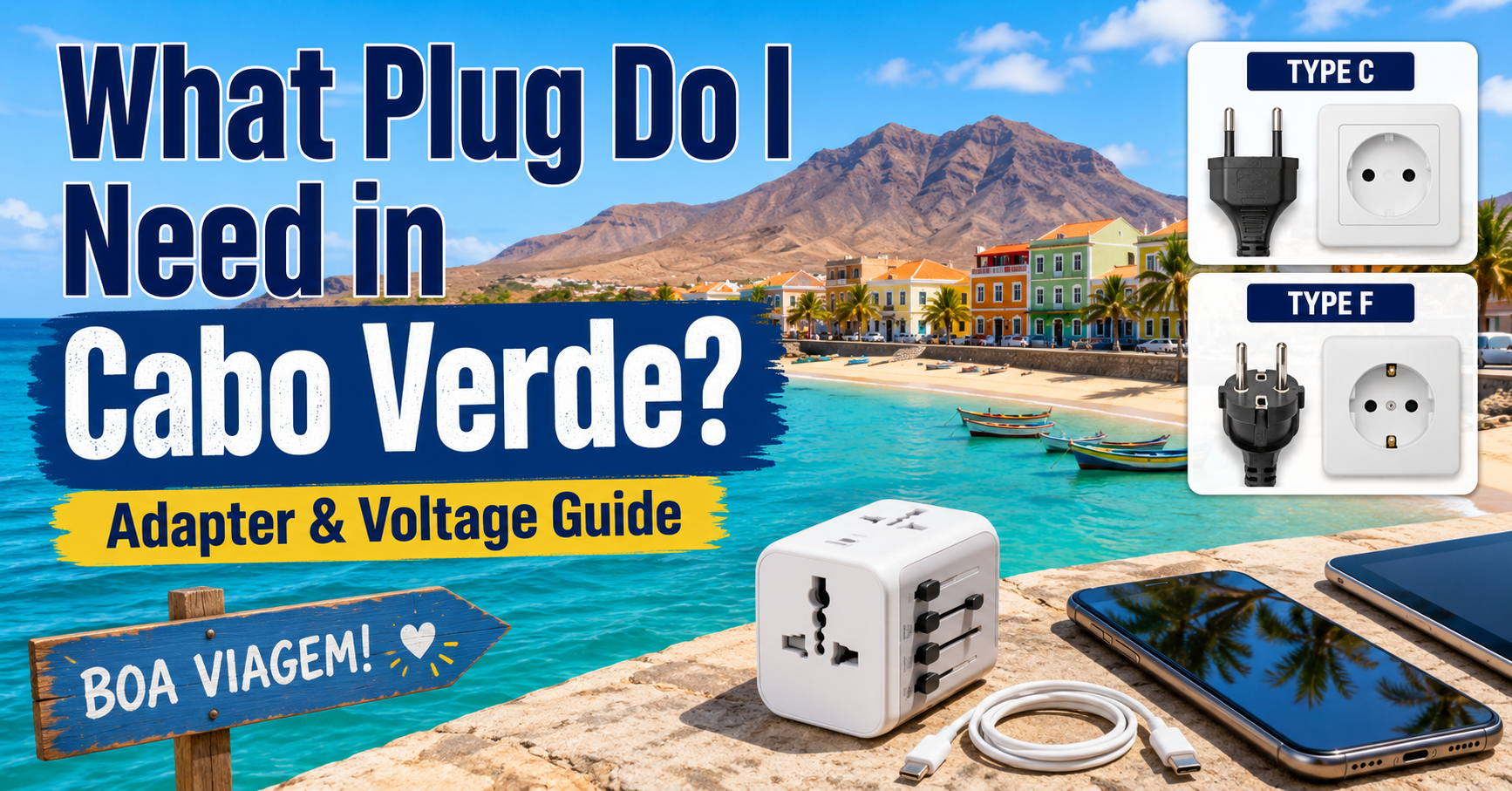
Cabo Verde uses Type C and Type F outlets, with 230V electricity and a frequency of 50Hz. These are the same round-pin outlet styles widely used across continental Europe.
However, having the correct plug shape does not automatically mean every appliance is safe to use.
A plug adapter fixes the shape.
It does not make the power safe for the wrong device.
That is especially important for travelers coming from countries such as the United States, Canada, Mexico, Japan, and others that commonly use 100–127V electricity. Cabo Verde’s 230V supply can damage a single-voltage appliance designed only for lower voltage if you plug it in with only a plug adapter.
That is why checking both the outlet and the voltage matters.
This is a complete, no-nonsense Cabo Verde outlet, plug, and voltage guide with clear explanations and practical packing advice for travelers from around the world. Scroll to your country below for exactly what you need — no guessing, no surprises.

Quick Overview: What You Need for Cabo Verde
✔ Plug Adapter
Cabo Verde uses Type C and Type F outlets.
Type C has two round pins. Type F also has two round pins, with grounding clips along the sides.
If your home country uses another plug type, you will need a plug adapter for Cabo Verde.
Because Type C and Type F are both widely used across continental Europe, travelers who already use compatible European-style plugs may not need an adapter. Travelers from the United States, Canada, the UK, Ireland, Australia, New Zealand, Japan, and many other countries generally will.
A universal adapter can be especially useful if Cabo Verde is part of a larger West Africa, Europe, Africa, or international trip. Check your adapter specifications before traveling to make sure it supports Type C and Type F outlets.
✔ Dual-Voltage Electronics
Phones, laptops, tablets, cameras, power banks, Kindles, and most modern chargers labeled 100–240V are usually fine in Cabo Verde with the correct plug adapter.
For those devices, you usually do not need a voltage converter.
The label on the charger is what matters.
Dual-voltage electronics are especially useful for international travelers because a device labeled 100–240V can safely handle Cabo Verde’s 230V electricity as well as the 110–127V systems used in countries such as the United States, Canada, Mexico, and Japan.
✔ Single-Voltage Small Appliances (Converter Needed for 110–127V Devices)
Cabo Verde uses 230V electricity. If you are coming from a 110–127V country and your appliance is labeled only for 110V, 115V, 120V, or 127V, do not plug it into a Cabo Verde outlet with only a plug adapter.
Hair dryers, curling irons, straighteners, steamers, electric kettles, heating pads, and other heat tools are the usual troublemakers.
For those items, you need a step-down voltage converter, or better yet, a dual-voltage travel version of that appliance.
Travelers coming from countries that already use 220–240V electricity generally do not need a voltage converter for standard single-voltage 220–240V appliances in Cabo Verde.
✔ Multi-Port USB Charger
A good charging setup can make travel much easier. If you are charging a phone, watch, earbuds, power bank, camera batteries, and perhaps a tablet or Kindle too, a multi-port USB charger is worth packing.
Choose one labeled 100–240V so it can continue working safely on future trips to countries with different voltage systems.
✔ Travel Power Strip
A compact travel power strip can be useful in Cabo Verde, especially if you are staying in older hotels, guesthouses, apartments, beach accommodations, small inns, locally run properties, or places where outlets are limited or inconveniently located.
✔ Power Bank
A power bank is extremely useful for long sightseeing days, island-hopping, boat trips, beach days, hiking, road trips, volcanic excursions, and any time you are relying on your phone for photos, maps, tickets, bookings, weather, or communication.
It can be particularly helpful when spending the day exploring Sal or Boa Vista, hiking on Santo Antão, sightseeing around Santiago, exploring São Vicente and Mindelo, visiting the volcanic landscapes of Fogo, or heading somewhere with limited charging opportunities.
✔ Electronics Organizer
Keeps your adapters, charging bricks, cords, camera batteries, memory cards, and small tech pieces from becoming a tangled mess in your bag.
Travel Hack:
A Cabo Verde-compatible universal adapter + travel power strip + multi-port USB charger = an instant charging hub almost anywhere in Cabo Verde.
Cabo Verde’s Electrical Basics
Plug Types Used:
Type C – Two round pins
Type F – Two round pins with grounding clips on the sides
Cabo Verde uses 230V electricity with 50Hz frequency.
✔ Safe With Only an Adapter
These are usually fine if the charger or device is labeled 100–240V:
Phones
Laptops
Tablets
Cameras
Power banks
E-readers / Kindles
Bluetooth headphones / earbuds
Most modern USB chargers
Not Always Safe
Be careful with:
Hair dryers
Curling irons
Straighteners
Steamers
Heating pads
Electric kettles
Cheap or older chargers
Any device labeled for only one voltage
Because Cabo Verde uses 230V power, travelers from 110–127V countries need to check single-voltage appliances carefully. A plug adapter only changes the plug shape. It does not convert electricity.
Check the Voltage Label Before You Pack
Look at the small print on each charger or device:
“110V,” “115V,” or “120V only” → Not safe in Cabo Verde with only a plug adapter. You need a proper step-down voltage converter or a dual-voltage travel version of the appliance.
“220V,” “230V,” or “240V only” → Usually compatible with Cabo Verde’s electrical system. You only need a plug adapter if the plug shape does not match the outlet you are using.
“100–240V” → Usually safe in Cabo Verde. You only need the correct plug adapter.
Frequency Note:
The 50Hz frequency is usually not a big deal for phones, laptops, tablets, cameras, and similar electronics. It can matter more for motor-based, clock-based, or certain heat-based appliances.
Consistency:
Cabo Verde is relatively straightforward electrically because Type C and Type F outlets are used throughout the country.
Both use two round pins, and they are among the most common outlet styles found across continental Europe.
Travelers from the United States, Canada, Mexico, the UK, Ireland, Australia, New Zealand, Japan, and many other countries will generally need a compatible plug adapter.
Travelers from countries that commonly use Type C or Type F plugs may already have plugs that work in Cabo Verde, but it is still smart to check each device before traveling.
If you are staying in hotels, resorts, apartments, guesthouses, beach accommodations, small inns, or moving between Sal, Boa Vista, Santiago, São Vicente, Santo Antão, Fogo, and other islands in Cabo Verde, it is smart to bring a reliable charging setup.
A Cabo Verde-compatible plug adapter, a dual-voltage multi-port USB charger, and a power bank will cover most normal traveler needs.
If Cabo Verde is part of a larger West Africa, Africa, or international trip, check each country on your itinerary before you leave. Plug types vary considerably across Africa, and nearby countries do not necessarily use the exact same outlet, voltage, or frequency setup.
Quick Jump to Your Region
🌎 North America
🌎 Central America & Caribbean
🌎 South America
🌏 Oceania
🌍 Europe
🌏 Asia
🌍 Africa
🧳 Universal Packing Checklist
⚡ Final Tips for Cabo Verde
🌎 North America

Cabo Verde uses Type C and Type F outlets with 230V electricity and 50Hz frequency. This is very different from the electrical systems used in the United States, Canada, and Mexico, where 110–127V electricity and Type A/B plugs are standard.
Travelers from North America should compare both their home plug type and voltage before packing.
🇺🇸 United States
Home: 120V, 60 Hz, Type A/B.
Vs. Cabo Verde: Cabo Verde uses 230V electricity, 50Hz frequency, and Type C/F outlets.
You need a plug adapter. Modern electronics labeled 100–240V should work normally.
Single-voltage 110–120V appliances require a step-down voltage converter. Cabo Verde also uses 50Hz rather than the U.S. 60Hz, which can matter for some frequency-sensitive appliances.
What to pack:
- Plug adapter
- Travel power strip
- Power bank
- Step-down voltage converter for blow dryers, curling irons, straighteners, steamers, or other single-voltage 110–120V appliances
- Multi-port USB charger
- Electronics organizer
🇨🇦 Canada
Home: 120V, 60 Hz, Type A/B.
Vs. Cabo Verde: Cabo Verde uses 230V electricity, 50Hz frequency, and Type C/F outlets.
You need a plug adapter. Modern electronics labeled 100–240V should work normally.
Single-voltage 110–120V appliances require a step-down voltage converter. Cabo Verde also uses 50Hz rather than Canada’s 60Hz, which can matter for some frequency-sensitive appliances.
What to pack:
- Plug adapter
- Travel power strip
- Power bank
- Step-down voltage converter for blow dryers, curling irons, straighteners, steamers, or other single-voltage 110–120V appliances
- Multi-port USB charger
- Electronics organizer
🇲🇽 Mexico
Home: 127V, 60 Hz, Type A/B.
Vs. Cabo Verde: Cabo Verde uses 230V electricity, 50Hz frequency, and Type C/F outlets.
You need a plug adapter. Modern electronics labeled 100–240V should work normally.
Single-voltage 110–127V appliances require a step-down voltage converter. Cabo Verde also uses 50Hz rather than Mexico’s 60Hz, which can matter for some frequency-sensitive appliances.
What to pack:
- Plug adapter
- Travel power strip
- Power bank
- Step-down voltage converter for blow dryers, curling irons, straighteners, steamers, or other single-voltage 110–120V appliances
- Multi-port USB charger
- Electronics organizer
🇬🇱 Greenland
Home: 230V, 50 Hz, Type C/F/K.
Vs. Cabo Verde: Greenland and Cabo Verde both use 230V electricity and 50Hz frequency, and both use Type C and Type F outlets.
If your device has a Type C or Type F plug, you generally do not need a plug adapter. If you are using a Type K plug, you will need a compatible adapter for Cabo Verde.
No voltage converter is normally needed.
What to pack:
🌎 Central America & Caribbean

110–127V / 50–60 Hz Countries
Voltage Check Required for Single-Voltage 110–120V Appliances
Travelers from these countries are used to lower voltage than Cabo Verde.
Cabo Verde uses 230V electricity and 50Hz frequency, with Type C and Type F outlets.
Dual-voltage electronics are safe with the correct adapter
Single-voltage 110–120V hair tools require a step-down voltage converter
Travelers using Type A, Type B, Type G, or Type L plugs generally need a Cabo Verde-compatible plug adapter
Type C plugs may already be compatible with Cabo Verde outlets
🇧🇿 Belize
Home: 110V / 220V mix, 60 Hz, Type A/B/G.
Vs. Cabo Verde: Cabo Verde uses Type C and Type F outlets, with 230V electricity and 50Hz frequency.
Belize uses mixed voltage and several plug types. Belizean Type A, Type B, and Type G plugs do not match Cabo Verde’s standard outlet types, so travelers need a Cabo Verde-compatible plug adapter.
If your appliance is designed only for 110V or 120V, it is not safe on Cabo Verde’s 230V electricity with only a plug adapter. You need a step-down voltage converter or a dual-voltage travel version.
Appliances designed for 220–240V are compatible with Cabo Verde’s voltage, but the change from 60Hz to 50Hz may affect frequency-sensitive motors, timers, and clocks.
What to pack:
- Plug adapter
- Travel power strip
- Power bank
- Step-down voltage converter for blow dryers, curling irons, straighteners, steamers, or other single-voltage 120V appliances
- Multi-port USB charger
- Electronics organizer
Dual-voltage devices labeled 100–240V need only the correct plug connection — no converter.
🇨🇷 Costa Rica
Home: 120V, 60 Hz, Type A/B.
Vs. Cabo Verde: Cabo Verde uses Type C and Type F outlets, so Costa Rican travelers need a plug adapter. Standard Type A/B plugs do not match Cabo Verde’s outlet types.
Voltage is the bigger issue. Costa Rica uses 120V power, while Cabo Verde uses 230V. Single-voltage 120V appliances are not safe in Cabo Verde with only a plug adapter.
Phones, laptops, tablets, cameras, and USB chargers are safe if they say 100–240V.
What to pack:
- Plug adapter
- Travel power strip
- Power bank
- Step-down voltage converter for blow dryers, curling irons, straighteners, steamers, or other single-voltage 120V appliances
- Multi-port USB charger
- Electronics organizer
Dual-voltage devices labeled 100–240V need an adapter only — no converter.
🇸🇻 El Salvador
Home: 115V, 60 Hz, Type A/B.
Vs. Cabo Verde: Cabo Verde uses Type C and Type F outlets. Travelers from El Salvador need a plug adapter because standard Type A/B plugs do not match Cabo Verde’s outlet types.
Cabo Verde uses 230V electricity, so single-voltage 115V appliances are not safe with only a plug adapter. Modern electronics are safe when the charger label says 100–240V.
What to pack:
- Plug adapter
- Travel power strip
- Power bank
- Step-down voltage converter for blow dryers, curling irons, straighteners, steamers, or other single-voltage 120V appliances
- Multi-port USB charger
- Electronics organizer
Dual-voltage devices labeled 100–240V need an adapter only — no converter.
🇬🇹 Guatemala
Home: 120V, 60 Hz, Type A/B.
Vs. Cabo Verde: Cabo Verde uses Type C and Type F outlets, so Guatemalan travelers need a plug adapter. Standard Type A/B plugs do not match Cabo Verde’s outlet types.
Voltage requires extra attention because Guatemala uses 120V power and Cabo Verde uses 230V. Single-voltage 120V appliances are not safe in Cabo Verde with only an adapter. Check every hair tool and heat-producing appliance before packing it.
What to pack:
- Plug adapter
- Travel power strip
- Power bank
- Step-down voltage converter for blow dryers, curling irons, straighteners, steamers, or other single-voltage 120V appliances
- Multi-port USB charger
- Electronics organizer
Dual-voltage devices labeled 100–240V need an adapter only — no converter.
🇭🇳 Honduras
Home: 120V, 60 Hz, Type A/B.
Vs. Cabo Verde: Cabo Verde uses Type C and Type F outlets, so Honduran travelers need a plug adapter. Standard Type A/B plugs do not match Cabo Verde’s outlet types.
Because Cabo Verde uses 230V power, single-voltage 120V appliances from Honduras are not safe with only a plug adapter. Phone, laptop, camera, and USB chargers are safe if they say 100–240V.
What to pack:
- Plug adapter
- Travel power strip
- Power bank
- Step-down voltage converter for blow dryers, curling irons, straighteners, steamers, or other single-voltage 120V appliances
- Multi-port USB charger
- Electronics organizer
Dual-voltage devices labeled 100–240V need an adapter only — no converter.
🇳🇮 Nicaragua
Home: 120V, 60 Hz, Type A/B.
Vs. Cabo Verde: Cabo Verde uses Type C and Type F outlets. Travelers from Nicaragua need a plug adapter because standard Type A/B plugs do not match Cabo Verde’s outlet types.
Nicaragua uses 120V power, while Cabo Verde uses 230V. Single-voltage 120V appliances require a step-down voltage converter or a dual-voltage travel replacement.
The frequency difference does not affect modern electronics labeled 100–240V, but it can affect motorized, timed, or heat-based appliances.
What to pack:
- Plug adapter
- Travel power strip
- Power bank
- Step-down voltage converter for blow dryers, curling irons, straighteners, steamers, or other single-voltage 120V appliances
- Multi-port USB charger
- Electronics organizer
Dual-voltage devices labeled 100–240V need an adapter only — no converter.
🇵🇦 Panama
Home: 120V, 60 Hz, Type A/B.
Vs. Cabo Verde: Cabo Verde uses Type C and Type F outlets, so Panamanian travelers need a plug adapter. Standard Type A/B plugs do not match Cabo Verde’s outlet types.
Because Cabo Verde uses 230V power, single-voltage 120V appliances are not safe with only an adapter. Devices labeled 100–240V are safe with the correct plug adapter.
What to pack:
- Plug adapter
- Travel power strip
- Power bank
- Step-down voltage converter for blow dryers, curling irons, straighteners, steamers, or other single-voltage 120V appliances
- Multi-port USB charger
- Electronics organizer
Dual-voltage devices labeled 100–240V need an adapter only — no converter.
🇧🇸 Bahamas
Home: 120V, 60 Hz, Type A/B.
Vs. Cabo Verde: Cabo Verde uses Type C and Type F outlets. Travelers from the Bahamas need a plug adapter because standard Type A/B plugs do not match Cabo Verde’s outlet types.
The Bahamas uses 120V power, while Cabo Verde uses 230V. Single-voltage 120V appliances require a step-down voltage converter or a dual-voltage replacement.
Modern dual-voltage electronics are safe with an adapter only.
What to pack:
- Plug adapter
- Travel power strip
- Power bank
- Step-down voltage converter for blow dryers, curling irons, straighteners, steamers, or other single-voltage 120V appliances
- Multi-port USB charger
- Electronics organizer
Dual-voltage devices labeled 100–240V need an adapter only — no converter.
🇧🇧 Barbados
Home: 115V, 50 Hz, Type A/B.
Vs. Cabo Verde: Cabo Verde uses Type C and Type F outlets, so travelers from Barbados need a plug adapter.
Cabo Verde uses 230V electricity, so single-voltage 115V appliances are not safe with only a plug adapter. Check hair tools and other heat-producing appliances before packing them.
Barbados and Cabo Verde both use 50Hz frequency, but matching frequency does not make a single-voltage 115V appliance safe on Cabo Verde’s 230V power.
What to pack:
- Plug adapter
- Travel power strip
- Power bank
- Step-down voltage converter for blow dryers, curling irons, straighteners, steamers, or other single-voltage 120V appliances
- Multi-port USB charger
- Electronics organizer
Dual-voltage devices labeled 100–240V need an adapter only — no converter.
🇨🇺 Cuba
Home: 110V / 220V mix, 60 Hz, Type A/B/C/L.
Vs. Cabo Verde: Cuba uses mixed voltage, while Cabo Verde uses 230V electricity and 50Hz frequency. Cabo Verde uses Type C and Type F outlets.
Cuban Type A, Type B, and Type L plugs generally require a Cabo Verde-compatible plug adapter. Type C plugs may work directly in Cabo Verde outlets.
Appliances designed only for 110V or 120V are not safe in Cabo Verde with only a plug adapter. Appliances designed for 220–240V are compatible with Cabo Verde’s voltage but still need the correct plug connection.
The change from 60Hz to 50Hz can also affect frequency-sensitive motors, timers, and clocks.
What to pack:
- Plug adapter
- Travel power strip
- Power bank
- Step-down voltage converter for blow dryers, curling irons, straighteners, steamers, or other single-voltage 120V appliances
- Multi-port USB charger
- Electronics organizer
Dual-voltage devices labeled 100–240V need only the correct plug connection — no converter.
🇩🇴 Dominican Republic
Home: 120V, 60 Hz, Type A/B/C.
Vs. Cabo Verde: Cabo Verde uses Type C and Type F outlets. Dominican Type C plugs can work in Cabo Verde, while Type A and Type B plugs require a Cabo Verde-compatible plug adapter.
Voltage is the bigger issue. The Dominican Republic uses 120V power, while Cabo Verde uses 230V. Single-voltage 120V appliances are not safe in Cabo Verde with only a plug adapter.
A plug adapter only changes the physical connection. It does not make a single-voltage 120V appliance safe on Cabo Verde’s 230V electricity.
What to pack:
- Plug adapter
- Travel power strip
- Power bank
- Step-down voltage converter for blow dryers, curling irons, straighteners, steamers, or other single-voltage 120V appliances
- Multi-port USB charger
- Electronics organizer
Dual-voltage devices labeled 100–240V need only the correct plug connection — no converter.
🇭🇹 Haiti
Home: 110V, 60 Hz, Type A/B.
Vs. Cabo Verde: Cabo Verde uses Type C and Type F outlets, so travelers from Haiti need a plug adapter. Standard Type A/B plugs do not match Cabo Verde’s outlet types.
Because Cabo Verde uses 230V electricity, single-voltage 110V appliances are not safe with only a plug adapter. Dual-voltage electronics are safe with the correct adapter.
What to pack:
- Plug adapter
- Travel power strip
- Power bank
- Step-down voltage converter for blow dryers, curling irons, straighteners, steamers, or other single-voltage 120V appliances
- Multi-port USB charger
- Electronics organizer
Dual-voltage devices labeled 100–240V need an adapter only — no converter.
🇯🇲 Jamaica
Home: 110V, 50 Hz, Type A/B.
Vs. Cabo Verde: Cabo Verde uses Type C and Type F outlets. Travelers from Jamaica need a plug adapter because standard Type A/B plugs do not match Cabo Verde’s outlet types.
Cabo Verde uses 230V electricity, so single-voltage 110V appliances are not safe with only a plug adapter. Check every hair tool and heat-producing appliance before using it.
Jamaica and Cabo Verde both use 50Hz frequency, but the matching frequency does not make a 110V appliance compatible with Cabo Verde’s 230V electricity.
What to pack:
- Plug adapter
- Travel power strip
- Power bank
- Step-down voltage converter for blow dryers, curling irons, straighteners, steamers, or other single-voltage 120V appliances
- Multi-port USB charger
- Electronics organizer
Dual-voltage devices labeled 100–240V need an adapter only — no converter.
🇹🇹 Trinidad and Tobago
Home: 115V, 60 Hz, Type A/B.
Vs. Cabo Verde: Cabo Verde uses Type C and Type F outlets. Travelers from Trinidad and Tobago need a plug adapter because standard Type A/B plugs do not match Cabo Verde’s outlet types.
Because Cabo Verde uses 230V power, single-voltage 115V appliances are not safe with only a plug adapter. Modern electronics are safe if the label says 100–240V.
What to pack:
- Plug adapter
- Travel power strip
- Power bank
- Step-down voltage converter for blow dryers, curling irons, straighteners, steamers, or other single-voltage 120V appliances
- Multi-port USB charger
- Electronics organizer
Dual-voltage devices labeled 100–240V need an adapter only — no converter.
220–240V / 50–60 Hz Countries
Plug Adapter May Be Required — Voltage Is Compatible
Travelers from these countries are already used to higher-voltage power.
Cabo Verde uses 230V / 50Hz, so voltage is compatible with appliances designed for 220V, 230V, or 240V.
Type C plugs may fit Cabo Verde outlets directly
Type A, Type B, and Type G plugs generally require a Cabo Verde-compatible adapter
A voltage converter is not needed for devices rated 220–240V or 100–240V
The device’s voltage label still determines whether it is safe
Frequency-sensitive motors, timers, and clocks designed only for 60Hz may not operate correctly on Cabo Verde’s 50Hz system
🇦🇬 Antigua and Barbuda
Home: 230V, 60 Hz, Type A/B.
Vs. Cabo Verde: Antigua and Barbuda uses 230V electricity, so the voltage matches Cabo Verde’s 230V system.
The plug shape is different. Cabo Verde uses Type C and Type F outlets, while Antigua and Barbuda uses Type A/B plugs. Travelers need a Cabo Verde-compatible plug adapter.
The frequency changes from 60Hz to 50Hz. This does not affect modern electronics labeled 100–240V, but it can affect frequency-sensitive motors, timers, and clocks.
What to pack:
🇩🇲 Dominica
Home: 230V, 50 Hz, Type G.
Vs. Cabo Verde: Dominica and Cabo Verde both use 230V electricity with 50Hz frequency, so devices designed for Dominica’s electrical system do not need a voltage converter in Cabo Verde.
The plug shape is different. Dominica uses Type G plugs, while Cabo Verde uses Type C and Type F outlets. Travelers from Dominica need a Cabo Verde-compatible plug adapter.
What to pack:
🇬🇩 Grenada
Home: 230V, 50 Hz, Type G.
Vs. Cabo Verde: Grenada and Cabo Verde use the same 230V electricity and 50Hz frequency.
The plug systems are different. Grenada uses Type G plugs, while Cabo Verde uses Type C and Type F outlets. Travelers from Grenada need a Cabo Verde-compatible plug adapter.
A voltage converter is not needed for devices and appliances designed for Grenada’s electrical system.
What to pack:
🇰🇳 Saint Kitts and Nevis
Home: 230V, 60 Hz, Type A/B/G/D.
Vs. Cabo Verde: Saint Kitts and Nevis and Cabo Verde both use 230V electricity.
The plug systems are different. Type A, Type B, Type G, and Type D plugs do not match Cabo Verde’s standard Type C/F outlets, so travelers should bring a Cabo Verde-compatible plug adapter.
The frequency changes from 60Hz to 50Hz. Modern electronics labeled 100–240V are safe, but frequency-sensitive motors, clocks, and timed appliances require a label check.
What to pack:
🇱🇨 Saint Lucia
Home: 240V, 50 Hz, Type A/B/G.
Vs. Cabo Verde: Saint Lucia uses 240V / 50Hz power, which is compatible with Cabo Verde’s 230V / 50Hz system.
The plug shape is different. Type A, Type B, and Type G plugs generally do not match Cabo Verde’s Type C or Type F outlets, so travelers need a Cabo Verde-compatible plug adapter.
A voltage converter is not needed for devices designed for Saint Lucia’s 240V electrical system.
What to pack:
🇻🇨 Saint Vincent and the Grenadines
Home: 230V, 50 Hz, Type A/B/G.
Vs. Cabo Verde: Saint Vincent and the Grenadines and Cabo Verde both use 230V electricity with 50Hz frequency.
Type A, Type B, and Type G plugs generally do not match Cabo Verde’s Type C or Type F outlets, so travelers need a Cabo Verde-compatible plug adapter.
A voltage converter is not needed for devices designed for Saint Vincent and the Grenadines’ electrical system.
What to pack:
🌎 South America

220–240V / 50–60 Hz Countries
Voltage Is Usually Compatible — Check the Plug Shape
Cabo Verde uses 230V electricity and 50Hz frequency, so travelers from most higher-voltage South American countries generally do not need a voltage converter for appliances designed for 220–240V.
Plug compatibility varies because Cabo Verde uses Type C and Type F outlets.
Modern electronics are usually the easy part.
- Type C plugs generally work directly in Cabo Verde
- Type F plugs also work directly
- Other plug types may require an adapter
- Modern electronics labeled 100–240V usually need only the correct plug connection
- Appliances designed for 220–240V are generally compatible with Cabo Verde’s 230V electricity
- A voltage converter is not normally needed for 220–240V appliances
- Check frequency-sensitive appliances if your home country uses 60Hz rather than Cabo Verde’s 50Hz
🇦🇷 Argentina
Home: 220V, 50 Hz, Type C/I.
Vs. Cabo Verde: Argentina’s 220V electricity is compatible with Cabo Verde’s 230V system, and both countries use 50Hz frequency.
Argentina uses Type C and Type I plugs, while Cabo Verde uses Type C and Type F outlets.
A Type C plug generally works directly in Cabo Verde. Type I plugs require an adapter.
Phones, laptops, tablets, cameras, USB chargers, power banks, and other modern electronics labeled 100–240V should work normally.
A voltage converter is generally not needed for appliances designed for Argentina’s 220V electrical system.
A universal adapter is still useful if some of your devices use Type I plugs or Cabo Verde is part of a larger international trip.
What to pack:
- Plug adapter if your device uses Type I
- Travel power strip
- Power bank
- Multi-port USB charger
- Electronics organizer
🇧🇴 Bolivia
Home: 230V, 50 Hz, Type A/C.
Vs. Cabo Verde: Bolivia and Cabo Verde both use 230V electricity with 50Hz frequency.
Plug compatibility depends on the device. Bolivian Type C plugs work directly in Cabo Verde, while Type A plugs require an adapter.
Modern electronics labeled 100–240V should work normally.
A voltage converter is not needed for appliances designed for Bolivia’s 230V electrical system.
A universal adapter is useful if some of your devices use Type A plugs.
What to pack:
🇨🇱 Chile
Home: 220–230V, 50 Hz, Type C/L.
Vs. Cabo Verde: Chile’s 220–230V electricity and 50Hz frequency are compatible with Cabo Verde’s 230V / 50Hz electrical system.
Chile uses Type C and Type L plugs. Type C plugs work directly in Cabo Verde, while Type L plugs require an adapter.
Modern phones, laptops, tablets, cameras, USB chargers, and power banks labeled 100–240V should work normally.
A voltage converter is not needed for appliances designed for Chile’s 220–230V electrical system.
What to pack:
🇵🇾 Paraguay
Home: 220V, 50 Hz, Type C.
Vs. Cabo Verde: Paraguay uses 220V electricity and 50Hz frequency, which is compatible with Cabo Verde’s 230V / 50Hz system.
Paraguay primarily uses Type C plugs, and Cabo Verde also uses Type C outlets.
A standard Type C plug generally works directly in Cabo Verde.
Modern electronics labeled 100–240V should work normally.
A voltage converter is generally not needed for appliances designed for Paraguay’s 220V electrical system.
This is one of the easiest South American electrical matches for travel to Cabo Verde.
What to pack:
🇵🇪 Peru
Home: 220V, 60 Hz, Type A/B/C.
Vs. Cabo Verde: Peru uses 220V electricity, which is generally compatible with Cabo Verde’s 230V supply.
The main differences are plug shape and frequency.
Peruvian Type C plugs work directly in Cabo Verde. Type A and Type B plugs require an adapter.
Phones, laptops, tablets, cameras, USB chargers, power banks, and other electronics labeled 100–240V should work normally.
Cabo Verde uses 50Hz rather than Peru’s 60Hz. This usually does not matter for modern electronics, but frequency-sensitive motors, timers, clocks, and some appliances should be checked carefully.
A voltage converter is generally not needed for appliances designed for Peru’s 220V electrical system.
What to pack:
🇺🇾 Uruguay
Home: 220–230V, 50 Hz, Type C/F/I/L.
Vs. Cabo Verde: Uruguay’s 220–230V electricity and 50Hz frequency are compatible with Cabo Verde’s 230V / 50Hz electrical system.
Uruguay uses Type C, Type F, Type I, and Type L plugs, while Cabo Verde uses Type C and Type F outlets.
Type C and Type F plugs generally work directly in Cabo Verde. Type I and Type L plugs require an adapter.
Modern electronics labeled 100–240V should work normally.
A voltage converter is not generally needed for appliances designed for Uruguay’s 220–230V electrical system.
What to pack:
110–127V / 60 Hz or Mixed-Voltage Countries
Voltage Check Required — Cabo Verde Uses 230V
Cabo Verde uses 230V electricity, so travelers from lower-voltage South American countries need to check single-voltage appliances carefully.
Dual-voltage electronics labeled 100–240V are normally straightforward.
- Type A/B plugs require an adapter
- Type C plugs generally work directly in Cabo Verde
- Standard 110–127V single-voltage appliances are not safe on Cabo Verde’s 230V electricity with only a plug adapter
- Travelers from mixed-voltage countries need to check whether each appliance is designed for lower or higher voltage
- Single-voltage 110–127V appliances require a step-down voltage converter in Cabo Verde
- Appliances designed for 220–240V are generally voltage-compatible
🇧🇷 Brazil
Home: 127V / 220V mix, varies by region, 60 Hz, Type C/N.
Vs. Cabo Verde: Brazil has mixed voltage, while Cabo Verde uses 230V electricity.
If your appliance is designed for 220V, Cabo Verde’s 230V electricity is generally compatible.
If your appliance is designed only for 127V, it is not safe on Cabo Verde’s 230V electricity with only a plug adapter. You need a step-down voltage converter or a dual-voltage travel version.
Plug shape also matters. Brazil uses Type C and Type N plugs, while Cabo Verde uses Type C and Type F outlets.
A Type C plug generally works directly in Cabo Verde. Type N plugs require an adapter.
Modern electronics labeled 100–240V should work normally.
Brazil uses 60Hz electricity while Cabo Verde uses 50Hz, so frequency-sensitive appliances should also be checked.
What to pack:
- Travel power strip
- Plug adapter if your device uses Type N
- Power bank
- Step-down voltage converter for single-voltage 110–127V appliances if bringing them
- Multi-port USB charger
- Electronics organizer
🇨🇴 Colombia
Home: 110V, 60 Hz, Type A/B.
Vs. Cabo Verde: Colombia and Cabo Verde use very different electrical systems.
Colombia uses 110V electricity with Type A/B plugs and 60Hz frequency, while Cabo Verde uses 230V electricity with Type C/F outlets and 50Hz frequency.
Colombian travelers need a plug adapter.
Phones, laptops, tablets, cameras, USB chargers, power banks, and most modern electronics should work normally if labeled 100–240V.
Single-voltage 110V appliances are not safe on Cabo Verde’s 230V electricity with only a plug adapter. These require a step-down voltage converter or a dual-voltage replacement.
The change from 60Hz to 50Hz may also affect some motorized, timed, or frequency-sensitive appliances.
What to pack:
- Travel power strip
- Plug adapter
- Power bank
- Step-down voltage converter for single-voltage 110–127V appliances if bringing them
- Multi-port USB charger
- Electronics organizer
🇪🇨 Ecuador
Home: 120–127V, 60 Hz, Type A/B.
Vs. Cabo Verde: Ecuador uses much lower voltage than Cabo Verde.
Ecuador uses 120–127V electricity with Type A/B plugs and 60Hz frequency, while Cabo Verde uses 230V electricity with Type C/F outlets and 50Hz frequency.
You need a plug adapter.
Modern electronics labeled 100–240V should work normally with the correct adapter.
Single-voltage 120–127V appliances are not safe in Cabo Verde with only a plug adapter. They require a step-down voltage converter or a dual-voltage replacement.
The difference between Ecuador’s 60Hz frequency and Cabo Verde’s 50Hz frequency can also matter for some motors, timers, clocks, and other frequency-sensitive appliances.
What to pack:
- Travel power strip
- Plug adapter
- Power bank
- Step-down voltage converter for single-voltage 110–127V appliances if bringing them
- Multi-port USB charger
- Electronics organizer
🇬🇾 Guyana
Home: 120V / 240V mix, 60 Hz, Type A/B/D/G.
Vs. Cabo Verde: Guyana has mixed voltage, while Cabo Verde uses 230V electricity with Type C and Type F outlets.
If your appliance is designed for 220–240V electricity, Cabo Verde’s 230V system is generally compatible.
If your appliance is designed only for 120V, it is not safe on Cabo Verde’s 230V electricity with only a plug adapter. You need a step-down voltage converter.
Plug compatibility also depends on the device.
Guyana uses Type A, Type B, Type D, and Type G plugs. These do not match Cabo Verde’s standard Type C/F outlets, so travelers should bring a plug adapter.
Modern electronics labeled 100–240V should work normally.
Guyana uses 60Hz while Cabo Verde uses 50Hz, so frequency-sensitive equipment should be checked.
What to pack:
- Travel power strip
- Plug adapter
- Power bank
- Step-down voltage converter for single-voltage 110–127V appliances if bringing them
- Multi-port USB charger
- Electronics organizer
🇸🇷 Suriname
Home: 127V, 60 Hz, Type A/B/C.
Vs. Cabo Verde: Suriname uses 127V electricity and 60Hz frequency, while Cabo Verde uses 230V electricity and 50Hz frequency.
Single-voltage 127V appliances are not safe on Cabo Verde’s 230V electricity with only a plug adapter.
Modern phones, laptops, tablets, cameras, USB chargers, power banks, and other electronics labeled 100–240V should work normally.
Suriname uses Type A, Type B, and Type C plugs. Type C plugs generally work directly in Cabo Verde, while Type A and Type B plugs require an adapter.
For a single-voltage 127V appliance, you need a step-down voltage converter or a dual-voltage travel replacement.
What to pack:
- Travel power strip
- Plug adapter
- Power bank
- Step-down voltage converter for single-voltage 110–127V appliances if bringing them
- Multi-port USB charger
- Electronics organizer
🇻🇪 Venezuela
Home: 120V, 60 Hz, Type A/B.
Vs. Cabo Verde: Venezuela and Cabo Verde use very different electrical systems.
Venezuela uses Type A/B plugs with 120V electricity and 60Hz frequency, while Cabo Verde uses Type C/F outlets with 230V electricity and 50Hz frequency.
Venezuelan travelers need a plug adapter.
Phones, laptops, tablets, cameras, power banks, USB chargers, and most modern electronics should work normally if labeled 100–240V.
Single-voltage 120V appliances are not safe on Cabo Verde’s 230V electricity with only a plug adapter. You need a step-down voltage converter or a dual-voltage replacement.
The 60Hz-to-50Hz frequency difference can also matter for some motorized, clock-based, and frequency-sensitive appliances.
What to pack:
- Travel power strip
- Plug adapter
- Power bank
- Step-down voltage converter for single-voltage 110–127V appliances if bringing them
- Multi-port USB charger
- Electronics organizer
🌏 Oceania

220–240V / 50 Hz Countries
Voltage Is Compatible — Plug Adapter Usually Needed
Cabo Verde uses 230V electricity and 50Hz frequency, so travelers from most Oceania countries are already used to a very similar electrical system.
Voltage is generally straightforward. Plug shape is the main issue.
- You’ll usually need the correct plug adapter
- Cabo Verde uses Type C and Type F outlets
- Modern electronics labeled 100–240V usually need only the correct plug adapter
- Appliances designed for 220–240V are generally compatible with Cabo Verde’s 230V electricity
- A voltage converter is normally not needed for 220–240V appliances
- Most of these countries also use 50Hz electricity, matching Cabo Verde
🇦🇺 Australia
Home: 230V, often 240V in practice, 50 Hz, Type I.
Vs. Cabo Verde: Australia and Cabo Verde use compatible voltage and the same 50Hz frequency.
Australia uses Type I plugs, while Cabo Verde uses Type C and Type F outlets, so Australian travelers need a plug adapter.
Phones, laptops, tablets, cameras, USB chargers, power banks, and other modern electronics should work normally if they say 100–240V.
Appliances designed for Australia’s 230–240V electrical system generally do not need a voltage converter in Cabo Verde.
What to pack:
🇫🇯 Fiji
Home: 240V, 50 Hz, Type I.
Vs. Cabo Verde: Fiji uses 240V electricity and 50Hz frequency, which is compatible with Cabo Verde’s 230V / 50Hz electrical system.
Fiji uses Type I plugs, which do not match Cabo Verde’s Type C or Type F outlets, so you need a plug adapter.
Modern electronics labeled 100–240V should work normally with the correct adapter.
A voltage converter is generally not needed for appliances designed for Fiji’s 240V electrical system.
What to pack:
🇳🇿 New Zealand
Home: 230V, 50 Hz, Type I.
Vs. Cabo Verde: New Zealand and Cabo Verde both use 230V electricity with 50Hz frequency.
New Zealand uses Type I plugs, while Cabo Verde uses Type C and Type F outlets.
You need a plug adapter.
Phones, laptops, tablets, cameras, USB chargers, power banks, and similar electronics should work normally if labeled 100–240V.
A voltage converter is generally not needed for appliances designed for New Zealand’s 230V electrical system.
What to pack:
🇵🇬 Papua New Guinea
Home: 240V, 50 Hz, Type I.
Vs. Cabo Verde: Papua New Guinea’s 240V / 50Hz electricity is compatible with Cabo Verde’s 230V / 50Hz system.
Papua New Guinea uses Type I plugs, so you need an adapter for Cabo Verde’s Type C and Type F outlets.
Modern dual-voltage electronics labeled 100–240V should work normally with the correct adapter.
A voltage converter is generally not needed for appliances designed for Papua New Guinea’s 240V system.
What to pack:
🇸🇧 Solomon Islands
Home: 220–230V, 50 Hz, Type I; some Type G.
Vs. Cabo Verde: Solomon Islands electricity is compatible with Cabo Verde’s 230V / 50Hz system.
Type I and Type G plugs do not match Cabo Verde’s Type C or Type F outlets, so you need a plug adapter.
Modern electronics labeled 100–240V should work normally with the correct adapter.
A voltage converter is generally not needed for appliances designed for the Solomon Islands’ 220–230V electrical system.
What to pack:
🇹🇴 Tonga
Home: 240V, 50 Hz, Type I.
Vs. Cabo Verde: Tonga uses 240V electricity and 50Hz frequency, which is compatible with Cabo Verde’s 230V / 50Hz system.
Tonga uses Type I plugs, which require an adapter for Cabo Verde’s Type C and Type F outlets.
Dual-voltage electronics labeled 100–240V should work normally with the correct adapter.
A voltage converter is generally not needed for appliances designed for Tonga’s 240V electrical system.
What to pack:
🇼🇸 Samoa
Home: 230V, 50 Hz, Type I.
Vs. Cabo Verde: Samoa and Cabo Verde both use 230V electricity with 50Hz frequency.
Samoa uses Type I plugs, while Cabo Verde uses Type C and Type F outlets, so travelers need a plug adapter.
Modern electronics labeled 100–240V should work normally with the correct adapter.
A voltage converter is not needed for appliances designed for Samoa’s 230V electrical system.
What to pack:
🇹🇻 Tuvalu
Home: 230V, 50 Hz, Type I.
Vs. Cabo Verde: Tuvalu and Cabo Verde both use 230V electricity with 50Hz frequency.
Tuvalu uses Type I plugs, while Cabo Verde uses Type C and Type F outlets.
You need a plug adapter.
Modern dual-voltage electronics labeled 100–240V should work normally.
A voltage converter is generally not needed for appliances designed for Tuvalu’s 230V electrical system.
What to pack:
🇻🇺 Vanuatu
Home: 220V, 50 Hz, Type I.
Vs. Cabo Verde: Vanuatu’s 220V electricity and 50Hz frequency are compatible with Cabo Verde’s 230V / 50Hz system.
Vanuatu’s Type I plugs do not match Cabo Verde’s Type C or Type F outlets, so you need a plug adapter.
Modern electronics labeled 100–240V should work normally with the correct adapter.
A voltage converter is generally not needed for appliances designed for Vanuatu’s 220V electrical system.
What to pack:
🇰🇮 Kiribati
Home: 240V, 50 Hz, Type I.
Vs. Cabo Verde: Kiribati’s 240V electricity and 50Hz frequency are compatible with Cabo Verde’s 230V / 50Hz system.
Kiribati uses Type I plugs, while Cabo Verde uses Type C and Type F outlets.
You need a plug adapter.
Modern electronics labeled 100–240V should work normally with the correct adapter.
A voltage converter is generally not needed for appliances designed for Kiribati’s 240V electrical system.
What to pack:
🇳🇷 Nauru
Home: 240V, 50 Hz, Type I.
Vs. Cabo Verde: Nauru’s 240V / 50Hz system is compatible with Cabo Verde’s 230V / 50Hz electricity.
Nauru uses Type I plugs, while Cabo Verde uses Type C and Type F outlets.
You need a plug adapter.
Phones, laptops, tablets, cameras, USB chargers, power banks, and other devices labeled 100–240V should work normally.
A voltage converter is generally not needed for appliances designed for Nauru’s 240V electrical system.
What to pack:
🇵🇫 French Polynesia
Home: 110V / 220V mix, 60 / 50 Hz, Type A/B/E.
Vs. Cabo Verde: French Polynesia has a mixed electrical system, while Cabo Verde uses a standard 230V / 50Hz system with Type C and Type F outlets.
Plug compatibility depends on the device.
Type A and Type B plugs require an adapter. Some European-style Type E plugs may be physically compatible with Type F sockets, but travelers should check the exact plug on their device rather than assuming compatibility.
Voltage depends on the appliance you use at home.
A device designed only for 110–120V electricity is not safe on Cabo Verde’s 230V electricity with only a plug adapter. You need a step-down voltage converter or a dual-voltage replacement.
An appliance designed for 220V electricity is generally compatible with Cabo Verde’s 230V system.
Modern electronics labeled 100–240V should work normally.
What to pack:
- Plug adapter if your plug is not compatible with Type C/F
- Travel power strip
- Power bank
- Step-down voltage converter for single-voltage 110–120V appliances if bringing them
- Multi-port USB charger
- Electronics organizer
120V / 60 Hz Countries
Voltage Converter Needed for Single-Voltage 110–120V Appliances
Travelers from these Oceania destinations are used to much lower voltage than Cabo Verde.
Cabo Verde uses 230V electricity and 50Hz frequency.
- Type A and Type B plugs require a Cabo Verde-compatible plug adapter
- Standard single-voltage 110–120V appliances are not safe on Cabo Verde’s 230V electricity with only an adapter
- Modern electronics labeled 100–240V work normally with the correct plug adapter
- A step-down voltage converter is required for single-voltage 110–120V appliances
- Cabo Verde uses 50Hz rather than 60Hz, which can matter for some frequency-sensitive appliances
🇲🇭 Marshall Islands
Home: 120V, 60 Hz, Type A/B.
Vs. Cabo Verde: The Marshall Islands and Cabo Verde use very different electrical systems.
The Marshall Islands uses Type A/B plugs with 120V electricity and 60Hz frequency, while Cabo Verde uses Type C/F outlets with 230V electricity and 50Hz frequency.
You need a plug adapter.
Phones, laptops, tablets, cameras, power banks, and modern chargers labeled 100–240V should work normally with the correct adapter.
Single-voltage 110–120V appliances are not safe on Cabo Verde’s 230V electricity with only an adapter. You need a step-down voltage converter or a dual-voltage replacement.
What to pack:
- Plug adapter
- Travel power strip
- Power bank
- Step-down voltage converter for single-voltage 110–120V appliances if bringing them
- Multi-port USB charger
- Electronics organizer
🇫🇲 Micronesia
Home: 120V, 60 Hz, Type A/B.
Vs. Cabo Verde: Micronesia uses 120V electricity with Type A/B outlets and 60Hz frequency, while Cabo Verde uses 230V electricity with Type C/F outlets and 50Hz frequency.
You need a plug adapter.
Most modern electronics labeled 100–240V should work normally.
Single-voltage 110–120V appliances require a step-down voltage converter or a dual-voltage travel replacement.
The change from 60Hz to 50Hz may also affect some motors, timers, clocks, and other frequency-sensitive appliances.
What to pack:
- Plug adapter
- Travel power strip
- Power bank
- Step-down voltage converter for single-voltage 110–120V appliances if bringing them
- Multi-port USB charger
- Electronics organizer
🇵🇼 Palau
Home: 120V, 60 Hz, Type A/B.
Vs. Cabo Verde: Palau uses Type A/B plugs with 120V electricity and 60Hz frequency, while Cabo Verde uses Type C/F outlets with 230V electricity and 50Hz frequency.
You need a plug adapter.
Phones, laptops, tablets, cameras, USB chargers, power banks, and other electronics labeled 100–240V should work normally.
Single-voltage 110–120V appliances are not safe on Cabo Verde’s 230V electricity with only an adapter. A step-down voltage converter or dual-voltage replacement is required.
What to pack:
- Plug adapter
- Travel power strip
- Power bank
- Step-down voltage converter for single-voltage 110–120V appliances if bringing them
- Multi-port USB charger
- Electronics organizer
🇦🇸 American Samoa
Home: 120V, 60 Hz, Type A/B/F/I.
Vs. Cabo Verde: American Samoa uses 120V electricity and 60Hz frequency, while Cabo Verde uses 230V electricity and 50Hz frequency.
Type A, Type B, and Type I plugs require a Cabo Verde-compatible plug adapter. Type F plugs are compatible with Cabo Verde’s Type F outlets.
Modern electronics labeled 100–240V should work normally with the correct plug connection.
Single-voltage 110–120V appliances are not safe on Cabo Verde’s 230V electricity with only a plug adapter. You need a step-down voltage converter or a dual-voltage replacement.
The frequency also changes from 60Hz to 50Hz, which can matter for some motorized, timed, or frequency-sensitive appliances.
What to pack:
- Plug adapter
- Travel power strip
- Power bank
- Step-down voltage converter for single-voltage 110–120V appliances if bringing them
- Multi-port USB charger
- Electronics organizer
🌍 Europe

230V / 50 Hz Countries
Voltage Is Compatible — Plug Adapter Depends on Your Plug Type
Travelers from most of Europe are already used to 230V / 50Hz power, which matches Cabo Verde’s 230V / 50Hz electrical system. That means:
- Dual-voltage electronics labeled 100–240V work normally
- Standard European 220–240V appliances generally do not need a voltage converter
- Cabo Verde uses Type C and Type F outlets
- Type C and Type F plugs generally work directly
- Other European plug types may require an adapter
- Travelers using Type E plugs should check the exact plug on their device; many modern European grounded plugs are designed for compatibility with both Type E and Type F sockets
🇦🇱 Albania
Home: 230V, 50 Hz, Type C/F.
Vs. Cabo Verde: Albania and Cabo Verde use the same 230V electricity and 50Hz frequency.
They also use the same Type C/F plug system, making this one of the simplest electrical matches.
Phones, laptops, tablets, cameras, power banks, and modern chargers labeled 100–240V should work normally.
You do not need a voltage converter for appliances designed for Albania’s 230V electrical system, and a plug adapter is generally not needed for standard Albanian Type C/F plugs.
What to pack:
🇦🇩 Andorra
Home: 230V, 50 Hz, Type C/F.
Vs. Cabo Verde: Andorra and Cabo Verde both use 230V electricity with 50Hz frequency and Type C/F plugs.
No plug adapter or voltage converter is normally needed for standard Andorran devices and appliances.
Dual-voltage electronics labeled 100–240V should work normally.
What to pack:
🇦🇹 Austria
Home: 230V, 50 Hz, Type C/F.
Vs. Cabo Verde: Austria and Cabo Verde use the same voltage, frequency, and Type C/F plug system.
Modern electronics labeled 100–240V should work normally, and standard Austrian 220–240V appliances do not need a voltage converter.
A plug adapter is generally not needed.
What to pack:
🇧🇪 Belgium
Home: 230V, 50 Hz, Type C/E.
Vs. Cabo Verde: Belgium and Cabo Verde use the same 230V electricity and 50Hz frequency.
Type C plugs work directly in Cabo Verde. Many modern grounded Belgian plugs are designed for Type E/F compatibility, but check your exact plug if it relies specifically on a Type E grounding connection.
No voltage converter is needed for appliances designed for Belgium’s electrical system.
What to pack:
- Plug adapter if your plug is not Type F compatible
- Travel power strip
- Power bank
- Multi-port USB charger
- Electronics organizer
🇧🇦 Bosnia and Herzegovina
Home: 230V, 50 Hz, Type C/F.
Vs. Cabo Verde: Bosnia and Herzegovina and Cabo Verde both use 230V / 50Hz electricity and Type C/F outlets.
Dual-voltage electronics and standard 220–240V appliances do not need a voltage converter.
A plug adapter is generally not needed.
What to pack:
🇧🇬 Bulgaria
Home: 230V, 50 Hz, Type C/F.
Vs. Cabo Verde: Bulgaria and Cabo Verde use the same 230V electricity, 50Hz frequency, and Type C/F plug system.
No voltage converter or plug adapter is normally needed for standard Bulgarian devices and appliances.
What to pack:
🇭🇷 Croatia
Home: 230V, 50 Hz, Type C/F.
Vs. Cabo Verde: Croatia and Cabo Verde use matching 230V / 50Hz electrical systems and the same Type C/F outlets.
Modern electronics and standard 220–240V appliances do not need a voltage converter.
A plug adapter is generally not needed.
What to pack:
🇨🇿 Czechia
Home: 230V, 50 Hz, Type C/E/F.
Vs. Cabo Verde: Czechia and Cabo Verde both use 230V electricity and 50Hz frequency.
Type C and Type F plugs work directly. If your device uses a Type E-specific plug, check whether it is the common E/F-compatible style.
No voltage converter is needed for standard 220–240V appliances.
What to pack:
🇩🇰 Denmark
Home: 230V, 50 Hz, Type C/E/F/K.
Vs. Cabo Verde: Denmark and Cabo Verde use the same 230V electricity and 50Hz frequency.
Danish Type C and Type F plugs work directly in Cabo Verde. Type K plugs require an adapter, while Type E-style grounded plugs should be checked for Type F compatibility.
No voltage converter is needed for standard Danish appliances.
What to pack:
🇪🇪 Estonia
Home: 230V, 50 Hz, Type C/F.
Vs. Cabo Verde: Estonia and Cabo Verde use the same voltage, frequency, and Type C/F plug system.
Modern 100–240V electronics and standard 220–240V appliances do not need a voltage converter.
A plug adapter is generally not needed.
What to pack:
🇫🇮 Finland
Home: 230V, 50 Hz, Type C/F.
Vs. Cabo Verde: Finland and Cabo Verde both use 230V / 50Hz electricity and Type C/F plugs.
No voltage converter or plug adapter is normally needed for standard Finnish devices.
What to pack:
🇫🇷 France
Home: 230V, 50 Hz, Type C/E.
Vs. Cabo Verde: France and Cabo Verde use the same 230V / 50Hz electricity.
French Type C plugs work directly. Many modern French grounded plugs are designed for both Type E and Type F sockets, making Cabo Verde straightforward for most French travelers.
If your device relies on a Type E-specific grounding arrangement, check the exact plug before traveling.
No voltage converter is needed for standard French appliances.
What to pack:
🇩🇪 Germany
Home: 230V, 50 Hz, Type C/F.
Vs. Cabo Verde: Germany and Cabo Verde use the same voltage, frequency, and Type C/F outlets.
Modern electronics and standard 220–240V German appliances do not need a voltage converter.
A plug adapter is generally not needed.
What to pack:
🇬🇷 Greece
Home: 230V, 50 Hz, Type C/F.
Vs. Cabo Verde: Greece and Cabo Verde use matching 230V / 50Hz electricity and Type C/F outlets.
No voltage converter or plug adapter is normally needed for standard Greek devices.
What to pack:
🇭🇺 Hungary
Home: 230V, 50 Hz, Type C/F.
Vs. Cabo Verde: Hungary and Cabo Verde both use 230V electricity with 50Hz frequency and Type C/F plugs.
Dual-voltage electronics and standard Hungarian 220–240V appliances do not need a voltage converter.
A plug adapter is generally not needed.
What to pack:
🇮🇸 Iceland
Home: 230V, 50 Hz, Type C/F.
Vs. Cabo Verde: Iceland and Cabo Verde use the same 230V / 50Hz electricity and Type C/F plug system.
No voltage converter or plug adapter is normally needed for standard Icelandic appliances.
What to pack:
🇮🇪 Ireland
Home: 230V, 50 Hz, Type G.
Vs. Cabo Verde: Ireland and Cabo Verde use the same 230V electricity and 50Hz frequency, so voltage conversion is not an issue.
The plug shape is different. Ireland uses Type G plugs, while Cabo Verde uses Type C and Type F outlets.
You need a plug adapter.
Modern electronics and standard Irish 220–240V appliances do not need a voltage converter.
What to pack:
🇮🇹 Italy
Home: 230V, 50 Hz, Type C/F/L.
Vs. Cabo Verde: Italy and Cabo Verde use the same voltage and frequency.
Italian Type C and Type F plugs work directly in Cabo Verde. Type L plugs require an adapter.
No voltage converter is needed for standard Italian 220–240V appliances.
What to pack:
🇱🇻 Latvia
Home: 230V, 50 Hz, Type C/F.
Vs. Cabo Verde: Latvia and Cabo Verde use the same 230V electricity, 50Hz frequency, and Type C/F outlets.
No voltage converter or plug adapter is normally needed for standard Latvian appliances.
What to pack:
🇱🇹 Lithuania
Home: 230V, 50 Hz, Type C/F.
Vs. Cabo Verde: Lithuania and Cabo Verde use matching 230V / 50Hz electricity and the same Type C/F plug system.
Modern electronics and standard 220–240V appliances do not need a voltage converter.
A plug adapter is generally not needed.
What to pack:
🇱🇺 Luxembourg
Home: 230V, 50 Hz, Type C/F.
Vs. Cabo Verde: Luxembourg and Cabo Verde both use 230V electricity with 50Hz frequency and Type C/F outlets.
No voltage converter or plug adapter is normally needed for standard Luxembourg appliances.
What to pack:
🇲🇹 Malta
Home: 230V, 50 Hz, Type G.
Vs. Cabo Verde: Malta and Cabo Verde use matching 230V / 50Hz electricity, so voltage is straightforward.
Malta uses Type G plugs, while Cabo Verde uses Type C and Type F outlets.
You need a plug adapter.
No voltage converter is needed for standard Maltese 220–240V appliances.
What to pack:
🇲🇩 Moldova
Home: 230V, 50 Hz, Type C/F.
Vs. Cabo Verde: Moldova and Cabo Verde use the same voltage, frequency, and Type C/F plug system.
No voltage converter or plug adapter is normally needed for standard Moldovan appliances.
What to pack:
🇲🇨 Monaco
Home: 230V, 50 Hz, Type C/E/F.
Vs. Cabo Verde: Monaco and Cabo Verde both use 230V / 50Hz electricity.
Type C and Type F plugs work directly in Cabo Verde. For Type E-specific plugs, check whether your plug is the common E/F-compatible version.
No voltage converter is needed for standard Monaco appliances.
What to pack:
🇲🇪 Montenegro
Home: 230V, 50 Hz, Type C/F.
Vs. Cabo Verde: Montenegro and Cabo Verde use matching 230V / 50Hz electricity and Type C/F plugs.
No voltage converter or plug adapter is normally needed for standard Montenegrin appliances.
What to pack:
🇳🇱 Netherlands
Home: 230V, 50 Hz, Type C/F.
Vs. Cabo Verde: The Netherlands and Cabo Verde both use 230V electricity with 50Hz frequency and Type C/F plugs.
No voltage converter or plug adapter is normally needed for standard Dutch appliances.
What to pack:
🇲🇰 North Macedonia
Home: 230V, 50 Hz, Type C/F.
Vs. Cabo Verde: North Macedonia and Cabo Verde use matching 230V / 50Hz electricity and Type C/F plugs.
No voltage converter or plug adapter is normally needed for standard appliances.
What to pack:
🇳🇴 Norway
Home: 230V, 50 Hz, Type C/F.
Vs. Cabo Verde: Norway and Cabo Verde use the same voltage, frequency, and Type C/F plug system.
No voltage converter or plug adapter is normally needed for standard Norwegian appliances.
What to pack:
🇵🇱 Poland
Home: 230V, 50 Hz, Type C/E.
Vs. Cabo Verde: Poland and Cabo Verde use matching 230V / 50Hz electricity.
Polish Type C plugs work directly. Many modern grounded Polish plugs are compatible with both Type E and Type F sockets, but check your exact plug if it uses a Type E-specific grounding connection.
No voltage converter is needed for standard Polish appliances.
What to pack:
🇵🇹 Portugal
Home: 230V, 50 Hz, Type C/F.
Vs. Cabo Verde: Portugal and Cabo Verde both use 230V electricity with 50Hz frequency and Type C/F outlets.
Portuguese travelers generally do not need a plug adapter or voltage converter.
What to pack:
🇷🇴 Romania
Home: 230V, 50 Hz, Type C/F.
Vs. Cabo Verde: Romania and Cabo Verde use matching 230V / 50Hz electricity and Type C/F outlets.
No voltage converter or plug adapter is normally needed for standard Romanian appliances.
What to pack:
🇷🇸 Serbia
Home: 230V, 50 Hz, Type C/F.
Vs. Cabo Verde: Serbia and Cabo Verde use the same voltage, frequency, and Type C/F plug system.
No voltage converter or plug adapter is normally needed for standard Serbian appliances.
What to pack:
🇸🇰 Slovakia
Home: 230V, 50 Hz, Type C/E.
Vs. Cabo Verde: Slovakia and Cabo Verde both use 230V / 50Hz electricity.
Slovak Type C plugs work directly. Many modern grounded plugs used in Slovakia are Type E/F compatible, but check the exact plug if it relies specifically on a Type E grounding pin.
No voltage converter is needed for standard Slovak appliances.
What to pack:
🇸🇮 Slovenia
Home: 230V, 50 Hz, Type C/F.
Vs. Cabo Verde: Slovenia and Cabo Verde use the same 230V electricity, 50Hz frequency, and Type C/F plugs.
No voltage converter or plug adapter is normally needed for standard Slovenian appliances.
What to pack:
🇪🇸 Spain
Home: 230V, 50 Hz, Type C/F.
Vs. Cabo Verde: Spain and Cabo Verde use matching 230V / 50Hz electricity and Type C/F outlets.
Phones, laptops, tablets, cameras, power banks, and other modern electronics should work normally. Standard Spanish 220–240V appliances do not need a voltage converter.
A plug adapter is generally not needed.
What to pack:
🇸🇪 Sweden
Home: 230V, 50 Hz, Type C/F.
Vs. Cabo Verde: Sweden and Cabo Verde use the same voltage, frequency, and Type C/F outlet system.
Modern electronics and standard Swedish 220–240V appliances do not need a voltage converter.
A plug adapter is generally not needed.
What to pack:
🇨🇭 Switzerland
Home: 230V, 50 Hz, Type C/J.
Vs. Cabo Verde: Switzerland and Cabo Verde use matching 230V / 50Hz electricity.
Swiss Type C plugs work directly in Cabo Verde. Type J plugs require an adapter.
No voltage converter is needed for standard Swiss appliances.
What to pack:
🇺🇦 Ukraine
Home: 230V, 50 Hz, Type C/F.
Vs. Cabo Verde: Ukraine and Cabo Verde use the same 230V electricity, 50Hz frequency, and Type C/F outlets.
Modern electronics and standard Ukrainian 220–240V appliances do not need a voltage converter.
A plug adapter is generally not needed.
What to pack:
🇬🇧 United Kingdom
Home: 230V, 50 Hz, Type G.
Vs. Cabo Verde: The United Kingdom and Cabo Verde both use 230V electricity with 50Hz frequency.
The plug shape is different. The United Kingdom uses Type G plugs, while Cabo Verde uses Type C and Type F outlets.
You need a plug adapter.
Modern electronics and standard UK 220–240V appliances do not need a voltage converter.
What to pack:
🇻🇦 Vatican City
Home: 230V, 50 Hz, Type C/F/L.
Vs. Cabo Verde: Vatican City and Cabo Verde use the same 230V electricity and 50Hz frequency.
Type C and Type F plugs work directly in Cabo Verde. Type L plugs require an adapter.
Modern electronics and standard 220–240V appliances do not need a voltage converter.
What to pack:
🌏 Asia

220–240V / 50–60 Hz Countries
Voltage Is Usually Compatible — Check Plug Shape and Frequency
Cabo Verde uses 230V electricity and 50Hz frequency, so travelers from most of these Asian countries are already used to similar voltage.
For most travelers in this group, plug shape is the main thing to check.
- Modern electronics labeled 100–240V usually work normally
- Cabo Verde uses Type C and Type F outlets
- Asian Type C and Type F plugs generally work directly
- Other plug types require an adapter
- Appliances designed for 220–240V generally do not need a voltage converter
- Travelers from 60Hz countries should check motorized, clock-based, or frequency-sensitive appliances because Cabo Verde uses 50Hz
🇦🇫 Afghanistan
Home: 220V, 50 Hz, Type C/F.
Vs. Cabo Verde: Afghanistan’s 220V / 50Hz system is compatible with Cabo Verde’s 230V / 50Hz electricity.
Afghanistan and Cabo Verde also use the same Type C/F plug system, so a plug adapter is generally not needed.
Modern electronics labeled 100–240V should work normally.
A voltage converter is generally not needed for appliances designed for Afghanistan’s 220V electrical system.
What to pack:
🇦🇲 Armenia
Home: 220V, 50 Hz, Type C/F.
Vs. Cabo Verde: Armenia and Cabo Verde use compatible voltage and the same 50Hz frequency.
Both countries use Type C/F plugs, so Armenian travelers generally do not need a plug adapter.
Modern dual-voltage electronics and standard 220V appliances generally do not need a voltage converter.
What to pack:
🇦🇿 Azerbaijan
Home: 220V, 50 Hz, Type C/F.
Vs. Cabo Verde: Azerbaijan’s 220V / 50Hz electricity is compatible with Cabo Verde’s 230V / 50Hz system.
Both countries use Type C/F plugs, so a plug adapter is generally not needed.
No voltage converter is normally needed for appliances designed for Azerbaijan’s electrical system.
What to pack:
🇧🇭 Bahrain
Home: 230V, 50 Hz, Type G.
Vs. Cabo Verde: Bahrain and Cabo Verde both use 230V electricity with 50Hz frequency.
The plug shape is different. Bahrain uses Type G plugs, while Cabo Verde uses Type C and Type F outlets.
You need a plug adapter.
Dual-voltage electronics and standard 230V appliances do not need a voltage converter.
What to pack:
🇧🇩 Bangladesh
Home: 220–230V, 50 Hz, Type C/D/G/K.
Vs. Cabo Verde: Bangladesh and Cabo Verde use compatible voltage and the same 50Hz frequency.
Bangladeshi Type C plugs generally work directly in Cabo Verde. Type D, Type G, and Type K plugs require an adapter.
No voltage converter is normally needed for appliances designed for Bangladesh’s 220–230V system.
What to pack:
🇧🇹 Bhutan
Home: 230V, 50 Hz, Type C/D/G/M.
Vs. Cabo Verde: Bhutan and Cabo Verde both use 230V electricity with 50Hz frequency.
Bhutanese Type C plugs work directly in Cabo Verde. Type D, Type G, and Type M plugs require an adapter.
Modern electronics and standard 230V appliances do not need a voltage converter.
What to pack:
🇧🇳 Brunei
Home: 240V, 50 Hz, Type G.
Vs. Cabo Verde: Brunei’s 240V / 50Hz electricity is compatible with Cabo Verde’s 230V / 50Hz system.
Brunei uses Type G plugs, which require an adapter for Cabo Verde’s Type C/F outlets.
A voltage converter is generally not needed for appliances designed for Brunei’s 240V system.
What to pack:
🇰🇭 Cambodia
Home: 230V, 50 Hz, Type A/C/G.
Vs. Cabo Verde: Cambodia and Cabo Verde both use 230V / 50Hz electricity.
Cambodian Type C plugs work directly in Cabo Verde. Type A and Type G plugs require an adapter.
No voltage converter is needed for standard 230V appliances.
What to pack:
🇨🇳 China
Home: 220V, 50 Hz, Type A/C/I.
Vs. Cabo Verde: China’s 220V / 50Hz electricity is compatible with Cabo Verde’s 230V / 50Hz system.
Chinese Type C plugs work directly in Cabo Verde. Type A and Type I plugs require an adapter.
A voltage converter is generally not needed for appliances designed for China’s 220V system.
What to pack:
🇨🇾 Cyprus
Home: 230V, 50 Hz, Type G.
Vs. Cabo Verde: Cyprus and Cabo Verde use the same 230V / 50Hz electricity.
Cyprus uses Type G plugs, while Cabo Verde uses Type C and Type F outlets.
You need a plug adapter.
No voltage converter is needed for standard 230V appliances.
What to pack:
🇬🇪 Georgia
Home: 220V, 50 Hz, Type C/F.
Vs. Cabo Verde: Georgia’s 220V / 50Hz system is compatible with Cabo Verde’s 230V / 50Hz electricity.
Georgia and Cabo Verde both use Type C/F plugs, so a plug adapter is generally not needed.
No voltage converter is normally needed.
What to pack:
🇮🇳 India
Home: 230V, 50 Hz, Type C/D/M.
Vs. Cabo Verde: India and Cabo Verde both use 230V electricity with 50Hz frequency.
Indian Type C plugs work directly in Cabo Verde. Type D and Type M plugs require an adapter.
Modern electronics and standard Indian 230V appliances do not need a voltage converter.
What to pack:
🇮🇩 Indonesia
Home: 220V, 50 Hz, Type C/F.
Vs. Cabo Verde: Indonesia’s 220V / 50Hz electricity is compatible with Cabo Verde’s 230V / 50Hz system.
Indonesia and Cabo Verde use the same Type C/F plug system.
No voltage converter or plug adapter is generally needed for standard Indonesian appliances.
What to pack:
🇮🇷 Iran
Home: 220V, 50 Hz, Type C/F.
Vs. Cabo Verde: Iran’s 220V / 50Hz electrical system is compatible with Cabo Verde’s 230V / 50Hz electricity.
Both countries use Type C/F plugs.
No voltage converter or plug adapter is generally needed for appliances designed for Iran’s 220V system.
What to pack:
🇮🇶 Iraq
Home: 230V, 50 Hz, Type C/D/G.
Vs. Cabo Verde: Iraq and Cabo Verde both use 230V / 50Hz electricity.
Iraqi Type C plugs work directly in Cabo Verde. Type D and Type G plugs require an adapter.
No voltage converter is needed for standard Iraqi 230V appliances.
What to pack:
🇮🇱 Israel
Home: 230V, 50 Hz, Type C/H.
Vs. Cabo Verde: Israel and Cabo Verde use matching 230V / 50Hz electricity.
Israeli Type C plugs work directly in Cabo Verde. Type H plugs require an adapter.
No voltage converter is needed for standard Israeli 230V appliances.
What to pack:
🇯🇴 Jordan
Home: 230V, 50 Hz, Type C/F/G.
Vs. Cabo Verde: Jordan and Cabo Verde both use 230V electricity with 50Hz frequency.
Jordanian Type C and Type F plugs work directly in Cabo Verde. Type G plugs require an adapter.
No voltage converter is needed for standard Jordanian appliances.
What to pack:
🇰🇿 Kazakhstan
Home: 220V, 50 Hz, Type C/F.
Vs. Cabo Verde: Kazakhstan’s 220V / 50Hz electrical system is compatible with Cabo Verde’s 230V / 50Hz electricity.
Both countries use Type C/F plugs.
No plug adapter or voltage converter is generally needed for standard Kazakh appliances.
What to pack:
🇰🇼 Kuwait
Home: 240V, 50 Hz, Type G.
Vs. Cabo Verde: Kuwait’s 240V / 50Hz electricity is compatible with Cabo Verde’s 230V / 50Hz system.
Kuwait uses Type G plugs, so you need a plug adapter.
No voltage converter is generally needed for standard Kuwaiti 240V appliances.
What to pack:
🇰🇬 Kyrgyzstan
Home: 220V, 50 Hz, Type C/F.
Vs. Cabo Verde: Kyrgyzstan and Cabo Verde use compatible voltage, the same 50Hz frequency, and the same Type C/F plug system.
No plug adapter or voltage converter is generally needed for standard Kyrgyz appliances.
What to pack:
🇱🇦 Laos
Home: 230V, 50 Hz, Type A/B/C/E/F.
Vs. Cabo Verde: Laos and Cabo Verde use the same 230V / 50Hz electricity.
Type C and Type F plugs work directly in Cabo Verde. Type A and Type B plugs require an adapter. Travelers using Type E-style grounded plugs should check the exact plug for Type F compatibility.
No voltage converter is needed for standard 230V appliances.
What to pack:
🇱🇧 Lebanon
Home: 230V, 50 Hz, Type C/F/G.
Vs. Cabo Verde: Lebanon and Cabo Verde use matching 230V / 50Hz electricity.
Lebanese Type C and Type F plugs work directly in Cabo Verde. Type G plugs require an adapter.
No voltage converter is needed for standard Lebanese 230V appliances.
What to pack:
🇲🇾 Malaysia
Home: 240V, 50 Hz, Type G.
Vs. Cabo Verde: Malaysia’s 240V / 50Hz system is compatible with Cabo Verde’s 230V / 50Hz electricity.
Malaysia uses Type G plugs, so you need a plug adapter.
No voltage converter is generally needed for appliances designed for Malaysia’s 240V system.
What to pack:
🇲🇻 Maldives
Home: 230V, 50 Hz, Type G.
Vs. Cabo Verde: Maldives and Cabo Verde use the same voltage and frequency.
Maldives uses Type G plugs, while Cabo Verde uses Type C and Type F outlets.
You need a plug adapter.
No voltage converter is needed for standard 230V appliances.
What to pack:
🇲🇳 Mongolia
Home: 220V, 50 Hz, Type C/E.
Vs. Cabo Verde: Mongolia’s 220V / 50Hz system is compatible with Cabo Verde’s 230V / 50Hz electricity.
Mongolian Type C plugs work directly in Cabo Verde. Many modern Type E grounded plugs are also designed for Type F compatibility, but check your exact plug before traveling.
No voltage converter is generally needed for standard Mongolian appliances.
What to pack:
🇲🇲 Myanmar
Home: 230V, 50 Hz, Type A/B/C/D/G.
Vs. Cabo Verde: Myanmar and Cabo Verde both use 230V / 50Hz electricity.
Myanmar Type C plugs work directly in Cabo Verde. Type A, Type B, Type D, and Type G plugs require an adapter.
No voltage converter is needed for standard Myanmar appliances.
What to pack:
🇳🇵 Nepal
Home: 230V, 50 Hz, Type C/D/M.
Vs. Cabo Verde: Nepal and Cabo Verde use the same 230V electricity and 50Hz frequency.
Nepalese Type C plugs work directly in Cabo Verde. Type D and Type M plugs require an adapter.
No voltage converter is needed for standard Nepalese appliances.
What to pack:
🇴🇲 Oman
Home: 240V, 50 Hz, Type G.
Vs. Cabo Verde: Oman’s 240V / 50Hz electricity is compatible with Cabo Verde’s 230V / 50Hz system.
Oman uses Type G plugs, so you need an adapter.
No voltage converter is generally needed for standard Omani appliances.
What to pack:
🇵🇰 Pakistan
Home: 230V, 50 Hz, Type C/D/M.
Vs. Cabo Verde: Pakistan and Cabo Verde both use 230V / 50Hz electricity.
Pakistani Type C plugs work directly in Cabo Verde. Type D and Type M plugs require an adapter.
No voltage converter is needed for standard Pakistani appliances.
What to pack:
🇵🇭 Philippines
Home: 220V, 60 Hz, Type A/B/C.
Vs. Cabo Verde: The Philippines uses 220V electricity, which is compatible with Cabo Verde’s 230V system.
The plug shape and frequency need more attention.
Philippine Type C plugs work directly in Cabo Verde. Type A and Type B plugs require an adapter.
Modern electronics labeled 100–240V should work normally.
Cabo Verde uses 50Hz rather than the Philippines’ 60Hz, which can matter for motorized, clock-based, or frequency-sensitive appliances.
A voltage converter is generally not needed for standard 220V appliances.
What to pack:
🇶🇦 Qatar
Home: 240V, 50 Hz, Type G.
Vs. Cabo Verde: Qatar’s 240V / 50Hz system is compatible with Cabo Verde’s 230V / 50Hz electricity.
Type G plugs require an adapter.
No voltage converter is generally needed for standard Qatari appliances.
What to pack:
🇸🇦 Saudi Arabia
Home: 220–240V, 60 Hz, Type G.
Vs. Cabo Verde: Saudi Arabia’s voltage is compatible with Cabo Verde’s 230V electricity.
Saudi Type G plugs require an adapter.
The main electrical difference is frequency. Cabo Verde uses 50Hz rather than Saudi Arabia’s 60Hz, which can matter for some motors, clocks, timers, and other frequency-sensitive appliances.
Modern electronics should work normally, and a voltage converter is generally not needed for 220–240V appliances.
What to pack:
🇸🇬 Singapore
Home: 230V, 50 Hz, Type G.
Vs. Cabo Verde: Singapore and Cabo Verde use the same 230V / 50Hz electricity.
Singapore uses Type G plugs, which require an adapter for Cabo Verde’s Type C/F outlets.
Modern electronics and standard Singaporean 230V appliances do not need a voltage converter.
What to pack:
🇰🇷 South Korea
Home: 220V, 60 Hz, Type C/F.
Vs. Cabo Verde: South Korea’s 220V electricity is compatible with Cabo Verde’s 230V system.
South Korea and Cabo Verde both use Type C/F plugs, so a plug adapter is generally not needed.
Cabo Verde uses 50Hz rather than South Korea’s 60Hz, so frequency-sensitive appliances need a careful label check.
Modern electronics labeled 100–240V should work normally.
A voltage converter is generally not needed for standard 220V appliances.
What to pack:
🇱🇰 Sri Lanka
Home: 230V, 50 Hz, Type D/G/M.
Vs. Cabo Verde: Sri Lanka and Cabo Verde use the same 230V / 50Hz electricity.
The plug systems are different. Sri Lanka uses Type D, Type G, and Type M plugs, while Cabo Verde uses Type C and Type F outlets.
You need a plug adapter.
No voltage converter is needed for standard Sri Lankan appliances.
What to pack:
🇸🇾 Syria
Home: 220V, 50 Hz, Type C/E/L.
Vs. Cabo Verde: Syria’s 220V / 50Hz system is compatible with Cabo Verde’s 230V / 50Hz electricity.
Syrian Type C plugs work directly in Cabo Verde. Type L plugs require an adapter. For Type E grounded plugs, check whether your plug is compatible with Type F sockets.
No voltage converter is generally needed for standard Syrian appliances.
What to pack:
🇹🇯 Tajikistan
Home: 220V, 50 Hz, Type C/F.
Vs. Cabo Verde: Tajikistan and Cabo Verde use compatible voltage, the same frequency, and the same Type C/F plug system.
No plug adapter or voltage converter is normally needed for standard 220V appliances.
What to pack:
🇹🇭 Thailand
Home: 220–230V, 50 Hz, Type A/B/C/F/O.
Vs. Cabo Verde: Thailand and Cabo Verde use compatible voltage and the same 50Hz frequency.
Thai Type C and Type F plugs work directly in Cabo Verde. Type A, Type B, and Type O plugs require an adapter.
Modern electronics labeled 100–240V should work normally.
A voltage converter is generally not needed for standard Thai 220–230V appliances.
What to pack:
🇹🇱 Timor-Leste
Home: 220V, 50 Hz, Type C/F/I.
Vs. Cabo Verde: Timor-Leste’s 220V / 50Hz system is compatible with Cabo Verde’s 230V / 50Hz electricity.
Type C and Type F plugs work directly in Cabo Verde. Type I plugs require an adapter.
No voltage converter is generally needed for standard 220V appliances.
What to pack:
🇹🇷 Turkey
Home: 230V, 50 Hz, Type C/F.
Vs. Cabo Verde: Turkey and Cabo Verde use matching 230V / 50Hz electricity and the same Type C/F plug system.
No plug adapter or voltage converter is needed for standard Turkish appliances.
What to pack:
🇹🇲 Turkmenistan
Home: 220V, 50 Hz, Type C/F.
Vs. Cabo Verde: Turkmenistan’s 220V / 50Hz system is compatible with Cabo Verde’s 230V / 50Hz electricity.
Both countries use Type C/F plugs.
No plug adapter or voltage converter is generally needed for standard 220V appliances.
What to pack:
🇦🇪 United Arab Emirates
Home: 220–240V, 50 Hz, Type G.
Vs. Cabo Verde: The UAE and Cabo Verde use compatible voltage and the same 50Hz frequency.
UAE Type G plugs require an adapter for Cabo Verde’s Type C/F outlets.
Modern electronics and standard 220–240V appliances do not need a voltage converter.
What to pack:
🇺🇿 Uzbekistan
Home: 220V, 50 Hz, Type C/F.
Vs. Cabo Verde: Uzbekistan’s 220V / 50Hz system is compatible with Cabo Verde’s 230V / 50Hz electricity.
Both countries use Type C/F plugs.
No plug adapter or voltage converter is normally needed for standard Uzbek appliances.
What to pack:
🇻🇳 Vietnam
Home: 220V, 50 Hz, Type A/C/F.
Vs. Cabo Verde: Vietnam’s 220V / 50Hz electricity is compatible with Cabo Verde’s 230V / 50Hz system.
Vietnamese Type C and Type F plugs work directly in Cabo Verde. Type A plugs require an adapter.
Modern electronics labeled 100–240V should work normally.
No voltage converter is generally needed for standard Vietnamese 220V appliances.
What to pack:
🇾🇪 Yemen
Home: 230V, 50 Hz, Type A/C/D/G.
Vs. Cabo Verde: Yemen and Cabo Verde both use 230V / 50Hz electricity.
Yemeni Type C plugs work directly in Cabo Verde. Type A, Type D, and Type G plugs require an adapter.
No voltage converter is needed for standard Yemeni 230V appliances.
What to pack:
100–120V Countries
Voltage Converter Needed for Single-Voltage Appliances
Travelers from Japan and Taiwan are used to much lower voltage than Cabo Verde.
Cabo Verde uses 230V electricity and 50Hz frequency.
- Type A/B plugs require a plug adapter
- Modern electronics labeled 100–240V usually work normally with the correct adapter
- Single-voltage 100–110V appliances are not safe on Cabo Verde’s 230V electricity with only a plug adapter
- A step-down voltage converter is required for single-voltage 100–110V appliances
- Frequency also needs attention, especially for appliances designed only for 60Hz
🇯🇵 Japan
Home: 100V, 50/60 Hz, Type A/B.
Vs. Cabo Verde: Japan and Cabo Verde use very different electrical systems.
Japan uses 100V electricity with Type A/B plugs, while Cabo Verde uses 230V electricity with Type C and Type F outlets.
You need a plug adapter.
Phones, laptops, tablets, cameras, power banks, USB chargers, and other devices labeled 100–240V should work normally with the correct adapter.
A device labeled only for 100V is not safe on Cabo Verde’s 230V electricity with only a plug adapter. A proper step-down voltage converter is required for single-voltage 100V appliances.
Japan also uses both 50Hz and 60Hz depending on the region. Devices labeled 50/60Hz should be straightforward. Equipment designed only for 60Hz needs additional care on Cabo Verde’s 50Hz supply.
What to pack:
- Plug adapter
- Travel power strip
- Power bank
- Step-down voltage converter for single-voltage 100V appliances if bringing them
- Multi-port USB charger
- Electronics organizer
🇹🇼 Taiwan
Home: 110V, 60 Hz, Type A/B.
Vs. Cabo Verde: Taiwan uses 110V electricity with Type A/B plugs and 60Hz frequency, while Cabo Verde uses 230V electricity with Type C and Type F outlets and 50Hz frequency.
You need a plug adapter.
Modern electronics labeled 100–240V should work normally with the correct adapter.
Single-voltage 110V appliances are not safe on Cabo Verde’s 230V electricity with only a plug adapter. You need a step-down voltage converter or a dual-voltage travel replacement.
Cabo Verde also uses 50Hz rather than Taiwan’s 60Hz, which can matter for some motorized, clock-based, or frequency-sensitive appliances.
What to pack:
- Plug adapter
- Travel power strip
- Power bank
- Step-down voltage converter for single-voltage 110V appliances if bringing them
- Multi-port USB charger
- Electronics organizer
🌍 Africa

220–240V / 50 Hz Countries
Voltage Is Compatible — Check Your Plug Type
Cabo Verde uses 230V electricity and 50Hz frequency, so travelers from most African countries are already used to very similar electricity.
For travelers in this group, plug shape is usually the main thing to check.
- Modern electronics labeled 100–240V usually work normally
- Cabo Verde uses Type C and Type F outlets
- Type C and Type F plugs generally work directly
- Other plug types may require an adapter
- Appliances designed for 220–240V generally do not need a voltage converter
- These countries use 50Hz electricity, matching Cabo Verde
🇩🇿 Algeria
Home: 230V, 50 Hz, Type C/F.
Vs. Cabo Verde: Algeria and Cabo Verde use the same 230V electricity, 50Hz frequency, and Type C/F plug system.
You generally do not need a plug adapter.
Modern electronics labeled 100–240V and standard Algerian 230V appliances should work normally without a voltage converter.
What to pack:
🇦🇴 Angola
Home: 220V, 50 Hz, Type C.
Vs. Cabo Verde: Angola’s 220V / 50Hz electricity is compatible with Cabo Verde’s 230V / 50Hz system.
Angola uses Type C plugs, which work directly with Cabo Verde’s Type C/F outlets.
No plug adapter or voltage converter is generally needed.
What to pack:
🇧🇯 Benin
Home: 220V, 50 Hz, Type C/E.
Vs. Cabo Verde: Benin’s 220V / 50Hz electricity is compatible with Cabo Verde’s 230V / 50Hz system.
Type C plugs work directly. If your appliance uses a grounded Type E plug, check whether the plug is also designed for Type F sockets; many modern European-style grounded plugs are compatible with both.
No voltage converter is generally needed.
What to pack:
🇧🇼 Botswana
Home: 230V, 50 Hz, Type D/G/M.
Vs. Cabo Verde: Botswana and Cabo Verde both use 230V / 50Hz electricity.
The plug systems are different. Botswana uses Type D, Type G, and Type M plugs, while Cabo Verde uses Type C and Type F outlets.
You need a plug adapter.
No voltage converter is needed for standard Botswana 230V appliances.
What to pack:
🇧🇫 Burkina Faso
Home: 220V, 50 Hz, Type C/E.
Vs. Cabo Verde: Burkina Faso’s 220V / 50Hz electricity is compatible with Cabo Verde’s 230V / 50Hz system.
Type C plugs work directly. For grounded Type E plugs, check whether your particular plug is Type F compatible.
No voltage converter is generally needed.
What to pack:
🇧🇮 Burundi
Home: 220V, 50 Hz, Type C/E.
Vs. Cabo Verde: Burundi’s 220V / 50Hz electricity is compatible with Cabo Verde’s 230V / 50Hz system.
Type C plugs work directly. Travelers using Type E grounded plugs should check whether the plug is Type F compatible.
No voltage converter is generally needed.
What to pack:
🇨🇲 Cameroon
Home: 220V, 50 Hz, Type C/E.
Vs. Cabo Verde: Cameroon and Cabo Verde use compatible voltage and the same 50Hz frequency.
Type C plugs work directly in Cabo Verde. Type E users should check the exact grounded plug for Type F compatibility.
Modern electronics labeled 100–240V should work normally.
No voltage converter is generally needed for standard 220V appliances.
What to pack:
🇨🇫 Central African Republic
Home: 220V, 50 Hz, Type C/E.
Vs. Cabo Verde: The Central African Republic’s 220V / 50Hz electricity is compatible with Cabo Verde’s 230V / 50Hz system.
Type C plugs work directly. Grounded Type E plugs should be checked for Type F compatibility.
No voltage converter is generally needed.
What to pack:
🇹🇩 Chad
Home: 220V, 50 Hz, Type C/E/F.
Vs. Cabo Verde: Chad’s 220V / 50Hz system is compatible with Cabo Verde’s 230V / 50Hz electricity.
Type C and Type F plugs work directly. For Type E grounded plugs, check whether the plug is compatible with Type F sockets.
No voltage converter is generally needed.
What to pack:
🇰🇲 Comoros
Home: 220V, 50 Hz, Type C/E.
Vs. Cabo Verde: Comoros and Cabo Verde use compatible voltage and the same 50Hz frequency.
Type C plugs work directly. Type E grounded plugs should be checked for Type F compatibility.
No voltage converter is generally needed.
What to pack:
🇨🇬 Congo / Republic of the Congo
Home: 230V, 50 Hz, Type C/E.
Vs. Cabo Verde: The Republic of the Congo and Cabo Verde use the same 230V electricity and 50Hz frequency.
Type C plugs work directly. Type E grounded plugs should be checked for Type F compatibility.
No voltage converter is generally needed.
What to pack:
🇨🇩 Democratic Republic of the Congo
Home: 220V, 50 Hz, Type C.
Vs. Cabo Verde: The Democratic Republic of the Congo uses 220V / 50Hz electricity, which is compatible with Cabo Verde’s 230V / 50Hz system.
Type C plugs work directly in Cabo Verde.
No plug adapter or voltage converter is generally needed.
What to pack:
🇩🇯 Djibouti
Home: 220V, 50 Hz, Type C/E.
Vs. Cabo Verde: Djibouti and Cabo Verde use compatible voltage and matching 50Hz frequency.
Type C plugs work directly. Type E grounded plugs should be checked for Type F compatibility.
No voltage converter is generally needed.
What to pack:
🇪🇬 Egypt
Home: 220V, 50 Hz, Type C/F.
Vs. Cabo Verde: Egypt’s 220V / 50Hz electrical system is compatible with Cabo Verde’s 230V / 50Hz electricity.
Both countries use Type C/F plugs.
Modern electronics labeled 100–240V should work normally.
No plug adapter or voltage converter is generally needed.
What to pack:
🇬🇶 Equatorial Guinea
Home: 220V, 50 Hz, Type C/E.
Vs. Cabo Verde: Equatorial Guinea’s 220V / 50Hz system is compatible with Cabo Verde’s 230V / 50Hz electricity.
Type C plugs work directly. Type E grounded plugs should be checked for Type F compatibility.
No voltage converter is generally needed.
What to pack:
🇪🇷 Eritrea
Home: 220V, 50 Hz, Type C.
Vs. Cabo Verde: Eritrea’s 220V / 50Hz system is compatible with Cabo Verde’s 230V / 50Hz electricity.
Type C plugs work directly in Cabo Verde.
No plug adapter or voltage converter is generally needed.
What to pack:
🇸🇿 Eswatini
Home: 230V, 50 Hz, Type M.
Vs. Cabo Verde: Eswatini and Cabo Verde use the same 230V electricity and 50Hz frequency.
Eswatini uses Type M plugs, while Cabo Verde uses Type C/F outlets.
You need a plug adapter.
No voltage converter is needed for standard Eswatini 230V appliances.
What to pack:
🇪🇹 Ethiopia
Home: 220V, 50 Hz, Type C/F/L.
Vs. Cabo Verde: Ethiopia’s 220V / 50Hz electricity is compatible with Cabo Verde’s 230V / 50Hz system.
Type C and Type F plugs work directly. Type L plugs require an adapter.
No voltage converter is generally needed.
What to pack:
🇬🇦 Gabon
Home: 220V, 50 Hz, Type C.
Vs. Cabo Verde: Gabon’s 220V / 50Hz electrical system is compatible with Cabo Verde’s 230V / 50Hz electricity.
Type C plugs work directly.
No plug adapter or voltage converter is generally needed.
What to pack:
🇬🇲 Gambia
Home: 230V, 50 Hz, Type G.
Vs. Cabo Verde: Gambia and Cabo Verde use the same voltage and frequency.
Gambia uses Type G plugs, while Cabo Verde uses Type C and Type F outlets.
You need a plug adapter.
No voltage converter is needed for standard Gambian 230V appliances.
What to pack:
🇬🇭 Ghana
Home: 230V, 50 Hz, Type D/G.
Vs. Cabo Verde: Ghana and Cabo Verde both use 230V / 50Hz electricity.
Ghana uses Type D and Type G plugs, while Cabo Verde uses Type C/F outlets.
You need a plug adapter.
No voltage converter is needed for standard Ghanaian 230V appliances.
What to pack:
🇬🇳 Guinea
Home: 220V, 50 Hz, Type C/F.
Vs. Cabo Verde: Guinea and Cabo Verde use compatible voltage, the same 50Hz frequency, and the same Type C/F plug system.
No plug adapter or voltage converter is generally needed.
What to pack:
🇬🇼 Guinea-Bissau
Home: 220V, 50 Hz, Type C.
Vs. Cabo Verde: Guinea-Bissau’s 220V / 50Hz system is compatible with Cabo Verde’s 230V / 50Hz electricity.
Type C plugs work directly in Cabo Verde.
No plug adapter or voltage converter is generally needed.
What to pack:
🇰🇪 Kenya
Home: 240V, 50 Hz, Type G.
Vs. Cabo Verde: Kenya’s 240V / 50Hz system is compatible with Cabo Verde’s 230V / 50Hz electricity.
Kenya uses Type G plugs, so you need a plug adapter.
No voltage converter is generally needed for appliances designed for Kenya’s 240V system.
What to pack:
🇱🇸 Lesotho
Home: 220V, 50 Hz, Type M.
Vs. Cabo Verde: Lesotho’s 220V / 50Hz electricity is compatible with Cabo Verde’s 230V / 50Hz system.
Lesotho uses Type M plugs, while Cabo Verde uses Type C/F outlets.
You need a plug adapter.
No voltage converter is generally needed.
What to pack:
🇱🇾 Libya
Home: 230V, 50 Hz, Type C/F/L.
Vs. Cabo Verde: Libya and Cabo Verde use the same 230V electricity and 50Hz frequency.
Type C and Type F plugs work directly. Type L plugs require an adapter.
No voltage converter is needed for standard Libyan 230V appliances.
What to pack:
🇲🇼 Malawi
Home: 230V, 50 Hz, Type G.
Vs. Cabo Verde: Malawi and Cabo Verde use the same voltage and frequency.
Malawi uses Type G plugs, so you need a plug adapter for Cabo Verde’s Type C/F outlets.
No voltage converter is needed for standard Malawian appliances.
What to pack:
🇲🇱 Mali
Home: 220V, 50 Hz, Type C/E.
Vs. Cabo Verde: Mali’s 220V / 50Hz electrical system is compatible with Cabo Verde’s 230V / 50Hz electricity.
Type C plugs work directly. Type E grounded plugs should be checked for Type F compatibility.
No voltage converter is generally needed.
What to pack:
🇲🇷 Mauritania
Home: 220V, 50 Hz, Type C.
Vs. Cabo Verde: Mauritania’s 220V / 50Hz electricity is compatible with Cabo Verde’s 230V / 50Hz system.
Type C plugs work directly.
No plug adapter or voltage converter is generally needed.
What to pack:
🇲🇺 Mauritius
Home: 230V, 50 Hz, Type C/E/G.
Vs. Cabo Verde: Mauritius and Cabo Verde use the same 230V electricity and 50Hz frequency.
Mauritian Type C plugs work directly. Type G plugs require an adapter. Travelers using Type E grounded plugs should check whether the plug is Type F compatible.
No voltage converter is needed for standard 230V appliances.
What to pack:
🇲🇦 Morocco
Home: 220V, 50 Hz, Type C/E.
Vs. Cabo Verde: Morocco’s 220V / 50Hz system is compatible with Cabo Verde’s 230V / 50Hz electricity.
Type C plugs work directly. Type E grounded plugs should be checked for Type F compatibility.
No voltage converter is generally needed.
What to pack:
🇲🇿 Mozambique
Home: 220V, 50 Hz, Type C/F/M.
Vs. Cabo Verde: Mozambique uses 220V / 50Hz electricity, which is compatible with Cabo Verde’s 230V / 50Hz system.
Type C and Type F plugs work directly. Type M plugs require an adapter.
No voltage converter is generally needed.
What to pack:
🇳🇦 Namibia
Home: 220V, 50 Hz, Type M.
Vs. Cabo Verde: Namibia’s 220V / 50Hz electricity is compatible with Cabo Verde’s 230V / 50Hz system.
Namibia uses Type M plugs, while Cabo Verde uses Type C/F outlets.
You need a plug adapter.
No voltage converter is generally needed.
What to pack:
🇳🇪 Niger
Home: 220V, 50 Hz, Type C/E.
Vs. Cabo Verde: Niger and Cabo Verde use compatible voltage and the same 50Hz frequency.
Type C plugs work directly. Type E grounded plugs should be checked for Type F compatibility.
No voltage converter is generally needed.
What to pack:
🇳🇬 Nigeria
Home: 230V, 50 Hz, Type D/G.
Vs. Cabo Verde: Nigeria and Cabo Verde use the same 230V electricity and 50Hz frequency.
Nigeria uses Type D and Type G plugs, while Cabo Verde uses Type C/F outlets.
You need a plug adapter.
No voltage converter is needed for standard Nigerian appliances.
What to pack:
🇷🇼 Rwanda
Home: 230V, 50 Hz, Type C/J.
Vs. Cabo Verde: Rwanda and Cabo Verde use the same 230V electricity and 50Hz frequency.
Rwandan Type C plugs work directly. Type J plugs require an adapter.
No voltage converter is needed for standard Rwandan appliances.
What to pack:
🇸🇹 São Tomé and Príncipe
Home: 220V, 50 Hz, Type C/F.
Vs. Cabo Verde: São Tomé and Príncipe and Cabo Verde use compatible voltage, the same 50Hz frequency, and the same Type C/F plugs.
No plug adapter or voltage converter is generally needed.
What to pack:
🇸🇳 Senegal
Home: 230V, 50 Hz, Type C/D/E.
Vs. Cabo Verde: Senegal and Cabo Verde both use 230V electricity with 50Hz frequency.
Senegalese Type C plugs work directly in Cabo Verde. Type D plugs require an adapter. Travelers using grounded Type E plugs should check whether their plug is Type F compatible.
No voltage converter is needed for standard Senegalese 230V appliances.
What to pack:
🇸🇨 Seychelles
Home: 240V, 50 Hz, Type G.
Vs. Cabo Verde: Seychelles’ 240V / 50Hz electricity is compatible with Cabo Verde’s 230V / 50Hz system.
Seychelles uses Type G plugs, which require an adapter.
No voltage converter is generally needed for standard Seychellois 240V appliances.
What to pack:
🇸🇱 Sierra Leone
Home: 230V, 50 Hz, Type D/G.
Vs. Cabo Verde: Sierra Leone and Cabo Verde use the same voltage and frequency.
Sierra Leone uses Type D and Type G plugs, while Cabo Verde uses Type C/F outlets.
You need a plug adapter.
No voltage converter is needed for standard Sierra Leonean appliances.
What to pack:
🇸🇴 Somalia
Home: 220V, 50 Hz, Type C/G.
Vs. Cabo Verde: Somalia’s 220V / 50Hz electricity is compatible with Cabo Verde’s 230V / 50Hz system.
Somali Type C plugs work directly. Type G plugs require an adapter.
No voltage converter is generally needed.
What to pack:
🇸🇸 South Sudan
Home: 230V, 50 Hz, Type C.
Vs. Cabo Verde: South Sudan and Cabo Verde use the same 230V electricity and 50Hz frequency.
Type C plugs work directly in Cabo Verde.
No plug adapter or voltage converter is generally needed.
What to pack:
🇸🇩 Sudan
Home: 230V, 50 Hz, Type C/D.
Vs. Cabo Verde: Sudan and Cabo Verde use the same voltage and frequency.
Sudanese Type C plugs work directly. Type D plugs require an adapter.
No voltage converter is needed for standard Sudanese 230V appliances.
What to pack:
🇹🇿 Tanzania
Home: 230V, 50 Hz, Type D/G.
Vs. Cabo Verde: Tanzania and Cabo Verde use the same 230V / 50Hz electricity.
Tanzania uses Type D and Type G plugs, while Cabo Verde uses Type C/F outlets.
You need a plug adapter.
No voltage converter is needed for standard Tanzanian appliances.
What to pack:
🇹🇬 Togo
Home: 220V, 50 Hz, Type C.
Vs. Cabo Verde: Togo’s 220V / 50Hz system is compatible with Cabo Verde’s 230V / 50Hz electricity.
Type C plugs work directly.
No plug adapter or voltage converter is generally needed.
What to pack:
🇹🇳 Tunisia
Home: 230V, 50 Hz, Type C/E.
Vs. Cabo Verde: Tunisia and Cabo Verde use the same voltage and frequency.
Type C plugs work directly. Type E grounded plugs should be checked for Type F compatibility.
No voltage converter is needed for standard Tunisian appliances.
What to pack:
🇺🇬 Uganda
Home: 240V, 50 Hz, Type G.
Vs. Cabo Verde: Uganda’s 240V / 50Hz electricity is compatible with Cabo Verde’s 230V / 50Hz system.
Uganda uses Type G plugs, so you need a plug adapter.
No voltage converter is generally needed for standard Ugandan 240V appliances.
What to pack:
🇿🇲 Zambia
Home: 230V, 50 Hz, Type C/D/G.
Vs. Cabo Verde: Zambia and Cabo Verde use the same 230V electricity and 50Hz frequency.
Zambian Type C plugs work directly. Type D and Type G plugs require an adapter.
No voltage converter is needed for standard Zambian appliances.
What to pack:
🇿🇼 Zimbabwe
Home: 220V, 50 Hz, Type D/G.
Vs. Cabo Verde: Zimbabwe’s 220V / 50Hz electricity is compatible with Cabo Verde’s 230V / 50Hz system.
Zimbabwe uses Type D and Type G plugs, while Cabo Verde uses Type C/F outlets.
You need a plug adapter.
No voltage converter is generally needed.
What to pack:
120V or Mixed-Voltage Countries
Cabo Verde’s Voltage Is Higher — Check the Exact Appliance Voltage
Cabo Verde uses 230V electricity and 50Hz frequency, so travelers from lower-voltage or mixed-voltage African countries need to check which voltage their individual appliances are designed to use.
Modern electronics labeled 100–240V should work normally.
- Type C plugs work directly in Cabo Verde
- Type A/B plugs require an adapter
- Single-voltage 110–127V appliances are not safe on Cabo Verde’s 230V electricity with only an adapter
- A step-down voltage converter is required for single-voltage 110–127V appliances
- Mixed-voltage countries require a careful label check before packing
- Frequency also needs attention when moving from a 60Hz system to Cabo Verde’s 50Hz electricity
🇱🇷 Liberia
Home: 120V, 60 Hz, Type A/B/C.
Vs. Cabo Verde: Liberia and Cabo Verde use very different electrical systems.
Liberia uses 120V electricity and 60Hz frequency, while Cabo Verde uses 230V electricity and 50Hz frequency.
Liberian Type C plugs fit Cabo Verde’s outlets directly, but Type A and Type B plugs require an adapter.
Modern electronics labeled 100–240V should work normally.
Single-voltage 110–120V appliances are not safe on Cabo Verde’s 230V electricity with only a plug adapter. You need a step-down voltage converter or a dual-voltage travel replacement.
Cabo Verde also uses 50Hz rather than Liberia’s 60Hz, which can matter for motorized, clock-based, or frequency-sensitive appliances.
What to pack:
- Plug adapter if your device uses Type A/B
- Travel power strip
- Power bank
- Step-down voltage converter for single-voltage 110–120V appliances if bringing them
- Multi-port USB charger
- Electronics organizer
🇲🇬 Madagascar
Home: 127V / 220V mix, 50 Hz, Type C/E.
Vs. Cabo Verde: Madagascar has a mixed-voltage electrical system, while Cabo Verde uses 230V electricity and 50Hz frequency.
Madagascar and Cabo Verde both use round-pin European-style plugs. Type C plugs work directly. Travelers using Type E grounded plugs should check whether the plug is compatible with Type F sockets.
The important issue is the voltage of the individual appliance.
If your appliance is designed for 220V electricity, Cabo Verde’s 230V system is generally compatible.
If your appliance is designed only for 127V electricity, it is not safe on Cabo Verde’s 230V electricity with only a plug adapter. You need a step-down voltage converter or a dual-voltage replacement.
Modern electronics labeled 100–240V should work normally.
Both Madagascar and Cabo Verde use 50Hz frequency.
What to pack:
- Plug adapter if required for your exact plug
- Travel power strip
- Power bank
- Step-down voltage converter for single-voltage 127V appliances if bringing them
- Multi-port USB charger
- Electronics organizer
🧳 Universal Packing Checklist
Use this checklist no matter where you’re traveling from. Adjust adapter and converter needs based on your home country’s plug type and voltage.
Essential Power Gear
- Plug adapter — required if your home plug does not fit Cabo Verde’s Type C/F outlets
- Travel power strip
- Multi-port USB charger
- Power bank
Conditional — Only If Needed
Required only if you bring a single-voltage 100–127V appliance like a hair dryer, curling iron, straightener, steamer, or other heat tool that is not compatible with Cabo Verde’s 230V electricity.
Travelers bringing appliances labeled only for 100V, particularly from Japan, should not use them directly on Cabo Verde’s 230V electricity. A suitable step-down voltage converter or a dual-voltage replacement is required.
Travelers from the United States, Canada, Mexico, Taiwan, Liberia, and other countries using approximately 110–127V electricity should also check every single-voltage appliance carefully before packing.
Organization & Protection
- Electronics organizer for cords, adapters, chargers, camera batteries, memory cards, and small tech pieces
Quick Safety Check
Look for “100–240V” printed on chargers and devices.
✔ Usually safe with Cabo Verde’s voltage
✔ Plug adapter only if your plug does not fit Type C/F
✖ No voltage converter needed for 100–240V devices
If the label says 100–240V, your device is usually safe in Cabo Verde. You only need a plug adapter if the plug shape does not match Cabo Verde’s Type C/F outlets.
If the label says 220V only, 230V only, or 240V only, it is generally compatible with Cabo Verde’s 230V electricity. You only need an adapter if the plug shape does not fit.
If the label says 110V, 115V, 120V, or 127V only, do not rely on a plug adapter alone. You need a proper step-down voltage converter or a dual-voltage replacement.
If the label says 100V only, do not use the appliance directly with Cabo Verde’s 230V electricity. A suitable step-down voltage converter or dual-voltage replacement is required.
⚡ Final Tips for Cabo Verde
Travelers with phones, laptops, cameras, tablets, Kindles, power banks, and USB chargers usually have an easy voltage situation because these devices are commonly dual-voltage.
Adapters change plug shape, not voltage. If a device is single-voltage, plugging it into an incompatible electrical system without the correct converter can prevent it from working properly or damage the device.
Cabo Verde uses Type C and Type F outlets, with 230V electricity and 50Hz frequency.
Travelers from countries that already use 220–240V electricity and Type C/F plugs generally have the easiest setup. Travelers from the United States, Canada, Mexico, Japan, Taiwan, Liberia, and other lower-voltage countries need to pay much closer attention to the voltage rating on single-voltage appliances.
Outlets can be limited. In hotels, resorts, guesthouses, apartments, beach accommodations, smaller island properties, older buildings, and independently operated stays, convenient outlets may be in short supply. A travel power strip can make charging several devices much easier.
USB ports are not guaranteed. Do not assume your hotel room, resort, apartment, guesthouse, airport lounge, café, bedside lamp, beach accommodation, or island property will have built-in USB charging.
Hair tools are one of the biggest voltage concerns. If yours is a single-voltage 100–127V appliance, do not assume it will work in Cabo Verde just because you have a plug adapter. You need a proper step-down voltage converter, a hotel-provided tool, or a dual-voltage travel version.
Power banks are incredibly useful. Beach days, island tours, hiking, boat trips, road trips, long transfers, and photo-heavy sightseeing can drain your phone quickly.
Cabo Verde’s electrical setup is especially simple for travelers already using Type C/F plugs and 220–240V electricity. For everyone else, the main things to check are whether your plug fits and whether your device can safely handle Cabo Verde’s 230V electricity.
Once your adapter and voltage situation are handled, you are prepared for Sal, Santa Maria, Boa Vista, Praia, Santiago, Mindelo, São Vicente, Santo Antão, Fogo, São Filipe, beach stays, hiking trips, island-hopping, and longer Cabo Verde itineraries.
Power access can be more limited when you move beyond larger resorts and city hotels into smaller guesthouses, locally operated accommodations, mountain stays, remote beach properties, or less-developed island areas. If you are spending full days hiking, swimming, snorkeling, boating, exploring volcanic landscapes, road-tripping, island-hopping, or relying on your phone for bookings, maps, tickets, photos, messages, or transportation details, keep your devices charged when you can and bring a reliable power bank.