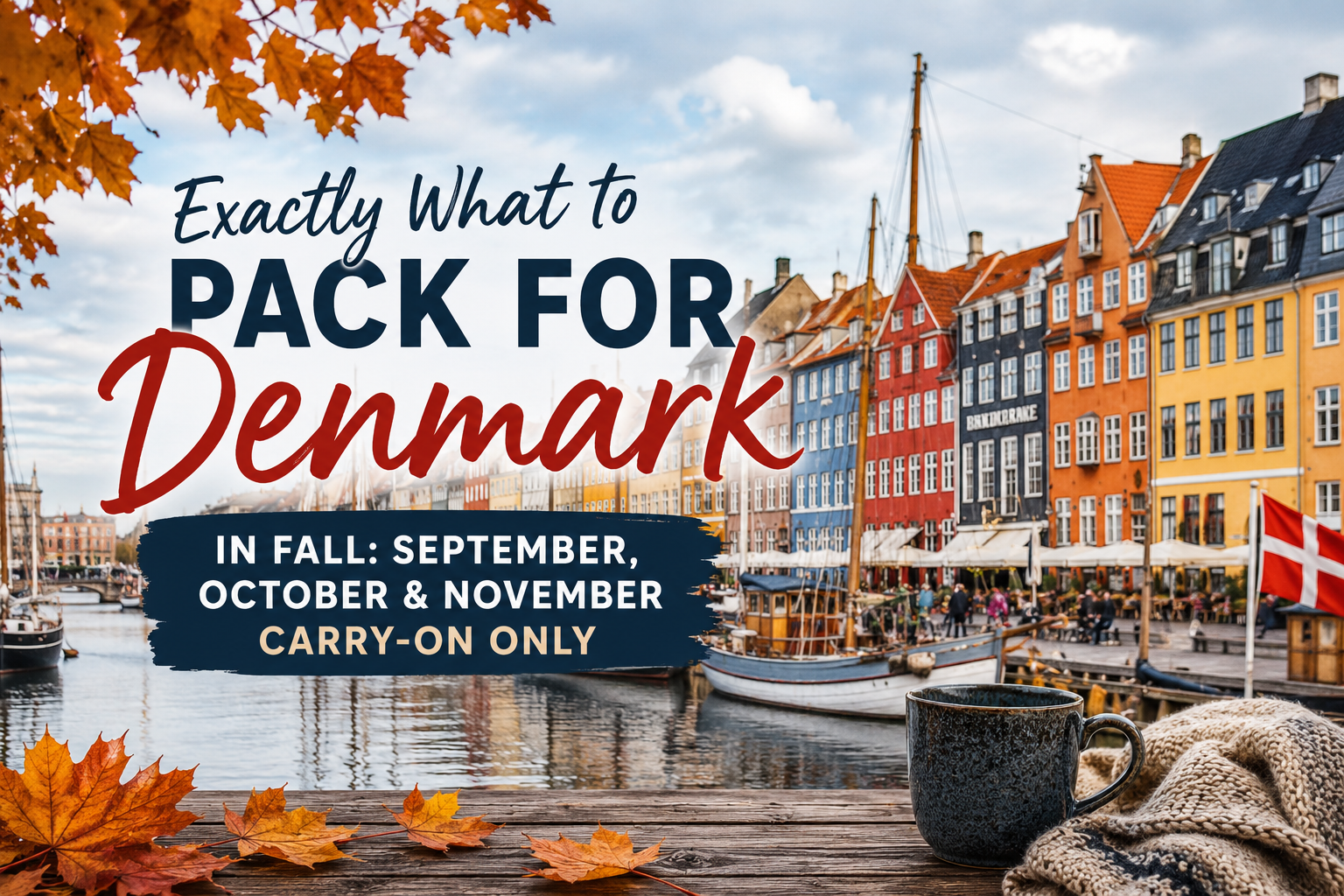
Colorful Copenhagen streets turn golden, Tivoli shifts into its cozy autumn atmosphere, coastal towns become quieter, and Denmark’s cafés suddenly feel even more inviting when the wind and rain roll in.
Fall is a beautiful time to visit Denmark, but September, October, and November do not require exactly the same suitcase.
September can still be pleasantly mild. October brings cooler temperatures, stronger winds, more layers, and plenty of damp days. By November, Denmark feels much closer to winter, particularly when cold wind comes off the water.
You do not need an enormous suitcase or three completely different wardrobes.
You need layers, dependable rain protection, comfortable walking shoes, and enough flexibility to adjust your clothing as the season gets colder.
This Denmark fall packing list is designed for travelers visiting during September, October, or November while still packing carry-on only.
What Denmark Is Like in Fall
Fall in Denmark generally starts mild and becomes increasingly chilly, wet, and windy as the season progresses.
September can still bring comfortable sightseeing weather, while October usually requires more consistent layering. By November, colder temperatures, shorter daylight hours, wind, and damp weather make a warmer jacket and cold-weather accessories much more useful.
Denmark’s coastal location also means the wind can make temperatures feel colder than the forecast suggests, especially around Copenhagen’s waterfront, Skagen, Bornholm, ferries, and other exposed coastal areas.
Rain is possible throughout fall, so a wind-resistant rain jacket and comfortable shoes that can handle wet sidewalks and cobblestones are especially useful.
Planning your itinerary too? See my guide to the best places to visit in Denmark, including Copenhagen, Aarhus, Odense, Skagen, Bornholm, and more.

Who This Denmark Fall Packing List Is For
This packing list is for travelers visiting Denmark in September, October, or November who want to travel with a carry-on + personal item without feeling underpacked.
It works especially well if:
- Fall travel: September, October, and November
- Carry-on + personal item only
- You are traveling for approximately two weeks
- You are comfortable repeating outfits
- You are willing to do light laundry
- You may visit Copenhagen, Aarhus, Odense, Aalborg, Skagen, Bornholm, or several Danish destinations
- You expect cool weather, rain, wind, and changing temperatures
- You plan to spend time sightseeing outdoors as well as inside museums, cafés, restaurants, shops, and attractions
- You expect to walk extensively
- You want practical clothing that works for sightseeing, transportation days, casual evenings, and changing weather
The listed clothing quantities are suitable for approximately two weeks of travel with light laundry.
They can also work for trips of up to about a month when you do laundry regularly and repeat outfits.
Travelers planning serious hiking, cycling tours, camping, sailing, or other specialized outdoor activities will need additional activity-specific gear.
Universal Essentials
Travel Documents and Money

- Passport
- Visa or entry documents required for your nationality and travel dates
- Digital and printed copies of your passport
- Digital and printed copies of any visa or entry approval
- Wallet
- Credit and debit cards
- Danish kroner
- International driver’s permit if required
- Travel insurance information
- Flight confirmations
- Hotel confirmations
- Train, ferry, transfer, rental car, or tour confirmations
- Reservation screenshots available offline
- Hotel names, addresses, and phone numbers saved offline
- Prescription medication list
- Emergency contact information
- Writing pen for travel forms or other paperwork
Denmark is extremely card-friendly, so travelers generally do not need to carry much cash.
A small amount of Danish kroner can still be useful as backup.
Keep your passport, medications, valuables, essential travel documents, and one complete change of clothing in your personal item during flights and longer transportation days.
Luggage and Organization

- Carry-on suitcase
- Personal item that fits beneath the airplane seat
- Compression packing cubes
- Small jewelry or accessory organizer
- Reusable shopping bag
- Luggage tag
- Wet bag for damp or messy items
- Lightweight shoe bags
- Small zippered pouch for tickets, receipts, and loose travel documents
A wet bag is particularly useful during a Danish fall trip.
It gives you somewhere to put a damp umbrella, rain jacket, swimsuit, or clothing caught in the rain without soaking everything else in your bag.
Leave a little empty space in your suitcase for purchases rather than starting your trip with an overstuffed carry-on.
Tech & Power
Denmark commonly uses Type C, E, F, and K outlets with 230V electricity and a 50Hz frequency.
Most modern phones, tablets, laptops, cameras, power banks, and chargers are dual voltage, but always check the label for 100–240V before plugging anything in.
A plug adapter changes the shape of your plug.
It does not change voltage.

Pack:
- Universal power adapter
- Multi-port USB charger
- Camera
- Portable power bank
- Travel Power Strip
- Extra charger cables
- Earbuds or headphones for planes, trains, and long transit days
- Tech Organizer Case
- Cell Phone (set up an international plan with your provider before you go, or buy a SIM/eSIM for Sweden)
- If you’re packing single-voltage electronics like heating pads, hair styling tools, or an electric kettle you’ll need a step-down voltage converter if you’re traveling from a lower voltage country
- Optional: Laptop or Chromebook or Tablet (for work if you must and/or easy entertainment in your own language)
- Optional: Kindle or other e-reader (not sure if Kindle is good for you? Check out my full article about how it’s a perfect travel companion)
Read my complete Denmark plug, outlet, adapter, and voltage guide before bringing appliances from a lower-voltage country.
A power bank is useful during long sightseeing days when your phone is handling maps, transportation information, tickets, reservations, photos, restaurant searches, and changing plans.
Cooler weather can also reduce battery performance, making backup power even more useful later in fall.
Toiletries & Health
Pack the toiletries and medications you already use rather than assuming you will easily find your preferred brand or formula after arrival.

- Shampoo + Conditioner + Hair masks and /or Olaplex (these are easiest transported in cadence capsules or as solids)
- Toothbrush + toothpaste + mouthwash + floss (travel solids are easiest for these I still pack them in cadence capsules) It’s also a good idea to bring a couple of on the go toothbrushes for long travel days/flights and/or day trips to stay feeling fresh
- Body wash and face wash as well as any other regularly used shower/bath accessories like salt scrubs, bath soaks, and mud in cadence capsules
- Skincare basics for body, hands, face, and feet as well as any daily facial routines like anti-aging serums in cadence capsules
- Deodorant (body deodorant is also recommended for long flights)
- Disposable shavers are easiest to use and leave behind instead of repacking, but be sure to bring at least 1 shaver
- Personal medications with labels
- Pain relievers and any other common OTC medications you use like ant-acids, anti-diarrhea and/or constipation relief, allergy pills, and common cold medicine
- Deep blue, salon-pas, and lidocaine patches are always helpful for unexpected pain from excessive walking, sitting or other activities done while traveling and especially helpful if you’re traveling with older ones
- Blister prevention (bandages or blister pads) and a simple first aid kit
- Sunscreen
- Lip balm
- After-sun lotion
- Hand sanitizer
- Compact wet wipes
- Toiletry Case
- Feminine products, even if you only might need them
- Electrolyte packets
Wind, cool air, and indoor heating can dry your lips and hands much faster than expected.
Lip balm and hand cream are especially useful later in the season.
Bring enough of any medication or personal-care product you rely on regularly.
Laundry Kit

Pack:
- Travel-size laundry detergent sheets or liquid in a cadence capsule
- Sink stopper (optional, but helpful in older hotels) or mini travel washer
- A few clothespins or a lightweight travel clothesline
- Clothes refresher spray can be used daily to refresh your clothing between washes
- Small stain-removal pen or wipes
- Separate wet bag for damp clothing or swimsuits
What Makes Laundry Easier
- Quick-dry fabrics
- Lightweight layers
- Clothing that works across several temperatures
- Pieces you can comfortably rewear
- Clothing that mixes together
- Darker pieces for transportation days
- Wrinkle-friendly fabrics
- Washing small loads before everything becomes dirty
- Booking accommodation with laundry access at least once during a longer trip
Clothing may take longer to air-dry during Denmark’s cool, damp fall weather.
Heavy jeans, thick cotton sweatshirts, and bulky sweaters are therefore less convenient if you are relying on sink washing.
Wash smaller loads and give them plenty of time to dry.
Day Bag Essentials

- Lightweight backpack or secure crossbody bag
- Reusable water bottle
- Compact umbrella
- Packable tote
- Small snack
- Power bank
- Tissues or handkerchief
- Wet wipes
- Hand sanitizer
- Hand cream
- Lip balm
- Light sweater or cardigan
- Packable scarf
- Gloves and a hat
- Sunglasses
Move your power bank into your day bag each morning instead of leaving it inside your luggage.
Denmark sightseeing can involve waterfronts, canals, parks, castles, ferries, cobblestone streets, historic neighborhoods, outdoor attractions, coastal areas, museums, and days when returning to your hotel for another layer is inconvenient.
A compact umbrella is useful.
A wind-resistant rain jacket is often even more useful.
Clothing Packing Lists
Best Fabrics
- Cotton blends
- Modal
- Bamboo
- Lightweight merino wool
- Breathable travel fabrics
- Quick-dry fabrics
- Wrinkle-friendly fabrics
- Lightweight knits
- Thin fleece
- Water-resistant or waterproof outerwear
- Fabrics that layer comfortably without becoming bulky
Choose Carefully
- Heavy denim that takes a long time to dry
- Thick cotton sweatshirts
- Several bulky sweaters
- Oversized winter coats you do not actually need
- Suede shoes or bags when rain is expected
- Shoes with slippery soles
- Delicate clothing
- Pieces that only work with one outfit
- Clothing that is difficult to layer
- Shoes you have never worn before
Denmark fall packing is much easier when you think in layers.
September travelers can rely primarily on lightweight tops, a sweater, and rain protection.
October travelers need a more balanced combination of lighter clothing, sweaters, rain protection, and warmer layers.
November travelers should bring a genuinely warm jacket and cold-weather accessories.
Jump to the Packing List You Need
Women
Clothing

- 3 short-sleeve or lightweight tops
- 2 long-sleeve tops
- 1-2 pairs of comfortable pants, trousers, or jeans
- 1-2 lightweight skirt or additional pair of pants
- 1–2 versatile dresses
- 1 cardigan or lightweight sweater
- 1 warmer sweater or thin fleece
- 1 packable rain jacket
- 1 packable warm jacket for November
- 1 optional thin thermal base layer for late November
- 1–2 sleep sets or nightgowns
- 6–7 pairs of underwear
- 2 bras
- 4–5 pairs of socks
- 1 swimsuit
- 1 swimsuit cover-up
September: Favor lighter layers and keep the warm jacket optional depending on the forecast.
October: Keep both sweaters and dependable wind/rain protection.
November: Prioritize the warm jacket and cold-weather accessories. Tights or thermal leggings become much more useful with dresses and skirts.
Choose a coordinated color palette so your tops, bottoms, sweaters, jacket, and shoes can be mixed easily.
Shoes
- 1 pair of comfortable walking sneakers or supportive slip-on walking shoes
- 1 pair of comfortable closed-toe shoes, water-resistant ankle boots, or other supportive walking shoes
Your shoes should already be broken in.
Denmark can involve cobblestones, wet leaves, slick sidewalks, waterfront paths, ferry docks, parks, and rainy streets.
Traction matters.
Water resistance becomes increasingly useful as fall progresses.
Accessories
- Compact crossbody bag
- Travel make-up stack, eyeliner and mascara
- Makeup remover
- Regular facial skincare
- Small hair brush
- Hair ties or clips
- Simple jewelry
- Optional tights or thermal leggings for dresses and skirts
- Optional gloves and beanie for late November or mountain destinations
You do not need a complicated wardrobe.
You need pieces that work for walking, ferries, public transportation, cafés, restaurants, museums, castles, rain, wind, and changing temperatures.
Men
Clothing

- 3 breathable shirts
- 2 long-sleeve shirts
- 1 casual button-down shirt or overshirt
- 2 pairs of comfortable pants, jeans, or travel trousers
- 1 light sweater, hoodie, or pullover
- 1 warmer sweater or fleece
- 1 packable rain jacket
- 1 packable warm jacket for November or colder destinations
- 1 optional thin thermal base layer for late November
- 1–2 sleep sets
- 6–7 pairs of underwear
- 5–6 pairs of socks
- 1 pair of swim trunks
September travelers may prefer an additional lightweight shirt rather than bringing the warmest layer.
October is when the sweater + rain jacket combination becomes particularly useful.
November travelers should prioritize warmth rather than packing extra lightweight shirts they are unlikely to wear alone.
Shoes
- 1 pair of comfortable walking sneakers
- 1 pair of clean casual walking shoes or water-resistant boots
Avoid packing several bulky pairs of shoes.
Wear the heavier pair while traveling and pack the lighter pair.
Accessories
Choose shirts, trousers, and layers that work together rather than creating completely separate outfits for every activity.
Girls
Clothing

- 2–3 short-sleeve tops
- 2–3 long-sleeve tops
- 2–3 pairs of pants, leggings, or comfortable bottoms
- 1 skirt or dress, optional
- 1 cardigan, sweater, or hoodie
- 1 warmer layer for October or November
- 1 packable rain jacket
- 1–2 sleep sets
- 6–7 pairs of underwear
- 5–6 pairs of socks
- 1 swimsuit
- Optional tights or thermal leggings
For younger children, consider adding one additional top because spills and messy meals can make rewearing clothing less realistic.
September travelers can favor lighter layers.
November travelers should prioritize warmth.
Shoes
- 1 pair of comfortable walking sneakers
- 1 pair of lightweight backup shoes or water-resistant walking shoes
Choose shoes with dependable grip for wet sidewalks and leaves.
Accessories
Keep rain and cold-weather accessories somewhere easy to reach rather than buried at the bottom of the suitcase.
Boys
Clothing

- 2–3 short-sleeve tops
- 2–3 long-sleeve tops
- 2–3 pairs of pants or joggers
- 1 light sweater or hoodie
- 1 warmer layer for October or November
- 1 packable rain jacket
- 1–2 sleep sets
- 6–7 pairs of underwear
- 5–6 pairs of socks
- 1 pair of swim trunks
- Optional thin thermal layer
Pack one additional top for younger children if you expect spills, messy meals, or outdoor play.
November requires considerably more warmth than September.
Shoes
- 1 pair of comfortable walking sneakers
- 1 pair of lightweight backup shoes or water-resistant walking shoes
Shoes should be comfortable enough for full sightseeing days and have reliable traction.
Accessories
Things Nobody Tells You About Denmark in Fall

The Wind Changes Everything
This may be the single most important thing to understand when packing for Denmark in fall.
A temperature in the 50s°F does not sound particularly cold.
Spend several hours beside Copenhagen Harbor, along the coast, on a ferry, or walking through an exposed area on a windy day and it can feel considerably colder.
A wind-resistant outer layer is often more useful than adding another enormous sweater.
Your Umbrella May Lose the Battle
A compact umbrella is worth carrying.
It is not always your best defense.
Wind can make umbrellas awkward or nearly useless, particularly along waterfronts and coastal areas.
A hooded rain jacket lets you keep sightseeing without spending half your day fighting with an umbrella.
Copenhagen Is a Walking City Even If Everyone Else Is Biking
Denmark is famous for bicycles, but visitors still tend to walk a lot.
You may spend entire days moving between neighborhoods, museums, canals, castles, parks, restaurants, shopping streets, and public transportation.
Comfortable shoes are not optional.
Neither is traction when the cobblestones and leaves are wet.
The Daylight Disappears Quickly
September still provides relatively comfortable sightseeing days.
By November, daylight becomes considerably shorter.
This matters if your plans include gardens, castles with outdoor grounds, scenic drives, coastal areas, photography, parks, or other attractions you particularly want to experience during daylight.
Denmark also switches back to standard time on the last Sunday in October, making late-October evenings suddenly feel darker.
Plan your most important outdoor activities earlier in the day later in fall.
Indoor Denmark Can Be Very Warm
Outside you may be wearing a sweater, scarf, and rain jacket.
Then you step inside a café, museum, restaurant, train, shop, or hotel and suddenly feel overheated.
This is exactly why layers are better than one gigantic sweater beneath one gigantic coat.
Wear pieces you can remove easily.
Wet Cobblestones and Leaves Can Be Slippery
Those golden fall streets are beautiful.
They can also become slick after rain.
Cobblestones, stone steps, leaves, wooden docks, and waterfront paths all become considerably less forgiving when wet.
Shoes with decent tread are worth prioritizing.
You May Still Want a Swimsuit
Packing a swimsuit beside sweaters and rain jackets can feel strange.
Bring one anyway.
Hotels with pools, spas, saunas, wellness facilities, and heated indoor swimming areas can make it surprisingly useful.
It takes almost no suitcase space and is much more annoying to need and not have.
Hygge Weather Is Real — But You Still Have to Get There

Cold, rainy Denmark can be incredibly cozy once you are sitting inside a candlelit café with something warm to drink.
Unfortunately, you still have to walk through the wind and rain to reach it.
Pack for the outdoor part of Denmark rather than assuming your entire fall trip will happen inside picturesque cafés.
The reward is that chilly Danish weather makes those cozy breaks feel even better.
Final Denmark Fall Packing Tips
The easiest way to pack for Denmark in fall is to think in layers instead of individual outfits.
Start with comfortable clothing you can wear repeatedly.
Add:
- A lightweight sweater
- A warmer mid-layer
- Dependable wind and rain protection
- Comfortable shoes with good traction
- Water resistance where possible
- A warmer jacket as the season progresses
- Gloves, a scarf, and a hat for colder weather
- Optional thermals for late November or unusually cold forecasts
September and November are noticeably different trips.
September may give you mild afternoons where a light sweater is enough.
By November, cold wind and damp weather can make you very glad you packed proper outerwear.
Check the forecast for the actual Danish destinations you are visiting shortly before departure and adjust the warmth of your layers accordingly.
For most travelers visiting Copenhagen, Aarhus, Odense, Aalborg, Skagen, Bornholm, or several destinations around Denmark, this list provides enough clothing for approximately two weeks while staying carry-on only.
With regular laundry and repeated outfits, it can easily stretch to a longer trip.
Pack for Denmark’s wind and changing temperatures rather than every imaginable possibility, leave a little extra space in your suitcase, and you will be ready for colorful Copenhagen streets, castles, coastal towns, golden parks, rainy afternoons, harbor walks, cozy cafés, and everything that makes Denmark especially inviting in fall.