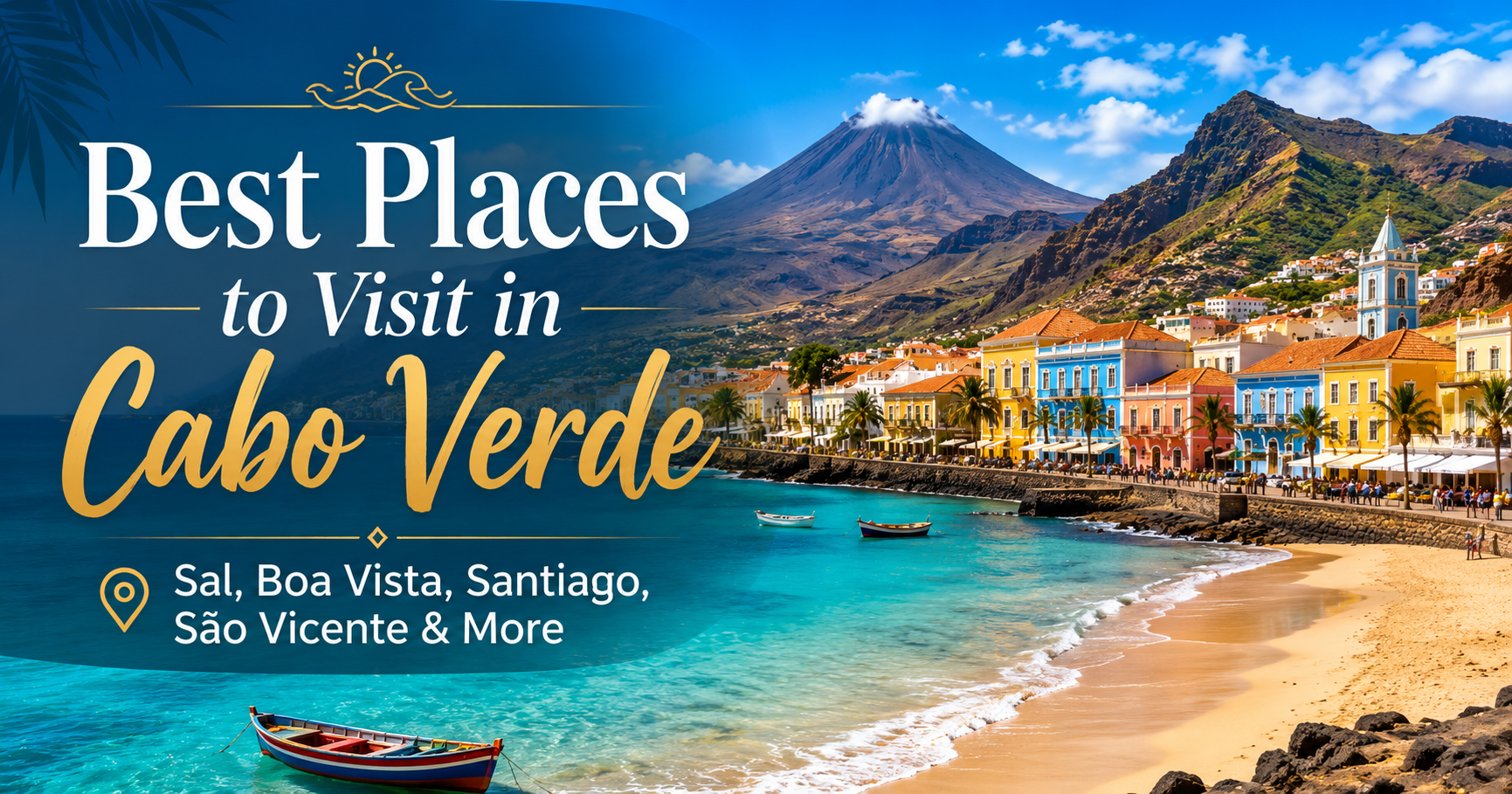
Golden beaches stretch for miles beside turquoise Atlantic water. Volcanic peaks rise above black lava fields. Colorful cities fill with music after sunset. Green valleys cut through mountains that look almost impossible to farm, while windswept dunes make other islands feel closer to the Sahara than a tropical beach destination.
Cabo Verde may be a relatively small island country, but choosing where to go is not as simple as picking whichever island has the prettiest beach.
Each island has a personality.
Sal is easy, sunny, beachy, and built for travelers who want a straightforward island vacation.
Boa Vista adds enormous beaches, dunes, wildlife, and a more spacious feel.
Santiago brings Praia, Cidade Velha, markets, mountains, history, and a much deeper look at everyday Cabo Verdean life.
São Vicente is the place for Mindelo, music, nightlife, art, and culture.
Santo Antão trades sandy resort beaches for some of the most dramatic mountain scenery in the country.
Fogo gives you an active volcano, lava landscapes, vineyards, villages, and one of the most unusual places you can spend a few days anywhere in the Atlantic.
Then there are quieter islands including Maio, São Nicolau, and Brava for travelers willing to trade convenience for fewer visitors and a slower trip.
The goal is not to visit every island.
It is to figure out which Cabo Verde fits the vacation you actually want.

1. Sal
Best for: First-time visitors, beach vacations, couples, families, resort stays, watersports, and travelers who want an easy introduction to Cabo Verde.
Sal is the Cabo Verde many vacationers imagine before they arrive.
Wide beaches. Blue water. Sunshine. Resorts. Beach bars. Watersports. Restaurants within walking distance. Long afternoons where doing almost nothing is completely acceptable.
Santa Maria is the island’s main tourism center and the most practical base for most visitors. Its long beach provides plenty of room for swimming, sunbathing, waterfront meals, sailing, snorkeling, diving, and watersports.
But Sal is not only Santa Maria.
Travel inland and the island becomes increasingly dry, rocky, and almost lunar. Salt pans, volcanic landscapes, natural pools, desert-like roads, and tiny settlements make it worth spending at least one day away from the resort areas.
Main Highlights
Santa Maria, Santa Maria Beach, Pedra de Lume salt crater, Buracona, the Blue Eye, Palmeira, Espargos, Kite Beach, Shark Bay, salt flats, snorkeling, diving, sailing, kitesurfing, windsurfing, beaches, seafood, and Atlantic sunsets.
Why I Recommend It
Sal is the easiest Cabo Verde island to recommend to someone who wants a vacation first and expedition second.
You can arrive, check into a comfortable hotel, walk to restaurants, spend days at the beach, book organized excursions when you want them, and have very little pressure to constantly figure out transportation or logistics.
That makes it particularly useful for families, couples, first-time visitors to Africa, shorter trips, and travelers who simply want winter sun without turning the vacation into a complicated island-hopping project.
It also works surprisingly well for active travelers because wind and water conditions have made Sal one of Cabo Verde’s major watersports destinations.
Don’t Miss
- Santa Maria Beach — the classic Sal experience, with a long stretch of sand, water activities, restaurants, and plenty of space to simply settle in for the day.
- Pedra de Lume — explore the old saltworks inside a volcanic crater and see a completely different side of the island.
- Buracona and the Blue Eye — visit the rocky coastline and natural pool area when sea conditions allow.
- Kite Beach — particularly interesting for travelers who want to watch or participate in kiteboarding.
- Palmeira — a small port town that offers a contrast to resort-centered Santa Maria.
- A full-island tour — Sal is compact enough that seeing several of its major landscapes in one day is realistic.
- Get on the water — snorkeling, sailing, diving, fishing, and other boat excursions are a major part of a Sal trip.
Good to Know
- Sal is dry and often windy.
- Do not arrive expecting a lush tropical island filled with rainforests and palms.
- The beauty here is much more elemental: sand, salt, lava, ocean, wide skies, and almost desert-like terrain.
- Swimming conditions can also vary considerably between beaches and from one day to another. Respect flags and local advice rather than assuming every beautiful stretch of Atlantic water is automatically calm.
- If your idea of Cabo Verde is primarily beach + resort + easy excursions, Sal should probably be at the top of your list.
2. Boa Vista

Best for: Huge beaches, quieter resort stays, dunes, wildlife, couples, photographers, watersports, and travelers who want more open space.
Boa Vista competes directly with Sal for Cabo Verde’s beach-vacation crown, but the two islands do not feel exactly the same.
Boa Vista is bigger, more spread out, and often feels emptier.
Long roads cross dry landscapes. Sand dunes roll across the interior. Enormous beaches stretch far beyond the developed areas, and some excursions require 4×4 vehicles rather than a quick taxi ride from town.
Sal Rei is the island’s main town and gives travelers a glimpse of everyday island life beyond the large resort properties.
Then there is the coast.
Santa Mónica Beach alone seems to stretch almost endlessly, while other beaches around Boa Vista are connected with surfing, windsurfing, kiteboarding, fishing, and important marine wildlife.
Main Highlights
Sal Rei, Santa Mónica Beach, Deserto de Viana, Praia de Chaves, Varandinha, Cabo Santa Maria shipwreck area, João Barrosa, turtle conservation areas, 4×4 island tours, sand dunes, snorkeling, diving, watersports, whale-watching opportunities, beaches, and dramatic Atlantic scenery.
Why I Recommend It
Boa Vista gives beach travelers more than a row of resorts facing the ocean.
The island itself becomes part of the adventure.
One morning might involve crossing pale dunes in a 4×4.
Another could be spent on an enormous beach with surprisingly few people around you.
Another may involve a wildlife excursion, small-town wandering in Sal Rei, snorkeling, sailing, or watching the coastline change from white sand to rock.
It works especially well for couples and travelers who want a resort vacation but still want the landscape outside the hotel to feel wild.
Don’t Miss
- Santa Mónica Beach — one of the island’s signature stretches of white sand.
- Deserto de Viana — sweeping dunes give the interior of Boa Vista a completely different personality from its beaches.
- Sal Rei — spend some time outside the resort environment exploring the island’s principal town.
- A 4×4 island excursion — many of Boa Vista’s most memorable landscapes are easier to reach with appropriate transportation.
- Marine wildlife experiences — seasonal turtle and whale experiences can be extraordinary when conditions and timing are right.
- The wilder coastline — do not assume the beach directly outside your hotel represents the entire island.
Good to Know
- Distances matter more here than they do on Sal.
- A destination that looks close on a map may involve rough roads or slow travel.
- Wildlife experiences are seasonal. Never book a turtle or whale excursion based solely on a beautiful advertising photo without checking whether your travel dates actually align with the activity.
- Turtle nesting beaches also need to be treated as wildlife habitat rather than nighttime entertainment. Choose responsible excursions and follow rules about lights, noise, distance, and photography.
- Choose Boa Vista over Sal when you want more wilderness, more dunes, bigger empty spaces, and a beach trip that feels slightly less compact.
3. Santiago — Praia, Cidade Velha & Tarrafal

Best for: History, culture, food, markets, local life, road trips, travelers who want more than a resort vacation, and first-time visitors interested in understanding Cabo Verde.
Santiago is Cabo Verde’s largest island and home to Praia, the national capital.
It is also one of the best choices for travelers who want the country to feel like a country rather than simply an island resort destination.
Praia brings restaurants, markets, government buildings, neighborhoods, nightlife, museums, beaches, and the everyday rhythm of Cabo Verde’s largest urban center.
Just outside the capital, Cidade Velha introduces an entirely different layer of history.
Farther into the island, mountain roads lead through settlements and changing landscapes before eventually reaching Tarrafal and the northern coast.
That makes Santiago one of Cabo Verde’s most complete islands.
Main Highlights
Praia, Plateau, Sucupira Market, Quebra Canela, Cidade Velha, Ribeira Grande de Santiago, Fortaleza Real de São Filipe, Serra Malagueta, Assomada, Tarrafal, mountain scenery, markets, music, beaches, historic sites, restaurants, and island road trips.
Why I Recommend It
Santiago gives context to everything else.
A traveler who visits only an all-inclusive resort on Sal or Boa Vista can have a wonderful vacation, but they will experience a very specific side of Cabo Verde.
Santiago exposes you to urban life, history, mountain communities, markets, restaurants, beaches, music, agriculture, and dramatic changes in landscape within a single island.
You can spend one day exploring Praia, another in Cidade Velha, another crossing the interior, and another relaxing near Tarrafal.
For culturally curious travelers, Santiago may actually be a better first island than Sal.
Don’t Miss
- Cidade Velha — one of the country’s essential historic destinations and an easy addition to a Praia stay.
- Praia’s Plateau — explore the central area rather than treating the capital exclusively as an airport stop.
- Local markets — Santiago gives travelers excellent opportunities to experience Cabo Verde beyond tourism-focused shopping.
- Serra Malagueta — a dramatic contrast to the drier coastal landscapes.
- Tarrafal — combine northern scenery and beaches with the journey across the island.
- Cabo Verdean food — look for cachupa, grilled fish and seafood, stews, local produce, pastries, and other island specialties.
Good to Know
- Santiago is larger than Sal, and exploring it properly takes time.
- Do not plan Praia, Cidade Velha, the mountain interior, and Tarrafal as though everything sits twenty minutes apart.
- This is an island where hiring a driver, joining an organized excursion, or carefully planning transportation can dramatically improve the experience.
- Praia also feels like a real working capital rather than a purpose-built resort town.
- That is exactly why I recommend it.
- Come expecting daily life, traffic, markets, businesses, neighborhoods, nightlife, and people going about their ordinary routines.
4. São Vicente & Mindelo

Best for: Music, nightlife, art, culture, food, city breaks, Carnival travelers, and anyone pairing São Vicente with Santo Antão.
If Cabo Verde has a cultural city that travelers fall unexpectedly in love with, it is Mindelo.
Set around Porto Grande on São Vicente, Mindelo is colorful, musical, social, and distinctly different from the resort centers of Sal and Boa Vista.
This is the island for evenings that begin with dinner and somehow turn into live music.
It is the island associated with morna, artists, musicians, festivals, cafés, waterfront walks, and a cultural life that feels much larger than São Vicente’s physical size.
The surrounding island is rugged and relatively dry, with beaches and mountain viewpoints providing an easy escape from the city.
Main Highlights
Mindelo, Porto Grande, Laginha Beach, Rua de Lisboa, Praça Nova, markets, live music, morna, cafés, nightlife, Monte Verde, Baía das Gatas, São Pedro, beaches, art, Carnival, and ferry access to Santo Antão.
Why I Recommend It
Mindelo fills a gap in a Cabo Verde itinerary that beaches and mountains cannot.
It gives you city energy without a huge city.
You can wander through markets and colorful streets during the day, swim at Laginha Beach, eat near the waterfront, watch ferries and ships move through the harbor, and then hear live music after dark.
It also serves as the natural partner to Santo Antão.
That combination may be the strongest multi-island pairing in Cabo Verde for travelers who want culture and adventure rather than an all-inclusive beach vacation.
Don’t Miss
- Live music in Mindelo — make room for evenings rather than scheduling every day from sunrise to bedtime.
- Laginha Beach — a city beach that makes it easy to mix sightseeing and swimming.
- Mindelo’s markets and streets — this is an island where wandering is part of the experience.
- Monte Verde — head upward for broad views across São Vicente when weather conditions cooperate.
- Baía das Gatas — combine coastal scenery with another side of island life.
- A Santo Antão extension — one of the best reasons to choose São Vicente in the first place.
Good to Know
- São Vicente is not the place I would choose if your primary goal is to disappear into a giant beachfront resort for a week.
- It is better for travelers who enjoy being around restaurants, music, streets, markets, local businesses, and nightlife.
- It is also wind-exposed, like much of Cabo Verde.
- If you plan to continue to Santo Antão, give the pairing enough time. Trying to see Mindelo and do one hurried day trip across Santo Antão misses much of what makes the combination special.
5. Santo Antão

Best for: Hiking, mountains, photography, active trips, nature, villages, dramatic road journeys, and travelers who do not need a conventional beach vacation.
Then Cabo Verde changes completely.
Santo Antão is mountainous, deeply cut by valleys, greener in many areas, and famous for walking routes connecting villages, ridges, agricultural areas, and astonishing viewpoints.
The scenery can feel almost absurdly dramatic.
Roads curl along mountainsides.
Terraced fields cling to steep slopes.
Villages sit beneath towering peaks.
Green valleys appear where travelers arriving from the drier islands may not expect them at all.
This is one of Cabo Verde’s great adventure islands.
Main Highlights
Paul Valley, Ribeira Grande, Ponta do Sol, Ribeira da Torre, Cova crater, mountain roads, coastal trails, terraced agriculture, sugarcane, coffee-growing areas, villages, hiking, viewpoints, photography, and traditional rural landscapes.
Why I Recommend It
Santo Antão destroys the idea that Cabo Verde is simply a beach destination.
A traveler could spend a week here without caring about a resort pool.
The attraction is the landscape itself.
Walk through valleys. Follow mountain trails. Stop in villages. Watch clouds change the light on enormous ridges. See crops growing on slopes that look far too steep to cultivate.
It is especially rewarding for travelers who like trips where the journey between two places becomes as memorable as either destination.
Don’t Miss
- Paul Valley — one of the island’s signature landscapes.
- Cova — a volcanic crater area connected with some of Santo Antão’s best-known walking routes.
- Ponta do Sol — a useful northern base with access to remarkable coastal scenery.
- Ribeira Grande — another practical base for exploring the northern valleys.
- Mountain drives — even travelers who cannot complete demanding hikes can experience extraordinary scenery by road.
- Local agricultural landscapes — sugarcane, fruit, coffee, and terraced farms are part of Santo Antão’s identity.
Good to Know
- Santo Antão requires more physical consideration than Sal or Boa Vista.
- Some of the island’s famous experiences involve steep trails, uneven surfaces, significant elevation changes, and long walks.
- Travelers with lower mobility can still enjoy parts of the island, but transportation and accommodation should be chosen carefully.
- Santo Antão is generally reached from São Vicente by ferry, which is another reason the two islands work so naturally together.
- If hiking is one of the main reasons you are coming to Cabo Verde, do not squeeze Santo Antão into one rushed day.
- Stay.
6. Fogo — São Filipe & Chã das Caldeiras

Best for: Volcanoes, unusual landscapes, hiking, photography, wine, coffee, geology, adventure, and travelers who want somewhere dramatically different.
Fogo means fire.
That should tell you something.
The island is dominated by Pico do Fogo, the highest point in Cabo Verde and the country’s active volcano.
Around it, black lava fields spread across the caldera. Villages sit within volcanic landscapes. Grapes grow in mineral-rich soil. Coffee thrives elsewhere on the island. São Filipe adds colorful architecture and Atlantic views.
Fogo does not feel like Sal.
It does not feel like Boa Vista.
It does not really feel like anywhere else in Cabo Verde.
Main Highlights
Pico do Fogo, Chã das Caldeiras, volcanic crater landscapes, lava fields, São Filipe, historic architecture, vineyards, local wine, coffee, hiking, mountain scenery, villages, photography, and black volcanic landscapes.
Why I Recommend It
Fogo gives travelers the kind of experience that can become the story they tell first when someone asks about Cabo Verde.
You are not simply looking at a volcano from a distant viewpoint.
The volcano has shaped the island’s roads, villages, agriculture, architecture, economy, and history.
Spending time around Chã das Caldeiras makes the landscape feel immediate.
Add São Filipe, local food, wine, coffee, mountain drives, and hiking, and Fogo becomes one of the country’s strongest destinations for travelers who care more about experience than resort convenience.
Don’t Miss
- Chã das Caldeiras — stay long enough to appreciate the scale of the volcanic landscape.
- Pico do Fogo — experienced hikers can investigate guided summit opportunities when conditions permit.
- Local wine — grapes grown in volcanic terrain are part of Fogo’s distinctive agricultural story.
- Coffee — another side of the island’s volcanic agriculture.
- São Filipe — give the island’s principal town its own time rather than treating it purely as transportation to the volcano.
- Sunrise and sunset in the caldera — changing light can completely transform the lava landscape.
Good to Know
- Pico do Fogo is an active volcano.
- Its most recent eruption was in 2014–2015, dramatically affecting communities within the caldera.
- Conditions, access, and hiking arrangements should therefore always be checked when planning the actual trip.
- Summit hiking is also not a casual stroll.
- Altitude, steep terrain, loose volcanic material, sun exposure, wind, and physical exertion all matter.
- Travelers who do not want to climb Pico do Fogo can still have an extraordinary visit. Simply spending time inside the caldera and exploring the surrounding island provides an experience unlike anywhere else in Cabo Verde.
Other Cabo Verde Islands Worth Considering
The six destinations above are where I would start for most first-time trips.
But Cabo Verde still has several inhabited islands that deserve attention from travelers looking beyond the obvious route.
Maio
Choose Maio when your dream vacation involves quiet beaches and very few distractions.
The island is flatter, drier, and far less developed for tourism than Sal or Boa Vista.
That is the point.
Come for uncrowded beaches, slow days, small communities, nature, and the feeling that you have deliberately stepped away from Cabo Verde’s larger tourism centers.
Maio makes the most sense for travelers who are comfortable with simpler infrastructure and who do not need a packed list of attractions.
São Nicolau

São Nicolau deserves a look from hikers and travelers who enjoy remote mountain landscapes but want somewhere less famous than Santo Antão.
Rugged peaks, valleys, villages, agricultural areas, coastlines, and walking routes give the island enormous visual variety.
It is a destination to choose intentionally rather than tack onto an already overloaded itinerary.
Come because you want São Nicolau itself.
Brava
Small, mountainous, green in places, floral, quiet, and comparatively difficult to reach, Brava rewards travelers willing to add extra logistics.
This is not the island for someone trying to collect Cabo Verde’s greatest hits in seven days.
It works better for slower travelers who enjoy villages, walking, scenery, local life, and places where tourism has not overwhelmed the rhythm of the island.
Brava pairs most naturally with Fogo for travelers building a longer southern-island itinerary.
Which Cabo Verde Island Should You Choose?
Choose Sal for the easiest first visit, resorts, long beaches, watersports, Santa Maria, and simple vacation logistics.
Choose Boa Vista for enormous beaches, dunes, wildlife, 4×4 adventures, and a quieter, more spacious resort experience.
Choose Santiago for Praia, Cidade Velha, history, markets, food, mountains, local life, road trips, and the most complete cultural introduction.
Choose São Vicente for Mindelo, music, nightlife, art, cafés, city life, beaches, and an easy pairing with Santo Antão.
Choose Santo Antão for hiking, mountains, valleys, villages, photography, and one of Cabo Verde’s most dramatic landscapes.
Choose Fogo for volcanoes, lava fields, vineyards, coffee, adventure, unusual scenery, and a destination that feels completely different from the beach islands.
Choose Maio for peaceful beaches and very few crowds.
Choose São Nicolau for remote hiking and mountain scenery.
Choose Brava for a slow, secluded island experience that rewards travelers willing to work a little harder to reach it.
How Many Cabo Verde Islands Should You Visit?
This is where it is very easy to become overambitious.
Cabo Verde looks small on a world map.
That does not mean changing islands is the same as changing neighborhoods.
Flights and ferries connect much of the archipelago, but schedules, routes, weather, and sea conditions can affect an island-hopping itinerary.
Build breathing room into the trip.
For about one week, choose one primary island or a very natural two-island combination.
Sal or Boa Vista can easily fill a relaxed week.
Santiago can fill a week for travelers who want culture and road trips.
São Vicente plus Santo Antão is particularly logical when you want both culture and hiking.
For 10 to 14 days, two or three islands can create a much more interesting contrast.
Think:
Sal + Santiago
for beaches followed by culture and history.
São Vicente + Santo Antão
for music, city life, mountains, and hiking.
Santiago + Fogo
for history, daily life, volcanoes, and dramatic landscapes.
For two to three weeks, a more ambitious island-hopping itinerary becomes realistic, but resist the temptation to change hotels every other night.
Cabo Verde rewards travelers who actually spend time on the islands.
Short Packing List for Cabo Verde
Cabo Verde trips can involve strong sun, wind, salt water, sand, ferries, boat excursions, hiking, volcanic terrain, beaches, dry air, long driving days, and areas where replacing forgotten specialty items may not be easy.

A few particularly useful things to bring include:
- High-protection sunscreen
- SPF lip balm
- Sunglasses
- Sun hat
- Reusable water bottle
- Electrolyte packets
- Small day bag
- Portable phone charger
- Dry bag or waterproof phone pouch
- Lightweight travel towel
- Motion-sickness medication if you are prone to seasickness
- Basic first-aid supplies
- Hand sanitizer or sanitizing wipes
- Wet wipes
- Tissues or handkerchiefs
- Small cash pouch
- Snorkeling gear if you strongly prefer using your own
- Hiking poles for appropriate Santo Antão or Fogo routes
- Windproof layer for exposed boat trips, mountain areas, and breezy evenings
Keep medication, travel documents, electronics, cash, and anything else that cannot get wet protected during ferry and boat journeys.
Final Thoughts: Where Should You Go in Cabo Verde?
Cabo Verde is not one island vacation repeated ten times.
That is what makes it interesting.
You can spend a week walking from your hotel to Santa Maria Beach on Sal and have exactly the easy Atlantic vacation you wanted.
You can cross Boa Vista in a 4×4 and watch dunes meet the ocean.
You can eat in Praia, walk through centuries of history in Cidade Velha, cross the mountains of Santiago, and finish near the beach in Tarrafal.
You can spend the evening listening to music in Mindelo and wake up the next morning heading toward the valleys of Santo Antão.
You can stand inside the enormous volcanic landscape of Fogo and wonder how this is part of the same country as Sal’s pale beaches.
That contrast is Cabo Verde’s greatest strength.
For a first beach-focused trip, I would choose Sal or Boa Vista.
For a first culture-focused trip, I would choose Santiago.
For the strongest two-island combination, I would choose São Vicente and Santo Antão.
For the most unusual adventure, I would choose Fogo.
And if you have enough time?
Combine two completely different islands.
Cabo Verde gets much more interesting the moment you realize the question is not simply “Should I go?”
It is:
“Which Cabo Verde do I want to experience first?”