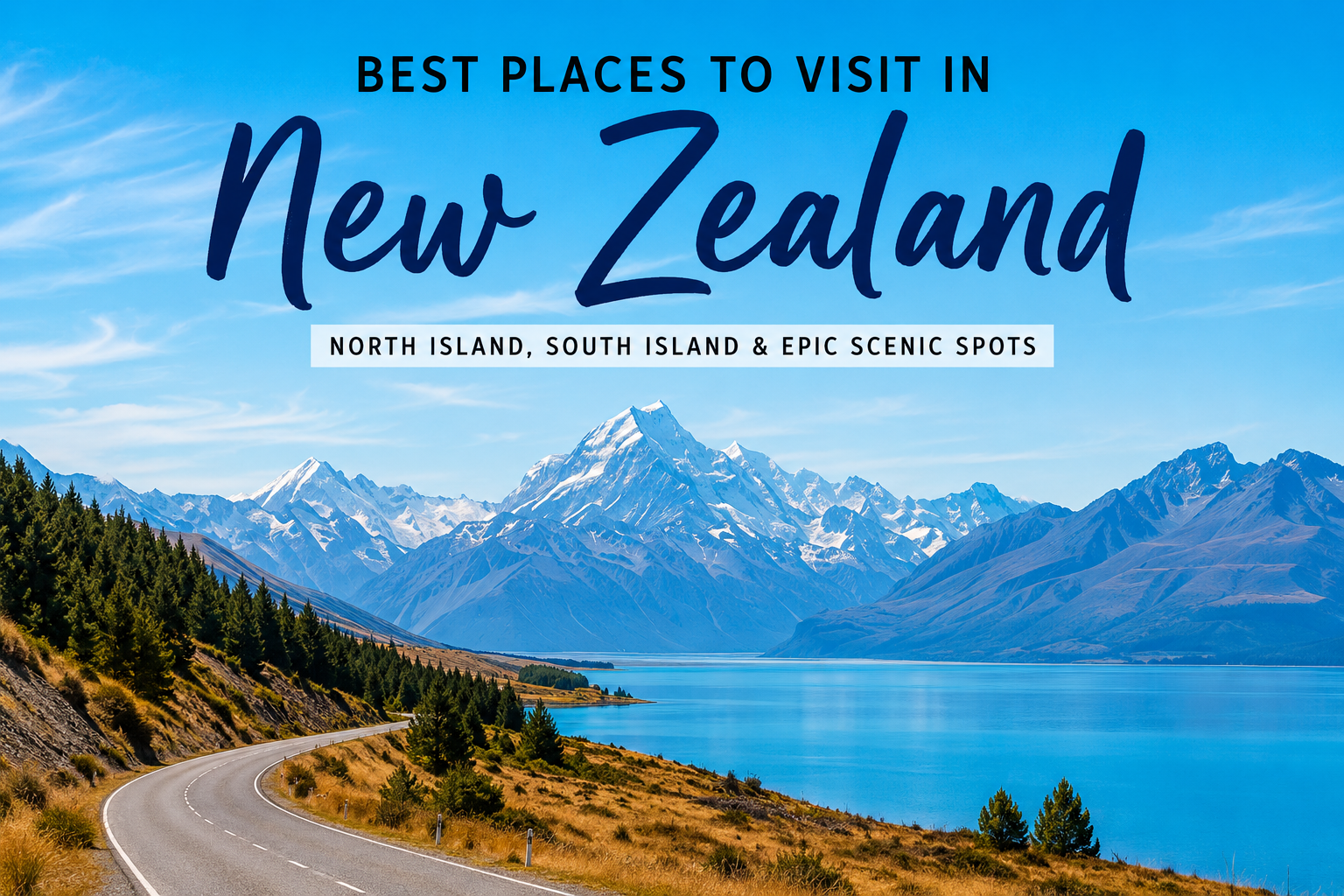
New Zealand is one of those places that almost feels unfairly beautiful. It has snow-covered mountains, glowworm caves, volcanic landscapes, fjords, beaches, wine islands, geothermal pools, rainforest roads, glacier valleys, turquoise lakes, Māori cultural sites, storybook movie locations, and little towns that feel like they exist purely to make travelers rethink what “scenic” means.
It is also a country where the landscape changes fast. One day can feel polished and urban in Auckland or Wellington, the next can feel steamy and ancient in Rotorua, and then suddenly you are standing in the South Island looking at mountains, lakes, and skies that feel too dramatic to be real. New Zealand rewards travelers who give it time, but it also gives even short trips something memorable: a fjord cruise, a wine day, a Hobbiton visit, a glacier valley, a beach walk, or a road trip that makes you stop the car every ten minutes.
If you are planning a New Zealand trip, these are some of the best places to visit — from the obvious dream stops to smaller scenic towns, Māori cultural centers, movie-famous landscapes, coastal escapes, and wild corners that make Aotearoa New Zealand feel so unforgettable.
As an Amazon Associate I earn from qualifying purchases. These are at no extra cost to you and help support my blog.
1. Queenstown

Region: southwestern South Island, inland Otago region, on Lake Wakatipu near the Southern Alps
What kind of place it is: mountain resort town, adventure capital, lakefront base, scenic road trip hub, and one of New Zealand’s most iconic travel stops
Best for: first New Zealand trips, couples, adventure travelers, friend trips, road trippers, lake views, mountain scenery, winter trips, and travelers who want dramatic South Island landscapes
Why travelers should care
Queenstown is one of the easiest places in New Zealand to fall in love with quickly. It sits on the edge of Lake Wakatipu with mountains rising all around it, so even a simple walk through town can feel cinematic. This is the New Zealand many travelers picture before they arrive: blue water, jagged peaks, crisp air, scenic drives, and a town built around the idea that the outdoors should be part of every day.
It is famous for adventure travel, but you do not have to bungee jump or throw yourself off anything to enjoy Queenstown. You can take lake cruises, ride the gondola, visit nearby wineries, walk by the water, take day trips to Glenorchy, or simply use it as a base for some of the South Island’s most beautiful scenery.
Main highlights
Queenstown’s biggest draws include Lake Wakatipu, the Skyline Gondola, mountain views, adventure activities, wineries in nearby Gibbston Valley, scenic drives to Glenorchy, lake cruises, winter skiing nearby, and easy access to some of the South Island’s most dramatic landscapes.
Historical points of interest
Queenstown grew during the Otago gold rush era, and that history still shows up in nearby Arrowtown, old mining landscapes, and heritage buildings. Today, it is better known as a modern adventure and resort town, but its setting has always been the real star: lake, mountains, and a sense of being tucked into one of the most beautiful corners of the South Island.
Don’t miss
- Lake Wakatipu — The long, deep lake that gives Queenstown its spectacular setting, with mountain reflections, waterfront walks, boat rides, and scenery that changes constantly with the weather.
- Skyline Queenstown — A gondola ride up to one of the best viewpoints over the town, lake, and surrounding mountains.
- Glenorchy — A small lakeside settlement reached by one of New Zealand’s most beautiful scenic drives, with mountain views and an “edge of the world” feeling.
- Arrowtown — A historic gold rush town with pretty streets, old cottages, cafés, and especially beautiful autumn scenery.
- Gibbston Valley wineries — A nearby wine area known for Pinot Noir, perfect if you want a slower day between adventure outings.
Why I recommend it
Queenstown is one of the best first stops in New Zealand because it delivers the dream quickly. Even if you only have a few days, the lake, mountains, food, wine, day trips, and scenery make it feel like a complete South Island experience.
Side notes / good to know
- Queenstown can be popular and busy, but the scenery is strong enough that it still feels worth it.
- It works beautifully in both winter and summer, with skiing in colder months and lake-and-hiking energy in warmer months.
- The Queenstown-to-Glenorchy drive is one of those drives where the journey is the point.
- Queenstown is also a natural base for day trips, but do not overpack every day. Some of the magic is just being there.
2. Milford Sound / Piopiotahi

Region: southwestern South Island, Fiordland National Park, on the remote west coast of Southland
What kind of place it is: fjord landscape, cruise destination, rainforest-and-mountain wonder, and one of New Zealand’s most famous natural landmarks
Best for: scenery lovers, photographers, cruise travelers, nature travelers, couples, bucket-list trips, and anyone who wants New Zealand at its most dramatic
Why travelers should care
Milford Sound / Piopiotahi is one of the most famous places in New Zealand for a reason. It is not just pretty scenery; it feels immense. Steep cliffs rise straight from dark water, waterfalls pour down the rock faces, mist moves through the mountains, and the whole place has a moody, almost mythic feeling.
Most travelers experience Milford Sound on a boat cruise, which is exactly the right way to see it. From the water, the scale finally makes sense. The cliffs feel taller, the waterfalls feel closer, and the fjord feels less like a place you are looking at and more like a place you are inside.
Main highlights
Milford Sound highlights include boat cruises, Mitre Peak, waterfalls, rainforest, dramatic cliffs, wildlife sightings, the Milford Road, scenic flights, and the wider Fiordland National Park landscape.
Historical points of interest
Milford Sound / Piopiotahi is part of Fiordland National Park and the larger Te Wāhipounamu UNESCO World Heritage area. The Māori name Piopiotahi is tied to cultural stories connected to the landscape, while the European name Milford Sound came later. Even though it is commonly called a sound, it is actually a fjord carved by glaciers.
Don’t miss
- A Milford Sound cruise — The classic way to experience the fjord, with close views of cliffs, waterfalls, rainforest, and the water itself.
- Mitre Peak — The iconic mountain shape most travelers associate with Milford Sound, rising sharply from the water.
- The Milford Road — A spectacular drive with mountain valleys, waterfalls, mirror lakes, and frequent reasons to stop.
- Waterfalls after rain — Rain is common in Fiordland, but it can make Milford even more dramatic by creating temporary waterfalls down the cliff faces.
- Scenic flight options — A splurge, but one of the most memorable ways to understand the scale of Fiordland.
Why I recommend it
Milford Sound is one of New Zealand’s true bucket-list places. It is famous, yes, but it still feels powerful in person. The cliffs, water, rain, mist, waterfalls, and silence give it a kind of grandeur that photographs cannot fully explain.
Side notes / good to know
- Milford Sound can be visited from Queenstown, but it is a long day. Te Anau is a much easier base.
- Rain does not ruin Milford Sound. In many ways, it makes the waterfalls and atmosphere better.
- This is one of the best places in New Zealand for travelers who want scenery without needing a difficult hike.
- Cruise travelers may see Fiordland scenic cruising on some New Zealand itineraries, but a small-boat day cruise gives a very different experience.
3. Rotorua

Region: central North Island, Bay of Plenty region, south of Tauranga and southeast of Auckland
What kind of place it is: geothermal city, Māori cultural center, spa destination, lake district, and one of the North Island’s most distinctive stops
Best for: Māori culture, geothermal landscapes, families, first New Zealand trips, spa days, unusual scenery, and travelers who want something beyond mountains and cities
Why travelers should care
Rotorua is one of the most important places to include if you want New Zealand to feel culturally and geologically layered. It is famous for geothermal activity — steaming vents, bubbling mud pools, hot springs, mineral terraces, and that unmistakable sulfur smell — but it is also one of the best-known places for travelers to experience Māori culture in a respectful, accessible way.
This is the stop that makes a North Island itinerary feel less generic. Rotorua has lakes, forests, cultural experiences, geothermal parks, and spa options, so it can be active, relaxing, educational, or family-friendly depending on how you plan it.
Main highlights
Rotorua highlights include geothermal parks, Māori cultural experiences, hot springs, mud pools, Lake Rotorua, the Redwoods / Whakarewarewa Forest, spa experiences, adventure activities, and nearby scenic lakes.
Historical points of interest
Rotorua has long been important for Māori culture and geothermal tourism. Visitors have traveled to the region for its hot springs and unusual landscapes for generations, and the area remains deeply connected to Māori identity, performance, food traditions, carving, storytelling, and the relationship between people and land.
Don’t miss
- A Māori cultural experience — One of the most meaningful ways to learn about traditions, performance, food, language, and local identity when done through a reputable experience.
- Geothermal parks — Places where you can see steaming ground, colorful mineral formations, bubbling mud, and landscapes that feel alive.
- Polynesian Spa or hot spring bathing — A relaxing way to connect with Rotorua’s geothermal identity.
- Whakarewarewa Forest / Redwoods — A beautiful forest area for walking, biking, and seeing a completely different side of Rotorua.
- Lake Rotorua — The city’s main lake, useful for views, gentle walks, and understanding the wider volcanic landscape.
Why I recommend it
Rotorua gives New Zealand a deeper sense of place. It is scenic, but not in the same way Queenstown or Milford Sound are scenic. It is earthy, steamy, cultural, unusual, and memorable in a way that helps travelers understand the North Island better.
Side notes / good to know
- Rotorua does have a sulfur smell in some areas. That is part of the geothermal reality, not a sign that something is wrong.
- This is one of the best New Zealand stops for families because the mix of nature, culture, and activity is strong.
- Rotorua pairs easily with Hobbiton, Waitomo, Taupō, and Auckland on a North Island route.
- Give yourself time here instead of treating it as a quick photo stop. The cultural and geothermal sides both deserve space.
4. Auckland

Region: northern North Island, Auckland region, between the Waitematā and Manukau harbors
What kind of place it is: harbor city, international arrival hub, island-and-city base, food destination, and practical starting point for many New Zealand trips
Best for: first arrivals, short stays, food lovers, island day trips, city breaks, families, cruise travelers, and travelers who want easy logistics before exploring farther
Why travelers should care
Auckland is often treated as just the place where travelers land, but it deserves more credit than that. It is a city of harbors, volcanic cones, neighborhoods, food, ferries, nearby islands, and waterfront views. It may not have the immediate mountain drama of Queenstown or the geothermal strangeness of Rotorua, but it is one of the easiest places to settle into New Zealand.
This is also a practical first stop. You can recover from a long flight, eat well, walk the waterfront, take a ferry to Waiheke Island, visit museums, or use Auckland as the launch point for the Bay of Islands, Hobbiton, Rotorua, or Waitomo.
Main highlights
Auckland highlights include the waterfront, Sky Tower, Auckland War Memorial Museum, Mount Eden / Maungawhau, Waiheke Island ferries, neighborhoods like Ponsonby and Britomart, harbor views, beaches, food, and nearby island escapes.
Historical points of interest
Auckland sits on a landscape shaped by volcanic cones and Māori history, with many sites holding cultural significance. It later became a major colonial and commercial center, and today it is New Zealand’s largest city, with a diverse population and strong Pacific influence.
Don’t miss
- Auckland waterfront — A good first-day area for walking, eating, and getting a sense of the city’s harbor setting.
- Mount Eden / Maungawhau — A volcanic cone with some of the best city views and a visible reminder of Auckland’s volcanic landscape.
- Auckland War Memorial Museum — A major museum for understanding New Zealand history, Māori culture, natural history, and the wider Pacific context.
- Waiheke Island ferry — One of the easiest and most rewarding day trips from Auckland, especially for wine, beaches, and scenery.
- Sky Tower — A landmark viewpoint that helps you understand Auckland’s size, harbors, and layout.
Why I recommend it
Auckland is useful and underrated. It makes arrivals easier, gives travelers a softer landing, and offers enough food, views, museums, and island access that it can be more than just a transit stop.
Side notes / good to know
- Auckland is especially helpful at the beginning or end of a trip because international flights often route through it.
- Do not judge New Zealand only by Auckland, but also do not skip Auckland automatically.
- Waiheke Island can make an Auckland stay feel more vacation-like very quickly.
- Cruise travelers may also find Auckland important because many New Zealand cruise itineraries begin, end, or stop here.
5. Hobbiton / Matamata

Region: central North Island, Waikato region, near Matamata between Auckland and Rotorua
What kind of place it is: movie-set destination, countryside stop, fantasy travel experience, and one of New Zealand’s most recognizable pop-culture landmarks
Best for: Lord of the Rings fans, families, couples, fantasy lovers, movie-location travelers, first New Zealand trips, and anyone who wants a charming themed stop
Why travelers should care
Hobbiton is one of those places that could have felt like a gimmick but somehow works beautifully. The rolling green hills, little hobbit holes, gardens, fences, pathways, and the Green Dragon Inn make the whole place feel lovingly preserved rather than slapped together for tourists.
Even if you are not a massive Lord of the Rings fan, Hobbiton can still be enjoyable because the setting is so charming. For fans, though, it is one of the most emotional movie-location stops in New Zealand. It is not just “where they filmed something.” It feels like stepping into a world people have loved for years.
Main highlights
Hobbiton highlights include guided movie-set tours, hobbit holes, Bag End views, gardens, the Green Dragon Inn, rolling Waikato countryside, and easy connections with Rotorua, Waitomo, or Auckland itineraries.
Historical points of interest
Hobbiton was created for The Lord of the Rings films and later rebuilt in more permanent detail for The Hobbit films. Its location near Matamata turned a quiet rural area into one of New Zealand’s most famous screen-tourism destinations.
Don’t miss
- The hobbit holes — The tiny doors, gardens, tools, and details that make the set feel lived-in and photograph beautifully.
- Bag End views — One of the most iconic parts of the set and a must for fans.
- The Green Dragon Inn — A themed stop that adds to the feeling of being inside the story rather than only looking at a set.
- The guided tour details — The stories behind the filming, set design, and hidden details help the experience feel richer.
- The countryside setting — The rolling Waikato landscape is a major part of why Hobbiton feels so convincing.
Why I recommend it
Hobbiton is one of New Zealand’s most joyful stops. It is polished, yes, but it is also genuinely charming, especially for travelers who grew up with the books or films.
Side notes / good to know
- Hobbiton is a guided experience, so book ahead if it is a priority.
- It pairs very well with Rotorua or Waitomo instead of being treated as a standalone detour.
- This is one of the easiest New Zealand stops to recommend for multi-generational travelers because it is scenic, gentle, and fun.
- Even non-fans often enjoy the gardens and countryside, but fans will get much more out of it.
6. Waitomo Glowworm Caves

Region: western-central North Island, Waikato region, southwest of Hamilton and west of Rotorua
What kind of place it is: cave system, glowworm experience, underground boat ride, and one of New Zealand’s most magical natural attractions
Best for: families, couples, first New Zealand trips, unusual nature experiences, rainy-day plans, and travelers who like soft adventure without extreme activity
Why travelers should care
Waitomo is famous for glowworms, and the experience really does feel otherworldly. The classic visit takes you underground into limestone caves where tiny glowworms create a starry effect overhead. It is quiet, strange, beautiful, and unlike most other travel experiences.
This is not a big city or a long-stay destination for most travelers, but it is one of the best North Island stops to fold into a route between Auckland, Hobbiton, Rotorua, or Taupō.
Main highlights
Waitomo highlights include glowworm cave tours, underground boat rides, limestone formations, black water rafting options, nearby cave systems, and scenic rural surroundings.
Historical points of interest
The Waitomo caves are part of a limestone landscape shaped over millions of years. They are also culturally significant, with Māori connections to the area and local guiding traditions that help frame the caves as more than just a natural attraction.
Don’t miss
- The glowworm boat ride — The classic Waitomo experience, where the ceiling glows like a tiny underground night sky.
- Limestone cave formations — Stalactites, stalagmites, and cave chambers add geological interest beyond the glowworms.
- Black water rafting — A more adventurous option for travelers who want to float, climb, and explore the caves more actively.
- Nearby cave tours — Some travelers combine multiple caves for a fuller Waitomo visit.
- The quiet — Part of the magic is how still and hushed the glowworm experience can feel.
Why I recommend it
Waitomo adds wonder to a New Zealand trip. It is a small stop compared with Queenstown or Rotorua, but the glowworm experience is so distinctive that it stays with people.
Side notes / good to know
- Waitomo works well as a route stop instead of a long base.
- Book ahead if you are traveling during busy periods.
- The classic glowworm experience is gentle and accessible for many travelers, while black water rafting is better for the more adventurous.
- This is one of the best “New Zealand does not look like everywhere else” experiences.
7. Taupō

Region: central North Island, Waikato region, on the northeastern shore of Lake Taupō
What kind of place it is: lake town, volcanic landscape, geothermal base, road trip stop, and outdoor destination
Best for: road trippers, families, lake views, geothermal side trips, waterfalls, relaxed outdoor days, and travelers connecting Rotorua with Tongariro or Wellington
Why travelers should care
Taupō sits beside New Zealand’s largest lake, in a landscape shaped by volcanic activity. It is not as famous internationally as Queenstown or Rotorua, but it is an extremely useful and rewarding North Island stop. You get lake views, waterfalls, hot springs, boat rides, and easy access to outdoor activities without the same level of “must-see checklist” pressure.
It is also one of those places that helps a New Zealand itinerary breathe. After Rotorua’s geothermal energy or before a more intense hiking day near Tongariro, Taupō gives you room for lake walks, casual meals, and scenic drives.
Main highlights
Taupō highlights include Lake Taupō, Huka Falls, geothermal areas, hot springs, boat trips to Māori rock carvings, lakefront walks, fishing, scenic viewpoints, and nearby volcanic landscapes.
Historical points of interest
Lake Taupō sits in the caldera of a massive ancient volcanic eruption, making the whole area geologically significant. The region also has strong Māori history and cultural importance, including sites and stories connected to the lake and surrounding landscape.
Don’t miss
- Lake Taupō — A huge volcanic lake that gives the town its scenery, outdoor rhythm, and relaxed holiday feeling.
- Huka Falls — A powerful, bright-blue waterfall where the Waikato River rushes through a narrow channel.
- Māori rock carvings — Large carvings at Mine Bay, usually seen by boat or kayak, adding cultural depth to the lake experience.
- Hot springs — A relaxing way to enjoy the geothermal side of the region.
- Lakefront walks — Easy, low-pressure scenery for travelers who want a beautiful day without a major hike.
Why I recommend it
Taupō is a smart North Island stop because it blends scenery, geology, culture, and easy pacing. It may not be the loudest name on a New Zealand itinerary, but it helps connect the route beautifully.
Side notes / good to know
- Taupō pairs naturally with Rotorua, Waitomo, and Tongariro National Park.
- It is a good place to slow down if your itinerary is becoming too aggressive.
- Huka Falls is easy to visit and very rewarding for the effort.
- The lake is enormous, so do not expect it to feel like a small-town pond. It has real scale.
8. Tongariro National Park

Region: central North Island, on the volcanic plateau south of Lake Taupō
What kind of place it is: volcanic national park, alpine hiking destination, sacred landscape, Lord of the Rings filming area, and one of New Zealand’s most dramatic inland environments
Best for: hikers, nature lovers, Lord of the Rings fans, photographers, active travelers, volcanic scenery, and travelers who want a wilder North Island stop
Why travelers should care
Tongariro National Park is where the North Island becomes stark, volcanic, and cinematic. The landscape is shaped by volcanoes, lava flows, crater lakes, alpine terrain, and wide-open views that feel very different from Rotorua’s steamy geothermal parks or Auckland’s harbor scenery.
The Tongariro Alpine Crossing is the famous bucket-list hike here, but the park is meaningful beyond that one trail. It is a place of deep Māori cultural significance, dramatic geology, and some of the most memorable landscapes in the country.
Main highlights
Tongariro highlights include the Tongariro Alpine Crossing, Mount Ruapehu, Mount Ngauruhoe, volcanic landscapes, crater lakes, alpine views, shorter walks, winter skiing areas, and Lord of the Rings filming associations.
Historical points of interest
Tongariro National Park is New Zealand’s oldest national park and is significant for both natural and cultural reasons. The mountains are sacred to local Māori, and the park’s volcanic landscape has shaped how travelers, hikers, and filmmakers experience this part of the North Island.
Don’t miss
- Tongariro Alpine Crossing — One of New Zealand’s most famous day hikes, known for volcanic terrain, crater lakes, and huge views.
- Mount Ngauruhoe — A striking volcanic cone familiar to many Lord of the Rings fans as part of the Mordor filming landscape.
- Mount Ruapehu — An active volcano and major winter ski area, adding another seasonal layer to the park.
- Shorter park walks — Useful if you want volcanic scenery without committing to the full Alpine Crossing.
- The stark volcanic atmosphere — This is not soft, green New Zealand. It is raw, open, and powerful.
Why I recommend it
Tongariro is one of the best places to see the North Island’s wild volcanic side. It adds drama, sacred landscape, hiking, and film-location atmosphere to an itinerary that might otherwise lean too heavily on cities, lakes, and geothermal parks.
Side notes / good to know
- The Tongariro Alpine Crossing is weather-dependent and should not be treated casually.
- Conditions can change quickly, even when the day starts well.
- This is a great stop for Lord of the Rings fans, but the cultural and natural importance of the landscape goes far beyond the films.
- Travelers who do not hike can still enjoy the park through viewpoints, shorter walks, and scenic drives.
9. Wellington

Region: southern tip of the North Island, on Wellington Harbour and Cook Strait
What kind of place it is: capital city, harbor city, arts-and-culture hub, food stop, film-industry base, and ferry gateway to the South Island
Best for: food lovers, museum travelers, solo travelers, film fans, city breaks, ferry connections, and travelers who like compact, walkable capitals
Why travelers should care
Wellington is New Zealand’s capital, but it has a very different feel from Auckland. It is smaller, windier, artsier, more compact, and wrapped around a dramatic harbor. This is a city of cafés, politics, museums, hills, viewpoints, creative energy, and film connections.
For many travelers, Wellington also becomes the bridge between the North and South Islands. Whether you fly onward or take the ferry across Cook Strait, it is a natural place to pause, eat well, visit Te Papa, and enjoy a more local-feeling city stop.
Main highlights
Wellington highlights include Te Papa, the waterfront, Cuba Street, Mount Victoria, Zealandia, the Wellington Cable Car, Wētā Workshop experiences, cafés, restaurants, harbor views, and ferry access to the South Island.
Historical points of interest
Wellington has been New Zealand’s capital since the 19th century and remains the political center of the country. It is also deeply tied to creative industries, especially film, with Wētā Workshop and the wider Wellington film scene giving the city a special place in modern pop culture.
Don’t miss
- Museum of New Zealand Te Papa Tongarewa — One of the country’s most important museums, with exhibits on history, Māori culture, natural history, art, and national identity.
- Wellington waterfront — A scenic and easy area for walking, eating, and getting a feel for the city.
- Mount Victoria lookout — One of the best viewpoints over Wellington, the harbor, and surrounding hills.
- Cuba Street — A lively area for cafés, restaurants, shops, and Wellington’s more creative side.
- Wētā Workshop — A fun stop for film fans interested in the design, props, and practical magic behind major movies.
Why I recommend it
Wellington is compact but full of personality. It adds culture, food, film, museums, and harbor atmosphere to a New Zealand trip, while also working beautifully as a practical transition between islands.
Side notes / good to know
- Wellington is famously windy, so bring layers even when the forecast looks mild.
- It is one of the best New Zealand cities for travelers who like cafés, museums, and walkable urban exploring.
- Film fans should make time for Wētā-related experiences.
- The ferry from Wellington to Picton can be scenic, but weather can affect comfort and schedules.
10. Christchurch

Region: eastern South Island, Canterbury region, on the Canterbury Plains near the Pacific coast
What kind of place it is: garden city, South Island gateway, rebuilding city, food-and-culture base, and road trip launch point
Best for: South Island arrivals, road trippers, families, garden lovers, slower city days, and travelers heading toward Aoraki / Mount Cook, Lake Tekapo, Kaikōura, or the West Coast
Why travelers should care
Christchurch is one of the most practical and interesting South Island bases. It has gardens, museums, cafés, street art, riverside areas, and a city center shaped by rebuilding and reinvention after the earthquakes. It is not the same kind of obvious scenic knockout as Queenstown, but it has heart, resilience, and excellent travel logistics.
This is also one of the best places to begin or end a South Island road trip. From Christchurch, you can head toward Lake Tekapo and Aoraki / Mount Cook, drive north to Kaikōura, cross to the West Coast, or connect with other parts of Canterbury.
Main highlights
Christchurch highlights include the Botanic Gardens, Hagley Park, the Avon River, Riverside Market, street art, museums, the city tram, nearby beaches, day trips, and access to major South Island routes.
Historical points of interest
Christchurch has English colonial roots visible in its older architecture and garden-city identity, but its modern story is also shaped by the 2010 and 2011 earthquakes. The city’s rebuilding has created a mix of preserved heritage, memorial spaces, new architecture, public art, and a strong sense of resilience.
Don’t miss
- Christchurch Botanic Gardens — A beautiful, easy place to walk and slow down, especially after flights or long drives.
- Hagley Park — A large green space that helps Christchurch feel open and restful.
- Riverside Market — A good food stop for casual meals, local products, and an easy first taste of the city.
- Avon River punting — A gentle, scenic activity that leans into Christchurch’s garden-city charm.
- Street art and rebuilding areas — A way to understand the city’s creative and resilient modern identity.
Why I recommend it
Christchurch is a useful and worthwhile South Island stop because it combines logistics with personality. It works as a travel base, but it also gives you gardens, food, culture, and a very human city story.
Side notes / good to know
- Christchurch is one of the easiest places to start a South Island road trip.
- It can be a calmer alternative to Queenstown if you want a less resort-heavy city base.
- Do not treat it only as an airport stop if you have time to spare.
- The city’s post-earthquake story is important, so approach memorial and rebuilding spaces with respect.
11. Aoraki / Mount Cook National Park

Region: central South Island, inland Canterbury region, in the Southern Alps west of Lake Pukaki
What kind of place it is: alpine national park, mountain destination, hiking base, stargazing region, and one of the South Island’s most spectacular landscapes
Best for: mountain lovers, hikers, photographers, road trippers, couples, stargazing, dramatic scenery, and travelers who want the Southern Alps at full volume
Why travelers should care
Aoraki / Mount Cook National Park is one of the places where the South Island becomes almost impossibly grand. The mountains are sharp, high, and snowy; the valleys feel wide and glacial; and the whole area has a clean, elemental beauty that makes you understand why New Zealand is such a dream for landscape travelers.
You do not need to be an expert hiker to enjoy it. There are accessible scenic walks, viewpoints, and road trip stops that let travelers experience the mountains without needing a technical adventure.
Main highlights
Aoraki / Mount Cook highlights include Aoraki / Mount Cook itself, Hooker Valley Track, Tasman Glacier viewpoints, alpine scenery, stargazing, scenic flights, glacial lakes, and the surrounding Southern Alps.
Historical points of interest
Aoraki is deeply significant in Māori tradition and is the highest mountain in New Zealand. The wider region is also important in mountaineering history, alpine exploration, and conservation. Its dual name reflects both Māori and European naming traditions.
Don’t miss
- Hooker Valley Track — One of New Zealand’s most famous day walks, with swing bridges, mountain views, and a glacier lake outlook.
- Aoraki / Mount Cook views — The country’s tallest mountain and the central visual anchor of the national park.
- Tasman Glacier viewpoints — A way to see glacial landscapes and understand the scale of the region.
- Stargazing — The surrounding dark-sky region makes this one of the best places in New Zealand for night skies.
- Scenic flights — A splurge-worthy option for travelers who want to see glaciers, peaks, and the Southern Alps from above.
Why I recommend it
Aoraki / Mount Cook is one of the strongest South Island stops for travelers who want mountain drama without needing to commit to extreme adventure. It is majestic, humbling, and unforgettable.
Side notes / good to know
- Weather can change quickly, so build flexibility into your plans.
- Even shorter walks can be rewarding here because the scenery is so strong.
- This area pairs naturally with Lake Tekapo and a Christchurch-to-Queenstown road trip.
- The night sky can be a major part of the experience, so do not only plan daytime activities.
12. Lake Tekapo

Region: central South Island, inland Canterbury region, in the Mackenzie Basin between Christchurch and Aoraki / Mount Cook
What kind of place it is: turquoise lake stop, stargazing base, scenic road trip town, and one of New Zealand’s prettiest alpine-lake settings
Best for: photographers, couples, road trippers, stargazing, relaxed scenery, South Island itineraries, and travelers moving between Christchurch and Queenstown
Why travelers should care
Lake Tekapo is famous for its almost unreal blue water, mountain backdrop, and wide-open sky. It is the kind of place that looks simple at first — lake, church, mountains — and then somehow becomes one of the most memorable stops on a South Island road trip.
It is also part of a major dark-sky region, which makes it especially appealing if you want New Zealand to include stargazing instead of only daytime scenery.
Main highlights
Lake Tekapo highlights include the lake itself, the Church of the Good Shepherd, lupins in season, stargazing, hot pools, mountain views, nearby Lake Pukaki, and easy access toward Aoraki / Mount Cook.
Historical points of interest
The Church of the Good Shepherd is one of New Zealand’s most photographed small churches, set beside the lake with mountain views beyond. The wider Mackenzie Basin has pastoral history, Māori connections, and an increasingly strong identity as a stargazing destination.
Don’t miss
- Lake Tekapo views — The turquoise water and mountain backdrop are the main reason to come.
- Church of the Good Shepherd — A tiny stone church in a spectacular setting, especially beautiful at quieter times.
- Stargazing — One of the best reasons to stay overnight instead of treating Tekapo as only a lunch stop.
- Lake Pukaki nearby — Another vivid glacial lake with some of the best Aoraki / Mount Cook views.
- Hot pools — A relaxing way to enjoy the area if you want something slower and easy.
Why I recommend it
Lake Tekapo is one of the prettiest road trip stops in New Zealand. It does not need to be complicated. The lake, mountains, church, sky, and stillness are enough.
Side notes / good to know
- Lake Tekapo can be crowded around the most photographed spots, so go early or late if you want a calmer feeling.
- Staying overnight gives you a much better chance to enjoy the dark sky.
- The lupins are seasonal, so do not build your whole trip around them unless timing matters.
- Tekapo pairs beautifully with Aoraki / Mount Cook and Lake Pukaki.
13. Wānaka

Region: southwestern South Island, inland Otago region, on Lake Wānaka north of Queenstown
What kind of place it is: lake town, mountain base, softer Queenstown alternative, hiking-and-road-trip stop, and scenic South Island favorite
Best for: couples, road trippers, hikers, families, photographers, slower scenic stays, and travelers who want mountain beauty without Queenstown’s full intensity
Why travelers should care
Wānaka has many of the ingredients travelers love about Queenstown — lake, mountains, outdoor activities, beautiful drives — but with a calmer, more relaxed feeling. It is still popular, but it often feels more spacious and less performative.
This is a wonderful place to build in breathing room. You can walk along the lake, hike, visit nearby viewpoints, take scenic drives, or simply enjoy being somewhere that feels naturally beautiful without needing constant activity.
Main highlights
Wānaka highlights include Lake Wānaka, Roys Peak, Mount Aspiring National Park access, the famous lake tree, waterfront walks, nearby vineyards, scenic drives, and outdoor activities.
Historical points of interest
Wānaka’s identity is strongly tied to its lake, surrounding mountains, and role as a gateway to Mount Aspiring National Park. The region has Māori history, pastoral history, and a modern outdoor-travel identity that makes it one of the South Island’s most beloved smaller bases.
Don’t miss
- Lake Wānaka — The heart of the town, with mountain views, waterfront walks, and a gentler pace than Queenstown.
- That Wānaka Tree — A famous lone tree in the lake, especially popular with photographers.
- Roys Peak — A demanding but famous hike with huge lake-and-mountain views.
- Mount Aspiring National Park access — A gateway to some of the region’s wilder alpine scenery.
- Lakefront sunset — One of the simplest and best ways to enjoy Wānaka.
Why I recommend it
Wānaka is one of the best places in New Zealand when you want beauty without over-scheduling. It is scenic, restful, outdoorsy, and easy to love.
Side notes / good to know
- Wānaka is not a secret, but it still usually feels less intense than Queenstown.
- It works well as a slower stop between Queenstown and the West Coast.
- Some hikes here are more demanding than they look, so check conditions and difficulty carefully.
- Give yourself at least one unstructured lakefront evening.
14. Franz Josef Glacier & Fox Glacier

Region: western South Island, West Coast region, between rainforest, mountains, and the Tasman Sea
What kind of place it is: glacier country, rainforest-and-mountain landscape, wild West Coast stop, and one of New Zealand’s most unusual scenic regions
Best for: road trippers, glacier experiences, photographers, nature lovers, dramatic weather, scenic flights, and travelers who want the wilder side of the South Island
Why travelers should care
The glacier region on New Zealand’s West Coast is special because the landscape feels so unexpected. You get rainforest, mountains, wild weather, rivers, and glaciers all near each other. It is moody, rugged, and very different from the polished resort feeling of Queenstown or the open alpine beauty of Mount Cook.
Franz Josef and Fox Glacier are often discussed together, and many travelers choose one or use the area as a broader West Coast stop. The glaciers themselves have changed over time, and access can vary, so this is a place where current conditions matter.
Main highlights
Franz Josef and Fox Glacier highlights include glacier valley walks, scenic flights, heli-hike options when available, rainforest trails, mirror-lake views near Fox Glacier, dramatic West Coast drives, and mountain scenery.
Historical points of interest
The glaciers are part of a dynamic landscape shaped by ice, mountains, rainforest, and weather. The region is also tied to West Coast settlement, guiding history, and the changing reality of glacier access as the ice retreats and conditions shift.
Don’t miss
- Franz Josef Glacier valley area — A powerful landscape where you can understand the scale and change of the glacier environment.
- Fox Glacier region — Another major glacier area with access to nearby scenic stops and West Coast atmosphere.
- Lake Matheson — A famous reflective lake near Fox Glacier, known for mirror views of Aoraki / Mount Cook and Mount Tasman when conditions cooperate.
- Scenic flights — Often the most dramatic way to see the glaciers and surrounding peaks.
- Rainforest walks — The lush West Coast forest makes the glacier region feel even more unusual.
Why I recommend it
The glacier region adds a wilder, moodier layer to a New Zealand trip. It is not always predictable, but that is part of its character. Rainforest, ice, mountains, and rough West Coast atmosphere make it memorable.
Side notes / good to know
- Glacier access changes, so check current conditions before building your plans around a specific activity.
- Weather can affect flights and tours, so flexibility helps.
- The West Coast is wet for a reason. Bring rain gear and do not expect every day to be clear.
- This region is best appreciated as part of a road trip rather than a rushed detour.
15. Abel Tasman National Park

Region: northern South Island, Tasman region, along the sheltered northwest coast near Nelson and Motueka
What kind of place it is: coastal national park, beach-and-kayak destination, walking trail region, and one of New Zealand’s sunniest, gentler outdoor escapes
Best for: beach lovers, kayakers, families, couples, walkers, summer trips, wildlife, and travelers who want coastal beauty instead of only alpine scenery
Why travelers should care
Abel Tasman National Park shows a softer side of the South Island. Instead of glaciers, fjords, and jagged mountains, you get golden beaches, clear water, forested headlands, kayaking routes, coastal walks, and a relaxed outdoor feeling.
This is one of the best New Zealand choices for travelers who want nature without the intensity of alpine hiking. You can walk sections of the coast track, take water taxis, kayak, swim in season, or simply enjoy the beaches and coves.
Main highlights
Abel Tasman highlights include the Abel Tasman Coast Track, golden beaches, kayaking, water taxis, forest walks, clear bays, wildlife sightings, and access from towns such as Nelson, Motueka, or Kaiteriteri.
Historical points of interest
The park is named after Dutch explorer Abel Tasman, but the region has much deeper Māori history and long-standing connections to coastal travel, food gathering, and settlement. Today, it is one of New Zealand’s most beloved national parks for accessible coastal scenery.
Don’t miss
- Abel Tasman Coast Track — A famous coastal walk that can be done in sections or as a longer multi-day route.
- Kayaking — One of the best ways to experience the beaches, coves, and clear water.
- Water taxis — A practical and scenic way to access different points without hiking the entire trail.
- Kaiteriteri — A popular gateway with a beautiful beach and easy park access.
- Golden sand beaches — The park’s warm-toned beaches give it a very different mood from New Zealand’s mountain regions.
Why I recommend it
Abel Tasman adds warmth, softness, and coastal beauty to a New Zealand trip. It is especially useful if your itinerary has become mountain-heavy and you want beach scenery without leaving the country’s outdoor focus behind.
Side notes / good to know
- Abel Tasman is especially appealing in warmer months, but it can still be beautiful in quieter seasons.
- Water taxis make the park much easier to customize.
- This is one of the best national parks for travelers who want flexible activity levels.
- It pairs well with Nelson, Marlborough, or a northern South Island road trip.
16. Bay of Islands

Region: far northern North Island, Northland region, on the east coast north of Auckland
What kind of place it is: coastal and island region, sailing destination, history-rich area, beach escape, and warm northern getaway
Best for: beach travelers, boat trips, history lovers, families, couples, sailing, warmer weather, and travelers who want a gentler North Island coastal stop
Why travelers should care
The Bay of Islands is one of the best places to see New Zealand’s northern coastal beauty. It has islands, beaches, boat trips, historic towns, marine wildlife, and a softer holiday feeling than many of the country’s more rugged landscapes.
It is also historically important, especially around Waitangi, where travelers can learn more about New Zealand’s founding treaty and the relationship between Māori and the Crown. That combination of scenery and history makes the Bay of Islands much more than just a beach stop.
Main highlights
Bay of Islands highlights include Paihia, Russell, Waitangi Treaty Grounds, boat trips, island cruises, beaches, dolphin and wildlife tours, sailing, historic sites, and warm northern scenery.
Historical points of interest
The Waitangi Treaty Grounds are one of the most important historic and cultural sites in New Zealand. The Treaty of Waitangi, signed in 1840, is central to the country’s history and ongoing conversations about partnership, rights, and national identity.
Don’t miss
- Waitangi Treaty Grounds — A major cultural and historical site that gives travelers important context for understanding New Zealand.
- Russell — A historic town with waterfront charm, old buildings, and a slower coastal atmosphere.
- Paihia — A practical base for boat tours, beaches, and access to Waitangi.
- Island boat trips — The best way to understand why the region is called the Bay of Islands.
- Coastal viewpoints — Northland’s light, water, and greenery give this area a very different feeling from the South Island.
Why I recommend it
The Bay of Islands gives a New Zealand itinerary warmth, history, and coastal ease. It is especially valuable for travelers who want the North Island to include more than Auckland, Rotorua, and Hobbiton.
Side notes / good to know
- The Bay of Islands is north of Auckland, so it needs intentional itinerary space.
- It is a strong choice for travelers who want a warmer, more relaxed coastal beginning or ending.
- Waitangi is not just a side stop; it is one of the most important places in the country for historical context.
- Boat trips are a major part of the experience, so build in weather flexibility.
17. Dunedin & the Otago Peninsula

Region: southeastern South Island, coastal Otago region, on the Pacific coast
What kind of place it is: university city, Scottish-heritage town, wildlife base, moody coastal escape, and one of New Zealand’s best slightly-offbeat stops
Best for: wildlife lovers, history travelers, architecture fans, repeat New Zealand visitors, slower travelers, photographers, and anyone who wants a less obvious South Island destination
Why travelers should care
Dunedin and the Otago Peninsula are perfect for travelers who want New Zealand to feel more layered and less predictable. Dunedin has Scottish heritage, historic architecture, a university-town feeling, and a cooler, moodier personality than the big scenic resorts. Then the Otago Peninsula adds wildlife, coastal roads, rugged views, albatross, penguins, and sea cliffs.
This is one of those places that makes a New Zealand trip feel more interesting because it is not just the same obvious circuit. It gives the South Island texture: academic, historic, coastal, windswept, and full of wildlife.
Main highlights
Dunedin and the Otago Peninsula highlights include Larnach Castle, Dunedin Railway Station, Baldwin Street, Otago Peninsula wildlife, royal albatross, penguin viewing, coastal scenery, beaches, historic architecture, and university-town atmosphere.
Historical points of interest
Dunedin has strong Scottish roots, reflected in its name, architecture, and old institutions. It became wealthy during the Otago gold rush, which helped shape its grand buildings and cultural confidence. The Otago Peninsula adds another layer through conservation, wildlife, and coastal history.
Don’t miss
- Dunedin Railway Station — One of New Zealand’s most photographed historic buildings, known for its striking architecture.
- Larnach Castle — A dramatic mansion on the Otago Peninsula with gardens, history, and sweeping views.
- Royal Albatross Centre — A rare chance to see a northern royal albatross colony in a wild coastal setting.
- Penguin viewing experiences — The peninsula is one of the best places in New Zealand for responsible penguin-related wildlife experiences.
- Otago Peninsula scenic drives — Coastal roads, cliffs, beaches, and wildlife areas make the peninsula feel wonderfully atmospheric.
Why I recommend it
Dunedin and the Otago Peninsula are ideal for travelers who want their New Zealand trip to feel more personal and less predictable. They add wildlife, history, architecture, coast, and mood without feeling like a copy of the more famous South Island stops.
Side notes / good to know
- This is a great oddball addition if you want your New Zealand trip to feel more personal and less cookie-cutter.
- Wildlife experiences should be chosen carefully and respectfully.
- Dunedin can feel cooler, windier, and moodier than travelers expect, so pack layers.
- The Scottish heritage gives the city a very different personality from Queenstown, Christchurch, or Wellington.
18. Waiheke Island

Region: northern North Island, Auckland region, in the Hauraki Gulf east of central Auckland
What kind of place it is: wine island, beach escape, Auckland day trip, food-and-view destination, and relaxed island getaway
Best for: couples, food lovers, wine lovers, girls’ trips, Auckland visitors, slow travel days, and travelers who want a beautiful easy escape without a major itinerary shift
Why travelers should care
Waiheke Island is one of the easiest ways to make an Auckland stay feel dreamy. A short ferry ride takes you from city energy to beaches, vineyards, olive groves, coves, coastal views, and long lunch territory. It is polished enough to feel special but relaxed enough that it still feels like an island escape.
This is especially useful if you are arriving in New Zealand after a long flight and want something beautiful without immediately driving across the country.
Main highlights
Waiheke highlights include wineries, beaches, coastal walks, vineyard lunches, ferry rides, art galleries, olive oil producers, sea views, and easy access from downtown Auckland.
Historical points of interest
Waiheke has long had Māori history and later developed as a farming, holiday, arts, and wine destination. Today, it is one of Auckland’s most beloved island escapes, with a strong identity built around scenery, food, wine, and creative community.
Don’t miss
- A vineyard lunch — One of the best ways to experience Waiheke slowly, with wine, food, and views.
- Oneroa — A useful village area with shops, cafés, beach access, and an easy first stop after arriving.
- Waiheke beaches — Soft coastal scenery that makes the island feel like a real getaway from Auckland.
- Coastal walks — A good way to enjoy the views beyond the wineries.
- The ferry ride — Part of the pleasure is leaving Auckland by water and watching the city fall away.
Why I recommend it
Waiheke is an easy win. It adds wine, beaches, views, and island atmosphere to a New Zealand trip without requiring complicated logistics.
Side notes / good to know
- Waiheke works as a day trip, but staying overnight gives it a more relaxed feeling.
- Book winery meals or tours ahead during busy periods.
- It is especially good for couples or travelers who want a gentle recovery day after arrival.
- Waiheke pairs beautifully with an Auckland stay before heading deeper into the North Island.
What to Pack for New Zealand
New Zealand is one of those destinations where packing well genuinely matters because the weather, landscapes, and activity styles can shift quickly. You might be in a city one day, on a boat the next, near geothermal steam after that, and then in a mountain valley with wind and rain rolling through.
A few practical things I would not leave home without:
- A lightweight rain jacket — New Zealand weather can change quickly, especially around Fiordland, the West Coast, Wellington, and mountain areas.
- A compact day bag — Useful for boat cruises, geothermal parks, city wandering, hikes, and long road trip days.
- Motion-sickness help if you need it — Boat trips, winding roads, ferries, and scenic drives can be rough for sensitive travelers.
- A power bank — Long sightseeing days, road trips, photo-heavy stops, and navigation can drain your phone quickly.
For a full no brainer packing breakdown, see my guides to what to pack for New Zealand in winter and New Zealand Outlet, Plug & Voltage Guide
More New Zealand Travel Guides
If you are still planning your trip, these guides can help you build out the rest of your New Zealand itinerary:
- New Zealand Cruises: What to Expect, Where They Go, and Whether They’re Worth It — A helpful guide if you are considering seeing New Zealand by cruise, especially for Fiordland scenic cruising, port stops, and whether a cruise matches your travel style.
Final Thoughts
New Zealand is not a destination that fits neatly into one travel style. It can be adventurous, romantic, outdoorsy, cultural, cinematic, slow, luxurious, rugged, family-friendly, or deeply scenic depending on how you shape the trip.
For a first visit, I would try to include at least one strong city base, one Māori cultural or historical stop, one major natural wonder, and one slower scenic place where you are not rushing from attraction to attraction. That could mean Auckland, Rotorua, Queenstown, and Milford Sound. Or Wellington, Abel Tasman, Lake Tekapo, and Aoraki / Mount Cook. Or a road trip that stitches together the North and South Islands in a way that feels wild, beautiful, and completely your own.
The best New Zealand itinerary is not necessarily the one with the most stops. It is the one that gives you enough space to feel the country: the lakes, the mountains, the sea, the steam, the stories, the weather, the roads, and those little moments where you look around and realize the view is somehow even better than the photos.