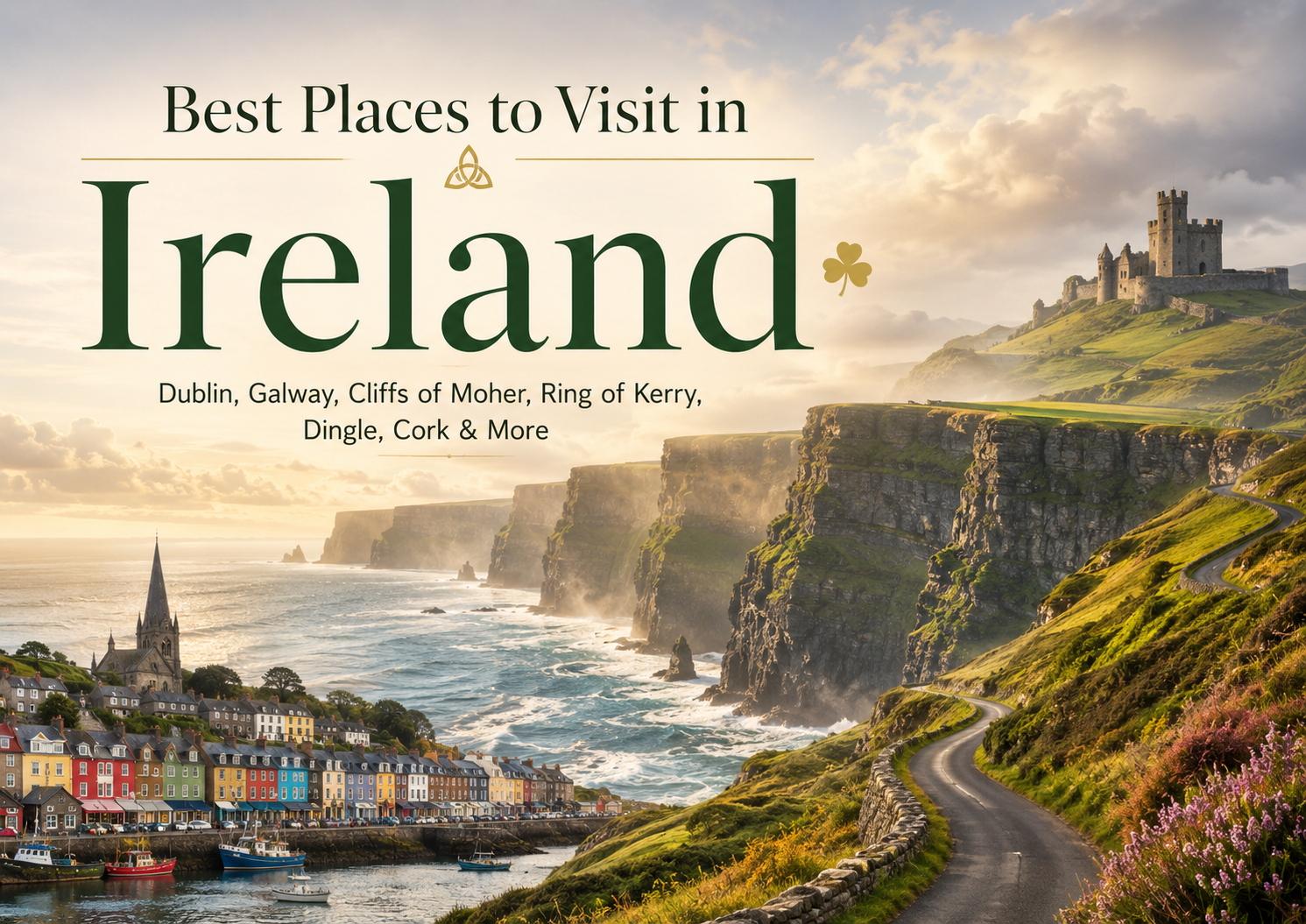
Ireland is the kind of place that feels like it was made for travelers who love atmosphere. It has wind-swept cliffs, green hills, castle ruins, lively cities, cozy pubs, colorful harbor towns, ancient tombs, soft rain, wild coastlines, literary corners, music-filled evenings, and roads that seem to turn every few minutes into another postcard.
But Ireland is also more varied than many people realize. Yes, there are famous places like Dublin, Galway, the Cliffs of Moher, and the Ring of Kerry, but there are also rocky lunar landscapes, remote islands, monastic ruins, food-loving coastal towns, myth-heavy ancient sites, and dramatic corners of Northern Ireland that fit beautifully into an island-wide Ireland trip.
This guide focuses on the island of Ireland, including both the Republic of Ireland and Northern Ireland. Northern Ireland is part of the United Kingdom, but for many travelers, places like Belfast, the Giant’s Causeway, and the Causeway Coast fit naturally into an Ireland itinerary.
Here are some of the best places to visit in Ireland, from classic first-trip favorites to more unusual places that make the island feel even more memorable.
1. Dublin

Country / Ireland region: Republic of Ireland, County Dublin, eastern Ireland
What kind of place it is: capital city, historic hub, literary destination, pub culture center, and classic Ireland starting point
Best for: history, museums, pubs, literary atmosphere, first Ireland trips, city breaks, and easy arrival logistics
Why travelers should care
Dublin is one of the easiest and most natural places to begin an Ireland trip. It gives you history, walkable neighborhoods, museums, cathedrals, river views, parks, shopping streets, pubs, and enough classic Irish atmosphere to ease you into the country before you head toward the wilder west or south.
It may not be the greenest or most dramatic part of Ireland, but it has the cultural weight. Dublin is where you feel the country’s literary side, political history, city energy, and pub tradition all layered together.
Main highlights
Dublin’s highlights include Trinity College, the Book of Kells, Dublin Castle, St. Patrick’s Cathedral, Christ Church Cathedral, St. Stephen’s Green, Grafton Street, Temple Bar, the River Liffey, the Guinness Storehouse, and EPIC The Irish Emigration Museum.
Historical points of interest
Dublin is packed with Irish history, from medieval cathedrals to Georgian squares to major sites connected with Irish independence. It is also one of Europe’s great literary cities, tied to writers like James Joyce, Oscar Wilde, W. B. Yeats, Samuel Beckett, and Bram Stoker.
Don’t miss
- Trinity College and the Book of Kells — one of Dublin’s most famous cultural stops, especially if you love old libraries, illuminated manuscripts, and that classic literary Ireland feeling.
- St. Stephen’s Green — a pretty city park that gives you a calmer break between museums, shops, churches, and pub-heavy streets.
- A walk along the River Liffey — one of the easiest ways to get your bearings in Dublin, with bridges, city views, and a sense of how the capital fits together.
- Dublin Castle and the cathedral area — a strong historic pocket of the city where you can connect medieval, religious, and political layers of Dublin in one area.
- An atmospheric pub or live music stop — Dublin’s pub culture is part of the city’s identity, so even a low-key evening stop can make the city feel more alive.
Why I recommend it
Dublin is the best place to settle into Ireland before the trip becomes more rural, coastal, or road-trip focused. It gives you the city layer of Ireland: history, books, pubs, museums, music, and old streets.
Side notes / good to know
- Dublin works especially well at the beginning or end of an Ireland itinerary.
- If you are renting a car, you may want to wait until you leave Dublin. The city itself is easier to enjoy on foot, by taxi, or with public transportation.
- Literary travelers should give Dublin more time than a quick overnight. This is one of the best places in Ireland to lean into books, old libraries, historic pubs, and writerly atmosphere.
- You can access my best hotels to stay at in Dublin guide here to help plan your trip.
2. Galway

Country / Ireland region: Republic of Ireland, County Galway, western Ireland
What kind of place it is: colorful west coast city, music hub, artsy base, and gateway to some of Ireland’s wildest landscapes
Best for: music, pubs, seafood, couples, friend trips, solo travelers, western Ireland road trips, and lively-but-manageable city energy
Why travelers should care
Galway is one of the most charming cities in Ireland and one of the best bases for exploring the west. It feels smaller and more intimate than Dublin, but it still has plenty of life: music, restaurants, pubs, shops, street performers, and colorful lanes.
It also works beautifully as a launch point for the Cliffs of Moher, Connemara, the Aran Islands, and the Wild Atlantic Way.
Main highlights
Galway’s main highlights include the Latin Quarter, Quay Street, Eyre Square, Galway Cathedral, the Spanish Arch, Salthill Promenade, traditional music pubs, seafood restaurants, and day trips into western Ireland.
Historical points of interest
Galway has a long trading history and a strong connection to Irish-language culture, music, and the west of Ireland’s artistic identity. The Spanish Arch hints at the city’s maritime past, while the surrounding region connects travelers with older, wilder parts of Irish culture.
Don’t miss
- The Latin Quarter — Galway’s most atmospheric central area, with colorful streets, shops, pubs, restaurants, and the kind of lively foot traffic that makes the city so easy to love.
- Traditional live music — Galway is one of the best places in Ireland to follow the sound of music rather than overplan every evening.
- Salthill Promenade — a seaside walk that gives you fresh air, Galway Bay views, and a softer coastal break from the busy city center.
- A day trip toward the Cliffs of Moher or Connemara — Galway’s location makes it one of the best bases for exploring the west of Ireland without changing hotels constantly.
- Seafood and slow wandering — Galway is better when you leave room for browsing, eating, listening, and letting the city unfold naturally.
Why I recommend it
Galway is one of the easiest places to fall in love with Ireland. It has the music, color, food, friendliness, and west-coast access that make a trip feel fuller without being overwhelming.
Side notes / good to know
- Galway is a great place to stay for several nights if you want to avoid moving hotels constantly.
- The city is lively, but the real magic is how easily it connects to dramatic landscapes outside the city.
- Galway is a good choice for travelers who want Ireland to feel musical, social, and atmospheric rather than only scenic.
- You can access my best hotels to stay at in Galway guide here to help plan your trip.
3. Cliffs of Moher

Country / Ireland region: Republic of Ireland, County Clare, western Ireland
What kind of place it is: dramatic Atlantic sea cliffs and one of Ireland’s most iconic natural landmarks
Best for: scenery, photography, first Ireland trips, road trips, coastal walks, nature lovers, and classic Ireland moments
Why travelers should care
The Cliffs of Moher are famous for a reason. They are one of those places that still feel powerful even if you have seen photos a hundred times. The cliffs rise sharply over the Atlantic, with wind, waves, seabirds, and sweeping views that make the landscape feel huge.
They are popular and can be crowded, but they are still one of the defining sights of western Ireland.
Main highlights
The main highlights include the cliff viewpoints, O’Brien’s Tower area, Atlantic views, walking paths, seabird watching, nearby Doolin, and the surrounding County Clare scenery.
Historical points of interest
The cliffs sit in a region rich with older Irish landscapes, coastal settlements, and nearby archaeological sites. They are also close to the Burren, which gives this part of Ireland an unusual mix of dramatic cliffs and ancient limestone terrain.
Don’t miss
- The main cliff viewpoints — this is where you get the classic Cliffs of Moher experience: huge Atlantic drops, sea air, and some of Ireland’s most recognizable scenery.
- O’Brien’s Tower area — a popular viewpoint that gives travelers one of the most iconic perspectives over the cliffs and coastline.
- A stop in Doolin — a small nearby village that works well for food, music, ferry connections, and making the cliffs feel like part of a fuller County Clare day.
- The Burren nearby — pairing the cliffs with the Burren gives you two completely different Irish landscapes in one route: dramatic sea cliffs and strange limestone terrain.
- A real wind layer — not glamorous, but essential. The cliffs can be breezy, chilly, and exposed even when the rest of the day feels mild.
Why I recommend it
The Cliffs of Moher are one of Ireland’s big emotional scenery moments. They are not obscure, but they belong on this list because they deliver that wild Atlantic drama so many travelers come to Ireland hoping to feel.
Side notes / good to know
- Weather changes the experience dramatically. Mist, rain, wind, and low visibility can all affect the views.
- The cliffs are better when treated as part of a County Clare day rather than a rushed photo stop.
- This is one of the strongest places in Ireland for travelers who want scenery that feels cinematic, moody, and unmistakably Atlantic.
4. Ring of Kerry

Country / Ireland region: Republic of Ireland, County Kerry, southwestern Ireland
What kind of place it is: classic scenic driving route with mountains, lakes, coast, villages, and sweeping Irish countryside
Best for: road trips, photographers, couples, scenic drives, outdoor travelers, and travelers who want a big Irish landscape experience
Why travelers should care
The Ring of Kerry is one of Ireland’s most famous road trips because it gives you a little bit of everything: coastal roads, mountain views, lakes, villages, beaches, stone forts, and green countryside. It is popular, but it still earns its place because the scenery is genuinely beautiful.
This is one of the best places to experience the Irish road-trip dream: winding roads, changing weather, small stops, and views that make you pull over more often than expected.
Main highlights
Highlights include Killarney, Killarney National Park, Ladies View, Kenmare, Sneem, Waterville, coastal viewpoints, mountain scenery, and possible detours toward the Skellig Ring.
Historical points of interest
The route passes through landscapes with ancient forts, old settlements, historic estates, and traditional villages. It also sits near some of Ireland’s most important monastic and coastal heritage areas.
Don’t miss
- Killarney National Park — one of the easiest ways to add lakes, waterfalls, woodland, castles, and mountain views to a Ring of Kerry route.
- Ladies View — a classic scenic viewpoint with sweeping Kerry landscapes that help explain why this drive became so famous.
- Kenmare or Sneem — colorful, appealing towns that make the route feel like more than just a drive between viewpoints.
- Coastal viewpoints along the route — the Ring of Kerry is best when you leave time for unplanned pullovers, sea views, and slower scenic stops.
- The Skellig Ring if time allows — a wilder add-on that can make the Kerry route feel more dramatic and less predictable.
Why I recommend it
The Ring of Kerry is one of the best all-around scenic drives in Ireland. It gives travelers the sweeping, green, coastal, village-filled version of Ireland that many people dream about before they go.
Side notes / good to know
- Roads can be narrow, and drive times can feel longer than they look on a map.
- This is not a route to speed through. The stops are the point.
- If you are choosing between the Ring of Kerry and Dingle on a short trip, the Ring of Kerry feels broader and more classic, while Dingle can feel more intimate and rugged.
5. Dingle Peninsula

Country / Ireland region: Republic of Ireland, County Kerry, southwestern Ireland
What kind of place it is: rugged peninsula with coastal drives, Irish-language culture, beaches, cliffs, ruins, and a colorful harbor town
Best for: scenic drives, couples, photographers, seafood lovers, slower road trips, coastal scenery, and travelers who want Ireland to feel wilder
Why travelers should care
The Dingle Peninsula is one of the most atmospheric places in Ireland. It has the drama of the coast, the charm of Dingle town, the beauty of Slea Head Drive, and a strong sense of place that makes it feel more personal than some of the bigger-name routes.
This is a place for slowing down: seafood, music, sea air, old stones, and views that feel like they belong in a story.
Main highlights
Main highlights include Dingle town, Slea Head Drive, Coumeenoole Beach, Dunquin Pier, Gallarus Oratory, Blasket Islands views, pubs, seafood, and coastal viewpoints.
Historical points of interest
The peninsula has deep connections to Irish-language culture, early Christian sites, ancient stone structures, and maritime history. Gallarus Oratory and other old sites give the area a sense of age and continuity.
Don’t miss
- Slea Head Drive — the peninsula’s signature scenic route, with cliffs, beaches, stone ruins, island views, and some of the most atmospheric coastal scenery in Ireland.
- Dingle town — a colorful harbor town with pubs, seafood, shops, and enough charm to deserve more than a quick stop.
- Dunquin Pier — one of the most photogenic spots on the peninsula, especially if you love dramatic roads, sea views, and Blasket Islands scenery.
- Gallarus Oratory — a small but fascinating early Christian stone structure that adds historical depth to the peninsula.
- A seafood meal or cozy pub evening — Dingle is one of those places where the food, music, and town atmosphere matter almost as much as the views.
Why I recommend it
Dingle has a special kind of magic. It feels wild, warm, colorful, ancient, and lived-in all at once. For many travelers, it becomes one of the most memorable parts of Ireland.
Side notes / good to know
- The Dingle Peninsula is wonderful for travelers who want folklore, language, ruins, scenery, and food in one place.
- Parts of the peninsula are tied to Irish-speaking Gaeltacht culture, which gives the region added depth.
- If the weather turns moody, Dingle often feels even more atmospheric rather than ruined.
6. Killarney National Park

Country / Ireland region: Republic of Ireland, County Kerry, southwestern Ireland
What kind of place it is: national park with lakes, mountains, waterfalls, woodland, historic houses, and classic Irish scenery
Best for: nature, easy outdoor time, families, couples, photography, road trips, and travelers who want beautiful scenery without going extremely remote
Why travelers should care
Killarney National Park is one of the most accessible and rewarding nature stops in Ireland. It has lakes, mountains, trails, waterfalls, old trees, historic buildings, and scenic viewpoints, all close to the town of Killarney and the Ring of Kerry.
It is especially useful if you want a strong nature experience without needing to plan a difficult hike or remote route.
Main highlights
Highlights include Muckross House, Muckross Abbey, Torc Waterfall, Ross Castle, the Lakes of Killarney, Ladies View, walking paths, and scenic drives.
Historical points of interest
Killarney National Park includes historic estates, abbey ruins, castle history, and landscapes connected to old Irish aristocratic and monastic life. Muckross Abbey and Ross Castle add a strong historical layer to the natural scenery.
Don’t miss
- Torc Waterfall — an easy, beautiful nature stop that gives you classic Irish woodland-and-waterfall atmosphere without needing a major hike.
- Muckross Abbey — atmospheric ruins that add a quiet, historic layer to the park’s lakes and mountains.
- Ross Castle — a lakeside castle that gives the park one of its most recognizable historic landmarks.
- The Lakes of Killarney — the heart of the park’s scenery, especially if you want water, mountains, and soft Irish landscape views.
- Ladies View — a scenic overlook that works especially well if you are combining the park with the Ring of Kerry.
Why I recommend it
Killarney National Park gives you an easy, beautiful dose of Ireland’s lakes-and-mountains scenery. It is practical, scenic, and flexible, which makes it useful for many different types of trips.
Side notes / good to know
- This is a good place for travelers who want nature but do not necessarily want a rugged adventure itinerary.
- It pairs naturally with the Ring of Kerry.
- Killarney can be busy, but the park still gives travelers plenty of places to slow down and breathe.
7. Cork

Country / Ireland region: Republic of Ireland, County Cork, southern Ireland
What kind of place it is: lively southern city with food culture, history, markets, nearby harbor towns, and easy access to County Cork scenery
Best for: food lovers, city travelers, southern Ireland routes, history, day trips, and travelers who want a city with a slightly different feel from Dublin or Galway
Why travelers should care
Cork is one of Ireland’s best cities for travelers who like food, local character, and a slightly less obvious city base. It has markets, historic streets, restaurants, pubs, river views, and easy access to some of southern Ireland’s best day trips.
It also works well if you want to connect city time with Kinsale, Cobh, Blarney, or the wider County Cork coast.
Main highlights
Highlights include the English Market, St. Fin Barre’s Cathedral, Shandon Bells, Elizabeth Fort, the River Lee, Cork City Gaol, Blarney Castle and the Blarney Stone, nearby Cobh, Kinsale, and Cork’s food-focused city center.
Historical points of interest
Cork has layers of Viking, medieval, maritime, and rebel history. The English Market is one of its great cultural anchors, while nearby Cobh is deeply connected with emigration and Titanic history. Blarney Castle adds one of Ireland’s most famous folklore traditions: the Blarney Stone, said to give the gift of eloquence to those who kiss it.
Don’t miss
- The English Market — one of Cork’s best food stops and a great place to feel the city’s everyday local rhythm through stalls, ingredients, snacks, and browsing.
- St. Fin Barre’s Cathedral — a dramatic Gothic Revival cathedral that gives Cork a strong architectural landmark beyond its food and pub scene.
- Blarney Castle and the Blarney Stone — one of Ireland’s most famous castle traditions, where travelers can visit the medieval castle, explore the gardens, and decide whether they want to kiss the legendary stone said to grant eloquence.
- A food-focused wander through Cork city — Cork is one of Ireland’s best cities for eating, so leave room for cafés, pubs, restaurants, markets, and whatever looks good as you walk.
- A day trip to Kinsale or Cobh — two of the best nearby Cork-area add-ons: Kinsale for colorful harbor charm and food, Cobh for maritime history, Titanic connections, and pretty hillside views.
Why I recommend it
Cork gives the Ireland itinerary more depth. It is not just a pass-through city; it is a strong southern base with food, history, personality, and easy access to some of Ireland’s most charming coastal towns.
Side notes / good to know
- Cork is a good choice if you want an Ireland trip that does not revolve only around Dublin, Galway, and Kerry.
- Food travelers should give Cork serious consideration.
- Blarney Castle is touristy, yes, but it is also one of Ireland’s most recognizable travel traditions. Even if kissing the Blarney Stone is not your style, the castle grounds and gardens make it a worthwhile Cork-area add-on.
- The surrounding county has enough to justify more time than many travelers expect.
8. Kinsale

Country / Ireland region: Republic of Ireland, County Cork, southern Ireland
What kind of place it is: colorful harbor town with food, coastal charm, sailing atmosphere, historic forts, and pretty streets
Best for: food lovers, couples, coastal town stays, relaxed southern Ireland itineraries, photography, and charming small-town atmosphere
Why travelers should care
Kinsale is one of Ireland’s prettiest and most enjoyable harbor towns. It is colorful, compact, food-focused, and coastal, with enough history and scenery to make it more than just a cute stop.
It is especially appealing if you want a softer, more relaxed version of southern Ireland with good food, harbor views, and walkable charm.
Main highlights
Highlights include Kinsale’s colorful streets, harbor, restaurants, Charles Fort, James Fort, coastal walks, shops, and sailing atmosphere.
Historical points of interest
Kinsale has major maritime and military history, especially around Charles Fort and the town’s strategic harbor. The area also played a role in important conflicts and trade routes over the centuries.
Don’t miss
- Kinsale’s colorful town center — one of the prettiest small-town wanderings in southern Ireland, with bright buildings, shops, restaurants, and harbor-town charm.
- A seafood or food-focused meal — Kinsale is known for its food scene, so this is a place to slow down and plan at least one memorable meal.
- Charles Fort — a star-shaped coastal fort that adds history, harbor views, and a strong sense of place beyond the town’s cute streets.
- The harbor area — a relaxed place for walking, views, boats, and that soft coastal atmosphere that makes Kinsale so appealing.
- A slower overnight or half-day stop — Kinsale is better when you do not treat it as a five-minute photo stop; the charm is in the wandering.
Why I recommend it
Kinsale is the kind of place that adds charm and texture to an Ireland itinerary. It is colorful, delicious, historic, and coastal in a way that feels easy to love.
Side notes / good to know
- Kinsale is a strong choice for travelers who like small towns with good food.
- It works well as a County Cork add-on from Cork city.
- The town feels polished and charming, but still very connected to the sea.
9. Kilkenny

Country / Ireland region: Republic of Ireland, County Kilkenny, southeastern Ireland
What kind of place it is: medieval city with a castle, old lanes, churches, craft culture, and historic atmosphere
Best for: castles, medieval streets, history, easy city wandering, couples, and travelers who want a compact heritage stop
Why travelers should care
Kilkenny is one of Ireland’s best places for medieval atmosphere without needing a complicated plan. It has a castle, old streets, historic buildings, churches, shops, pubs, and a very walkable center.
It is a great stop if you want a city that feels historic and manageable, especially between Dublin and southern or western Ireland.
Main highlights
Highlights include Kilkenny Castle, the Medieval Mile, St. Canice’s Cathedral, Rothe House, Black Abbey, craft shops, pubs, and historic lanes.
Historical points of interest
Kilkenny is one of Ireland’s strongest medieval cities. Its castle, cathedral, townhouses, abbeys, and narrow lanes make it especially good for travelers who want history that feels visible as they walk.
Don’t miss
- Kilkenny Castle — the city’s major landmark and one of the easiest places to step into Ireland’s castle history without leaving the town center.
- The Medieval Mile — a walkable route through Kilkenny’s historic core, linking old streets, churches, landmarks, and medieval atmosphere.
- St. Canice’s Cathedral — a beautiful historic cathedral that gives Kilkenny more depth than just its castle.
- Black Abbey — a quieter medieval stop with striking religious history and a more contemplative feel.
- A slow wander through the old center — Kilkenny’s appeal is partly in its compactness, so leave time for lanes, shopfronts, pubs, and small discoveries.
Why I recommend it
Kilkenny is easy to enjoy and easy to fit into an Ireland trip. It gives you castle-and-medieval atmosphere without needing to build an entire itinerary around it.
Side notes / good to know
- Kilkenny is a good choice if you want history, but not another large city.
- It can work as an overnight stop or a longer slow-travel stay.
- The compact layout makes it especially nice for travelers who like to explore on foot.
10. Wicklow Mountains & Glendalough

Country / Ireland region: Republic of Ireland, County Wicklow, eastern Ireland
What kind of place it is: mountain and lake region with monastic ruins, scenic drives, gardens, and easy nature access from Dublin
Best for: day trips from Dublin, nature, ancient ruins, soft adventure, photography, and travelers who want green Ireland without going far west
Why travelers should care
The Wicklow Mountains are one of the best ways to get into Ireland’s landscapes without traveling far from Dublin. Glendalough is especially beautiful, with lakes, wooded paths, mountain scenery, and monastic ruins that feel peaceful and atmospheric.
This is a great place to add nature and history to a Dublin-heavy itinerary.
Main highlights
Highlights include Glendalough’s monastic site, the round tower, upper and lower lakes, Wicklow Mountains scenery, Powerscourt Estate and Gardens, Sally Gap, and mountain roads.
Historical points of interest
Glendalough is one of Ireland’s most important early monastic sites. The ruins, round tower, graveyard, and lakeside setting create one of the most atmospheric historical landscapes near Dublin.
Don’t miss
- Glendalough’s monastic ruins — one of the most atmospheric historic sites near Dublin, with stone ruins, a round tower, and a peaceful valley setting.
- The lakes at Glendalough — the water, mountains, and wooded paths make this area feel much more remote than its distance from Dublin suggests.
- Powerscourt Gardens — a beautiful estate garden stop if you want a more polished, designed contrast to Wicklow’s wilder mountain scenery.
- A scenic drive through the Wicklow Mountains — one of the best ways to add moody green landscapes and soft mountain views to an eastern Ireland route.
- A rain layer for the day — Wicklow can feel misty and changeable, and being prepared makes the ruins and lakes much easier to enjoy.
Why I recommend it
Wicklow and Glendalough are perfect for travelers who want a beautiful nature-and-history day without needing to cross the country. It is one of the easiest ways to make a Dublin itinerary feel more scenic.
Side notes / good to know
- Wicklow’s landscapes have been used in film and television because they deliver moody, green, cinematic scenery close to Dublin.
- Glendalough is especially good for travelers who love monastic ruins, lakes, and a quieter historical atmosphere.
- This area can be misty or rainy, which often makes it feel more magical rather than less appealing.
11. Belfast

Country / Ireland region: Northern Ireland, United Kingdom / Belfast, northeastern Ireland
What kind of place it is: historic, creative, complex city with Titanic history, murals, museums, architecture, restaurants, and access to the Causeway Coast
Best for: history, city breaks, Titanic heritage, political history, food, culture, Northern Ireland road trips, and travelers who want a deeper island-of-Ireland itinerary
Why travelers should care
Belfast adds an important and very different layer to an Ireland trip. It is creative, historic, complicated, and increasingly polished, with museums, murals, Victorian architecture, food, pubs, and one of the best-known maritime stories in the world.
It is also a natural base for visiting the Giant’s Causeway and Causeway Coast.
Main highlights
Highlights include Titanic Belfast, the Titanic Quarter, Belfast City Hall, St. George’s Market, the Cathedral Quarter, political murals, Crumlin Road Gaol, Botanic Gardens, and nearby Causeway Coast day trips.
Historical points of interest
Belfast has major maritime, industrial, and political history. The Titanic was built here, and the city’s murals and neighborhoods reflect more recent historical layers that many travelers find important to understand.
Don’t miss
- Titanic Belfast — one of the city’s signature attractions, connecting Belfast’s shipbuilding history with the story of the Titanic.
- St. George’s Market — a lively indoor market that gives you food, local products, people-watching, and a more everyday feel for the city.
- The Cathedral Quarter — a good area for restaurants, pubs, street art, and a more creative side of Belfast.
- The city’s murals and political history — an important part of understanding Belfast, especially if you want the trip to have cultural depth instead of only sightseeing.
- A Causeway Coast day trip — Belfast works beautifully as a base for reaching the Giant’s Causeway, Dunluce Castle, and the northern coast.
Why I recommend it
Belfast adds depth, contrast, and a major Northern Ireland anchor to an island-wide Ireland trip. It is not just an add-on; it helps travelers understand the island more fully.
Side notes / good to know
- Belfast is part of the United Kingdom, but it fits very naturally into many Ireland itineraries.
- Travelers interested in history should give Belfast time instead of using it only as a quick stop before the coast.
- The city’s Titanic history gives it a strong identity beyond the usual castles-and-countryside version of Ireland.
12. Giant’s Causeway & Causeway Coast

Country / Ireland region: Northern Ireland, United Kingdom / County Antrim, northern coast of Ireland
What kind of place it is: dramatic coastal region with basalt columns, cliffs, castle ruins, beaches, sea roads, and mythic scenery
Best for: coastal drives, photography, folklore, natural wonders, Northern Ireland road trips, and travelers who love dramatic landscapes
Why travelers should care
The Giant’s Causeway and Causeway Coast are among the most memorable places on the island of Ireland. The basalt columns are unusual and instantly recognizable, but the wider coast is just as important: cliffs, beaches, ruins, viewpoints, and wild northern scenery.
This is one of the best places in Ireland to mix natural drama with folklore.
Main highlights
Highlights include the Giant’s Causeway, Dunluce Castle, Ballintoy Harbour, Carrick-a-Rede area, Portrush, Portstewart Strand, coastal viewpoints, and the Causeway Coastal Route.
Historical points of interest
The Giant’s Causeway is tied to the legend of Finn McCool, giving the landscape a mythic layer beyond the geology. Dunluce Castle adds ruined-castle drama along the coast, while the region has deep connections to maritime life and Northern Ireland’s coastal heritage.
Don’t miss
- The Giant’s Causeway basalt columns — the area’s most famous natural wonder, with unusual rock formations tied to both geology and the legend of Finn McCool.
- Dunluce Castle — a ruined coastal castle that gives the Causeway Coast a dramatic, storybook edge.
- The Causeway Coastal Route — one of the best scenic drives on the island, with sea views, cliffs, villages, beaches, and plenty of places to stop.
- Ballintoy Harbour or nearby coastal stops — small, rugged places like this help the coast feel more textured than a single attraction visit.
- Time for changing weather — the northern coast can shift quickly, and the scenery is better when you are not rushing from stop to stop.
Why I recommend it
This is one of the strongest Northern Ireland additions to an Ireland itinerary. It feels dramatic, legendary, windswept, and completely different from the softer green countryside many travelers expect.
Side notes / good to know
- The Giant’s Causeway is connected to the legend of Finn McCool, which makes it one of the best folklore stops in this guide.
- Several places along the Causeway Coast have appeared in or are associated with fantasy-style filming routes, which adds to the area’s cinematic feel.
- This is a natural fit with Belfast, but it deserves more than a rushed check-the-box stop if you have time.
13. Derry / Londonderry

Country / Ireland region: Northern Ireland, United Kingdom / County Londonderry, northwestern Ireland
What kind of place it is: historic walled city with powerful political history, murals, river views, culture, and a strong sense of identity
Best for: history, city walls, cultural depth, Northern Ireland itineraries, travelers interested in complex places, and city stops beyond Belfast
Why travelers should care
Derry / Londonderry is one of the most interesting cities on the island for travelers who want more than pretty views. It has intact city walls, layered history, murals, museums, and a strong cultural identity.
It can be a powerful stop because it helps visitors understand Northern Ireland beyond Belfast and the Causeway Coast.
Main highlights
Highlights include the city walls, Guildhall, Peace Bridge, Bogside murals, Tower Museum, St. Columb’s Cathedral, riverfront views, and the historic center.
Historical points of interest
Derry / Londonderry has major significance in Irish and Northern Irish history. Its walls, neighborhoods, murals, and museums reflect centuries of conflict, identity, and change.
Don’t miss
- The city walls — one of the best ways to understand the city’s layout, history, and layered identity while getting elevated views over the streets.
- The Peace Bridge — a modern landmark that connects different parts of the city and adds a symbolic layer to the visit.
- The Guildhall — a beautiful historic building that gives the city architectural presence and a strong civic focal point.
- The Bogside murals — powerful public art connected to the city’s modern history, best approached with context and respect.
- A slower history-focused visit — Derry / Londonderry is most rewarding when travelers take time to understand it rather than treating it as a quick photo stop.
Why I recommend it
Derry / Londonderry adds history, emotion, complexity, and cultural importance to a Northern Ireland route.
Side notes / good to know
- The city’s name can be politically sensitive, which is why many travel guides use both names.
- This is a strong stop for travelers who care about history and identity.
- It pairs well with Donegal or the Causeway Coast if you are building a northern route.
14. Connemara

Country / Ireland region: Republic of Ireland, County Galway, western Ireland
What kind of place it is: wild western landscape of mountains, bogs, lakes, coast, villages, and moody open scenery
Best for: road trips, photography, rugged landscapes, slow travel, nature, and travelers who want Ireland to feel remote and windswept
Why travelers should care
Connemara is one of the most atmospheric regions in Ireland. It is not about one single sight as much as the feeling of the place: empty roads, lakes, mountains, bogland, stone walls, sheep, coastal views, and a sense that the west of Ireland is opening up around you.
It is a great choice if you want Ireland to feel wilder and less polished.
Main highlights
Highlights include Connemara National Park, Kylemore Abbey, Sky Road, Clifden, Killary Fjord, Roundstone, beaches, mountains, and scenic drives.
Historical points of interest
Connemara has strong connections to Irish-language culture, rural life, famine history, and western Irish identity. Kylemore Abbey adds a romantic and historic landmark to the region’s natural scenery.
Don’t miss
- Kylemore Abbey — one of Connemara’s most famous landmarks, combining romantic architecture, gardens, lake views, and a dramatic mountain backdrop.
- Sky Road near Clifden — a scenic drive that gives you classic west-of-Ireland coastal views without needing a complicated itinerary.
- Connemara National Park — a strong nature stop for mountains, bogland, trails, and wide-open western scenery.
- Killary Fjord — a striking fjord landscape that adds a different kind of water-and-mountain drama to the region.
- A slow scenic drive with room for surprises — Connemara is not just about named stops; the open roads, sheep, lakes, and weather are part of the experience.
Why I recommend it
Connemara is one of the best places to feel the wild west of Ireland. It is less about a checklist and more about mood, space, weather, and landscape.
Side notes / good to know
- Connemara is especially beautiful if you like moody skies and wide-open scenery.
- This is a great place for travelers who want to go beyond Ireland’s most obvious stops.
- It pairs naturally with Galway, but it feels completely different from the city.
15. Aran Islands

Country / Ireland region: Republic of Ireland, County Galway, off the western coast of Ireland
What kind of place it is: Atlantic island group with stone walls, cliffs, forts, Irish-language culture, cycling routes, and a slower rhythm
Best for: island trips, culture, cyclists, walkers, photographers, slow travel, and travelers who want a deeper west-of-Ireland experience
Why travelers should care
The Aran Islands feel like a different rhythm of Ireland. Stone walls crisscross the landscape, the Atlantic is always present, and the islands have a strong sense of culture and place.
They are ideal if you want something more distinctive than another city or scenic drive.
Main highlights
Highlights include Inis Mór, Dún Aonghasa, stone walls, cliff views, bike rentals, beaches, traditional culture, ferries, and views toward the Atlantic.
Historical points of interest
The islands are known for ancient forts, early Christian sites, Irish-language culture, and traditional island life. Dún Aonghasa, perched near the cliffs on Inis Mór, is one of the most dramatic ancient sites in western Ireland.
Don’t miss
- Dún Aonghasa on Inis Mór — a dramatic ancient stone fort near the cliffs, and one of the strongest historical reasons to visit the islands.
- A bike ride or slow island wander — one of the best ways to feel the islands’ rhythm, stone walls, sea air, and open landscapes.
- The stone wall scenery — the patchwork of walls gives the islands their unmistakable look and makes even simple walks feel memorable.
- Cliff and Atlantic views — the islands are at their best when you feel the edge-of-the-ocean setting, not just the village areas.
- Flexible ferry planning — ferry timing and weather matter here, so the islands are more enjoyable when you build in a little breathing room.
Why I recommend it
The Aran Islands make an Ireland trip feel more textured and memorable. They bring together ancient history, language, landscape, and island atmosphere in a way that feels very different from the mainland.
Side notes / good to know
- Ferry schedules and weather matter, so this is a place to plan with flexibility.
- The Aran Islands are one of the best places in this guide for travelers interested in Irish-language culture.
- This is a strong “not just the obvious Ireland itinerary” pick.
16. The Burren

Country / Ireland region: Republic of Ireland, County Clare, western Ireland
What kind of place it is: unusual limestone landscape with ancient sites, wildflowers, caves, rocky hills, and an almost lunar feel
Best for: geology, unusual landscapes, ancient history, walkers, photographers, nature lovers, and travelers who want Ireland to surprise them
Why travelers should care
The Burren is one of the best places in Ireland for travelers who think they already know what Ireland looks like. Instead of endless green fields, you get pale limestone pavement, strange rock formations, wildflowers, caves, tombs, and a landscape that feels ancient and almost otherworldly.
It is one of the best oddball places to include in an Ireland trip because it breaks the expected postcard image in the best way.
Main highlights
Highlights include Poulnabrone Dolmen, Burren National Park, limestone pavement, Aillwee Cave, wildflowers, walking routes, ancient tombs, and nearby connections to the Cliffs of Moher and County Clare.
Historical points of interest
The Burren is rich in ancient monuments, including tombs, ring forts, and sacred sites. Poulnabrone Dolmen is one of Ireland’s most striking prehistoric landmarks.
Don’t miss
- Poulnabrone Dolmen — one of Ireland’s most striking prehistoric monuments, set in the Burren’s unusual limestone landscape.
- The limestone pavement — the Burren’s rocky, almost lunar terrain is what makes it feel so different from the green Ireland many travelers expect.
- Wildflowers in season — the Burren is famous for delicate plant life growing in a surprisingly harsh-looking landscape.
- A cave or walking route — caves and trails help you experience the Burren as a full landscape, not just a quick roadside stop.
- A combined Burren and Cliffs of Moher route — seeing both in one area gives you two completely different versions of County Clare’s natural drama.
Why I recommend it
The Burren is one of Ireland’s strongest niche picks. It is weird, beautiful, ancient, and memorable — exactly the kind of place that makes an Ireland itinerary feel more original.
Side notes / good to know
- The Burren is a perfect “Ireland is more varied than you think” stop.
- It pairs naturally with the Cliffs of Moher, Doolin, and Galway routes.
- This is a great place to mention if you want your Ireland trip to feel less generic and more layered.
17. Skellig Michael & the Skellig Coast

Country / Ireland region: Republic of Ireland, County Kerry, southwestern Ireland
What kind of place it is: remote Atlantic island and coastal region known for ancient monastic history, sea cliffs, wildlife, and cinematic drama
Best for: ancient history, remote landscapes, boat trips, photography, film fans, coastal scenery, and travelers who want one of Ireland’s most unusual places
Why travelers should care
Skellig Michael feels like a place at the edge of the world. The island’s ancient monastic site, steep stone steps, seabirds, Atlantic isolation, and jagged silhouette make it one of the most unforgettable places in Ireland.
Even if you do not land on the island, the Skellig Coast is still dramatic and worth considering as part of a Kerry route.
Main highlights
Highlights include Skellig Michael, Little Skellig, boat trips, the Skellig Coast, Portmagee, Valentia Island, Kerry Cliffs, sea views, seabirds, and ancient monastic heritage.
Historical points of interest
Skellig Michael is famous for its early monastic settlement, where monks lived in extreme isolation on a steep Atlantic island. Its beehive huts and remote setting make it one of Ireland’s most extraordinary historic sites.
Don’t miss
- Skellig Michael if conditions allow — one of Ireland’s most extraordinary historic sites, with ancient monastic ruins perched on a remote Atlantic island.
- The Skellig Coast — a dramatic coastal area that is still worth exploring even if you cannot land on Skellig Michael itself.
- Portmagee or Valentia Island — good bases or add-ons for experiencing the Skellig area, sea views, and southwest Kerry atmosphere.
- The Kerry Cliffs — a powerful cliff stop that pairs well with the Skellig Coast and adds more Atlantic drama to the route.
- Early planning for boat trips — access to Skellig Michael is limited and weather-dependent, so this is one place where planning ahead really matters.
Why I recommend it
Skellig Michael is one of Ireland’s most dramatic and unusual places. It combines ancient faith, isolation, ocean scenery, and modern movie fame in a way few destinations can match.
Side notes / good to know
- Skellig Michael became even more widely known because of its appearance in Star Wars filming.
- Access is limited, seasonal, and weather-dependent, so this is not a casual last-minute stop.
- Even if you cannot visit the island itself, the surrounding coast can still make this part of Kerry feel special.
18. Donegal & Slieve League

Country / Ireland region: Republic of Ireland, County Donegal, northwestern Ireland
What kind of place it is: wild northwestern county with huge cliffs, beaches, mountains, peninsulas, and remote Atlantic scenery
Best for: dramatic landscapes, road trips, photographers, hikers, repeat Ireland visitors, and travelers who want a wilder, less polished feel
Why travelers should care
Donegal is one of the best places in Ireland for travelers who want the country to feel raw, remote, and rugged. It has cliffs, beaches, mountains, peninsulas, villages, and a stronger sense of distance than many of Ireland’s more famous southern routes.
Slieve League is one of the great cliff landscapes of Ireland and deserves more attention from travelers who only know the Cliffs of Moher.
Main highlights
Highlights include Slieve League, Glenveagh National Park, Donegal town, Malin Head, Fanad Head Lighthouse, beaches, coastal drives, and wild Atlantic scenery.
Historical points of interest
Donegal has strong Gaelic heritage, castle history, traditional culture, and deep connections to the northwestern edge of Ireland. Its landscapes feel tied to older, wilder layers of Irish life.
Don’t miss
- Slieve League — one of Ireland’s most dramatic cliff landscapes, with huge Atlantic views and a wilder feel than the more famous Cliffs of Moher.
- Glenveagh National Park — a beautiful inland stop with mountains, lakes, gardens, and a more remote Donegal atmosphere.
- Fanad Head Lighthouse — a striking coastal landmark that adds lighthouse drama to a northern road trip.
- Malin Head if you are going far north — one of the most rugged, windswept places to feel the northern edge of Ireland.
- Enough time for Donegal to breathe — this region is less convenient than some classic routes, but that is exactly why it feels so special.
Why I recommend it
Donegal is one of the best places to go if you want Ireland to feel bigger, wilder, and less packaged. It adds a strong northwestern edge to this guide.
Side notes / good to know
- Donegal is less convenient than some classic Ireland stops, but that is part of why it feels special.
- Slieve League is a great choice for travelers who want dramatic cliffs beyond the Cliffs of Moher.
- This region pairs well with Derry / Londonderry or a broader northern Ireland route.
19. Boyne Valley & Brú na Bóinne

Country / Ireland region: Republic of Ireland, Counties Meath and Louth, eastern Ireland
What kind of place it is: ancient landscape with passage tombs, myths, sacred sites, river valleys, castles, and deep prehistoric history
Best for: ancient history, mythology, archaeology, culture, day trips from Dublin, and travelers who want Ireland before castles and cathedrals
Why travelers should care
The Boyne Valley is one of the best places in Ireland to feel the island’s ancient past. This is not just medieval Ireland or pub-and-castle Ireland; this is prehistoric Ireland, tied to passage tombs, mythic landscapes, sacred sites, and stories that go back thousands of years.
Brú na Bóinne is the centerpiece, but the wider valley has enough history to make it one of the most important cultural regions in the country.
Main highlights
Highlights include Newgrange, Knowth, Dowth, the River Boyne, Trim Castle, the Hill of Tara, Monasterboice, and surrounding historic landscapes.
Historical points of interest
Brú na Bóinne is one of Ireland’s great prehistoric sites, with passage tombs older than many of Europe’s most famous ancient monuments. The Hill of Tara adds a mythic and royal layer to the region’s history.
Don’t miss
- Newgrange — one of Ireland’s most important prehistoric sites and a powerful reminder that Irish history goes far beyond castles and medieval towns.
- Knowth if available — another major passage tomb site that helps make Brú na Bóinne feel like a full ancient landscape, not just one monument.
- The Hill of Tara — a mythic and royal site tied to ancient Irish kingship, landscape, and legend.
- Trim Castle — a strong medieval contrast to the prehistoric sites and one of the most impressive castles in the region.
- Time to absorb the ancient-history layer — the Boyne Valley is best when travelers treat it as one of Ireland’s deepest cultural regions, not just an easy Dublin day trip.
Why I recommend it
The Boyne Valley adds ancient Ireland to the itinerary. It is perfect for travelers who want the country to feel mythic, old, and historically layered rather than only scenic.
Side notes / good to know
- This is one of the best places in Ireland for mythology and ancient history.
- It works well from Dublin, but it should not be treated as a throwaway day trip if ancient sites matter to you.
- The Boyne Valley helps balance the coastal-heavy parts of an Ireland itinerary.
20. Achill Island

Country / Ireland region: Republic of Ireland, County Mayo, western Ireland
What kind of place it is: rugged Atlantic island with beaches, cliffs, mountains, sea roads, and a remote west-coast feeling
Best for: remote scenery, road trips, beaches, photographers, walkers, repeat visitors, and travelers who want a quieter island feel
Why travelers should care
Achill Island is one of those places that makes Ireland feel larger and more surprising. It has cliffs, beaches, mountains, Atlantic roads, and a rugged island atmosphere that feels far from the busier tourist routes.
It is a strong choice for travelers who want to go deeper into western Ireland.
Main highlights
Highlights include Keem Bay, Minaun Heights, Atlantic Drive, Slievemore, deserted village landscapes, beaches, cliffs, and coastal roads.
Historical points of interest
Achill has layers of island history, including older settlements, famine-era stories, fishing culture, and remote western life. The deserted village near Slievemore adds a haunting historical note to the landscape.
Don’t miss
- Keem Bay — one of Achill’s most beautiful coastal spots, with a sheltered beach setting that can feel almost unreal when the weather is clear.
- Atlantic Drive — a scenic route that shows off the island’s cliffs, coastline, sea views, and rugged western atmosphere.
- Minaun Heights — a viewpoint area that helps you understand Achill’s scale, with sweeping views over beaches, mountains, and Atlantic edges.
- The deserted village near Slievemore — a haunting historical stop that adds depth to Achill’s wild scenery.
- Slow roads and flexible timing — Achill is best when you leave room for weather, pullovers, and the slightly remote feeling that makes the island special.
Why I recommend it
Achill Island is one of the best places in Ireland for travelers who want a wilder west-coast island experience beyond the more famous Aran Islands.
Side notes / good to know
- Achill is best with a car and a flexible schedule.
- This is a strong pick for people who like windswept, rugged, slightly lonely-feeling landscapes.
- Keem Bay is one of those places that can feel shockingly beautiful when the weather is right.
21. Cobh

Country / Ireland region: Republic of Ireland, County Cork, southern Ireland
What kind of place it is: colorful harbor town with maritime history, Titanic connections, hillside views, and an easy day-trip feel from Cork
Best for: maritime history, photography, cruise travelers, colorful streets, Cork-area day trips, and travelers interested in emigration stories
Why travelers should care
Cobh is one of the most visually charming towns in southern Ireland, but it also has real historical depth. Its harbor, colorful houses, cathedral views, and maritime stories make it more than just a pretty stop.
It is especially meaningful for travelers interested in emigration history or the Titanic.
Main highlights
Highlights include the Deck of Cards houses, St. Colman’s Cathedral, Cobh Heritage Centre, Titanic Experience Cobh, the waterfront, harbor views, and Spike Island nearby.
Historical points of interest
Cobh was the Titanic’s last port of call and has deep connections to Irish emigration. Millions of people left Ireland through this harbor, which makes the town emotionally important as well as scenic.
Don’t miss
- The colorful hillside views — Cobh’s bright houses and harbor setting make it one of the prettiest town views in southern Ireland.
- St. Colman’s Cathedral — a dramatic landmark above the town that gives Cobh its distinctive skyline.
- Titanic-related history — Cobh was the Titanic’s last port of call, which gives the town a major maritime-history connection.
- Cobh Heritage Centre — a meaningful stop for understanding Irish emigration and the millions of people who left Ireland by sea.
- A harbor walk — the waterfront helps tie together Cobh’s beauty, maritime past, and present-day town atmosphere.
Why I recommend it
Cobh is a great Cork-area addition because it combines beauty, history, and easy logistics. It gives southern Ireland a maritime layer that feels very different from inland castles or western cliffs.
Side notes / good to know
- Cobh is especially good for travelers who like places that are pretty but also historically meaningful.
- It works well as a day trip from Cork.
- Cruise travelers may already pass through or near this area, depending on the itinerary.
22. Westport & County Mayo

Country / Ireland region: Republic of Ireland, County Mayo, western Ireland
What kind of place it is: charming western town and surrounding region with mountains, coastal drives, pilgrimage history, islands, and a strong local feel
Best for: road trips, western Ireland, charming towns, outdoor travelers, scenic drives, and travelers who want a base near Mayo’s landscapes
Why travelers should care
Westport is one of Ireland’s most appealing western towns, and County Mayo around it is full of scenery that deserves more attention. It gives travelers a friendly base with access to mountains, coast, islands, beaches, and quieter parts of the Wild Atlantic Way.
It is a good choice if you want western Ireland but do not want to stay only in Galway or Kerry.
Main highlights
Highlights include Westport town, Croagh Patrick, Clew Bay, Achill Island access, Great Western Greenway, beaches, and Mayo’s coastal routes.
Historical points of interest
Croagh Patrick is one of Ireland’s most famous pilgrimage mountains, while the wider region has strong connections to rural history, famine memory, coastal life, and western Irish culture.
Don’t miss
- Westport town — a charming western base with colorful streets, restaurants, pubs, and a friendly feel that makes it easy to settle in for a few days.
- Clew Bay views — one of the prettiest landscape features in the area, especially if you love coastal scenery and island-dotted water.
- Croagh Patrick if it fits your travel style — an important pilgrimage mountain that adds cultural and spiritual depth to the region.
- The Great Western Greenway — a scenic cycling and walking route that gives travelers a more active way to experience Mayo.
- Using Westport as a base for Mayo and Achill Island — the town works well for travelers who want western Ireland scenery without feeling completely isolated.
Why I recommend it
Westport and Mayo give western Ireland more balance. This area feels scenic, local, and rewarding without being as obvious as Dublin, Galway, Kerry, or the Cliffs of Moher.
Side notes / good to know
- Westport is a good base if you want charm and scenery without feeling too isolated.
- Croagh Patrick adds a pilgrimage and cultural layer to the region.
- This is a strong pick for travelers who want the Wild Atlantic Way but prefer slightly less predictable routes.
What to Pack for Ireland Without Overthinking It
Ireland is not a place where you need glamorous, complicated packing. It is a place where smart layers matter. Even in summer, the weather can shift quickly, and a day can feel sunny, breezy, rainy, cool, and mild within a few hours.
A few things are especially useful for Ireland:
- A lightweight rain jacket
- A compact umbrella if you like using one in cities
- A cardigan, fleece, or light sweater
- A compact scarf for wind, chilly evenings, and cold transit days
- A small day bag for sightseeing
- A power bank for long sightseeing days and road trips
- A plug adapter for Ireland and the UK if your itinerary includes Northern Ireland
- Sunglasses, because Ireland can still surprise you with bright sun between rain showers
The main thing is to pack for changeable weather, not extreme weather. Ireland rewards travelers who can stay comfortable when the forecast does a little bit of everything.
My what to pack for Ireland in the summer guide gives you a full on no brainer list of what to pack for your trip to Ireland in June July & August. And my Ireland Outlet, Plug & Voltage Guide will help you use your electronics safely in Ireland.
Final Thoughts
Ireland is one of those destinations where the obvious places are famous for a reason, but the deeper magic comes from mixing them with places that feel more personal, remote, ancient, or unexpected.
Dublin and Galway give you city energy. The Cliffs of Moher, Ring of Kerry, Dingle, Donegal, Achill Island, and the Causeway Coast give you drama. Kilkenny, Cork, Kinsale, Cobh, and Westport bring charm and character. The Burren, Brú na Bóinne, the Aran Islands, Skellig Michael, and Glendalough add the older, stranger, more mythic side of Ireland.
The best Ireland trip is not only about checking off the biggest names. It is about choosing the places that match the kind of Ireland you want to feel: literary, musical, coastal, ancient, wild, cozy, cinematic, or a little bit of everything.