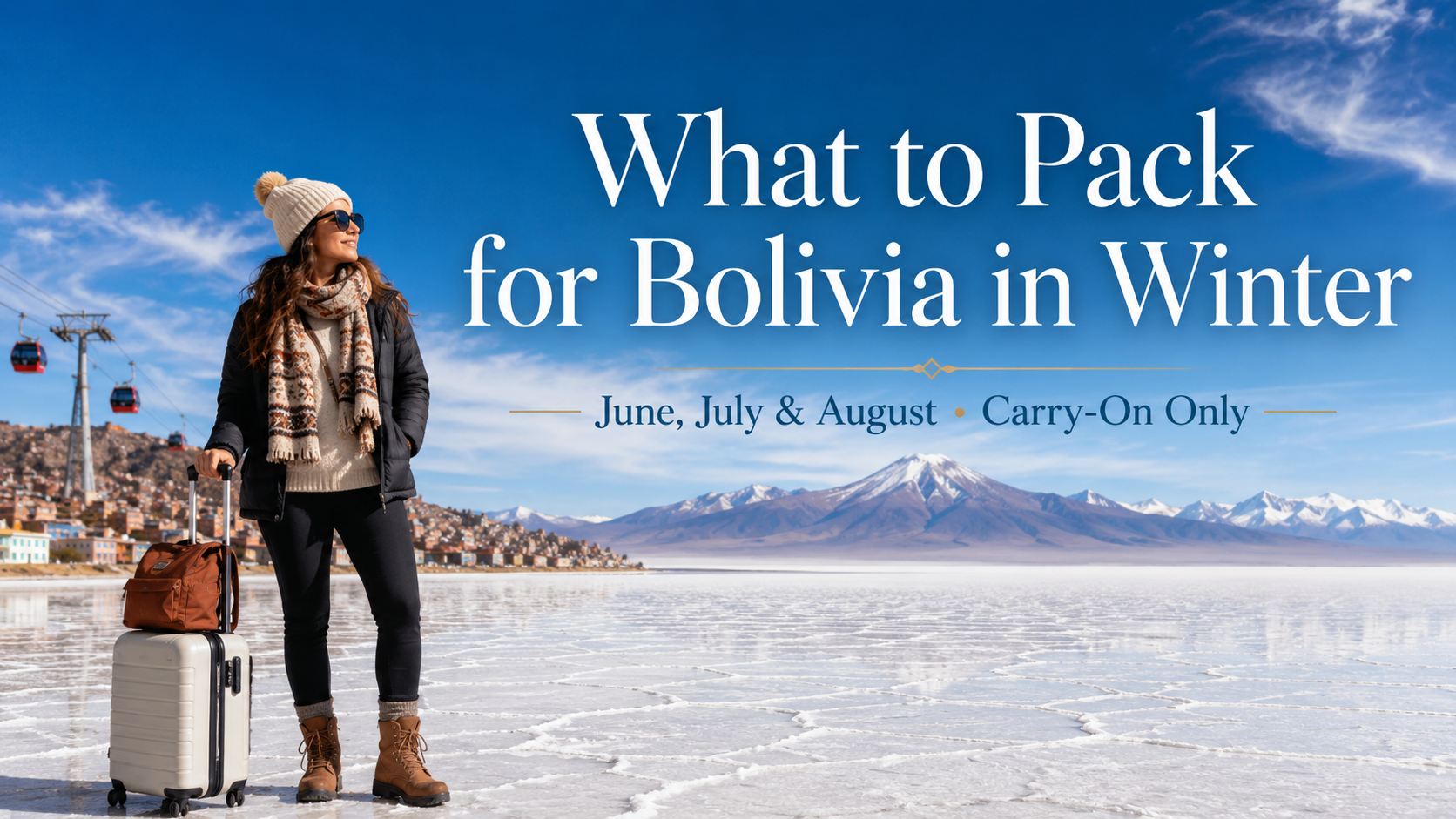
Bolivia in winter feels like one of South America’s most surreal trips. This is the season of bright blue high-altitude skies, white salt flats that look like they belong on another planet, deep lake views at Titicaca, steep streets in La Paz, colonial plazas, cold desert nights, and long scenic drives through landscapes that feel bigger than real life.
It is also not a destination where you want to pack by vibes alone.
Bolivia in June, July, and August can be dry, sunny, dusty, cold, bright, and physically demanding all in the same trip. One day might be spent walking through La Paz in strong mountain sun, another on the Salar de Uyuni surrounded by blinding white salt, and another wrapped in layers as the temperature drops hard after sunset.
That does not mean you need a huge suitcase. It means you need a smarter carry-on.
This is the Bolivia winter packing list I would use for a carry-on-only trip without overcomplicating it.
Destination context / notes
Bolivia in winter is one of the best times to visit if your trip is focused on the highlands, salt flats, cities, viewpoints, and classic outdoor scenery. June, July, and August fall during the dry season, which usually means clearer skies, less rain, better road conditions, and beautiful visibility in places like La Paz, Uyuni, Lake Titicaca, Sucre, Potosí, and the Altiplano.
But “dry season” does not mean warm and easy.
Bolivia’s winter weather can swing hard between sunny daytime conditions and very cold mornings, evenings, and nights. The altitude also changes everything. Sun feels stronger. Hills feel steeper. Dry air feels drier. A normal sightseeing day can feel more tiring than expected.
The Salar de Uyuni is another packing situation all by itself. During dry season, the salt flats can be intensely bright, dusty, windy, cold at night, and surprisingly hard on your skin, lips, eyes, and batteries.
A good Bolivia winter packing list is about staying warm without overpacking, protecting yourself from the sun, handling dust and dry air, and keeping your day bag useful enough for long days away from your hotel.

Who this is for
This packing list is for travelers who are:
- Visiting Bolivia in winter: June, July, or August
- Packing carry-on + personal item only
- Planning to rewear outfits
- Comfortable doing sink laundry or a small wash
- Expecting lots of walking
- Visiting La Paz, Uyuni, Salar de Uyuni, Lake Titicaca, Copacabana, Sucre, Potosí, or the Bolivian highlands
- Using planes, buses, vans, taxis, tours, private transfers, or 4×4 salt flats tours
- Dealing with altitude, cold nights, dusty roads, uneven streets, stairs, markets, viewpoints, and long travel days
- Wanting to stay comfortable and pulled together without hauling around too much stuff
If your Bolivia trip is mostly focused on the Amazon, Santa Cruz, or lower-elevation jungle areas, you will need to adjust this list with more warm-weather clothing, insect protection, and humidity-friendly pieces.
Universal Essentials
- passport + digital/printed copies
- wallet
- credit cards
- local currency (Bolivian Boliviano)
- International driver’s permit if needed
- travel insurance information
- flight confirmations
- hotel confirmations
- train, ferry, or car rental confirmations if needed
- reservation screenshots or printouts
- medications prescription list
- emergency contact information
- writing pen (for customs forms and other random exchanges)
Bolivia is not the kind of trip where I would want to depend entirely on my phone for everything. Keep the important details saved offline and have screenshots ready, especially for tour pickups, hotel addresses, transport details, and domestic travel days.
Tech & Power
Bolivia commonly uses Type A and Type C plugs. Voltage is often listed as 230V / 50Hz, though some travel-adapter references note that voltage can vary locally, so travelers should check device labels and hotel/outlet situations carefully.

- Universal power adapter
- Multi-port USB charger
- Phone, or camera
- Portable power bank (essential for long sightseeing days)
- Travel Power Strip
- Earbuds or headphones for planes, trains, and long transit days
- Tech Organizer Case
- Cell Phone (set up an international plan with your provider before you go, or buy a SIM/eSIM for Bolivia)
- If you’re packing single-voltage electronics like heating pads, hair styling tools, or an electric kettle you’ll need a step-down voltage converter if you’re traveling from a lower voltage country
- Optional: Laptop or Chromebook or Tablet (for work if you must and/or easy entertainment in your own language if you don’t speak Spanish)
- Optional: Kindle or other e-reader (not sure if Kindle is good for you? Check out my full article about how it’s a perfect travel companion)
Bolivia is a place where a power bank earns its spot fast. You may use your phone all day for maps, photos, translations, hotel details, tour messages, ride coordination, weather checks, and altitude-friendly slow wandering.
It is especially useful for Salar de Uyuni tours, Lake Titicaca days, long bus rides, domestic travel days, and any itinerary where you may be away from easy outlets for hours.
Toiletries & Health
- Shampoo + Conditioner + Hair masks and /or Olaplex (these are easiest transported in cadence capsules or as solids)
- Toothbrush + toothpaste + mouthwash + floss (travel solids are easiest for these I still pack them in cadence capsules) It’s also a good idea to bring a couple of on the go toothbrushes for long travel days/flights and/or day trips to stay feeling fresh
- Body wash and face wash as well as any other regularly used shower/bath accessories like salt scrubs, bath soaks, and mud in cadence capsules
- Skincare basics for body, hands, face, and feet as well as any daily facial routines like anti-aging serums in cadence capsules
- Deodorant (body deodorant is also recommended for long flights)
- Disposable shavers are easiest to use and leave behind instead of repacking, but be sure to bring at least 1 shaver
- Personal medications with labels
- Pain relievers and any other common OTC medications you use like ant-acids, anti-diarrhea and/or constipation relief, allergy pills, and common cold medicine
- Deep blue, salon-pas, and lidocaine patches are always helpful for unexpected pain from excessive walking, sitting or other activities done while traveling and especially helpful if you’re traveling with older ones
- Blister prevention (bandages or blister pads) and a simple first aid kit
- Hand sanitizer
- Compact wet wipes
- Toiletry Case
- Inscet Repellant
- Electrolyte packets for hydration on the go
- Anti-chafing balm
- After-sun lotion or aloe if you burn easily
- Hair ties, clips, or a compact brush if your hair hates humidity, lake days, or summer heat
The big things not to skip for Bolivia are sunscreen, SPF lip balm, moisturizer, electrolytes, blister care, pain relief, and anything that helps with dryness.
Bolivia’s high-altitude sun can be intense even when the air feels cool. The dry air can also make your skin, lips, nose, and eyes feel rough quickly. This is one of those destinations where the “tiny comfort items” are not silly. They are what keep you from feeling like a dried-out raisin by day three.
Laundry Kit
Bolivia is very doable carry-on only if you are willing to do a little laundry refresh work.
A tiny laundry kit helps a lot:
- Travel-size laundry detergent sheets or liquid
- Sink stopper (optional, but helpful in older hotels) or mini travel washer
- A few clothespins or a lightweight travel clothesline
- Clothes refresher spray can be used daily to refresh your clothing between washes
What to know:
- Quick-dry fabrics make this much easier
- Wash small items as needed
- Let socks and base layers dry fully before repacking
- If you hate sink laundry, add 1 extra top and 1 extra underwear set and keep the rest the same
- If possible, choose accommodation with laundry access once during a longer trip
Bolivia’s dry season can be dusty, especially if your itinerary includes Uyuni, road transfers, markets, viewpoints, or rural areas. A laundry bag keeps dusty clothes from taking over your suitcase.
Day Bag Essentials

- lightweight crossbody or backpack
- reusable filtered water bottle
- sunglasses
- sunscreen
- lip balm
- wet wipes
- hand sanitizer
- tissues or handkerchiefs
- hand cream
- cardigan or scarf
- packable tote
- portable power bank
- small first aid/blister kit
- hat
- gloves if you are doing early starts, high-altitude tours, or Uyuni
- compact rain shell or windbreaker
Your Bolivia day bag should be practical, not fussy.
You do not want to carry a giant backpack all day, but you do want enough room for water, sun protection, a layer, snacks, power, and the little comfort items that help with altitude and dry air.
This matters even more for Salar de Uyuni, Lake Titicaca, long transfers, viewpoints, markets, and La Paz sightseeing days where you may not want to run back to your hotel.
Jump Packing Lists
Women
Clothing
- 2 lightweight wool long-sleeve tops
- 2 short-sleeve or breathable rayon tops
- 1 thermal
- 1 light sweater or cardigan 100% cashmere is best
- 1 warm coat or insulated jacket
- 1 packable raincoat or lightweight rain-friendly jacket
- 2 pairs of pants (one lighter, one slightly warmer)
- 1 wool skirt or dress
- 1-2 sleep set or nightgown
- 6–7 underwear
- 2 bras
- 1 comfortable walking sneaker
- 1 dressier but walkable shoe (loafers, flats, or low-profile sneakers)
- pairs of socks
Accessories
- Neutral scarf
- Compact crossbody bag
- Travel make-up stack, eyeliner and mascara
- Facial skincare routine
- Make-up remover wipes
For Bolivia in winter, I would lean toward practical layers that still look neat in photos. You do not need to dress like you are on an expedition every day, but you also do not want outfits that only work for a cute café and fail the second the wind picks up.
Pants, layers, real shoes, sunglasses, and a warm jacket matter here. A scarf or wrap is also especially useful because it can help with cold air, dust, sun, and chilly transfers.
Men
Clothing
- 3–4 wool tops (mix of short and long sleeve)
- 1 light sweater or hoodie
- 1 warm coat or insulated jacket
- 1 thermal base-layer top
- 1 lightweight jacket
- 2 pairs of pants
- 1 optional casual button-down
- 1 sleep set
- 6–7 underwear
- 4–5 pairs of socks
- 1 comfortable walking sneaker
- 1 cleaner casual shoe for evenings
Accessories
For men, Bolivia winter packing can stay simple, but it should not be too lightweight. The biggest mistake would be packing as if bright sun means warm weather.
You want shirts that layer well, pants that can handle long travel days, shoes that work on uneven streets, and enough warmth for cold mornings, evenings, and high-altitude tours.
Girls
Clothing
- 4–5 wool tops
- 2 bottoms
- 1 warmer layer
- 1 light jacket
- 1 sleep set
- Underwear + socks for 6–7 days
- Comfortable walking shoes
- Small backpack
- Handheld game console and/or Kindle
- Snacks
For girls, Bolivia is a beautiful but active trip. There may be markets, plazas, boat rides, salt flats, viewpoints, stairs, uneven sidewalks, long drives, and cold mornings all in one itinerary.
Comfort matters more than cute extras. Pack layers that are easy to add and remove, shoes that can handle real walking, and a small day bag for snacks, water, and entertainment.
Boys
Clothing
- 4–5 wool tops
- 2 bottoms
- 1 warmer layer
- 1 light jacket
- 1 sleep set
- Underwear + socks for 6–7 days
- Comfortable sneakers
- Handheld game console and/or Kindle
- Backpack
- Snacks
For boys, I would pack for movement. Bolivia is not the kind of trip where kids only sit in restaurants and museums. Even a gentle itinerary may include stairs, markets, viewpoints, boats, road transfers, salt flats, plazas, and outdoor time.
Good shoes, a warm layer, sun protection, and snacks will make the trip much easier.
Things Nobody Tells You About Bolivia in Winter

A lot of people hear “South America” and imagine warm-weather packing, but Bolivia in winter is a very different situation. If you are traveling through La Paz, Uyuni, Lake Titicaca, Potosí, Sucre, or the Altiplano, you are packing for altitude, dry air, strong sun, cold nights, and long travel days.
The first thing people underestimate is the sun. Bolivia’s high-altitude sun can be incredibly strong, even when the air feels cool. Sunscreen, sunglasses, SPF lip balm, and a hat are not optional little extras. They are core packing items.
The second thing is the cold. Winter nights can feel genuinely cold, especially around Uyuni and highland areas. You do not need to bring a giant suitcase full of winter gear, but you do need a packable jacket, warm socks, a hat, gloves, and layers that actually work.
The third thing is dryness. Your lips, hands, nose, skin, and eyes may feel dry fast. Moisturizer, hand cream, SPF lip balm, saline spray, and eye drops can make a bigger difference than you expect.
Another thing people do not always realize is how bright the Salar de Uyuni can be. The salt flats are not just “sunny.” They can be blinding. Bring sunglasses you can wear comfortably for hours.
Bolivia can also be more physically demanding than it looks on paper. Altitude can make hills, stairs, sightseeing, and even airport days feel harder. This is not the place to overpack a heavy bag just because you might want more outfit options.
And finally, do not pack like every day will be the same. Bolivia rewards travelers who pack layers, practical shoes, sun protection, and a day bag that can handle whatever the day turns into.
Final Thoughts
Bolivia in winter can be spectacular: clear skies, surreal salt flats, high-altitude cities, lake views, mountain scenery, markets, plazas, and landscapes that feel completely unlike anywhere else.
But the best Bolivia packing is not about bringing the most clothes. It is about bringing the right layers.
Think warm, practical, rewearable, sun-protective, and comfortable. Pack for cold mornings, sunny afternoons, dusty roads, dry air, bright salt-flat glare, long transfers, and high-altitude sightseeing.
Bring the sunglasses. Bring the SPF lip balm. Bring the warm layer. Bring the shoes that can actually handle the trip.
Bolivia is much easier to enjoy when your bag is light, your skin is protected, your feet are comfortable, and you are ready for the way the country changes from one altitude, town, and landscape to the next.