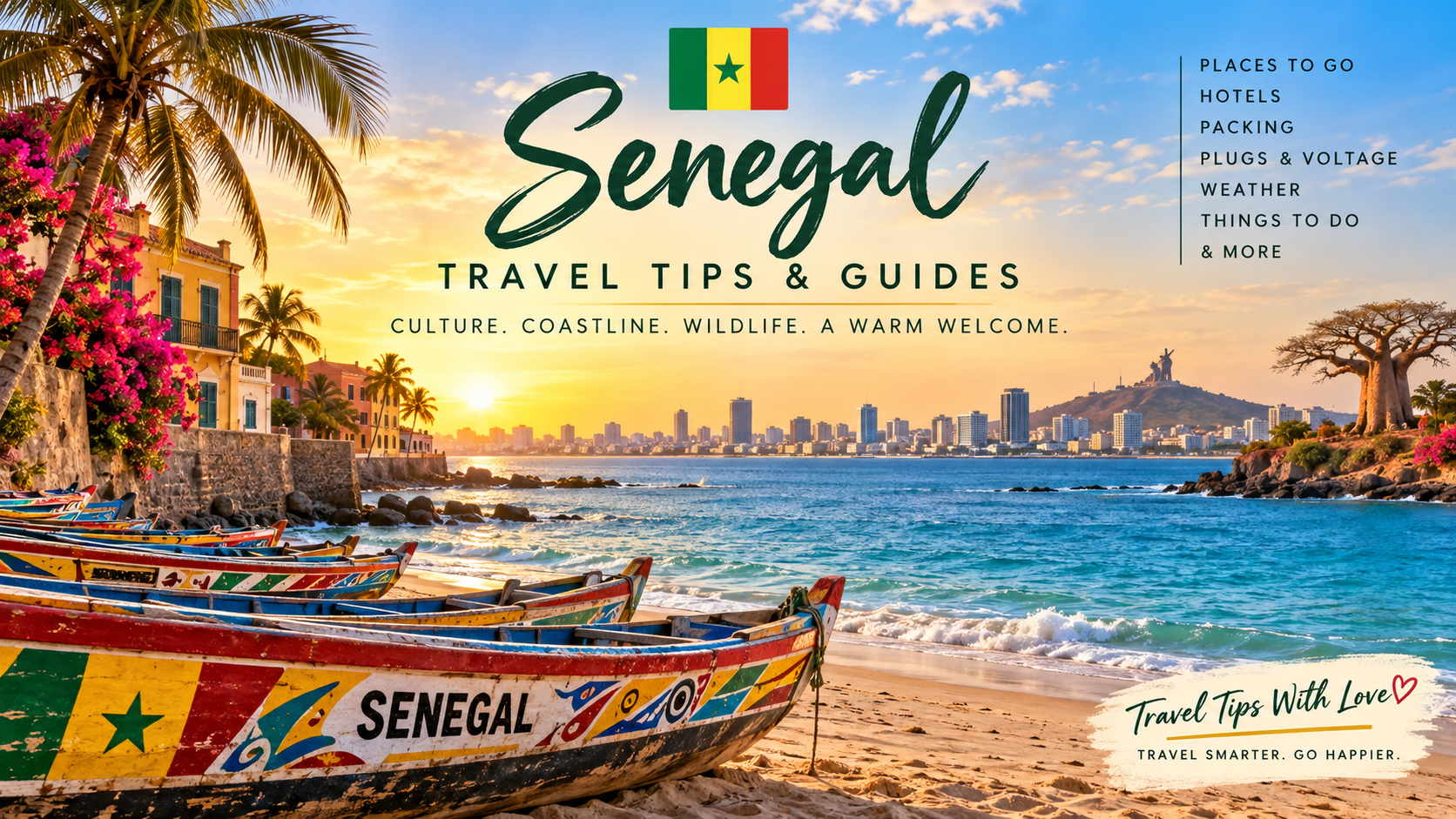
Easy One-Stop Planning Guides for Senegal
Planning a trip to Senegal can raise a surprising number of questions.
Dakar or Saint-Louis? Should you stay on the Petite Côte? Is Gorée Island a day trip or somewhere to spend longer? When should you visit the Sine-Saloum Delta? Is Senegal unbearably hot in summer? What should you pack? Do you need a plug adapter? And how much of the country can you realistically see without spending your entire vacation moving between places?
This page brings all of our Senegal travel planning resources together in one place so you can find what you need without digging through the entire site.
Last updated: September 5, 2026
🇸🇳 Senegal at a Glance
⚠️ Current Travel Considerations
🌦️ Weather & Best Time to Visit
🗺️ Senegal Travel Map
📍 Where to Go in Senegal
🚢 Cruises Around Senegal
🏨 Where to Stay
🧳 What to Pack
🔌 Plugs & Voltage
🎟️ Things to Do
🇸🇳 Senegal at a Glance
| Basics | Details |
|---|---|
| Capital | Dakar |
| Official Language | French; Wolof is extremely widely spoken, along with Pulaar, Serer, Jola, Mandinka and other Senegalese languages |
| Currency | West African CFA franc (XOF) |
| Time Zone | GMT / UTC+0 year-round |
| Driving Side | Right |
| Emergency Numbers | Police: 17; Ambulance: 15; Fire: 18 |
| Plug Types | Type C, D, E and K |
| Electricity | 230V, 50Hz |
| Best Travel Months | November through February |
| Popular Shoulder Months | March–April and late October, depending on region |
| Entry Requirements | Depend on your nationality, passport and length/purpose of stay. Always check the requirements that apply to you before traveling. |
Senegal stretches from the dry Sahel-influenced north to much greener landscapes farther south.
The Atlantic also strongly influences coastal destinations, particularly Dakar and Saint-Louis, so weather can feel very different from inland Senegal.
⚠️ Current Travel Considerations
Last reviewed: September 5, 2026
Senegal remains a destination I am comfortable recommending for leisure travel.
Most travelers visit Senegal without serious problems, but crime deserves normal city awareness, particularly in Dakar. Pickpocketing, bag snatching, robbery and theft can occur, especially in crowded areas, markets, transportation areas and after dark. Keep valuables discreet and arrange reliable transportation rather than accepting unsolicited offers at the airport.
Political demonstrations occur periodically in Dakar and other cities and can disrupt roads, including routes between Dakar and the international airport. Avoid demonstrations and areas where crowds appear tense or police presence is increasing.
Casamance requires additional planning. The main tourism areas are generally calmer than they were historically, but some rural and border areas still carry increased security concerns connected with separatist activity, crime and residual landmine risks. Travelers heading into Casamance should stay on established routes and avoid unnecessary travel after dark.
Road conditions vary considerably. Major roads can be good, while secondary roads may be rough, lighting is limited outside urban areas and heavy rain during the wet season can cause flooding or road damage. Night driving is best minimized when possible.
Mosquito-borne illness is also an important part of Senegal travel planning. Malaria risk exists throughout the country, and dengue, yellow fever and Zika are among the mosquito-borne illnesses travelers should be aware of. Bring serious mosquito protection and sort out any recommended pre-trip health measures before departure.
Medical facilities are considerably better in Dakar than elsewhere, so travel insurance that includes appropriate medical coverage is especially useful if your itinerary includes remote areas.
There are currently no broad security concerns that would make me recommend postponing an ordinary trip to Senegal, but travelers heading into remote border areas or Casamance should plan more carefully than visitors staying around Dakar, Saint-Louis and the main tourist areas.
🌦️ Senegal Weather by Month
Senegal has a tropical climate with a distinct dry season and rainy season, but conditions vary substantially from north to south.
Dakar and northern Senegal are considerably drier than Casamance and the far south.
The Atlantic also keeps Dakar somewhat more moderate than inland areas.
Broadly, November through May is the dry season, while June through October brings the majority of the rain, with August and September among the wettest and most humid months in many areas. Dakar itself remains warm year-round.
| Month | What to Generally Expect |
|---|---|
| January | Dry, sunny and generally comfortable. Cooler evenings and Atlantic breezes make this one of the easiest months for sightseeing. |
| February | Dry with plenty of sunshine and relatively manageable temperatures. Excellent for Dakar, Saint-Louis and multi-stop trips. |
| March | Still dry but gradually hotter, especially inland. Coastal destinations remain more comfortable. |
| April | Hotter and very dry across much of Senegal. Dust and dry Harmattan conditions can occasionally affect visibility and air quality. |
| May | Very warm to hot, especially away from the Atlantic. Humidity begins increasing as the rainy season approaches. |
| June | The transition into the rainy season. Heat and humidity increase and showers become more likely, particularly farther south. |
| July | Hot and humid with increasingly frequent tropical rain. Southern Senegal is substantially wetter than Dakar and the north. |
| August | One of the wettest and most humid periods. Heavy downpours can affect roads and outdoor plans, although rain does not necessarily last all day. |
| September | Still very humid and rainy, with lush landscapes and occasional transportation disruption from heavy rainfall. |
| October | Rain begins easing, especially later in the month. It remains hot and humid but conditions generally become more predictable. |
| November | The dry season returns. Humidity drops and conditions become increasingly comfortable for sightseeing and outdoor travel. |
| December | Dry, sunny and generally excellent for travel, with comfortable coastal conditions and cooler evenings. |
⭐ Best Time to Visit Senegal
For the best overall combination of dry weather, comfortable sightseeing and easier transportation, November through February is generally the sweet spot for visiting Senegal.
December, January and February are especially strong choices.
These months work well for Dakar and Gorée, Saint-Louis, Djoudj, the Petite Côte and Sine-Saloum without the intense humidity and heavy rain of the wet season.
Wildlife interests can affect the answer too.
The cooler dry-season months are particularly appealing for birdwatching around northern wetlands such as Djoudj, where migratory birds add enormously to the experience.
March and April can also work well if you are comfortable with hotter temperatures.
🌧️ Most Challenging Time to Visit Senegal
For most sightseeing-focused travelers, August and September are the most challenging months.
These fall within the heart of the rainy season.
Heat and humidity are high, tropical downpours can be intense and flooding can affect roads and transportation.
Southern Senegal receives substantially more rain than Dakar and the north, so this becomes particularly important if Casamance is part of your itinerary.
That does not make the wet season a bad time to visit.
The landscape becomes much greener, crowds may be lower and tropical storms can create spectacular skies.
But travelers prioritizing straightforward transportation and comfortable days outdoors will generally find the dry season easier.
Important: Always check the actual forecast for the destinations on your itinerary shortly before departure. Dakar, Saint-Louis and southern Senegal can experience very different conditions during the same week.
🗺️ Get Oriented: Senegal’s Main Travel Areas

Senegal is much easier to understand when you group destinations into practical travel regions rather than treating every beach, island and wildlife reserve as a separate stop.
Dakar & Cap-Vert Peninsula: Dakar, Gorée Island, Ngor, Ouakam and Senegal’s main international gateway.
Northern Senegal: Saint-Louis, the Senegal River and Djoudj National Bird Sanctuary.
Dakar Day-Trip Area: Lac Rose and destinations within relatively easy reach of the capital.
Petite Côte: Saly, Somone, Bandia Wildlife Reserve and relaxed Atlantic beach stays.
Sine-Saloum: Joal-Fadiouth, Palmarin, Toubacouta, Mar Lodj, mangroves, waterways and small islands.
Central Senegal: Touba and important inland religious and cultural destinations.
Casamance: Ziguinchor, Cap Skirring and Senegal’s much greener south.
Southeastern Senegal: Niokolo-Koba National Park and more remote wildlife-oriented travel.
For most first trips, Dakar plus one or two contrasting regions is plenty.
🗺️ Start Here: Where Should You Go in Senegal?
If you haven’t decided exactly where you’re going yet, start with our complete Senegal destination guide.
Best Places to Visit in Senegal: Dakar, Gorée Island, Saint-Louis, Sine-Saloum, Saly & More
Dakar and Gorée introduce Senegal’s contemporary culture and extraordinary history.
Saint-Louis and Djoudj combine a historic city with wetlands and birdlife.
The Petite Côte brings beaches, resorts and easy wildlife experiences.
And Sine-Saloum offers mangrove channels, islands, traditional communities and slower travel by pirogue.
This guide organizes Senegal around practical bases instead of creating an unnecessarily long checklist of individual sights.
Read: Best Places to Visit in Senegal
🌺 Festivals & Seasonal Experiences
Senegal’s music, religious celebrations, cultural events and seasonal wildlife patterns can significantly change the experience of a trip.
Major religious celebrations can affect traffic, transportation, accommodation and the rhythm of everyday life, while Dakar’s cultural scene brings festivals, music, art and fashion events throughout the year.
Senegal festivals and seasonal experiences guide coming soon.
🚢 Cruises Around Senegal
Dakar appears on some West Africa, Atlantic and expedition-style cruise itineraries.
Cruise calls are much less frequent than in major Mediterranean or Caribbean ports, but Dakar can be an interesting stop for travelers combining several West African countries by sea.
Gorée Island, Dakar sightseeing and cultural excursions are among the most natural options during a port call.
Senegal cruise guide coming soon.
🏨 Where to Stay in Senegal
🏨 Where to Stay in Senegal
Where you stay depends heavily on the kind of Senegal trip you are planning.
Dakar makes the most practical base for first arrivals, city sightseeing, Gorée Island and many of the easiest day trips from the capital.
Saint-Louis works well for travelers combining history with Djoudj and northern Senegal.
Saly and the Petite Côte offer the easiest concentration of beach resorts and vacation-style accommodation.
Sine-Saloum is better suited to small lodges, nature-focused stays and travelers looking for a quieter experience.
Dakar
→ Where to Stay in Dakar, Senegal: Best Hotels for Every Kind of Trip
More Senegal hotel guides will be added here as we build them.
🧳 What to Pack for Senegal
🧳 What to Pack for Senegal
Packing for Senegal needs to account for powerful sun, heat, humidity, insects, dust, ferries, beaches, wetlands and long travel days.
Conditions also change noticeably through fall. September is still firmly within the hot, humid rainy season in much of the country, October is transitional, and November moves into Senegal’s much drier and more comfortable travel season.
🍂 Fall
→ Exactly What to Pack for Senegal in Fall: September, October & November — Carry-On Only
A practical carry-on-only packing guide covering Senegal’s heat, humidity, rain, mosquitoes, powerful sun, coastal conditions and the major weather shift between September and November.
Winter Senegal packing guide coming soon.
Spring Senegal packing guide coming soon.
Summer Senegal packing guide coming soon.
🔌 Senegal Plugs, Outlets & Voltage
Senegal uses 230V electricity at 50Hz, with Type C, D, E and K outlets.
Because several different socket styles may be encountered, travelers should not assume that one familiar European-style plug will necessarily cover every outlet.
Phones, laptops, cameras and most modern chargers labeled 100–240V are generally fine with the correct adapter.
Travelers coming from countries using 100–127V electricity need to pay particular attention to single-voltage appliances. A plug adapter changes the shape of the plug. It does not convert voltage.
Read: Senegal Outlet, Plug & Voltage Guide for Travelers — Complete Edition ⚡
The full guide explains adapters, voltage compatibility, converters and what travelers from different electrical systems need to know.
🎟️ Things to Do in Senegal
Senegal’s best experiences go well beyond traditional sightseeing.
You might take the ferry to Gorée Island, explore Dakar’s contemporary art scene, hear live music, eat Senegalese food, travel by pirogue through mangrove channels, watch enormous concentrations of birds at Djoudj, visit fishing communities, spend a day at Bandia, explore Saint-Louis, or simply slow down along the Atlantic coast.
A complete Senegal Things to Do collection will be added here as we build it.
❤️ Helpful Travel Guides for Any Trip
Some travel questions aren’t specific to Senegal. These Travel Tips With Love guides can help wherever you’re going.
🧳 Choosing & Packing Your Luggage
✈️ Surviving a Long Flight
🎒 Check Your Airline’s Carry-On Limits
Airline rules vary enormously, especially when you’re connecting between different carriers.
→ Global Carry-On & Personal Item Size Limits by Airline A–Z
🤒 What If You Get Sick While Traveling?
This is particularly worth planning ahead for when traveling beyond Dakar, where medical facilities become more limited.
→ What to Do If You Get Sick While Traveling
🎟️ Should You Book Activities Ahead?
Some Dakar tours and popular excursions can be booked before arrival, while many boat trips and smaller local experiences are easier to arrange through accommodations or local operators.
→ Should I Book Tours & Activities Ahead of Time?
💆♀️ Make Any Vacation Feel More Relaxing
A few slower beach or lodge days can work beautifully between Dakar sightseeing and longer road trips.
→ How to Make Any Vacation a Spa Vacation
🌍 Explore More Countries
Not sure Senegal is the trip this time?
Explore our All Countries Travel Tips & Guides to find destination planning hubs around the world.
Each country hub brings together practical planning information, current travel considerations, weather basics and all of our available destination guides in one easy place.
→ Explore All Countries & Destinations
This Senegal hub is a living travel-planning resource. I update it as new Travel Tips With Love Senegal guides are published and as important planning or safety information changes.
From Tracy, With Love ♥