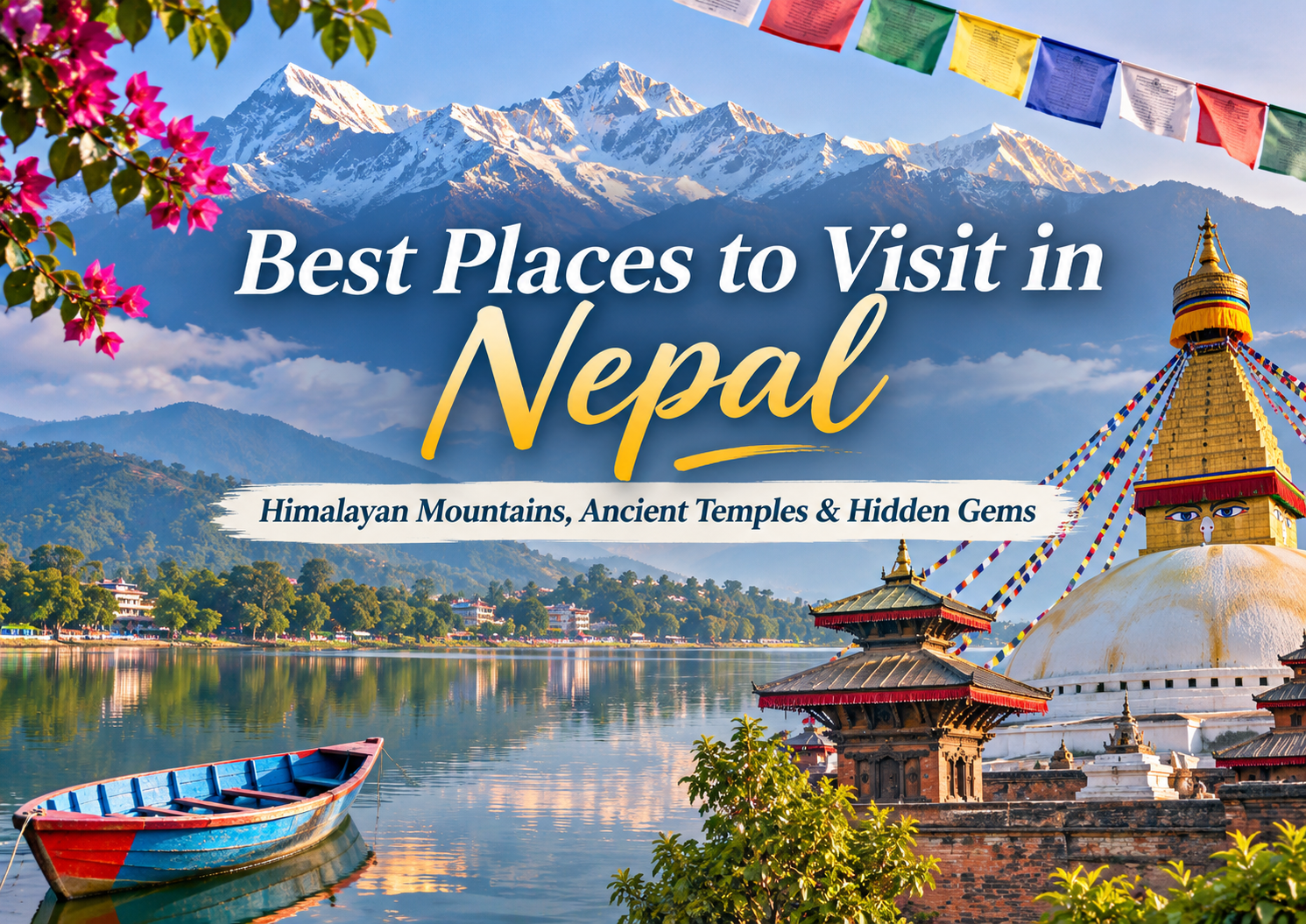
Nepal is a country where snow-covered Himalayan peaks rise above colorful prayer flags, ancient temples fill historic city squares, and peaceful lakes reflect some of the world’s most extraordinary mountain scenery.
But Nepal is so much more than Mount Everest.
Beyond its famous trekking routes, you’ll discover beautifully preserved hill towns, lush national parks filled with wildlife, sacred pilgrimage destinations, and tea-covered landscapes that feel wonderfully removed from everyday life.
Whether you’re dreaming of a Himalayan adventure, a cultural escape, a wildlife safari, or a slower journey through historic villages, Nepal offers some truly unforgettable places to explore.
Here are my favorite places to visit in Nepal, including the highlights, nearby attractions, and experiences that make each destination worth adding to your itinerary.

1. Kathmandu — Ancient Temples, Royal Squares & Cultural Treasures
Region: Bagmati Province, Central Nepal
Best for: First-time visitors, history lovers, architecture enthusiasts, cultural experiences, temples, shopping, and food.
Kathmandu is Nepal’s fascinating capital and one of the best places to begin exploring the country.
The city combines centuries-old temples, magnificent Buddhist stupas, traditional markets, royal palace squares, and lively streets filled with shops and restaurants.
But the real beauty of staying in Kathmandu is how much of the surrounding valley you can explore without constantly changing hotels.
The historic cities of Patan and Bhaktapur are nearby, each offering extraordinary architecture and cultural heritage.
You can also escape toward the valley’s hilltop viewpoints for Himalayan panoramas when visibility is clear.
Main Highlights
- Kathmandu Durbar Square — Explore historic royal courtyards, temples, traditional architecture, and centuries of Nepalese history.
- Swayambhunath Stupa — Visit the famous Monkey Temple, set on a hill overlooking Kathmandu with sweeping views across the valley.
- Boudhanath Stupa — Discover one of Nepal’s most important Buddhist landmarks, surrounded by monasteries, prayer flags, and rooftop cafés.
- Pashupatinath Temple — Experience one of Hinduism’s most sacred temple complexes beside the Bagmati River. Access to some areas is restricted to Hindu worshippers.
- Patan Durbar Square — Explore elaborate temples, traditional Newari architecture, and the excellent Patan Museum.
- Bhaktapur Durbar Square — Wander through an extraordinary historic city known for its palace courtyards, pottery traditions, and beautifully preserved architecture.
- Changu Narayan Temple — Visit an important ancient Hindu temple known for its detailed stone carvings and historic significance.
- Thamel — Browse shops, discover local restaurants, and enjoy Kathmandu’s lively tourism district.
- Nagarkot — Head into the surrounding hills for Himalayan viewpoints, sunrise scenery, and peaceful countryside.
- Garden of Dreams — Enjoy a quiet garden retreat away from the capital’s busy streets.
Why I Recommend It
Kathmandu is one of those destinations where sightseeing feels almost endless.
The city’s religious landmarks and historic buildings are fascinating, but the surrounding valley makes it particularly rewarding.
You can spend one day exploring Kathmandu’s famous stupas, another discovering Patan’s intricate architecture, and another wandering through Bhaktapur’s historic streets.
And there’s no need to treat each nearby town as an entirely separate holiday destination.
Kathmandu provides plenty of accommodation, restaurants, organized excursions, and transportation options, making it a practical base for travelers who want to experience the valley’s cultural highlights.
Don’t Miss
- Visiting Boudhanath Stupa in the evening, when worshippers gather and the surrounding area becomes especially atmospheric.
- Exploring Bhaktapur’s historic squares and traditional streets.
- Admiring the Kathmandu Valley from Swayambhunath.
- Discovering the extraordinary craftsmanship inside Patan Museum.
Good to Know
- Allow approximately 3–5 days to explore Kathmandu and the surrounding valley.
- Traffic can be extremely congested, so short distances may require surprisingly long journeys.
- Thamel is a convenient accommodation area for restaurants, shopping, and organized tours.
- Religious sites may have entry fees, photography restrictions, and specific visitor rules.
- Mountain views from Nagarkot depend on weather and atmospheric visibility.
- Many historic attractions include uneven paving, steps, and limited accessibility.
2. Pokhara — Beautiful Lakes, Himalayan Views & Outdoor Adventures 🏔️

Region: Gandaki Province, Central Nepal
Best for: Couples, families, nature lovers, photographers, outdoor adventures, mountain scenery, and relaxing lakeside holidays.
Pokhara is one of Nepal’s most beautiful destinations, and it’s easy to understand why travelers fall in love with it.
Set beside peaceful Phewa Lake with the Annapurna mountains rising dramatically in the distance, the city offers a wonderful combination of scenery, relaxation, and outdoor experiences.
Colorful boats float across the lake, restaurants line the waterfront, and nearby hills provide spectacular mountain viewpoints.
Pokhara is also an important gateway to the Annapurna trekking region, although you don’t have to be an experienced hiker to appreciate its beauty.
There are plenty of memorable experiences for visitors who simply want to enjoy the landscapes at a gentler pace.
Main Highlights
- Phewa Lake — Enjoy boating, waterfront restaurants, mountain reflections, and beautiful lakeside scenery.
- Lakeside District — Explore Pokhara’s most popular visitor area, filled with cafés, restaurants, shops, and accommodation.
- Sarangkot — Visit one of the region’s famous sunrise viewpoints for spectacular panoramas of the Annapurna range.
- World Peace Pagoda — Admire a beautiful white Buddhist monument overlooking Phewa Lake and the surrounding mountains.
- Pumdikot Shiva Statue — Discover an impressive hilltop Shiva statue with wide views over Pokhara.
- International Mountain Museum — Learn about Himalayan exploration, mountaineering history, mountain communities, and the world’s highest peaks.
- Devi’s Falls — See a waterfall disappearing into an underground passage during periods of sufficient water flow.
- Gupteshwor Mahadev Cave — Explore a cave complex with religious significance and views toward the underground waterfall.
- Begnas Lake — Enjoy a quieter lake setting surrounded by hills and peaceful countryside.
- Paragliding — Experience Pokhara’s dramatic landscapes from above with an experienced operator when conditions permit.
- Annapurna excursions — Use Pokhara as the starting point for guided hikes, scenic mountain trips, and longer trekking adventures.
Why I Recommend It
Pokhara offers some of Nepal’s most spectacular scenery without requiring travelers to commit to a demanding mountain expedition.
It’s a destination where you can do as much or as little as you like.
You might spend the morning watching the sunrise over the Annapurnas, enjoy lunch beside the lake, and finish the afternoon exploring a temple or relaxing at a waterfront café.
For adventurous visitors, there are opportunities for trekking, paragliding, mountain biking, and guided outdoor experiences.
But Pokhara is equally appealing for couples and families who prefer a comfortable hotel, beautiful views, and sightseeing at their own pace.
Don’t Miss
- Watching sunrise illuminate the Annapurna mountains from Sarangkot.
- Taking a boat onto Phewa Lake.
- Visiting the World Peace Pagoda for its wonderful views.
- Enjoying an evening along the Lakeside waterfront.
Good to Know
- Allow 3–5 days for the city and nearby attractions.
- Lakeside offers the widest selection of visitor accommodation and restaurants.
- Clear mountain views are more likely during favorable weather, particularly outside the monsoon season.
- Longer Annapurna treks require separate planning, suitable equipment, and attention to permits.
- Some mountain excursions involve substantial altitude changes and demanding terrain.
- Domestic flights and road transfers can be disrupted by weather.
3. Sauraha & Chitwan — Wildlife Safaris, Rhinoceroses & Jungle Adventures 🦏

Region: Chitwan District, South-Central Nepal
Best for: Wildlife enthusiasts, families, photographers, nature lovers, couples, and safari experiences.
Nepal’s southern plains reveal a completely different landscape from its famous Himalayan mountains.
Instead of snow-covered peaks, you’ll discover dense forests, tropical grasslands, winding rivers, and remarkable wildlife.
Chitwan National Park is one of Nepal’s most celebrated natural attractions, particularly famous for its greater one-horned rhinoceroses.
Sauraha is a convenient base for exploring the park, with safari lodges, hotels, restaurants, and organized wildlife excursions.
The surrounding landscape provides opportunities to discover another fascinating side of Nepal.
Main Highlights
- Chitwan National Park — Explore a UNESCO World Heritage Site protecting rhinoceroses, Bengal tigers, elephants, crocodiles, and numerous bird species.
- Guided Jeep Safaris — Travel through forests and grasslands while searching for wildlife with experienced guides.
- One-Horned Rhinoceroses — Look for one of the park’s signature animals in its natural habitat.
- Bengal Tiger Habitat — Discover the forests and grasslands where these elusive predators live.
- Rapti River Canoe Excursions — Enjoy guided river experiences with opportunities to spot crocodiles and waterbirds.
- Birdwatching — Search for kingfishers, hornbills, storks, and many other species.
- Tharu Cultural Experiences — Learn about the traditions, architecture, and cultural heritage of local Tharu communities.
- Rapti River Sunsets — Relax beside the river and watch the changing evening light.
- Guided Nature Walks — Explore suitable forest and buffer-zone areas with qualified local guides.
Why I Recommend It
Chitwan is one of the strongest reasons to visit Nepal beyond its mountain destinations.
The opportunity to see rhinoceroses in the wild is extraordinary, particularly for travelers who haven’t experienced a wildlife safari before.
The park also offers beautiful natural scenery, interesting cultural experiences, and a very different atmosphere from Kathmandu or Pokhara.
Sauraha makes organizing activities relatively straightforward, with accommodation ranging from modest guesthouses to comfortable jungle resorts.
It’s especially rewarding as part of a longer itinerary combining Kathmandu, Pokhara, and Nepal’s southern plains.
Don’t Miss
- A guided jeep safari through Chitwan National Park.
- Watching for rhinoceroses in their natural habitat.
- A canoe excursion along the Rapti River when conditions are suitable.
- Sunset beside the river.
Good to Know
- Allow 2–3 nights for wildlife experiences.
- Rhinoceros sightings are possible, but no particular animal encounter is guaranteed.
- Bengal tigers inhabit the park but are much harder to spot.
- Avoid elephant-riding activities and choose responsible wildlife operators.
- The southern plains can become very hot, especially before the monsoon.
- Park activities may be restricted during heavy rainfall or flooding.
- Only undertake wildlife walks with authorized, qualified guides.
4. Bandipur — Traditional Newari Architecture & Peaceful Mountain Views 🏘️

Region: Tanahun District, Gandaki Province
Best for: Couples, photographers, architecture lovers, traditional villages, scenic retreats, and slow travel.
Bandipur is one of Nepal’s most charming historic hill towns.
Perched above the surrounding valleys, it offers beautiful traditional architecture, quiet streets, mountain views, and a wonderfully relaxed atmosphere.
The historic bazaar is filled with preserved Newari buildings, carved wooden windows, traditional shops, and inviting places to sit and enjoy the surroundings.
Unlike Kathmandu’s energetic city streets, Bandipur feels much slower and more intimate.
It’s an appealing overnight destination for travelers who enjoy historic places and want to experience Nepal’s smaller communities.
Main Highlights
- Bandipur Bazaar — Wander through traditional streets lined with beautifully preserved Newari buildings.
- Tundikhel Viewpoint — Enjoy panoramic views across the valleys and toward distant Himalayan peaks.
- Thani Mai Temple — Climb to a hilltop temple for spectacular views over Bandipur and the surrounding countryside.
- Siddha Gufa — Explore one of Nepal’s notable cave attractions with an appropriate local guide.
- Traditional Architecture — Admire the carved wooden windows, historic merchant houses, and beautifully detailed buildings.
- Local Village Walks — Explore surrounding communities, agricultural landscapes, and hillside trails.
- Mountain Sunsets — Enjoy peaceful evening scenery from the town’s elevated viewpoints.
Why I Recommend It
Bandipur is the sort of place that deserves an overnight stay rather than a hurried stop for photographs.
Its architecture is beautiful, but much of its appeal comes from the atmosphere.
You can spend hours walking through the bazaar, sitting at a café, admiring mountain views, or exploring the surrounding countryside.
Bandipur also makes an excellent stop between Kathmandu and Pokhara, allowing travelers to break up a longer road journey while experiencing a completely different destination.
Don’t Miss
- Walking through Bandipur’s historic bazaar.
- Watching sunset from Tundikhel.
- Exploring the traditional architecture and quiet streets.
- Visiting Thani Mai Temple if you’re comfortable with the uphill walk.
Good to Know
- One or two nights is ideal for most visitors.
- The town is reached by a winding uphill road from the main highway.
- Some attractions involve steep paths, uneven steps, or challenging terrain.
- Mountain panoramas depend on visibility and weather.
- Bandipur is especially appealing for travelers who enjoy smaller hotels and traditional guesthouses.
5. Lumbini — The Birthplace of Buddha & Sacred Gardens 🪷

Region: Rupandehi District, Lumbini Province
Best for: History lovers, Buddhist heritage, religious travelers, cultural experiences, architecture, and peaceful sightseeing.
Lumbini is one of Nepal’s most important historical and religious destinations.
Recognized as the birthplace of Siddhartha Gautama, the Buddha, it attracts pilgrims and visitors from around the world.
The Sacred Garden contains important archaeological and religious landmarks, while the surrounding monastic area features temples representing Buddhist traditions from different countries.
Unlike Nepal’s busier cities, Lumbini offers a more peaceful and contemplative experience.
It’s a fascinating destination even for travelers who aren’t visiting for religious reasons.
Main Highlights
- Maya Devi Temple — Visit the sacred site traditionally identified as the birthplace of Buddha.
- Sacred Garden — Explore the peaceful grounds surrounding Lumbini’s most significant historical landmarks.
- Ashoka Pillar — See an ancient pillar commemorating the site’s significance.
- Lumbini Monastic Zone — Discover beautiful monasteries built in different national and architectural traditions.
- World Peace Pagoda — Admire a striking white Buddhist monument surrounded by peaceful grounds.
- International Monasteries — Visit monastery complexes representing countries including Thailand, Myanmar, Japan, and others.
- Lumbini Museum — Learn about Buddhism’s history and the cultural significance of the region.
- Sacred Ponds and Gardens — Enjoy quiet places for reflection and photography.
Why I Recommend It
Lumbini offers an experience that’s completely different from Nepal’s mountain adventures and wildlife destinations.
Its significance in world religious history makes it extraordinary.
Walking through the Sacred Garden and exploring the international monasteries provides an opportunity to appreciate the artistic and cultural traditions associated with Buddhism.
The variety of architectural styles is particularly fascinating, and the peaceful atmosphere makes Lumbini an appealing place to slow down.
Don’t Miss
- Maya Devi Temple and the Sacred Garden.
- Exploring several monasteries with different architectural styles.
- Visiting the World Peace Pagoda.
- Taking time to appreciate the historical importance of the site.
Good to Know
- Allow 1–2 nights.
- The sacred and monastic areas are spread across considerable distances.
- Bicycles, electric vehicles, or arranged transportation can make sightseeing easier.
- Dress respectfully when visiting religious sites.
- Summers are hot, and exposed areas can be uncomfortable during the middle of the day.
- Some temples have restrictions on photography or visitor access.
6. Tansen — Historic Streets, Traditional Culture & Hilltop Scenery 🏰
Region: Palpa District, Lumbini Province
Best for: History enthusiasts, architecture lovers, photographers, traditional crafts, mountain views, and quieter cultural experiences.
Tansen is a historic hillside town that offers another beautiful perspective on Nepal’s traditional architecture and everyday culture.
Its old streets are lined with historic buildings, temples, shops, and distinctive Newari architectural details.
The town is also famous for Palpali Dhaka, a traditional woven textile often used to create clothing and accessories.
Beyond its historic center, Tansen offers sweeping views across the hills and access to interesting attractions in the surrounding countryside.
Main Highlights
- Tansen Durbar — Discover the town’s historic palace complex and its architectural heritage.
- Tansen Bazaar — Wander through traditional streets, markets, and historic neighborhoods.
- Shreenagar Hill — Enjoy beautiful viewpoints overlooking the surrounding valleys and distant mountains.
- Amar Narayan Temple — Visit an important temple known for its traditional architecture.
- Palpali Dhaka Workshops — Learn about the region’s famous textile-weaving traditions.
- Rani Mahal — Explore a striking historic palace beside the Kali Gandaki River, reached by a separate excursion.
- Traditional Newari Buildings — Admire historic wooden windows and architectural craftsmanship.
- Local Markets — Discover traditional goods, textiles, and everyday town life.
Why I Recommend It
Tansen is particularly appealing because it offers meaningful cultural experiences without the crowds associated with Nepal’s best-known attractions.
It’s a town where wandering through the streets can be just as rewarding as visiting the major landmarks.
The traditional textile workshops add another interesting dimension, while Shreenagar Hill provides lovely views across the surrounding landscape.
Tansen also fits naturally into a journey between Pokhara and Lumbini, making it a worthwhile destination for travelers who want to see more of Nepal than its usual tourism circuit.
Don’t Miss
- Exploring Tansen’s historic bazaar.
- Visiting a Palpali Dhaka weaving workshop.
- Enjoying the views from Shreenagar Hill.
- Taking an excursion to Rani Mahal if road conditions and travel time allow.
Good to Know
- One or two nights is suitable for most visitors.
- Tansen’s hillside streets can be steep.
- Rani Mahal requires additional road travel and is not a quick walk from town.
- Smaller guesthouses and local hotels provide accommodation options.
- Tansen is a good choice for travelers interested in culture rather than major adventure activities.
7. Janakpur — Magnificent Temples, Religious Heritage & Mithila Art 🛕
Region: Madhesh Province, Southeastern Nepal
Best for: Religious heritage, architecture, colorful festivals, traditional art, history, and cultural exploration.
Janakpur is one of Nepal’s most distinctive cultural cities.
Located in the southern plains, it is closely associated with Sita, also known as Janaki, and holds immense religious importance in Hindu tradition.
Its most famous attraction, Janaki Mandir, is a magnificent temple with elaborate architectural details and a beautiful white exterior.
The city is also an important center of Mithila culture, known for its colorful paintings, traditional designs, and lively religious celebrations.
Janakpur offers an experience quite different from Nepal’s mountain towns and Buddhist heritage destinations.
Main Highlights
- Janaki Mandir — Admire the city’s magnificent landmark temple, dedicated to Sita.
- Ram Mandir — Visit another important Hindu temple associated with the city’s religious heritage.
- Vivah Mandap — Discover a site commemorating the traditional marriage of Rama and Sita.
- Mithila Art — Explore colorful traditional paintings depicting mythology, daily life, nature, and cultural traditions.
- Sacred Ponds — Visit historic religious ponds, including Ganga Sagar and Dhanush Sagar.
- Local Markets — Discover regional crafts, sweets, and traditional goods.
- Dhanushadham — Take an excursion to a religious site associated with the Ramayana tradition.
- Vivah Panchami Festival — Experience one of Janakpur’s most important annual celebrations when your visit coincides with the festival.
Why I Recommend It
Janakpur deserves attention because it introduces travelers to the rich cultural traditions of Nepal’s southern plains.
The architecture of Janaki Mandir alone makes the city memorable.
But there’s much more to discover through its sacred sites, artistic traditions, and local markets.
Mithila paintings are particularly fascinating, with distinctive colorful patterns and meaningful cultural imagery.
For travelers who enjoy exploring religious history and regional traditions, Janakpur provides an excellent contrast to Kathmandu and Pokhara.
Don’t Miss
- Admiring Janaki Mandir’s extraordinary architecture.
- Exploring traditional Mithila artwork.
- Visiting the city’s sacred ponds.
- Experiencing Janakpur during a major religious festival if your dates allow.
Good to Know
- Allow 1–2 nights.
- Janakpur has a warmer climate than Nepal’s mountain destinations.
- Religious festivals can attract enormous crowds.
- Hotels and transportation should be arranged early during major celebrations.
- Modest dress and respectful behavior are important around religious sites.
- Janakpur is a significant destination in its own right, not a practical day trip from Kathmandu.
8. Thakurdwara & Bardiya — Remote Jungles, Tigers & Wild Nepal 🐅
Region: Bardiya District, Western Nepal
Best for: Wildlife enthusiasts, adventurous travelers, photographers, jungle safaris, and quieter nature experiences.
Bardiya National Park offers one of Nepal’s most exciting wilderness experiences.
Located in the country’s western lowlands, this beautiful national park protects forests, grasslands, rivers, and important habitats for Bengal tigers, rhinoceroses, elephants, and other wildlife.
Compared with Chitwan, Bardiya is more remote and generally receives fewer international visitors.
The village of Thakurdwara provides a practical base for park excursions, with safari lodges and guided activities available nearby.
For travelers who love wildlife and don’t mind a longer journey, Bardiya can be an extraordinary addition to a Nepal itinerary.
Main Highlights
- Bardiya National Park — Explore one of Nepal’s important protected wildlife landscapes.
- Bengal Tigers — Search for signs of these elusive predators during professionally guided safaris.
- Greater One-Horned Rhinoceroses — Look for rhinoceroses in the park’s grasslands and forest habitats.
- Guided Jeep Safaris — Explore wildlife-rich areas of the park with qualified local guides.
- Wild Elephants — Learn about the region’s elephant populations and their protected habitats.
- Karnali River — Discover beautiful river landscapes and opportunities for wildlife observation.
- Crocodiles and Birdwatching — Look for gharials, other crocodiles, and a wide variety of birds.
- Tharu Cultural Experiences — Discover local traditions and village life.
- Jungle Lodges — Stay near the wilderness and enjoy the atmosphere of Nepal’s western lowlands.
Why I Recommend It
Bardiya is particularly appealing for travelers who want a safari experience that feels genuinely remote.
The park’s wildlife and extensive natural landscapes are extraordinary, but the quieter atmosphere is another major attraction.
Unlike destinations where sightseeing is organized around numerous nearby landmarks, Bardiya is about spending time in nature.
A morning safari might reveal animal tracks, interesting birds, or movement through the grasslands.
And even without a rare tiger sighting, the experience of exploring this wilderness can be memorable.
Don’t Miss
- A professionally guided wildlife safari.
- Exploring different forest and grassland habitats.
- Birdwatching around suitable river areas.
- Enjoying the peaceful atmosphere of a jungle lodge.
Good to Know
- Allow approximately 3–4 nights.
- Bardiya is remote and requires more transportation planning than Chitwan.
- Tiger sightings are never guaranteed.
- Guided activities should be arranged with reputable operators.
- Seasonal weather can affect access and safari conditions.
- The southern plains can become extremely hot during warmer months.
- Wildlife should never be approached or disturbed for photographs.
9. Ilam — Rolling Tea Plantations & Beautiful Green Hills 🍃
Region: Koshi Province, Eastern Nepal
Best for: Couples, tea lovers, nature photographers, peaceful countryside, hill scenery, and slow travel.
Ilam reveals another beautiful side of Nepal.
Instead of dramatic high-altitude mountain landscapes or tropical forests, this eastern region is famous for rolling green hills covered in tea plantations.
The scenery is wonderfully peaceful, with winding roads, lush valleys, traditional settlements, and distant mountain views.
Ilam Bazaar provides a useful base for exploring the wider area, while the surrounding tea-growing communities offer attractive countryside accommodation.
It’s an excellent destination for travelers who enjoy scenic landscapes, local culture, and places that feel less heavily visited.
Main Highlights
- Ilam Tea Gardens — Explore rolling hills covered in beautifully maintained tea plantations.
- Kanyam Tea Estate — Visit one of eastern Nepal’s most recognizable tea-growing landscapes.
- Ilam Bazaar — Discover local markets, shops, and the town’s everyday atmosphere.
- Mai Pokhari — Explore a peaceful lake and wetland area surrounded by forest.
- Shree Antu / Antu Danda — Visit scenic viewpoints known for sunrise landscapes and distant mountain panoramas.
- Tea Tasting — Learn about local tea production and sample regional varieties.
- Traditional Villages — Explore rural communities and surrounding agricultural landscapes.
- Scenic Countryside Drives — Enjoy winding routes through green hills and tea-growing areas.
Why I Recommend It
Ilam is a lovely choice for travelers who want to experience Nepal beyond its famous cities and trekking routes.
The tea plantations create an entirely different landscape from the Annapurna and Everest regions.
There’s something especially peaceful about the green hills, small villages, and slow pace of the countryside.
You don’t need a long list of major attractions to appreciate Ilam.
A few days exploring tea estates, enjoying viewpoints, and discovering local food and culture can be wonderfully rewarding.
Don’t Miss
- Visiting Kanyam’s scenic tea plantations.
- Watching sunrise from Shree Antu when visibility is good.
- Sampling locally grown tea.
- Exploring the peaceful countryside around Ilam.
Good to Know
- Allow 2–3 nights, or longer for a relaxed countryside stay.
- Ilam is in eastern Nepal and is not a convenient short excursion from Kathmandu or Pokhara.
- Road journeys can be lengthy and winding.
- Some attractions are spread across the district and require arranged transportation.
- Tea plantations and viewpoints can look especially lush during wetter months, although rain and mist may reduce visibility.
- Smaller accommodations and countryside homestays are common in the region.
10. Jomsom & Lower Mustang — Dramatic Mountain Valleys & Tibetan-Influenced Culture 🏔️
Region: Mustang District, Gandaki Province
Best for: Adventurous travelers, mountain scenery, cultural exploration, road journeys, photography, and unusual landscapes.
Lower Mustang is one of Nepal’s most visually extraordinary regions.
Located beyond the lush landscapes surrounding Pokhara, this area features rugged mountains, deep valleys, windswept settlements, and landscapes influenced by the Tibetan Plateau.
The scenery feels dramatically different from the green valleys and tropical forests found elsewhere in Nepal.
Jomsom is a practical base for discovering the lower Kali Gandaki Valley and nearby settlements.
From here, travelers can explore traditional villages, sacred pilgrimage sites, and spectacular high-altitude landscapes.
Main Highlights
- Jomsom — Explore the region’s principal gateway town, surrounded by dramatic mountain scenery.
- Kali Gandaki Valley — Admire the extraordinary river valley separating major Himalayan mountain ranges.
- Marpha Village — Discover traditional whitewashed buildings, narrow streets, apple orchards, and local products.
- Kagbeni — Explore an atmospheric Himalayan village with Tibetan-influenced architecture and ancient streets.
- Muktinath Temple — Visit a major pilgrimage destination sacred to both Hindus and Buddhists.
- Dhumba Lake — Discover a small, beautiful lake surrounded by mountain scenery.
- Mountain Viewpoints — Enjoy dramatic panoramas of rugged valleys and surrounding peaks.
- Traditional Mountain Villages — Experience the architecture, customs, and landscapes of the Lower Mustang region.
Why I Recommend It
Lower Mustang feels almost like entering another world.
The combination of barren mountain landscapes, ancient villages, and Tibetan-influenced culture makes it unlike most other destinations in Nepal.
It’s especially appealing for photographers and travelers who enjoy dramatic scenery.
The journey itself is part of the adventure, with extraordinary valleys and mountain views along the way.
And while the region is associated with trekking, some Lower Mustang attractions can be reached by road, making certain experiences possible without undertaking a traditional multi-day hiking route.
Don’t Miss
- Exploring the beautiful village of Marpha.
- Wandering through Kagbeni’s traditional streets.
- Visiting Muktinath Temple if altitude and conditions permit.
- Enjoying the dramatic scenery of the Kali Gandaki Valley.
Good to Know
- Allow at least 3–4 days for Lower Mustang, with extra time for transportation disruptions.
- Jomsom is approximately 2,700 meters above sea level, while Muktinath is considerably higher.
- Altitude sickness can affect travelers even when they arrive by vehicle.
- Roads are rugged and can be affected by landslides, flooding, and seasonal weather.
- Flights to Jomsom are highly weather-dependent.
- The Annapurna Conservation Area has permit requirements.
- Upper Mustang is a separate, more remote destination with additional restrictions and permits. Do not assume that a Lower Mustang itinerary includes it.
- Travel in this region should be planned with particular care during winter and periods of unstable weather.
11. Namche Bazaar — The Gateway to Everest & Sherpa Mountain Culture 🥾
Region: Solukhumbu District, Koshi Province, Northeastern Nepal
Best for: Experienced hikers, Himalayan trekking, mountain photography, Sherpa culture, and adventurous travelers.
Namche Bazaar is one of the most famous mountain settlements in Nepal.
Situated high in the Everest region, this remarkable town is surrounded by spectacular Himalayan landscapes.
Colorful buildings climb the mountainside, shops and teahouses line narrow paths, and trekking routes lead toward some of the highest peaks on Earth.
Namche is an important stop for trekkers heading toward Everest Base Camp, but it can also serve as a destination for travelers planning a shorter, carefully organized Himalayan trek.
Unlike Kathmandu or Pokhara, however, reaching Namche requires real physical effort and altitude preparation.
Main Highlights
- Namche Bazaar — Explore the famous Sherpa settlement with its colorful buildings, mountain shops, and traditional teahouses.
- Everest Region Viewpoints — Enjoy extraordinary Himalayan panoramas from suitable viewpoints around Namche.
- Sagarmatha National Park — Discover the protected mountain region surrounding Mount Everest.
- Sherpa Culture Museum — Learn about local mountain culture, heritage, and traditions.
- Khumjung Village — Visit a traditional Sherpa settlement on an acclimatization excursion.
- Khunde Village — Discover another beautiful community in the surrounding highlands.
- Everest View Hotel Area — Walk toward a celebrated mountain viewpoint on an appropriate acclimatization hike.
- Monasteries and Prayer Flags — Experience the spiritual traditions of the Himalayan communities.
- Mountain Trekking Routes — Explore routes leading toward Tengboche and other destinations with suitable preparation.
Why I Recommend It
Namche Bazaar offers one of Nepal’s most extraordinary mountain experiences.
Unlike Pokhara, where you can admire the Himalayas from a comfortable lakeside hotel, Namche places you directly among the high mountain landscapes.
The scenery is breathtaking, and the surrounding communities offer fascinating insight into Sherpa culture and life in the Everest region.
For travelers who enjoy trekking, Namche can be a memorable destination in its own right.
You don’t necessarily have to continue all the way to Everest Base Camp to appreciate the region’s spectacular mountain environment.
But this is not a casual sightseeing destination.
The journey requires careful planning, appropriate fitness, and sufficient time to acclimatize safely.
Don’t Miss
- Exploring Namche Bazaar’s colorful mountain streets.
- Enjoying the Himalayan views from suitable viewpoints.
- Learning about Sherpa culture and local traditions.
- Visiting Khumjung or Khunde as part of a properly planned acclimatization excursion.
Good to Know
- Namche Bazaar sits at approximately 3,500 meters above sea level.
- Reaching Namche normally requires a multi-day trek from the Lukla area, rather than a direct road journey.
- Allow time for acclimatization and do not rush your ascent.
- Altitude sickness can become a serious medical emergency.
- Mountain flights, including those serving Lukla, can be delayed or canceled by weather.
- Trekking permits and guide requirements should be checked for the planned route.
- This destination is most suitable for travelers who genuinely want a trekking experience.
- Everest Base Camp is much farther along the trekking routes and is not a day trip from Namche.
How Long Should You Spend in Nepal?
Nepal offers enough variety to keep travelers busy for weeks, but you don’t need to explore the entire country to have a wonderful experience.
7–10 Days: Focus on Kathmandu, Pokhara, and Chitwan for a combination of cultural attractions, Himalayan scenery, and wildlife experiences.
10–14 Days: Add Bandipur and consider Lumbini or Tansen depending on your route and interests.
2–3 Weeks: Explore Kathmandu, Pokhara, Chitwan, Bandipur, Lumbini, and additional destinations that fit naturally into your journey.
Three Weeks or Longer: Consider extending your itinerary toward Ilam, Janakpur, Bardiya, or Lower Mustang.
Dedicated Trekking Holiday: Plan a separate itinerary for Namche Bazaar and the Everest region, allowing sufficient time for walking, acclimatization, and weather delays.
For most first-time visitors, Kathmandu, Pokhara, and Chitwan provide an excellent introduction to Nepal.
Getting Around Nepal
Traveling around Nepal requires more planning than distances on a map might suggest.
The country’s mountainous terrain, winding roads, and changing weather conditions can make journeys considerably longer than expected.
Domestic Flights: Flights connect Kathmandu with several important regional destinations and can reduce travel time significantly. However, weather-related delays and cancellations are common, particularly on mountain routes.
Tourist Coaches: Tourist buses operate on popular routes, including Kathmandu to Pokhara and connections toward Chitwan.
Private Drivers: Hiring a car with a local driver can be useful for exploring smaller towns and destinations that are difficult to reach by public transportation.
Local Transportation: Taxis and local vehicles are available in many cities, although reliability and comfort vary.
Trekking Routes: Destinations such as Namche Bazaar require specialist planning and should not be treated as ordinary road-accessible sightseeing locations.
Important: Mountain roads and trekking routes can be affected by landslides, flooding, and seasonal weather. Always check regional access conditions before traveling, particularly in remote Himalayan areas.
A Few Useful Things to Pack for Nepal
Nepal’s landscapes range from warm southern plains to cool hill towns and high-altitude mountain regions.
The right accessories can make sightseeing, road journeys, and guided excursions much more comfortable.
A few useful essentials include:
- Small day bag or crossbody bag: Convenient for carrying personal belongings while exploring museums, villages, and attractions.
- Reusable water bottle: Especially useful for sightseeing and outdoor excursions.
- Portable charger: Helpful for navigation, photography, and longer days away from the hotel.
- Sunglasses and sun hat: Helpful for bright sunny days, waterfront restaurants, sightseeing, and boat trips.
- Sunscreen:: Particularly useful in exposed Alpine environments.
- SPF lip balm: Helps protect lips from cold, wind, and dry mountain air.
- Compact umbrella: Practical for rainy days in Vaduz and the Rhine Valley.
- Small first-aid kit: Useful for minor inconveniences during sightseeing and outdoor excursions.
- Travel tissues, handkerchiefs and hand sanitizer: Convenient for everyday travel.
- Compact binoculars: Wonderful for admiring mountain scenery and observing wildlife.
- Trekking poles: Useful for suitable mountain trails, particularly where additional stability is helpful.
- Waterproof Backpack: Helps protect electronics and other belongings during unexpected rain or snow.
- Small flashlight or headlamp: Useful for outdoor excursions and areas with limited lighting.
- Insulated reusable bottle: Convenient for mountain excursions in colder weather.
- Compact dry bag: Helps protect important belongings during wet outdoor activities.
- Portable power bank: Particularly valuable when using navigation apps or taking photographs throughout the day.
- Insect repellent: Useful during outdoor activities, especially in tropical gardens and around coastal vegetation.
- Wet wipes: Handy for refreshing yourself during busy days outdoors.
If you’re planning a Himalayan trek, you’ll need more specialized equipment and safety preparations than this general sightseeing list covers.
Final Thoughts: Where Should You Go in Nepal?
Nepal is one of those destinations where the hardest part of planning a trip might be deciding what to leave out.
For most first-time visitors, I would begin with Kathmandu, Pokhara, and Chitwan.
These three destinations showcase some of the country’s most extraordinary contrasts.
Kathmandu introduces Nepal’s magnificent cultural heritage, ancient architecture, temples, and historic cities.
Pokhara delivers beautiful lakes, Himalayan scenery, and opportunities for outdoor adventure.
Chitwan offers an entirely different experience, with tropical forests, wildlife safaris, and the possibility of seeing rhinoceroses in their natural habitat.
But if you have additional time, Nepal becomes even more interesting.
Choose Bandipur if you love historic towns, traditional architecture, and peaceful mountain views.
Choose Lumbini if Buddhist history and sacred cultural landmarks interest you.
Choose Tansen if you enjoy discovering quieter historic destinations and traditional crafts.
Choose Janakpur for magnificent temples, religious heritage, and colorful Mithila culture.
Choose Bardiya if you want a quieter, more adventurous wildlife safari.
Choose Ilam if rolling tea plantations and peaceful countryside sound like your perfect escape.
Choose Lower Mustang if dramatic mountain valleys and Tibetan-influenced villages appeal to you.
And choose Namche Bazaar if you’re ready for a genuine Himalayan trekking adventure.
There’s no need to attempt every destination in one trip.
Nepal’s mountains, winding roads, and remote regions mean that traveling between distant places can require considerable time.
A thoughtful itinerary with a few carefully chosen bases will usually be far more rewarding than constantly changing hotels.
Whether you’re admiring the Himalayas from a lakeside café, exploring an ancient temple courtyard, or watching wildlife in the jungle, Nepal offers experiences that are difficult to forget.
And once you’ve discovered its remarkable variety, you may find yourself dreaming of returning to explore even more. ❤️