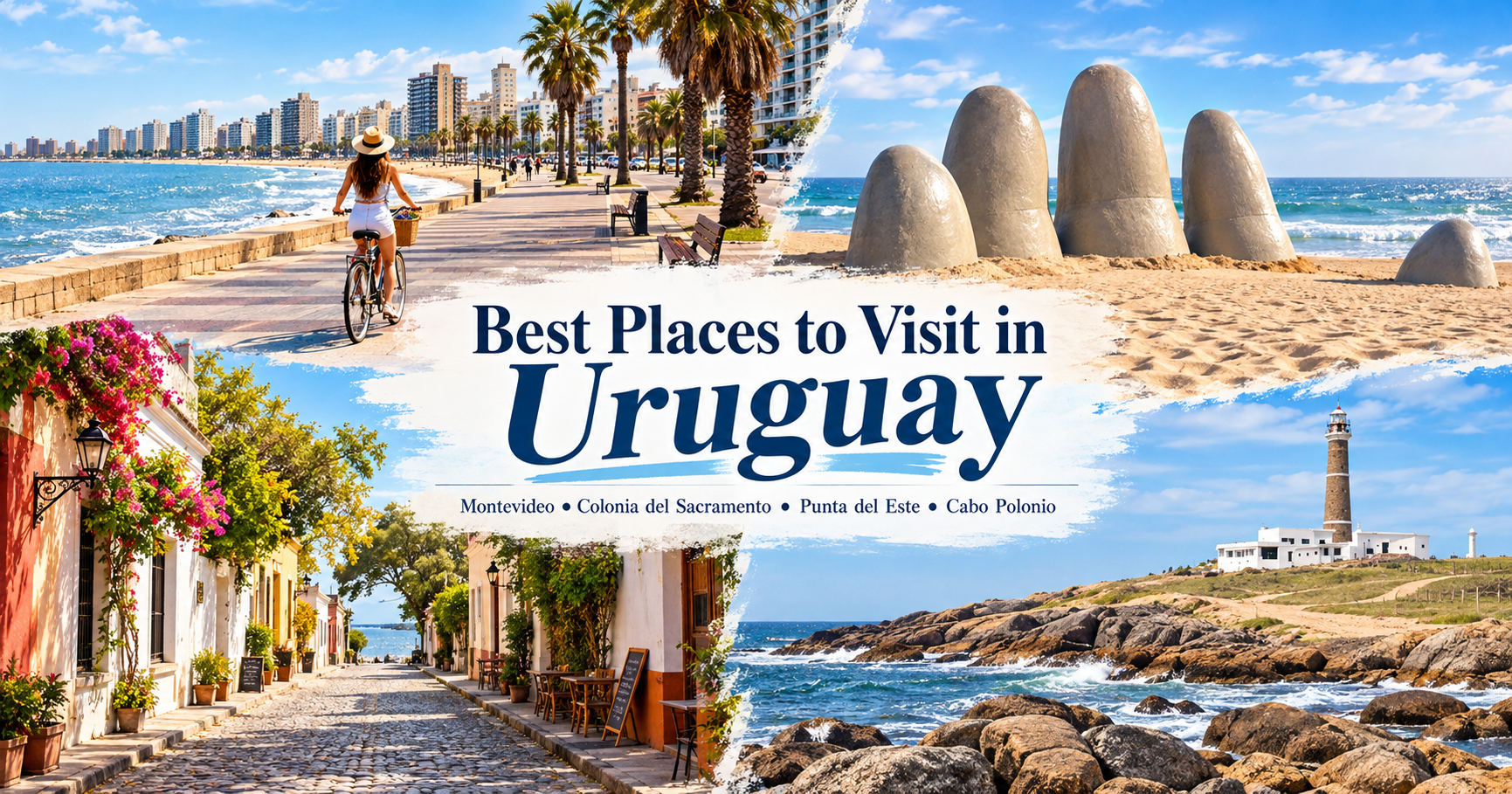
Historic streets curve between colorful colonial buildings.
Long beaches stretch along the Atlantic.
Vineyards sit quietly outside small riverside towns.
Sea lions gather beside a remote lighthouse reached across enormous sand dunes.
And in the capital, people walk, bike and sit beside the Río de la Plata along miles of waterfront.
Uruguay may be one of South America’s smaller countries, but it gives travelers several very different kinds of trips without requiring enormous distances between them.
You can explore Montevideo’s old city.
Spend a few quiet days among the cobbled streets of Colonia del Sacramento.
Head east for the beaches and nightlife of Punta del Este.
Continue along the Atlantic coast toward laid-back fishing villages and some of Uruguay’s wildest landscapes.
Or head inland and north toward wineries, countryside and thermal springs.
You do not need to see all of Uruguay in one trip.
For a first visit, I would combine a few places that give you genuinely different experiences rather than simply moving from one beach town to another.
Here are the places I would prioritize.

1. Montevideo
Best for: First-time visitors, food, history, architecture, museums, markets, nightlife, waterfront walks, culture, and travelers who want the easiest introduction to Uruguay.
If you visit Uruguay, Montevideo deserves more than a quick arrival night before heading somewhere else.
The capital stretches along the Río de la Plata and combines historic neighborhoods, busy commercial streets, beaches, parks, markets and a seemingly endless waterfront promenade.
Start in Ciudad Vieja, the historic old city.
Walk through Plaza Independencia.
See Teatro Solís.
Continue toward Mercado del Puerto and the old port district.
Then make time for the Rambla.
This enormous waterfront promenade is one of the defining features of Montevideo, and it is where the city begins to feel less like a sightseeing checklist and more like somewhere people actually enjoy living.
Walk.
Bike.
Sit beside the water.
Stop at a beach.
Watch sunset.
Montevideo works especially well for travelers who like cities but do not necessarily want the intensity of one of South America’s enormous capitals.
Main Highlights
Ciudad Vieja, Plaza Independencia, Teatro Solís, Mercado del Puerto, the Rambla, Pocitos, Parque Rodó, museums, beaches, architecture, cafés, markets, Uruguayan food and waterfront sunsets.
Why I Recommend It
Montevideo gives you the broadest introduction to Uruguay.
You get history.
Architecture.
Food.
Local neighborhoods.
Museums.
Beaches.
Nightlife.
And the Río de la Plata constantly running alongside the city.
It is also one of the easiest places to begin understanding Uruguay rather than simply seeing its resort towns.
Do not rush through it.
Give yourself time to wander Ciudad Vieja, eat well, explore beyond the historic center and spend at least one evening along the Rambla.
Don’t Miss
- Ciudad Vieja — Montevideo’s historic center and one of the best areas to explore on foot.
- Plaza Independencia — the major square connecting the historic and modern parts of central Montevideo.
- Teatro Solís — one of the city’s landmark cultural buildings.
- Mercado del Puerto — especially good for travelers interested in traditional Uruguayan food.
- The Rambla — the long waterfront promenade that follows the Río de la Plata.
- Pocitos — a popular beachfront neighborhood with restaurants, cafés and an easy coastal atmosphere.
- Sunset beside the water — one of the simplest and best ways to enjoy Montevideo.
Good to Know
- Montevideo is large enough to deserve several days rather than being treated purely as a transportation hub.
- Ciudad Vieja is especially convenient for history and sightseeing, while Pocitos gives you more of a residential beach-city atmosphere.
- Uruguay is known for beef, and Montevideo is an excellent place to try a traditional parrilla.
- Like most major cities, keep normal precautions around phones, bags and valuables, particularly in busy areas.
- The city works well as the beginning or end of a wider Uruguay itinerary.
2. Colonia del Sacramento

Best for: History, couples, photography, architecture, slower trips, short stays, waterfront sunsets, and travelers combining Uruguay with Buenos Aires.
Colonia del Sacramento feels completely different from Montevideo.
Its historic center is compact.
The streets are cobbled.
Low colonial buildings sit beneath leafy trees.
Old stone walls and ruins remain scattered around the neighborhood.
And the Río de la Plata surrounds everything with wide water views.
Founded by the Portuguese in 1680 and later contested by Portugal and Spain, Colonia developed a mixture of architectural influences that still gives the historic district its distinctive appearance.
Today, the old quarter is a UNESCO World Heritage Site and one of Uruguay’s most recognizable destinations.
This is not somewhere that needs an enormous itinerary.
Walk slowly.
Climb the lighthouse.
Explore the old streets.
Stop for lunch.
Sit beside the river.
Stay through sunset.
That is enough.
Main Highlights
The Historic Quarter, Calle de los Suspiros, Colonia Lighthouse, Plaza Mayor, old city walls, colonial architecture, museums, waterfront walks, cafés, restaurants and Río de la Plata sunsets.
Why I Recommend It
Colonia is one of those destinations where the atmosphere matters as much as any individual attraction.
The historic center is small enough to explore comfortably but interesting enough that you do not need to hurry.
You can wander without a complicated plan.
Turn down side streets.
Look at old buildings.
Stop at a café.
Walk beside the river.
And watch the light change over the Río de la Plata.
It also works extremely well as part of a larger South America trip because passenger ferries connect Colonia with Buenos Aires across the river.
Don’t Miss
- The Historic Quarter — the heart of Colonia and the main reason to visit.
- Calle de los Suspiros — one of the city’s most photographed old streets.
- Colonia Lighthouse — climb for elevated views over the historic district and river.
- Plaza Mayor — surrounded by historic remains, museums and old architecture.
- The old city walls and gate — reminders of Colonia’s fortified past.
- The waterfront — particularly beautiful later in the day.
- Sunset over the Río de la Plata — absolutely worth staying for.
Good to Know
- Colonia can be visited as a day trip, but staying overnight gives you a much quieter experience after many daytime visitors leave.
- Uneven cobblestones can make parts of the historic district harder for travelers with limited mobility.
- The historic center is compact and best explored slowly on foot.
- Colonia is particularly convenient for travelers combining Uruguay and Argentina.
- If you have several days in the area, nearby countryside and wineries give you reasons to stay longer.
3. Punta del Este

Best for: Beaches, couples, luxury trips, nightlife, restaurants, resorts, shopping, art, water sports and travelers who want Uruguay’s most famous seaside destination.
Punta del Este is Uruguay’s best-known resort destination.
And it is considerably more developed than the quieter beach towns farther east.
High-rise buildings face the coast.
Yachts fill the marina.
Restaurants, hotels and nightlife attract visitors during the busy summer season.
But Punta del Este is not only about luxury.
Its location gives travelers access to two very different coastlines.
Playa Mansa faces the calmer Río de la Plata side.
Playa Brava faces the Atlantic and is known for stronger surf.
That is also where you will find one of Uruguay’s most recognizable landmarks: the giant fingers emerging from the sand at La Mano.
Nearby Punta Ballena adds one of the region’s most unusual buildings, Casapueblo, created by Uruguayan artist Carlos Páez Vilaró.
Main Highlights
Playa Mansa, Playa Brava, La Mano, Punta del Este marina, Gorlero Avenue, restaurants, nightlife, art galleries, water sports, Punta Ballena, Casapueblo and Atlantic sunsets.
Why I Recommend It
Punta del Este gives you Uruguay’s most complete traditional beach-resort experience.
You have beaches during the day.
Restaurants in the evening.
Shopping.
Art.
Nightlife.
Boat trips.
Water sports.
And enough surrounding attractions to fill several days without simply sitting beside the pool.
It is also a useful base for exploring more of the Maldonado coast.
If your idea of a beach trip includes good hotels and restaurants rather than disappearing completely off the grid, this is probably the coast I would choose.
Don’t Miss
- Playa Brava — the Atlantic-facing side of Punta del Este.
- La Mano — the famous hand sculpture emerging from the sand at Playa Brava.
- Playa Mansa — generally calmer than Playa Brava and popular for swimming and relaxing.
- The marina — an easy area for an evening walk.
- Punta Ballena — a scenic peninsula just outside Punta del Este.
- Casapueblo — the striking former home and studio of artist Carlos Páez Vilaró.
- Sunset — particularly beautiful around Punta Ballena.
Good to Know
- Punta del Este changes dramatically between the busy summer season and quieter parts of the year.
- Prices can be higher here than in many other parts of Uruguay.
- Playa Mansa and Playa Brava provide noticeably different beach experiences.
- You do not need a luxury budget to visit, but this is Uruguay’s most upscale major beach destination.
- Punta del Este can also work as a base for day trips along the surrounding coast.
4. Cabo Polonio

Best for: Nature, dunes, remote beaches, photography, wildlife, unusual destinations, slow travel and travelers who genuinely want to get away from conventional resort areas.
Cabo Polonio is where Uruguay becomes wild.
You cannot simply drive your rental car into the village.
Instead, visitors leave ordinary vehicles outside the protected area and cross the enormous dunes aboard authorized all-terrain vehicles.
Then the landscape opens.
Sand.
Ocean.
Small houses.
Footpaths.
A lighthouse.
Rocky coastline.
And one of Uruguay’s most important sea lion colonies just offshore.
Cabo Polonio deliberately feels separated from the world around it.
Infrastructure is limited.
Roads are replaced by sandy paths.
Many accommodations operate with an off-grid atmosphere.
And once you arrive, there is very little reason to hurry anywhere.
Main Highlights
Cabo Polonio National Park, enormous dunes, Playa Sur, Playa de la Calavera, Cabo Polonio Lighthouse, sea lions, Atlantic scenery, beaches, sunsets, stargazing and the 4×4 journey into the village.
Why I Recommend It
Cabo Polonio is one of the few places in Uruguay that feels like an adventure simply to reach.
The journey across the dunes immediately separates it from a normal beach town.
Once there, the appeal is simple.
Walk.
Explore the beaches.
Climb toward the lighthouse.
Watch the sea lions.
Look across the Atlantic.
Stay for sunset.
And enjoy being somewhere without the usual urban distractions.
If you only visit polished resort towns, you miss this completely different side of Uruguay.
Don’t Miss
- The 4×4 ride across the dunes — part transportation and part introduction to Cabo Polonio itself.
- Cabo Polonio Lighthouse — one of the defining landmarks of the area.
- The sea lion colony — visible around the rocky coast near the lighthouse.
- Playa Sur — one of Cabo Polonio’s two main beaches.
- Playa de la Calavera — the other major beach on the opposite side of the cape.
- Walking the dunes and shoreline — the landscape is the main attraction.
- Sunset and the night sky — particularly special in such a remote setting.
Good to Know
- Private vehicles are not allowed to simply drive into Cabo Polonio; visitors normally enter using the authorized transport across the dunes.
- Pack lightly if you are staying overnight.
- Do not expect the same level of infrastructure you would find in Punta del Este or Montevideo.
- Bring cash and important personal supplies rather than assuming everything will be easy to buy once inside.
- Cabo Polonio is a much better choice for travelers who enjoy rustic, remote places than travelers who prioritize conventional hotel comforts.
5. Punta del Diablo

Best for: Beaches, surfing, laid-back trips, seafood, backpacker-style atmosphere, couples, coastal road trips and travelers who want something relaxed without going fully off-grid.
Punta del Diablo began as a fishing village and still feels much more informal than Punta del Este.
Dirt roads wind between colorful buildings.
Rocky outcrops break up the coastline.
Fishing boats sit beside the beach.
Surf rolls toward shore.
Restaurants and small bars fill with travelers during the warmer months.
It has tourism.
But it does not feel like a polished high-rise resort.
That balance makes Punta del Diablo a great choice for travelers who want a relaxed beach town without going completely off-grid.
Punta del Diablo gives you a relaxed Atlantic beach town while still providing significantly more accommodation, restaurants and everyday services than Cabo Polonio.
Main Highlights
Playa de los Pescadores, Playa del Rivero, Playa de la Viuda, surfing, fishing boats, seafood, craft stalls, rocky coastline, sunsets and nearby Santa Teresa National Park.
Why I Recommend It
Punta del Diablo occupies a very useful middle ground.
It is more developed and easier to stay in than Cabo Polonio.
But considerably more relaxed than Punta del Este.
Spend the morning at the beach.
Eat seafood.
Watch fishing boats.
Try surfing.
Walk through town.
Then use Punta del Diablo as a base for exploring more of the Rocha coastline.
It is the kind of destination where you can have things to do without feeling like you need to constantly do something.
Don’t Miss
- Playa de los Pescadores — closely tied to Punta del Diablo’s fishing-village history.
- Playa de la Viuda — particularly popular with surfers.
- Playa del Rivero — another easy beach option close to town.
- The artisan area — especially lively during the busier travel season.
- Fresh seafood — appropriate for a town where fishing remains part of its identity.
- Santa Teresa National Park — a worthwhile nearby addition if you have extra time.
Good to Know
- Punta del Diablo becomes much busier during Uruguay’s summer.
- Outside peak season, the town can feel considerably quieter and some tourism businesses may reduce hours.
- Roads within town are often unpaved.
- Surf conditions vary, so beginners should use a reputable local school rather than simply heading into unfamiliar waves.
- Punta del Diablo and Cabo Polonio can work especially well together on a Rocha coast trip.
6. Piriápolis

Best for: Beaches, families, couples, coastal views, history, easier beach trips, hills, road trips and travelers who want something quieter than Punta del Este.
Piriápolis offers a very different experience from Punta del Este.
The landscape is different.
Long beaches sit beneath hills.
Historic buildings remain from the town’s development as an early planned seaside resort.
And viewpoints rise above the coast.
The town was developed by Francisco Piria around the turn of the 20th century, and traces of that ambitious resort vision remain throughout Piriápolis.
You can walk along the waterfront.
Spend the day at the beach.
Head into the hills for elevated views.
See Castillo de Piria.
And experience a coastal town that feels much less intense than Punta del Este.
Main Highlights
Piriápolis waterfront, beaches, Cerro San Antonio, coastal viewpoints, Castillo de Piria, Argentino Hotel, surrounding hills, fishing, hiking and scenic drives.
Why I Recommend It
Piriápolis works particularly well for travelers who want a beach destination without needing nightlife or a luxury-resort scene.
The hills are the big difference.
Uruguay is not a country most travelers associate with dramatic elevation, so being able to combine beaches with hillside viewpoints gives Piriápolis a personality of its own.
Its historic resort architecture adds another layer.
And because Punta del Este is relatively nearby, the two destinations are easy to combine without feeling identical.
Don’t Miss
- The waterfront promenade — the easiest place to begin exploring town.
- Piriápolis beaches — stretching along a substantial section of coastline.
- Cerro San Antonio — head upward for broad coastal views.
- Castillo de Piria — connected to the unusual history of the town’s founder.
- The Argentino Hotel — one of Piriápolis’ most recognizable historic buildings.
- The surrounding hills — great for travelers wanting something beyond another beach day.
Good to Know
- Piriápolis is generally calmer than Punta del Este.
- It is a particularly good choice for travelers who want beach time but are not interested in a major nightlife scene.
- A car makes exploring the surrounding hills and coastline easier.
- Summer is the busiest period.
- You could stay here or visit as part of a wider Maldonado coast road trip.
7. Carmelo

Best for: Wine, couples, romantic trips, countryside, slow travel, boutique stays, cycling and travelers looking for a quieter alternative to Uruguay’s major cities and beach resorts.
Carmelo shows you yet another version of Uruguay.
This time, the attraction is not a major city or Atlantic beach.
It is wine country.
Countryside.
The Uruguay River.
Quiet roads.
Historic estancias.
And a slower rhythm that works especially well for a couple of relaxing days.
Several wineries sit in and around Carmelo, making the area one of the easiest places to build wine tasting into an Uruguay itinerary.
You can combine vineyard visits with cycling, river scenery and long meals rather than filling your days with traditional sightseeing.
Main Highlights
Uruguayan wineries, Tannat wine, countryside, cycling, the Uruguay River, Carmelo beaches, yacht harbor, Puente Giratorio, Calera de las Huérfanas and historic estancias.
Why I Recommend It
Carmelo offers a completely different side of Uruguay, centered on vineyards, countryside and slower travel.
After Uruguay’s cities and coastal destinations, Carmelo offers a much slower change of pace.
Carmelo slows everything down.
Visit a winery.
Have lunch.
Bike through the countryside.
Walk beside the river.
Stay somewhere peaceful.
And do not worry about seeing ten attractions before dinner.
For couples in particular, this may be one of the most relaxing stops in Uruguay.
Don’t Miss
- A winery visit — the main reason I would prioritize Carmelo.
- Tannat — Uruguay’s signature red wine and an obvious choice to try locally.
- Cycling through the countryside — a good way to explore at a slower pace.
- Puente Giratorio — Carmelo’s distinctive rotating bridge.
- Calera de las Huérfanas — historic ruins outside the city.
- The riverfront — particularly pleasant when your goal is simply to slow down.
Good to Know
- Winery visits may require advance reservations.
- Carmelo works best if you are comfortable with a slower itinerary.
- Having your own transportation can make visiting wineries and countryside attractions considerably easier.
- Do not drink and drive; arrange transportation if your day includes wine tasting.
- Carmelo combines particularly naturally with Colonia del Sacramento.
8. Salto & Uruguay’s Thermal Region

Best for: Hot springs, wellness trips, families, relaxing breaks, road trips, inland Uruguay and travelers who want something completely different from the Atlantic coast.
If you want to see a completely different side of Uruguay beyond its cities and Atlantic beaches, head north toward Salto.
Head north and the focus changes to thermal water.
The region around Salto is one of Uruguay’s major hot-spring destinations, with thermal complexes and water parks built around naturally heated groundwater.
Termas del Daymán is the best-known thermal area near Salto, while the wider region gives travelers several options for turning a few days into a dedicated wellness or family stop.
Salto itself also gives you a substantial regional city rather than simply a resort complex.
Main Highlights
Termas del Daymán, thermal pools, water parks, spa experiences, Salto city center, Río Uruguay, historic architecture and relaxing resort stays.
Why I Recommend It
The thermal region offers an experience you will not find elsewhere on this route: naturally heated pools and dedicated hot-spring resorts.
You can spend several days exploring Uruguay’s beaches.
Then suddenly spend an afternoon soaking in naturally heated thermal water.
It is an entirely different experience.
Families may particularly enjoy the water parks, while couples and slower travelers can choose quieter thermal hotels and pools.
This is also a good way to see more of inland Uruguay rather than staying entirely along the southern and eastern coasts.
Don’t Miss
- Termas del Daymán — the most obvious starting point for a thermal trip near Salto.
- Thermal pools — choose a complex that matches whether you want relaxation or family activities.
- A slow spa day — this is one destination where doing less is the point.
- Salto itself — spend some time in the city rather than seeing it only as the gateway to the springs.
- The Río Uruguay — the river forms Uruguay’s border with Argentina through this part of the country.
Good to Know
- Salto is considerably farther from Montevideo than destinations such as Colonia or Punta del Este, so allow enough time to make the journey worthwhile.
- The thermal region is not just a winter destination; the pools can be enjoyed throughout much of the year.
- Different complexes appeal to different travelers, from family water parks to quieter spa-style stays.
- If your Uruguay trip is short, I would prioritize Montevideo, Colonia and the coast before traveling this far north.
- For a longer trip, Salto adds excellent variety.
Short Packing List for Uruguay
Uruguay is easier to pack for than many destinations because you are unlikely to face extreme tropical heat, high-altitude conditions or complicated adventure travel on a typical itinerary.
But your packing needs can change considerably depending on whether you are exploring Montevideo, spending time on Atlantic beaches, visiting wineries or heading to Cabo Polonio.
A few things I would make sure to bring:
- High-protection sunscreen
- SPF lip balm
- Sunglasses
- Sun hat
- Reusable water bottle
- Portable phone charger
- Compact umbrella
- Small day bag
- Hand sanitizer
- Wet wipes
- Tissues or a handkerchief
And remember that Uruguay is in the Southern Hemisphere.
December, January and February are summer.
June, July and August are winter.
Check the forecast for your actual destinations before packing rather than assuming every South American trip will be hot.
Final Thoughts: Where Should You Go in Uruguay?
Uruguay is small enough that you can combine several very different places without turning your vacation into a marathon.
For a first trip, I would start with Montevideo.
Give the capital enough time to explore Ciudad Vieja, eat well, walk along the Rambla and actually experience the city rather than simply arriving at the airport and leaving.
Then add Colonia del Sacramento.
It is compact, historic, beautiful and completely different from Montevideo.
If you want the classic Uruguay beach experience, continue to Punta del Este.
If you want something wilder, go farther east.
Punta del Diablo gives you the relaxed beach-town version.
Cabo Polonio gives you dunes, wildlife, remote beaches and one of the most unusual destinations in the country.
Piriápolis works particularly well if you want beaches with hills, views and a quieter atmosphere than Punta del Este.
Then there are the places that pull you away from the coast.
Choose Carmelo for wineries, countryside and a romantic slower-paced stay.
Choose Salto and the thermal region if you have more time and want hot springs and a completely different look at inland Uruguay.
You do not have to visit all eight.
In fact, I would not try.
Uruguay is better when you give each place enough time to actually enjoy it.
Walk Montevideo’s waterfront.
Watch sunset in Colonia.
Spend a lazy day on the beach.
Cross the dunes into Cabo Polonio.
Drink wine in Carmelo.
Soak in a thermal pool.
Eat slowly.
Stay a little longer than you planned.
Uruguay does not need an enormous list of famous attractions to make a good trip.
The appeal is how easily the country moves between city life, history, beaches, wild coastline, vineyards and countryside.
Pick the version of Uruguay that sounds like you.
Then give yourself enough time to enjoy it.