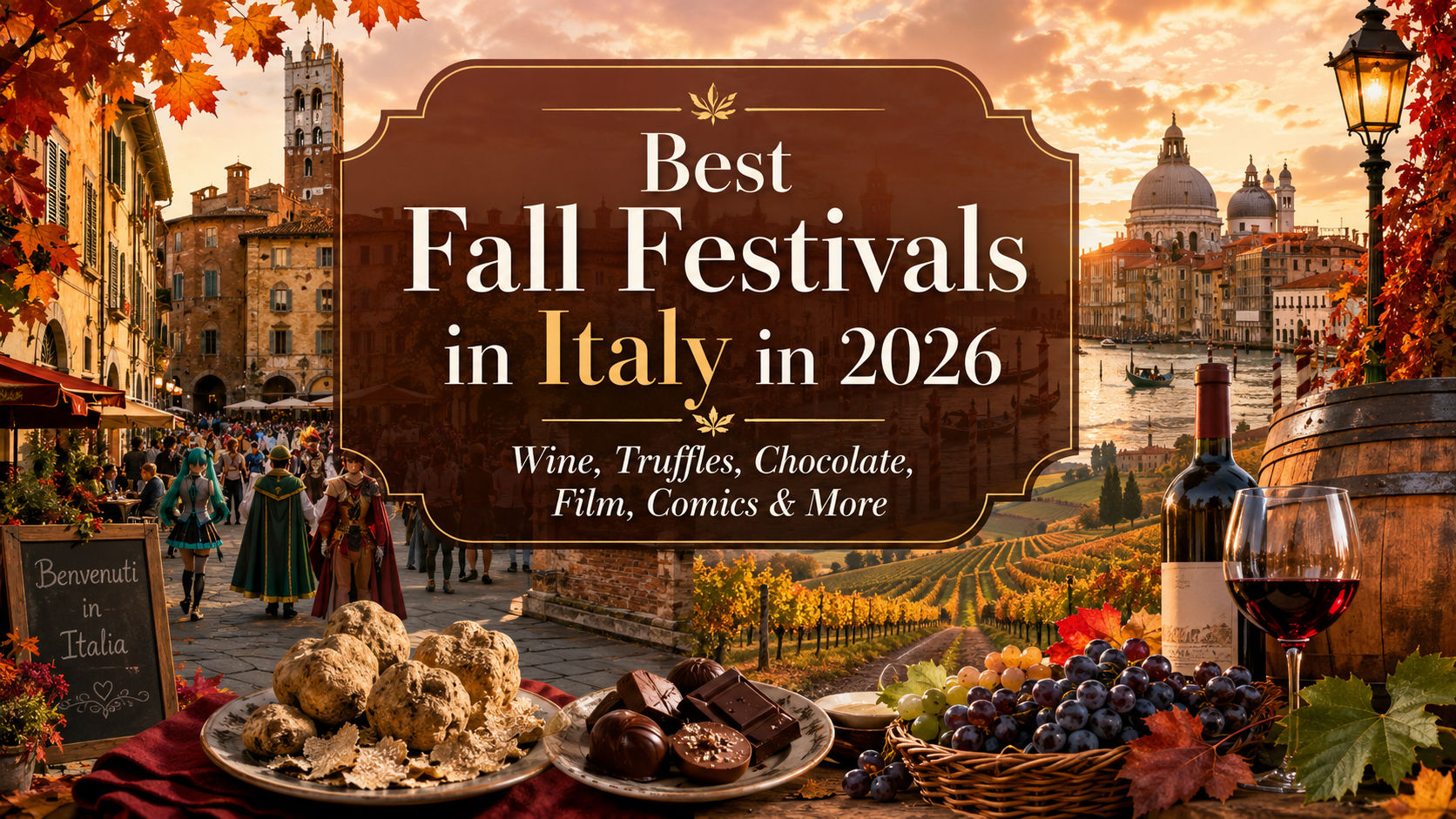
There is something especially beautiful about Italy in the fall.
Summer slowly loosens its grip, vineyards move into harvest season, truffles begin appearing on menus and in market stalls, and cities that are extraordinary at any time of year take on a completely different atmosphere. Tuscany turns toward wine and the vendemmia. Piedmont celebrates one of the world’s most prized ingredients. Perugia fills with chocolate. Trieste looks toward the sea. Venice rolls out the red carpet. And in Lucca, a medieval Tuscan city is temporarily taken over by cosplay, comics, manga, games, fantasy, and pop culture.
Then there are the smaller traditions — the kind of celebrations where generations of local families have been participating for decades and where the event is tied as much to the identity of the town as it is to entertaining visitors.
That is part of what makes planning a trip around a festival so much fun.
You are not simply visiting another beautiful Italian city. You are seeing it during a few days when something unusual is happening — when streets are decorated, residents are celebrating, food is being prepared for an occasion, traditions come out into public view, and thousands of other people have arrived because they are excited about the same thing.
Some of Italy’s fall festivals are enormous international events. Others are deeply local. Some are worth building an entire vacation around, while others fit perfectly into a larger Tuscany, Piedmont, Umbria, Veneto, Lazio, or Friuli-Venezia Giulia itinerary.
You certainly do not need to visit all of them.
Choose the one that makes you start mentally checking flight prices.

🍂 September Festivals in Italy
1. Venice International Film Festival — Venice, Veneto
2026 dates: September 2–12, 2026
The Venice International Film Festival brings world premieres, filmmakers, actors, critics, movie lovers, and an unmistakable dose of old-school cinematic glamour to the Venice Lido every September.
But this is not an event reserved entirely for celebrities and people carrying industry credentials.
Regular travelers can buy tickets to selected public screenings, which means it is entirely possible to build a Venice trip around seeing a film at one of the world’s most famous film festivals.
The festival takes place primarily on the Lido di Venezia, rather than around St. Mark’s Square in Venice’s historic center. The Palazzo del Cinema is at the heart of the action, with additional screenings and festival venues around the Lido.
Main Highlights
- World-premiere film screenings
- International films competing for the Golden Lion and other awards
- Public screenings that regular visitors can book
- Red-carpet arrivals
- Actors and filmmakers attending official screenings
- The glamorous atmosphere around the Lido during the festival
- Venice itself waiting just across the lagoon

Don’t Miss
See an actual festival screening.
Watching celebrities arrive is fun, but being able to say you watched a film at the Venice International Film Festival is the experience that really makes this different from simply visiting Venice in September.
Selected screenings are open to the public, although other screenings are restricted to accredited festival attendees.
Tickets for the 2026 festival went on sale online beginning August 11, and the daily schedule determines which screenings are available to the public.
If you have a particular film on your list, do not assume you can arrive in Venice and figure it out once you get there. Check the festival program and book the screening you want.
Watch the red carpet even if you do not have a screening ticket.
The public can watch the talent and delegations walking the red carpet from the pedestrian viewing area. You do not need a festival ticket or accreditation simply to watch the arrivals.
What to Wear
This is one festival where what you wear can depend heavily on what you are doing.
For normal sightseeing around the Lido and attending ordinary public screenings, you do not need to spend the day dressed like you are waiting for your own close-up.
If you have tickets to a gala screening in the Sala Grande, however, formal attire is recommended.
That makes Venice worth packing a little differently if a gala is part of your plans. A polished dress, jumpsuit, suit, blazer, dressier trousers, or similarly elevated evening look makes far more sense here than it would at most of the festivals in this guide.
You will still be walking in Venice, though, so do not let movie-festival glamour convince you that impractical footwear has suddenly become practical.
Good to Know
- Public screenings are ticketed and are not available for every film.
- Festival tickets are sold online.
- Some screenings are reserved for accredited attendees.
- Directors and actors typically attend official afternoon and evening screenings held in the Sala Grande.
- If you qualify for a discounted ticket, bring the identification required to prove eligibility.
- Do not run late. Admission is permitted only until 10 minutes before the scheduled screening time, and late arrivals are not admitted once a screening begins.
- Children younger than six are not permitted at screenings, and additional age restrictions apply to some films.
- Festival venues are accessible to visitors with disabilities.
How to Get There
The festival is on the Venice Lido, which is reached by boat.
If you arrive in Venice by train at Venezia Santa Lucia, you can continue to the Lido by vaporetto.
From Venice Marco Polo Airport, boat service can also take you directly toward Lido Santa Maria Elisabetta.
If the film festival is the main reason for your trip, staying directly on the Lido removes a surprising amount of back-and-forth travel across the lagoon.
How Long to Stay
Three to four nights gives you time for the festival and some classic Venice sightseeing without turning every day into a race between screening times and vaporetto departures.
Stay longer if this is your first trip to Venice.
The festival is exciting, but it would be painful to come all this way and never have enough time to wander St. Mark’s Square, cross the Rialto Bridge, eat cicchetti, explore the canals, or venture farther into the Venetian Lagoon.
Where to Stay
Festival-period hotels on the Lido can sell out well before September. If the best Lido properties are already unavailable for your dates, look for a hotel near a direct vaporetto connection to Lido Santa Maria Elisabetta rather than choosing a random hotel elsewhere in Venice

The most convenient hotels directly on the Venice Lido can sell out surprisingly early for Film Festival dates, so staying near a direct vaporetto connection is an excellent alternative.
Hotel Bisanzio is in Castello, just 150 meters from the San Marco–San Zaccaria vaporetto stop, making it particularly practical for getting to and from the Lido during the festival.
From San Zaccaria, vaporetto services connect directly with Lido Santa Maria Elisabetta, so you can spend your festival days on the Lido while still staying in Venice’s historic center.
The hotel is also within easy walking distance of St. Mark’s Square, Doge’s Palace, and the Bridge of Sighs, which makes it much easier to combine festival screenings with classic Venice sightseeing.
Book as early as possible for festival dates. By mid-August 2026, several of the most convenient Lido hotels were already sold out for the September festival period.
While You’re in Venice
If you are already traveling all the way to Venice for the festival, give yourself time to experience more than the inside of a cinema.
Lido Bike Tour: With a Local on the Island of Cinema
This one is particularly appropriate for a film-festival trip because it keeps you on the Lido and explores the island beyond the festival venues, including its beaches, architecture, and quieter corners.
Eat Like a Local: Venice Small-Group Food Tasting Tour
Spend part of a non-screening day back in Venice discovering cicchetti, wine, and the small bars and food traditions that are part of everyday Venetian life.
Murano & Burano Islands Guided Small-Group Tour by Private Boat
If you have an extra day, this is an easy way to see two very different parts of the Venetian Lagoon while learning about Murano glassmaking and Burano lace.
Be Sure to Bring
The big festival-specific item here is identification if your screening ticket or discount requires it.
Also save your ticket somewhere you can access it easily and check your exact venue and screening time before leaving your hotel. Venice transportation takes time, and this is not the event for discovering five minutes before a movie starts that you are standing on the wrong side of the lagoon.
2. Festa dell’Uva di Impruneta — Impruneta, Tuscany

Main 2026 festival date: September 27, 2026
2026 is the 100th-anniversary celebration
Imagine spending a Sunday in the Tuscan hills watching an entire town turn grape harvest season into theater.
That is much closer to the spirit of the Festa dell’Uva di Impruneta than thinking of it as simply another Italian wine festival.
Impruneta sits just south of Florence among the hills of Chianti, and its grape festival has become one of the town’s defining traditions.
For the main event, Impruneta’s four historic districts — Fornaci, Pallò, Sant’Antonio, and Sante Marie — compete with elaborate floats, costumes, choreography, music, and performances centered around grapes, wine, harvest traditions, and whatever creative theme each district has developed for the year.
The work is done by local volunteers, and what eventually rolls into Piazza Buondelmonti represents months of planning and construction.
And 2026 is special.
The festival was born in 1926, making this year its 100th anniversary.
If there were ever a particularly good year to plan a trip around the Festa dell’Uva, this is it.
Main Highlights
- The 100th-anniversary edition
- Elaborate allegorical floats created by Impruneta’s four districts
- Choreographed performances
- Costumes, music, and large groups of performers
- The competition between the four rioni
- Piazza Buondelmonti becoming the center of the celebration
- Wine-harvest traditions in the hills of Chianti
- Being close enough to Florence to combine the festival with a larger Tuscany trip
Don’t Miss
The main Sunday spectacle in Piazza Buondelmonti.
The heart of the festival is the competition between the four districts.
These are not simply tractors pulling a few grape-decorated trailers through town. Each rione creates a full presentation using large-scale floats, performers, choreography, costumes, scenery, and music.
That competitive element is what makes the experience particularly fun. You are not just watching a harvest parade — you are watching four parts of the same town try to outdo each other.
Tickets
The main centenary celebration on Sunday, September 27 begins at 2:00 p.m. in Piazza Buondelmonti and is a ticketed event.
Tickets are already on sale for 2026, with both grandstand seating and standing admission available.
Because this is the centenary year, this is absolutely one of the festivals where I would buy the ticket before arriving in Tuscany rather than assume there will be plenty of room on the day.
What to Wear
This is Tuscany during harvest season, not a formal wine gala.
Think comfortable fall clothes that work for spending hours outside and walking around a small hill town.
September can still feel pleasantly warm during the day, while evenings can cool down, so an outfit that works with a light layer is useful.
A scarf, cardigan, light sweater, or light jacket can come out later without requiring you to carry half your suitcase through the festival.
Good to Know
- The main festival takes place in Piazza Buondelmonti in the center of Impruneta.
- The 2026 main event begins at 2:00 p.m. on September 27.
- Tickets are available in both grandstand and standing categories.
- If standing for much of the event would be difficult for you, this is one festival where reserving a seated option is worth considering.
- Impruneta is close to Florence, but the festival is very much an Impruneta event. Staying locally lets you experience the town before and after day-trippers arrive.
- The surrounding region is Chianti country, making this incredibly easy to turn into a wine, food, Florence, and Tuscan countryside trip.
How to Get There
Impruneta is only a short distance south of Florence.
If you are coming by public transportation, buses connect central Florence with Impruneta, including connections from around Florence Santa Maria Novella station.
If you are driving, Impruneta is reached from the A1 via the Firenze Impruneta exit.
A car becomes useful if you plan to continue exploring wineries, rural villages, and the countryside after the festival, although driving yourself is obviously not the plan for a day devoted to Chianti wine tastings.
How Long to Stay
If you are coming almost entirely for Festa dell’Uva, two nights can work well.
For a proper Tuscany trip, I would give it three to five nights and combine Impruneta with Florence and at least one day devoted to the Chianti countryside.
This is one of those festivals where the surrounding destination is every bit as tempting as the event itself.
Where to Stay

For the Festa dell’Uva, Relais Villa Olmo is one of the most convenient places to stay because it is only about a six-minute walk from Piazza Buondelmonti, where the main festival celebration takes place.
That means you can walk into the center for the festivities without worrying about festival traffic, parking, or arranging transportation at the end of the day.
The property also gives you the beautiful Tuscan atmosphere you would hope for from a trip built around a grape-harvest festival, while keeping you close enough to Impruneta’s historic center to make the festival the focus of the stay.
Book as early as possible for the 2026 centenary celebration. Central Impruneta accommodation is already extremely limited for festival weekend, and the best-located properties can sell out well in advance.
While You’re Here
A grape-harvest festival in Chianti is practically begging to become part of a larger food-and-wine trip.
Chianti Wine Tour from Florence with 3 Wineries and Tuscan Lunch
This one is almost comically well matched to the trip: it visits three wineries and includes a stop in Impruneta itself, along with a Tuscan lunch and wine tastings.
Sidecar Tour in Florence and Chianti with Wine Tasting and Lunch
For something much more playful, this small-group sidecar experience combines Florence, the Chianti countryside, a winery, tastings, lunch, and a stop in Impruneta.
If you came to Tuscany because a century-old grape festival sounded fun, continuing through Chianti on a sidecar feels appropriately committed to the theme.
Be Sure to Bring
If you purchased standing admission, plan for a considerably different afternoon than someone who has reserved grandstand seating.
Bring your ticket where you can access it easily and leave enough time to reach the center of Impruneta before the performances begin.
🍂 October Festivals in Italy
3. Sagra dell’Uva di Marino — Marino, Lazio

2026 festival dates: September 26–27 and October 3–5, 2026
Main festival Sunday: October 4, 2026
There are wine festivals, and then there is a town outside Rome where one of the most anticipated traditions involves wine flowing from the fountains.
The Sagra dell’Uva di Marino has been celebrating Marino’s wine-growing traditions since 1925 and has grown into one of the most distinctive harvest celebrations in Lazio.
Marino is part of the Castelli Romani, a collection of historic towns, vineyards, volcanic lakes, and countryside in the hills southeast of Rome. That location makes this an especially easy festival to work into a longer Italy trip: you can spend several days in Rome, head into the countryside for the festival, and add nearby Castel Gandolfo or Frascati without completely rebuilding your itinerary.
But Marino is not simply throwing a giant outdoor wine tasting.
The festival mixes wine and harvest traditions with the town’s history, religious celebrations, costumes, processions, food, music, performances, and the famous “miracle of the fountains that give wine.”
Main Highlights
- Wine flowing from selected fountains during the traditional Miracolo delle Fontane
- Marino wine and local food
- Historic processions through the town
- Costumed reenactments
- Music and entertainment
- Streets filled with festival activity
- A celebration rooted in both the grape harvest and Marino’s local history
- An easy location to combine with Rome and the Castelli Romani
Don’t Miss
The wine fountains.
This is the tradition everyone hears about, and yes, it is real.
During the festival’s famous Miracolo delle Fontane, selected fountains in Marino dispense wine rather than water while wine and grapes are distributed as part of the celebration.
It is wonderfully strange, extremely Italian, and exactly the type of thing that makes building a trip around a local festival memorable.
Do not treat the wine fountain as the entire festival, though.
Another important tradition is the historic procession commemorating Marcantonio Colonna’s return from the Battle of Lepanto in 1571, with elaborate costumes and participants moving through the historic center.
The combination is what makes Marino interesting: one minute you are watching a historical reenactment and the next you are waiting for a fountain to start pouring wine.
What Is Confirmed for 2026?
2026 festival programming is scheduled for September 26–27 and October 3–5.
The traditional main Sunday falls on October 4, 2026.
The complete day-by-day 2026 program has not yet been published, so exact times for the wine fountains, processions, entertainment, and individual events should be checked again before your trip.
If the wine fountain is the reason you are coming, do not guess the time based on a previous year’s schedule.
What to Wear
This is a lively town festival rather than a formal wine event.
Casual fall clothing works perfectly.
Marino is a hill town, so expect to spend plenty of time walking, standing, moving through crowded streets, and dealing with slopes rather than simply sitting at a table sipping wine.
October can also mean a warm afternoon followed by a noticeably cooler evening, so light layers make sense.
If you are planning a full festival day, this is not the place for shoes that only work for two picturesque blocks before your feet revolt.
Good to Know
The main events spread through Marino’s historic center, so this feels much more like a town celebration than an event contained inside one festival ground.
That also means crowds, traffic changes, controlled access points, and transportation changes can become part of festival weekend.
Previous editions have included special transportation arrangements and restrictions on items such as glass containers. Check the official 2026 visitor and security information shortly before attending rather than assuming the rules will be identical from one year to the next.
The public-facing festival has traditionally been free to enter, although individual activities, tastings, or special events may operate separately.
And while free wine sounds like an invitation to abandon all common sense, remember that you still have to get back to your hotel afterward.
How to Get There
Marino is one of the easier smaller Italian festival towns to reach without renting a car.
Regional trains connect Roma Termini with Marino Laziale, making this very workable as part of a Rome trip.
Driving gives you more freedom for exploring the surrounding countryside, but festival weekend is exactly when having a car can become less convenient because of crowds, parking pressure, and traffic restrictions.
If you are staying in Rome and only attending for one day, the train is the first option I would consider.
How Long to Stay
Marino can absolutely be visited as a day trip from Rome, especially if this is part of a larger Roman vacation.
But if the festival is one of the main reasons for your trip, one or two nights in Marino gives you much more flexibility.
You can experience the town before and after the biggest crowds arrive and avoid joining thousands of other visitors trying to leave at exactly the same time.
For a broader Castelli Romani trip, give yourself three or four days and add Castel Gandolfo, Lake Albano, Frascati, vineyards, and countryside.
Where to Stay

With many of the closest hotels in Marino already sold out for the 2026 festival period, nearby Frascati makes a practical alternative base within the Castelli Romani.
Hotel & Spa Villa Mercede is in Frascati, approximately 2.8 miles from Marino, keeping you close to the Sagra dell’Uva while giving you somewhere comfortable to retreat after a busy festival day.
The 4-star hotel also has a restaurant, outdoor pool, and full-service spa, making it especially appealing if you are turning the festival into a longer Castelli Romani getaway rather than simply commuting back and forth from central Rome.
Book early for festival weekend. Accommodation in and around Marino can become extremely limited well before October, particularly for travelers hoping to stay close to the historic center.
While You’re Here
Marino is close enough to Rome that it would be easy to rush back into the capital after the festival, but the surrounding Castelli Romani deserve some attention of their own.
Castelli Romani, Frascati, Castel Gandolfo, Albano Lake + Wine Tasting
Turn the festival into a fuller Castelli Romani experience with a day exploring Frascati, Castel Gandolfo, Lake Albano, and the surrounding wine country. The tour includes a visit to a family-run winery for tastings and gives you a broader look at the same countryside and wine traditions that make Marino’s grape festival such a fun reason to visit this part of Lazio.
Castel Gandolfo: Papal Apartments and Secret Garden Entry Ticket
Nearby Castel Gandolfo makes an excellent addition to a Marino trip. Visit the Papal Apartments and gardens and spend some time around beautiful Lake Albano.
Be Sure to Bring
Check the 2026 security and access rules shortly before your visit, particularly if you normally travel with a glass water bottle or other glass container.
Keep the latest festival schedule saved on your phone so you know exactly when and where the major traditions are happening.
And if the wine fountain is high on your list, arrive in the historic center well before its scheduled start rather than attempting to push through the crowd at the last minute.
4. Barcolana — Trieste, Friuli-Venezia Giulia

2026 dates: October 2–11, 2026
Main Barcolana regatta: Sunday, October 11, 2026
Race start: 10:30 a.m.
Even if you know absolutely nothing about competitive sailing, Barcolana is worth knowing about.
For ten days, Trieste leans completely into its relationship with the Adriatic Sea.
Boats fill the water. Sailing competitions take place throughout the Gulf of Trieste. Events spread onto land. The Barcolana Village fills the waterfront. Exhibitions, tastings, performances, and gatherings appear around the city.
Then Sunday arrives.
At 10:30 a.m. on October 11, an enormous fleet starts the main Barcolana regatta between Barcola and Miramare, eventually racing back toward a finish line directly in front of Piazza Unità d’Italia.
This is not an event where spectators need to understand sailing strategy to enjoy themselves.
Part of the attraction is simply seeing the Gulf of Trieste suddenly filled with sails.
Main Highlights
- The main Barcolana regatta on October 11
- One of the world’s great mass-participation sailing events
- A starting line stretching between Barcola and Miramare
- The finish in front of Piazza Unità d’Italia
- Barcolana Village
- Events and exhibitions throughout Trieste
- Additional sailing races during the week
- Vintage and classic boats
- Open-water swimming
- Waterfront food, drinks, and festival atmosphere
- Trieste itself — one of Italy’s most interesting and distinctive port cities
Don’t Miss
The main regatta on Sunday morning.
The start alone is extraordinary.
Instead of watching a handful of boats leave one after another, spectators see a huge field of boats gathered across the Gulf before the race begins.
The course travels through the Gulf before turning back along the coastline and eventually finishing in front of Piazza Unità d’Italia.
You can watch from several different perspectives.
You can watch the race from several excellent spots around the Gulf, including:
- The Trieste waterfront
- The Napoleonica panoramic path
- Victory Lighthouse
- The Santa Croce lookout area
- The Muggia promenade
For a first visit, the waterfront has a major advantage: you remain in the middle of the citywide festival atmosphere and can see the finish near Piazza Unità.
For a broader panoramic view of the fleet spread across the Gulf, one of the elevated viewpoints can be spectacular.
There Is Much More Than One Race
Do not assume Barcolana means arriving Sunday morning, watching some sailboats, and leaving.
The larger festival runs for days.
The 2026 program includes additional competitions and sailing events leading up to Sunday, while Barcolana Village brings the celebration onto land.
The 2026 edition is also expanding the village concept farther into central Trieste, including Piazza Ponterosso and the Borgo Teresiano area.
Among the events already confirmed for 2026 are:
- Barcolana Nuota open-water swimming
- The Italian Meteor Championship
- Barcolana Maxi
- Barcolana Classic
- Barcolana by Night
- Additional regattas and sailing events before the main race
If you genuinely enjoy boats or sailing, arriving several days before Sunday makes much more sense than treating Barcolana as a one-morning event.
What to Wear
Think Italian coastal city in October, not yacht-club costume party.
You do not need nautical stripes unless you want them.
The practical issue is the wind.
Trieste is famously associated with the Bora, and while nobody can tell you months in advance what conditions will be like on your particular festival day, the city and surrounding coast are genuinely windy enough that this should influence what you bring.
A light wind-resistant outer layer is extremely useful, particularly if you are standing along the waterfront or at an exposed viewpoint watching the race.
Layers also make sense because you may spend part of the day walking through central Trieste and another part standing still beside the water.
Good to Know
You do not need to be a sailor to enjoy Barcolana.
The land-based festival atmosphere is a major part of the event, and spectators line the waterfront and viewpoints around the Gulf for the main race.
Because the event spreads across the city rather than operating behind one entrance gate, individual activities work differently. Some can simply be watched or visited; other special experiences may require reservations or tickets.
If you want one of the best panoramic viewing spots, do not expect to arrive at 10:25 a.m. for a 10:30 start and find yourself alone with an unobstructed view.
And if Sunday morning weather is windy, remember that the people on the boats are enjoying the wind far more than your hair is.
How to Get There
Trieste has its own airport, Trieste Airport, with rail connections into the city.
Trieste Centrale train station also makes the festival accessible from other parts of Italy and nearby European destinations.
Once you are staying centrally, much of the Barcolana atmosphere can be experienced on foot.
This is one event where staying near Piazza Unità d’Italia and the waterfront is particularly valuable. You can walk into the festival instead of spending your trip commuting toward it.
How Long to Stay
Three to four nights is a great starting point if you want the Barcolana experience plus some time to explore Trieste.
For sailing fans, four to five nights gives you the opportunity to watch additional events before Sunday’s main regatta.
Try not to make Trieste nothing more than a place to sleep between sailing events.
The city has a fascinating mix of Italian, Austro-Hungarian, Slovenian, and Adriatic influences, along with grand cafés, architecture, seafood, castles, and one of the most dramatic waterfront squares in Italy.
Where to Stay
Savoia Excelsior Palace Trieste – Starhotels Collezione

For Barcolana, location wins.
Savoia Excelsior Palace sits steps from Piazza Unità d’Italia and the waterfront, placing you right where much of the land-based festival atmosphere happens and near the main race finish.
That means you can walk out of your hotel and immediately be in the heart of Barcolana rather than relying on transportation during one of Trieste’s busiest weekends.
It is an upscale choice, but for a trip specifically built around this festival, the location is exceptional.
While You’re in Trieste
The sea may bring you here, but Trieste has plenty to justify staying after the sails disappear.
Prosecco Origins Wine Experience
This is particularly fun because Prosecco is actually the name of a village near Trieste. The experience explores the terraced vineyards around Prosecco and Contovello before tasting locally produced sparkling wines and regional food overlooking the Gulf.
Panoramic Tour of Trieste and Miramare Castle
Miramare Castle sits dramatically above the Gulf of Trieste and is one of the most natural additions to a Barcolana trip. This tour combines the castle with wider views and highlights around Trieste without requiring you to organize transportation between them yourself.
Trieste Unique Food Tour with Local Flavors and Tastings
Trieste’s location and history have produced a food culture that does not feel exactly like anywhere else in Italy. A food-focused tour is an easy way to experience the city beyond the waterfront and sailing events.
Be Sure to Bring
A wind-resistant layer earns its place here more than at almost any other festival in this guide.
If you are choosing an elevated viewpoint away from central Trieste for the main regatta, save the location offline before leaving your hotel and plan your transportation in advance.
Binoculars can also be genuinely useful if watching the race from an elevated viewpoint or somewhere farther along the Gulf.
5. International Alba White Truffle Fair — Alba, Piedmont

2026 dates: October 10–December 6, 2026
Alba White Truffle World Market: Every Saturday and Sunday during the fair, 9:30 a.m.–7:30 p.m.
There are festivals you attend because they happen to coincide with your vacation.
The International Alba White Truffle Fair is the kind of event people build the vacation around.
Every fall, the small Piedmontese city of Alba becomes one of Italy’s great culinary destinations as the region celebrates the intensely aromatic and extraordinarily valuable Alba white truffle.
The setting makes the experience even better.
Alba sits within the Langhe, Roero, and Monferrato wine country, surrounded by rolling vineyard-covered hills associated with wines including Barolo and Barbaresco.
So a trip built around the truffle fair can very quickly turn into several days of truffle hunting, wine tasting, Piedmontese cooking, vineyard visits, medieval villages, and extremely serious eating.
Main Highlights
- The Alba White Truffle World Market
- Fresh white truffles inspected for quality
- Truffle hunters and traders selling directly at the market
- Piedmontese food producers
- Barolo, Barbaresco, and other regional wines
- Cooking demonstrations
- Truffle sensory-analysis experiences
- Tastings
- Special dinners
- Cooking classes
- Traditional events and folklore
- The new MUDET Alba Truffle Museum experience included with online World Market tickets
- Easy access to the vineyards and villages of the Langhe
Don’t Miss
The Alba White Truffle World Market.
This is the heart of the fair.
The market takes place at Cortile della Maddalena in Alba’s historic center every Saturday and Sunday from October 10 through December 6.
Inside, visitors can see and purchase certified white truffles directly from participating truffle hunters and traders.
The truffles are monitored by a Quality Commission, which is particularly useful if this is your first time staring at several extremely expensive knobby fungi and wondering what exactly separates one from another.
The market also brings together local food producers and wines from Langhe, Monferrato, and Roero, along with food areas where truffle can become lunch rather than simply something you admire.
The Market Is Only the Beginning
This is where Alba becomes much more interesting than a simple food market.
The 2026 fair program includes:
- Cooking shows featuring chefs working with Alba white truffle
- Truffle sensory analysis
- Wine tastings and masterclasses
- Cooking classes
- Special dinners
- Fine aperitivo experiences
- Food workshops
- Truffle-themed experiences for children
- Guided activities in Alba
- Events at the nearby Castle of Roddi
If you are curious about truffles but have never really understood them, the sensory-analysis sessions are particularly useful.
Instead of simply telling you that white truffles smell wonderful, the sessions teach you how to evaluate aroma, quality, preservation, and the best ways to enjoy them.
That is exactly the kind of knowledge that makes eating one afterward considerably more interesting.
Tickets
The Alba White Truffle World Market is ticketed.
For 2026, the standard admission price is €6, plus applicable online booking fees when purchased online.
There is also an important difference between buying online and buying at the entrance:
An online World Market ticket includes admission to both the market and MUDET, the Alba Truffle Museum.
A ticket purchased onsite includes the World Market but does not include MUDET.
For such a small price difference in overall trip terms, buying online before you go is the more useful option if you want to see both.
Individual cooking shows, tastings, dinners, workshops, and special experiences have their own reservations and prices.
If one of those is the reason you are particularly excited about the fair, reserve it instead of assuming you can decide when you arrive.
When Should You Go?
Unlike many festivals in this guide, you have multiple weekends to choose from.
The World Market operates every Saturday and Sunday from October 10 through December 6.
That flexibility makes Alba easier to build into a larger Italian fall trip, but it does not mean accommodation is unlimited.
October and November are major tourism months for Alba precisely because of the truffle fair.
If you want to be able to walk to the market rather than staying well outside town, book your hotel before the best-located rooms disappear.
What to Wear
There is no formal dress code for walking through the World Market.
Smart-casual fall clothing works beautifully for Alba because you can move from sightseeing and the market into a nice lunch, wine tasting, or dinner without needing a complete change of clothes.
Layers are useful, especially later in the season.
If you are adding an actual truffle hunt in the countryside, however, dress for the countryside rather than the photographs you plan to take afterward.
Forest paths, damp ground, mud, and autumn weather are very different from wandering Alba’s historic streets.
Good to Know
Fresh white truffles can be extremely expensive.
You do not have to buy an entire truffle to enjoy this festival.
You can experience white truffle through dishes, tastings, cooking demonstrations, restaurant meals, and guided sensory experiences without making a large purchase at the market.
If you do decide to buy a fresh truffle, ask the seller specifically about storage, how quickly it should be eaten, and how to transport it.
International travelers should also check the current food-import rules for their destination before assuming a fresh truffle can simply go into the suitcase for the flight home.
How to Get There
Alba is in Piedmont, southeast of Turin.
Turin is the most natural major gateway for many international travelers, while Milan can also work as part of a broader northern Italy itinerary.
Alba has a train station, so renting a car is not strictly necessary if you plan primarily to stay in town.
A car becomes much more useful if you want to explore the surrounding Langhe wine country independently.
If wine tasting is going to be a major part of the trip, though, tours and private transportation remove the obvious problem of deciding who is driving through Barolo country.
How Long to Stay
Give Alba at least three nights if the truffle fair is the reason for your trip.
That allows you to spend one day focused on the fair and another exploring the surrounding wine country.
Four to five nights is even better if you want truffle hunting, Barolo and Barbaresco tastings, villages, long lunches, and a little room to enjoy Piedmont instead of scheduling every hour.
This is one festival where slowing down actively improves the trip.
Where to Stay

Hotel Calissano is a strong choice for the Alba White Truffle Fair because it keeps you close to the action without requiring a car every time you want to head into the historic center.
The hotel is about 0.3 mile from Cortile della Maddalena, where the Alba White Truffle World Market takes place, and Alba Cathedral is also within an easy walk. Alba train station is about nine minutes away on foot, which is especially convenient if you are arriving without a rental car.
It is also close to Piazza Michele Ferrero and has its own restaurant and bistrot, making it a comfortable base for a trip centered around Alba’s food, wine, and truffle season.
For fair weekends, book early. Alba becomes one of Piedmont’s busiest culinary destinations during white truffle season, and well-located hotels can fill quickly.
While You’re Here
This is one destination where the surrounding experiences are almost impossible to separate from the reason you came.
Alba Truffle Fair: Guided Tour and Skip-the-Line Access
If you want more context than simply walking through the market independently, this experience is directly focused on the Alba Truffle Fair itself and pairs entry with a guided visit.
Truffle Hunt & Wine Tasting
Go from seeing truffles displayed at the fair to actually heading into the countryside in search of them. The experience combines a truffle hunt with local wine and food, making it one of the most natural additions to this particular trip.
Barolo Wine Tour
The Langhe is too important a wine region to completely ignore while you are already in Alba. This half-day tour explores Barolo country and includes a family-run winery and guided tastings.
Be Sure to Bring
Have your World Market ticket and any separate cooking-show, tasting, workshop, or dinner reservations easily accessible on your phone.
If you plan to buy fresh truffle, think about transportation and storage before making the purchase rather than after you are standing in a hotel room with one of the world’s most expensive fungi.
And if a truffle hunt is part of your itinerary, make sure at least one outfit works for damp countryside conditions rather than only for restaurants and wine bars.
6. Rome Film Fest — Rome, Lazio

2026 dates: October 14–25, 2026
Rome already feels cinematic before anyone rolls out a red carpet.
Add premieres, filmmakers, actors, international competition films, special screenings, public conversations, and one of the world’s largest red carpets, and the city becomes an especially fun place to visit in October.
The Rome Film Fest is centered at the Auditorium Parco della Musica Ennio Morricone, where the main screening theaters and red carpet are located, although festival events also spread to other cultural venues around Rome.
And unlike a film festival that feels primarily designed for the industry, Rome makes a point of welcoming the general public.
Most of the festival program is intended for regular moviegoers, and many events are either publicly ticketed or offered with free admission.
That means you can actually build part of a Rome vacation around the festival without needing press credentials or an invitation from a movie studio.
Main Highlights
- International film premieres
- Public movie screenings
- The Progressive Cinema international competition
- Red-carpet premieres
- Filmmakers, actors, and other cinema guests
- Public conversations and encounters
- Special screenings
- Tributes and retrospectives
- Free events mixed into the program
- Twelve autumn days in Rome surrounding the festival
What Is Already Confirmed for 2026?
The full 2026 program is still being completed.
Paolo Genovese’s Il rumore delle cose nuove will open the 2026 Rome Film Fest in the Grand Public section.
The complete program is expected to be announced in September, while the final schedule with exact screening dates and times is typically released about a week before the festival begins.
That late schedule is important if you are planning a trip from abroad.
You can book your Rome hotel and general travel dates well ahead of time, but you may not know exactly which film you are seeing on which evening until fairly close to departure.
Don’t Miss
Go to an actual screening.
The red carpet is entertaining, but the best way to experience a film festival is still to sit in a theater and watch something that may be having one of its first public screenings.
The festival includes competition films as well as non-competitive premieres, special screenings, restored films, tributes, and other programming.
And because much of the event is aimed at ordinary moviegoers, you do not need to be part of the film industry to participate.
Watch the Red Carpet
The main red carpet is at the Auditorium Parco della Musica and becomes one of the focal points of the festival.
Do not expect the full celebrity schedule months beforehand.
The festival announces individual red-carpet appearances daily during the event, so this is one occasion when checking the official schedule each morning can genuinely change your plans for that day.
Tickets
Tickets for the Rome Film Fest usually go on sale approximately one week before the festival begins.
Online ticket sales are handled through BOXOL.
Because the final screening timetable is also released close to the festival, this is a trip where you should be prepared to make some of your movie decisions after you have already booked your flights and hotel.
Some festival events are free, so do not assume everything worth attending requires a paid screening ticket.
Once the 2026 program is released, look through the entire schedule rather than only the headline premieres.
What to Wear
You are attending a film festival in Rome, so this is an easy excuse to dress a little nicer if that sounds fun.
For ordinary public screenings, however, you do not need red-carpet attire.
Smart-casual clothing works perfectly well, particularly if you are spending the day sightseeing before heading to an evening screening.
If you happen to have access to a special premiere, gala, or invitation-only event, check the specific invitation or event information for any dress expectations.
Otherwise, let the celebrities handle the gowns.
Good to Know
- The primary festival venue is Auditorium Parco della Musica Ennio Morricone.
- Additional events can take place elsewhere in Rome, so always check the venue listed for your specific screening or event.
- Most of the festival is designed to be accessible to the public.
- Many events have free admission.
- Films are shown in their original language with Italian and/or English subtitles.
- The complete program is announced in September.
- Exact screening dates and times are released closer to opening day.
- Red-carpet appearances are announced daily during the festival.
- Advance ticket sales begin approximately one week before the event.
How to Get There
The Auditorium Parco della Musica is in the Flaminio area of Rome, north of the historic center and close to MAXXI, the city’s National Museum of 21st Century Arts.
You do not need to stay directly beside the festival to enjoy it, particularly if this is also your first visit to Rome.
But if you expect to attend screenings on several different days, staying within walking distance of the Auditorium can make the trip considerably easier — especially after an evening screening when you would rather walk back to your hotel than cross the city.
How Long to Stay
If the Film Fest is only one part of a larger Rome vacation, four to five nights works well.
If you are genuinely excited about cinema and want to attend several screenings, five to seven nights gives you far more freedom to mix festival events with Rome itself.
Do not schedule every waking hour around movies.
The Colosseum, Roman Forum, Vatican Museums, Pantheon, Trevi Fountain, neighborhoods, restaurants, cafés, and archaeological sites are still sitting outside the theater waiting for you.
Where to Stay

Hotel Villa Glori is in the Flaminio neighborhood and is approximately a 12-minute walk from Auditorium Parco della Musica.
That is close enough to make repeated festival visits practical while still giving you access to the rest of Rome.
MAXXI is also only about an eight-minute walk away, so you have another major cultural stop nearby for the hours between screenings.
For someone building a Rome trip specifically around the Film Fest, the ability to walk back after a late event gives this hotel a real logistical advantage over staying on the opposite side of the city.
While You’re in Rome
A film-festival trip creates an obvious opportunity to see another side of Rome’s relationship with cinema.
La Dolce Vita Movie Tour — Rome Back to the ’60s
Stay with the movie theme while exploring Rome through the world of Federico Fellini’s La Dolce Vita. This private tour visits locations connected with the film and 1960s Rome, including some of the city’s most cinematic landmarks. It’s an especially fun addition to a Rome Film Fest trip because it takes the celebration of cinema beyond the festival screenings and out into the streets of the city.
Rome Food Tour: Hidden Gems of Trastevere with Dinner & Wine
Spend an evening exploring Trastevere through Roman food and wine, with stops at several neighborhood eateries and a sit-down meal along the way. Tastings include traditional Roman specialties, wine, and gelato, making this an easy way to enjoy a completely different side of Rome between Film Fest screenings.
Be Sure to Bring
Keep your screening tickets and exact venue information readily accessible on your phone.
Because festival events take place at more than one location, double-check the venue before leaving your hotel instead of automatically heading toward the Auditorium.
And once the full 2026 program is released, save the schedule somewhere you can access quickly throughout the trip. Red-carpet appearances and daily festival activity can change what you decide to do at surprisingly short notice.
7. Lucca Comics & Games — Lucca, Tuscany

2026 dates: October 28–November 1, 2026
Festival hours: 9:00 a.m.–7:00 p.m., with additional evening events
2026 edition: 60th Anniversary — LEGACY
Imagine taking one of Tuscany’s most beautiful walled cities and filling it with manga artists, comic creators, cosplayers, video games, board games, fantasy worlds, illustrators, musicians, collectors, Pokémon fans, Final Fantasy creators, anime legends, and thousands upon thousands of people who are extremely excited to be there.
That is Lucca Comics & Games.
This is not a convention tucked inside an exhibition hall on the outskirts of town.
The city is part of the experience.
Festival spaces, stages, exhibitions, shops, pavilions, performances, themed areas, and crowds spread throughout and around Lucca’s historic center, while cosplayers move through medieval streets and across Renaissance walls that were obviously not designed with JRPG characters in mind.
The result is part convention, part city festival, and part giant celebration of fandom.
And 2026 is a particularly interesting year to go.
Lucca Comics & Games is celebrating its 60th anniversary with an edition themed LEGACY.
Main Highlights
- Comics and graphic novels
- Manga and anime
- Video games
- Board games and tabletop gaming
- Fantasy
- Cosplay
- Illustration and art
- Film and television
- Music
- Collectibles
- Major international creators and guests
- Exhibitions
- Evening events
- Japanese pop culture
- A festival that takes over a historic Tuscan city rather than remaining inside one convention center
The 2026 Guest List Is Already Huge
The 2026 guest list already includes an unusually strong group of international creators and performers.
Confirmed names include:
- Yoko Kanno — legendary composer whose work includes Cowboy Bebop, Ghost in the Shell: Stand Alone Complex, Macross Frontier, and more
- Go Nagai — creator associated with Mazinger Z, Devilman, Cutie Honey, and generations of Japanese manga and anime
- Paru Itagaki — creator of BEASTARS
- Tōru Fujisawa — creator of Great Teacher Onizuka
- Yoshinori Kitase — producer of the Final Fantasy VII Remake project and director of the original Final Fantasy VII
- Hideki Kamiya — influential video-game creator associated with titles including Devil May Cry, Ōkami, Bayonetta, and Resident Evil 2
- Frank Miller — one of the biggest names in American comics
- Jonathan Hickman
- Tillie Walden
- Rebecca Guay
- Scott M. Fischer
- Peach Momoko
Pokémon is also celebrating its 30th anniversary at Lucca in 2026.
So while the festival is much broader than anime and manga, fans of Japanese pop culture are absolutely not being relegated to a token corner of the event.
Yoko Kanno Fans, Take Note
Yoko Kanno is scheduled to be at Lucca Comics & Games on Saturday, October 31 and Sunday, November 1.
This will be her first appearance in Italy.
If seeing her is one of your main reasons for attending, those are obviously the two days to watch most closely when the detailed festival schedule is released.
Her appearance at Lucca should not be confused with her separate PIANO ME solo performance in Milan on November 3.
That Milan performance is not part of Lucca Comics & Games, but extremely dedicated fans could theoretically build the two events into the same northern Italy trip.
Don’t Miss
There is no single universal “must-do” at Lucca because someone obsessed with manga is going to have a very different priority list from a tabletop gamer or a Western-comics collector.
The real trick is to choose your priorities before arriving.
Once the full program is published, identify:
- Guests you absolutely want to see
- Panels or presentations you care about
- Exhibitions you do not want to miss
- Game demonstrations or releases you want to try
- Signing opportunities
- Concerts or evening events
- Areas you want time to explore without rushing
Then build your day around those fixed points.
Trying to wander into Lucca with no plan and “see everything” is a very efficient way to discover that you cannot, in fact, see everything.
Tickets
General ticket sales for Lucca Comics & Games 2026 open September 1, 2026.
The Early Bird sale has already ended.
Daily tickets and multi-day passes will be available, with 2026 online prices varying by day.
For general sale, total online daily prices range from approximately €26.50 on Wednesday to €34.50 on Saturday, while a five-day pass is listed at €95 total.
The important part is not simply buying the ticket.
You Need Both Your Ticket AND Your Wristband
To enter ticketed Lucca Comics & Games areas, you must have:
- A valid ticket
- The corresponding festival wristband
Do not throw your ticket away after receiving your wristband.
For some multi-day passes, the festival offers delivery of both ticket and wristband before the event. Certain shorter passes and individual tickets can add the shipment service for an additional fee if ordered before the stated October deadline.
If you do not have your wristband in advance, leave time to deal with the welcome-desk process before heading toward your first scheduled event.
That is exactly the kind of boring little logistical detail that becomes extremely important when there is a panel you have been waiting six months to see.
Do You Need a Ticket Just to Visit Lucca?
No.
Lucca itself remains open to everyone during the festival.
Pedestrians can still move through the city without buying a festival ticket.
There are also some festival areas that can be accessed without a ticket and wristband, including the Family Palace, Self Area, Area Pro, the walkway on top of Lucca’s walls except for pavilions located in the bastions, and some 2026 exhibitions.
But if you are traveling specifically for Lucca Comics & Games, a proper ticket is what gives you access to the broader festival experience.
Cosplay
Yes, absolutely.
This is one of those festivals where walking through Lucca in costume is not remotely going to make you the strangest person on the street.
But the fact that you are cosplaying does not override festival security rules.
If your costume includes a weapon or weapon-like prop, read the rules before packing it.
Actual weapons are prohibited.
Replica firearms must have the required red tip or equivalent red marking at the front.
Replica swords, knives, katanas, and other bladed props cannot have a sharpened point or cutting edge.
Permitted replica weapons are allowed only when they are being used as part of the costume itself.
If your entire cosplay depends on an elaborate prop, this is worth checking before you spend hours building something that security will not let through the entrance.
Bag and Entry Rules
This is another festival where what you carry matters.
The following items are prohibited inside festival areas:
- Bags or backpacks larger than 20 liters
- Glass containers
- Suitcases and wheeled luggage
- Spray cans
- Tripods
- Drones
- Laser pointers
- Large poles and sticks
- Bicycles, skateboards, skates, and similar equipment inside event areas
- Weapons
- Flammable or explosive substances
Bags may be inspected at entry.
You can bring your own food and drinks, but liquids should be carried in plastic containers or reusable bottles rather than glass.
So no, you do not need a clear festival bag.
But you do need to pay attention to the 20-liter maximum.
What to Wear
For most people: whatever makes you happy, within reason.
This is a fandom festival.
Anime shirts, game merch, character-inspired outfits, fandom accessories, full cosplay, subtle cosplay, elaborate fantasy clothing, or completely ordinary street clothes can all make sense here.
The practical problem is that you will be spending an enormous amount of time on your feet.
Lucca’s historic center means old streets, stone surfaces, crowds, and a lot of walking between festival areas.
If you are cosplaying, think about the entire day rather than only how the costume looks in photographs.
Can you walk in it for hours?
Can you sit down?
Can you use a restroom without needing three assistants and a degree in engineering?
Can you add a layer underneath or over it if Tuscany decides October 31 should be colder than expected?
And if the answer to all of those questions is “absolutely not,” at least know what you are signing yourself up for.
Good to Know
- Festival days run from 9:00 a.m. to 7:00 p.m.
- Some evening events continue beyond normal festival hours.
- A ticket and wristband are both required for paid festival areas.
- Parts of Lucca remain freely accessible without a festival ticket.
- Some exhibitions and festival areas are also free.
- The festival spreads through the city rather than operating from one single convention building.
- The official app is particularly useful for schedules and navigating events.
- Large crowds can affect mobile-data performance, so save the information you absolutely need before relying on your phone in the middle of the festival.
- Hotels in and around Lucca can become extremely valuable during festival dates simply because walking back to your room beats joining the transportation rush at the end of the day.
How to Get There
Train is one of the easiest ways to reach Lucca during the festival.
Lucca railway station is located just outside the historic walls near Porta San Pietro.
Direct or connecting train services link Lucca with:
- Florence Santa Maria Novella
- Pisa Centrale
- Viareggio
If you are flying, Pisa International Airport is the closest major airport, approximately 30 kilometers from Lucca.
Florence Airport is approximately 60 kilometers away.
For an event this large, arriving by train can be considerably simpler than dealing with driving, festival traffic, and parking.
How Long to Stay
If this is your first Lucca Comics & Games and you are genuinely interested in the festival, I would give it at least two full festival days.
One day is enough to experience the atmosphere.
It is not enough to explore an event of this scale without constantly choosing what to sacrifice.
Three festival days gives you much more room for scheduled panels, guests, shopping, gaming, exhibitions, cosplay, and simply wandering around enjoying how completely absurd Lucca looks during the event.
For the larger trip, four to six nights works beautifully.
That gives you time to experience the festival and still see Lucca when you are not racing toward a panel or standing behind someone dressed as Sephiroth.
Where to Stay

Hotels in Lucca can sell out extremely early for Comics & Games, so if the best options inside or near the historic walls are already gone, Pisa is one of the most practical backup bases.
NH Pisa sits directly across from Pisa Centrale train station, making it especially convenient for traveling into Lucca by train each festival day without needing to deal with festival traffic or parking.
The train ride between Pisa Centrale and Lucca is relatively short, and Lucca station is just outside the historic walls, so you can arrive close to the festival and walk into the city from there.
Staying in Pisa also gives you the chance to explore another Tuscan city before or after the festival, including the Leaning Tower and Piazza dei Miracoli.
Book as early as possible. Accommodation in Lucca becomes extremely limited during Comics & Games, and even well-connected alternatives in Pisa can start filling as festival week approaches.
While You’re in Lucca
Try to give yourself at least a little time to discover what Lucca looks like when you are not following a cosplayer through the streets.
Discover Lucca’s Secrets on a Guided Walking Tour
Explore Lucca’s historic center, Renaissance walls, medieval streets, churches, Piazza dell’Anfiteatro, and the city’s Roman past. If possible, do this before your first full festival day or after the convention ends so you can actually look at the city instead of the Pikachu walking in front of you.
Lucca: Wine Tasting Experience — Tenuta Adamo Winery
Step outside the convention atmosphere for a taste of the Tuscan countryside surrounding Lucca. This is a lovely way to remind yourself that yes, you did in fact travel all the way to Tuscany even if you have spent the previous two days discussing manga and buying collectibles.
Be Sure to Bring
For Lucca Comics & Games specifically:
- Your festival ticket
- Your wristband, once issued
- A bag or backpack no larger than 20 liters
- A plastic or non-glass water bottle
- Any reservation or event confirmations you need
- Your saved priority schedule
- Offline screenshots of anything you absolutely need to access
- A small cosplay repair kit if you are wearing an elaborate costume
- Weather protection that can work with your costume if you are cosplaying
And check any cosplay prop before you leave home against the current festival security rules.
Discovering at the entrance that your carefully constructed katana violates festival policy is a considerably less magical start to the day than walking through a medieval Tuscan gate dressed like your favorite character.
8. Merano WineFestival — Merano, South Tyrol

2026 dates: November 6–10, 2026
By November, northern Italy is firmly into sweater weather, the mountains around South Tyrol may already be dusted with snow, and the elegant spa town of Merano feels like it was designed for a long weekend involving wine, beautiful scenery, good food, and absolutely nowhere you need to rush.
Then the Merano WineFestival arrives.
Held primarily inside Merano’s beautiful historic Kurhaus, this is one of the more refined festivals in this guide — a multi-day celebration of Italian and international wine, food, spirits, beer, Champagne, and carefully selected producers.
This is not a giant outdoor harvest party.
It is a place to actually taste, compare, learn, talk to producers, attend masterclasses, and discover wines you may never encounter at home.
And when you walk back outside, you are in an Alpine city surrounded by the mountains of South Tyrol.
That combination makes Merano particularly tempting for anyone who wants the festival to become part of a romantic, food-focused, or slower-paced fall trip.
2026 Festival Schedule
The 2026 festival is divided into several distinct experiences rather than repeating the same program for five days.
Friday, November 6 — TasteTerroir: bio&dynamica
The festival opens with a day focused on organic, biodynamic, and terroir-driven wines, along with food, spirits, and beer.
Saturday, November 7–Monday, November 9 — The Festival
These are the main wine-festival days, bringing together selected Italian and international producers inside the Kurhaus and GourmetArena.
Tuesday, November 10 — Catwalk Champagne & More
The final day turns the focus toward Champagne and other sparkling wines.
Masterclasses and additional events also run during the festival.
Main Highlights
- Hundreds of selected wine and food producers
- Italian wines from across the country
- International wines
- South Tyrolean wines
- Organic and biodynamic producers
- Food, spirits, and beer in the GourmetArena
- WineHunter selections
- Guided masterclasses
- Champagne and sparkling wine
- A beautiful historic venue in the center of Merano
- Easy access to the vineyards, mountains, spas, and food culture of South Tyrol
Which Day Should You Attend?
This depends much more on what you enjoy than it does at most festivals.
If you are particularly interested in organic, biodynamic, and lower-intervention wines, Friday’s TasteTerroir program may be your favorite day.
If you want the broadest classic Merano WineFestival experience, choose Saturday, Sunday, or Monday during the main festival.
And if your idea of happiness involves spending several hours tasting Champagne, Tuesday exists for you.
Wine enthusiasts could easily justify more than one day, especially if a masterclass or specific producer becomes part of the plan.
Don’t Miss
Try wines you would not normally order.
It is tempting to walk straight toward a familiar Barolo, Brunello, Amarone, or Champagne producer, but a festival like this is one of the best opportunities to discover smaller wineries, unfamiliar regions, unusual grape varieties, and producers whose bottles may be difficult to find once you return home.
The WineHunter Area is another useful place to explore because it gathers selected wines from Italy and abroad rather than limiting the experience to one region.
And if you genuinely want to learn rather than simply taste, look at the masterclass schedule.
Masterclasses are guided tastings built around particular wines, regions, varieties, or production philosophies and are booked separately from the main festival.
Tickets
Merano WineFestival is a ticketed event, and prices vary depending on the day and when you purchase.
Buying early can save money.
There are also First Class tickets that include priority access, a tasting glass, and cloakroom service.
Some multi-day ticket combinations are available, and masterclasses require separate tickets.
If you are building an international trip around the festival, buy the festival day you actually want rather than assuming you can simply decide after arriving in Merano.
What to Wear
This is one festival where smart-casual feels especially natural.
You are walking through an elegant historic venue tasting high-end wines rather than spending the afternoon at an outdoor village fair.
A sweater with polished trousers, a skirt with boots, a dress with a warm layer, or a button-down and jacket all fit easily into the setting.
You do not need formal eveningwear just to attend the main tastings.
November in Merano can be chilly, though, so remember that whatever looks wonderful inside the Kurhaus still needs to work when you step outside into South Tyrol.
A Small Wine-Tasting Reality Check
You can taste a remarkable amount of wine here.
That does not mean you should swallow every sample offered to you.
Professional and experienced wine tasters regularly use spittoons, and there is absolutely nothing embarrassing about doing the same.
Eat.
Drink water.
Take breaks.
And do not schedule yourself to drive around South Tyrol immediately afterward.
The goal is to enjoy an extraordinary wine festival, not discover the upper limit of your ability to identify grape varieties after your 38th tasting.
Good to Know
- The main festival venue is the Kurhaus in central Merano.
- Different days have different themes and programming.
- Masterclasses are separately ticketed.
- Ticket prices increase closer to the event.
- Some premium tickets include a tasting glass and cloakroom access.
- Merano is also known for its thermal baths, making this particularly easy to turn into a spa-and-wine trip.
- South Tyrol has both Italian and German cultural influences, and you will commonly see both Italian and German place names throughout the region.
How to Get There
Merano is in South Tyrol in far northern Italy, close to the Austrian border.
For many international travelers, the easiest route is to travel by train through Bolzano/Bozen and continue to Merano.
Merano has its own railway station, so once you arrive you do not need a rental car simply to attend the festival.
Bolzano also has a small airport with limited scheduled service.
Travelers coming from farther away may find larger airports such as Verona, Innsbruck, Venice, or Milan more practical depending on their itinerary and available flights.
If you plan to explore remote wineries, villages, and mountain areas outside Merano, a car can be useful on non-festival days.
How Long to Stay
Three nights works beautifully for the festival itself and a little time in Merano.
Give yourself four or five nights if you want to add wineries, thermal baths, nearby villages, Bolzano, or a scenic day in the Dolomites.
This is not a destination I would rush.
A large part of Merano’s appeal is being somewhere that encourages long meals, scenic walks, wine, spa time, and generally behaving as though your inbox has ceased to exist.
Where to Stay

For Merano WineFestival, the location is almost absurdly convenient.
ImperialArt is in the heart of Merano and just steps from the Kurhaus, which means you can walk to the festival without worrying about taxis, parking, or transportation after a day of wine tasting.
Merano Thermal Baths are also within about a five-minute walk.
That makes this an especially good base for building the kind of weekend this festival practically demands: wine at the Kurhaus, dinner in town, thermal baths, and very little unnecessary transportation.
While You’re Here
Private Tour: The Ultimate South Tyrol Wine & Food Experience
If Merano WineFestival makes you curious about where South Tyrol’s wines actually come from, take that curiosity into the vineyards. This private experience combines regional wine, food, scenery, and the distinctive culture of Alto Adige/South Tyrol.
One-Day Private Tour: The Hidden Dolomites
Use an extra day to leave the tasting rooms behind and head into one of Europe’s most dramatic mountain landscapes. The route can include valleys, mountain passes, Lago di Carezza, villages, and panoramic stops throughout the Dolomites.
Be Sure to Bring
Bring your festival ticket and any separately booked masterclass confirmations.
If your ticket type does not include a tasting glass, check the current ticket inclusions before arriving so you know exactly what is provided.
And bring a way to keep track of the wines you love.
Take photos of labels, create a note on your phone, or use whatever system works for you. After dozens of tastings, “that incredible red from the third room somewhere near the window” is not particularly useful information when you want to find it again.
9. Eurochocolate — Perugia, Umbria

2026 dates: November 13–22, 2026
2026 theme: Fate Dolci
Perugia is already the kind of place that makes you wonder why more people do not build entire Italian vacations around Umbria.
It is a beautiful medieval hill city filled with steep lanes, stone buildings, grand piazzas, underground passages, Etruscan history, cafés, and sweeping views across the Umbrian countryside.
Then, for ten days in November, chocolate takes over the historic center.
Welcome to Eurochocolate.
This is not a little chocolate market with six vendors selling truffles under a tent.
Eurochocolate has been celebrating chocolate in Perugia since the 1990s and transforms the city center into a sprawling chocolate-focused festival with producers, tastings, displays, activities, entertainment, and more varieties of chocolate than anyone reasonably needs access to at one time.
Which is, of course, precisely why you should go.
What Is Confirmed for 2026?
Eurochocolate returns to Perugia’s historic center from November 13–22, 2026.
The theme for the new edition is Fate Dolci.
The full 2026 program is still being released, so specific demonstrations, entertainment schedules, exhibitors, workshops, and special attractions will become clearer closer to November.
That means you can safely build your trip around the confirmed dates now, then check the final schedule closer to November for exact event times and activities.
What Is Eurochocolate Actually Like?
Eurochocolate spreads through the center of Perugia rather than locking everyone inside a single convention hall.
Chocolate brands and artisan producers set up throughout the festival area while tastings, themed attractions, entertainment, demonstrations, workshops, and special events give you plenty to do besides simply buy candy.
Previous editions have included the enormous Chocolate Show, chocolate workshops and labs, international cacao producers, street entertainment, themed installations, and activities designed around each year’s festival concept.
The exact lineup changes from year to year, which is why checking the final 2026 program before your trip is worth doing.
Main Highlights
- Chocolate producers from Italy and beyond
- Artisan chocolates
- Chocolate tastings
- Perugia’s historic center filled with festival activity
- Chocolate-making demonstrations and workshops
- International cacao and chocolate traditions
- Special festival products
- Family-friendly activities
- Street entertainment
- Perugia’s own deep connection with Italian chocolate
- Ten days to choose from rather than one single festival weekend
Don’t Miss
Try something you have never eaten before.
You can buy perfectly good milk chocolate almost anywhere.
Eurochocolate is the place to seek out unusual origins, unexpected flavor combinations, artisan makers, single-origin chocolate, regional specialties, and products you are unlikely to find in an airport gift shop on the way home.
And take your time.
This is one festival where charging through every stand trying to sample everything as quickly as possible is a spectacular way to discover that even chocolate has limits.
Probably.
Perugia and Chocolate Go Together Even Without the Festival
Eurochocolate feels particularly at home here because Perugia has a long chocolate history.
The city is associated with Perugina, the company behind Italy’s famous Baci chocolates.
Its chocolate factory and museum sit outside the historic center, which means a serious chocolate lover can quite reasonably attend Eurochocolate and then dedicate additional time to seeing where one of Italy’s most recognizable chocolates is made.
If you have ever unwrapped a Bacio and read the tiny love note tucked inside, this is where that story leads.
Tickets
The complete visitor and ticketing details for Eurochocolate 2026 have not yet been published.
Recent editions in Perugia’s historic center have offered free general admission, while particular activities or experiences could operate separately.
Do not assume every 2025 ticketing detail will automatically remain unchanged for 2026.
Check the latest 2026 visitor information before your trip, especially if a particular workshop, tasting, or special experience becomes something you absolutely want to attend.
What to Wear
This is a casual city festival.
November, however, changes the equation.
Perugia is an Umbrian hill city, and by mid-to-late November you should be prepared for genuinely cool fall weather rather than packing as though all of Italy lives in eternal Tuscan summer.
Layers work particularly well.
A sweater, coat or jacket, scarf, and comfortable walking shoes make sense because you will be moving between outdoor festival areas, shops, cafés, historic buildings, and indoor activities.
And remember the hills.
Perugia is gorgeous.
Perugia is also apparently opposed to flat ground.
Good to Know
- Eurochocolate takes place throughout Perugia’s historic center.
- The 2026 festival lasts ten days, giving you two full weekends plus weekdays to choose from.
- Weekend crowds are likely to be heavier than weekday crowds.
- The full 2026 activity schedule is still being developed.
- Perugia is a hill city with steep streets, stairs, and elevation changes.
- Escalators and the MiniMetro help connect lower parts of the city with the historic center.
- Chocolate purchases can become surprisingly heavy surprisingly quickly.
How Long to Stay
Two nights is enough for a quick Eurochocolate-focused getaway.
But three to four nights turns this into a much better trip.
Spend one day enjoying the festival, another actually exploring Perugia, and use an additional day for somewhere else in Umbria.
Assisi is the obvious addition, but it is far from the only one.
Spello, Montefalco, Bevagna, Gubbio, Orvieto, and the Umbrian wine country can all give you reasons to stay longer.
Where to Stay

For Eurochocolate, staying inside Perugia’s Old Town is the move.
Hotel Priori Secret Garden puts you right in the historic center and only about a three-minute walk from Piazza IV Novembre, one of the central landmarks around which Perugia’s festival atmosphere unfolds.
That means you can walk out of the hotel and straight into the city rather than commuting uphill every time you want another round of chocolate.
This is especially valuable at night, when you can have dinner, wander through illuminated medieval streets, and walk back to your room without dealing with transportation.
While You’re Here
Chocolate Museum Entrance Ticket
Take the chocolate theme beyond Eurochocolate with a visit to Perugia’s Chocolate Museum. The experience explores chocolate from cacao cultivation through production, with immersive exhibits and tastings along the way. It is an easy addition to a Eurochocolate trip for travelers who want to learn more about the ingredient behind the festival rather than simply spend the day sampling it.
Taste Perugia: The Original Perugia Food Tour
Eventually you should probably eat something that is not chocolate. This walking food tour explores Perugia’s historic center through Umbrian specialties including cheeses, cured meats, olive oil, truffles, local foods, and — because apparently escape is impossible — more chocolate.
Perugia and Assisi Full-Day Tour from Perugia
If you have an extra day, pair Perugia with nearby Assisi rather than flying into Umbria, eating an irresponsible quantity of chocolate, and immediately leaving again.
Be Sure to Bring
Bring a foldable tote or leave some room in your day bag if you expect to shop.
Chocolate bars, gift boxes, spreads, cocoa products, and festival souvenirs accumulate much faster than you expect when you keep telling yourself, “This one is for someone at home.”
If you are flying afterward, think about how you will transport anything fragile or temperature-sensitive before buying it.
And if there is a specific 2026 workshop, tasting, demonstration, or event you want to attend once the full program appears, save the reservation information somewhere easy to access rather than relying entirely on mobile data in a crowded historic center.
A Few Things to Know Before Planning an Italy Festival Trip
Book the Hotel Earlier Than You Normally Would
Several of these festivals draw large crowds into cities that do not have unlimited hotel inventory.
That is particularly important in Lucca, Alba, Impruneta, Merano, and Perugia, where being able to stay close to the festival can completely change the experience.
A hotel that lets you walk back at the end of the day is worth considerably more during a festival than one that looks slightly prettier in photos but requires complicated transportation.
If you are building the trip around a specific festival, reserve the hotel once your travel dates are firm.
Do Not Assume Every Festival Works the Same Way
Some festivals are largely free and spread through public streets.
Others require tickets.
Some have individually ticketed screenings, tastings, masterclasses, grandstand seats, or special activities inside a larger festival.
Lucca requires both a ticket and wristband for its paid areas. Alba has separately bookable food and wine experiences. Film festivals operate around individual screening schedules.
Read all the information for your specific festival.
Stay Longer Than the Festival Requires

One of the best things about these events is where they happen.
You are not flying to an isolated exhibition center and leaving afterward.
You are going to Venice.
Rome.
Tuscany.
Piedmont wine country.
Trieste.
Umbria.
South Tyrol.
If you can, leave room in the itinerary for the destination itself.
A festival can give you the reason to choose the trip, but the days surrounding it are often what turn that trip into something much bigger.
Leave Some Flexibility
Festival schedules can change.
Weather can change.
You may discover a tasting you desperately want to attend, a guest you did not know would be appearing, a restaurant you want to try, or a neighboring town that suddenly looks worth half a day.
Do not schedule an Italian festival vacation so tightly that every unexpected discovery becomes an inconvenience.
🧳 Easy Packing List for Fall Festivals in Italy
Fall in Italy does not mean one single weather pattern.
Early September on the Venice Lido can feel completely different from November in the mountains of South Tyrol.
A sunny afternoon in Lazio can become a cool evening. Trieste can be windy. Perugia can be chilly and damp in November. A truffle hunt outside Alba requires different preparation from an indoor wine tasting in Merano.
Check the forecast for your exact destination and dates shortly before leaving.

For most Italy fall-festival trips, these are useful additions to your day bag and suitcase:
- Refillable water bottle — Check individual festival rules before bringing glass; a lightweight reusable non-glass bottle is the safest choice for events with container restrictions.
- Portable charger / power bank — Tickets, maps, train information, photographs, festival apps, reservations, translations, and schedules can destroy a phone battery surprisingly quickly.
- Small secure crossbody or day bag — Keep it manageable in crowds and check individual size restrictions. Lucca, in particular, limits bags and backpacks to 20 liters.
- Packable reusable tote — Useful for chocolate, wine-related purchases, festival merchandise, local food products, souvenirs, and all the things you were definitely not planning to buy.
- Cardigan, or easy removable layer — Particularly useful when a warm afternoon becomes a much cooler evening.
- Scarf — Small to pack, easy to carry, and useful in cooler or windy weather.
- Compact umbrella
- Sunglasses
- Sunscreen — Fall does not make the sun disappear, particularly during long outdoor festival days.
- Lip balm
- Hand sanitizer
- Wet wipes — Wine, chocolate, festival food, crowded outdoor events. You will find a use for them.
- Tissues or handkerchief
- Camera or phone with plenty of storage space
- Binoculars — Optional, but genuinely useful for Barcolana if you plan to watch the regatta from a panoramic viewpoint.
For Food and Wine Festivals
You do not need special equipment simply because you are attending a food or wine event.
But a few habits make the day much better:
- Eat before and during wine tastings.
- Drink water throughout the day.
- Use tasting spittoons when you want to.
- Keep notes or photograph labels if you discover something you love.
- Leave room in your luggage if you already know you are likely to shop.
- Check airline, customs, and destination rules before buying food or alcohol that you intend to bring home internationally.
For Lucca Comics & Games
Lucca has enough specific rules to deserve a quick reminder.
Bring:
- Your festival ticket
- Your wristband once issued
- A bag no larger than 20 liters
- A non-glass water bottle
- Your saved schedule
- Any confirmations for events or activities
- A small cosplay repair kit if needed
Check any costume weapons or props against the current rules before traveling with them.
For Film Festivals
Keep:
- Screening ticket
- Photo ID if required
- Exact screening venue
- Screening start time
- Current festival schedule
saved somewhere easy to access.
And if you are attending a gala or other event with specific dress expectations, pack for that event separately rather than assuming ordinary sightseeing clothes will cover every occasion.
Final Thoughts
Italy does not need a festival to be worth visiting in the fall.
The vineyards, food, historic cities, cooler weather, harvest season, mountains, coastlines, museums, cafés, and countryside already make September, October, and November wonderful months to explore the country.
But a festival can give the trip a story.
You can remember Venice as the place where you watched a movie premiere during one of the world’s great film festivals.
You can remember Tuscany as the place where an entire town celebrated a century of grape-harvest traditions.
You can remember Marino as the Italian hill town where you watched wine come out of a fountain.
Trieste can become the place where you stood beside the Adriatic and watched the sea fill with sails.
Alba can smell forever in your memory like white truffles and autumn in Piedmont.
Lucca can become the medieval Tuscan city where you walked past cosplayers, manga artists, gamers, fantasy characters, and people carrying bags full of collectibles beneath Renaissance walls.
Merano can be wine, mountains, and a cold November evening in South Tyrol.
And Perugia can become the place where you discovered that perhaps there is, eventually, such a thing as enough chocolate.
That is what makes traveling for festivals so much fun.
You are not simply seeing a destination.
For a few days, you are getting to experience what that destination is excited about.
Food.
Wine.
Film.
Sailing.
Harvest traditions.
Chocolate.
Art.
Games.
Stories.
Centuries-old customs and completely modern fandoms can all become reasons to choose one Italian city over another and build a trip you might never have planned otherwise.
So pick the festival that makes you curious.
Give yourself enough time to enjoy the place around it.
And let the festival be the beginning of the trip rather than the only thing you remember about it.