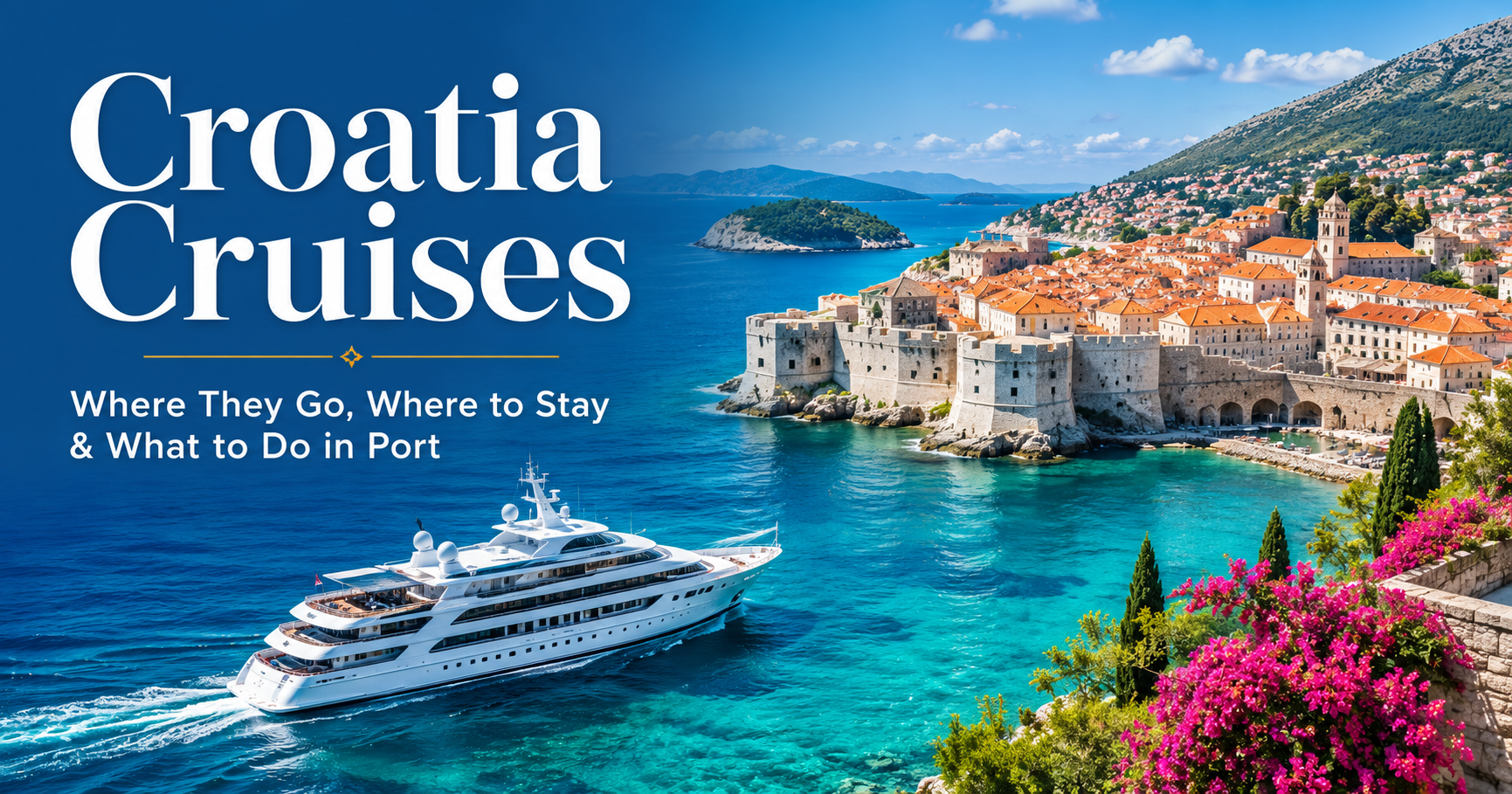
Imagine waking up beside an island covered in pine trees, opening your cabin door, and finding the Adriatic glowing almost impossibly blue beneath the morning sun.
Later, you might walk through a medieval walled city, swim from the back of a small ship, wander through a Roman palace that became part of a living city, taste wine on a quiet island, or watch the sunset while the sea plays music through Zadar’s waterfront Sea Organ.
Then, while you sleep, your ship carries you toward another stone harbor, another island, another hidden bay, or another beautiful Croatian town.
That is what makes a Croatia cruise feel so special.
Croatia’s coast is not merely a collection of cruise ports. The islands, channels, historic towns, swimming coves, waterfront promenades, and stretches of brilliant blue water between them are part of the experience.
There are two main ways to cruise Croatia.
Large cruise ships usually visit Croatia as part of a wider Adriatic or Eastern Mediterranean itinerary, often combining Dubrovnik, Split, Zadar, or Šibenik with destinations in Italy, Montenegro, Greece, or Slovenia.
Small Croatian cruise ships and sailing vessels offer a more intimate island-hopping experience. These cruises frequently travel between Split and Dubrovnik, stopping at places such as Hvar, Korčula, Brač, Vis, Mljet, Šipan, Trogir, Šibenik, or Zadar along the way. Some include swimming stops directly from the ship, evenings ashore, guided sightseeing, wine experiences, cycling, hiking, or specialty food itineraries.
This guide covers the main types of Croatia cruises, where they usually go, the best things to do in the most important ports, where to stay before or after sailing, and the few cruise-specific things you really should not forget to pack.

Quick Answer: Are Croatia Cruises Worth It?
A Croatia cruise can be extremely worth it if you want to experience the country’s coastline and islands without repeatedly packing, checking into hotels, coordinating ferries, or carrying luggage across old stone streets.
Cruising is especially good for travelers who want:
- Several Croatian islands and coastal cities in one trip
- Clear Adriatic water and beautiful sailing scenery
- Historic towns mixed with swimming and beach time
- Easier transportation between islands
- Evenings in waterfront towns rather than every night at sea
- A first introduction to Croatia before planning a longer land trip
- An alternative to a traditional giant cruise ship
A cruise may be less ideal if your dream trip involves several nights in each destination, spontaneous ferry changes, a long inland road trip, extensive time in Zagreb, or slower exploration of Croatia’s national parks and countryside.
But for travelers who want Dubrovnik, Split, islands, medieval towns, swimming stops, and Adriatic scenery with easier logistics, cruising is one of the most practical and memorable ways to experience coastal Croatia.
Croatia Cruises at a Glance

| Cruise Style | Typical Route Experience | Best For |
|---|---|---|
| Dalmatian Coast Small-Ship Cruise | Split, Dubrovnik, Hvar, Korčula, Brač, Vis, Mljet, Trogir, or nearby islands | Travelers who want island hopping, swimming, and evenings ashore |
| Traditional Adriatic or Eastern Mediterranean Cruise | Croatian ports combined with Italy, Montenegro, Greece, Slovenia, or other Mediterranean destinations | Travelers who want several countries on one cruise |
| Croatia-Intensive Cruise | Dubrovnik, Split, Zadar, Šibenik, Hvar, Korčula, Rovinj, or several Croatian ports | Travelers who want more Croatia and fewer unrelated destinations |
| Yacht or Sailing Cruise | Smaller islands, quiet bays, swimming stops, and compact harbors | Travelers who prioritize the sea and a more intimate experience |
| Active or Specialty Cruise | Cycling, hiking, wine, food, wellness, or themed island itineraries | Travelers who want activities built into the cruise |
| Short One-Way Cruise | Split to Dubrovnik, Dubrovnik to Split, Zadar to Opatija, or another short coastal segment | Travelers adding a cruise to a longer Croatia trip |
Small-ship Croatia cruises are not simply miniature versions of traditional cruises.
The vessels are smaller, cabins may be more compact, and entertainment is usually the coastline rather than theaters, casinos, water parks, or elaborate nightly shows. Days may include swimming stops and lunch onboard, while afternoons and evenings are spent exploring towns independently or with a guide.
That rhythm is one of their biggest appeals.
Where Do Croatia Cruises Usually Go, and What Should You Do in Port?
Dubrovnik

Dubrovnik is Croatia’s most famous cruise destination and one of the most dramatic arrivals on the Adriatic.
Most large ships use the port in Gruž Bay, while cruise scheduling also allows a limited number of large ships near the Old City. Gruž is separate from the historic center, so travelers should leave time for a shuttle, bus, taxi, or arranged excursion before beginning their sightseeing.
The main attraction is the magnificent walled Old Town, where polished stone streets, historic gates, churches, palaces, steep lanes, and terracotta rooftops sit directly beside the sea.
Best things to do in Dubrovnik:
- Walk Dubrovnik’s city walls on a cruise-friendly guided tour
- Combine the Old Town, city walls, and Mount Srđ cable car
- Take a Dubrovnik cable-car shore excursion
- Visit the city’s Game of Thrones filming locations
- Walk along Stradun and explore the lanes branching away from it
- Visit Rector’s Palace, the old harbor, churches, monasteries, and historic squares
Dubrovnik is also one of the ports where you should resist trying to do everything. The walls, Old Town, cable car, Lokrum, beaches, and longer day trips cannot all be squeezed comfortably into one ordinary port call.
For many travelers, the strongest first visit is the Old Town, city walls, and one additional priority.
For substantially more options, see my full guide to the best things to do in Dubrovnik.
Split

Split is both a historic city and one of Croatia’s most important gateways to the islands.
The extraordinary part is that Diocletian’s Palace is not preserved as an isolated museum complex. Its ancient walls, cellars, courtyards, gates, and passages have become part of the living center of Split, filled with homes, restaurants, shops, cafés, and everyday city life.
The Riva waterfront, palace area, old lanes, markets, and ferry activity all sit close together, making Split one of the easiest Croatian ports to enjoy without spending most of the day in transportation.
Best things to do in Split:
- Take a cruise-port walking tour of Diocletian’s Palace and Split Old Town
- Explore Split and nearby Trogir on a half-day shore tour
- Join a small-group Split food tour
- Visit Salona and Klis Fortress
- Take a half-day boat trip to the Blue Lagoon and Trogir
- Walk the Riva and explore the palace independently
- Climb Marjan Hill if you want views and your port schedule leaves enough time
Travelers embarking or disembarking in Split should strongly consider adding extra time. The city is worth more than a rushed afternoon, and it is also useful for day trips, ferry connections, beaches, and recovery after a long international journey.
Hvar

Hvar is one of the signature stops on a small-ship Croatian cruise.
Hvar Town wraps around a beautiful harbor backed by stone buildings, narrow lanes, café terraces, historic churches, and a hilltop fortress. It can feel glamorous and lively, but it also has real history and one of the most attractive harbor settings on the coast.
Smaller vessels may dock or anchor near town, although exact arrival arrangements vary by ship and harbor conditions.
Best things to do in Hvar:
- Walk through Hvar Town and climb toward Fortica Fortress
- Visit St. Stephen’s Square and the historic theater
- Cruise around Hvar and the Pakleni Islands
- Explore the Pakleni Islands, Red Rocks, and Hvar’s southern shore
- Take a Blue Cave and Pakleni Islands speedboat trip
- Enjoy a relaxed waterfront meal or drink
- Explore nearby beaches or take a short water taxi when time allows
Check the length of your port call before booking another full-day boat tour. Some small-ship itineraries already include swimming stops and may give you only part of the afternoon or evening in Hvar Town.
Korčula

Korčula Town is smaller and quieter than Dubrovnik, but the historic center has a similar walled, stone-built beauty on a much more intimate scale.
The Old Town occupies a compact peninsula, with narrow lanes arranged around the main street and sea views appearing between buildings. It is easy to explore on foot, while the surrounding island is known for beaches, villages, olive oil, vineyards, and local white wines.
Best things to do in Korčula:
- Wander through Korčula Old Town
- Visit St. Mark’s Cathedral
- Walk around the waterfront and old defensive walls
- Join a Korčula wine and sightseeing tour
- Experience a Korčula wine, food, and countryside tour
- Combine vineyard walking, wine tastings, and dinner
- Relax at a waterfront café instead of turning the stop into another race
Korčula is especially suited to a slower port day. You do not necessarily need a complicated excursion unless wine, cycling, beaches, or the island’s countryside are a major priority.
Zadar

Zadar combines Roman ruins, medieval churches, Venetian walls, waterfront promenades, and two striking modern installations: the Sea Organ and Greeting to the Sun.
Large cruise ships may use Gaženica, which is approximately 3.5 kilometers from Zadar’s center, while smaller vessels may use facilities closer to the peninsula. That means passengers should check their exact berth rather than assuming they can walk directly into the Old Town.
Best things to do in Zadar:
- Take a guided Old Town, city walls, and Sea Organ walking tour
- Join a compact Zadar history walk
- Listen to the Sea Organ along the waterfront
- See the Greeting to the Sun installation
- Visit the Roman Forum and Church of St. Donatus
- Walk through the old city gates and historic streets
- Visit Plitvice Lakes from Zadar Cruise Port when the ship’s schedule genuinely allows it
Plitvice Lakes is spectacular, but it creates a long and fairly structured port day. Travelers with a shorter call may be much happier remaining in Zadar rather than spending most of their limited time traveling inland.
Šibenik

Šibenik is a historic stone city with steep lanes, fortresses, waterfront views, and the UNESCO-listed Cathedral of St. James.
It is also one of the most useful cruise gateways to Krka National Park, making it possible to combine a historic city with waterfalls and river scenery.
Best things to do in Šibenik:
- Explore the Old Town and Cathedral of St. James
- Walk up toward one of Šibenik’s fortresses
- Visit Krka National Park and Skradinski Buk
- Reach Krka National Park by speedboat
- Combine Šibenik’s waterfront, St. Nicholas Fortress, and Krka
- Enjoy the waterfront and historic center at a slower pace
Krka is the obvious big excursion, but Šibenik itself deserves attention. Do not automatically skip the city without seeing how much time remains after transportation and park sightseeing.
Rovinj

Rovinj gives a Croatia cruise a completely different atmosphere from the Dalmatian ports farther south.
The Old Town rises from a compact peninsula in Istria, with colorful buildings along the water, tightly packed lanes, art studios, cafés, and the Church of St. Euphemia crowning the hill.
Best things to do in Rovinj:
- Take a guided Rovinj Old Town walking tour
- Walk up to the Church of St. Euphemia
- Explore the harbor and old lanes
- Browse local galleries and shops
- Take a broader private tour through Istria
- Enjoy seafood, truffles, olive oil, or other Istrian specialties
- Take a short scenic boat ride when the port schedule allows
Rovinj appears more often on northern Adriatic, luxury, and smaller-ship itineraries than on classic Split-to-Dubrovnik island cruises.
Where to Stay Before or After a Croatia Cruise
Split and Dubrovnik are the two most useful Croatian cities for pre- and post-cruise stays, particularly for small-ship itineraries traveling between them.
| Cruise City | My Hotel Pick | Why It Works |
|---|---|---|
| Split | Cornaro Hotel | Central location, comfortable full-service stay, close to major sights, and approximately a 13-minute walk from the Port of Split |
| Dubrovnik | Hotel Kompas | Stylish Lapad waterfront setting, resort comfort, and a more convenient position for Gruž Harbor than many hotels near the Old Town |
Cornaro Hotel is my practical Split cruise pick because it places travelers near Diocletian’s Palace, the Riva, restaurants, sightseeing, and the Port of Split without sacrificing the comfort of a full hotel. Expedia lists the port at roughly a 13-minute walk, although travelers with substantial luggage may still prefer a short taxi.
Hotel Kompas is my Dubrovnik cruise pick because Lapad gives travelers a scenic waterfront stay while keeping them closer to Gruž Harbor than most hotels around the Old Town. Expedia lists it approximately 0.8 miles from Dubrovnik Ferry Port.
For more choices organized by traveler type, see my complete guides to:
Traditional Mediterranean cruises may begin or end outside Croatia in cities such as Venice, Trieste, Ravenna, or Athens. Always confirm the exact embarkation port before booking flights or hotels because the advertised destination region is not necessarily where the ship begins.
How Many Nights Should You Add Before or After a Croatia Cruise?
Add One Night If:
- You primarily need protection against flight delays
- You want to avoid flying in on embarkation day
- You need time to recover from an overnight journey
- You want dinner, a walk, and a calmer boarding morning
Add Two Nights If:
- You want to see Split or Dubrovnik properly
- You want one complete sightseeing day
- You plan to walk Dubrovnik’s walls or explore Diocletian’s Palace
- You want time to enjoy the hotel rather than only sleep there
Add Three Nights If:
- Split or Dubrovnik is a major part of your vacation
- You want both city sightseeing and a day trip
- You are combining the cruise with a longer Croatian land itinerary
- You do not want the beginning or end of the trip to feel rushed
At minimum, I would add one night before any cruise involving an international flight.
Two nights is much better when time and budget allow.
Croatia Cruise or Croatia Land Trip?

A cruise is a wonderful way to experience Croatia’s coast, but it is not identical to traveling through the country independently.
Choose a Cruise If:
- You want several islands without managing ferry connections
- You dislike repeatedly changing hotels
- You want swimming and coastal scenery built into the trip
- You prefer a planned route with fewer daily logistics
- You want a gentle introduction to several destinations
Choose a Land Trip If:
- You want multiple nights on Hvar, Korčula, or another island
- You want flexibility to change plans
- You want to explore inland Croatia
- Zagreb, Plitvice Lakes, Istria, or rural areas are major priorities
- You prefer apartments, road trips, and independent ferry travel
Choose Both If:
This may be the best version.
Use the cruise for the islands, coastal towns, and Adriatic sailing. Then add Split, Dubrovnik, Istria, Plitvice Lakes, or another land destination before or after the voyage.
That gives you the ease of cruising without allowing a ship schedule to define the entire Croatia experience.
Things Not to Forget to Pack for a Croatia Cruise
This is not a complete Croatia packing list. These are the cruise-specific pieces I would not want to forget.

- Water shoes for pebbly beaches, stone swimming platforms, and sea ladders
- Swimsuit
- Quick-drying cover-up
- Sunscreen
- SPF lip balm
- Sunglasses
- Packable sun hat
- Day bag
- Refillable water bottle
- Portable power bank
- Phone lanyard or secure waterproof phone pouch
- Small amount of motion-sickness support
- Wet bag for damp swimwear
Small Croatian cruise cabins may offer less storage than travelers expect, especially on older or more traditional vessels. Soft-sided luggage is often easier to manage than a giant rigid suitcase.
For clothing quantities and a complete seasonal list, see my Croatia summer packing guide.
For adapters, voltage, charging, and electrical information, see my Croatia outlet, plug and voltage guide.
Things Nobody Tells You About Croatia Cruises

A Small-Ship Croatia Cruise Is Not a Miniature Resort Cruise
Do not expect water slides, huge production shows, casinos, endless restaurants, and a packed entertainment schedule.
The destination is the entertainment.
A small Croatian cruise is generally about swimming, scenery, food, conversation, islands, historic towns, and spending evenings ashore.
Swimming Stops May Be a Major Part of the Day
Many small-ship itineraries pause in bays or near beaches so passengers can swim directly from the vessel.
Bring your swimsuit, water shoes, sunscreen, and anything you need before settling onto the deck. Your main luggage may not be convenient to access every time the captain finds a gorgeous swimming spot.
You May Not Dock Directly Beside the Old Town
A destination name does not tell you the exact berth.
Large ships commonly use Gruž in Dubrovnik and Gaženica in Zadar, while smaller vessels may dock elsewhere, anchor offshore, use tenders, or rely on water taxis and local buses. Check the ship’s arrival information before planning an independently timed activity.
The Ship May Raft Beside Other Small Ships
In busy Croatian harbors, small vessels may tie up beside one another.
Passengers sometimes need to walk across another boat to reach shore. This is normal, but it makes practical shoes and manageable luggage much more important.
Cabins and Bathrooms Can Be Compact
A beautiful modern small ship can still have significantly less cabin space than a large ocean liner or hotel room.
Check the deck, cabin category, window style, bed configuration, and whether your room is above or below the waterline before booking.
Upper-Deck Cabins Are Not Automatically Better
Upper cabins may offer easier access and larger windows, but they can also experience more harbor noise, early-morning activity, music, footsteps, or movement.
Lower cabins can be quieter but may have smaller windows or portholes. The best choice depends on whether you prioritize views, quiet, accessibility, or motion comfort.
Croatia’s Stone Streets Are Beautiful and Unforgiving
Dubrovnik, Split, Hvar, Korčula, Šibenik, and Rovinj all involve some combination of polished stone, slopes, stairs, uneven lanes, and hot sun.
This is not the trip for flimsy shoes with slippery soles.
Not Every Island Stop Needs a Tour
Some ports are perfect for one major excursion. Others are better enjoyed by wandering through town, finding a swimming spot, sitting beside the harbor, visiting a church or fortress, and having a relaxed meal.
You do not need to turn every stop into a tightly scheduled project.
Your Exact Itinerary Matters More Than the Cruise Title
Two cruises both marketed as “Croatia” or “Dalmatian Coast” can offer very different experiences.
Look at:
- The actual ports and islands
- How many hours you receive ashore
- Whether the ship sails overnight or during the day
- How many swimming stops are included
- Which meals are included
- Whether guided tours are included or optional
- Where the cruise truly begins and ends
- The vessel size and cabin configuration
- Whether the trip is relaxed, luxury, active, or party-oriented
The itinerary details matter much more than a beautiful promotional photograph.
Final Thoughts on Croatia Cruises
Croatia is one of those destinations where cruising genuinely suits the geography.
You can wake beside a medieval island town, swim in clear Adriatic water before lunch, walk through a Roman palace in the afternoon, drink local wine in Korčula, climb above Hvar’s harbor, listen to the sea in Zadar, and watch Dubrovnik’s walls glow in the evening light—all without packing your suitcase every few days.
The key is choosing the right kind of cruise.
A large Mediterranean ship gives you resort amenities and several countries. A small Croatian ship gives you islands, swimming stops, harbor towns, and a more intimate connection with the coast. A yacht or active cruise creates another experience entirely.
Study the actual route. Add at least one hotel night before sailing. Reserve your highest-priority port activities. Pack water shoes, comfortable walking shoes, sun protection, and a secure day bag.
Then leave space for the quieter moments: morning light on the water, an unplanned swim, dinner beside a harbor, or an evening walk through an old stone town after the daytime crowds have disappeared.