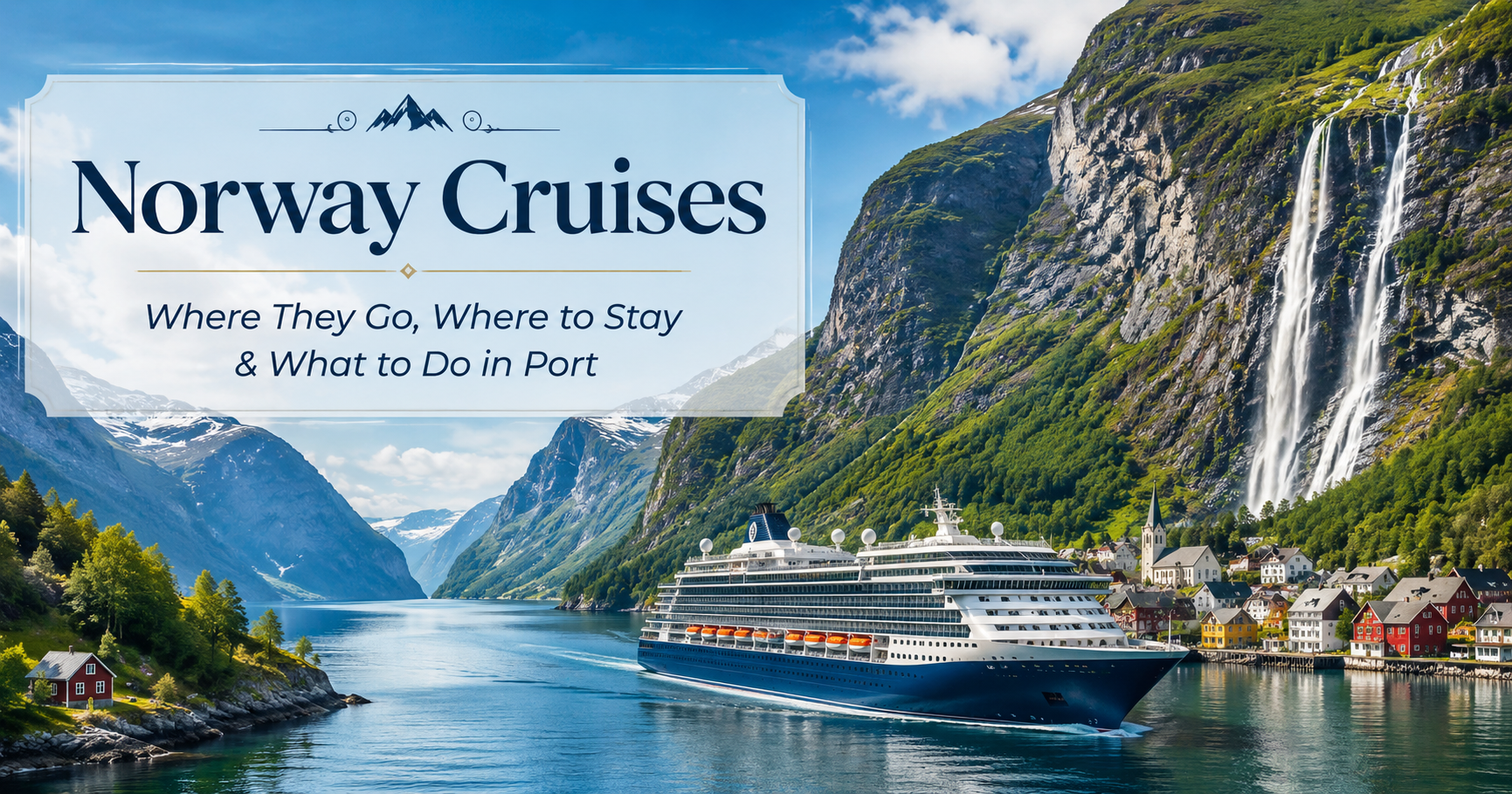
Imagine waking up, pulling back the curtains, and finding your ship surrounded by steep green mountains, silver waterfalls, and water so still it reflects the entire fjord.
Later, you might ride a train past mountain farms and rushing rivers, look down over a village from a sky-high viewpoint, walk through a colorful harbor town, or sail beneath a cliff that rises almost straight from the water.
Then, while you sleep, the ship carries you toward another fjord, another waterfall, another Arctic island, or another storybook port.
That is what makes a Norway cruise feel different.
The sailing is not simply transportation between destinations. The journey through the fjords and along Norway’s coast is part of the experience.
Norway cruises can include dramatic western fjords, historic coastal cities, glacier valleys, scenic railways, Arctic ports, the North Cape, the midnight sun, or northern lights, depending on the route and season. Some are traditional leisure cruises with full port days. Others follow Norway’s working coastal route between Bergen and Kirkenes, stopping at communities all along the coast.
This guide covers the main kinds of Norway cruises, where they usually go, the best things to do in the most important ports, where to stay before or after sailing, and the few things you really should not forget to pack.

Quick Answer: Are Norway Cruises Worth It?
A Norway cruise can be extremely worth it if your priority is scenery.
You can experience several fjords, cities, villages, mountains, waterfalls, and coastal regions without repeatedly changing hotels or coordinating a complicated series of trains, ferries, rental cars, and overnight stops.
Norway cruises are especially good for travelers who want:
- Dramatic scenery directly from the ship
- Fjords without planning every transportation connection
- Several Norwegian destinations in one trip
- A mixture of nature and city port days
- Scenic railways, glaciers, waterfalls, and viewpoints
- Comfortable travel without constant packing and unpacking
- A first introduction to Norway before planning a longer land trip
A cruise may be less ideal if your dream trip revolves around long hikes, flexible road trips, remote inland areas, or several nights in each destination.
But for travelers who want fjords, coastal cities, Arctic landscapes, and some of Norway’s most memorable scenery with easier logistics, cruising is one of the most practical ways to experience the country.
Norway Cruises at a Glance

| Cruise Style | Typical Route Experience | Best For |
|---|---|---|
| Norwegian Fjords Cruise | Bergen, Stavanger, Flåm, Geiranger, Ålesund, Olden, or other western fjord ports | First-time Norway cruisers and scenery lovers |
| Norway and Northern Europe Cruise | Norway combined with Denmark, Sweden, Germany, the Netherlands, or the United Kingdom | Travelers who want several countries |
| Arctic Norway Cruise | Tromsø, Lofoten, Honningsvåg, the North Cape, or other northern ports | Arctic scenery, wildlife, and midnight sun |
| Norwegian Coastal Voyage | Bergen to Kirkenes, Kirkenes to Bergen, or the complete round trip | Travelers who want more of Norway’s working coast |
| Small-Ship or Expedition Cruise | Smaller ports, remote islands, Arctic regions, and nature-heavy routes | Active and adventurous travelers |
Not every Norway cruise begins or ends in Norway. Many traditional fjord cruises depart from cities elsewhere in Northern Europe and visit Norway as the main destination.
The Norwegian Coastal Express is different. Hurtigruten and Havila operate along the historic Bergen–Kirkenes coastal route, serving cruise travelers while also connecting communities and carrying passengers and goods between ports. The complete route includes dozens of coastal stops rather than only a handful of full-day cruise destinations.
Where Do Norway Cruises Usually Go, and What Should You Do in Port?
Norway has many cruise ports, but most first-time travelers only need to understand the main route areas and the ports that appear most often on classic fjord and Arctic itineraries.
Bergen

Bergen feels like the natural gateway to fjord Norway.
Cruise ships use locations close to the city center, making it possible to reach colorful Bryggen, the Fish Market, cafés, museums, and the Fløibanen funicular without spending most of the port day in transit.
Bergen also works beautifully before or after a cruise. The compact center is easy to explore, while nearby fjord cruises provide a scenic introduction to western Norway.
Best things to do in Bergen:
- Walk through the historic Bryggen waterfront
- Ride the Fløibanen funicular to Mount Fløyen
- Visit the Fish Market and harbor
- Explore Bergenhus Fortress
- Take a Mostraumen fjord cruise from Bergen
- Join a guided Bergen city and fjord tour
Oslo

Oslo gives Norway cruises a more polished city day.
The waterfront brings together the Opera House, MUNCH, the National Museum, Akershus Fortress, harbor walks, ferries, restaurants, and striking modern architecture. Farther out, travelers can visit the museums of the Bygdøy Peninsula, Vigeland Sculpture Park, or Holmenkollen.
The compact center can be explored on foot or by public transportation, and many major cultural attractions sit within easy reach of the waterfront.
Best things to do in Oslo:
- Walk across the roof of the Oslo Opera House
- Visit MUNCH or the National Museum
- Explore Akershus Fortress
- See Vigeland Sculpture Park
- Visit the Fram Museum or Norwegian Museum of Cultural History
- Take a Oslofjord sightseeing cruise
- Join an Oslo city and fjord combination tour
Stavanger

Stavanger is one of Norway’s strongest city-and-fjord ports.
Ships dock in the heart of the city, close to Gamle Stavanger’s white wooden houses, the colorful street known as Fargegata, museums, restaurants, and waterfront walks.
The major scenic attraction is Lysefjord, where travelers can see waterfalls, steep cliffs, and Pulpit Rock from the water. Active travelers may instead choose a guided hike to the top of Pulpit Rock, provided their port schedule allows enough time.
Best things to do in Stavanger:
- Cruise through Lysefjord
- See Pulpit Rock from the water
- Take a guided Pulpit Rock hike
- Walk through Gamle Stavanger
- Visit the Norwegian Petroleum Museum
- Explore the harbor and colorful Fargegata
- See the Swords in Rock monument
Flåm

Flåm may be small, but it is one of the biggest scenery days on a Norwegian fjords itinerary.
The port sits in the village center, surrounded by mountains, waterfalls, and the Aurlandsfjord. It is also the starting point for the famous Flåm Railway, which climbs from the fjord through steep mountain scenery toward Myrdal.
Other popular choices include the Stegastein viewpoint, electric-boat trips through the UNESCO-listed Nærøyfjord, cycling, hiking, and nearby cultural experiences.
Best things to do in Flåm:
- Ride the Flåm Railway
- Cruise through Nærøyfjord
- Visit the Stegastein viewpoint
- Explore the village and Flåm Railway Museum
- Visit the Viking village at Gudvangen
- Take a scenic bike ride or guided hike
Popular Flåm experiences can fill quickly, so this is not the port where I would wait until the last minute to decide what matters most.
Geiranger and Hellesylt

Geirangerfjord is the Norway cruise scenery many travelers have imagined before they ever book the trip.
The UNESCO-listed fjord is surrounded by steep mountains, mountain farms, and waterfalls including the Seven Sisters and the Suitor. Cruise itineraries may use Geiranger, Hellesylt, Stranda, or a combination of nearby ports.
From Geiranger, travelers can visit Eagle Bend, Flydalsjuvet, Mount Dalsnibba, the Norwegian Fjord Centre, or see the fjord from a smaller sightseeing boat. Hellesylt offers waterfalls, viewpoints, kayaking, and overland access toward Stryn and Loen.
Best things to do in Geiranger and Hellesylt:
- Visit the Eagle Bend viewpoint
- See the view from Flydalsjuvet
- Travel to Mount Dalsnibba and the Geiranger Skywalk
- Take a smaller boat through Geirangerfjord
- See the Seven Sisters waterfall
- Walk beside Hellesylt Waterfall
- Kayak or take a scenic RIB tour
Ålesund

Ålesund is one of Norway’s prettiest city ports.
The cruise terminal is in the heart of town, close to the Art Nouveau center, shops, restaurants, canals, and the steps leading toward the Aksla viewpoint.
Travelers can keep the day compact with city sightseeing or head farther into the surrounding islands, fjords, fishing villages, and mountain scenery.
Best things to do in Ålesund:
- Explore the Art Nouveau center
- Climb or ride to the Aksla viewpoint
- Tour the nearby islands of Giske and Godøya
- See Alnes Lighthouse
- Cruise through Hjørundfjord
- Take a longer scenic trip into the surrounding fjord region
Olden and Nordfjord

Olden is the glacier-and-mountain-view port.
The village sits near the inner end of Nordfjord, where travelers can reach Briksdal Glacier, Olden Lake, Loen, and the Loen Skylift. The landscape feels greener and more pastoral than some of Norway’s steeper fjord ports, with glacier valleys, waterfalls, farms, and blue-green water.
Briksdal is the classic excursion, while the Loen Skylift is a strong choice for travelers who want huge views without committing to a long mountain hike. Local transportation also runs from the Olden cruise area toward both attractions when ships are in port.
Best things to do from Olden:
- Visit Briksdal Glacier
- Ride the Loen Skylift
- See Olden Lake and Loen Lake
- Take a scenic valley drive
- Join a RIB boat trip on Nordfjord
- Explore the small village and waterfront
Tromsø and Arctic Norway

Arctic Norway itineraries may include Tromsø, Honningsvåg for the North Cape, ports in Lofoten, or smaller coastal communities north of the Arctic Circle.
Tromsø is one of the most useful northern ports because it combines a compact city with quick access to fjords, wildlife, mountains, and seasonal Arctic experiences. Major sights include the Arctic Cathedral, Fjellheisen cable car, the Polar Museum, Polaria, and the harbor.
Summer cruises may focus on fjord scenery, wildlife, long daylight, and the midnight sun. Autumn and winter coastal voyages may offer northern lights excursions, snow activities, or darker Arctic landscapes.
Best things to do in Tromsø and Arctic Norway:
- Ride the Fjellheisen cable car
- Visit the Arctic Cathedral
- Take an Arctic fjord and wildlife tour
- Explore the Polar Museum
- Travel from Honningsvåg to the North Cape
- Take a scenic tour through Lofoten
- Book a northern lights chase during the appropriate season
Where to Stay Before or After a Norway Cruise
Many traditional Norwegian fjords cruises begin outside Norway, so always check the exact embarkation and disembarkation city before booking flights or hotels.
For itineraries that do begin or end in Norway, Bergen and Oslo are the most useful cities to consider for an extra stay. Bergen is the starting and ending point for the classic Norwegian coastal route, while Oslo appears on some traditional cruises, ferries, and extended cruise-and-rail itineraries.
| Cruise City | My Hotel Pick | Why It Works |
|---|---|---|
| Bergen | Clarion Hotel Admiral | Waterfront setting, central location, harbor atmosphere, and easy access to Bryggen and Bergen sightseeing |
| Oslo | Clarion Hotel The Hub | Next to Oslo Central Station, useful for airport-train arrivals, central sightseeing, luggage logistics, and taxi access to the waterfront |
Clarion Hotel Admiral is my best all-around Bergen cruise stay because it feels connected to the harbor while still placing travelers close to the city’s main attractions. Expedia currently lists it in Bergen City Centre near the Bryggen waterfront.
Clarion Hotel The Hub is my practical Oslo cruise pick because it sits beside the central station and works especially well for travelers arriving by airport train or continuing through Norway by rail.
For more Oslo options by traveler type, see my full guide to the best hotels in Oslo.
How Many Nights Should You Add Before or After a Norway Cruise?
Add One Night If:
- You mainly need a flight-delay buffer
- You want to avoid arriving on embarkation day
- You need time to recover from an overnight flight
- You want dinner, a short walk, and a calmer cruise morning
Add Two Nights If:
- You want to see Bergen or Oslo properly
- You want one full sightseeing day
- You plan to take a city tour, museum day, or short fjord cruise
- You do not want the start of your cruise to feel rushed
Add Three Nights If:
- Bergen or Oslo is a major part of the trip
- You want both city sightseeing and a day trip
- You are combining the cruise with a rail journey
- You want the cruise to feel like part of a larger Norway vacation
At minimum, I would add one night before any cruise involving an international flight.
Two nights is better when time and budget allow.
Norway Cruise or Norway Land Trip?

A Norway cruise is a beautiful introduction to the coast, but it is not the same experience as traveling through Norway entirely by land.
| Choose a Norway Cruise If | Choose a Norway Land Trip If |
|---|---|
| You want several fjords and ports | You want longer stays in each destination |
| You prefer simple transportation | You enjoy planning trains, ferries, and road trips |
| Scenic sailing is a priority | Hiking and inland scenery are your priorities |
| You do not want to change hotels repeatedly | You want flexible mornings and evenings |
| You want cities and nature in one itinerary | You want remote areas beyond cruise ports |
| You prefer structured travel days | You dislike fixed arrival and departure times |
Choose Both If:
This may be the best version.
Use the cruise for fjords, coastal ports, and scenic sailing. Then add Bergen, Oslo, a railway journey, or a short land extension before or after the voyage.
That gives you the ease of cruising without making the entire Norway experience dependent on a ship schedule.
Things Not to Forget to Pack for a Norway Cruise
This is not a full Norway packing list. These are the cruise-specific pieces I would not want to forget.
- Packable puffer
- Warm sweater or fleece
- Compact day bag
- Small umbrella
- Warm hat and light gloves
- Sunglasses
- Sunscreen
- SPF lip balm
- Power bank
- Binoculars for fjord scenery and wildlife
- Motion-sickness support
- Refillable water bottle
- Swimsuit for the ship’s pool, hot tub, spa, or sauna
- Phone lanyard or secure case for boat trips and viewpoints
- Any medication needed during long port days
The most important thing is layering.
Even during summer, a Norway cruise day can include a cool morning on deck, rain in port, sunshine at lunch, wind on a viewpoint, and a warm ship interior. You want pieces that are easy to add, remove, and carry.
For clothing quantities and a complete seasonal list, see my Norway summer packing guide.
For adapters, voltage, charging, and electrical information, see my Norway outlet, plug and voltage guide.
Things Nobody Tells You About Norway Cruises

The Sailing Hours Are Part of the Trip
Do not assume the best scenery only happens after the ship docks.
Some of the most memorable moments may happen while entering or leaving a fjord, passing tiny waterside farms, sailing beneath waterfalls, or watching mountains slowly close around the ship.
Check your itinerary, listen for onboard announcements, and be willing to wake up early when the approach is supposed to be special.
You Will Still Want Warm Layers in Summer
A sunny afternoon in town can feel completely different from an early morning on an exposed deck.
Wind, rain, shade, elevation, and moving boats can all make the day feel cooler than the forecast suggests. Pack for changing conditions rather than one predicted temperature.
Choose Your Priority Before You Reach Port
Some Norway ports offer several excellent experiences that cannot realistically be combined in one day.
In Flåm, you may need to choose between the railway, a longer fjord trip, and a road excursion. In Olden, you may have to prioritize Briksdal Glacier or the Loen Skylift. In Stavanger, a Pulpit Rock hike uses much more of the day than a Lysefjord cruise.
Decide what would disappoint you most to miss, then plan around that.
A Coastal Voyage Is Not the Same as a Traditional Cruise
Hurtigruten and Havila sail a historic working route connecting coastal communities between Bergen and Kirkenes.
That creates a different rhythm from a resort-style cruise. The journey includes many ports, some longer and some brief, with locals, cargo, transportation, and coastal life continuing alongside the vacation experience.
Not Every Port Needs a Huge Excursion
Norway’s scenery can make travelers feel as though every stop requires an expensive all-day tour.
It does not.
A major experience may be worth booking in Flåm, Geiranger, Olden, or Stavanger. But Bergen, Oslo, Ålesund, and Tromsø can also be enjoyable with a well-planned walk, museum visit, viewpoint, café stop, and one smaller activity.
Leave room to enjoy where you are instead of treating every port day like a race.
Final Thoughts on Norway Cruises
Norway is one of the rare places where a cruise can make the landscape feel bigger rather than smaller.
You can wake inside a fjord, ride one of the country’s most scenic railways, see waterfalls from the ship, visit a glacier valley, explore a colorful harbor city, cross the Arctic Circle, or stand at a viewpoint high above the water—all without changing hotels every few nights.
The key is choosing the right itinerary and deciding which port experiences matter most to you.
Look closely at the actual fjords and ports included. Add a hotel night before sailing. Reserve your highest-priority activities before they disappear. Pack waterproof layers, binoculars, and comfortable shoes. Then remember to spend time outside on the ship, because in Norway, some of the best moments happen while you are still sailing.