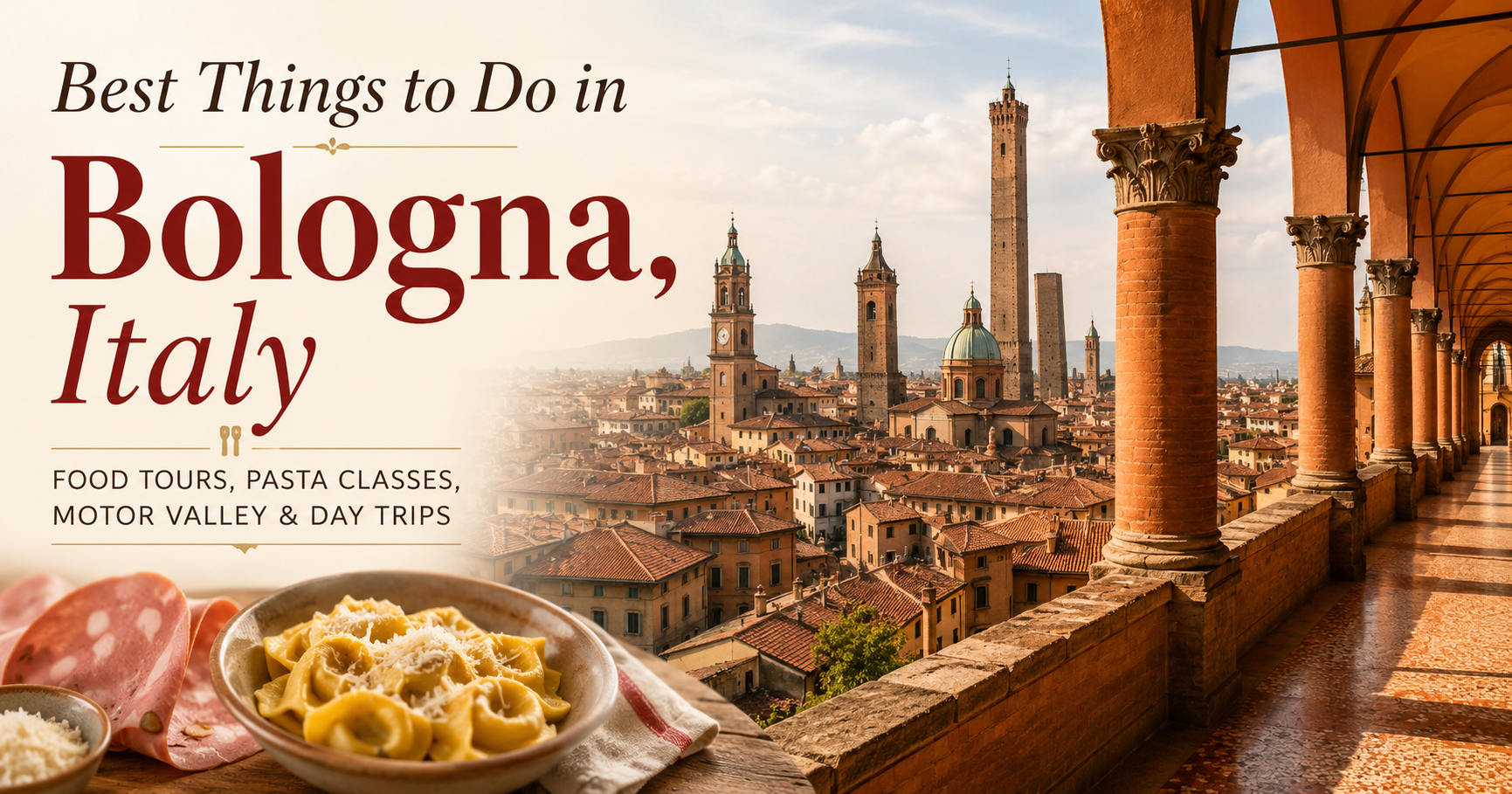
Bologna is one of the best cities in Italy for travelers who want incredible food, beautiful architecture, rich history, and easy access to places that feel completely different from one another. Its long porticoes lead through medieval streets, busy food markets, university courtyards, elegant piazzas, hidden churches, traditional shops, and neighborhoods that still feel lived in rather than arranged only for visitors.
Food is a major part of Bologna’s identity, but this is not a city where every experience needs to be another general tasting tour. You can explore local markets, learn to make fresh pasta, cook traditional ragù, shape tortellini, make gelato, dine in a local home, discover mortadella in the countryside, visit Parmigiano Reggiano and balsamic vinegar producers, taste Lambrusco, or spend a full day exploring the wider Food Valley.
Bologna is also an excellent base for experiences that have nothing to do with pasta. You can climb above the city for views, explore the world’s oldest university, follow the porticoes toward the Basilica of San Luca, ride through the hills by e-bike, Vespa, horseback, or vintage Fiat 500, visit Ferrari, Lamborghini, Ducati, Pagani, and Maserati collections, or take day trips to Ravenna, Ferrara, Dozza, Brisighella, medieval fortresses, wineries, and San Marino.
The number of available tours can make planning more confusing than it needs to be. Bologna has dozens of food walks, cooking classes, private city tours, and Motor Valley excursions that may sound different but cover much of the same ground. This guide keeps the choices distinct so you can understand what each experience offers and avoid booking several activities that feel repetitive.
The guide begins with one useful city introduction before moving into focused cultural experiences, food and wine tours, cooking classes, Food Valley, Motor Valley, active experiences, unusual local activities, and the best day trips from Bologna.

Bologna City Experience
Bologna’s historic center is compact enough to explore on foot, but that does not mean the city immediately explains itself. Medieval lanes open into grand piazzas, university buildings hide behind unassuming entrances, and many of the city’s most important stories are tied to details travelers could easily walk past without recognizing.
A city tour is especially useful at the beginning of a Bologna trip because it helps connect the major landmarks while giving you a practical sense of direction. Once you understand how Piazza Maggiore, the university quarter, the food streets, the towers, and the porticoes fit together, independent wandering becomes much easier.
You do not need to book several general walking tours. One good introductory experience is enough. The more focused Archiginnasio, Clock Tower, porticoes, and San Luca experiences appear separately in the culture section because they explore specific parts of Bologna rather than repeating the same general overview.
Bologna City Walking Tour

Best for: first-time visitors, solo travelers, couples, history lovers, short stays, and anyone who wants an affordable introduction to Bologna before exploring independently.
This is the general Bologna city tour I would choose because it offers a straightforward introduction without taking over the entire day. Bologna rewards slow wandering, long meals, market stops, and spontaneous detours, so a two-hour overview provides enough guidance without making the city feel overplanned.
A guided walk can help you understand what you are actually seeing as you move through the historic center. Bologna’s importance is not tied to one famous monument. Its character comes from the combination of medieval architecture, civic history, university traditions, food culture, religious buildings, towers, porticoes, and public spaces that have been used for centuries.
This is also a practical first-day activity. You can start identifying restaurants, market streets, shops, viewpoints, and landmarks you may want to revisit later. Instead of repeatedly checking a map while trying to understand the city at the same time, you can concentrate on the stories and let someone else handle the route.
The walking format is best for travelers who are comfortable spending a couple of hours on their feet. Bologna’s porticoes can offer useful protection from strong sun or rain, but the historic center still includes old paving and uneven surfaces. Comfortable shoes are important, especially if you plan to continue sightseeing afterward.
I would book this instead of one of the many expensive private introduction tours unless you specifically need a customized route or private guide. The shared walking tour provides the city orientation most first-time visitors need while leaving more of the travel budget available for Bologna’s food, cooking, countryside, and Motor Valley experiences.
Book this if: you want one clear, reasonably paced introduction to Bologna’s historic center before exploring the markets, cultural sites, food experiences, and surrounding region in more depth.
Bologna History, Architecture & Culture
Bologna’s history is layered rather than contained inside one major museum or monument. Its medieval towers, university buildings, churches, porticoes, civic collections, and historic homes each reveal a different part of the city.
These experiences go beyond the general city introduction. Some focus on a single landmark, while others explore Bologna’s academic history, artistic collections, religious heritage, or lesser-known local stories. You can choose one based on your interests or combine several because they do not simply repeat the same sightseeing route.
Bologna Skip-the-Line Entrance to the Clock Tower and Art Collections

Best for: independent travelers, couples, photographers, art lovers, short stays, and visitors who want both city views and an indoor cultural experience.
Bologna’s rooftops are one of the best ways to understand the city’s distinctive appearance. From above, the historic center becomes a dense landscape of terracotta tiles, church domes, medieval streets, towers, and hills rising beyond the city.
This experience combines access to the Clock Tower with Bologna’s municipal art collections. That makes it a particularly useful choice for travelers who want more than a viewpoint but do not necessarily need another guided walking tour.
The tower gives you a different perspective on Piazza Maggiore and the surrounding historic center. After seeing the streets at ground level, looking down from above helps show how tightly Bologna’s old neighborhoods, civic buildings, churches, and covered walkways fit together.
The art collections add important cultural context. Instead of visiting only for a photograph from the top, you can also see rooms and works connected to Bologna’s artistic and civic history. This makes the experience worthwhile even when the weather is not perfectly clear.
Travelers should be prepared for stairs and confined historic spaces. Old towers were not designed with modern accessibility in mind, so this is not the best option for anyone with significant mobility limitations, balance concerns, or discomfort in narrow spaces.
The timed-entry format can also be useful during busy travel periods. Bologna is less overwhelmed than some of Italy’s most famous cities, but its central attractions can still become crowded, particularly on weekends and during major events.
Book this if: you want panoramic views over Bologna along with a manageable cultural visit that fits easily into a day of independent sightseeing.
Archiginnasio Small Group Guided Tour in Bologna

Best for: history lovers, university students, medical professionals, architecture enthusiasts, and travelers interested in Bologna’s academic heritage.
Bologna is home to the oldest university in the Western world, and the Archiginnasio is one of the most important places for understanding that history. Its decorated halls, courtyards, coats of arms, classrooms, and anatomical spaces show how deeply education has shaped the city.
The building is visually impressive even before you understand its significance. Thousands of heraldic emblems cover the walls, creating a record of students and scholars who traveled to Bologna from across Europe.
A guided visit is especially useful because many of the details are easy to admire without understanding. A guide can explain how the university operated, how students were organized, what subjects were taught, and why Bologna became such an influential center of learning.
One of the highlights is the historic Anatomical Theatre, where medical students once observed dissections. The carved wooden interior is both beautiful and slightly unsettling, offering a memorable glimpse into the development of medical education.
This experience is much more focused than the general Bologna city tour. It will not provide a complete introduction to the historic center, but it offers far greater depth for travelers curious about education, medicine, architecture, or intellectual history.
The small-group format is also helpful inside a historic building where large groups can make it difficult to hear explanations or see architectural details clearly.
Book this if: Bologna’s university history and Anatomical Theatre interest you more than a broad overview of the city’s outdoor landmarks.
Porticoes of Bologna and Basilica of San Luca Guided Tour

Best for: architecture lovers, religious travelers, UNESCO-site collectors, photographers, active sightseers, and visitors who want to experience one of Bologna’s defining landmarks.
Bologna’s porticoes are not simply decorative covered sidewalks. They are part of the city’s daily life, architecture, history, and identity. Together, they create an enormous network of sheltered walkways connecting homes, shops, churches, university buildings, and public spaces.
The route toward the Sanctuary of the Madonna di San Luca is the most famous portico experience. It stretches from the city toward the hills in a long sequence of covered arches, creating one of Bologna’s most recognizable journeys.
A guided tour adds context to what might otherwise feel like a long architectural walk. You can learn why Bologna developed so many porticoes, how they were constructed, how they changed over time, and why they remain so important to residents today.
The Basilica of San Luca stands above the city and has long been a place of pilgrimage. Its elevated position also provides a sense of separation from the busy historic center, with views and a quieter atmosphere once you reach the sanctuary area.
This experience can be physically demanding depending on the exact route and transportation included. The climb toward San Luca is long, and some sections rise steadily. Travelers should check the current meeting point, walking distance, and transport details before booking.
Anyone with limited mobility may prefer the shorter Bologna Guided Tour of the Basilica of San Luca, which concentrates on the sanctuary itself rather than the full portico journey.
The full guided experience is best for travelers who want to understand why the porticoes matter rather than simply photographing a few arches near Piazza Maggiore.
Book this if: you want to experience Bologna’s UNESCO-recognized porticoes and visit San Luca as part of one connected architectural and cultural journey.
Bologna: Echoes of the Past in the Renzo Savini House Museum

Best for: art lovers, historic-home enthusiasts, repeat visitors, collectors, and travelers who enjoy small museums that feel personal and undiscovered.
Bologna’s major landmarks tell the city’s public story, but historic homes can reveal how individual residents lived, collected, decorated, and understood their surroundings. The Renzo Savini House Museum offers a more intimate cultural experience than Bologna’s large civic buildings and churches.
The appeal here is not scale. This is a quieter, more personal place filled with objects, furnishings, artwork, and details connected to the life and interests of its former resident.
Experiences like this are particularly rewarding for repeat visitors who have already seen Piazza Maggiore, the towers, and the university quarter. They provide a sense of discovery and can make Bologna feel more layered than a checklist of famous monuments.
A house museum also encourages slower observation. Rather than moving quickly between major masterpieces, you can notice how rooms are arranged, how objects relate to one another, and what the collection reveals about local taste and cultural life.
This will not be the right choice for every first-time visitor. Travelers with only one day in Bologna should generally prioritize the historic center, the Archiginnasio, the porticoes, or a food experience. Those with more time may find this one of the city’s most memorable hidden cultural stops.
Because small museums may have limited entry times, guided access, or changing schedules, verify the current arrangements before planning the rest of your day around the visit.
Book this if: you enjoy unusual historic homes and personal collections more than crowded, famous museums.
Bologna Night Walking Tour: Hidden Legends and Secret Places

Best for: couples, solo travelers, history lovers, mystery fans, repeat visitors, and anyone looking for an evening activity that does not revolve entirely around food or drinks.
Bologna changes after dark. The porticoes cast long shadows, medieval lanes become quieter, and familiar buildings feel more mysterious once the daytime crowds begin to disappear.
This night tour focuses on legends, unusual stories, hidden places, and details that are often left out of standard daytime sightseeing. It adds atmosphere and storytelling rather than repeating the same basic city introduction.
Bologna’s long history provides plenty of material. Stories tied to old families, university traditions, religious sites, political conflict, crime, superstition, and unexplained local legends can reveal a more dramatic side of the city.
An evening walking tour is also practical for travelers who want to use daylight hours for museums, markets, cooking classes, or day trips. It creates an additional sightseeing window without requiring another full afternoon.
This experience is likely to be most enjoyable for travelers who appreciate storytelling. It should not be treated as a rigorous academic history lecture or a theatrical haunted-house attraction. The appeal lies in hearing memorable local tales while exploring atmospheric streets.
Wear comfortable shoes and bring an extra layer outside the warmest months. Evenings can feel cooler beneath the porticoes and in narrow streets, particularly after spending the day in the sun.
Book this if: you want to discover Bologna after dark through legends, hidden corners, and stories that most daytime visitors never hear.
Bologna Food & Wine Experiences
Bologna’s food culture is one of the main reasons travelers choose the city, but not every culinary experience offers the same thing. Some tours focus on markets and classic local dishes, while others are built around dinner, wine, aperitivo, or one ingredient closely associated with Bologna.
These experiences are intentionally different from the cooking classes in the next section. Food tours are primarily about tasting, learning, and exploring, while cooking classes ask you to prepare the food yourself. Most travelers will only need one general food tour, but a market experience can pair well with an evening aperitivo or a highly specific countryside meal.
Bologna Food & Market Tour with Local Dishes, Pasta, Wines & More

Best for: first-time visitors, food lovers, solo travelers, couples, market enthusiasts, and anyone who wants a broad introduction to Bologna’s cuisine.
This is the main general food tour I would recommend for a first visit to Bologna. It combines the city’s market atmosphere with traditional dishes, local products, pasta, and wine, giving travelers a useful overview of what makes Bolognese food different from the Italian dishes they may already know.
Bologna’s food traditions make more sense when you see where ingredients are sold and how residents shop for them. A market tour can introduce you to cured meats, cheeses, fresh pasta, bread, produce, regional condiments, and specialty shops while explaining how those ingredients fit into local meals.
The experience is also helpful at the beginning of a trip because you can learn what to order later. Italian food names can sound familiar while referring to something quite specific in Emilia-Romagna, and a local guide can explain the difference between regional specialties and dishes that are more common elsewhere.
Because this tour includes several kinds of food and wine, it works well for travelers who only plan to book one culinary activity. It offers greater variety than a tasting focused exclusively on cheese, balsamic vinegar, wine, or pasta.
Come hungry and avoid scheduling a large meal immediately before or after the tour. Food tours often include more substantial tastings than travelers expect, even when the individual stops initially sound small.
Travelers with allergies, dietary restrictions, or strong food preferences should review the details before booking. Bologna’s cuisine relies heavily on meat, cheese, eggs, wheat, and traditional pasta, so not every stop will be easily adaptable.
Book this if: you want one comprehensive daytime introduction to Bologna’s markets, traditional foods, pasta, wine, and local eating culture.
Bologna: Dinner, Wine & Tastings Walking Tour

Best for: couples, friend trips, solo travelers who enjoy group dinners, food-focused evenings, and visitors who want sightseeing and dinner combined.
This experience is different from the daytime market tour because it is structured around an evening meal and the atmosphere of Bologna after dark. Instead of concentrating on market shopping and daytime food traditions, it turns dinner into a progressive experience across the city.
A dinner walk can be especially useful on a short trip. Rather than choosing one restaurant and spending the rest of the evening planning what to do next, you can combine several tastings, wine, local stories, and a nighttime walk through the historic center.
The evening timing also allows you to keep the day open for museums, a city tour, a cooking class, or a day trip. Bologna has more worthwhile activities than many travelers expect, so using dinner as an experience can help fit more into a limited itinerary without making the day feel rushed.
This is a stronger choice for travelers who want a social atmosphere. Sharing food and wine with a small group can make the evening feel more relaxed than formal sightseeing, particularly for solo visitors who do not want to eat every dinner alone.
The tour may include several stops rather than one continuous seated meal. That creates variety, but it also means walking and standing between tastings. Comfortable shoes are still important even though the experience is centered on dinner.
Because wine is part of the experience, travelers who do not drink should check whether nonalcoholic substitutions are available. The food may still make the tour worthwhile, but the format is designed partly around wine pairings.
Book this if: you want to experience Bologna’s food and wine at night while turning dinner into a guided, social activity.
Bologna Hidden Wine Bars and Aperitivo Experience

Best for: couples, friends, wine lovers, solo travelers, repeat visitors, and anyone interested in Bologna’s evening social culture rather than a full formal meal.
Aperitivo is not simply an early dinner. It is a social ritual built around drinks, small bites, conversation, and the transition between the working day and the evening. This experience focuses on that part of Italian life rather than trying to provide a complete overview of Bologna’s cuisine.
The tour’s strongest appeal is access to smaller wine bars and local drinking spots that visitors might not find confidently on their own. Bologna has plenty of places to drink wine, but the atmosphere, selection, and style can vary considerably from one bar to another.
A guide can help explain regional wines, local preferences, and the difference between a casual aperitivo stop and a more food-heavy tasting experience. This is particularly useful for travelers who enjoy wine but do not have extensive knowledge of Italian labels or Emilia-Romagna producers.
Compared with the dinner-and-wine tour, this experience should feel lighter and more drinks-focused. It is better for travelers who want an early-evening social activity and may still choose to have dinner afterward.
The tour can also work well after a day trip. Returning to Bologna in the late afternoon and joining an aperitivo experience is easier than committing to another major sightseeing activity.
Anyone who prefers large meals, formal wine education, or extensive food tastings may find the market tour or dinner tour more satisfying. This experience is about atmosphere, discovery, and the pleasure of lingering over drinks.
Book this if: you want to explore Bologna’s hidden wine bars and understand aperitivo culture without committing to a full dinner tour.
Mortadella Dining Experience in the Italian Countryside

Best for: adventurous food lovers, repeat visitors, couples, slow travelers, and anyone who wants an experience centered on one of Bologna’s most recognizable foods.
Mortadella is closely connected to Bologna, yet it is often treated as a small tasting on a general food tour rather than the focus of an experience. This countryside meal gives the ingredient the attention it deserves.
Travelers familiar only with inexpensive sliced “bologna” may be surprised by traditional mortadella. The authentic product has a much more delicate texture and flavor, and its preparation is part of a regional food tradition with a long history.
The countryside setting also makes this different from eating mortadella at a market stall in the historic center. Leaving the city creates space for a slower meal and a more focused introduction to how local food connects with the surrounding landscape.
This experience is best for travelers who enjoy specific regional foods and do not need every activity to cover ten different specialties. It is narrow by design, which is exactly what makes it memorable.
It can pair particularly well with a city-based market tour. The market tour gives you a broad introduction to Bologna’s cuisine, while this experience goes much deeper into one product strongly associated with the destination.
Transportation details matter. Travelers should confirm whether pickup is included or whether they need to reach the countryside location independently. A rural meal becomes much less relaxing when the return journey has not been planned.
This may not suit vegetarians or travelers who do not eat pork. Anyone with dietary restrictions should confirm the menu before booking because mortadella is the central feature rather than an optional tasting.
Book this if: you want to experience authentic mortadella in a countryside setting and explore one of Bologna’s signature foods in far greater depth than a standard tasting tour allows.
Wine-Tasting Workshop: Emilia vs. Romagna

Best for: curious wine drinkers, couples, small groups, repeat visitors, and travelers who want an educational tasting without leaving Bologna for an entire day.
Emilia-Romagna is often discussed as one region, but its wine traditions are more varied than the combined name suggests. This workshop compares wines from Emilia and Romagna, helping travelers understand regional differences instead of tasting several glasses without much context.
The workshop format makes this more educational than a casual wine-bar visit. You can learn how geography, grape varieties, production styles, and local food traditions influence the wines made on each side of the region.
It is especially useful for travelers who want to understand what they are drinking during the rest of their trip. After the workshop, restaurant wine lists and local bottle shops may feel less intimidating because you will recognize some of the regional names and styles.
This is a good alternative to a countryside winery tour for travelers with limited time. You still receive focused wine instruction without spending several hours traveling outside Bologna.
It is also clearly different from the hidden wine bars and aperitivo experience. The aperitivo tour is social and atmospheric, while this workshop is structured around comparison and learning.
Travelers who already have extensive knowledge of Italian wine may prefer a private producer visit or a full winery day trip. For casual and intermediate wine drinkers, however, the comparative format can be both accessible and genuinely informative.
Book this if: you want a focused introduction to Emilia-Romagna wine and would enjoy comparing the traditions of Emilia and Romagna without leaving central Bologna.
Bologna Pasta, Cooking & Gelato Classes
Cooking classes are one of the best ways to experience Bologna because the city’s most famous dishes depend on technique as much as ingredients. Fresh pasta must be rolled, shaped, filled, cut, and paired correctly, while traditional ragù is very different from the quick tomato-heavy sauce many travelers know as “Bolognese.”
These five classes are not interchangeable. One offers the classic pasta-and-dessert combination, another focuses more directly on Bologna’s ragù tradition, one recreates the intimacy of domestic cooking, another begins in the market and continues in a garden home, and the final option is devoted to gelato.
Most travelers only need to book one cooking class. Choose based on what you most want to learn, how social or intimate you want the experience to feel, and whether the setting matters as much as the recipes.
Bologna: Pasta and Tiramisu Small-Group Cooking Class with Wine

Best for: first-time cooking-class participants, couples, solo travelers, small groups, dessert lovers, and anyone seeking a classic Italian cooking experience.
This is the most broadly appealing cooking class in the Bologna lineup. It combines fresh pasta with tiramisu, giving travelers the chance to learn both a savory staple and one of Italy’s best-known desserts.
The small-group setting should provide more personal instruction than a large demonstration-style class. You are there to work with the ingredients yourself rather than simply watch a chef prepare the meal.
Fresh pasta can look deceptively simple, but the texture of the dough, the amount of flour used, the rolling technique, and the final shape all affect the result. A hands-on class allows you to feel those differences rather than trying to understand them from a written recipe.
Tiramisu adds variety and makes the experience particularly useful for travelers who want to take home more than one skill. Because it does not require specialized restaurant equipment, it is also one of the more realistic desserts to recreate after the trip.
Wine and a shared meal give the class a social side, making it a good choice for solo travelers who would enjoy meeting other visitors. Couples may also appreciate having an experience that feels both educational and relaxed.
This is the safest choice when several people in a travel group have different interests. Pasta satisfies travelers who want a regional cooking experience, while tiramisu appeals to anyone more excited about dessert.
Travelers with gluten, dairy, egg, or alcohol restrictions should confirm whether suitable substitutions are possible. Pasta and tiramisu rely heavily on these ingredients, so some adaptations may change the character of the class.
Book this if: you want a well-rounded, small-group introduction to making fresh pasta and a classic Italian dessert in one session.
Bologna Local Pasta Cooking Class, Ragù, Spritz, Wine & Gelato

Best for: travelers who want a more specifically Bolognese class, couples, friend trips, social cooks, and anyone especially interested in traditional ragù.
This experience stands apart because it centers more directly on the flavors associated with Bologna. Fresh pasta and ragù form the heart of the class, while spritz, wine, and gelato create a livelier, more social atmosphere.
Traditional Bolognese ragù is not simply tomato sauce with ground meat. It is usually cooked slowly and built around balance, texture, and depth rather than a strong tomato flavor. Learning how it is prepared can completely change the way travelers understand the dish.
The class is a particularly good choice for visitors who have eaten “spaghetti Bolognese” elsewhere and want to discover how Bologna’s actual pasta traditions differ. In Bologna, ragù is more commonly paired with tagliatelle or used in lasagna rather than served over spaghetti.
Including drinks and gelato makes this feel more like a complete food-centered gathering than a focused technical lesson. That can be ideal for travelers who want to learn but do not want the mood to feel too serious.
This experience may overlap slightly with the pasta-and-tiramisu class, so there is little reason to book both. Choose this one when the local ragù tradition matters more to you than learning to make tiramisu.
It may also appeal to friend groups because the spritz-and-wine element creates a more celebratory atmosphere. Travelers seeking the quietest or most intimate class may prefer Pastamama or a home-based market class instead.
Book this if: you want to make fresh pasta and traditional ragù while enjoying a relaxed, social experience built around Bologna’s local flavors.
Pastamama: Preserving the Intimacy of Italian Domestic Cooking

Best for: slow travelers, couples, solo travelers, home cooks, repeat visitors, and anyone who values personal hospitality over a polished cooking-school environment.
Pastamama is the strongest choice for travelers who want cooking to feel connected to Italian home life. The appeal is not only learning a recipe, but experiencing the warmth, rhythm, and intimacy of domestic cooking.
Italian food traditions are often passed through families rather than formal culinary schools. Techniques may be learned by watching, helping, tasting, and repeating rather than following exact written measurements. A home-style class can reveal that side of the culture more naturally than a commercial kitchen.
This is likely to feel more personal than a standard group lesson. The setting encourages conversation, questions, and stories about how dishes are prepared and served in everyday life.
Travelers who already know how to make basic pasta may still enjoy this experience because the value lies in the atmosphere and cultural exchange as much as the technical instruction.
It is especially well suited to slow travelers who do not want to rush through a checklist of sights. Spending several hours cooking, eating, and talking with a local host can become one of the most memorable parts of a Bologna stay.
Because home-based classes vary in layout and accessibility, travelers with mobility concerns should check whether stairs or narrow spaces are involved. Dietary needs should also be discussed before booking rather than assumed to be easy to accommodate.
This class may not be the best fit for travelers who want a highly structured professional lesson or a long list of techniques. It is better for those who appreciate hospitality, tradition, and the feeling of being invited into someone’s kitchen.
Book this if: you want a warm, personal cooking experience that feels more like learning in an Italian home than attending a formal culinary class.
Bologna Market Tour & Cooking Class in Paola’s Garden Home

Best for: market lovers, home cooks, couples, slow travelers, ingredient-focused food lovers, and visitors who want the setting to be part of the experience.
This class begins before anyone starts rolling pasta. By visiting the market first, travelers can see how ingredients are selected, where locals shop, and what makes a product suitable for a particular dish.
The market portion gives useful context to the meal. Instead of being handed premeasured ingredients in a kitchen, you can understand how the cooking process begins with recognizing quality, seasonality, and freshness.
After shopping, the experience continues in a local garden home. That setting makes the class feel more like a complete half-day encounter with Bologna’s food culture than a single cooking lesson.
The garden-home environment is one of the clearest reasons to choose this over the other classes. Travelers who care about atmosphere, hospitality, and the transition from shopping to cooking may find it more memorable than a class held entirely in a commercial kitchen.
This experience also works well for travelers who enjoy markets but want more depth than a tasting tour. You are not only sampling finished products; you are seeing how ingredients move from the market into a home-cooked meal.
Because it includes both walking and cooking, the experience requires more energy than a class that takes place in one location. Comfortable shoes are useful, and travelers should confirm how transportation between the market and home is handled.
The longer format may not suit a very short itinerary, but it is an excellent choice for travelers willing to give food a major part of the day.
Book this if: you want to shop for ingredients, cook with a local host, and enjoy a market-to-table experience in a distinctive garden-home setting.
Family-Friendly Gelato-Making Class in Bologna

Best for: families with children, dessert lovers, multigenerational trips, couples seeking a lighter class, and travelers who want an alternative to pasta.
Not every Bologna cooking experience needs to revolve around tagliatelle, tortellini, or ragù. A gelato-making class gives travelers the chance to learn a different Italian culinary tradition while keeping the experience playful and accessible.
This is the clearest family-friendly cooking option in the guide. Children can participate in a hands-on activity with a familiar and exciting result, while adults still learn about ingredients, texture, freezing, and flavor balance.
Authentic gelato differs from standard ice cream in its proportions, temperature, texture, and intensity of flavor. A class can help explain why gelato often tastes richer and smoother even though it may contain less cream than many ice creams.
The experience is also useful for travelers who have already taken a pasta class elsewhere in Italy. Instead of repeating similar dough-making techniques, they can learn an entirely different process.
Families may find the shorter, dessert-focused format easier than a long cooking class involving several courses and a late meal. It can fit into a sightseeing day without requiring everyone to remain engaged through a complex menu.
Adults traveling without children should not dismiss it. Dessert lovers, couples, and friend groups may enjoy the class precisely because it is less serious and more playful than a traditional culinary lesson.
Anyone with dairy, nut, egg, or other food allergies should check the available flavors and ingredient-handling procedures before booking. Gelato classes may be able to offer alternatives, but cross-contact can still be a concern.
Book this if: you want a fun, hands-on gelato experience that works especially well for families or anyone looking for a cooking class that does not involve another pasta dish.
Parmigiano, Prosciutto, Balsamic & Food Valley
Bologna sits at the heart of one of Italy’s most important food regions. Many of the products visitors associate with Italian cooking are made nearby, including Parmigiano Reggiano, traditional balsamic vinegar, prosciutto, Lambrusco, and other specialties connected to Emilia-Romagna’s farms, dairies, vineyards, and family producers.
These experiences go beyond eating finished dishes in the city. They show how regional products are made, aged, protected, and evaluated before they ever reach a restaurant or market counter.
The biggest difference between these tours is scale. One offers a full-day introduction to several major producers, another focuses on Parmigiano Reggiano and balsamic vinegar, one travels to Parma for cheese and ham, and the shorter tastings suit travelers who prefer to explore Modena independently.
Bologna Food Experience: Factory Tours & Lunch by Italian Days

Best for: serious food lovers, first-time visitors to Emilia-Romagna, couples, small groups, and travelers willing to devote a full day to regional food production.
This is the most comprehensive Food Valley experience in the Bologna lineup. It is designed for travelers who do not simply want to taste regional products, but want to understand how they are made and why their production methods matter.
A full-day factory tour typically begins early because Parmigiano Reggiano production follows a strict daily schedule. Visiting while the cheese is being made allows travelers to see the milk handled, curds formed, wheels shaped, and the long aging process explained in context.
Traditional balsamic vinegar introduces a completely different production system. Authentic vinegar from the Modena area may spend years aging in a sequence of wooden barrels, gradually becoming more concentrated and complex.
The experience may also include prosciutto or other regional products, depending on the current itinerary. Seeing several producers in one day helps travelers understand how deeply food production is connected to the landscape, climate, family businesses, and local identity.
Lunch is an important part of the experience rather than a quick break between stops. These tours are often generous, and the meal can feel like a celebration of everything you have learned and tasted throughout the day.
The long duration is the main consideration. This is not a small add-on to a city sightseeing day. It requires an early start and may leave little energy for major evening plans.
Come hungry, wear comfortable shoes, and bring an extra layer. Production areas, aging rooms, and cellars can feel cool even when the weather outside is warm.
Travelers with dietary restrictions should ask for exact details before booking. Cheese, cured meats, wine, and traditional regional dishes are central to the experience, so some menus may be difficult to adapt fully.
Book this if: you want the most complete introduction to Emilia-Romagna’s famous food producers and are happy to spend an entire day tasting, learning, and eating.
Secrets of Parmigiano Reggiano and Balsamic Vinegar

Best for: travelers with limited time, cheese lovers, couples, food-focused families, and visitors who want producer visits without committing to the longest Food Valley tour.
This experience concentrates on two of Emilia-Romagna’s most important products: Parmigiano Reggiano and traditional balsamic vinegar.
The narrower focus can be an advantage. Instead of moving through a long list of producers, travelers can spend more time understanding how these two products are made, aged, graded, and protected.
At a Parmigiano Reggiano producer, you may see the transformation from milk to cheese wheels and learn why the name is protected. Not every hard Italian cheese is Parmigiano Reggiano, and the production rules are much stricter than many visitors realize.
The balsamic portion can be equally surprising. Traditional balsamic vinegar is very different from the inexpensive bottles commonly used for salads. The aging process, barrel woods, concentration, and family traditions all influence the final flavor.
This tour is shorter than the full Italian Days experience, making it easier to combine with an evening in Bologna. It is a strong choice for travelers who want meaningful regional context without spending nine hours away from the city.
Because the focus is narrow, this may not satisfy someone hoping to visit prosciutto producers, wineries, Ferrari museums, and several food factories in one day. It is better for travelers who value depth over quantity.
Book this if: Parmigiano Reggiano and traditional balsamic vinegar are your main interests and you want a focused regional tour that leaves part of the day free.
From Bologna: Parma, Parmesan and Ham Tour by First-Class Train

Best for: travelers interested in Parma, prosciutto lovers, rail travelers, couples, and visitors who want a full-day food excursion without relying entirely on private road transport.
Parma is closely associated with both Parmigiano Reggiano and Prosciutto di Parma, making it one of the most logical food-focused day trips from Bologna.
This tour stands apart because it uses first-class train travel as part of the experience. For travelers who prefer rail or simply want a break from long hours in a minivan, that can make the journey feel more comfortable and distinctly Italian.
The cheese portion explains how Parmigiano Reggiano is produced and aged under strict regional rules. Visitors can see why wheels require so much time, labor, and storage before they are ready to be sold.
The ham portion introduces another protected product with its own climate, curing process, and production traditions. Prosciutto di Parma depends on far more than salting meat and waiting. Airflow, location, time, and careful handling all matter.
This tour is especially useful for travelers who want to visit Parma itself rather than only factories scattered through the countryside. Depending on the itinerary, there may also be time to understand more of the city and its food identity.
The full-day format still requires a substantial time commitment. Train travel reduces some road fatigue, but the experience involves transfers, walking, producer visits, tastings, and a structured schedule.
Travelers who are primarily interested in balsamic vinegar or Ferrari should choose another tour. This one is best for people who specifically care about Parmigiano Reggiano, prosciutto, and Parma.
Book this if: you want to explore Parma’s two most famous food traditions and like the idea of reaching the region by train rather than spending the entire day on the road.
Visit and Tasting of Traditional Balsamic Vinegar of Modena

Best for: independent travelers, budget-conscious food lovers, short stays, couples, and visitors already planning time in Modena.
This is one of the most useful low-commitment food experiences in the guide. It gives travelers the chance to learn about traditional balsamic vinegar without booking an expensive full-day excursion from Bologna.
The tasting is especially valuable because many visitors do not realize how different traditional balsamic vinegar is from mass-produced supermarket versions. The authentic product is thicker, more concentrated, and designed to be used in small amounts.
A guided producer visit can explain the sequence of barrels, aging process, wood types, and family traditions involved in production. These details make the tasting far more meaningful than simply sampling several vinegars at a shop counter.
The shorter duration makes this easy to combine with a day in Modena. Travelers can visit the historic center, explore markets or museums, and add the balsamic tasting without allowing it to dominate the entire itinerary.
The low price reflects the limited scope, not necessarily a lesser experience. Transportation from Bologna is generally not the main feature, so travelers should plan the train or car journey separately.
This is not a replacement for a full Food Valley tour if you want to see cheese, prosciutto, wine, and several production sites. It is a focused experience for travelers who prefer independence and one strong regional specialty.
Book this if: you are visiting Modena on your own and want an affordable, educational introduction to traditional balsamic vinegar.
Modena Area Lambrusco Wine-Tasting Experience

Best for: wine lovers, couples, independent day-trippers, repeat visitors, and travelers interested in Emilia-Romagna’s local wine traditions.
Lambrusco is one of Emilia-Romagna’s most recognizable wines, but it is often misunderstood. Many travelers know only sweet, inexpensive versions and may not realize how varied, dry, food-friendly, and regionally specific Lambrusco can be.
A tasting near Modena gives visitors the chance to explore the wine closer to where it is produced. The experience may include several styles, allowing travelers to compare sweetness, acidity, color, bubbles, and food pairings.
Lambrusco makes particular sense in this region because it pairs naturally with the rich foods Emilia-Romagna is known for. Its acidity and sparkle can balance cured meats, cheese, pasta, and fatty dishes.
This is a more relaxed alternative to a full winery day trip. The shorter duration works well for travelers combining Modena sightseeing with a balsamic tasting, museum visit, or leisurely lunch.
It is also distinct from the Emilia-versus-Romagna workshop in Bologna. The workshop is built around regional comparison and wine education, while this experience focuses specifically on Lambrusco near its production area.
Travelers should confirm transportation before booking. Some wineries are easy to reach only by car, taxi, or arranged transfer, and tasting alcohol makes driving afterward a poor choice.
Book this if: you want to discover the more serious side of Lambrusco and add a focused wine experience to an independent Modena day trip.
Ferrari, Lamborghini, Ducati & Motor Valley
Bologna is one of the best bases in Italy for exploring Motor Valley, the stretch of Emilia-Romagna associated with Ferrari, Lamborghini, Ducati, Pagani, Maserati, racetracks, factories, and automotive museums.
The biggest decision is whether you want a balanced day that combines cars with food, a more independent museum visit, or a premium enthusiast experience focused almost entirely on performance brands. These tours can become repetitive quickly, so there is little reason to book several unless cars are the main purpose of your trip.
Factory access, museum admission, transportation, simulators, and lunch are not always included in the same way. Read the current inclusions carefully before booking, especially when a tour title mentions both factories and museums.
Day Tour: Parmigiano, Ferrari Museum, Balsamic, Lambrusco and Lunch with Transfer

Best for: couples with different interests, first-time Motor Valley visitors, food lovers, families with older children, and travelers who want one varied day outside Bologna.
This is the strongest broad-interest Motor Valley choice because it does not spend the entire day moving between car museums. It combines Ferrari with several of Emilia-Romagna’s best-known food and wine traditions, making it easier to enjoy even when not everyone in the group is a serious automotive fan.
The Ferrari portion gives travelers a taste of the region’s racing and engineering heritage, while Parmigiano Reggiano, balsamic vinegar, Lambrusco, and lunch connect the experience to the wider identity of Emilia-Romagna.
That balance can be particularly valuable for couples or families. One traveler may be excited by Ferrari, while another cares more about food producers and wine. Instead of splitting up or compromising on two separate excursions, everyone gets something substantial from the day.
Included transportation also removes much of the logistical difficulty. Many producers and museums are spread across the countryside around Modena and Maranello, and visiting several independently can require careful coordination.
The day is still long, and the schedule may feel busy. Travelers who want to spend hours examining every Ferrari display may prefer a dedicated car tour, while serious food travelers may get more depth from the full Italian Days Food Valley experience.
Confirm the exact lunch, tastings, and museum inclusions before booking. Combination tours can change the order or specific producers depending on the day.
Book this if: you want one well-rounded Emilia-Romagna excursion that combines Ferrari with cheese, balsamic vinegar, wine, lunch, and transportation.
Bologna Lamborghini and Ferrari Museum Maranello Entry Ticket

Best for: independent travelers, budget-conscious car fans, families, flexible itineraries, and visitors who want museums without a full private tour.
This is the more independent Motor Valley option. It suits travelers who want to see Ferrari and Lamborghini collections without paying for an all-day guided factory itinerary.
Museum-focused experiences provide a useful introduction to the brands through historic models, racing cars, engineering displays, design evolution, and the personalities connected to each company.
The main advantage is flexibility. You are not committing to a long group schedule filled with producer visits, private transfers, or several factory stops. That can make this easier to fit into a broader Bologna or Modena itinerary.
However, the wording of entry-ticket packages can be confusing. Check whether transportation between museums is included, whether you must reach the first location independently, and whether the ticket covers the exact Ferrari and Lamborghini museums you expect.
Ferrari has more than one major museum in the region, and Lamborghini-related attractions may also involve different collections. A ticket mentioning Maranello may not automatically include every museum associated with the brands.
This is a good choice for casual enthusiasts who want the highlights. Serious fans may find a ticket-only experience too limited because it generally offers less commentary, fewer factory elements, and less assistance navigating the region.
Families should also consider the amount of travel between sites. Car museums can be exciting for children and teenagers, but a complicated independent route may be tiring without a clear plan.
Book this if: you want a more affordable and flexible way to visit Ferrari and Lamborghini museums without purchasing a premium guided day tour.
Ferrari, Lamborghini and Pagani Factories and Museums Tour from Bologna

Best for: serious supercar enthusiasts, milestone trips, collectors, engineering fans, and travelers willing to spend more for an intensive Motor Valley day.
This is the premium choice for travelers who want Motor Valley to be one of the main highlights of their Bologna trip.
Combining Ferrari, Lamborghini, and Pagani creates a broad look at Italian performance-car design. Each brand has a different history, visual identity, engineering philosophy, and relationship with the region.
Pagani adds important variety. Its smaller production scale and highly detailed approach can feel very different from the larger and more famous Ferrari and Lamborghini operations.
Factory access is the most important detail to verify. Some listings use “factory tour” to describe an external visit, production-area access, a guided museum experience, or a separate factory component that may depend on operating schedules.
Manufacturing visits may also change because of holidays, production needs, private events, or restrictions. Book for the overall Motor Valley experience rather than assuming you will see every assembly process in action.
The higher price usually reflects transportation, multiple sites, guided logistics, and the difficulty of coordinating these locations independently. For a committed enthusiast, that convenience can be worthwhile.
For casual car fans, this may be excessive. A mixed food-and-Ferrari day or museum-ticket package will generally provide enough automotive content at a lower cost.
The itinerary can be long and fast-paced, with significant time spent traveling between facilities. Comfortable clothing and realistic expectations about how much time is available at each stop are important.
Book this if: Ferrari, Lamborghini, and Pagani are central to your trip and you want one intensive, professionally coordinated Motor Valley experience.
Ducati Museum Entrance Ticket

Best for: motorcycle enthusiasts, Ducati fans, engineering lovers, budget-conscious visitors, and travelers seeking a shorter Motor Valley activity near Bologna.
Ducati deserves its own place in this guide because the company is directly connected to Bologna. Motor Valley is often reduced to Ferrari and Lamborghini, but Ducati is an essential part of the region’s engineering and racing identity.
The museum traces the development of Ducati motorcycles through historic models, racing achievements, technological changes, and design milestones.
This is a much more manageable experience than a full-day supercar tour. It can fit into a half day or combine with other Bologna sightseeing, depending on transportation and current opening arrangements.
Motorcycle fans will naturally get the most from the visit, but the museum can also appeal to travelers interested in industrial design, mechanics, racing history, or Italian manufacturing.
Check whether the ticket covers the museum only or includes any factory component. Museum admission and factory tours are often separate, and production access may require advance booking or operate only on selected days.
This can also be a useful choice for groups with mixed interests. A motorcycle enthusiast can enjoy a focused visit without requiring everyone to spend an entire day touring several automotive facilities.
The location is outside the main tourist core, so allow time for transportation. Verify the current route and opening schedule before building the visit into a tightly planned day.
Book this if: you want a focused and comparatively affordable Motor Valley experience connected directly to Bologna’s own motorcycle heritage.
Modena Maserati Umberto Panini Collection Guided Tour

Best for: dedicated automotive fans, Maserati enthusiasts, collectors, repeat Motor Valley visitors, and travelers looking for a lesser-known car experience.
The Umberto Panini Collection offers a more unusual alternative to the region’s heavily promoted Ferrari and Lamborghini attractions. It is particularly appealing to visitors who want to see an important Maserati collection without following the exact same route as most Motor Valley tours.
Private and enthusiast collections often feel more personal than major brand museums. The cars may be displayed in a setting that emphasizes preservation, individual history, and the passion behind assembling the collection.
Maserati has deep connections with Modena, and the collection helps broaden the story of Italian automotive design beyond the brands that dominate most tours.
This is not the best first Motor Valley experience for every traveler. Someone with only one automotive day may prefer Ferrari, Lamborghini, or the mixed food-and-car tour because those provide a more recognizable introduction.
For serious enthusiasts, however, the relative obscurity is the attraction. It offers a chance to see models and stories many casual visitors overlook.
Check the exact location and transportation plan before booking. Smaller collections may not be as straightforward to reach as major museums, and guided access may operate at limited times.
This experience can pair naturally with a day in Modena, a balsamic vinegar tasting, or another nearby automotive stop, provided the schedule leaves enough travel time.
Book this if: you have a strong interest in Maserati or want a quieter, less obvious Motor Valley collection beyond Ferrari and Lamborghini.
Active, Scenic & Interactive Bologna
Bologna is easy to enjoy at a slow pace, but travelers who prefer more movement have several ways to experience the city and surrounding hills beyond a standard walking tour.
These activities are intentionally varied. One uses an e-bike to cover more of Bologna, another takes you into the countryside on horseback, the Fiat 500 and Vespa experiences add a classic Italian road-trip feeling, and the scavenger hunt turns the historic center into an inexpensive interactive game.
Choose according to your comfort level, mobility, driving experience, and how far beyond central Bologna you want to travel.
Guided E-Bike Tour in Bologna with Aperitif

Best for: active travelers, couples, friends, solo travelers, first-time visitors, and anyone who wants to cover more ground than a walking tour allows.
An e-bike tour is one of the most practical ways to explore beyond Bologna’s compact central streets without turning the experience into an exhausting workout.
Electric assistance makes hills and longer distances more manageable, allowing the route to include neighborhoods, viewpoints, hidden streets, or areas that may be inconvenient to reach during a short walking tour.
The e-bike format is especially useful in a city where the terrain and historic paving can vary. Riders still need balance and confidence, but they do not have to rely entirely on their own strength when the route climbs.
Including an aperitif gives the experience a relaxed ending. Instead of finishing immediately after the final cycling stop, the group can slow down, enjoy a drink or small tasting, and reflect on the places covered during the ride.
This is a strong choice for travelers who want sightseeing to feel active without committing to a full countryside excursion. It can also help first-time visitors understand how Bologna’s central landmarks connect with less-touristed areas.
Cyclists should be comfortable riding near pedestrians, traffic, and other bicycles. Bologna’s porticoes are designed for walking, so much of the route may use streets or designated cycling areas rather than remaining under the covered walkways.
Check whether helmets are provided, what level of cycling experience is expected, and whether there are age or height requirements. Weather can also affect the experience, particularly during heavy rain or extreme summer heat.
Book this if: you want an active introduction to Bologna that covers more ground than a walking tour and ends with a relaxed aperitif.
Horseback Riding Experience in the Bolognese Hills

Best for: outdoor travelers, couples, animal lovers, countryside seekers, repeat visitors, and anyone wanting a break from museums, markets, and city streets.
Horseback riding offers a completely different view of Bologna’s surroundings. Instead of exploring medieval architecture or food producers, you can spend time among the hills, open landscapes, rural paths, and quieter scenery outside the city.
This is one of the most genuinely unusual activities available near Bologna. The region’s food and automotive experiences receive most of the attention, so riding through the countryside can feel refreshing after several days built around tasting rooms, museums, and urban sightseeing.
The short duration makes it easier to add to a broader countryside day. Travelers may be able to combine the ride with a winery, village, or leisurely meal, depending on transportation and the location of the stable.
Beginners should check whether the experience is suitable for first-time riders. A one-hour outing may be manageable for newcomers, but comfort levels, route difficulty, and the pace of the horses can vary.
Wear long trousers and closed-toe shoes. Even in warm weather, appropriate clothing protects your legs and makes the ride more comfortable.
Transportation may require extra planning because riding facilities are usually outside central Bologna. Confirm whether pickup is available or whether you will need a rental car, taxi, or arranged transfer.
Weather matters more here than with most indoor activities. Heavy rain, extreme heat, or unsafe trail conditions may lead to changes or cancellation, so avoid building an inflexible day around the ride.
Book this if: you want a peaceful outdoor experience in the Bolognese hills that feels completely different from Bologna’s food tours and cultural attractions.
Guided Tour of the Colli Bolognesi in a Fiat 500

Best for: couples, photographers, classic-car lovers, special occasions, scenic drives, and travelers looking for an unmistakably Italian countryside experience.
A vintage Fiat 500 is one of the most charming ways to explore the hills surrounding Bologna. The vehicle itself is part of the attraction, turning an ordinary scenic drive into a memorable Italian experience.
The Colli Bolognesi offer a softer, quieter contrast to the city’s dense historic center. Roads wind through rolling hills, vineyards, rural properties, and viewpoints where travelers can appreciate how quickly the landscape changes beyond Bologna.
This experience suits travelers who care as much about atmosphere as the number of landmarks visited. The appeal lies in the combination of a classic vehicle, countryside scenery, photographs, and the pleasure of the journey itself.
Because the tour is guided, it may be easier than arranging an independent vintage-car rental. Travelers can concentrate on the scenery and experience without managing every route detail themselves.
Confirm whether guests drive the vehicle, ride as passengers, or alternate depending on the booking. Vintage cars can have manual transmissions, compact interiors, and fewer modern conveniences than travelers expect.
The Fiat 500 is famously small. Taller travelers or anyone with limited flexibility should consider whether getting in and out of the vehicle will be comfortable.
This can be particularly memorable for anniversaries, honeymoons, birthdays, or travelers who want photographs that feel distinctly tied to Italy.
Book this if: you want a scenic countryside tour where traveling through the Bologna hills in a classic Fiat 500 is as important as the places you stop.
Bologna Hills Self-Guided Vespa Tour

Best for: experienced scooter riders, adventurous couples, independent travelers, repeat visitors, and anyone comfortable exploring countryside roads without a guide beside them.
A Vespa tour delivers the classic image of traveling through Italy on two wheels, with the freedom to move at your own pace and stop when the scenery catches your attention.
The self-guided format gives travelers more independence than the Fiat 500 tour. You are not following every decision made by a guide, which can make the day feel spontaneous and personal.
That freedom also comes with greater responsibility. Riders need to navigate, follow local traffic rules, manage changing road conditions, and remain aware of other vehicles while traveling through unfamiliar areas.
This experience should only be chosen by travelers who already feel comfortable operating a scooter or similar vehicle. A scenic vacation is not the ideal time to learn basic riding skills on winding Italian roads.
Check licensing requirements carefully. Depending on the scooter size, operator, and traveler’s home country, an appropriate motorcycle endorsement or international driving permit may be required.
Helmets should be worn throughout the ride, and closed-toe shoes are strongly preferable. Avoid loose clothing that could interfere with riding.
Alcohol and scooter use should not be combined. When planning winery or tasting stops, designate the driver to abstain or choose another form of transportation.
Weather can also change the suitability of the ride. Rain, strong wind, intense heat, and slick roads may make a self-guided Vespa experience less enjoyable or unsafe.
Book this if: you already have confident scooter-riding experience and want the freedom to explore the Bologna hills independently.
Bologna Scavenger Hunt & Highlights Self-Guided Walking Tour

Best for: families, couples, friend groups, budget travelers, independent visitors, and anyone who prefers interactive sightseeing over a traditional guided tour.
A scavenger hunt turns Bologna’s historic center into a game, using clues and challenges to guide travelers between landmarks and lesser-known details.
This is a good option for people who sometimes lose interest during conventional walking tours. Instead of listening to a continuous explanation, participants actively search, solve, observe, and move through the city at their own pace.
Families may find the format especially useful because it gives children and teenagers a task beyond simply following adults between monuments. Couples and friends can also enjoy the light competition and teamwork.
The self-guided structure offers flexibility. You can pause for coffee, lunch, shopping, photographs, or an unexpected attraction without worrying about delaying a tour group.
It is also one of the most affordable activities in the guide. Travelers can explore independently while still having enough structure to avoid wandering without purpose.
A scavenger hunt should not replace a detailed historical tour when deep interpretation is the priority. The information is usually lighter, and the activity depends more on discovery and entertainment.
Make sure every participant has comfortable walking shoes, a charged phone if the game is app-based, and mobile data or downloaded access where required.
Check whether the activity must be completed within a specific time window. Some self-guided games remain active for hours, while others may have limitations once started.
Book this if: you want an inexpensive, flexible, and playful way to explore Bologna’s landmarks without joining a conventional guided group.
Best Day Trips from Bologna
Bologna is one of the best bases in northern Italy for travelers who want to see more without changing hotels every night. Fast trains connect the city with major art destinations, while the surrounding countryside is filled with vineyards, mural-covered villages, medieval fortresses, food producers, and small towns that feel completely different from Bologna’s busy historic center.
The day trips below are intentionally varied. Ravenna is the strongest choice for mosaics and early Christian art, Ferrara offers Renaissance streets and a dramatic castle, Dozza and Brisighella provide smaller-town atmosphere, San Marino adds the novelty of visiting another country, and the winery, fortress, and village experiences suit travelers who want to spend more time in the countryside.
Several of these are private tours, which makes them convenient but expensive. Independent travelers can often reach Ravenna, Ferrara, and some regional towns by train, while the guided excursions are most useful when the destination is difficult to reach, spread across several locations, or requires a car.
Ravenna UNESCO Mosaics Private Day Tour from Bologna

Best for: art lovers, history enthusiasts, UNESCO-site collectors, religious travelers, photographers, and visitors who want one major cultural day trip from Bologna.
Ravenna is one of the most important art destinations in Italy, yet it often receives far less attention than Florence, Venice, or Rome. Its extraordinary mosaics preserve a world of gold backgrounds, imperial figures, religious symbolism, animals, plants, and architectural detail from late antiquity and the early Christian period.
The city’s monuments are spread across several locations, so a guided day trip can make the visit much easier. Instead of spending time determining which buildings matter most and how to connect them, travelers can focus on the mosaics and the historical context behind them.
A guide is particularly valuable in Ravenna because the visual beauty is only part of the experience. Understanding who commissioned the works, how religious power changed hands, and why Roman, Ostrogothic, and Byzantine influences appear together makes the monuments much more meaningful.
Ravenna is also a manageable city to explore on foot. Between the major churches and mausoleums, visitors can enjoy quiet streets, cafés, small shops, and a slower atmosphere than Bologna.
The private format is helpful for travelers who want a tailored pace, especially photographers or visitors who prefer more time inside each monument. It may also suit families or multigenerational groups that do not want to follow a large tour.
Travelers should expect a full cultural day rather than a casual sightseeing stop. Even though the monuments are visually spectacular, several churches and historic buildings in succession can feel intense for anyone with little interest in art or religious history.
An independent train trip is possible for travelers who want to reduce costs. The guided option is most valuable when you want transportation, organization, and interpretation handled together.
Book this if: Ravenna’s Byzantine mosaics are one of your priorities and you want a structured day with a guide who can explain why the city is so historically important.
Ferrara Private Day Tour from Bologna

Best for: Renaissance-history lovers, castle enthusiasts, architecture fans, cyclists, photographers, and travelers who want an elegant city day trip without the crowds of Italy’s biggest destinations.
Ferrara offers a completely different atmosphere from Bologna. Its broad streets, Renaissance palaces, medieval lanes, city walls, and imposing castle reflect centuries of rule by the Este family.
The Castello Estense is the city’s most recognizable landmark. Surrounded by a moat and rising directly from the center, it gives Ferrara a dramatic visual identity unlike most nearby cities.
Beyond the castle, Ferrara rewards travelers who enjoy architecture and urban history. The city contains both tightly packed medieval streets and carefully planned Renaissance districts, showing how it expanded and changed over time.
Ferrara is also strongly associated with bicycles. Its flat terrain and wide streets make cycling feel like part of the city’s daily rhythm rather than a tourist novelty.
A private tour can help visitors understand the connection between the castle, cathedral, Este family, Jewish history, Renaissance planning, and the quieter neighborhoods beyond the main square.
This is a good choice for travelers who enjoy culturally rich cities but would rather avoid another destination dominated by massive crowds and long museum lines.
The experience may involve a significant amount of walking, especially if the itinerary includes the city walls or less central districts. Comfortable shoes are important.
Ferrara is also accessible by train, so independent travelers can visit without a guided tour. The private option is most useful for visitors who want historical interpretation and a ready-made route.
Book this if: you want a refined Renaissance city, a memorable moated castle, and a quieter alternative to Italy’s more famous art destinations.
Farm Stay Experience and Dozza Private Day Tour from Bologna

Best for: couples, food lovers, slow travelers, photographers, rural-experience seekers, and visitors who want a day combining village culture with the countryside.
Dozza is one of the most visually distinctive villages near Bologna. Instead of limiting art to galleries, the town has transformed walls, doorways, lanes, and building facades into an open-air collection of murals.
The village is small enough to explore slowly. Travelers can walk through the historic center, notice how contemporary artwork interacts with old architecture, and enjoy the feeling of discovering something far removed from Bologna’s busy streets.
The farm-stay component makes this more than a standard village tour. It gives travelers a closer look at rural Emilia-Romagna, where food, agriculture, family traditions, and the landscape remain closely connected.
Depending on the current itinerary, the farm experience may include local products, a meal, tastings, demonstrations, or time spent learning about life outside the city.
This combination works particularly well because neither part needs an entire day alone. Dozza provides art and village atmosphere, while the farm adds hospitality and regional context.
The private format allows for a slower pace and can be especially useful because rural properties and small villages are not always easy to connect using public transportation.
This is a better choice for travelers who value atmosphere and local interaction than for visitors who want a long checklist of major monuments.
Book this if: you want a relaxed countryside day combining Dozza’s mural-covered streets with a more personal farm experience.
Charming Brisighella Half-Day Tour from Bologna

Best for: photographers, couples, medieval-village lovers, slower travelers, and visitors who want a scenic escape without committing to a full-day excursion.
Brisighella is a small hill town with winding lanes, historic buildings, countryside views, and a much quieter pace than Bologna.
The village’s appeal lies in its setting and atmosphere. It is the kind of place where travelers can wander without needing a long list of attractions, stopping for photographs, local food, and views across the surrounding hills.
Historic routes, elevated structures, religious buildings, and medieval remains give Brisighella enough cultural interest to make the visit worthwhile without making it feel like another museum-heavy day.
The half-day format is one of the strongest reasons to choose this experience. It leaves enough time for a relaxed evening in Bologna or can fit into a trip where full-day excursions already occupy much of the itinerary.
Because Brisighella is smaller and less internationally famous, it can feel more personal than major day-trip cities. The experience is best for travelers who enjoy discovering places that are beautiful without being filled with famous landmarks.
Expect slopes, steps, and uneven streets. Hill towns can be challenging for visitors with lower mobility, even when the total walking distance is not especially long.
Book this if: you want an atmospheric medieval hill town and countryside scenery in a manageable half-day trip.
Best Medieval Villages Getaway from Bologna

Best for: village lovers, photographers, couples, repeat Italy visitors, history enthusiasts, and travelers who want to see several smaller destinations in one day.
This excursion is the strongest choice for travelers who do not want to limit their countryside day to one village.
A multi-village route can reveal how much variety exists beyond Bologna. One stop may center on a fortress, another on murals, another on medieval streets, and another on panoramic views or local food.
The biggest advantage is efficiency. Small villages can be difficult to connect independently, particularly when bus schedules are limited or the destinations are located in different directions.
A private driver and guide allow travelers to experience several places without losing much of the day to transportation planning, parking, or waiting for regional connections.
This tour is particularly useful for repeat visitors to Italy who have already seen the major cities and now want smaller places with fewer crowds and a stronger sense of discovery.
The tradeoff is pace. Visiting multiple villages means less time in each one, so travelers who prefer lingering over lunch and exploring every street may be happier choosing only Dozza or Brisighella.
The exact villages matter. Review the current itinerary before booking so you know whether the route emphasizes castles, hill towns, art, food, or a mixture.
Book this if: you want a convenient village-hopping day and would rather see several medieval destinations than spend the entire excursion in one town.
San Marino: A Tiny World Private Day Tour from Bologna

Best for: country collectors, repeat Italy visitors, families with older children, history lovers, photographers, and travelers attracted to unusual border-crossing day trips.
San Marino offers the unusual opportunity to visit one of the world’s smallest independent countries during a Bologna trip.
Its historic center sits high on Monte Titano, with stone streets, defensive towers, government buildings, sweeping views, and a strong sense of national identity despite its tiny size.
The journey is longer than many of the other Bologna day trips, but the destination feels genuinely different. Crossing into another country gives the experience a novelty that appeals to travelers who enjoy unusual political geography and small states.
The medieval towers and elevated position create some of the most dramatic scenery in the region. On a clear day, the views extend across the surrounding countryside toward the Adriatic.
A private tour simplifies a journey that can be awkward using public transportation from Bologna. San Marino has no mainline railway station, so independent visits usually require a combination of train and bus connections or a rental car.
The old town includes steep streets, slopes, and steps. Travelers with mobility concerns should discuss the route before booking and determine how close transportation can reach the central sights.
This is not the best choice for a first-time visitor with only two days in Bologna. It makes more sense for longer stays, repeat Italy trips, or travelers especially excited by the idea of visiting San Marino.
Book this if: you want an unusual full-day adventure that combines medieval scenery, panoramic views, and the chance to visit another country.
Wine Experience in the Bologna Hills

Best for: wine lovers, couples, friend trips, countryside seekers, and travelers who want a true winery excursion rather than a city-center tasting.
A winery trip into the Bologna hills gives travelers a stronger sense of place than a tasting held entirely in the historic center.
The surrounding countryside contains vineyards, small producers, rolling hills, and rural roads that most visitors never see when they remain inside Bologna.
A half-day or full-day wine experience may include a vineyard walk, cellar visit, explanation of local grapes, several tastings, and regional food pairings.
The setting is an important part of the experience. Drinking wine where it is produced allows travelers to connect the flavor with the landscape, climate, farming methods, and people behind the bottle.
This is different from the Emilia-versus-Romagna workshop. The workshop provides structured comparison and wine education in the city, while the countryside tour emphasizes producers, scenery, and the winemaking environment.
A winery day can also provide a welcome pause after several days of urban sightseeing. The pace is generally slower, with more time spent sitting, tasting, and enjoying the surroundings.
Transportation should be included or arranged in advance. Travelers should not plan to drive after a wine tasting.
Check how many wineries are included and whether the experience focuses on one producer in depth or moves between several stops. Neither approach is automatically better, but they create different kinds of days.
Book this if: you want to leave Bologna for the vineyards and experience local wine in the landscape where it is made.
Daily Train Self-Tour from Bologna: Fortress and Castle

Best for: independent travelers, budget-conscious visitors, castle lovers, rail travelers, and anyone who wants a structured excursion without paying for a private driver.
This train-based self-tour provides a useful alternative to Bologna’s many expensive private countryside excursions.
The experience combines the freedom of independent travel with enough structure to guide you toward a fortress or castle destination that may otherwise be overlooked.
Traveling by train removes the need to rent a car, navigate rural roads, or coordinate private transportation. It also makes the excursion more accessible to solo travelers and visitors watching their budget.
The self-guided format means you can choose your own pace, pause for meals, and spend more time in the places that interest you most.
It also requires more personal responsibility. Travelers need to watch train times, locate the attractions, understand any walking route from the station, and make sure they do not miss the return journey.
Download tickets, maps, and instructions before leaving Bologna in case mobile service becomes unreliable. A portable charger is also helpful for a day that may depend heavily on a phone.
The experience will not provide the same historical depth as a private guided tour, but it can be a satisfying choice for travelers who enjoy figuring things out independently.
Book this if: you want an affordable castle or fortress day trip by train and prefer flexibility over a guided private itinerary.
Rocca di Riolo Terme Medieval Fortress Experience

Best for: castle enthusiasts, families, medieval-history fans, budget travelers, and visitors exploring the Romagna countryside by car.
The Rocca di Riolo Terme offers a focused medieval fortress experience outside Bologna’s most common day-trip circuit.
Its appeal lies in being smaller, less crowded, and more affordable than the region’s headline attractions. Travelers can explore defensive architecture and local history without spending an entire day inside a major museum complex.
This is a good niche option for families because fortresses often feel more tangible and engaging than traditional art museums. Towers, walls, defensive spaces, and historical displays can help younger travelers imagine how the structure functioned.
The experience is inexpensive, but transportation is the main challenge. Riolo Terme is not as simple to reach as Ferrara or Ravenna, so it is best suited to travelers with a car or those already exploring nearby towns.
This should not be treated as the only reason to leave Bologna for a full day. It makes more sense as part of a broader countryside route that may include Brisighella, wineries, thermal areas, or another regional stop.
Opening hours may be limited, particularly outside peak periods. Confirm access before making the drive.
Book this if: you enjoy small medieval fortresses and are planning a countryside day where Riolo Terme can be combined with other nearby attractions.
Dining Experience at a Local’s Home in Dozza with Show Cooking

Best for: food lovers, couples, slow travelers, independent day-trippers, and visitors who want personal hospitality rather than a formal restaurant meal.
This experience is a good alternative for travelers who want to visit Dozza independently rather than joining the full farm-stay tour.
After exploring the village’s murals and historic streets, dining in a local home adds a personal connection that a standard restaurant meal may not provide.
The show-cooking element allows guests to see part of the preparation process while still enjoying the experience primarily as diners. It sits somewhere between a cooking demonstration and a hosted meal.
This is different from taking a full cooking class in Bologna. Guests are not necessarily responsible for preparing every course, and the focus is more on hospitality, local food, and sharing a meal.
The experience works especially well for slow travelers who prefer one meaningful interaction to a rushed day filled with several stops.
Because it takes place in a private home, accessibility, seating arrangements, stairs, and dietary flexibility may vary. Communicate any needs before booking.
Transportation to and from Dozza must be considered carefully, particularly if wine is served. Travelers should not assume taxis will always be easy to find late in the day.
This can be paired with independent sightseeing in Dozza, but allow enough time between exploring the village and arriving at the host’s home.
Book this if: you want to combine Dozza’s murals with a relaxed local meal and cooking demonstration in a private home.
Easy Bologna Transfers & Logistics
Bologna is well connected by train, but private transfers can make certain parts of the trip easier when you are arriving with luggage, traveling with family, connecting to the Ravenna cruise port, or continuing to another city.
These are practical transportation options rather than sightseeing experiences.
Easy Bologna Transfers & Logistics
Bologna is well connected by train, but private transfers can make the trip easier when you are arriving with luggage, traveling with family, connecting to the Ravenna cruise port, or continuing to another Italian city.
| Logistics Need | Good Option to Book |
|---|---|
| Bologna Airport to Bologna city center | Private Transfer from Bologna Airport to Bologna city |
| Bologna city center to Bologna Airport | Private Transfer from Bologna to Bologna Airport |
| Bologna to or from Ravenna Cruise Terminal | Private transportation To/From Bologna To/From Ravenna Cruise Terminal |
| Bologna to or from Florence | Private transportation To/From Bologna To/From Florence |
What to Pack for Bologna Tours
You do not need to carry much, but a few basics will make Bologna walking tours, food experiences, countryside excursions, and long day trips more comfortable.
For most Bologna tours, I would bring:
- Sunglasses
- Sunscreen
- A refillable water bottle
- A small anti-theft day bag
- A portable charger
- A light layer for cool cellars, food-production rooms, museums, and air-conditioned vehicles
Bologna’s historic streets, towers, porticoes, hill towns, castles, and countryside experiences may include uneven paving, stairs, slopes, and long periods on your feet. Pack lightly and choose comfort over carrying a heavy day bag.
For the full seasonal packing list, read my Italy packing guides for Spring, and Summer before you go so you can plan clothes, shoes, toiletries, and travel basics in one place.
Final Thoughts on the Best Things to Do in Bologna, Italy
Bologna is famous for food, but the best Bologna itinerary should include more than pasta and restaurant reservations.
For a classic first trip, start with the Bologna City Walking Tour, choose one focused cultural experience, and book either a food tour or cooking class. Add a Food Valley or Motor Valley excursion if you have an extra day.
Travelers looking for something more unusual can dine on mortadella in the countryside, explore the Renzo Savini House Museum, ride through the Bologna hills on horseback or in a vintage Fiat 500, visit the Maserati collection, follow clues through the city on a scavenger hunt, or escape to medieval villages and fortresses.
Bologna is also an excellent base for exploring Emilia-Romagna. Ravenna, Ferrara, Dozza, Brisighella, local wineries, Food Valley, Motor Valley, and even San Marino can all add a completely different experience to the trip.
Leave room for unplanned time beneath the porticoes, slow meals, market browsing, aperitivo, and wandering through streets that catch your attention. The magic of Bologna is in the mix: medieval history, university culture, tortellini, mortadella, wine, countryside, supercars, hill towns, and some of the most rewarding food experiences in Italy.