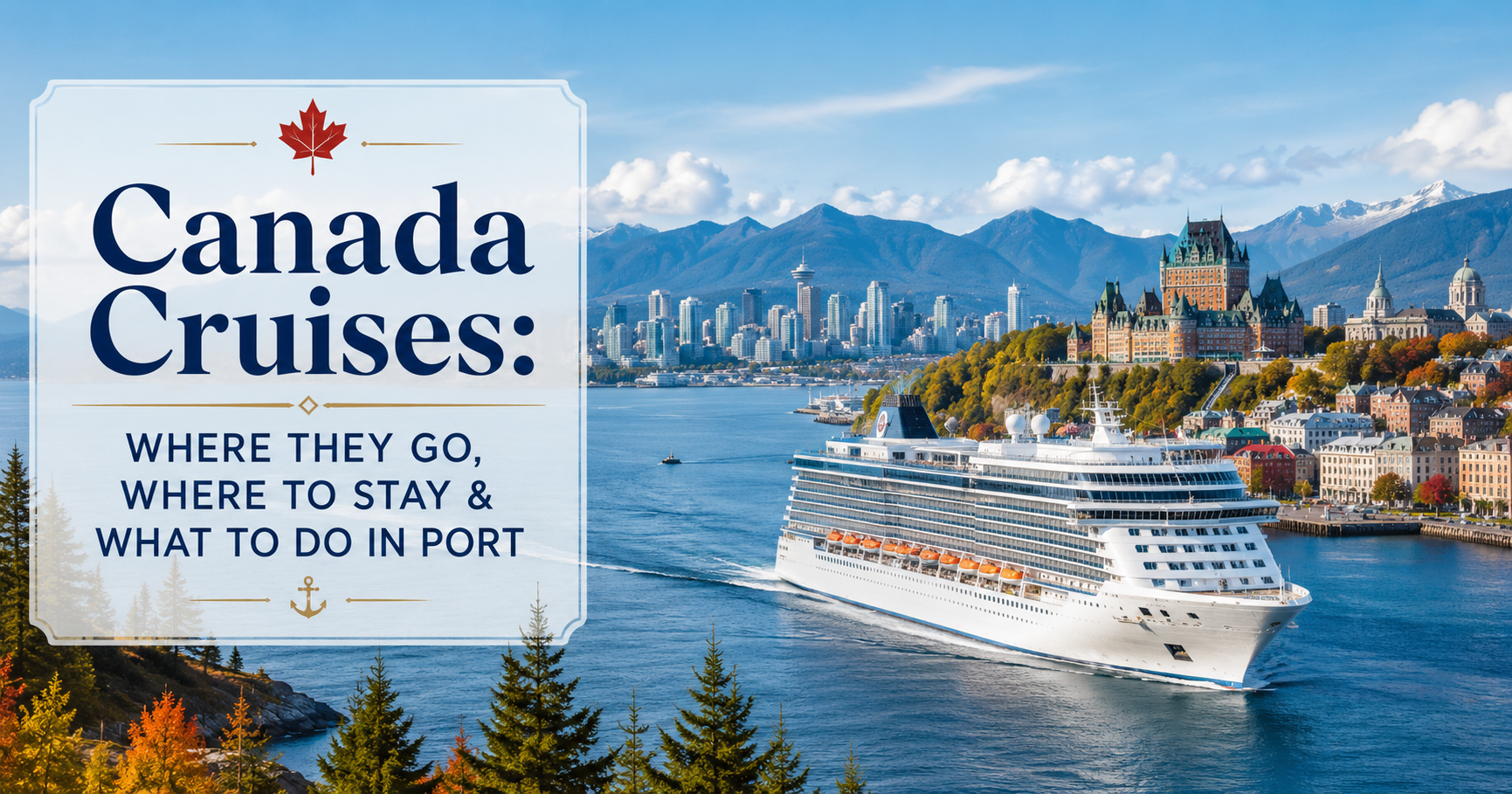
Canada is made for scenic cruising.
On the west coast, Vancouver is a major gateway for Alaska cruises through the Inside Passage. On the east coast, ships visit historic cities, colorful waterfront towns, rugged Atlantic scenery, and destinations known for brilliant fall foliage. Smaller ships also travel through the Great Lakes and along the St. Lawrence River, while expedition cruises explore Canada’s remote Arctic regions.
A Canada cruise can look completely different depending on the itinerary you choose. You might spend your days watching for wildlife and glaciers, exploring Québec City’s cobblestone streets, visiting the Bay of Fundy, tasting seafood in Halifax, or sailing past forests glowing with autumn color.
This guide covers the main Canada cruise routes, where to stay before or after your sailing, what to do in the most popular ports, what to expect onboard, and a few important things to pack.
Quick Answer: Are Canada Cruises Worth It?
Canada cruises can be very worth it if you enjoy beautiful scenery, historic waterfront cities, wildlife, comfortable sightseeing, and port days that mix nature with culture.
They are especially good for travelers who want:
- Scenic sailing through coastal, river, lake, or wilderness landscapes
- An easy way to visit several Canadian cities and smaller coastal communities
- Summer wildlife and outdoor experiences
- Fall foliage cruises during September and October
- A trip that combines Canada with Alaska, New England, or the northern United States
A Canada cruise may be less ideal if you want hot tropical weather, beach-focused port days, or enough time to explore Canada’s inland national parks and cities in depth.
However, for travelers who want changing scenery, cooler destinations, walkable ports, maritime history, and memorable sailing days, Canada offers several very different cruise experiences.

Canada Cruises at a Glance
Canada’s cruise options extend well beyond one coastline.
| Cruise Style | Common Route Idea | Best For |
|---|---|---|
| Alaska Cruises from Vancouver | Vancouver, the Inside Passage and Alaska ports | Wildlife, glaciers and dramatic scenery |
| Canada and New England Cruises | Québec, Atlantic Canada and New England | Historic ports, seafood and fall foliage |
| St. Lawrence Cruises | Montréal, Québec City, Saguenay and Atlantic Canada | French Canadian culture and river scenery |
| Great Lakes Cruises | Toronto, the Thousand Islands and Canadian and U.S. lake ports | Smaller ships and less conventional itineraries |
| Canadian Arctic Expeditions | Nunavut, Baffin Island and remote northern waterways | Expedition travelers and remote wilderness |
Not every cruise marketed as a Canada cruise begins or ends in Canada. Some depart from cities such as Boston or New York and visit Canadian ports along the way. Others begin or end in Vancouver, Québec City, Montréal or Toronto.
That distinction affects how you plan the trip. When your cruise begins or ends in Canada, adding at least one hotel night gives you a safer flight buffer and time to enjoy the departure city. When Canada is only part of the itinerary, your main planning decisions will involve shore excursions and how to use each port day.
Vancouver is an established homeport for cruises traveling through Canada’s Inside Passage and onward to Alaska, while Québec City serves as both a destination and a departure or arrival port for St. Lawrence, Eastern Canada and New England itineraries. Halifax’s official cruise season extends from April through November, showing how widely the Canadian season can stretch beyond only midsummer.
Where Do Canada Cruises Usually Go?
Canada cruises are not limited to one coastline or one style of trip. Some itineraries use a Canadian city as the gateway to another destination, while others focus heavily on Canadian ports, scenery and culture.
Alaska Cruises from Vancouver
Vancouver is one of the main departure points for Alaska cruises. Most itineraries sail through the Inside Passage before visiting Alaska destinations such as Juneau, Ketchikan, Sitka, Skagway and scenic glacier areas.
You can choose a round-trip cruise from Vancouver or a one-way sailing between Vancouver and Seward. These cruises are primarily Alaska vacations, but beginning or ending in Vancouver makes it easy to add a few days in Canada before or after the sailing.
Canada and New England Cruises
Canada and New England cruises travel along the northeastern coast of the United States and Atlantic Canada. Common Canadian ports include Halifax, Sydney, Charlottetown, Saint John, Québec City and Saguenay, although the exact combination varies by itinerary.
Some cruises depart from Boston or New York, while others begin or end in Québec City. Summer sailings offer pleasant coastal sightseeing, but September and October are especially popular with travelers hoping to see fall foliage.
St. Lawrence River Cruises
St. Lawrence itineraries usually include Montréal, Québec City and Saguenay, often continuing toward Atlantic Canada or New England. These cruises combine river scenery with French Canadian cities, historic districts and smaller communities that may be difficult to include in a typical land trip.
Québec City is both a major port of call and an embarkation or disembarkation port, making it one of the best places to add extra hotel nights before or after the cruise.
Great Lakes Cruises
Great Lakes cruises are generally operated by smaller ships and expedition-style vessels. Toronto is a common starting or ending point, with itineraries visiting places such as Niagara Falls via Port Colborne, the Welland Canal, Georgian Bay, Fathom Five National Marine Park and ports in the United States.
These sailings are a good alternative for travelers who want scenic waterways, smaller destinations and a less traditional cruise experience without traveling to the ocean coast.
Canadian Arctic Expedition Cruises
Canadian Arctic cruises explore remote areas such as Nunavut, Baffin Island and the Northwest Passage, sometimes continuing into Greenland. These are expedition voyages rather than conventional sightseeing cruises, with activities that may include Zodiac rides, guided hikes, wildlife watching and visits to Inuit communities.
They are typically longer, more expensive and more weather-dependent than other Canada itineraries, but they offer access to landscapes and communities that very few travelers ever experience.
For most first-time Canada cruisers, the most accessible choices are an Alaska cruise from Vancouver or a Canada and New England itinerary. Great Lakes, St. Lawrence and Arctic cruises are better suited to travelers looking for something smaller, slower or more unusual.
Where to Stay Before or After a Canada Cruise
When your cruise begins or ends in Canada, plan to arrive at least one day early. This protects you from flight delays and gives you time to enjoy the departure city instead of traveling directly from the airport to the ship.
Vancouver
Vancouver is the most convenient Canadian cruise gateway because ships depart from the Canada Place terminal in the heart of downtown. Restaurants, waterfront paths, Gastown and public transportation are all nearby.
| Hotel | Why Stay Here? |
|---|---|
| Pan Pacific Vancouver | The easiest choice for embarkation day. The hotel is located at Canada Place, allowing you to reach the cruise terminal without arranging transportation. |
| Fairmont Waterfront | Located steps from the terminal with harbor views and easy access to downtown Vancouver. A strong choice when you want cruise convenience with a more traditional luxury-hotel experience. |
Both hotels make it easy to explore central Vancouver while keeping embarkation morning simple.
How long to stay: Add two nights if you want time for Stanley Park, Granville Island, Gastown or a day trip before sailing.
Québec City
Québec City is one of the best places to extend a Canada and New England or St. Lawrence cruise. The main cruise terminal sits beside the Old Port and Petit-Champlain, although ships can use different wharves depending on the sailing.
| Hotel | Why Stay Here? |
|---|---|
| Auberge Saint-Antoine | A refined boutique hotel in the historic Old Port, convenient for the waterfront, Lower Town and nearby cruise facilities. |
| Fairmont Le Château Frontenac | The iconic Québec City stay, positioned inside Old Québec near many of the city’s best-known sights. Choose it when the pre- or post-cruise visit is part of the vacation experience. |
How long to stay: Two nights gives you a full day to explore Old Québec. Add a third night for Montmorency Falls, Île d’Orléans or a slower sightseeing pace.
Montréal
Montréal cruises generally use the Grand Quay in Old Montréal. Staying in or near the historic district places you close to the port while also giving you easy access to Notre-Dame Basilica, Place Jacques-Cartier, restaurants and the waterfront.
| Hotel | Why Stay Here? |
|---|---|
| Hôtel William Gray | A stylish boutique option in the heart of Old Montréal near Place Jacques-Cartier and the waterfront. |
| InterContinental Montréal | A comfortable full-service hotel between downtown and Old Montréal, with convenient access to sightseeing and transportation. |
How long to stay: Two nights works well for Old Montréal and the downtown highlights. Choose three nights if you also want to explore Mount Royal, local markets or neighborhoods beyond the historic center.
Toronto
Toronto serves as a starting or ending point for some Great Lakes cruises. The cruise terminal is at 8 Unwin Avenue in the Port Lands rather than directly beside the main downtown hotel district, so plan to use a taxi, rideshare or the seasonal TTC connection on embarkation day.
| Hotel | Why Stay Here? |
|---|---|
| Delta Hotels Toronto | A practical downtown option near Union Station, the UP Express airport train, the CN Tower and the waterfront. |
| The Westin Harbour Castle | A waterfront hotel that works well for travelers who want harbor views and easy access to central Toronto attractions before or after the cruise. |
How long to stay: Two nights gives you one full sightseeing day. Add another night if you want to visit the Toronto Islands, explore several neighborhoods or take a Niagara Falls day trip.
How Many Hotel Nights Should You Add?
For most travelers, one night is the minimum and two nights is better.
- One night: Flight-delay protection and a more relaxed embarkation morning
- Two nights: Enough time for the city’s main sights
- Three nights: Best when the cruise gateway is an important part of your vacation or you want to add a day trip
Avoid flying into the departure city on embarkation morning. Even when the airport appears close to the port, delays, luggage problems, traffic or weather can cause you to miss the ship.
What to Do in Canada’s Most Popular Cruise Ports
Canada’s cruise ports range from large cities to smaller waterfront communities. Some are easy to explore independently, while others are better suited to an organized excursion that travels beyond the port area.
Vancouver, British Columbia
Vancouver is more commonly a cruise starting or ending point than a full port-of-call day, but there is plenty to do when your itinerary allows extra time.
Top experiences:
- Explore Stanley Park and follow part of its waterfront Seawall
- Visit Granville Island Public Market for food, local shops and waterfront views
- Combine downtown Vancouver with Capilano Suspension Bridge or the North Shore
Stanley Park, Granville Island and Gastown can be combined on a city sightseeing tour, while Capilano requires additional travel beyond downtown.
Best for: Scenery, food, city sightseeing and outdoor experiences
Book this if: You want to see Vancouver’s major highlights without arranging transportation between them
My recommendation: Add Vancouver before or after the cruise rather than trying to squeeze the city into embarkation morning.
Victoria, British Columbia
Victoria is a common stop on Alaska itineraries, sometimes with a shorter or evening port call. The Inner Harbour and downtown are walkable, but Butchart Gardens is outside the city and requires transportation.
Top experiences:
- Walk around the Inner Harbour and see the Parliament Buildings
- Visit Butchart Gardens
- Take a whale-watching, food or city sightseeing tour
- Ride a small harbour ferry to Fisherman’s Wharf
Victoria is especially good for travelers who want gardens and gentle sightseeing rather than an intense excursion day.
Best for: Gardens, waterfront scenery, food and relaxed sightseeing
Book this if: Butchart Gardens is a priority or your port time is too limited to organize transportation independently
My recommendation: Check your arrival and departure times carefully before booking. Short evening calls require a simpler plan than a full daytime visit.
Québec City, Québec
Québec City is one of the easiest Canadian ports to enjoy on foot. The Old Port, Petit-Champlain, Place Royale, Dufferin Terrace and Château Frontenac are all part of the historic core near the waterfront.
Top experiences:
- Take a guided walking tour through Old Québec
- Explore Petit-Champlain, Place Royale and Dufferin Terrace
- Visit Montmorency Falls and Île d’Orléans
- Join a food tour focused on French Canadian specialties
Choose a city walking tour when you want history and architecture. Choose an excursion outside the city when Montmorency Falls or the countryside is the main attraction.
Best for: History, architecture, food and romantic city scenery
Book this if: You want deeper historical context or plan to travel beyond Old Québec
My recommendation: First-time visitors should prioritize Old Québec. Do not spend the entire port day traveling elsewhere unless you have already seen the historic center.
Halifax, Nova Scotia
Ships arrive close to Halifax’s waterfront, making this one of the easiest Atlantic Canada ports to explore independently. The waterfront boardwalk passes shops, restaurants, museums, public art and harbor attractions.
Top experiences:
- Walk the Halifax waterfront and visit the Maritime Museum of the Atlantic
- Tour Halifax’s historic sights and Citadel area
- Take a harbor cruise or sailing tour
- Visit Peggy’s Cove on a half-day excursion
Stay in Halifax for maritime history, museums and an easy waterfront day. Travel to Peggy’s Cove when dramatic coastal scenery is your priority.
Best for: Maritime history, seafood, coastal scenery and easy independent exploration
Book this if: You want to visit Peggy’s Cove or combine several sights outside the walkable waterfront
My recommendation: Avoid trying to combine too many distant stops. Halifax itself offers enough for a full port day, while Peggy’s Cove works better as the main excursion.
Charlottetown, Prince Edward Island
Charlottetown is a small, welcoming port with a walkable historic center and waterfront. It is also the gateway to Prince Edward Island’s countryside, beaches, seafood experiences and Anne of Green Gables attractions.
Top experiences:
- Explore historic Charlottetown and Peake’s Wharf
- Join a seafood or local food tour
- Visit Green Gables Heritage Place and the Cavendish area
- Take an island drive featuring red cliffs, coastal scenery and small communities
Green Gables Heritage Place is approximately a 45-minute drive from the cruise port, so an organized excursion is the simplest choice when you want to see the countryside and several island attractions.
Best for: Coastal scenery, seafood, literary history and small-town charm
Book this if: You want to leave Charlottetown and see the wider island
My recommendation: Stay in town for a relaxed, food-focused day. Book an excursion when Green Gables or Prince Edward Island’s countryside is the reason you chose the itinerary.
Sydney and Cape Breton Island, Nova Scotia
Sydney is the main cruise gateway to Cape Breton Island. The waterfront has a few shops and local attractions, but the island’s biggest sights require transportation.
Top experiences:
- Visit the reconstructed 18th-century Fortress of Louisbourg
- Take a scenic Cape Breton or partial Cabot Trail tour
- Learn about the island’s Celtic and Mi’kmaw heritage
- Enjoy coastal viewpoints and local seafood
The Cabot Trail is a 298-kilometre scenic route, so cruise excursions usually show you selected portions rather than the entire drive. The Fortress of Louisbourg is another strong choice for travelers interested in Canadian history.
Best for: Coastal scenery, history and cultural experiences
Book this if: You want to see Cape Breton beyond the immediate Sydney waterfront
My recommendation: Choose either the Fortress of Louisbourg or a scenic Cape Breton excursion. Trying to cover several distant parts of the island during one port day can leave you spending most of your time on a bus.
Saint John, New Brunswick
Saint John sits on the Bay of Fundy and is best known for its dramatic tides. The historic uptown area is close to the cruise terminals, while coastal villages and natural attractions require an excursion.
Top experiences:
- See the Reversing Falls Rapids
- Explore the Saint John City Market and historic uptown streets
- Visit the coastal village of St. Martins
- Travel along the Fundy Trail Parkway
- Experience the Bay of Fundy by sightseeing boat or jet boat
The appearance of the Reversing Falls changes with the tide, so the most dramatic view may not line up perfectly with your ship’s schedule.
Best for: Natural phenomena, coastal drives and maritime history
Book this if: You want to travel beyond central Saint John to St. Martins or the Fundy coast
My recommendation: Check the tide timing before building the entire day around the Reversing Falls. Pair it with uptown Saint John or choose a wider Bay of Fundy excursion.
Saguenay, Québec
Ships visiting Saguenay usually dock in La Baie, where passengers receive a warm local welcome and can explore the small port village. The main attraction is the surrounding Saguenay Fjord.
Top experiences:
- Take a scenic tour along the Route du Fjord
- Cruise or ride a Zodiac through the fjord
- Visit Saguenay Fjord National Park
- Explore the port village and browse local artisan products
- Join a nature or wildlife-focused excursion
Many of the region’s best viewpoints and outdoor experiences are spread beyond the immediate cruise area, making Saguenay one of the ports where an organized excursion is especially helpful.
Best for: Fjord scenery, nature and quieter port days
Book this if: Seeing the fjord from multiple viewpoints is a major reason you chose the itinerary
My recommendation: Prioritize the scenery rather than treating Saguenay like a city sightseeing stop. A guided fjord excursion offers more than remaining entirely near the ship.
Montréal, Québec
Montréal’s Grand Quay cruise terminal is located beside Old Montréal, placing historic streets, waterfront attractions and restaurants close to the ship.
Top experiences:
- Walk through Old Montréal
- Visit Notre-Dame Basilica
- Explore the Old Port and Grand Quay
- Take a food or history tour
- Visit Mount Royal for city views if time allows
Old Montréal is easy to explore during a port call, while destinations such as Mount Royal, Mile End and Jean-Talon Market require more travel time.
Best for: Food, history, architecture and city sightseeing
Book this if: You want a guided introduction to Montréal’s history or local food
My recommendation: Stay close to Old Montréal during a shorter call. Save the farther neighborhoods for a pre- or post-cruise stay when you can experience the city at a more relaxed pace.
Great Lakes Ports in Ontario
Great Lakes itineraries vary more than traditional ocean cruises. Ships may visit Port Colborne for access to Niagara Falls, Kingston and the Thousand Islands, smaller Georgian Bay communities, or Toronto as a starting or ending point.
Top experiences:
- Visit Niagara Falls from Port Colborne
- See the Welland Canal and watch ships pass through the locks
- Explore historic Kingston by trolley or walking tour
- Enjoy the scenery of the Thousand Islands
- Visit museums and waterfront communities along the lakes
Niagara Falls excursions may include the Voyage to the Falls boat tour, Journey Behind the Falls or Niagara-on-the-Lake. Kingston offers historic sites, waterfront sightseeing and access to the Thousand Islands region.
Best for: Smaller ships, freshwater scenery and less conventional itineraries
Book this if: Your priority attraction is located away from the docking area, particularly Niagara Falls
My recommendation: Read the itinerary carefully before booking activities. Great Lakes ports and docking locations vary, and the name of the destination may cover a much wider region than the immediate cruise terminal.
Should You Book Cruise-Line or Independent Shore Excursions?
The best option depends on the port, how far the activity is from the ship and how comfortable you are arranging your own transportation.
| Option | Best When | Main Consideration |
|---|---|---|
| Cruise-line excursion | The attraction is far from port, transportation is complicated or timing feels tight | Usually costs more, but the ship coordinates the schedule and knows you are on an official excursion |
| Independent tour | You want a smaller group, more flexible itinerary or better value | Choose a reputable operator with clear pickup details and enough time to return before departure |
| Explore independently | The ship docks near a walkable historic center or waterfront | Best for ports such as Québec City, Halifax, Montréal and central Charlottetown |
Cruise-line excursions make the most sense for destinations such as Peggy’s Cove, Cape Breton, Montmorency Falls, Prince Edward Island’s countryside, Saguenay Fjord and Niagara Falls, where the main sights require transportation.
Independent exploring works well when the port itself is the attraction. A walking tour, food tour or self-guided day can be more enjoyable than spending several hours traveling away from the ship.
Whatever you choose, confirm the ship’s departure time, meeting location and cancellation policy before booking. Plan to return well before the stated all-aboard time rather than treating it as the time you should arrive back at the port.
What to Expect on a Canada Cruise

Canada cruises are usually more about scenery, culture and comfortable sightseeing than warm-weather pool days. The experience changes by region and season, but a few practical expectations apply to most itineraries.
The Weather Can Change Quickly
Even during summer, mornings on the water may feel cool while afternoons in port are warmer. Wind and rain can also make the temperature feel different from the forecast, so plan for changing conditions rather than one consistent type of weather.
Fall cruises are generally cooler, especially during early mornings, evenings and scenic sailing days.
Summer and Fall Feel Very Different
Summer is best for longer daylight hours, outdoor sightseeing and greener landscapes. Fall sailings are popular for autumn color, particularly from late September into early or mid-October, although foliage timing varies each year and cannot be guaranteed.
Canada’s cruise season is broader than many travelers expect. Halifax receives ships from spring through fall, with its 2026 season scheduled from April 7 through November 5.
Scenic Sailing Is Part of the Experience
Some of the best moments may happen between ports. Inside Passage routes, the St. Lawrence River, Saguenay Fjord, Georgian Bay and Arctic itineraries all include scenery that is worth watching from the deck or your cabin.
Keep binoculars and a camera accessible rather than packing everything away between excursions.
Not Every Port Requires an Excursion
Québec City, Halifax, Montréal and Charlottetown all offer worthwhile sightseeing close to the ship. Other stops, including Sydney, Saguenay and Port Colborne, are more rewarding when you arrange transportation to attractions beyond the docking area.
Review each port separately instead of automatically booking an excursion everywhere.
Wildlife Sightings Are Never Guaranteed
Depending on the itinerary, you may have opportunities to see whales, seabirds, seals, bears or other wildlife. Sightings depend on the season, location and conditions, so choose wildlife tours for the overall experience rather than expecting one specific animal.
Port Schedules Can Change
Fog, wind, water conditions and operational issues can affect arrival times, port calls and excursion plans. Cruise ports publish schedules that remain subject to change, so avoid planning private activities with extremely tight timing.
Canada Cruises Are Not Always Cold
Summer days in Vancouver, Montréal, Toronto and other ports may be warm, even when mornings on the ship feel chilly. The best approach is to bring adaptable layers and weather protection rather than packing only heavy cold-weather clothing.
What to Pack for a Canada Cruise
Canada cruise weather can shift between cool mornings, warmer afternoons, wind and rain, sometimes all in the same day. Keep the packing list practical and focus on items that help you stay comfortable during scenic sailing and port excursions.

Weather and Sightseeing Essentials
- Packable raincoat
- Compact umbrella
- Packable scarf for windy decks and cooler evenings
- Sun hat or visor
- Sunglasses
- Sunscreen and SPF lip balm
- Small day bag for port days
- Refillable water bottle
Useful Cruise Extras
- Binoculars for wildlife and scenic sailing
- Portable phone charger
- Waterproof phone pouch or small dry bag
- Motion-sickness medication or preferred remedies
- Hand sanitizer and wet wipes
- Small camera or extra phone storage for photos
Bring items you can easily carry during excursions rather than packing bulky gear for every possible weather condition. A light raincoat, scarf and small day bag will be more useful than overpacking for extreme cold on a typical summer or early fall sailing.
For a complete seasonal checklist, see our Canada summer packing guide. You can also review our Canada plug and voltage guide before traveling with electronics.
Things Nobody Tells You About Canada Cruises
Your Phone Plan May Treat Canada as International Travel
Travelers arriving from the United States should check their mobile plan before sailing. Some plans include Canada automatically, while others charge roaming fees for calls, texts or data used in port.
Cruise-Terminal Locations Vary More Than You Expect
Some ships dock beside walkable historic districts, while others use terminals that require a shuttle, taxi or organized excursion. Always check the exact terminal rather than assuming the ship will arrive in the center of the destination.
Multiple Ships Can Change the Feel of a Small Port
Popular ports such as Charlottetown, Saguenay and Sydney can feel much busier when several ships arrive on the same day. Book priority excursions ahead of time, especially when transportation options are limited.
Canadian Prices Are Usually Shown in Canadian Dollars
Check the currency before comparing tour, restaurant and souvenir prices. Credit cards are widely useful, but it helps to understand whether a price is displayed in Canadian or U.S. dollars before purchasing.
The Local Food Can Be Part of the Port Experience
Leave room in the schedule for seafood, regional specialties and local markets. Depending on the itinerary, that might mean Pacific salmon in British Columbia, poutine and French Canadian dishes in Québec, or lobster and mussels in Atlantic Canada.
You do not need to schedule every minute of every port day. Some of the most enjoyable Canada cruise stops are well suited to a waterfront walk, a relaxed meal and time to explore without rushing between attractions.
Final Thoughts on Cruising Canada
A Canada cruise can be an easy way to experience dramatic coastlines, historic cities, small waterfront communities and changing seasonal scenery during one trip.
The best itinerary depends on what you want most. Choose Vancouver and Alaska for glaciers and wildlife, Canada and New England for coastal cities and fall foliage, the St. Lawrence for French Canadian culture, or the Great Lakes for a smaller and less traditional cruise experience.
Plan at least one hotel night before embarkation, research each port individually and avoid filling every day with long excursions. Canada’s best cruise moments often come from a mix of scenic sailing, one memorable activity and enough free time to enjoy the destination at a comfortable pace.