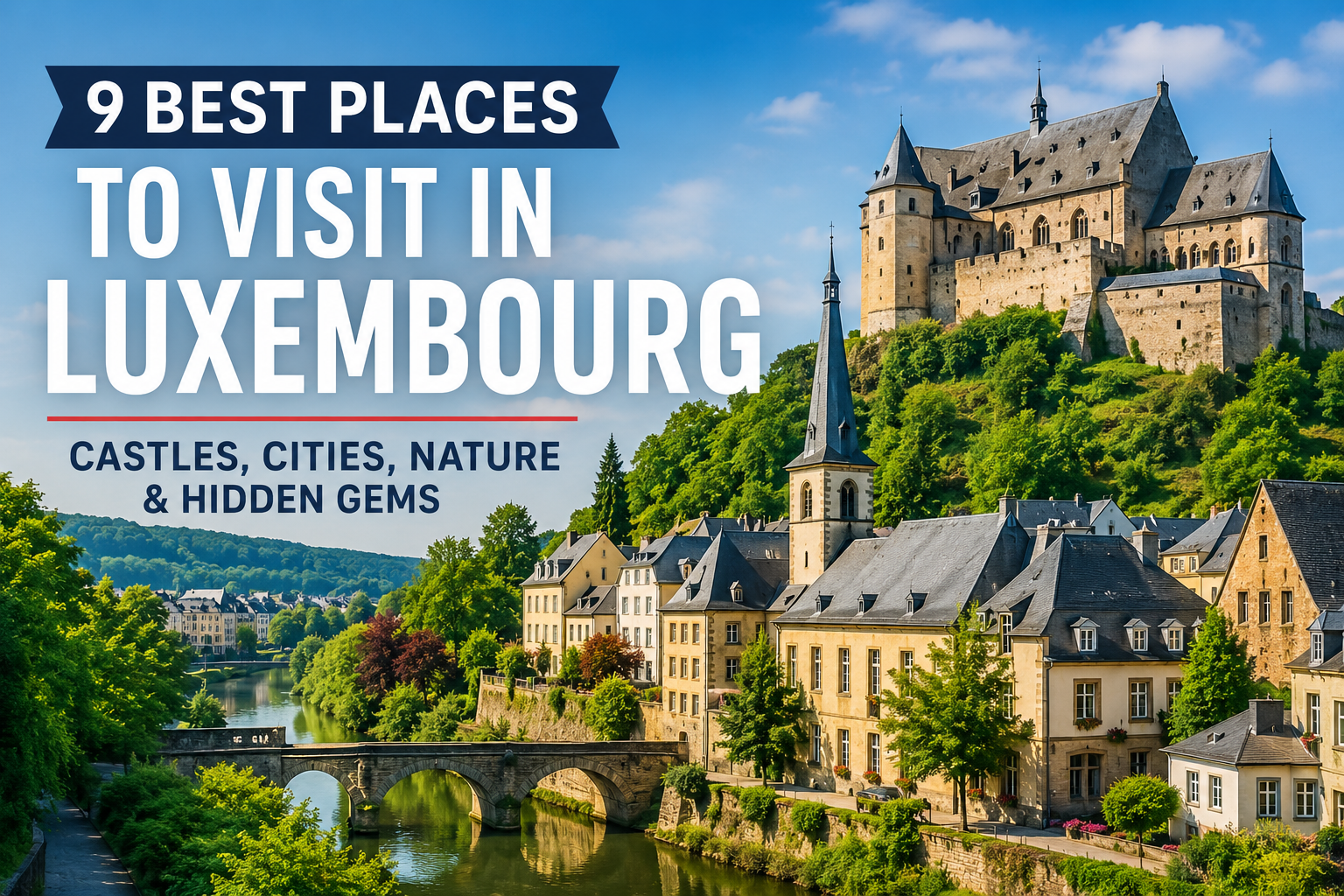
Luxembourg may be one of Europe’s smallest countries, but it offers far more variety than its size suggests. This compact grand duchy brings together dramatic fortifications, storybook castles, vineyard-covered river valleys, medieval towns, dense forests, rocky hiking trails, peaceful lakes, elegant city streets, and fascinating reminders of Europe’s industrial past.
A first trip to Luxembourg often revolves around Luxembourg City, and that makes sense. This is where you will find the country’s UNESCO-listed Old Town and fortifications, impressive viewpoints, historic neighborhoods, museums, grand public buildings, and the deep river valleys that give the capital its unusually dramatic landscape.
But Luxembourg is much more than its capital. You can wander beneath Vianden’s hilltop castle, hike among the unusual rock formations of the Mullerthal Region, explore the abbey town of Echternach, taste local wines beside the Moselle River, discover quiet villages in the forested Éislek region, relax near Upper Sûre Lake, or ride a historic train through the country’s former mining lands.
That is why this guide is organized around real cities, towns, countryside regions, and scenic areas instead of treating every famous castle or attraction as a separate destination. Luxembourg is small enough that many places can be visited as day trips, but each part of the country has its own personality. Some places are essential for first-time visitors, some are best for castles and history, and others reveal Luxembourg’s greener, quieter, or wonderfully unexpected side.
1. Luxembourg City

Region: Central Luxembourg; the country’s capital, main transportation hub, and the easiest place to begin your first trip.
Luxembourg City immediately feels different from most European capitals. Rather than spreading across flat streets, the city rises above the deep Alzette and Pétrusse river valleys, with bridges, stone fortifications, wooded slopes, and historic neighborhoods layered at dramatically different heights.
The UNESCO-listed Old Town sits above the valleys, where you can wander between elegant squares, the Grand Ducal Palace, Notre-Dame Cathedral, museums, cafés, and some of the city’s best viewpoints. Below, the atmospheric neighborhoods of Grund, Clausen, and Pfaffenthal offer riverside paths, old stone buildings, peaceful streets, and beautiful views back toward the fortified upper city.
Luxembourg City is compact enough to explore without feeling overwhelming, but its hills, stairways, bridges, elevators, and underground tunnels make it far more interesting than a quick walk through the center might suggest. Give yourself time to experience both the upper and lower neighborhoods rather than staying only around the main shopping streets.
Main Highlights
Luxembourg City is best for historic fortifications, dramatic viewpoints, underground casemates, UNESCO-listed architecture, museums, riverside neighborhoods, grand public buildings, European institutions, and an easy introduction to the country.
Why I Recommend It
Luxembourg City delivers the kind of dramatic arrival you might not expect from such a small capital. The Old Town appears to balance above steep valleys, while bridges and fortified walls create views that feel almost theatrical. Even an ordinary walk between neighborhoods can involve panoramic overlooks, hidden stairways, glass elevators, and paths beside centuries-old defenses.
It is also an excellent base for exploring the rest of Luxembourg. The country’s small size and convenient public transportation make it possible to visit castles, wine villages, hiking regions, and smaller towns as day trips without changing hotels every night.
Most importantly, Luxembourg City is more than a convenient base. Its combination of medieval history, elegant architecture, green valleys, international culture, and quiet lower-town neighborhoods gives it a personality of its own. Spend at least one full day here, although two days will allow you to explore at a much more enjoyable pace.
Don’t Miss
- Bock Casemates — a fascinating network of underground defensive galleries carved into the city’s rock. The tunnels, chambers, and openings reveal why Luxembourg once became known as the “Gibraltar of the North.”
- Chemin de la Corniche — a scenic walkway along the old ramparts with sweeping views over the Alzette Valley, Grund, Neimënster Abbey, and the historic lower city. It is one of the best places to appreciate Luxembourg City’s unusual landscape.
- The Grund — a picturesque lower-town neighborhood beside the Alzette River. Its stone buildings, bridges, riverside paths, restaurants, and views of the fortified upper city make it one of the capital’s most atmospheric areas.
- Grand Ducal Palace — the official city residence of Luxembourg’s grand ducal family. Its ornate façade is easy to admire while exploring the Old Town, and limited guided interior tours are typically offered during the summer.
- Notre-Dame Cathedral — Luxembourg City’s landmark cathedral, combining late Gothic architecture with Renaissance details. Step inside to see its stained glass, sculptural decoration, and important religious spaces.
- Place Guillaume II and Place d’Armes — two lively central squares surrounded by cafés, restaurants, civic buildings, and historic architecture. They are ideal places to stop for lunch or take a break between major sights.
- Pfaffenthal Panoramic Elevator — a free glass elevator connecting the upper city with the Pfaffenthal neighborhood below. The ride provides striking views across the valley and makes it much easier to move between the city’s different levels.
- Adolphe Bridge and Place de la Constitution — one of Luxembourg City’s classic viewpoints, overlooking the Pétrusse Valley, historic fortifications, and the graceful stone arches of Adolphe Bridge.
- Neimënster Abbey — a former Benedictine abbey in the Grund that now serves as a cultural center. Its courtyards, stone architecture, and position beneath the upper city make it worth including in a lower-town walk.
- Kirchberg — Luxembourg City’s modern European district, home to major European Union institutions, contemporary architecture, the Philharmonie, MUDAM, and landscaped public spaces. It provides a striking contrast to the medieval Old Town.
Good to Know / Side Notes
- Luxembourg City is one of the best places to stay on a first trip because it offers the widest selection of hotels, restaurants, transportation connections, and easy day-trip options.
- The city is compact, but the steep valleys mean that walking routes may include hills, stairs, cobblestones, and significant changes in elevation.
- Public elevators help connect the upper and lower neighborhoods. The Pfaffenthal Panoramic Elevator and the elevator between the Plateau du Saint-Esprit and Grund can save considerable walking.
- Allow at least one full day for the historic center, Bock area, Corniche, and Grund. Add a second day for museums, Kirchberg, additional neighborhoods, or a more relaxed pace.
- The Bock and Pétrusse casemates are separate underground attractions. Check current opening schedules and reserve ahead when required rather than assuming both can be visited at any time.
- Luxembourg’s public transportation is free throughout the country in standard class, making the capital particularly convenient for travelers planning several day trips.
- The Old Town is attractive throughout the day, but the viewpoints become especially beautiful in the early morning, around sunset, and after the city lights begin to glow.
- Luxembourg City is especially good for first-time visitors, couples, solo travelers, history lovers, photographers, museum visitors, and anyone who wants one convenient base for exploring the country.
2. Vianden

Region: Northern Luxembourg in the forested Éislek region, near the German border.
Vianden is one of Luxembourg’s most picturesque towns, with colorful riverside buildings, wooded hills, and an enormous medieval castle overlooking the Our Valley.
Most travelers come for Vianden Castle, but the compact town is also lovely for river walks, scenic viewpoints, cafés, and a ride on Luxembourg’s only chairlift during the warmer months. It is an easy and memorable day trip from Luxembourg City.
Main Highlights
Vianden Castle, the historic town center, the Our River promenade, the seasonal chairlift, Victor Hugo House, and forested valley views.
Why I Recommend It
Vianden gives you Luxembourg’s most classic fairytale scenery in one easy-to-explore destination. The combination of the hilltop castle, riverfront streets, forested hills, and scenic viewpoints makes it one of the country’s most rewarding day trips.
Don’t Miss
- Vianden Castle — Luxembourg’s most famous castle, filled with restored halls, towers, exhibits, and sweeping valley views.
- Vianden Chairlift — a seasonal ride above the town with excellent views of the castle and surrounding hills.
- Our River Promenade — a peaceful walk beneath the castle past bridges and traditional riverside buildings.
- Victor Hugo House — a small museum inside the home where the French writer stayed during his time in Vianden.
Good to Know
- Vianden is easy to visit as a full-day trip from Luxembourg City.
- The walk to the castle is steep and uphill.
- The chairlift operates seasonally and may close during poor weather.
- Visit early in summer when the town and castle are busiest.
3. Echternach & the Mullerthal Region

Region: Eastern Luxembourg, close to the German border.
Echternach is Luxembourg’s oldest town and the ideal gateway to the Mullerthal Region, an enchanting landscape known as “Luxembourg’s Little Switzerland.” Together, they combine abbey history and medieval streets with forests, streams, narrow gorges, and dramatic sandstone formations.
You can explore Echternach’s historic center before heading into the surrounding countryside for anything from a short scenic walk to a full day on the Mullerthal Trail.
Main Highlights
Echternach’s abbey and basilica, the medieval town center, Mullerthal Trail, Schiessentümpel waterfall, sandstone rock formations, forest walks, and nearby Beaufort Castle.
Why I Recommend It
This is one of Luxembourg’s best destinations when you want history and nature in the same trip. Echternach gives you a charming cultural base, while the surrounding region offers some of the country’s most distinctive scenery and hiking without requiring you to complete the entire 112-kilometer Mullerthal Trail.
Don’t Miss
- Echternach Old Town — explore the market square, medieval walls, ancient abbey grounds, and Basilica of Saint Willibrord.
- Schiessentümpel Waterfall — the region’s signature sight, where a picturesque stone bridge arches above a small forest waterfall.
- Mullerthal Trail — choose a shorter section to experience mossy forests, rocky passages, gorges, and unusual sandstone formations.
- Beaufort Castle — a fascinating nearby stop with medieval ruins and a separate Renaissance castle.
Good to Know
- You do not need to hike the complete Mullerthal Trail to enjoy the region.
- Echternach works well as a base if you want more than a quick day trip.
- Trails can include steps, uneven rocks, narrow passages, and slippery surfaces.
- A car provides the most flexibility, but many towns and trail areas can also be reached using Luxembourg’s public transportation.
4. The Moselle Valley: Remich, Grevenmacher & Schengen

Region: Southeastern Luxembourg along the Moselle River, beside the German border.
The Moselle Valley is Luxembourg’s wine country, where vineyard-covered hills rise above the river and relaxed towns invite you to slow down. Remich and Grevenmacher are the main bases for riverside walks, wine tastings, boat trips, and exploring the scenic Route du Vin.
Main Highlights
Vineyards, Luxembourg wine and crémant, Moselle River cruises, the Remich promenade, Grevenmacher wineries, scenic cycling routes, and Schengen’s European history.
Why I Recommend It
The Moselle Valley offers a gentler, more leisurely side of Luxembourg. It is perfect when you want to trade castles and city streets for vineyard views, waterside cafés, local wine, and peaceful scenery.
Don’t Miss
- Remich — stroll the long riverside promenade, enjoy a wine tasting, or take a scenic boat trip along the Moselle.
- Grevenmacher — visit local wineries, explore the pedestrian center, and experience the region’s wine culture.
- Schengen — see the village where the landmark Schengen Agreement was signed and learn about its importance to modern Europe.
- Route du Vin — follow the river through vineyards, small villages, wineries, and scenic countryside.
Good to Know
- Remich is the easiest base for river cruises and a relaxed day beside the water.
- Winery tours and tastings may require advance reservations.
- The region is especially beautiful from late spring through the autumn harvest season.
- You can explore by car, public transportation, bicycle, or a combination of all three.
5. Clervaux & Northern Éislek

Region: Northern Luxembourg in the wooded hills of the Éislek region.
Clervaux is a peaceful valley town surrounded by forests, with a white castle, a hilltop Benedictine abbey, and strong connections to Luxembourg’s World War II history. It makes a lovely base for exploring the quieter northern countryside.
Main Highlights
Clervaux Castle, The Family of Man photography exhibition, the Battle of the Bulge Museum, Saint-Maurice Abbey, forest walks, and scenic Éislek villages.
Why I Recommend It
Clervaux combines culture, history, and countryside without feeling crowded or rushed. You can explore an important photography collection and wartime museum, admire the castle and abbey, and still have plenty of time for a relaxed walk through the surrounding hills.
Don’t Miss
- Clervaux Castle — the town’s whitewashed landmark, home to several museums and exhibitions.
- The Family of Man — Edward Steichen’s influential photography exhibition, included in UNESCO’s Memory of the World Register.
- Battle of the Bulge Museum — exhibits exploring the fighting that affected Clervaux during World War II.
- Saint-Maurice Abbey — a striking Benedictine abbey overlooking the town from the wooded hillside.
Good to Know
- Clervaux works well as either a day trip or a peaceful overnight stop.
- The town is hilly, so expect some uphill walking between the center, castle, and abbey.
- Check museum opening days before visiting, especially outside the busiest travel season.
- Stay longer when you want to combine Clervaux with northern hiking trails and smaller Éislek villages.
6. Esch-sur-Sûre & Upper Sûre Lake

Region: Northwestern Luxembourg in the Upper Sûre Nature Park.
Esch-sur-Sûre is a tiny medieval village wrapped inside a dramatic bend of the Sûre River. Castle ruins rise above its narrow streets, while the nearby Upper Sûre Lake brings forest scenery, hiking, swimming, and water activities into the same easy escape.
Main Highlights
Esch-sur-Sûre Castle, the historic village, river views, Upper Sûre Lake, forest trails, swimming, kayaking, and the Upper Sûre Nature Park.
Why I Recommend It
This area combines one of Luxembourg’s prettiest small villages with one of its best outdoor destinations. You can explore medieval ruins and riverside streets before spending the rest of your day hiking, relaxing beside the lake, or getting out on the water.
Don’t Miss
- Esch-sur-Sûre Castle — climb to the freely accessible ruins for beautiful views over the village and narrow river valley.
- Historic Esch-sur-Sûre — wander the compact streets beneath the castle and admire the village’s remarkable position inside the river bend.
- Upper Sûre Lake — enjoy designated swimming areas, canoeing, sailing, windsurfing, and peaceful forest scenery.
- Upper Sûre Nature Park Centre — visit the former cloth factory to learn about local textile production and the surrounding nature park.
Good to Know
- The lake is approximately one kilometer from Esch-sur-Sûre.
- Swimming and water sports are allowed only in designated areas because the reservoir supplies drinking water.
- Follow all posted restrictions near protected sections of the lake.
- This area is especially rewarding in warmer weather when you can combine village sightseeing with outdoor activities.
7. Guttland & the Valley of the Seven Castles

Region: Central and western Luxembourg, just outside Luxembourg City.
Guttland is a peaceful countryside region filled with farmland, forests, small villages, and historic estates. Its best-known route is the Valley of the Seven Castles, which follows the Eisch Valley between Mersch and Koerich.
Main Highlights
The Valley of the Seven Castles, Ansembourg gardens, Koerich Castle, Mersch, Schoenfels, Hollenfels, Septfontaines, quiet villages, and scenic country roads.
Why I Recommend It
This is an easy choice when you want castle scenery without the crowds of Vianden. The short route brings together centuries of history, beautiful countryside, and several very different castles in one relaxed day.
Don’t Miss
- Ansembourg Castle Gardens — elegant terraced gardens and one of the prettiest stops along the route.
- Koerich Castle — atmospheric medieval ruins located directly inside the village.
- Schoenfels Castle — a striking tower rising above the wooded Mamer Valley.
- Hollenfels Castle — a dramatic castle perched high above the narrow Eisch Valley.
Good to Know
- The seven sites are Mersch, Schoenfels, Hollenfels, the two Ansembourg castles, Septfontaines, and Koerich.
- Some castles are privately owned or cannot be toured inside.
- Driving gives you the easiest way to explore the complete route.
- Allow extra time for the Ansembourg gardens and village stops rather than rushing through all seven.
8. Esch-sur-Alzette & the Minett Region

Region: Southern Luxembourg, close to the French border.
Esch-sur-Alzette and the surrounding Minett Region reveal Luxembourg’s industrial side, where former mines and steelworks now sit beside modern architecture, cultural spaces, forest trails, and red-rock nature reserves.
Main Highlights
Esch-sur-Alzette’s city center, Belval’s blast furnaces, contemporary architecture, Ellergronn Nature Reserve, the Minett Trail, and landscapes shaped by Luxembourg’s mining history.
Why I Recommend It
This region feels completely different from Luxembourg’s castles, vineyards, and medieval villages. It shows how former industrial land has been transformed into a destination for culture, architecture, hiking, and nature while preserving the structures that tell its story.
Don’t Miss
- Belval — explore a striking district where preserved blast furnaces stand beside university buildings, restaurants, public spaces, and modern architecture.
- Blast Furnace A — climb the former industrial landmark when tours are available for views across Belval and a closer look at Luxembourg’s steelmaking past.
- Ellergronn Nature Reserve — follow wooded trails through a former mining landscape just outside Esch-sur-Alzette.
- Minett Trail — choose a short section of the 90-kilometer route to experience red earth, forests, old mining sites, and industrial landmarks.
Good to Know
- Esch-sur-Alzette and Belval are easy to reach by public transportation from Luxembourg City.
- You only need to hike a small section of the Minett Trail to enjoy the landscape.
- Check tour schedules before planning to climb the Belval blast furnace.
- Pair Esch-sur-Alzette with Belval and Ellergronn for a varied full-day trip.
9. Minett Park Fond-de-Gras

Region: Southwestern Luxembourg near Pétange and the French border.
Minett Park Fond-de-Gras is an open-air industrial museum built around a former iron-mining valley. Historic trains, mine buildings, old workshops, forest paths, and the nearby village of Lasauvage bring Luxembourg’s mining past to life in a way that feels far more adventurous than a traditional museum visit.
Main Highlights
Train 1900, the Minièresbunn mining railway, historic industrial buildings, Lasauvage village, Giele Botter Nature Reserve, and the Titelberg archaeological site.
Why I Recommend It
This is one of Luxembourg’s most unusual and memorable destinations. You can ride a heritage train, travel through a former mine, explore industrial history, and see how nature has reclaimed the surrounding mining landscape—all within one fascinating area.
Don’t Miss
- Train 1900 — ride a historic railway between Pétange and Fond-de-Gras aboard vintage trains, including steam-hauled services on selected dates.
- Minièresbunn Mining Train — travel along a narrow-gauge railway and through a former iron-ore mine for an immersive look at the region’s mining history.
- Fond-de-Gras Industrial Site — explore the old station, workshops, railway buildings, rolling mill, and other restored structures from the mining era.
- Giele Botter Nature Reserve — walk through a former open-cast mine that has gradually transformed into a protected landscape of forests, trails, and wildlife.
Good to Know
- Train rides, mine visits, and special activities operate only on selected days and at specific times.
- Check the official schedule before traveling, especially outside summer weekends.
- The outdoor site itself can be explored throughout the year, but the trains are the main reason to time your visit carefully.
- Allow most of a day when you want to combine both heritage railways, the industrial site, and nearby nature walks.
Short Packing List for Luxembourg
Luxembourg trips often combine city sightseeing, castles, countryside walks, forests, and lakes, so bring a few practical items that work across different kinds of days.
- Compact umbrella for changeable weather
- Lightweight raincoat
- Reusable water bottle
- Portable phone charger
- Small day bag for sightseeing and day trips
- Sunscreen, sunglasses, and a sun hat
- Insect repellent for forests, lakes, and hiking areas
- Small first-aid kit with blister bandages and pain reliever
Luxembourg is easy to explore without specialized travel gear. Focus on rain protection, sun protection, and a comfortable day bag that can carry water and your essentials.
Final Thoughts: Where Should You Go in Luxembourg?
For a first trip, begin with Luxembourg City, then add Vianden for the country’s most memorable castle scenery. Echternach and the Mullerthal Region are the best addition when you want to combine historic streets with forests, waterfalls, rock formations, and scenic walks.
Choose the Moselle Valley for vineyards, river cruises, wine tastings, and a slower countryside day. Clervaux and northern Éislek are ideal for peaceful forest scenery and history, while Esch-sur-Sûre and Upper Sûre Lake combine one of Luxembourg’s prettiest villages with hiking and warm-weather activities.
For quieter castles and rural landscapes, explore Guttland and the Valley of the Seven Castles. Travelers interested in architecture, industrial history, or less traditional destinations should head south to Esch-sur-Alzette, Belval, and the Minett Region.
Luxembourg is compact enough that you can experience several completely different parts of the country without spending your entire trip changing hotels. The best visits combine the dramatic capital with at least one fairytale castle, one countryside region, and one destination that reveals Luxembourg’s greener or more unexpected side.