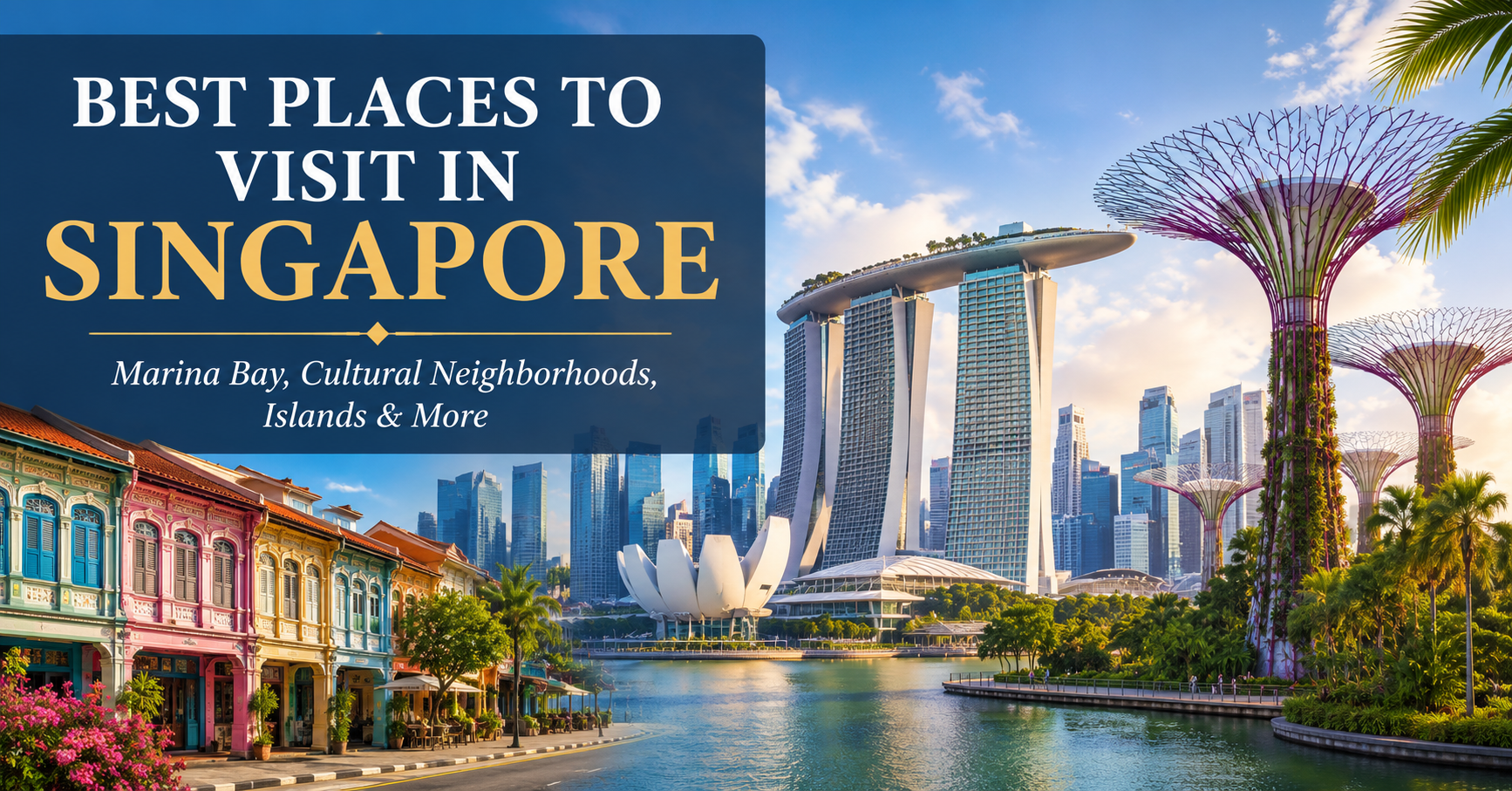
Singapore may be small on the map, but it never feels like a one-note destination. This compact city-state brings together futuristic skylines, tropical gardens, colorful heritage neighborhoods, peaceful nature reserves, buzzing hawker centers, waterfront promenades, wildlife parks, beaches, islands, museums, temples, luxury hotels, and some of the best food experiences in Asia.
A first Singapore trip often revolves around Marina Bay, and that makes sense. This is where you will find many of the skyline views and famous landmarks that immediately make the destination feel exciting. But Singapore is much more than Marina Bay Sands and the Supertrees. You can eat your way through Chinatown, browse the colorful streets of Kampong Gelam, explore Peranakan culture in Katong and Joo Chiat, walk through the greenery of the Southern Ridges, spend a resort-style day on Sentosa, or escape the polished city entirely on Pulau Ubin.
That is why this guide is organized around real districts, neighborhoods, nature areas, and islands instead of treating every famous attraction as a separate destination. Singapore is easy enough to explore without constantly changing hotels, but each part of the city has its own personality. Some places are essential for first-time visitors, some are best for food and culture, and others reveal the greener, quieter, or wonderfully unusual side of Singapore.
1. Marina Bay & Downtown Singapore

Region: Central Singapore; the city’s iconic waterfront district, most recognizable skyline, and one of the easiest places to begin a first Singapore trip.
Marina Bay is the Singapore you have probably seen in photographs: glittering skyscrapers, the three towers of Marina Bay Sands, enormous illuminated Supertrees, futuristic architecture, public art, waterfront paths, and city lights reflected across the bay.
This is where Singapore feels boldest and most modern. You can spend the morning exploring the indoor gardens at Gardens by the Bay, visit a museum shaped like an open lotus, walk along the waterfront toward the Merlion, and return after dark when the skyline and gardens light up. The area manages to feel polished and dramatic without being difficult to explore.
Marina Bay also connects easily with the Downtown Core, Civic District, and Singapore River, making it a practical base for sightseeing. You do not necessarily need to stay in one of the luxury waterfront hotels to enjoy the area, but nearly every first-time Singapore itinerary should include at least one full day and evening here.
Main Highlights
Marina Bay and Downtown Singapore are best for skyline views, futuristic gardens, iconic architecture, waterfront walks, museums, rooftop experiences, evening lights, luxury hotels, and the classic first-time Singapore experience.
Why I Recommend It
Marina Bay gives you the immediate sense of arrival that travelers hope for when visiting Singapore. The skyline is impressive during the day, but the area becomes especially memorable after dark, when the buildings, waterfront, and Supertree Grove begin to glow.
It is also one of the easiest places to appreciate how Singapore combines dense urban development with greenery and public spaces. You can move from glass towers and shopping centers into enormous gardens, waterfront promenades, museums, and open plazas without needing to travel far.
I would not make Marina Bay the only part of Singapore you see, but I would absolutely begin here. It delivers the major postcard moments while giving you easy access to several very different parts of the city.
Don’t Miss
- Gardens by the Bay — Singapore’s spectacular waterfront garden complex and one of the country’s most recognizable attractions. The outdoor gardens and Supertree Grove create the famous futuristic landscape, while the cooled conservatories contain elaborate plant displays and environments from around the world.
- Supertree Grove — the towering vertical gardens that give Gardens by the Bay its otherworldly appearance. Visit during the day to appreciate their scale and return after dark when the grove becomes even more atmospheric.
- Cloud Forest — a cool, misty conservatory filled with tropical mountain vegetation, elevated walkways, and a dramatic indoor waterfall. It is one of the best stops when Singapore’s outdoor heat becomes overwhelming.
- Flower Dome — a vast glass conservatory filled with plants and changing floral displays inspired by regions and seasons around the world. It feels completely different from Singapore’s humid outdoor landscape.
- Marina Bay Sands SkyPark Observation Deck — one of the most famous places to see Singapore from above, with sweeping views across the bay, downtown skyline, Gardens by the Bay, and surrounding waterways.
- ArtScience Museum — the lotus-shaped museum beside Marina Bay Sands, known for combining art, science, technology, design, and immersive rotating exhibitions.
- Merlion Park — home to Singapore’s famous half-lion, half-fish symbol. The statue itself is a quick stop, but the surrounding waterfront provides one of the classic views back toward Marina Bay Sands.
- The Helix Bridge — a striking pedestrian bridge designed with a twisting, DNA-inspired structure. It is especially beautiful after dark and creates an easy walking connection around the bay.
- Esplanade – Theatres on the Bay — Singapore’s major performing arts center, recognizable by its rounded, spiky exterior. Even without attending a performance, the surrounding waterfront is worth including in your walk.
- Singapore Flyer — a giant observation wheel offering elevated views over Marina Bay, the downtown skyline, and the surrounding city. It is a good alternative for travelers who prefer a slower sightseeing experience to a rooftop observation deck.
- The evening skyline — Marina Bay deserves to be seen after dark. Leave enough room in your plans for a relaxed waterfront walk, the illuminated gardens, and views of the city lights rather than visiting only during the busiest daytime hours.
Good to Know / Side Notes
- Marina Bay is one of the best areas for first-time visitors, especially if you want iconic views, luxury hotels, major attractions, and convenient public transportation.
- The neighborhood is polished and easy to explore, but accommodation near the waterfront can be expensive. You can stay elsewhere and reach Marina Bay easily by MRT.
- Give the area at least one full day and evening rather than trying to squeeze it into a quick photo stop.
- Gardens by the Bay is much larger than it appears in photographs. Comfortable walking shoes and extra time are important.
- Some outdoor areas at Gardens by the Bay are free, while the cooled conservatories, elevated walkways, and certain special attractions require tickets.
- Singapore is hot and humid throughout the year. Plan indoor stops between longer outdoor walks and carry water, sun protection, and a small umbrella.
- Marina Bay is especially good for couples, families, photographers, architecture lovers, garden lovers, and anyone visiting Singapore for the first time.
- Do not judge all of Singapore by Marina Bay. This district shows the city at its sleekest and most futuristic, while neighborhoods such as Chinatown, Little India, Kampong Gelam, and Joo Chiat reveal much more of its cultural personality.
2. Civic District & Singapore River

Region: Central Singapore; beside Marina Bay and stretching along the river through Boat Quay, Clarke Quay, and Robertson Quay.
The Civic District and Singapore River reveal Singapore’s historic side, with museums, government buildings, colonial-era landmarks, green spaces, restored shophouses, and riverside dining sitting beside the modern skyline.
This is a great area for a slower sightseeing day. Explore a museum or Fort Canning Park, walk along the river, and stay into the evening when the quays become livelier and the waterfront lights come on.
Main Highlights
Museums, history, heritage architecture, river cruises, waterfront walks, restaurants, and nightlife.
Why I Recommend It
This area gives important context to Singapore beyond its futuristic attractions. It is especially good for travelers who enjoy history and museums, but the riverside paths, restaurants, and evening atmosphere make it enjoyable even if you do not want a museum-heavy day.
Don’t Miss
- National Gallery Singapore — a major Southeast Asian art museum inside the former Supreme Court and City Hall buildings.
- Asian Civilisations Museum — explores Asian cultures, trade routes, religions, and artistic traditions from across the region.
- Fort Canning Park — a leafy hilltop park with gardens, historic sites, and walking paths.
- Boat Quay — restored riverside shophouses with excellent views of Singapore’s modern financial district.
- Clarke Quay — the liveliest section of the river, known for restaurants, bars, colorful buildings, and nightlife.
- Singapore River Cruise — an easy way to see the historic quays, bridges, landmarks, and skyline without another long walk.
Good to Know / Side Notes
- Visit in the late afternoon and stay through the evening when the weather is cooler.
- Fort Canning Park includes hills, steps, and uneven walking areas.
- Clarke Quay is best for nightlife, while Robertson Quay is quieter and more relaxed.
- This area can easily be combined with Marina Bay if you have limited time.
3. Chinatown & Tanjong Pagar

Region: Central Singapore; south of the Singapore River and within easy reach of Marina Bay and the Downtown Core.
Chinatown blends colorful shophouses, historic temples, traditional businesses, street art, hawker food, cafés, and modern bars within one compact neighborhood. Although it is one of Singapore’s most popular visitor districts, it remains an important place for understanding the city’s Chinese heritage and multicultural history.
Continue toward Tanjong Pagar and the atmosphere becomes more polished, with restored heritage buildings, stylish restaurants, and attractive streets around Ann Siang Hill and Duxton Hill.
Main Highlights
Temples, Chinese heritage, hawker food, colorful shophouses, street markets, murals, cafés, and evening dining.
Why I Recommend It
Chinatown is one of the easiest places to combine sightseeing with food. You can visit several important religious sites, wander through historic streets, stop for an inexpensive hawker meal, and then continue into Tanjong Pagar for cafés or dinner.
It also reveals how culturally layered Singapore is. Buddhist and Hindu temples and one of the city’s oldest mosques all sit within a relatively small area.
Don’t Miss
- Buddha Tooth Relic Temple and Museum — an elaborate Tang-inspired Buddhist temple with richly decorated interiors, cultural exhibits, and a peaceful rooftop garden.
- Sri Mariamman Temple — Singapore’s oldest Hindu temple, instantly recognizable by its colorful entrance tower covered with detailed sculptures.
- Maxwell Food Centre — a famous hawker center where you can try Singaporean favorites without committing to a formal restaurant meal.
- Chinatown’s historic streets — wander Pagoda Street, Trengganu Street, and South Bridge Road for shophouses, murals, traditional businesses, temples, and street-market atmosphere.
- Ann Siang Hill and Club Street — a photogenic pocket of restored shophouses, restaurants, cafés, and bars that becomes especially lively in the evening.
Good to Know / Side Notes
- Visit temples earlier in the day, then stay for dinner around Chinatown or Tanjong Pagar.
- Dress respectfully when entering religious sites and follow posted photography rules.
- Popular hawker centers can be very busy during lunch and dinner hours.
- Chinatown is compact and easy to combine with the Civic District, Singapore River, or Marina Bay.
4. Kampong Gelam

Region: Central Singapore; near Bugis and northeast of the Civic District.
Kampong Gelam blends Malay and Muslim heritage with colorful street art, independent shops, textile stores, cafés, restaurants, and some of Singapore’s most photogenic streets. Once associated with Malay royalty, the neighborhood developed around Sultan Mosque and Istana Kampong Gelam and remains an important center of culture and trade.
Main Highlights
Malay heritage, Islamic architecture, colorful shophouses, street art, shopping, cafés, and Middle Eastern and Malay food.
Why I Recommend It
Kampong Gelam is compact, lively, and easy to explore without a strict itinerary. Its combination of historic landmarks and creative modern businesses gives it a very different atmosphere from both Marina Bay and Chinatown.
Don’t Miss
- Sultan Mosque — the neighborhood’s golden-domed landmark and one of Singapore’s most important mosques.
- Bussorah Street — a pedestrian-friendly stretch of restored shophouses leading toward the mosque.
- Haji Lane — a narrow, colorful street filled with murals, boutiques, cafés, and small bars.
- Arab Street — known for fabric shops, carpets, perfumes, restaurants, and traditional businesses.
- Kampong Gelam’s murals — vibrant street art appears throughout the neighborhood and rewards unhurried wandering.
Good to Know / Side Notes
- Dress respectfully and follow visitor guidance when entering Sultan Mosque.
- Visit earlier for quieter sightseeing or later for cafés, dinner, and a livelier atmosphere.
- Haji Lane is small and can become crowded, so explore the surrounding streets too.
- Kampong Gelam is easy to combine with nearby Bugis or Little India.
5. Little India

Region: Central Singapore; north of Kampong Gelam and easily reached by MRT.
Little India is one of Singapore’s most colorful and energetic neighborhoods, filled with Hindu temples, flower garlands, spice shops, textile stores, murals, traditional restaurants, and busy markets. The area feels lively and sensory, with plenty to discover simply by walking along Serangoon Road and the surrounding streets.
Main Highlights
Indian heritage, ornate temples, colorful architecture, markets, shopping, street art, and excellent food.
Why I Recommend It
Little India adds another completely different cultural layer to a Singapore trip. It is an especially good place to combine sightseeing with a meal, whether you want dosas, biryani, curries, sweets, or a casual stop at Tekka Centre.
Don’t Miss
- Sri Veeramakaliamman Temple — one of the neighborhood’s most striking landmarks, with an elaborate entrance tower and a history dating back to a shrine established by Indian pioneers in the 1850s.
- Indian Heritage Centre — an interactive museum exploring the history, culture, art, and experiences of Singapore’s Indian communities.
- Tekka Centre — a busy local market and hawker center where you can browse produce, textiles, and affordable food.
- Former House of Tan Teng Niah — a brightly painted historic villa and one of Little India’s most recognizable photo stops.
- Serangoon Road and the surrounding lanes — the best area for temples, shops, flower garlands, murals, sweets, and unplanned wandering.
Good to Know / Side Notes
- Dress respectfully and follow posted rules when entering temples.
- Visit earlier for sightseeing, then stay for lunch or dinner.
- The neighborhood can become especially crowded during major Indian festivals.
- Little India is easy to combine with Kampong Gelam and Bugis.
6. Katong, Joo Chiat & East Coast

Region: Eastern Singapore; a heritage neighborhood stretching toward the coast, about 15–25 minutes from central Singapore by MRT, bus, or taxi.
Katong and Joo Chiat offer a more relaxed, residential side of Singapore, with ornate Peranakan shophouses, traditional bakeries, colorful architecture, local restaurants, and independent cafés. The area’s heritage reflects the Peranakan, Eurasian, Ceylonese, and other communities that settled here over time.
Nearby East Coast Park adds beaches, cycling paths, sea views, casual dining, and outdoor space, making this an easy neighborhood to combine with a slower coastal afternoon.
Main Highlights
Peranakan culture, colorful shophouses, local food, cafés, heritage streets, coastal walks, and cycling.
Why I Recommend It
Katong and Joo Chiat feel noticeably calmer than Marina Bay or Chinatown. They are especially rewarding for travelers who enjoy architecture, food, and neighborhoods that still feel lived-in rather than built entirely around sightseeing.
Don’t Miss
- Koon Seng Road — the neighborhood’s most photographed stretch of pastel Peranakan houses, decorated with shutters, tiles, and intricate architectural details.
- Joo Chiat Road and East Coast Road — the main streets for heritage shophouses, cafés, restaurants, bakeries, and local shops.
- Peranakan food — try local specialties such as laksa, colorful kueh sweets, and other dishes shaped by Chinese and Malay influences.
- Katong Antique House — a collection of Peranakan antiques and cultural objects, currently visited by appointment rather than as a casual walk-in attraction.
- East Coast Park — a long seaside park popular for walking, cycling, recreation, coastal views, and casual meals near the water.
Good to Know / Side Notes
- This area is more spread out than Singapore’s central heritage neighborhoods, so allow extra time for walking and transportation.
- The famous Peranakan houses are private homes; enjoy the architecture without blocking entrances or disturbing residents.
- Visit Katong and Joo Chiat earlier for food and architecture, then continue to East Coast Park in the late afternoon.
- This area is best for food lovers, photographers, repeat visitors, and travelers looking for a quieter side of Singapore.
7. Sentosa Island

Region: Southern Singapore; a resort island about 15 minutes from the city center.
Sentosa is Singapore’s main destination for beaches, theme parks, family attractions, resorts, and outdoor adventures. It offers an easy change of pace from temples, museums, and busy city neighborhoods.
Main Highlights
Beaches, theme parks, cable-car views, family attractions, water activities, and resort-style relaxation.
Why I Recommend It
Sentosa is especially worthwhile for families, couples, and travelers who want a fun break from traditional sightseeing. You can devote a full day to one major attraction or combine the beaches, cable car, and waterfront areas at a more relaxed pace.
Don’t Miss
- Universal Studios Singapore — Southeast Asia’s only Universal Studios theme park, with themed rides, shows, and movie-inspired lands.
- Singapore Oceanarium — a large marine attraction at Resorts World Sentosa featuring underwater habitats and ocean-focused exhibits.
- Sentosa’s beaches — choose between lively Siloso, family-friendly Palawan, and quieter Tanjong Beach.
- Singapore Cable Car — a scenic ride offering elevated views across the harbor and island.
- Fort Siloso — a preserved coastal fort that adds history to an otherwise recreation-focused day.
Good to Know / Side Notes
- Sentosa is larger than it appears, so choose a few priorities instead of trying to cover everything.
- Universal Studios can easily fill an entire day.
- A free beach tram connects Siloso, Palawan, and Tanjong beaches.
- Sentosa is best for families, theme-park fans, beach time, and travelers who want a resort-style day.
8. Mandai Wildlife Reserve

Region: Northern Singapore; around 30–45 minutes from the central sightseeing districts, depending on traffic and transportation.
Mandai Wildlife Reserve brings several of Singapore’s major wildlife attractions together in one large nature-focused area. It is best treated as a destination of its own rather than squeezed between central-city sights.
Main Highlights
Wildlife encounters, rainforest settings, immersive habitats, family attractions, birdlife, and nighttime experiences.
Why I Recommend It
Mandai is one of Singapore’s strongest choices for families and animal lovers. The parks are thoughtfully designed and varied enough that you can choose the experience that best suits your trip instead of attempting to visit everything.
Don’t Miss
- Singapore Zoo — an open-concept rainforest zoo known for spacious habitats, free-ranging orangutans, and more than 4,000 animals.
- Night Safari — an evening wildlife experience with walking trails, nocturnal animals, presentations, and a guided tram ride.
- Bird Paradise — a large bird park with immersive aviaries representing habitats from around the world.
- River Wonders — a river-themed wildlife park featuring freshwater species, giant pandas, and ecosystems inspired by major rivers.
- Rainforest Wild Adventure — an adventure-based wildlife park combining rainforest habitats, animal encounters, elevated walkways, and optional active experiences.
Good to Know / Side Notes
- The attractions require separate admission, so choose one or two priorities rather than trying to cover the entire reserve in one day.
- Singapore Zoo, River Wonders, and Night Safari are in Mandai Wildlife East, while Bird Paradise and part of Rainforest Wild Adventure are in Mandai Wildlife West. Allow time to move between them.
- Combining a daytime park with Night Safari makes for a long but popular wildlife-focused day.
- Much of Mandai is outdoors, so bring water, sun protection, rain protection, and comfortable shoes.
9. Singapore Botanic Gardens, Orchard Road & Dempsey

Region: Central Singapore; west of the main downtown districts and easy to explore together.
This part of Singapore combines tropical gardens, polished shopping streets, restaurants, and leafy heritage spaces. It works especially well when you want a slower day with a mix of nature, air-conditioned breaks, and good food.
Main Highlights
Botanical gardens, orchids, shopping, dining, heritage architecture, and peaceful green spaces.
Why I Recommend It
The Singapore Botanic Gardens provide a refreshing break from the dense city and are Singapore’s first UNESCO World Heritage Site. Nearby Orchard Road adds major shopping and dining, while Dempsey offers a quieter setting filled with restaurants, art spaces, and former military buildings surrounded by greenery.
Don’t Miss
- Singapore Botanic Gardens — an expansive tropical garden with lakes, walking paths, heritage trees, and plenty of space to slow down.
- National Orchid Garden — the garden’s standout attraction, featuring an enormous collection of orchids and landscaped displays.
- Orchard Road — Singapore’s best-known shopping district, lined with malls, hotels, cafés, restaurants, and international brands.
- Emerald Hill — a quieter heritage street near Orchard Road with colorful traditional shophouses.
- Dempsey Hill — a leafy former military area now filled with restaurants, specialty shops, galleries, and lifestyle spaces.
Good to Know / Side Notes
- The main Botanic Gardens are free, while the National Orchid Garden requires admission.
- Visit the gardens in the morning, then move to Orchard Road or Dempsey during the hotter part of the day.
- Dempsey is less convenient by MRT, so a taxi or rideshare is usually easiest.
- This area is best for garden lovers, shoppers, food-focused travelers, and anyone wanting a gentler sightseeing day.
10. Southern Ridges & Mount Faber

Region: Southern Singapore; a connected green area stretching through Mount Faber Park, Telok Blangah Hill Park, and surrounding nature trails.
The Southern Ridges offer elevated walkways, forested hills, skyline views, and one of Singapore’s best-known pedestrian bridges. It is an excellent choice when you want to experience the city’s greener side without traveling far from the central districts.
Main Highlights
Nature walks, elevated bridges, forest views, photography, harbor scenery, and outdoor exercise.
Why I Recommend It
This area proves that Singapore offers much more than skyscrapers and shopping centers. You can choose a short scenic walk around Mount Faber and Henderson Waves or follow a longer route through several connected parks.
Don’t Miss
- Henderson Waves — Singapore’s tallest pedestrian bridge, known for its distinctive wave-shaped structure above the forest canopy.
- Mount Faber Park — a hilltop park with viewpoints overlooking the southern coastline, harbor, and nearby islands.
- Marang Trail — a forested uphill route connecting HarbourFront with Mount Faber Park.
- Telok Blangah Hill Park — a leafy park with elevated viewpoints, forest trails, and landscaped terraces.
- Singapore Cable Car — a scenic alternative to hiking between HarbourFront, Mount Faber, and Sentosa.
Good to Know / Side Notes
- The trails include hills, stairs, and exposed outdoor sections, so bring water and wear comfortable shoes.
- Early morning and late afternoon are more comfortable than the hottest part of the day.
- You do not need to complete the entire Southern Ridges route to enjoy the scenery.
- Parts of the Forest Walk and nearby trails are temporarily closed for repairs, with alternative routes in place through July 31, 2026. Check current NParks notices before visiting.
11. Pulau Ubin

Region: Northeastern Singapore; a small offshore island reached by bumboat from Changi Point Ferry Terminal.
Pulau Ubin feels far removed from Singapore’s polished skyline, with quiet roads, forest trails, traditional village scenery, wetlands, old quarries, and abundant wildlife. It is one of the best places to experience the country’s rustic and natural side.
Main Highlights
Cycling, wetlands, wildlife, mangroves, village heritage, kayaking, and peaceful island scenery.
Why I Recommend It
Pulau Ubin offers a genuine change of pace from central Singapore. Rent a bicycle, follow the quiet island roads, explore Chek Jawa Wetlands, and enjoy a day that feels more adventurous and wonderfully unpolished.
Don’t Miss
- Chek Jawa Wetlands — a remarkably diverse natural area where mangroves, coastal forest, seagrass, beaches, and other habitats meet.
- Coastal and Mangrove Boardwalks — easy walking routes through Chek Jawa with views across the wetlands and shoreline.
- Cycling around the island — the most popular way to explore Pulau Ubin’s villages, forested roads, orchards, and old quarry landscapes.
- Pekan Quarry — a former granite quarry transformed into a scenic lake surrounded by greenery.
- Ubin Village — the small settlement near the jetty where you can rent bicycles, buy drinks, and stop for a simple meal before exploring.
Good to Know / Side Notes
- Bumboats usually leave when enough passengers have gathered rather than following a strict timetable.
- Chek Jawa Wetlands is currently open from 7 a.m. to 7 p.m., although its guided wetlands tour is temporarily suspended due to pontoon maintenance.
- Bring water, insect repellent, sun protection, and cash for transport, bicycle rentals, and small local businesses.
- Pulau Ubin is best for nature lovers, cyclists, photographers, active travelers, and repeat visitors seeking a quieter Singapore experience.
12. Haw Par Villa

Region: Southwestern Singapore; directly beside Haw Par Villa MRT station.
Haw Par Villa is Singapore’s strangest and most unexpected cultural attraction. Built in 1937 by Tiger Balm entrepreneur Aw Boon Haw, the park uses colorful statues and elaborate dioramas to illustrate Chinese mythology, morality stories, religion, folklore, and the consequences of bad behavior.
Main Highlights
Chinese folklore, surreal sculptures, mythology, unusual photography, cultural history, and wonderfully bizarre storytelling.
Why I Recommend It
Haw Par Villa gives the post the unusual final stop it needs. It is fascinating, occasionally unsettling, and completely different from Singapore’s polished gardens, shopping districts, and waterfront attractions.
Don’t Miss
- The outdoor sculpture park — a sprawling collection of brightly painted statues depicting legends, animals, deities, heroes, and morality tales.
- Hell’s Museum — an unusual museum exploring beliefs about death and the afterlife across different religions and cultures.
- The Ten Courts of Hell — graphic dioramas showing traditional Chinese ideas about judgment and punishment in the afterlife.
- Journey to the West displays — colorful scenes inspired by one of China’s best-known classical stories.
Good to Know / Side Notes
- Admission to the outdoor park is free, while Hell’s Museum and the Ten Courts of Hell require a separate ticket.
- Some displays are graphic and may be frightening for young or sensitive children.
- Check the official site for current opening details before visiting.
- Haw Par Villa is best for curious travelers, mythology lovers, photographers, repeat visitors, and anyone who enjoys wonderfully weird attractions.
Short Packing List for Singapore

Singapore is hot, humid, and rainy throughout the year, so pack lightweight clothing and a few simple items that make long sightseeing days more comfortable.
- Compact umbrella for sudden rain
- Sunscreen, sunglasses, and a sun hat
- Reusable water bottle
- Portable phone charger
- Small portable fan
- Light scarf or sweater for strong indoor air conditioning
- Insect repellent for Pulau Ubin, Mandai, and nature areas
Singapore is easy to explore without specialized travel gear. Focus on heat-friendly clothing, rain protection, and a comfortable day bag that can carry water and your sightseeing essentials.
Final Thoughts: Where Should You Go in Singapore?
For a first trip, begin with Marina Bay, then add Chinatown, Kampong Gelam, and Little India to experience Singapore’s cultural variety. The Civic District and Singapore River fit easily between these central neighborhoods and are especially worthwhile for museums, history, and evening waterfront walks.
Choose Katong and Joo Chiat for colorful Peranakan architecture and local food, or spend a day on Sentosa Island if beaches, theme parks, and family attractions are a priority. Wildlife lovers should set aside time for Mandai Wildlife Reserve, while the Singapore Botanic Gardens offer a gentler day surrounded by tropical greenery.
For a more active or less polished side of Singapore, walk part of the Southern Ridges or take the bumboat to Pulau Ubin. And when you are ready for something completely unexpected, finish with the mythology, strange sculptures, and wonderfully bizarre displays at Haw Par Villa.
Singapore is compact enough that you do not need to choose only one part of the city. The best trips combine its famous skyline with cultural neighborhoods, food, gardens, wildlife, and at least one place that feels far removed from the futuristic Singapore most travelers expect.