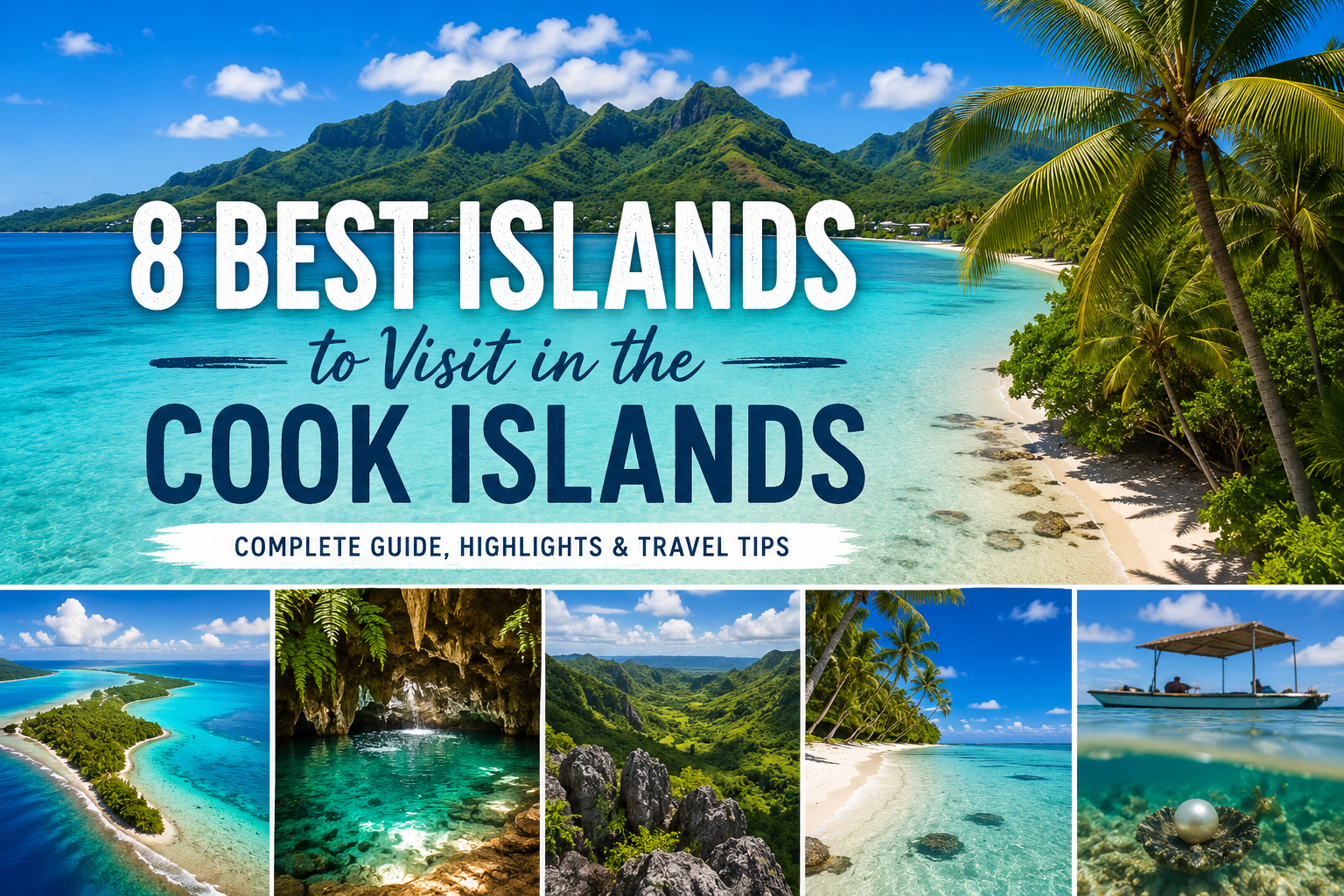
The Cook Islands look like the kind of tropical paradise people imagine when they close their eyes: luminous turquoise lagoons, palm-lined beaches, jungle-covered mountains, tiny uninhabited islands, coral reefs, warm Polynesian culture, and sunsets that seem to set the entire sky on fire.
Most first trips begin on Rarotonga, the country’s main island and international gateway. It is the easiest place to stay, explore, eat well, swim, snorkel, hike, and experience Cook Islands culture without complicated planning. But Rarotonga is only the beginning. Aitutaki has one of the most extraordinary lagoons in the South Pacific, while smaller islands such as Atiu, Mangaia, Mauke, and Mitiaro offer caves, quiet villages, rare birds, ancient landscapes, and the kind of slow island life that feels increasingly hard to find.
The Cook Islands are spread across a huge area of the Pacific, so choosing where to go matters. Some islands have regular flights, resorts, restaurants, and organized activities. Others are remote places with limited accommodations and very little tourism infrastructure. That difference is part of what makes the country so special, but it also means most travelers should build their trip around one or two islands rather than trying to see everything.
This guide focuses on the Cook Islands that make the most sense for travelers, from the easy first-time combination of Rarotonga and Aitutaki to quieter outer islands for people who want culture, nature, and a genuine escape from the modern world.
1. Rarotonga

Region: Southern Cook Islands; the country’s main international gateway, largest island, and easiest place to begin or end a Cook Islands trip.
Rarotonga is the heart of the Cook Islands and the best first stop for almost every traveler. It brings together nearly everything people dream about when planning a South Pacific escape: turquoise lagoons, palm-lined beaches, rainforest-covered mountains, coral reefs, Polynesian culture, waterfront restaurants, island markets, and warm evenings beneath the stars.
The island is developed enough to make a vacation feel easy, but it never feels like a crowded resort strip. Hotels, restaurants, villages, beaches, and small shops are scattered around one coastal road, while the mountainous interior remains wonderfully green and dramatic. You can spend the morning snorkeling straight from the beach, the afternoon exploring by bus or scooter, and the evening watching an island dance performance or eating beside the lagoon.
Rarotonga is also surprisingly simple to navigate. Clockwise and anticlockwise buses circle the island, and driving the entire coastal road takes about 45 minutes. That makes it easy to explore several parts of the island without constantly changing accommodations.
Main Highlights
Rarotonga is best for beautiful beaches, easy snorkeling, lagoon cruises, mountain scenery, island culture, restaurants, markets, hiking, family trips, romantic escapes, and first-time Cook Islands vacations.
Why I Recommend It
Rarotonga gives you the classic Cook Islands experience without complicated logistics. It has the country’s broadest selection of accommodations, restaurants, tours, transportation, and cultural experiences, but it still feels relaxed, personal, and connected to everyday island life.
It is also much more than an arrival point for travelers continuing to Aitutaki. Rarotonga has enough beaches, snorkeling spots, mountain adventures, cultural evenings, markets, and quiet corners to deserve several days of its own. For many travelers, it may be the only Cook Islands base they need.
Don’t Miss
- Muri Lagoon — one of Rarotonga’s most recognizable areas, with calm turquoise water, sandy beaches, and several small offshore motu. It is a beautiful place for swimming, kayaking, paddleboarding, glass-bottom boat trips, and relaxed lagoon days.
- A lagoon cruise — one of the easiest ways to experience the reef, marine life, and tiny islands around Rarotonga. Many cruises combine snorkeling, music, storytelling, and a beach barbecue, making them especially good for first-time visitors.
- Aroa and Tikioki marine reserves — two of the island’s strongest areas for snorkeling from shore. Clear lagoon water, coral formations, and tropical fish make these excellent stops even for travelers who do not want a full boat excursion.
- Punanga Nui Market — Rarotonga’s main market in Avarua, where you can browse local food, tropical fruit, crafts, clothing, pearls, and souvenirs. Saturday morning is generally the liveliest time to visit.
- Avarua — the Cook Islands’ capital and main town, with shops, cafés, churches, government buildings, and the market. It is small and easygoing, but it gives you a glimpse of everyday life beyond the beach resorts.
- The Cross-Island Track and Te Rua Manga — Rarotonga’s signature inland adventure, leading through thick rainforest toward the dramatic rock formation known as The Needle. The terrain can be steep, muddy, and challenging, so this is better for capable hikers than casual beach walkers.
- Cook Islands cultural night — an evening of drumming, dancing, storytelling, and traditional food is one of the best ways to understand the culture behind the scenery. Te Vara Nui Village and Highland Paradise are among the island’s established cultural experiences.
- Black Rock Beach — a scenic western-coast stop associated with Cook Islands legends and especially lovely near sunset. It is easy to include while circling the island.
- Ara Metua — the old inland road that runs through villages, farmland, and quieter parts of Rarotonga. Exploring sections of it reveals a softer, more local side of the island away from the main coastal route.
Good to Know / Side Notes
- Rarotonga is the best Cook Islands base for first-time visitors, families, couples, solo travelers, and anyone who wants tropical beauty without feeling isolated.
- Most travelers should give Rarotonga at least 4–5 nights, especially if they also want beach time rather than filling every day with tours.
- Muri is popular for lagoon scenery, activities, restaurants, and easy vacation energy, while the western and southern coasts are excellent for sunsets, snorkeling, and quieter stays.
- The island bus is useful for travelers who do not want to rent a vehicle. Buses travel clockwise and anticlockwise around the main coastal road and can be waved down along the route.
- Scooters are common, but travelers should confirm licensing rules and insurance coverage before renting one. A car is often the easier choice for families, nervous drivers, or rainy days.
- Rarotonga is surrounded by a reef, but swimming and snorkeling conditions vary around the island. Pay attention to local signs and advice, particularly near reef passages and stronger currents.
- Sundays are traditionally quieter, and some businesses may close or reduce their hours. Attending a local church service can be a meaningful cultural experience when done respectfully.
- Rarotonga and Aitutaki make the easiest two-island itinerary. Rarotonga supplies the variety, culture, dining, and mountain scenery, while Aitutaki brings the extraordinary lagoon escape.
2. Aitutaki

Region: Southern Cook Islands; approximately a 50-minute flight north of Rarotonga.
Aitutaki is the Cook Islands destination that looks almost too beautiful to be real. Its enormous turquoise lagoon is scattered with tiny palm-covered motu, brilliant white sandbars, coral gardens, and water that shifts through every imaginable shade of blue.
The lagoon is the star, but Aitutaki is not simply a place to visit for one photogenic boat ride. The main island has quiet villages, small beaches, local cafés, churches, scenic viewpoints, and an unhurried rhythm that feels noticeably sleepier than Rarotonga. There are fewer restaurants, shops, and organized attractions, but that is exactly the appeal.
Aitutaki is especially popular with honeymooners and couples, although it is equally wonderful for families, snorkelers, photographers, and anyone whose dream vacation involves spending as much time as possible in warm, clear water. It is about 220 kilometers from Rarotonga and reached by a short domestic flight.
Main Highlights
Aitutaki is best for spectacular lagoon scenery, snorkeling, swimming, romantic escapes, secluded beaches, small-island relaxation, boat trips, overwater stays, and unforgettable tropical photography.
Why I Recommend It
Aitutaki delivers the sweeping, untouched South Pacific scenery many travelers travel halfway around the world hoping to find. The lagoon is vast enough that even a full day on the water feels like an adventure rather than a quick sightseeing cruise.
It also complements Rarotonga beautifully. Rarotonga offers more culture, restaurants, hiking, shopping, and variety, while Aitutaki slows everything down and centers the trip around the lagoon. Staying on both islands creates a much more complete Cook Islands experience than rushing to Aitutaki and back in a single day.
Don’t Miss
- An Aitutaki Lagoon cruise — the essential Aitutaki experience, usually combining snorkeling, motu visits, time on white-sand beaches, and lunch beside or on the lagoon. This is the best way to appreciate just how large and spectacular the lagoon really is.
- One Foot Island — also known as Tapuaetai, this tiny motu is famous for powdery sand, impossibly clear water, and one of the Cook Islands’ most recognizable lagoon views. Many full-day cruises stop here for swimming, lunch, and time on the beach.
- Snorkeling in the lagoon — coral gardens, tropical fish, giant trevally, and clear, shallow water make Aitutaki one of the country’s most rewarding snorkeling destinations. A guided cruise is the easiest option because the strongest sites are spread throughout the lagoon.
- Honeymoon Island — a slender sand-and-coral motu with shallow turquoise water and a wonderfully remote atmosphere. It is particularly popular for private excursions, romantic picnics, kiteboarding, and photographs that capture the scale of the lagoon.
- Akaiami — a peaceful motu once used as a stop on the historic Coral Route flown by TEAL flying boats between Fiji and Tahiti. Today it combines beautiful beach scenery with an unexpected piece of Pacific aviation history.
- Maungapu — the highest point on Aitutaki and the island’s best accessible viewpoint. The walk is relatively short, and the reward is a broad view across the main island and the glowing lagoon beyond it.
- Arutanga — Aitutaki’s main village and administrative center, where you can see local churches, small shops, the harbor, and everyday island life away from the resorts.
- A private lagoon excursion — a worthwhile splurge for couples, families, or travelers who want quieter snorkeling locations and more control over the day. Smaller boats can often tailor the route around swimming, photography, secluded beaches, or longer motu stops.
- Sunset on the western coast — Aitutaki’s western side has several quiet places to watch the sun sink into the Pacific. The atmosphere is peaceful, and the skies can be just as memorable as the lagoon itself.
Good to Know / Side Notes
- Aitutaki is the strongest choice for honeymooners, anniversary trips, lagoon lovers, snorkelers, and travelers seeking a quieter island stay.
- Although day trips from Rarotonga are possible, staying at least 3 nights gives you time to enjoy the island without reducing the entire experience to one lagoon cruise.
- Travelers who want a slower honeymoon or beach vacation could comfortably stay considerably longer, especially at a lagoonfront resort.
- Aitutaki has fewer restaurants, stores, tours, and transportation choices than Rarotonga. Plan ahead rather than expecting the same flexibility found on the main island.
- The island is small enough to explore by scooter, car, bicycle, or organized tour, although the lagoon itself requires a boat excursion.
- Not every beach on the main island has the sweeping white sand associated with One Foot Island. Aitutaki’s most extraordinary scenery lies out in the lagoon among the motu and sandbars.
- Lagoon cruises vary from larger sociable boats to intimate private trips. The best choice depends on whether you prefer entertainment and a lively lunch or a quieter, more personalized day.
- Flights between Rarotonga and Aitutaki are short, but weather can occasionally affect small-island travel. Avoid scheduling a tight international connection immediately after returning to Rarotonga.
- Rarotonga and Aitutaki are the easiest and most rewarding pairing for a first Cook Islands trip: one provides variety and culture, while the other provides pure lagoon paradise.
3. Atiu

Region: Southern Cook Islands; one of the larger outer islands, located northeast of Rarotonga.
Atiu feels like the Cook Islands for travelers who want something quieter, older, and far more rooted in nature than resort life. It is often called Enuamanu — the island of birds — and it has a completely different atmosphere from Rarotonga or Aitutaki. Instead of big lagoon days and beach bars, Atiu offers makatea limestone cliffs, caves, dense tropical vegetation, coffee plantations, tiny villages, reef-fringed coastlines, and one of the strongest chances in the Cook Islands to feel genuinely off the main tourist trail.
This is not the island for a polished luxury beach vacation. It is for travelers who like places with personality, history, and a bit of wildness. The scenery is beautiful, but it is a more rugged beauty: raised coral terrain, hidden caves, dramatic coastal views, and birdlife rather than long strings of resort-backed white-sand beaches.
Atiu is especially good for repeat South Pacific travelers, nature lovers, birders, cave fans, and anyone who wants to balance a Rarotonga or Aitutaki stay with something quieter and more unusual. It is also one of the best places in the Cook Islands to see how traditional village life and island culture still shape the rhythm of everyday travel.
Main Highlights
Atiu is best for caves, birdwatching, coffee, cultural depth, village life, dramatic makatea landscapes, quiet island stays, and travelers who want a more offbeat Cook Islands experience.
Why I Recommend It
Atiu adds something completely different to a Cook Islands trip. It is not trying to compete with Aitutaki’s lagoon or Rarotonga’s easy beach holiday appeal. Instead, it gives you one of the country’s most distinctive outer-island experiences: less polished, less resort-driven, and far more focused on nature, local guides, caves, birds, and community life.
It is also one of the most realistic outer-island picks for travelers who want to go beyond the “big two” without choosing somewhere so remote that planning becomes difficult. If you want your Cook Islands trip to include at least one place that feels quieter, stranger, and more memorable than a standard tropical beach stay, Atiu is a very strong choice.
Don’t Miss
- Anatakitaki Cave — Atiu’s best-known cave and one of the island’s signature experiences. This large limestone cave is famous for its dramatic formations and for being one of the places where you may see the rare kopeka, a swiftlet-like bird that navigates in darkness using clicks. Visiting with a local guide adds the cultural and ecological context that makes the experience much richer.
- Atiu Coffee Factory — one of the island’s most distinctive stops and a fun reminder that not every tropical island experience has to revolve around beaches. Atiu’s coffee is locally grown and roasted, and a visit gives you a glimpse into one of the island’s small-scale agricultural success stories.
- Birdwatching with a local guide — Atiu is one of the best birding islands in the Cook Islands, and guided outings are especially worthwhile if you want to learn about the island’s native species, forest habitats, and the role birds play in local identity.
- Takitumu Conservation Area and forested interior — a chance to see more of Atiu’s wilder side beyond the villages, with native vegetation, birds, and the island’s distinctive raised coral terrain.
- The makatea coastline — Atiu’s uplifted coral rim creates a very different kind of coastal scenery from the soft lagoon shores of Rarotonga and Aitutaki. Expect dramatic rock formations, sea views, and a more rugged edge to the island.
- Village visits around Areora, Ngatiarua, Teenui, and Mapumai — Atiu’s villages are quiet and traditional, with churches, local homes, and a slower rhythm of life that feels very different from busier island destinations.
- A guided cultural tour — one of the best ways to understand Atiu beyond its scenery. Local guides can connect the caves, villages, agriculture, history, and oral traditions into something much more meaningful than simply driving around on your own.
- Sunrise and sunset viewpoints along the coast — because the island is small and undeveloped, it is easy to find beautiful quiet stretches of coast without much competition.
Good to Know / Side Notes
- Atiu is a much better fit for nature lovers, repeat visitors, and travelers who actively want a quieter outer-island stay than for people hoping for a classic resort beach vacation.
- It works especially well as the “different” island in a longer Cook Islands itinerary: do Rarotonga for ease, maybe Aitutaki for the lagoon, then Atiu for caves, birds, and a more local island atmosphere.
- Accommodations and dining are much more limited than on Rarotonga. This is a place to book ahead and keep expectations grounded.
- Guided experiences matter more here than they do on Rarotonga. On Atiu, a knowledgeable local guide can turn caves, forests, and village drives into one of the most memorable parts of the whole trip.
- Beach time here is not the main event. You come to Atiu for landscapes, nature, and atmosphere, not for a long list of swimmable lagoon beaches.
- If you love unusual wildlife facts, Atiu’s kopeka are one of the island’s coolest claims to fame. They are among the few birds in the world known to use echolocation-like clicks in dark caves.
- The pace is slow, the infrastructure is simple, and that is very much the point. Atiu shines when you lean into the quiet rather than expecting lots of entertainment or polished resort amenities.
4. Mangaia

Region: Southern Cook Islands; the country’s southernmost island and approximately a 40-minute flight from Rarotonga.
Mangaia is one of the most ancient and intriguing islands in the South Pacific. Estimated to be more than 18 million years old, it is widely described as the oldest island in the Pacific and has a landscape unlike anywhere else in the Cook Islands. A volcanic interior of fertile valleys and wetlands is surrounded by towering makatea—raised fossilized coral riddled with caves, underground passages, and narrow routes cut directly through the limestone.
This is another Cook Islands choice where the appeal is not a polished resort strip or a perfect lagoon. Mangaia feels rugged, deeply historic, and wonderfully removed from modern tourism. Its coastline alternates between cliffs, reef, rock pools, and small secluded beaches, while the interior is lush, green, and shaped by natural streams and underground waterways.
Mangaia is best for adventurous travelers who enjoy caves, archaeology, island history, hiking, local crafts, and destinations that require a little curiosity. It is quieter and less visitor-ready than Rarotonga or Aitutaki, but that is exactly why it can become one of the most memorable stops in a longer Cook Islands journey.
Main Highlights
Mangaia is best for ancient landscapes, cave exploration, archaeology, local legends, hiking, secluded beaches, traditional crafts, village life, and genuinely remote island travel.
Why I Recommend It
Mangaia has one of the strongest personalities of any island in the country. Its enormous age, fossilized coral landscape, complex cave systems, and lush sunken interior make it feel less like a standard tropical getaway and more like an expedition into a very old living landscape.
It is especially rewarding for travelers who have already enjoyed the lagoons and beaches of Rarotonga or Aitutaki and want to see a completely different side of the Cook Islands. Mangaia brings history, geology, local traditions, and a sense of discovery that you will not find on the country’s more frequently visited islands.
Don’t Miss
- A guided cave tour — Mangaia is honeycombed with extensive caves and underground chambers, many connected to local legends, historic conflicts, refuge, and burial traditions. Some are culturally sensitive or dangerous to enter independently, so exploring with a knowledgeable local guide is essential.
- Teruarere Cave — one of the island’s better-known cave experiences, with limestone formations, underground spaces, and stories that help reveal how Mangaia’s caves have been used and understood over generations.
- The Mangaia “Cuttings” — extraordinary roads and pathways carved through walls of fossilized coral to connect the coast with the island’s interior. Traveling through them gives you a close-up look at the makatea and the sheer effort required to create routes across this rugged landscape.
- Lake Tiriara — a small freshwater lake within Mangaia’s fertile interior. The surrounding wetlands, streams, and underground drainage systems create a surprisingly green landscape behind the island’s harsh coral rim.
- Tuaati Rock Pool — a natural swimming area along the coast where travelers can cool off and experience Mangaia’s rugged reef scenery. Conditions vary with the tide and weather, so ask locally before swimming.
- Ara’oa Beach — a secluded pocket of sand framed by makatea formations. It offers a softer, more intimate beach experience than Mangaia’s predominantly rocky coastline.
- A cross-island nature walk — one of the best ways to understand Mangaia’s unusual structure, moving through tropical vegetation, valleys, farmland, limestone formations, and the contrasting landscapes of the coast and interior.
- Ei pupu shell jewelry — Mangaia is known for delicate necklaces and adornments made from tiny golden pupu shells. Seeing how the shells are collected and threaded introduces you to one of the island’s most distinctive craft traditions.
- Oneroa village — Mangaia’s main settlement and the best place to glimpse daily island life, churches, small stores, local homes, and the relaxed rhythm of a community that receives relatively few visitors.
Good to Know / Side Notes
- Mangaia is best for adventurous, curious, and independent travelers, not people seeking a conventional luxury island vacation.
- The island’s geology is the main attraction. Its beaches can be lovely, but they are not the broad, powdery lagoon beaches associated with Aitutaki.
- Most caves should only be explored with a local guide. Beyond practical safety, several sites have deep historical, spiritual, or burial significance and must be treated respectfully.
- Accommodation, dining, transportation, and organized activities are limited. Arrange the essentials ahead of arrival rather than expecting to improvise once you are there.
- A local host or guide can make an enormous difference on Mangaia. Many of the island’s most interesting places are difficult to find or impossible to fully understand without someone explaining the stories behind them.
- Mangaia is the second-largest Cook Island after Rarotonga, but it feels vastly quieter and more remote.
- Sturdy shoes are more useful here than a suitcase filled entirely with beachwear. Cave floors, sharp coral, uneven trails, and damp terrain can all be part of exploring the island.
- Mangaia pairs best with Rarotonga for travelers who want contrast: Rarotonga provides easy beaches and restaurants, while Mangaia provides caves, ancient geology, and a true outer-island adventure.
5. Mauke

Region: Southern Cook Islands; part of the closely grouped Nga-Pu-Toru islands northeast of Rarotonga.
Mauke is often called the Garden Island of the Cook Islands, and it is easy to understand why. Tropical flowers grow beside quiet coral roads, carefully tended gardens surround village homes, and thick greenery covers much of this small, peaceful island. Its traditional name, Akatokamanava, is commonly translated as “where my heart rests,” which suits a place built around stillness, community, and natural beauty.
Mauke is not a resort island, and it does not have the enormous lagoon scenery of Aitutaki. Its appeal is gentler: freshwater caves hidden beneath the makatea, small beaches appearing between coral outcrops, sleepy villages, historic churches, tropical gardens, and quiet roads that are easy to explore by bicycle or scooter.
This is a wonderful choice for travelers who genuinely want to slow down. Days here are less about checking off attractions and more about swimming in a cool cave pool, wandering through flower-filled villages, chatting with local hosts, and discovering corners of the island that feel almost entirely untouched by tourism.
Main Highlights
Mauke is best for tropical gardens, freshwater cave swimming, quiet cycling, small beaches, village life, local hospitality, historic churches, and deeply peaceful outer-island escapes.
Why I Recommend It
Mauke offers one of the softest and most approachable outer-island experiences in the Cook Islands. It feels remote, but its small size makes exploring relatively simple. The island measures only about 18 kilometers around, and a drive around it can take roughly 30 minutes before stops.
It is especially appealing for travelers who want an island that feels culturally grounded and naturally beautiful without requiring strenuous hikes or adventurous cave expeditions. Mauke is less dramatic than Mangaia and less wildlife-focused than Atiu, but it may be the best of the outer islands for pure peace and quiet.
Don’t Miss
- Vai Tango Cave — one of Mauke’s most accessible freshwater caves, with a clear, cool pool surrounded by limestone. Swimming here is a refreshing change from the ocean and one of the island’s most memorable experiences.
- Motuanga Cave — a larger and more adventurous underground cave system with freshwater pools and impressive limestone formations. Visit with a local guide who understands the route, conditions, and cultural significance of the site.
- Mauke’s flower-filled gardens — the island is famous for the care residents put into their homes and gardens. Exploring the villages reveals hibiscus, bougainvillea, orchids, and other tropical plants growing in wonderful abundance.
- Ziona Church — Mauke’s striking historic church is sometimes called the “Divided Church” because its interior reflects an old division between village communities. It is both an architectural landmark and an intriguing window into the island’s social history.
- Kimiangatau and Oiretumu villages — Mauke’s two principal village areas offer churches, homes, gardens, and a quiet glimpse of everyday outer-island life.
- A bicycle or scooter ride around the island — Mauke’s coral roads curve through coconut palms, hardwood trees, gardens, and small settlements. Because the island is compact and traffic is minimal, exploring slowly is part of the experience.
- The small coastal beaches — Mauke’s shoreline is largely edged by reef and makatea, but small sandy coves appear between the coral formations. These intimate beaches feel wonderfully private, though swimming conditions should always be checked locally.
- Taunganui Landing — a scenic coastal area associated with the island’s historic sea access. The rugged reef, vivid water, and coastal landscape show a more dramatic side of otherwise gentle Mauke.
- A locally guided island tour — the island is easy to circle independently, but a guide can explain family histories, church stories, cave traditions, medicinal plants, and places that would otherwise look like unmarked stretches of road.
Good to Know / Side Notes
- Mauke is best for travelers seeking peace, local connection, gentle exploration, and a true escape from busy resort life.
- This is not the right island for nightlife, shopping, luxury resorts, or a packed schedule of organized tours.
- Accommodation and dining choices are extremely limited, so arrange your stay, transportation, and meals before arriving.
- The island’s close reef means it does not have a broad lagoon like Aitutaki. Its strongest swimming experiences may be the freshwater caves rather than the coastline.
- Reef shoes or sturdy walking shoes are useful because exposed coral and makatea can be sharp and uneven.
- Mauke is small enough to explore quickly, but rushing would miss the point. It is better suited to slow rides, conversations, swimming stops, and unplanned pauses beneath the palms.
- Outer-island travel comes with fewer modern conveniences and occasional communication or scheduling delays. That simplicity is part of the experience rather than a flaw.
- Mauke pairs especially well with Rarotonga for travelers who want an easy main-island stay followed by a few days somewhere beautifully quiet and almost entirely removed from mainstream tourism.
6. Mitiaro

Region: Southern Cook Islands; one of the three closely grouped Nga-Pu-Toru islands alongside Atiu and Mauke.
Mitiaro may be one of the Cook Islands’ least-known destinations, but beneath its quiet, flat landscape are some of the most beautiful cave pools in Polynesia. Also known as Nukuroa, the island is surrounded by fossilized coral and coconut palms, with freshwater lakes, plantations, peaceful villages, secluded coastal pockets, and extraordinary limestone caverns hidden beneath the greenery.
This is not an island built around resorts, nightlife, or a long menu of organized excursions. Mitiaro is tiny, remote, and deeply relaxed. Its most memorable experiences involve swimming in cool underground pools, exploring silent roads, visiting freshwater lakes, learning about village life, and spending time with local hosts who can explain places that would otherwise be difficult to find.
Mitiaro suits travelers who are excited by the thought of discovering somewhere almost entirely outside the usual South Pacific tourism circuit. It has a similar outer-island atmosphere to Mauke, but its caves and freshwater landscapes give it a personality all its own.
Main Highlights
Mitiaro is best for underground cave pools, freshwater swimming, lakes, quiet villages, local hospitality, cycling, secluded beaches, traditional island life, and travelers seeking a genuinely remote escape.
Why I Recommend It
Mitiaro offers one of the most unusual swimming experiences in the Cook Islands. Rather than focusing entirely on ocean lagoons, the island invites you underground into clear limestone pools surrounded by rock walls, tangled roots, and shafts of tropical sunlight.
It is also reportedly the only Cook Island with freshwater lakes, adding another unexpected element to a destination already known for its subterranean pools.
Mitiaro is not the easiest island to visit, and it will not suit everyone. But for travelers who value quiet, natural oddities, and genuine connection more than polished amenities, it can be one of the most rewarding islands in the country.
Don’t Miss
- Vai Nauri — Mitiaro’s signature cave pool and one of the most striking natural swimming places in the Cook Islands. The deep, clear water sits beneath limestone walls and tropical vegetation, creating a wonderfully secluded atmosphere. Always ask locally about current access and safe swimming conditions before entering.
- Vai Marere — a distinctive sulfur cave pool known for its green-tinted water. It provides a completely different experience from the island’s clearer freshwater pools and is one of Mitiaro’s most unusual natural attractions.
- Te Pitakare — another of Mitiaro’s freshwater caves, offering cool water, dramatic limestone surroundings, and the feeling of discovering a hidden natural swimming hole beneath the island.
- Lake Rotonui and Lake Rotoiti — Mitiaro’s freshwater lakes lie within the island’s interior and help distinguish it from the rest of the Cook Islands. The wetlands and surrounding vegetation create a striking contrast with the fossilized coral terrain nearer the coast.
- A locally guided cave tour — cave entrances can be difficult to locate, and conditions may change after rain. A guide can help with safe access while also explaining the traditional stories, local names, and cultural importance connected to each site.
- A bicycle or scooter ride around the island — Mitiaro’s quiet roads pass through villages, plantations, coconut groves, and forested stretches. Traffic is minimal, making slow exploration one of the loveliest ways to experience the island.
- The western villages — the communities of Mangarei, Atai, Auta, and Takaue sit close together on the western side of Mitiaro. Exploring them offers a glimpse of churches, family homes, gardens, and everyday life on an island with a population of fewer than 200 people.
- Plantation areas in the interior — fertile pockets within the island are used to grow tropical produce and traditional crops. Visiting with a local host helps reveal how residents make use of land that may initially appear wild or empty.
- The secluded coastline — Mitiaro’s shore alternates between fossilized coral, reef flats, and small sandy openings. These quiet coastal spots are beautiful for walking and photography, although swimming conditions should always be checked locally.
Good to Know / Side Notes
- Mitiaro is best for travelers who genuinely enjoy remote places, simple accommodations, cave swimming, and quiet local life.
- The island has very limited lodging, dining, transportation, and organized tourism. Book the essential parts of the trip before flying rather than assuming arrangements can be made after arrival.
- A local host or guide is extremely valuable. Many caves and pools are unmarked, hidden by vegetation, or reached by routes that would be difficult for a visitor to recognize.
- Ask before swimming in any cave pool. Water depth, access, visibility, and slippery limestone can all affect safety.
- Pack reef shoes or sturdy sandals for sharp coral, uneven tracks, and slippery cave entrances.
- Mitiaro has beautiful coastal scenery, but it is not a classic broad-lagoon destination. The underground pools and freshwater landscapes are the main reason to come.
- Flights are limited, and outer-island schedules can change. Leave flexibility in the itinerary rather than planning tight onward connections.
- Mitiaro pairs well with Rarotonga for travelers who want a dramatic contrast between an easy, activity-filled main island and a tiny place where daily life feels almost completely removed from mainstream tourism.
7. Manihiki

Region: Northern Cook Islands; a remote coral atoll approximately 1,200 kilometers north of Rarotonga.
Manihiki reveals a completely different side of the Cook Islands. Rather than volcanic mountains, jungle trails, and raised limestone caves, this far-northern atoll is formed by slender palm-covered islets circling an enormous blue lagoon. It is beautiful, intensely remote, and best known as the center of the Cook Islands’ black pearl industry.
Often called the Island of Pearls, Manihiki is one of the most fascinating choices for travelers who have already seen the country’s better-known southern islands and want to venture much farther beyond the usual itinerary. Pearl farms sit within the lagoon, fishing remains central to daily life, and the communities of Tauhunu and Tukao preserve the close-knit rhythm of an isolated Pacific atoll.
Manihiki is not an easy add-on to a standard Cook Islands vacation. Flights are limited, accommodations are simple, and plans may need to shift around weather and transportation. But the difficulty of reaching it is also what protects its extraordinary sense of remoteness. For travelers who dream of seeing pearl farming firsthand and experiencing life on a genuine northern atoll, Manihiki is one of the country’s most distinctive destinations.
Main Highlights
Manihiki is best for black pearls, pearl-farm visits, remote lagoon scenery, fishing, snorkeling, village life, traditional crafts, and adventurous travelers seeking an exceptionally isolated Pacific island.
Why I Recommend It
Manihiki earns its place on this list because it offers an experience that cannot be replicated on Rarotonga, Aitutaki, or the southern outer islands. The immense lagoon is both the island’s visual centerpiece and the foundation of its economy, with pearl farming woven directly into local life.
It is also one of the strongest choices for travelers who want to understand where the Cook Islands’ famous black pearls actually come from. Seeing the lagoon, meeting people involved in pearl cultivation, and learning how oysters are raised gives far more meaning to the jewelry displayed in shops back on Rarotonga.
This is a specialist destination rather than a universal recommendation, but for the right traveler, its rarity is exactly what makes it unforgettable.
Don’t Miss
- A black pearl farm visit — Manihiki is the heart of the Cook Islands’ pearl industry, and seeing a working farm is the island’s signature experience. Local hosts can explain how oysters are seeded, suspended in the lagoon, monitored over time, and eventually harvested for their pearls.
- The vast Manihiki Lagoon — the atoll’s enormous central lagoon creates luminous shades of turquoise and deep blue between the scattered motu. Boat trips across it reveal just how broad and remote the island landscape really is.
- Tauhunu village — one of Manihiki’s two principal settlements and a center of community life. Visiting offers a glimpse of homes, churches, pearl-industry activity, and the practical realities of living on a distant coral atoll.
- Tukao village — located on the opposite side of the lagoon, Tukao has its own church, homes, and strong community identity. Traveling between the two villages by boat is part of understanding Manihiki’s geography and everyday life.
- Snorkeling in the lagoon — clear water, reef fish, coral formations, and relatively little visitor traffic can make snorkeling especially rewarding. Conditions and suitable sites vary, so arrange outings with someone local rather than entering unfamiliar passages independently.
- Lagoon fishing — fishing is both a livelihood and a daily tradition on Manihiki. Joining a local trip provides a more meaningful experience than a standard recreational charter and offers insight into how the lagoon supports the community.
- Traditional rito weaving — finely woven hats, fans, mats, baskets, and accessories may be made from carefully prepared young coconut leaves. These crafts represent an important skill passed through families and make meaningful locally produced souvenirs when available.
- A church service — churches remain central to social and spiritual life throughout the Cook Islands. On Manihiki, the singing and close community atmosphere can make a respectful Sunday visit particularly memorable.
- Quiet motu and lagoon-edge beaches — Manihiki’s beauty lies in its thin strips of sand, palms, reef, and water rather than large resort beaches. A locally arranged boat outing can lead to secluded places that receive almost no outside visitors.
Good to Know / Side Notes
- Manihiki is best for experienced, flexible travelers who are genuinely interested in pearl farming, atoll culture, fishing, and remote island life.
- This is not a straightforward extension of a normal Rarotonga vacation. Transportation can be infrequent, expensive, and vulnerable to weather or operational changes.
- Accommodation, dining, shops, medical services, and tourism infrastructure are extremely limited. Every major part of the visit should be arranged before departure.
- Bring sufficient cash, medications, toiletries, sun protection, and any other essentials you cannot easily replace.
- Internet and mobile connections may be slow or unreliable. Travelers should be comfortable spending time largely disconnected.
- Manihiki is a coral atoll with very little elevation. Its scenery is defined by lagoon, reef, palms, sky, and narrow strips of land rather than mountains or inland hiking.
- Ask permission before photographing residents, pearl-farming operations, homes, or community gatherings. Visitors are rare, and respectful behavior matters enormously in such a small community.
- Manihiki is not necessary for a first Cook Islands trip. It is better viewed as a special northern-island expedition for travelers who want something far beyond the familiar Rarotonga-and-Aitutaki route.
- Reaching Manihiki may require a charter or specially scheduled northern-group flight rather than the regular, frequent connections available between Rarotonga and Aitutaki. Confirm the entire route directly before building the rest of the itinerary around it.
8. Penrhyn

Region: Northern Cook Islands; the country’s northernmost island and one of its most remote atolls.
Penrhyn, traditionally known as Tongareva, is the kind of place that makes the rest of the Cook Islands feel almost accessible by comparison. Its enormous enclosed lagoon stretches across roughly 233 square kilometers, surrounded by a thin ring of coral islets, pearl shell, coconut palms, and an almost endless horizon of blue. It is widely described as the largest atoll in the Cook Islands and is also one of the country’s most difficult islands to reach.
There are no mountains, jungle-covered interiors, busy markets, or polished resorts here. Penrhyn’s beauty is stripped back to its simplest elements: lagoon, reef, sky, palms, villages, boats, and long distances between communities. The island has two principal settlements, Omoka and Tetautua, positioned on opposite sides of the vast lagoon.
Penrhyn is not a practical choice for most first-time visitors, but it deserves a place on this list because it represents the most remote and rarely seen side of the country. Travelers who make it here come for the immense lagoon, traditional weaving, fishing, village life, and the rare experience of staying somewhere almost completely untouched by mainstream tourism.
Main Highlights
Penrhyn is best for immense atoll scenery, traditional weaving, lagoon exploration, fishing, snorkeling, remote village life, cultural immersion, and highly adventurous travelers seeking one of the Cook Islands’ rarest experiences.
Why I Recommend It
Penrhyn offers a scale and sense of isolation that none of the southern islands can match. The lagoon is so large that traveling between its two communities feels like crossing open water rather than circling a compact tropical island.
It is also especially important for its weaving traditions. Tongarevan artisans are known for finely worked hats, fans, mats, baskets, and jewelry made using pandanus and coconut materials, with skills taught through generations. These are not simply souvenirs; they are part of the island’s cultural identity and everyday life.
Penrhyn is undeniably difficult to reach, but that difficulty is part of what makes the experience so exceptional. This is a destination for travelers who care more about cultural connection, remoteness, and understanding island life than comfort or convenience.
Don’t Miss
- The immense Penrhyn Lagoon — the island’s defining natural feature, covering approximately 233 square kilometers. Its deep-blue channels, reef flats, pearl shell, and scattered motu create one of the grandest lagoon landscapes in the Cook Islands.
- Omoka village — one of Penrhyn’s two principal communities and the location of the island’s airstrip. Walking through the village offers a glimpse of churches, homes, boats, local crafts, and everyday life in an exceptionally isolated settlement.
- Tetautua village — positioned across the lagoon from Omoka, Tetautua has its own strong community identity and traditions. Reaching it by boat emphasizes just how enormous the atoll really is.
- A lagoon crossing — traveling between Omoka and Tetautua is not merely transportation; it is one of the best ways to appreciate the scale of Penrhyn. The journey crosses a vast expanse of water surrounded by little more than reef, sky, and distant strips of land.
- Traditional Tongarevan weaving — spend time learning about the intricate hats, fans, mats, baskets, and jewelry produced by local artisans. Watching the preparation and weaving process reveals the extraordinary patience and skill behind each finished piece.
- Fishing with local residents — fishing remains essential to daily life on the atoll. A locally arranged trip can introduce visitors to lagoon fishing, reef passages, traditional knowledge, and the ways the surrounding water sustains the community.
- Snorkeling in the lagoon — Penrhyn’s clear water, reef habitat, fish, and pearl-shell beds make the lagoon fascinating to explore. Go with someone local who understands currents, channels, tides, and appropriate swimming areas.
- Church singing and village gatherings — as elsewhere in the Cook Islands, churches remain central to community life. Attending respectfully can provide one of the most moving cultural experiences of a Penrhyn visit.
- The night sky — with almost no artificial light and an enormous open horizon, Penrhyn offers extraordinary stargazing. On a clear night, the isolation that makes the island so difficult to reach becomes one of its greatest gifts.
Good to Know / Side Notes
- Penrhyn is best for highly experienced, patient, and flexible travelers who actively want cultural immersion and extreme remoteness.
- It is probably the most difficult Cook Island to access, and transportation may depend on limited flights, charter arrangements, government services, or visiting vessels rather than a dependable tourist schedule.
- This is not an island to add casually to a short vacation. Build substantial flexibility into the itinerary and confirm every leg before committing to international connections.
- Accommodation, meals, transportation, tours, banking, shopping, medical care, and communications are extremely limited. Arrangements generally need to be made directly with local hosts.
- Bring all essential medications, toiletries, sun protection, cash, and backup supplies. Do not assume anything can be easily purchased after arrival.
- Ask permission before photographing residents, homes, churches, weaving, fishing activities, or community events.
- Visitors should expect simple conditions and should arrive ready to adapt to local routines rather than expecting the island to operate around tourism.
- Penrhyn is not necessary for a first or even second Cook Islands trip. It is a true specialist destination for travelers seeking one of the most remote inhabited atolls in the South Pacific.
- For most readers, Penrhyn may remain a dream rather than a realistic itinerary stop—and that is okay. Its inclusion shows just how much more geographically and culturally varied the Cook Islands are beyond Rarotonga and Aitutaki.
Short Packing List for the Cook Islands
The Cook Islands are wonderfully easy to dress for, but the combination of strong tropical sun, warm rain, coral beaches, boat days, and limited shopping on the outer islands makes a few practical items especially important. Think lightweight clothing, dependable sun protection, comfortable water shoes, and anything essential that may be difficult to replace once you leave Rarotonga.
- Sunscreen and sunglasses for lagoon cruises, beach days, and island exploring
- A wide-brimmed sun hat for strong South Pacific sun, especially during long boat trips
- A lightweight rain jacket or compact umbrella for passing tropical showers
- Water shoes for coral, rocky shorelines, cave pools, and lagoon excursions
- A dry bag or waterproof phone pouch for lagoon cruises, kayaking, and boat transfers
- Insect repellent for humid evenings, gardens, forests, and outer-island stays
- A reusable water bottle to stay hydrated during hot island days
- A portable phone charger for cruises, long excursions, and islands with less dependable electricity
- A basic first-aid kit and enough prescription medication for the full trip, particularly when visiting remote islands
- A light scarf, wrap, or modest layer for church visits and village settings
If your trip stays entirely on Rarotonga and Aitutaki, replacing forgotten basics is usually manageable. Travelers continuing to Atiu, Mangaia, Mauke, Mitiaro, Manihiki, Penrhyn, or another remote island should pack more carefully because shops may carry only a limited selection and transportation delays can make replacements difficult.
Final Thoughts: Where Should You Go in the Cook Islands?
The Cook Islands may look like one simple tropical destination on a map, but the islands offer very different kinds of trips. You can keep the vacation easy with Rarotonga and Aitutaki, or travel farther into the outer islands for caves, birds, village life, pearl farming, and the kind of remoteness that requires real flexibility.
For a first trip, I would start with Rarotonga, then add Aitutaki if time and budget allow. Rarotonga is the easiest all-around base, with beaches, snorkeling, restaurants, cultural experiences, mountain scenery, and the country’s best range of accommodations. Aitutaki is the strongest choice for extraordinary lagoon scenery, romantic escapes, and the classic South Pacific experience of sailing between tiny motu.
Travelers who want something quieter and more unusual should look toward the southern outer islands. Choose Atiu for birds, caves, coffee, and nature. Choose Mangaia for ancient geology, underground landscapes, and a more adventurous trip. Choose Mauke for tropical gardens, peaceful villages, and gentle island exploration. Choose Mitiaro for freshwater lakes and unforgettable cave-pool swimming.
Manihiki and Penrhyn are better for highly experienced travelers who are specifically drawn to remote atolls, black pearls, fishing, traditional weaving, and cultural immersion. They are not necessary additions to a normal Cook Islands vacation, and reaching them requires much more time, planning, patience, and flexibility.
The best Cook Islands itinerary does not need to include as many islands as possible. It should match the kind of vacation you actually want. Choose Rarotonga for ease and variety, Aitutaki for lagoon paradise, Atiu for wildlife and caves, Mangaia for ancient landscapes, Mauke for peace, Mitiaro for hidden swimming holes, Manihiki for pearls, and Penrhyn for true edge-of-the-world remoteness.
That variety is what makes the Cook Islands so memorable. The country can be an effortless tropical escape, a romantic lagoon honeymoon, a quiet cultural journey, or a genuine outer-island adventure. Whether you spend the trip floating across Aitutaki’s blue lagoon, circling Rarotonga beneath green mountains, swimming inside a limestone cave, or listening to church singing in a tiny village, the Cook Islands have a way of making the rest of the world feel wonderfully far away.