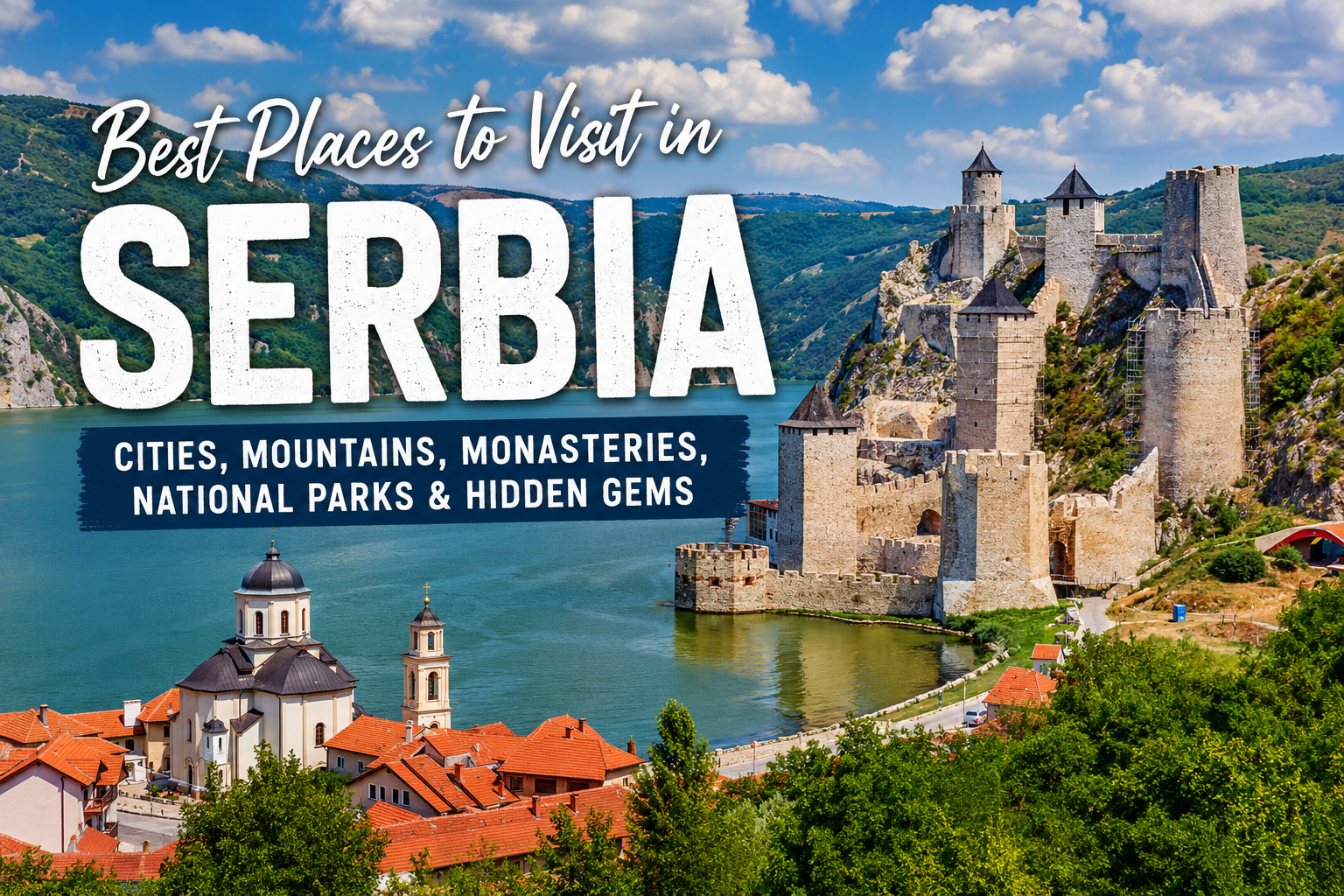
Serbia is one of those European countries that can be easy to underestimate until you start looking closer.
At first, it might sound like a Belgrade city break, a Novi Sad day trip, and maybe a few fortress views along the Danube. But Serbia is much richer than that. This is a country of river confluences and old fortresses, lively café streets and mountain resorts, medieval monasteries and wine towns, dramatic gorges and forested national parks, spa towns, scenic railways, and small places that make a Balkans itinerary feel more textured.
Serbia has the big, easy starting points travelers remember — Belgrade’s fortress views, Novi Sad’s Danube setting, Tara’s mountain scenery, and Uvac’s river meanders — but it also has layers. There are monastery valleys, northern Art Nouveau towns, old spa resorts, countryside wine stops, Ottoman and Austro-Hungarian traces, national parks, and road-trip routes that feel very different from one region to the next.

That mix is what makes Serbia such a rewarding place to travel. A first trip can be built around Belgrade and Novi Sad, but the country becomes much more memorable when you add western Serbia, the Iron Gate, mountain towns, historic monastery regions, and quieter corners that do not feel overly polished for tourism.
Here are the best places to visit in Serbia, from Belgrade and Novi Sad to national parks, Danube fortresses, monastery regions, spa towns, mountain escapes, and hidden gems.
Belgrade

Region: Northern-central Serbia, where the Sava and Danube rivers meet
Belgrade is the natural starting point for most Serbia trips, and it gives the country one of its strongest first impressions. The city sits at the meeting point of the Sava and Danube rivers, with fortress walls, parks, churches, museums, pedestrian streets, café culture, riverfront restaurants, and nightlife all layered together.
This is not a city that feels like one simple thing. Belgrade can feel grand, gritty, creative, historic, loud, relaxed, and emotional all in the same day. You can wander through Kalemegdan, look out over the river confluence, visit Saint Sava Temple, eat in Skadarlija, spend time in Zemun, or settle into a café and just let the city move around you.
Belgrade works especially well for first-time visitors because it gives you history, food, culture, nightlife, river scenery, and access to several excellent day trips without needing to move hotels constantly.
Main Highlights
Belgrade is best known for Belgrade Fortress and Kalemegdan Park, the Sava and Danube river confluence, Saint Sava Temple, Knez Mihailova pedestrian street, Skadarlija, Zemun, Gardoš Tower, museums, riverfront restaurants, and nightlife.
Why I Recommend It
Belgrade gives Serbia its capital-city energy. It is the easiest place to begin, the best place to get your bearings, and the strongest base if you want a trip that mixes sightseeing, food, history, and day trips. It also helps travelers understand Serbia before heading into smaller cities, national parks, monastery regions, or mountain areas.
Don’t Miss
- Belgrade Fortress and Kalemegdan Park for the classic view over the Sava and Danube rivers
- Saint Sava Temple for one of the city’s most important religious landmarks
- Knez Mihailova for the main pedestrian shopping and strolling street
- Skadarlija for traditional restaurants, old-town atmosphere, and evening energy
- Zemun and Gardoš Tower for a different riverside neighborhood feel
- Ada Ciganlija if you want a lakefront break, cycling, swimming, or summer outdoor time
- The riverfront for restaurants, nightlife, and a different side of the city
Good to Know / Side Notes
- Belgrade is usually the easiest place to begin a Serbia itinerary.
- Two full days is enough for a quick visit, but three or four days gives you more room for neighborhoods, museums, food, and day trips.
- The city is large, so choose your hotel location based on how much walking, nightlife, or sightseeing you want.
- Belgrade is a good base for day trips to Novi Sad, Fruška Gora, Sremski Karlovci, Golubac Fortress, and parts of western Serbia.
- Travelers who like lively cities, café culture, river views, history, nightlife, and practical bases will probably connect with Belgrade most.
Novi Sad

Region: Northern Serbia in Vojvodina, along the Danube River
Novi Sad is one of the best places to visit in Serbia if you want a softer, more graceful city after Belgrade. It has a colorful historic center, café streets, Danube views, and Petrovaradin Fortress rising across the river.
The city feels calmer than Belgrade but still has plenty of life. Novi Sad is especially good for travelers who like walkable centers, architecture, river views, relaxed meals, museums, and easy access to nearby wine country and monastery landscapes.
Novi Sad can be visited as a day trip from Belgrade, but it feels better if you stay overnight and let the city slow down after the day-trip rhythm fades.
Main Highlights
Novi Sad is best known for Petrovaradin Fortress, the Danube River, Liberty Square, the old town, Danube Park, riverfront walks, museums, cafés, galleries, and easy access to Fruška Gora and Sremski Karlovci.
Why I Recommend It
Novi Sad gives Serbia a gentler northern chapter. It is beautiful, manageable, and easy to enjoy without needing an intense sightseeing schedule. It also pairs naturally with Fruška Gora, Sremski Karlovci, wineries, monasteries, and a slower Vojvodina route.
Don’t Miss
- Petrovaradin Fortress for the classic view over Novi Sad and the Danube
- Liberty Square for the main city-center atmosphere
- Danube Park for a relaxed walk between sightseeing stops
- The old town streets for cafés, architecture, and easy wandering
- The riverfront if you want a slower sunset or evening stroll
- A side trip to Fruška Gora or Sremski Karlovci if you have extra time
Good to Know / Side Notes
- Novi Sad is easy to visit from Belgrade, especially for travelers who want a simple two-city Serbia trip.
- Staying overnight makes the city feel much more relaxed and rewarding.
- It is one of the best Serbia stops for couples, friend trips, architecture lovers, and travelers who like walkable cities.
- Novi Sad is a smart base if you want to explore Fruška Gora without staying in the countryside.
- Summer can bring festival energy, while spring and fall are especially comfortable for walking.
Fruška Gora & Sremski Karlovci

Region: Northern Serbia near Novi Sad, in the Vojvodina countryside
Fruška Gora is one of Serbia’s easiest countryside escapes. It has forested hills, Orthodox monasteries, vineyards, picnic areas, walking routes, and small settlements that feel very different from Belgrade’s city energy.
Sremski Karlovci is the classic town to include with Fruška Gora. It is small, pretty, wine-focused, and easy to pair with monastery visits or a vineyard stop. The pace here is gentle, which makes it a lovely contrast after Belgrade or Novi Sad.
This region is especially useful for travelers who want their Serbia itinerary to include countryside, wine, religious heritage, and a slower northern Serbia atmosphere without requiring a complicated journey.
Main Highlights
Fruška Gora and Sremski Karlovci are known for Fruška Gora National Park, Serbian Orthodox monasteries, local wineries, Sremski Karlovci’s historic center, countryside restaurants, forested hills, and easy day-trip access from Novi Sad.
Why I Recommend It
This area adds softness and texture to a Serbia trip. It gives travelers a break from big-city sightseeing and shows a calmer side of northern Serbia, with wine, monasteries, small-town architecture, and green hills all close together.
Don’t Miss
- Sremski Karlovci for wine cellars, churches, pastel buildings, and a small-town atmosphere
- Fruška Gora monasteries for Serbian Orthodox heritage and peaceful countryside settings
- A local wine tasting if you want the region to feel slower and more personal
- A scenic drive through the hills if you have a car
- A countryside lunch or café stop between Novi Sad and the park
Good to Know / Side Notes
- Fruška Gora is easiest with a car, private transfer, or guided tour.
- This is a great add-on from Novi Sad and can also work from Belgrade.
- It does not need a full multi-day itinerary unless you want a very slow countryside stay.
- This is a strong choice for wine lovers, couples, road trippers, monastery travelers, and anyone who wants a calmer day between city stops.
- If your Serbia trip is short, combine Novi Sad, Sremski Karlovci, and Fruška Gora into one focused northern Serbia day.
Subotica & Palić

Region: Far northern Serbia near the Hungarian border
Subotica is one of Serbia’s prettiest architectural surprises. It feels different from Belgrade, Novi Sad, and the mountain regions because of its Central European influence, colorful Art Nouveau buildings, and northern borderland atmosphere.
Nearby Palić adds a lakeside resort feel, with walking paths, villas, green spaces, and a relaxed old-holiday atmosphere. Together, Subotica and Palić are best for travelers who love architecture, photography, cafés, lake walks, and places that feel a little less obvious on a first Serbia route.
This area is not necessary for every short trip, but it is one of the best places to add if you want northern Serbia to feel more complete.
Main Highlights
Subotica and Palić are known for Subotica City Hall, Art Nouveau architecture, historic civic buildings, churches, cafés, Palić Lake, lakeside promenades, villas, and a gentle northern Serbia atmosphere.
Why I Recommend It
Subotica and Palić give Serbia a very different visual identity. The architecture, borderland feeling, and lake-resort setting make this area stand out from the rest of the country and add variety to a longer itinerary.
Don’t Miss
- Subotica City Hall for one of the city’s most famous architectural landmarks
- The Art Nouveau buildings around the center for the strongest sense of the city’s style
- The synagogue and historic civic buildings if you enjoy architecture
- Palić Lake for an easy lake walk, fresh air, and a slower resort-town feel
- A café stop in Subotica before continuing through northern Serbia
Good to Know / Side Notes
- Subotica is better for longer itineraries than very short first trips.
- It pairs naturally with Novi Sad, Palić, and routes toward Hungary.
- The area is good for architecture lovers, photographers, slow travelers, and road trippers.
- Palić is more of a relaxed lake stop than a dramatic sightseeing destination.
- Add this region if you want Serbia to feel more varied and less predictable.
Tara National Park & the Drina River

Region: Western Serbia near the Bosnia and Herzegovina border
Tara National Park is one of the most beautiful nature areas in Serbia. This is where the country becomes forested, green, mountainous, and scenic in a completely different way from Belgrade or Novi Sad.
The park is known for viewpoints, deep forests, river canyon scenery, hiking routes, mountain air, and the Drina River landscapes near Bajina Bašta. This is one of the best places to visit in Serbia if you want the country’s natural beauty to be a major part of your trip.
Tara works especially well as part of a western Serbia route with Zlatibor, Mokra Gora, and Uvac Canyon.
Main Highlights
Tara National Park and the Drina River area are known for Banjska Stena viewpoint, Drina River scenery, forested mountains, hiking, Zaovine Lake, Perućac Lake, Bajina Bašta, and the famous Drina River House.
Why I Recommend It
Tara gives Serbia one of its strongest nature chapters. It is peaceful, scenic, and dramatic enough to make a Serbia itinerary feel much bigger than a city break. It is also one of the best places to add if you want mountain views, fresh air, and a slower road-trip rhythm.
Don’t Miss
- Banjska Stena viewpoint for one of the classic views over the Drina River canyon
- Zaovine Lake for mountain lake scenery and a quieter nature stop
- Bajina Bašta as a practical gateway town for the area
- The Drina River House for a quick, famous photo stop
- Forest walks or marked hiking routes if you are prepared for outdoor conditions
- Perućac Lake if you want more water scenery in the region
Good to Know / Side Notes
- Tara is much easier with a car or organized tour.
- It can be visited on a long trip from Belgrade, but it is better with at least one overnight nearby.
- Weather can affect views, hiking, and road conditions.
- This is a strong choice for nature lovers, photographers, hikers, couples, families, and road trippers.
- Add Tara if you want Serbia to feel green, spacious, and mountainous.
Zlatibor

Region: Western Serbia, in the mountain area between Tara, Mokra Gora, and Uvac
Zlatibor is one of Serbia’s most popular mountain resort areas. It is more developed than Tara, with hotels, restaurants, walking areas, family-friendly activities, viewpoints, and easy access to nearby nature and cultural stops.
This is not the quietest mountain escape in Serbia, but it is one of the most practical. Zlatibor works well for travelers who want mountain scenery with convenience, especially families, road trippers, and anyone who prefers an easy base with food, lodging, and activities nearby.
It also pairs naturally with Tara National Park, Mokra Gora, Sirogojno, Stopića Cave, and the wider western Serbia route.
Main Highlights
Zlatibor is known for mountain scenery, resort hotels, walking paths, restaurants, the Gold Gondola, Stopića Cave, Sirogojno open-air museum, viewpoints, and easy access to western Serbia road-trip stops.
Why I Recommend It
Zlatibor is useful because it makes western Serbia easy. It gives travelers a practical mountain base with enough infrastructure to feel comfortable while still being close to scenic and cultural places.
Don’t Miss
- The Gold Gondola for a scenic mountain experience
- Sirogojno open-air museum for traditional architecture and rural heritage
- Stopića Cave for an easy nature stop near the resort area
- A slow mountain lunch or café stop if you want the day to feel relaxed
- Using Zlatibor as a base for nearby western Serbia sights
Good to Know / Side Notes
- Zlatibor is popular and can feel busy during Serbian holiday periods.
- It is better for convenience than solitude.
- Families and road trippers may find it especially useful as a base.
- It works well with Tara, Mokra Gora, and Uvac, but do not treat all of those as the same place.
- Choose Zlatibor if you want a mountain stay with restaurants, hotels, and easy logistics.
Mokra Gora

Region: Western Serbia near Tara National Park and the Bosnia and Herzegovina border
Mokra Gora is one of the most atmospheric places in western Serbia. It is a mountain village area best known for the Šargan Eight scenic railway, Drvengrad, forested scenery, and a storybook rural feel.
This is a place where the experience is less about a big city-style checklist and more about the mood: old railway curves, mountain views, wooden buildings, quiet roads, and the feeling of being tucked into western Serbia’s hills.
Mokra Gora is especially good when paired with Tara or Zlatibor, because the region works best as part of a wider western Serbia route.
Main Highlights
Mokra Gora is known for the Šargan Eight railway, Drvengrad, mountain scenery, wooden architecture, rural roads, viewpoints, and easy access to Tara and Zlatibor.
Why I Recommend It
Mokra Gora adds charm and atmosphere to a Serbia trip. It feels different from the bigger mountain resort areas and gives western Serbia a scenic, nostalgic, village-like chapter.
Don’t Miss
- The Šargan Eight railway for the classic scenic train experience
- Drvengrad for wooden village architecture and a quirky cultural stop
- Mountain views around Mokra Gora for the area’s quieter beauty
- Pairing the visit with Tara National Park if you want a fuller western Serbia route
- Slowing down instead of treating it like a rushed photo stop
Good to Know / Side Notes
- Check train schedules before building your whole day around the Šargan Eight.
- Mokra Gora is best with a car or guided tour.
- It does not need a long stay for most travelers, but it is very worthwhile as part of a western Serbia route.
- This is a good stop for scenic-railway lovers, photographers, couples, families, and road trippers.
- Add it if you want western Serbia to feel more charming and less resort-focused.
Uvac Canyon & Zlatar

Region: Southwestern Serbia near Nova Varoš, Sjenica, and Zlatar mountain
Uvac Canyon is one of Serbia’s most dramatic natural landscapes. The river bends through limestone scenery in sweeping curves, creating the famous meanders that make this one of the country’s most photogenic places.
The wider Zlatar area gives the visit more depth, with mountain scenery, viewpoints, quiet roads, and a calmer countryside feeling. Uvac is especially rewarding for travelers who like landscapes, photography, wildlife, boat trips, and places that take a little more effort to reach.
This is not the simplest stop in Serbia, but it is one of the most memorable if you want nature that feels genuinely dramatic.
Main Highlights
Uvac Canyon and Zlatar are known for Uvac River meanders, canyon viewpoints, griffon vultures, boat trips, cave systems, Zlatar mountain scenery, quiet countryside, and southwestern Serbia landscapes.
Why I Recommend It
Uvac gives Serbia one of its most unforgettable nature views. It adds a wild, scenic, and almost cinematic chapter to a Serbia itinerary, especially for travelers who want something beyond cities, spa towns, and standard road-trip stops.
Don’t Miss
- The Uvac viewpoints for the classic meander views
- A boat trip if schedules and conditions work for your itinerary
- Griffon vulture watching if you are interested in wildlife
- Zlatar mountain scenery for a fuller sense of the region
- Planning enough time so the visit does not feel rushed
Good to Know / Side Notes
- Uvac takes more planning than many Serbia stops.
- Roads, weather, boat schedules, and viewpoint access can affect the experience.
- It is easiest with a car, local guide, or organized tour.
- This is a strong stop for photographers, nature lovers, wildlife travelers, and road trippers.
- Add Uvac if you want one of Serbia’s most dramatic natural landscapes.
Đerdap National Park & the Iron Gate

Region: Eastern Serbia along the Danube River near the Romanian border
Đerdap National Park gives Serbia one of its grandest river landscapes. This is where the Danube becomes dramatic, with gorge scenery, fortress views, archaeological sites, viewpoints, and river towns along the Iron Gate.
Golubac Fortress is the most famous stop in this region, but the wider Đerdap area is bigger than one fortress. It includes Danube scenery, Lepenski Vir, viewpoints, Roman history, and a road-trip feeling that is completely different from western Serbia’s forests and mountains.
This is one of the best places to visit in Serbia if you want river drama, history, and a strong scenic route from Belgrade.
Main Highlights
Đerdap National Park and the Iron Gate are known for Golubac Fortress, the Danube River, Iron Gate gorge scenery, Lepenski Vir archaeological site, viewpoints, Roman heritage, river roads, and eastern Serbia landscapes.
Why I Recommend It
This region gives Serbia a powerful Danube chapter. It is scenic, historic, and easy to understand visually, especially for travelers who love fortresses, rivers, archaeology, and road trips.
Don’t Miss
- Golubac Fortress for one of Serbia’s most dramatic fortress settings
- The Iron Gate gorge for grand Danube scenery
- Lepenski Vir if you are interested in archaeological history
- Viewpoints and river stops if you have a car
- A slower route through Đerdap rather than only a quick fortress stop
Good to Know / Side Notes
- Golubac can work as a long day trip from Belgrade.
- The wider Đerdap region is better if you have more time and a car.
- River cruises, road trips, and guided day trips can all work depending on your travel style.
- This is a strong choice for history lovers, photographers, road trippers, and travelers who want dramatic river scenery.
- Add Đerdap if you want Serbia’s Danube side to be part of the trip.
Niš

Region: Southern Serbia, on major routes toward Bulgaria and North Macedonia
Niš is one of Serbia’s most important historic cities and a strong southern stop for travelers who want to see more than Belgrade and Novi Sad. It has Roman history, Ottoman-era sites, a fortress, memorials, local food, and a more everyday city atmosphere.
Niš is not the prettiest city in Serbia in the polished postcard sense, but it has depth. It is a place for travelers who like history, regional food, practical route stops, and cities that feel lived-in rather than staged.
It also works well if you are continuing through the Balkans by land toward Bulgaria, North Macedonia, or deeper southern Serbia.
Main Highlights
Niš is known for Niš Fortress, Skull Tower, Mediana archaeological site, Tinkers Alley, local grilled food, city cafés, Ottoman and Roman history, and its position as a southern Serbia gateway.
Why I Recommend It
Niš adds a different kind of city experience to a Serbia itinerary. It is historic, practical, and less polished than Belgrade or Novi Sad, which can make it more interesting for travelers who enjoy places with layers.
Don’t Miss
- Niš Fortress for the easiest historic starting point in the city
- Skull Tower if you want a deeper and more somber historical site
- Mediana for Roman-era history
- Tinkers Alley for food, cafés, and a more atmospheric city walk
- Local grilled food if you want one of the city’s classic pleasures
Good to Know / Side Notes
- Niš is useful as an overnight stop on longer Serbia or Balkans itineraries.
- It is better for history and food than for polished old-town beauty.
- This is a strong choice for road trippers, overland travelers, history lovers, and travelers heading south.
- It can pair with Đavolja Varoš or other southern Serbia stops if you have a car.
- Add Niš if you want your Serbia trip to go beyond the north and west.
Kopaonik National Park

Region: Southern-central Serbia, in one of the country’s main mountain resort areas
Kopaonik is Serbia’s best-known mountain resort area, especially for winter sports. In winter, it is a ski destination. In warmer months, it becomes a place for hiking, mountain air, viewpoints, and a cooler escape from city heat.
This is a different kind of Serbia mountain stop from Tara or Zlatibor. Kopaonik has a stronger resort identity and makes the most sense for travelers who specifically want skiing, hiking, wellness hotels, or a mountain stay with established tourism infrastructure.
It is not necessary for every first Serbia trip, but it is a strong option if your route or season fits.
Main Highlights
Kopaonik is known for skiing, winter sports, hiking, mountain viewpoints, national park scenery, resort hotels, restaurants, and fresh-air escapes.
Why I Recommend It
Kopaonik gives Serbia a classic mountain-resort chapter. It is especially useful for winter trips, active travelers, and anyone who wants a higher-altitude stay with more structure than a remote nature area.
Don’t Miss
- Skiing or snow activities in winter if conditions are right
- Hiking and mountain viewpoints in warmer months
- A resort stay if you want comfort, restaurants, and easy access to activities
- Cooler mountain air if you are visiting Serbia in summer
- Pairing the region with monastery or central Serbia routes if your itinerary allows
Good to Know / Side Notes
- Kopaonik is most worthwhile if you want winter sports, hiking, or a mountain-resort stay.
- It is less essential for a short first trip focused on Belgrade and Novi Sad.
- Winter and summer feel very different here.
- This is a good choice for active travelers, families, ski trips, and mountain-resort travelers.
- Add it if you want Serbia’s alpine side, not just city and river scenery.
Novi Pazar & the Raška Monastery Region

Region: Southwestern Serbia, in the historic Raška area
Novi Pazar and the surrounding Raška region add one of Serbia’s most important cultural and historical chapters. This area is connected with medieval Serbian heritage, Orthodox monasteries, Ottoman influence, old trading routes, and landscapes that feel very different from northern Serbia.
The monastery sites are the major reason many travelers come to the region. Studenica, Sopoćani, Stari Ras, and Đurđevi Stupovi help tell the story of medieval Serbia and give the itinerary a deeper historical layer.
Novi Pazar itself adds a different atmosphere, with a more Ottoman-influenced feel, local food, markets, and a crossroads identity that makes this part of Serbia especially interesting.
Main Highlights
Novi Pazar and the Raška region are known for Studenica Monastery, Sopoćani Monastery, Stari Ras, Đurđevi Stupovi, Novi Pazar’s old-town atmosphere, Ottoman-influenced heritage, local food, and medieval Serbian history.
Why I Recommend It
This region adds depth. It is not just pretty scenery or an easy city break; it is one of the best parts of Serbia for travelers who want history, religious heritage, architecture, and a stronger sense of how layered the country is.
Don’t Miss
- Studenica Monastery for one of Serbia’s most meaningful monastery visits
- Sopoćani Monastery for medieval frescoes and religious heritage
- Stari Ras and Đurđevi Stupovi for historic context around the medieval Serbian state
- Novi Pazar for food, market life, and a different cultural atmosphere
- A slow route through the region rather than trying to treat it as a quick checklist stop
Good to Know / Side Notes
- This region is easiest with a car or carefully planned transport.
- Monastery visits should be approached respectfully, with modest dress and quiet behavior.
- The sites are spread out, so do not overpack one day.
- This is a strong choice for history travelers, architecture lovers, religious-heritage travelers, and road trippers.
- Add this region if you want Serbia to feel deeper and more historically grounded.
Vrnjačka Banja

Region: Central Serbia, in one of the country’s best-known spa-town areas
Vrnjačka Banja is one of Serbia’s classic spa towns. It has mineral springs, parks, promenades, wellness hotels, cafés, and a slower resort-town rhythm that feels very different from Belgrade, Novi Sad, or the national parks.
This is not a destination built around big landmark sightseeing. It is more about rest, walks, spa time, wellness, and a softer travel pace. That makes it useful for travelers who want to break up a route through central Serbia or add a relaxing stop between cities, monasteries, and mountain areas.
Vrnjačka Banja is especially good if you like old European spa-town energy, gentle walks, and travel days that do not require constant movement.
Main Highlights
Vrnjačka Banja is known for mineral springs, spa hotels, wellness stays, parks, promenades, cafés, the Bridge of Love, and a classic Serbian resort-town atmosphere.
Why I Recommend It
Vrnjačka Banja adds a slower, restorative chapter to a Serbia itinerary. It is not the country’s most dramatic stop, but it is useful, pleasant, and very different from the major city and mountain destinations.
Don’t Miss
- The central park and promenade for the heart of the spa-town atmosphere
- Mineral spring areas if you want the classic wellness side of the town
- The Bridge of Love for a simple, famous local stop
- A spa hotel or wellness treatment if relaxation is your goal
- A slow café break instead of rushing through
Good to Know / Side Notes
- Vrnjačka Banja is best for travelers who want rest, wellness, and a slower pace.
- It pairs well with central Serbia, monastery routes, and road trips.
- It is not a must-do for every first Serbia itinerary.
- This is a good choice for couples, older travelers, wellness travelers, and anyone who wants a relaxed break.
- Add it if your trip needs a softer stop between heavier sightseeing days.
Topola & Oplenac

Region: Central Serbia in the Šumadija region
Topola and Oplenac add royal history, wine country, and central Serbian countryside to a travel route. This is a smaller and quieter stop than Belgrade, Novi Sad, or Tara, but it gives the country another useful layer.
The area is closely tied to Serbian royal history, and Oplenac is the main reason many travelers visit. Around it, the Šumadija region adds vineyards, rolling countryside, rural restaurants, and an easy break from bigger destinations.
Topola and Oplenac work best as a day trip or road-trip stop rather than a major base, but they are worth considering if you want history and countryside without going too far off route.
Main Highlights
Topola and Oplenac are known for royal history, Oplenac Church, mosaics, vineyards, Šumadija countryside, wine routes, and easy day-trip potential from Belgrade or central Serbia routes.
Why I Recommend It
Topola and Oplenac add a central Serbia chapter that feels historic, rural, and easy to include. It is a good way to balance city time with countryside and royal heritage.
Don’t Miss
- Oplenac Church for the area’s main historic and artistic landmark
- A countryside wine stop if your route and timing allow it
- Topola for a small-town base around the royal-history sites
- Šumadija scenery if you are driving through central Serbia
- Pairing the area with a relaxed lunch or winery visit rather than rushing
Good to Know / Side Notes
- This area is best as a day trip or road-trip stop.
- It is easiest with a car, private driver, or organized tour.
- It is not as dramatic as Tara, Uvac, or Đerdap, but it adds a different kind of depth.
- This is a strong stop for history travelers, wine lovers, couples, and slower road trippers.
- Add it if you want central Serbia to feel more complete.
Đavolja Varoš & Southern Serbia

Region: Southern Serbia near Kuršumlija
Đavolja Varoš, often translated as Devil’s Town, is one of Serbia’s strangest natural landmarks. It is known for unusual stone formations, earthy colors, forested paths, and a slightly otherworldly atmosphere that feels very different from the country’s cities, rivers, monasteries, and mountain resorts.
This is a more niche stop, but it can be memorable if you enjoy geology, unusual landscapes, and offbeat road-trip places. It works best as part of a southern Serbia route rather than a standalone trip from Belgrade.
Đavolja Varoš is the kind of place to add when you want your itinerary to include something unexpected.
Main Highlights
Đavolja Varoš and the surrounding southern Serbia area are known for stone formations, forested walking paths, unusual natural scenery, rural landscapes, and offbeat road-trip appeal.
Why I Recommend It
Đavolja Varoš adds a strange and memorable natural stop to Serbia. It is not essential for every traveler, but it gives longer itineraries something different from the usual city, monastery, and mountain route.
Don’t Miss
- The stone formations for the main reason to visit
- The walking paths around the site if weather and conditions are comfortable
- The unusual landscape colors and shapes for photography
- Pairing it with Niš or southern Serbia if you are already traveling in the region
- Keeping expectations realistic: this is an interesting offbeat stop, not a full-city destination
Good to Know / Side Notes
- Đavolja Varoš is easiest with a car.
- It is better for longer Serbia itineraries than short first trips.
- This is a good stop for road trippers, geology lovers, photographers, and travelers who enjoy unusual landscapes.
- It does not need a full day for most visitors.
- Add it if you want southern Serbia to feel more distinctive and less predictable.
Best Time to Visit Serbia
Serbia can be visited year-round, but the best time depends on the kind of trip you want.
For most travelers, late spring through early fall is the easiest season. May, June, September, and early October are especially nice for Belgrade, Novi Sad, Fruška Gora, Tara, Đerdap, monastery routes, and road trips because the weather is generally more comfortable for walking and sightseeing.
June, July, and August can be beautiful for mountain escapes, long days, festivals, national parks, lakes, and scenic road trips, but summer can also bring heat in cities and lower-elevation areas. If you are visiting in peak summer, plan Belgrade, Novi Sad, Niš, fortresses, and open viewpoints earlier or later in the day when possible, and save the hottest hours for lunch, shade, museums, cafés, or travel between stops.
Spring is lovely for greener landscapes, city walks, wine country, and countryside day trips. Fall can be excellent for Belgrade, Novi Sad, Fruška Gora, Šumadija, monastery routes, and mountain scenery. Winter can be atmospheric in Belgrade and Novi Sad if you like cozy cafés and city breaks, while Kopaonik is the strongest choice for a winter sports-focused trip.
Getting Around Serbia
Serbia is not huge, but getting around depends heavily on what kind of trip you are planning.
Belgrade and Novi Sad are the easiest places to combine without a car, and many first-time itineraries can be built around trains, buses, private transfers, and organized day trips. This works especially well if you are focusing on Belgrade, Novi Sad, Fruška Gora, Sremski Karlovci, Subotica, or simple Danube day trips.
A rental car becomes much more useful if you want to include places like Tara National Park, Uvac Canyon, Mokra Gora, Zlatibor, Đerdap National Park beyond Golubac, the Raška monastery region, Kopaonik, Vrnjačka Banja, Topola, or Đavolja Varoš. These are the places that make Serbia feel more layered, but they also benefit from flexibility.
Do not plan only by distance. Mountain roads, rural access, weather, viewpoint stops, slower driving, and seasonal schedules can affect the rhythm of the trip. Build in time for cafés, meals, photos, scenic pauses, and the kinds of stops that make Serbia feel more personal.
For hiking, national parks, viewpoints, and rural exploring, use marked paths, check conditions, and do not assume every scenic place is easy to access without planning.
What to Pack for Serbia
Serbia has a mix of cities, old streets, river walks, fortresses, monasteries, wine regions, spa towns, mountain areas, national parks, and long road trips, so a few practical items can make the trip much easier.

Useful items to pack include:
- A lightweight day bag for Belgrade wandering, Novi Sad sightseeing, national park stops, and day trips
- Sunglasses for bright city days, river views, fortress walks, and open viewpoints
- Sunscreen for Belgrade, Novi Sad, Tara, Uvac, Đerdap, Zlatibor, Kopaonik, and summer road trips
- A refillable water bottle for old towns, hikes, long transfers, and warm-weather sightseeing
- A power bank for photo-heavy days, navigation, day tours, and long bus or transfer routes
- A light rain jacket for shoulder season, mountain areas, and changeable weather
- Bug repellant if you are visiting rivers, lakes, forests, or rural nature areas in warm weather
- Tissues or wipes for road trips, small towns, public bathrooms, and long sightseeing days
- Blister patches for fortress walks, cobblestones, hills, stairs, and long city days
- A small cash pouch because smaller cafés, markets, rural stops, monastery areas, and local attractions may not always be card-friendly
For a full trip, adjust your clothing based on season and route. A summer trip to Belgrade and Novi Sad feels very different from a winter stay in Kopaonik or a mountain-focused route through Tara, Zlatibor, Uvac, or Đerdap.
Final Thoughts on the Best Places to Visit in Serbia
Serbia is not just a Belgrade city break or a quick stop between other Balkan countries. It is a country of river fortresses, mountain viewpoints, lively cafés, monastery valleys, Art Nouveau towns, spa resorts, dramatic gorges, wine regions, old railways, and quiet corners that make a trip feel more layered than expected.
For a first trip, Belgrade, Novi Sad, Fruška Gora, Sremski Karlovci, Tara National Park, Zlatibor, Mokra Gora, Uvac Canyon, and Đerdap National Park make one of the strongest starting points. Add Niš, Kopaonik, Novi Pazar and the Raška monastery region, Vrnjačka Banja, Topola, Subotica, Palić, or Đavolja Varoš if you want Serbia to unfold more slowly.
The best Serbia trips leave room for both the famous and the overlooked. Come for Belgrade’s energy and Novi Sad’s Danube views, but make time for forests, monasteries, mountain roads, wine towns, river gorges, spa walks, and places that still feel quietly under-discovered.
That is where Serbia becomes more than a practical Balkans stop. It becomes a country with texture, history, warmth, scenery, and a few very good surprises.