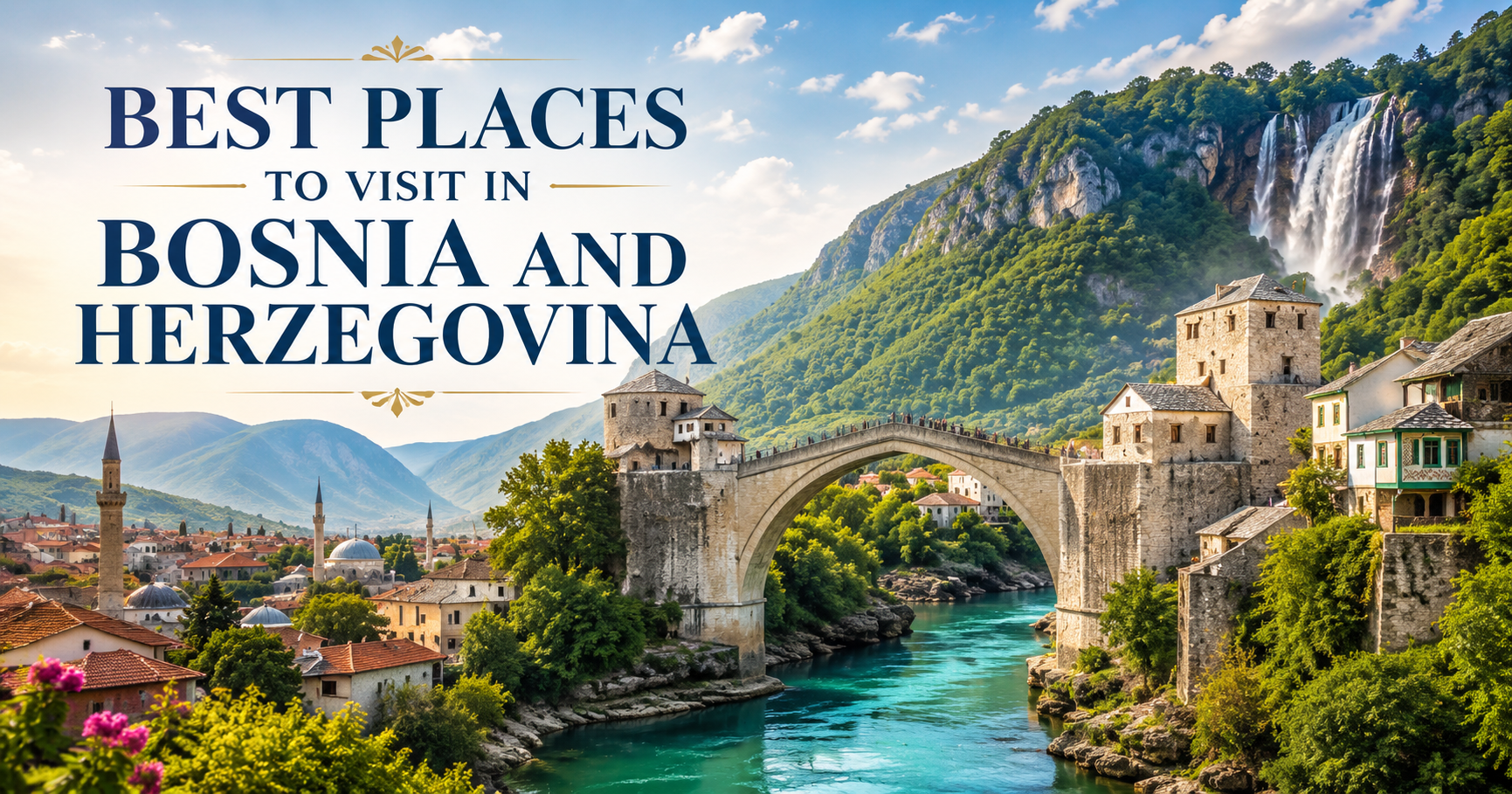
Best Places to Visit in Bosnia and Herzegovina: Sarajevo, Mostar, Waterfalls, Mountain Towns & Hidden Gems
Bosnia and Herzegovina is one of those European countries that feels much bigger, deeper, and more emotional than it looks on a map. At first, it may sound like a simple Balkans add-on: Sarajevo, Mostar, maybe a famous bridge photo. But Bosnia and Herzegovina is much richer than that.
This is a country of stone bridges and emerald rivers, Ottoman bazaars and Austro-Hungarian streets, mountain villages and forested national parks, old fortresses and café culture, waterfalls and canyon roads, sacred sites and quiet towns that still feel wonderfully under-discovered.
Bosnia and Herzegovina has the dramatic pieces travelers remember — Sarajevo’s old bazaar, Mostar’s Stari Most, Kravica Waterfall, and the mountain valley views — but it also has texture. There are medieval royal towns, Sufi monasteries, rafting rivers, highland villages, Yugoslav-era monuments, wine country, remote national parks, and a tiny stretch of Adriatic coastline.
That mix is what makes Bosnia and Herzegovina such a rewarding place to travel. It can be emotional, beautiful, complicated, welcoming, rugged, and soft all at once. A first trip can be built around Sarajevo and Mostar, but the country becomes even more memorable when you add smaller towns, waterfalls, mountain routes, and places that do not feel overly polished for tourism.
Here are the best places to visit in Bosnia and Herzegovina, from Sarajevo and Mostar to waterfalls, national parks, historic towns, mountain villages, and hidden gems.
Sarajevo

Region: Central Bosnia and Herzegovina, capital city set in a mountain valley
Sarajevo is the natural starting point for most Bosnia and Herzegovina trips, and it gives the country one of its strongest first impressions. The city sits in a narrow valley surrounded by hills, with minarets, church towers, old market streets, Austro-Hungarian buildings, cafés, museums, and layered history all folded together.
This is not a city that feels like one simple thing. Sarajevo is beautiful, but it is also emotional. It has Ottoman lanes, European architecture, religious landmarks, hillside neighborhoods, old Olympic sites, war-history museums, and a daily café rhythm that makes the city feel deeply lived-in.
Sarajevo works especially well for first-time visitors because it gives you history, food, culture, atmosphere, and access to several excellent day trips without needing to move hotels constantly.
Main Highlights
Sarajevo is best known for Baščaršija, the old Ottoman bazaar, Latin Bridge, Gazi Husrev-beg Mosque, Sarajevo City Hall, Yellow Fortress views, the Sarajevo Tunnel Museum, Trebević Mountain, and its mix of Ottoman, Austro-Hungarian, Yugoslav, and modern layers.
Why I Recommend It
Sarajevo gives Bosnia and Herzegovina its capital-city soul. It is atmospheric, walkable, complex, and memorable in a way that goes beyond pretty streets. It also makes a practical base for travelers who want to understand the country before branching out to Mostar, Travnik, Jajce, Konjic, or the mountains.
Don’t Miss
- Baščaršija for copper shops, old lanes, Bosnian coffee, and the most classic Sarajevo atmosphere
- Gazi Husrev-beg Mosque and the surrounding old-town streets for Ottoman-era architecture and city texture
- Latin Bridge for one of the most historically famous spots in the city
- Sarajevo City Hall for one of the city’s most striking Austro-Hungarian buildings
- Yellow Fortress for a beautiful view over Sarajevo’s valley setting
- The Sarajevo Tunnel Museum if you want deeper context on the city’s wartime history
- Trebević Mountain and the old Olympic bobsled track for views, nature, and a very different side of the city
Good to Know / Side Notes
- Sarajevo is usually the easiest place to begin a Bosnia and Herzegovina itinerary.
- Two full days is enough for a quick visit, but three days gives the city more room to unfold.
- The old town is walkable, but the city has hills, cobblestones, stairs, and uneven pavement.
- Sarajevo is a good base for day trips to Travnik, Jajce, Konjic, Lukomir, and even Mostar if you are short on time.
- Travelers who like cities with layered history, café culture, mountain views, and emotional depth will probably connect with Sarajevo most.
Mostar

Region: Herzegovina, in southern Bosnia and Herzegovina along the Neretva River
Mostar is the Bosnia and Herzegovina image many travelers know before they arrive: the pale stone arch of Stari Most rising above the emerald Neretva River, with minarets, stone rooftops, bazaar lanes, and rugged hills all around it.
The old bridge is the centerpiece, but Mostar is more than a single view. The town has a warm Herzegovinian feel, with bright stone, river terraces, souvenir shops, mosque courtyards, cobbled lanes, and a slower evening mood once the day-trip crowds begin to leave.
Mostar is one of the most beautiful places in the country, and it pairs naturally with Blagaj, Počitelj, Kravica Waterfall, and other southern stops.
Main Highlights
Mostar is best known for Stari Most, the old bazaar, the Neretva River, Koski Mehmed Pasha Mosque, Crooked Bridge, riverside viewpoints, Ottoman architecture, and day-trip access to Herzegovina’s most famous sights.
Why I Recommend It
Mostar gives Bosnia and Herzegovina one of its most unforgettable travel moments. It is beautiful, easy to understand, and iconic without feeling empty. It also makes the best base for exploring Herzegovina’s warmer southern landscapes.
Don’t Miss
- Stari Most for the classic old bridge view over the Neretva River
- The riverbank viewpoints below the bridge for some of the best photos of Mostar
- Koski Mehmed Pasha Mosque for old-town views and a beautiful position near the river
- The old bazaar for stone lanes, small shops, and the most atmospheric part of the historic center
- Crooked Bridge for a smaller, quieter stone-bridge scene near the old town
- An early morning or evening walk, when Mostar feels softer and less crowded
Good to Know / Side Notes
- Mostar can be visited as a day trip, but staying overnight makes the experience much better.
- The old town has cobblestones, steps, and slippery stone in places, so walking comfort matters.
- Summer can feel hot and busy, especially in the middle of the day.
- Mostar is the best base for Blagaj, Počitelj, Kravica Waterfall, and other Herzegovina stops.
- This is a great choice for couples, photographers, first-time Balkans travelers, and anyone who wants one of the country’s most iconic views.
Blagaj

Region: Herzegovina, southeast of Mostar near the Buna River spring
Blagaj is one of the easiest and most beautiful places to add to a Mostar itinerary. The village is best known for the Blagaj Tekija, a historic Dervish monastery tucked dramatically against a cliff beside the vivid blue-green spring of the Buna River.
The setting is what makes Blagaj so memorable. The monastery, cliff, water, and riverside restaurants create a peaceful little pocket that feels completely different from Mostar, even though it is close by.
Blagaj is a short stop for many travelers, but it adds softness and spiritual texture to a Herzegovina route.
Main Highlights
Blagaj is known for the Blagaj Tekija, Buna River spring, cliffside scenery, riverside restaurants, historic architecture, and easy day-trip access from Mostar.
Why I Recommend It
Blagaj gives a Bosnia and Herzegovina itinerary one of its most peaceful and photogenic moments. It is close to Mostar, easy to combine with other stops, and beautiful in a way that feels calm rather than overwhelming.
Don’t Miss
- Blagaj Tekija for the classic cliffside monastery view
- The Buna River spring for clear blue-green water and dramatic natural scenery
- The viewpoint from across the water for the best perspective on the monastery and cliff
- A riverside meal or coffee stop if you want the visit to feel slower
- Pairing Blagaj with Počitelj or Kravica Waterfall for a fuller Herzegovina day
Good to Know / Side Notes
- Blagaj is very easy to visit from Mostar.
- It does not need a full day unless you want a very slow visit.
- The setting can be busy in peak season, so earlier or later in the day may feel nicer.
- This is a good stop for couples, photographers, spiritual-history travelers, and anyone who wants a gentle break between bigger sightseeing stops.
Počitelj

Region: Herzegovina, between Mostar and the Croatian border
Počitelj is a small historic village built into a hillside above the Neretva River. It has stone houses, Ottoman-era architecture, fortress ruins, a mosque, narrow paths, pomegranate trees, and valley views that make the village feel almost suspended in time.
This is one of the best places in Bosnia and Herzegovina for travelers who love texture. Počitelj is not about big-city sightseeing. It is about stone, steps, views, old walls, and the feeling of walking through a place where the architecture and landscape still speak to each other.
It is especially rewarding as part of a Herzegovina day trip from Mostar.
Main Highlights
Počitelj is known for its hillside old town, stone houses, fortress ruins, Ottoman-era architecture, mosque, Neretva River views, and atmospheric village lanes.
Why I Recommend It
Počitelj adds depth to a Herzegovina route. It shows a quieter, more weathered side of the region and gives travelers something more textured than just a quick waterfall or bridge stop.
Don’t Miss
- The climb toward the fortress ruins for views over the village and river valley
- The stone lanes for the best sense of Počitelj’s old-world atmosphere
- The mosque and historic architecture for a glimpse of the village’s Ottoman layers
- The Neretva River views from above the town
- Seasonal fruit stands or small local stops if they are open during your visit
Good to Know / Side Notes
- Počitelj is steep, uneven, and full of stone paths.
- It is best with comfortable walking shoes and some patience for stairs.
- Summer sun can feel strong because there is limited shade in parts of the village.
- This is a beautiful stop for photographers, history lovers, couples, and travelers who enjoy old villages more than polished attractions.
- Počitelj pairs naturally with Mostar, Blagaj, and Kravica Waterfall.
Kravica Waterfall

Region: Herzegovina, near Ljubuški and often visited from Mostar
Kravica Waterfall is one of the most popular natural sights in Bosnia and Herzegovina. The waterfalls spread in a wide crescent over a green pool, creating a lush, dramatic scene that feels especially appealing in warm weather.
This is one of the easiest ways to add a nature break to a Mostar-based itinerary. It is scenic, straightforward, and easy to understand: come for the waterfall, the water, the greenery, and the chance to cool off or slow down between historic towns.
Kravica is not exactly hidden, but it is popular for a reason.
Main Highlights
Kravica Waterfall is known for its wide waterfall amphitheater, green swimming area, warm-weather atmosphere, lush scenery, and easy access from Mostar, Ljubuški, Blagaj, and Počitelj.
Why I Recommend It
Kravica adds a beautiful nature chapter to a Bosnia and Herzegovina trip without requiring a rugged hiking itinerary. It is one of the easiest waterfall stops for first-time visitors and fits perfectly into a southern Herzegovina route.
Don’t Miss
- The full waterfall view from a little distance so you can see the crescent shape
- The lower viewing area for the classic close-up experience
- A swim or water stop in warm weather if conditions allow
- Visiting earlier or later in the day if you want a softer atmosphere
- Pairing Kravica with Počitelj and Blagaj for one of the easiest Mostar-area day trips
Good to Know / Side Notes
- Kravica can be very popular in summer.
- Conditions and access can vary by season, so check locally before planning around swimming.
- It is easier to visit by car, driver, or organized tour than by relying only on public transport.
- This is one of the best stops for families, couples, photographers, and travelers who want a simple nature break from Mostar.
- If you want wilder waterfalls and more remote scenery, Una National Park may feel more adventurous.
Konjic

Region: Northern Herzegovina, between Sarajevo and Mostar on the Neretva River
Konjic is one of the most useful and underrated stops between Sarajevo and Mostar. The town sits along the Neretva River, with an old stone bridge, mountain scenery, rafting access, traditional woodcraft, and one of the country’s most fascinating Cold War-era sites nearby.
For many travelers, Konjic becomes the place that turns a simple transfer day into something more memorable. It is scenic, practical, and active without requiring a major detour.
Konjic is especially good if you want to add river adventure or a more local-feeling stop between Bosnia and Herzegovina’s two most famous cities.
Main Highlights
Konjic is known for its old bridge, Neretva River scenery, rafting, mountain views, Tito’s Bunker, woodcarving traditions, and convenient location between Sarajevo and Mostar.
Why I Recommend It
Konjic makes a Bosnia and Herzegovina itinerary feel more complete. It breaks up the Sarajevo-to-Mostar route with scenery, adventure, and history, while still fitting naturally into a first trip.
Don’t Miss
- Konjic Old Bridge for the town’s classic river view
- Neretva River rafting if you want an active outdoor experience
- Tito’s Bunker for a fascinating Cold War-era site hidden in the mountains
- Local woodcarving traditions if you enjoy craft and heritage stops
- A slow walk by the river before continuing toward Sarajevo or Mostar
Good to Know / Side Notes
- Konjic can be a quick stop, a rafting base, or an overnight depending on your route.
- It is especially useful if you do not want to rush directly between Sarajevo and Mostar.
- Rafting is seasonal and should be planned with a reputable operator.
- This is a great stop for adventure travelers, road trippers, history lovers, and anyone who likes turning travel days into real itinerary days.
Travnik

Region: Central Bosnia and Herzegovina, northwest of Sarajevo
Travnik is a historic central Bosnian town with Ottoman-era architecture, a fortress, colorful houses, minarets, mountain views, and a relaxed old-town feel. It was once an important Ottoman administrative center, and that history still gives the town a strong sense of character.
The appeal of Travnik is quieter than Sarajevo or Mostar. It is not trying to be the most dramatic stop in the country. Instead, it gives travelers a more regional, everyday version of Bosnia and Herzegovina, with enough history and scenery to make it worth the detour.
Travnik works especially well when paired with Jajce.
Main Highlights
Travnik is known for Travnik Fortress, Ottoman-era architecture, colorful old-town streets, Plava Voda, mosque architecture, mountain scenery, and its role in Bosnian history and literature.
Why I Recommend It
Travnik adds central Bosnian texture to the trip. It helps the country feel less like just Sarajevo and Mostar, and it gives travelers a historic town that feels atmospheric without being overly crowded.
Don’t Miss
- Travnik Fortress for views over the town and surrounding valley
- Plava Voda for a scenic spring area with cafés and a softer local atmosphere
- The old-town streets for Ottoman-era architecture and color
- Mosque architecture and historic buildings that give Travnik its distinct identity
- Pairing Travnik with Jajce for one of the best inland day trips from Sarajevo
Good to Know / Side Notes
- Travnik can be visited as a day trip from Sarajevo.
- It pairs naturally with Jajce if you want a fuller central Bosnia route.
- The fortress involves uphill walking and uneven surfaces.
- This is a good stop for travelers who like history, smaller towns, architecture, and places with a strong local feel.
- Travnik is especially useful if you want your itinerary to go beyond the most obvious Bosnia and Herzegovina highlights.
Jajce

Region: Central Bosnia and Herzegovina, northwest of Sarajevo and near Pliva Lakes
Jajce is one of the best small-town surprises in Bosnia and Herzegovina. It has a dramatic waterfall near the center, a medieval fortress above the town, old streets, lakes, wooden watermills, and a layered history that makes it feel much more substantial than a quick roadside stop.
This is the kind of place that adds real texture to a Bosnia and Herzegovina itinerary. Jajce gives you nature, medieval history, water scenery, and small-town atmosphere in one compact area.
It is also one of the most rewarding stops for travelers who want more than the standard Sarajevo-and-Mostar route.
Main Highlights
Jajce is known for Pliva Waterfall, Jajce Fortress, Pliva Lakes, traditional wooden watermills, medieval history, old town streets, and its scenic setting where rivers, hills, and historic architecture meet.
Why I Recommend It
Jajce makes Bosnia and Herzegovina feel more layered. It combines a waterfall, fortress, lakes, and historic town atmosphere in a way that feels both scenic and meaningful.
Don’t Miss
- Pliva Waterfall for one of the most memorable urban waterfall settings in the Balkans
- Jajce Fortress for views over the town and surrounding hills
- Pliva Lakes for a peaceful nature break close to town
- The wooden watermills for one of Jajce’s most charming and distinctive sights
- A slow walk through the old town instead of treating Jajce as only a waterfall stop
Good to Know / Side Notes
- Jajce can be paired with Travnik on a long day trip from Sarajevo.
- It is worth an overnight if you enjoy lakes, smaller towns, and slower travel.
- The fortress and old town involve hills, steps, and uneven paths.
- This is a great stop for families, photographers, history lovers, and travelers who want a strong mix of nature and culture.
- Jajce is one of the best places to add if you want Bosnia and Herzegovina to feel more complete.
Una National Park & Bihać

Region: Northwestern Bosnia and Herzegovina, near the Croatian border
Una National Park is one of the most beautiful nature regions in Bosnia and Herzegovina. It is known for clear rivers, waterfalls, rafting, kayaking, forests, and a greener, wilder feeling than the more commonly visited Sarajevo-Mostar corridor.
Bihać is the main gateway for many travelers, and it makes a practical base for exploring the Una River area. This part of the country works especially well for travelers who want outdoor adventure, waterfalls, and a route that can connect naturally with Croatia.
Una National Park takes more planning than a quick Mostar day trip, but the scenery is worth it if you have the time.
Main Highlights
Una National Park is known for the Una River, Štrbački Buk waterfall, Martin Brod, rafting, kayaking, hiking, cycling, clear water, forest scenery, and Bihać as a gateway town.
Why I Recommend It
Una National Park gives Bosnia and Herzegovina one of its strongest nature experiences. It is ideal for travelers who want the country to feel wild, green, river-filled, and adventurous rather than only historic and urban.
Don’t Miss
- Štrbački Buk for the park’s most famous waterfall scenery
- Martin Brod for a quieter waterfall and village atmosphere
- Rafting on the Una River if you want a more active trip
- Bihać as a practical riverside base for the region
- Scenic river viewpoints and slower nature stops if you are not rafting
Good to Know / Side Notes
- Una National Park is farther from Sarajevo and Mostar than many first-time visitors realize.
- It works best with extra days, a car, or a route that connects Bosnia and Herzegovina with Croatia.
- Rafting and outdoor activities are seasonal, so plan ahead.
- This is one of the best places in the country for nature lovers, adventure travelers, families with older kids, and road trippers.
- If your trip is very short, Una may be too far out of the way, but it is excellent for a longer Bosnia and Herzegovina itinerary.
Lukomir

Region: Bjelašnica mountain area, above Sarajevo
Lukomir is one of the most atmospheric mountain village experiences near Sarajevo. Set high in the mountains, it is known for stone houses, rural landscapes, sheep pastures, steep valley views, and a way of life that feels very different from the country’s cities and river towns.
This is not the kind of place you add for polished attractions. You add Lukomir for mountain air, traditional architecture, dramatic scenery, and the feeling of stepping into a more remote side of Bosnia and Herzegovina.
It is especially rewarding for travelers who want a guided day trip from Sarajevo that feels deeper than another town stop.
Main Highlights
Lukomir is known for traditional stone houses, Bjelašnica mountain scenery, rural village life, hiking routes, valley views, seasonal access, and its highland setting above Sarajevo.
Why I Recommend It
Lukomir adds a mountain-village chapter to Bosnia and Herzegovina. It gives travelers a sense of rural life, landscape, and tradition that they will not get from Sarajevo or Mostar alone.
Don’t Miss
- The village setting for stone houses, mountain views, and rural atmosphere
- The valley viewpoints for some of the most dramatic scenery near Sarajevo
- A guided mountain walk if you want to experience the area safely and meaningfully
- Traditional food experiences if included in your tour or visit
- The drive into the mountains, which is part of the experience when conditions are good
Good to Know / Side Notes
- Lukomir is seasonal and weather-dependent.
- Access can be difficult outside warmer months.
- This is best done with a guide, tour, or someone who knows the roads and trails.
- Stay on known routes and marked paths when exploring rural or mountain areas.
- This is a strong choice for hikers, photographers, cultural travelers, and anyone who wants a more off-the-beaten-path Sarajevo day trip.
Sutjeska National Park

Region: Southeastern Bosnia and Herzegovina, near the Montenegro border
Sutjeska National Park is one of the wildest and most dramatic places in Bosnia and Herzegovina. It has mountains, deep forest, waterfalls, memorial landscapes, remote trails, and some of the country’s most powerful scenery.
This is not the easiest stop for a short first trip, but it is one of the best choices for travelers who want Bosnia and Herzegovina’s rugged side. Sutjeska feels bigger, rougher, and more remote than many of the country’s more accessible nature stops.
It is especially appealing for hikers, outdoor travelers, and people building a deeper Balkans route.
Main Highlights
Sutjeska National Park is known for Perućica primeval forest, Maglić mountain, Skakavac waterfall, the Tjentište memorial area, Zelengora landscapes, hiking, forest scenery, and remote mountain views.
Why I Recommend It
Sutjeska gives Bosnia and Herzegovina a wild national park chapter. It is the place to add if you want the trip to move beyond cities, waterfalls, and old towns into real mountain terrain.
Don’t Miss
- Perućica primeval forest for one of the park’s most special natural areas
- The Tjentište memorial area for a striking Yugoslav-era monument in a dramatic valley setting
- Mountain viewpoints if you are traveling with a guide or proper hiking plan
- Skakavac waterfall for a more remote waterfall experience
- Zelengora landscapes if you are building a serious outdoor itinerary
Good to Know / Side Notes
- Sutjeska is best for travelers with more time and stronger outdoor planning.
- A guide is a good idea for many hikes and remote areas.
- Weather and road conditions can affect access.
- This is not the best stop for travelers who want only easy sightseeing.
- Add Sutjeska if you want Bosnia and Herzegovina to feel wild, mountainous, and less polished.
Trebinje

Region: Southern Herzegovina, near the borders with Croatia and Montenegro
Trebinje is one of the loveliest slower stops in Herzegovina. It has a warm southern feeling, a river, old stone architecture, plane-tree squares, monasteries, hillside views, and nearby wine country.
The town feels closer to the Adriatic in mood than Sarajevo or central Bosnia. It is sunny, relaxed, and easy to imagine as part of a route connecting Mostar, Dubrovnik, Montenegro, or the southern Herzegovina countryside.
Trebinje is not always on first-time Bosnia and Herzegovina itineraries, but it is a beautiful choice for travelers who like slower towns with atmosphere.
Main Highlights
Trebinje is known for Arslanagić Bridge, the Trebišnjica River, old town streets, plane-tree squares, Hercegovina Gračanica, nearby monasteries, wine country, and its southern Herzegovina atmosphere.
Why I Recommend It
Trebinje adds softness and warmth to the trip. It gives Bosnia and Herzegovina a more Mediterranean-feeling chapter and works especially well for travelers connecting the country with Croatia or Montenegro.
Don’t Miss
- Hercegovina Gračanica for one of the best views over Trebinje
- Arslanagić Bridge for the town’s classic historic bridge scene
- The old town and main square for a relaxed café stop
- The Trebišnjica River for a peaceful walk and softer scenery
- Nearby wineries or monastery stops if you have extra time
Good to Know / Side Notes
- Trebinje is especially useful on routes between Mostar, Dubrovnik, and Montenegro.
- It is better as an overnight or slow stop than a rushed detour.
- Summer can be hot, so early and late-day wandering feels best.
- This is a good choice for couples, road trippers, wine-curious travelers, and anyone who likes southern, sunlit towns.
- Trebinje helps Herzegovina feel like more than just Mostar and a few day trips.
Banja Luka

Region: Northwestern Bosnia and Herzegovina, on the Vrbas River
Banja Luka is one of Bosnia and Herzegovina’s major cities, and it gives travelers a different view of the country than Sarajevo or Mostar. It has a more everyday city feel, with leafy streets, cafés, a river, religious landmarks, a fortress, and access to nearby rafting and canyon scenery.
This is not the most obvious first-trip stop, but it can be rewarding for travelers who want to see a less touristy urban side of Bosnia and Herzegovina. Banja Luka feels lived-in, local, and useful as a base for the northwestern part of the country.
It works best if you are building a longer route or entering from Croatia.
Main Highlights
Banja Luka is known for Kastel Fortress, the Vrbas River, Ferhadija Mosque, the Cathedral of Christ the Saviour, café culture, leafy streets, rafting access, and a more local-feeling city atmosphere.
Why I Recommend It
Banja Luka adds variety to a Bosnia and Herzegovina itinerary. It shows that the country is not only Sarajevo’s valley, Mostar’s bridge, and Herzegovina’s stone towns. It has another urban rhythm worth noticing if your route allows.
Don’t Miss
- Kastel Fortress for a central historic landmark near the river
- The Vrbas River for walks, views, and the city’s outdoor identity
- Ferhadija Mosque for an important religious and architectural landmark
- The Cathedral of Christ the Saviour for another side of the city’s religious landscape
- A café stop, because Banja Luka is a good place to slow down and watch local life
- Rafting nearby if you want to add adventure to a northwestern route
Good to Know / Side Notes
- Banja Luka is not essential for a short first trip.
- It works better for longer itineraries, road trips, or travelers entering from Croatia.
- The city can be a useful base for exploring the Vrbas River region.
- This is a good choice for travelers who like second cities, everyday local atmosphere, and less obvious urban stops.
- If you only have five or six days, Sarajevo, Mostar, and central Herzegovina will probably be stronger priorities.
Višegrad

Region: Eastern Bosnia and Herzegovina, on the Drina River
Višegrad is best known for the Mehmed Paša Sokolović Bridge, one of the country’s most important Ottoman-era landmarks. The bridge crosses the Drina River and gives the town its most famous image.
This is a quieter and more specific stop than Sarajevo, Mostar, or Jajce. Višegrad is most rewarding for travelers who care about historic bridges, river towns, architecture, literature, and eastern Bosnia’s less-touristed atmosphere.
It is not the easiest place to add to every itinerary, but it brings a different mood to the country.
Main Highlights
Višegrad is known for the Mehmed Paša Sokolović Bridge, the Drina River, Ottoman bridge architecture, Andrićgrad, literary associations, river views, and eastern Bosnia scenery.
Why I Recommend It
Višegrad adds a historic river-town chapter to Bosnia and Herzegovina. It is especially worthwhile for travelers who want to go beyond the most common route and see another side of the country’s architecture and landscape.
Don’t Miss
- Mehmed Paša Sokolović Bridge for the town’s most important landmark
- A walk along the Drina River for the best sense of the setting
- The bridge views in softer light if you are staying nearby
- Andrićgrad if you are interested in the town’s literary and cultural associations
- The slower atmosphere of eastern Bosnia if your route allows time for it
Good to Know / Side Notes
- Višegrad is better for longer itineraries than short first trips.
- It can be more logistically awkward than places along the Sarajevo-Mostar route.
- This is a strong stop for architecture lovers, history travelers, literature-focused travelers, and road trippers.
- It may not need a full day unless you are building a deeper eastern Bosnia route.
- Add it if you want your Bosnia and Herzegovina trip to feel less predictable.
Blidinje Nature Park

Region: Herzegovina, in the mountain area northwest of Mostar
Blidinje Nature Park gives Herzegovina a cooler, quieter mountain chapter. Instead of the bright stone and river towns around Mostar, this area has lake scenery, mountain landscapes, rural roads, hiking, winter sports in season, and a more spacious inland feeling.
It is a good choice for travelers who want nature but do not necessarily want the remoteness of Sutjeska or the longer journey to Una National Park. Blidinje feels scenic, regional, and peaceful.
This is one of those places that can make Herzegovina feel much more varied than travelers expect.
Main Highlights
Blidinje Nature Park is known for Blidinje Lake, mountain scenery, hiking, rural Herzegovina landscapes, winter sports in season, and a quieter nature-focused atmosphere.
Why I Recommend It
Blidinje adds a mountain-and-lake mood to a Herzegovina itinerary. It gives travelers a reason to look beyond Mostar, Blagaj, Počitelj, and Kravica, especially if they like scenic drives and quieter regional landscapes.
Don’t Miss
- Blidinje Lake for the park’s main scenic focus
- Mountain views and rural roads for a slower Herzegovina experience
- Hiking routes in suitable weather if you are prepared for outdoor conditions
- Winter sports atmosphere if visiting in the right season
- A slow scenic drive if you want to experience inland Herzegovina beyond the famous towns
Good to Know / Side Notes
- Blidinje is easiest with a car or local transfer.
- It works best for slower travelers, road trippers, and nature lovers.
- Weather and road conditions can affect the experience.
- This is not a must-do for every first trip, but it is a beautiful texture stop.
- Add it if you want Herzegovina to feel cooler, quieter, and more mountainous.
Neum

Region: Southern Bosnia and Herzegovina, on the Adriatic Sea
Neum is Bosnia and Herzegovina’s small stretch of Adriatic coastline. It is not the country’s most dramatic destination, and it does not have the old-town magic of Mostar, Dubrovnik, or Kotor, but it is interesting because it gives Bosnia and Herzegovina its tiny window to the sea.
For most travelers, Neum is more of a route stop than a primary destination. Still, it can be useful if you are traveling between Croatia, Herzegovina, and Montenegro, or if you want to understand the geography of the country a little better.
Neum is optional, but it has a place in a wider Balkans itinerary.
Main Highlights
Neum is known for Bosnia and Herzegovina’s Adriatic coastline, sea views, summer beach atmosphere, hotels, practical road-trip logistics, and its position between Croatia and Herzegovina.
Why I Recommend It
Neum adds geographic context to Bosnia and Herzegovina. It is not the strongest sightseeing stop, but it is interesting and practical for travelers building a coastal Balkans route.
Don’t Miss
- The novelty of seeing Bosnia and Herzegovina’s small Adriatic coastline
- A quick sea-view stop if you are passing through
- Using Neum as a practical break between Croatia and Herzegovina
- Pairing it with Mostar, Počitelj, Blagaj, or Trebinje if you want the route to feel more complete
- A relaxed overnight only if the location fits your larger trip
Good to Know / Side Notes
- Neum is optional for most Bosnia and Herzegovina itineraries.
- It is better as a practical or curious stop than a must-see destination.
- Travelers with limited time should prioritize Sarajevo, Mostar, Jajce, Blagaj, Počitelj, Kravica, or Una National Park first.
- It can be useful on Croatia-Bosnia-Montenegro road trips.
- Add Neum if you want a coastal pause, but do not build your whole Bosnia and Herzegovina trip around it.
Best Time to Visit Bosnia and Herzegovina
Bosnia and Herzegovina can be visited year-round, but the best time depends on the kind of trip you want.
For most travelers, late spring through early fall is the easiest season. May, June, September, and early October are especially nice for Sarajevo, Mostar, waterfalls, old towns, national parks, and road trips because the weather is generally more comfortable for walking and sightseeing.
June, July, and August can be beautiful for waterfalls, rafting, mountain villages, and long travel days, but summer can also bring heat, especially in Mostar and southern Herzegovina. If you are visiting in peak summer, plan old towns early or later in the day and save the hottest hours for lunch, shade, water, or travel between stops.
Spring is lovely for greener landscapes and waterfalls. Fall can be excellent for city wandering, road trips, mountain scenery, and softer light. Winter can be atmospheric in Sarajevo and mountain areas, especially if you like snowy landscapes, cozy cafés, and winter-sports possibilities, but it is less ideal for remote nature stops or waterfall-heavy routes.
Getting Around Bosnia and Herzegovina

Bosnia and Herzegovina is not huge, but getting around takes more planning than the map may suggest.
Sarajevo and Mostar can be connected by public transport, and many first-time itineraries can be built around buses, trains, private transfers, and organized day trips. This works especially well if you are focusing on Sarajevo, Mostar, Blagaj, Počitelj, Kravica Waterfall, Travnik, Jajce, and Konjic.
A rental car becomes much more useful if you want to include places like Una National Park, Sutjeska National Park, Blidinje Nature Park, Trebinje, Lukomir, or smaller rural stops. These are the places that add texture, but they also benefit from flexibility.
Do not plan only by distance. Mountain roads, border routes, weather, rural access, and slower driving can affect the rhythm of the trip. Build in time for viewpoints, café stops, meals, photos, and the kinds of pauses that make Bosnia and Herzegovina feel more personal.
For hiking, rural exploring, and mountain areas, stay on marked paths and known routes. Some areas of the country still require caution in the countryside, so this is not a destination where you should casually wander off-trail.
What to Pack for Bosnia and Herzegovina
Bosnia and Herzegovina has a mix of old towns, cobbled streets, hills, waterfalls, rivers, mountains, cafés, religious sites, and scenic road trips, so a few practical items can make the trip much easier.
Useful items to pack include:
- A lightweight day bag for Sarajevo wandering, Mostar sightseeing, waterfall stops, and day trips
- Sunglasses for bright Herzegovina days, river reflections, and open viewpoints
- Sunscreen for Mostar, Počitelj, Kravica Waterfall, Trebinje, and summer road trips
- A refillable water bottle for old towns, hikes, long transfers, and warm-weather sightseeing
- A power bank for photo-heavy days, navigation, day tours, and long bus or transfer routes
- A light rain jacket for Sarajevo, mountain areas, shoulder season, and changeable weather
- Bug repellant if you are visiting rivers, lakes, forests, or rural nature areas in warm weather
- Tissues or wipes for road trips, small towns, public bathrooms, and long sightseeing days
- Blister patches for cobblestones, hills, stairs, and long walking days
- A small cash pouch because smaller cafés, markets, rural stops, and local attractions may not always be card-friendly
For a full trip, adjust your clothing based on season and route. A summer trip to Mostar and Kravica Waterfall feels very different from a winter city break in Sarajevo or a mountain-focused route through Sutjeska, Lukomir, or Blidinje.
Final Thoughts on the Best Places to Visit in Bosnia and Herzegovina
Bosnia and Herzegovina is not just a quick Balkans add-on. It is a country of old bridges, mountain valleys, Ottoman markets, emerald rivers, waterfalls, fortress towns, sacred places, national parks, and quiet corners that make a trip feel more layered than expected.
For a first trip, Sarajevo, Mostar, Blagaj, Počitelj, Kravica Waterfall, Travnik, Jajce, and Konjic make one of the strongest starting points. Add Una National Park, Lukomir, Sutjeska National Park, Trebinje, Banja Luka, Višegrad, Blidinje Nature Park, or Neum if you want Bosnia and Herzegovina to unfold more slowly.
The best Bosnia and Herzegovina trips leave room for both the famous and the overlooked. Come for Sarajevo’s atmosphere and Mostar’s bridge, but make time for river towns, waterfalls, mountain villages, old fortresses, forested national parks, and places that still feel quietly under-discovered.
That is where Bosnia and Herzegovina becomes more than a beautiful Balkans stop. It becomes a country with memory, warmth, texture, and soul.