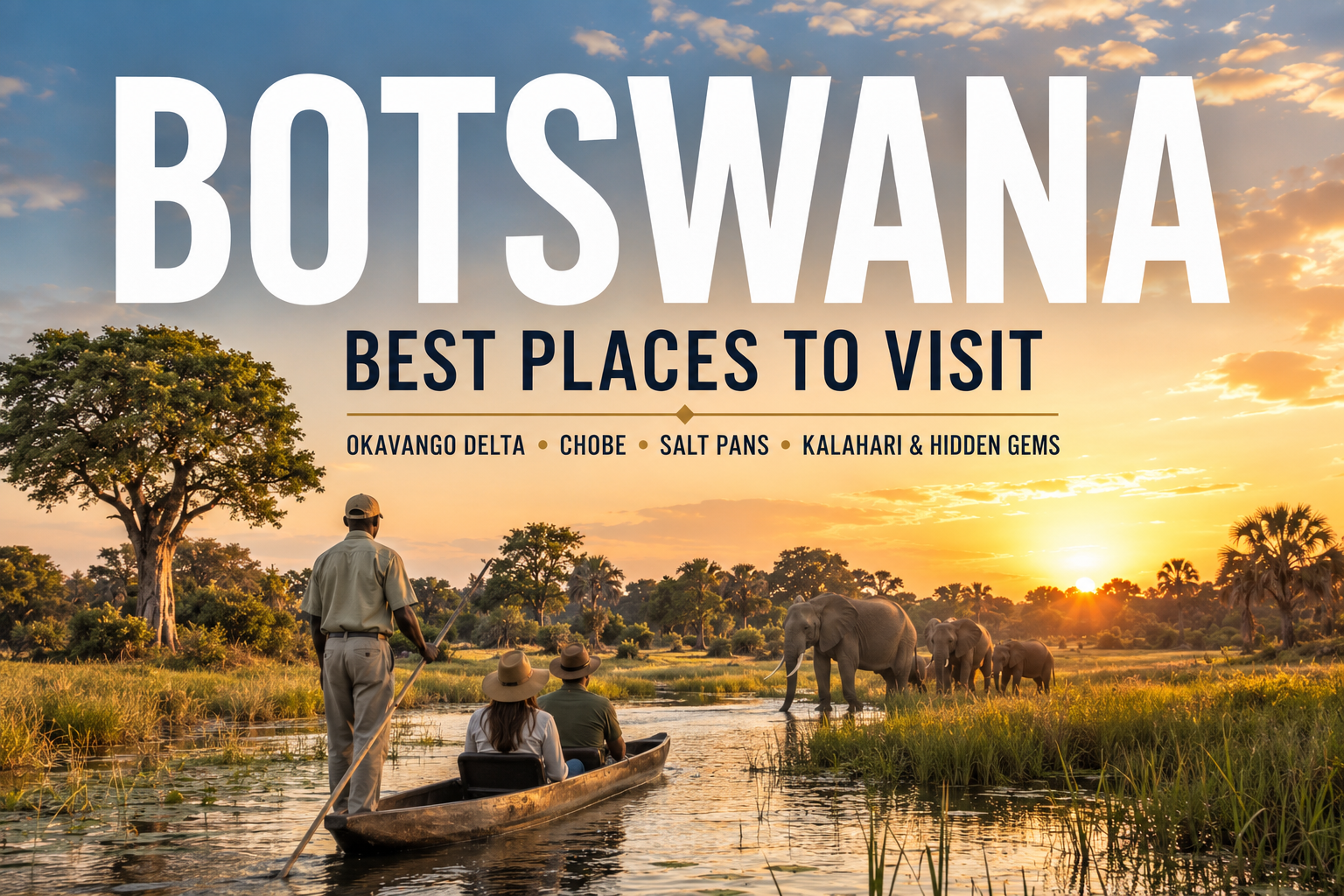
Botswana is one of those countries that feels less like a checklist and more like a deep breath.
This is not a destination built around one pretty capital city, one famous beach town, or a neat little loop of old towns. Botswana’s best places are wilder than that. They are river channels full of reeds, elephant-covered floodplains, salt pans that look like the edge of another planet, desert reserves, ancient rock art sites, quiet conservation projects, and gateway towns that lead into some of Southern Africa’s most unforgettable landscapes.
For many travelers, Botswana means safari — and yes, the safari here can be extraordinary. The Okavango Delta, Chobe National Park, Moremi Game Reserve, and the Kalahari are all worth the hype. But Botswana is also more layered than the standard safari brochure makes it sound. There are sacred hills covered in ancient rock art, bird sanctuaries on the edge of salt pans, rhino conservation areas, gorge walks, historic ruins, and lesser-known regions that can make a trip feel much more personal.
Botswana is also a place where planning matters. Distances are long, some areas are remote, and many of the best wilderness experiences are reached by guided safari, small aircraft, 4×4 routes, or carefully planned lodge stays. It is often a more expensive safari destination than some neighboring countries because of its low-volume, conservation-focused tourism model, but that is also part of what makes the landscapes feel so protected and uncrowded.
If you are dreaming of wildlife, wilderness, strange landscapes, and places that feel far from the usual tourist trail, these are the best places to visit in Botswana.
Okavango Delta

Region notes: Northern Botswana. The Okavango Delta is usually accessed through Maun, with many safari camps reached by small aircraft, boat, or 4×4 transfer depending on the area and season.
The Okavango Delta is the dream image of Botswana: a vast inland delta where water spreads across the Kalahari, creating channels, lagoons, floodplains, islands, and some of the most beautiful safari scenery in Africa.
This is one of the best places in Botswana for travelers who want the full wilderness feeling. Instead of only dry savanna game drives, the Delta can bring mokoro rides, boat safaris, birdwatching, walking safaris, and wildlife viewing around water. The mood is soft, green, and almost dreamlike, especially when you are gliding through reeds or watching elephants move across the floodplain.
The Delta is also one of Botswana’s most iconic luxury safari regions, but the real reason to come is not just the lodges. It is the contrast: desert country transformed by water, wildlife gathering around channels, and a landscape that feels completely different from the drier parks elsewhere in Southern Africa.
Main Highlights
- Mokoro rides through quiet Delta channels
- Boat safaris in water-based areas
- Elephants, hippos, antelope, crocodiles, and incredible birdlife
- Seasonal floodplains and islands
- Remote safari camps with a deep wilderness feel
- One of Botswana’s most iconic landscapes
Why I Recommend It
The Okavango Delta is the place most travelers picture when they dream of Botswana, and it really does deserve its reputation. It gives you the watery, magical side of safari that you will not find in every African destination.
Don’t Miss
- A mokoro ride if you are staying in an area where water levels allow it
- A boat safari at golden hour
- Birdwatching, even if you are not usually a birder
- Flying over the Delta if your route includes a small-plane transfer
- Combining the Delta with Moremi Game Reserve for a fuller safari experience
Good to Know / Side Notes
- The Delta is seasonal, and water levels vary by area.
- The dry season is often a strong time for wildlife viewing because animals concentrate around water.
- Some camps are land-based, some are water-based, and some offer a mix, so check the style before booking.
- This is one of Botswana’s pricier safari regions.
- Maun is the main gateway town for many Delta itineraries.
Moremi Game Reserve

Region notes: Northeastern Okavango Delta. Moremi is often combined with the wider Delta and can be reached from Maun by air or, for experienced travelers, by 4×4 routes.
Moremi Game Reserve is one of the best places in Botswana for travelers who want classic wildlife viewing inside the Okavango Delta region. It protects a mix of floodplains, lagoons, woodland, savanna, and dry land, which makes it feel beautifully varied.
This is where the Delta becomes especially safari-focused. You may see elephants, buffalo, giraffes, antelope, predators, and a huge variety of birds, depending on the season and route. Moremi is also a good choice if you want the Delta experience but with a slightly more traditional game-drive structure.
The landscapes change quickly here. One moment you might be near water, and the next you are moving through woodland or open plains. That variety is what makes Moremi feel so rewarding.
Main Highlights
- Classic Okavango Delta wildlife viewing
- Game drives through floodplains, woodland, and savanna
- Elephants, antelope, predators, and rich birdlife
- Beautiful lagoon and island scenery
- A strong option for first-time Botswana safari travelers
Why I Recommend It
Moremi gives the Okavango Delta a more grounded safari shape. It is wild, beautiful, and easier for many travelers to understand than the more scattered private concessions of the Delta.
Don’t Miss
- Game drives around productive wildlife areas
- Lagoon viewpoints and water-edge scenery
- Birdwatching during green season
- A combined Moremi and Okavango itinerary
- Sunrise and sunset drives if your safari setup allows them
Good to Know / Side Notes
- Independent travel generally requires serious 4×4 preparation.
- Many travelers visit with a safari operator or lodge-based itinerary.
- Roads and access can change seasonally.
- Moremi pairs naturally with Maun, the Okavango Delta, and Chobe.
- Book early for peak safari months.
Chobe National Park

Region notes: Northern Botswana, near Kasane and close to the borders with Namibia, Zambia, and Zimbabwe. Chobe is one of Botswana’s most accessible major safari areas.
Chobe National Park is one of the best places to visit in Botswana if you want dramatic wildlife without feeling quite as remote as the deepest Delta or Kalahari regions. The Chobe Riverfront is especially famous for elephants, and it can be one of the most rewarding safari areas for first-time visitors.
This is the place for river safaris, big herds, and easy access from Kasane. You can do traditional game drives, but the river is what makes Chobe feel special. Seeing elephants along the water, hippos in the river, crocodiles on the banks, and birds everywhere gives Chobe a very different rhythm from dry-land safari.
Chobe also works well for travelers who want to combine Botswana with Victoria Falls, since Kasane is a common base for that regional route.
Main Highlights
- Huge elephant sightings
- Chobe River boat safaris
- Easy access from Kasane
- Strong wildlife viewing, especially in the dry season
- A good option for first-time safari travelers
- Possible combination with Victoria Falls
Why I Recommend It
Chobe is popular for a reason. It is accessible, wildlife-rich, and visually unforgettable, especially from the river. If you want a Botswana safari that feels exciting without being logistically overwhelming, Chobe is one of the best choices.
Don’t Miss
- A Chobe River cruise
- A morning or late-afternoon game drive
- Elephant sightings along the riverfront
- Birdwatching from the water
- A Kasane stay if you want easier logistics
Good to Know / Side Notes
- Chobe can feel busier than more remote Botswana safari areas.
- The riverfront is the most famous section, but Chobe is larger and more varied than many travelers realize.
- Kasane is practical for travelers who want lodges, transfers, and regional connections.
- It pairs well with Victoria Falls, but border logistics should be planned carefully.
- River cruises can be a wonderful option for travelers who want wildlife without a full day of bumpy drives.
Savuti

Region notes: Western Chobe National Park. Savuti is more remote than the Chobe Riverfront and is often included in longer Botswana safari itineraries.
Savuti is for travelers who want Botswana to feel more rugged. While the Chobe Riverfront is famous for water and elephants, Savuti has a drier, more dramatic safari atmosphere, with open plains, rocky outcrops, predator activity, and a much wilder mood.
This is one of those places that serious safari lovers often talk about with a little extra excitement. It has a reputation for lions, hyenas, elephants, and intense wildlife drama. The landscape feels ancient and exposed, and the sense of remoteness is part of the appeal.
Savuti is not usually the easiest first stop in Botswana, but it is an excellent addition if you are building a bigger safari route between Chobe and the Delta.
Main Highlights
- Remote safari atmosphere
- Predator sightings
- Open plains and dramatic dry landscapes
- Elephants, lions, hyenas, and seasonal wildlife movement
- A stronger wilderness feel than the Chobe Riverfront
- Great addition to a longer safari itinerary
Why I Recommend It
Savuti is worth considering if you want Botswana to feel wilder, dustier, and more dramatic. It has a stronger sense of remoteness than the Chobe Riverfront, with open landscapes, predator activity, and the kind of raw safari atmosphere that feels especially memorable on a longer Botswana itinerary
Don’t Miss
- Game drives in the Savuti area
- Watching for lions and hyenas
- Sunset over the dry plains
- Rockier landscape features and viewpoints
- Combining Savuti with Chobe Riverfront or Moremi
Good to Know / Side Notes
- Savuti is more remote and usually needs a proper safari setup.
- Road conditions can be challenging.
- It is best for travelers who are comfortable with wilderness logistics.
- Wildlife sightings are never guaranteed, but the area has a strong reputation.
- This is not the easiest choice for travelers who want simple, city-style comfort.
Linyanti and Selinda

Region notes: Northern Botswana, near the Chobe and Okavango regions. These areas are often associated with private concessions and higher-end remote safari stays.
Linyanti and Selinda are excellent choices if you want Botswana safari without only following the most obvious route. This region sits in the broader northern safari circuit and offers a more remote, exclusive-feeling wilderness experience than the busiest parts of Chobe.
The draw here is water, floodplains, elephants, predators, and a quieter safari atmosphere. Depending on the camp and season, travelers may have access to game drives, walking safaris, boating, or other guided activities. It is the kind of region that appeals to travelers who have already heard of Chobe and the Okavango but want something a little more tucked away.
This is still safari, but it feels more insider and less generic.
Main Highlights
- Remote northern Botswana safari landscapes
- Elephants, predators, antelope, and birdlife
- Private concession atmosphere
- Floodplains and water-influenced scenery
- Less obvious than Chobe or Moremi
- Excellent for travelers seeking a quieter safari feel
Why I Recommend It
Linyanti and Selinda are excellent choices for travelers who want a more secluded safari experience. They offer the wildlife, water-influenced landscapes, and strong guiding Botswana is known for, but with a quieter, more private feeling than the country’s best-known safari areas.
Don’t Miss
- A lodge or camp with strong guiding
- Seasonal water-based activities if available
- Slow wildlife watching rather than rushing between sightings
- Combining the area with Chobe, Moremi, or the Okavango Delta
- Asking your safari operator how the area changes by season
Good to Know / Side Notes
- This area is often expensive and lodge-based.
- Access may involve light aircraft or specialized transfers.
- It is better for travelers who want remote safari than budget travel.
- Check exactly which activities your camp offers.
- The experience can vary significantly by season and concession.
Makgadikgadi Pans

Region notes: Northeastern/central Botswana. The Makgadikgadi Pans are often reached as part of a road or safari route between Maun, Nata, Gweta, and other northern Botswana stops.
The Makgadikgadi Pans are one of the strangest and most beautiful places in Botswana. Instead of lush Delta channels or thick riverfront wildlife, this region is about vast salt pans, huge skies, silence, and landscapes that can feel almost lunar.
This is where Botswana becomes surreal. In the dry season, the pans can look endless, pale, and cracked. After rains, parts of the region can transform with water, birds, and wildlife movement. Depending on the area and trip style, travelers may experience salt pan scenery, baobabs, zebra migration, meerkat encounters, quad biking, or stargazing.
The Makgadikgadi is not just a side note. It gives Botswana a totally different personality.
Main Highlights
- Vast salt pan landscapes
- Stargazing and big-sky scenery
- Seasonal wildlife and zebra migration
- Baobabs and desert-edge landscapes
- Meerkat experiences in some areas
- A completely different mood from the Delta and Chobe
Why I Recommend It
The Makgadikgadi Pans make Botswana feel bigger and stranger. They are perfect for travelers who want more than safari animals — travelers who want atmosphere, silence, and landscapes they will remember.
Don’t Miss
- Sunset or sunrise over the pans
- Stargazing if staying overnight
- Baobab scenery
- Seasonal wildlife movement
- A guided experience rather than trying to freestyle the area without preparation
Good to Know / Side Notes
- Conditions change dramatically between dry and wet seasons.
- Some activities are seasonal.
- The pans can be remote and disorienting, so guided travel is smart.
- Do not underestimate heat, distances, or lack of services.
- This region pairs well with Nxai Pan, Nata, Maun, or longer northern Botswana routes.
Nata Bird Sanctuary

Region notes: Northeastern Botswana, near Nata and the edge of the Makgadikgadi salt pan system. This is a useful stop for travelers moving between Kasane/Chobe and Maun or the pans.
Nata Bird Sanctuary is one of Botswana’s quieter and more distinctive nature stops. It sits near the edge of the salt pans and is especially interesting for birdwatchers, photographers, and travelers who like peaceful places that feel different from the country’s major safari parks.
When conditions are right, the sanctuary can attract flamingos and other waterbirds, creating a completely different scene from the big mammal safari areas. It is not the kind of place where you should expect guaranteed drama every minute, but that is part of its charm. It is quieter, more seasonal, and more specific.
Nata is also practical because it can break up long travel routes across northern Botswana.
Main Highlights
- Birdwatching near the salt pans
- Seasonal flamingo and waterbird sightings
- Quiet, less obvious nature stop
- Good route break near Nata
- Salt pan-edge scenery
- A nice contrast to big safari parks
Why I Recommend It
Nata Bird Sanctuary is worth considering because it adds a quieter, more specific nature stop to a Botswana route. It is especially appealing for birders, photographers, and road-trip travelers who want salt-pan scenery, seasonal birdlife, and a peaceful break between bigger safari destinations.
Don’t Miss
- Visiting when water conditions are favorable
- Looking for flamingos and pelicans
- Sunset over the pan-edge landscape
- Using Nata as a practical stop between bigger destinations
- Bringing binoculars if you enjoy birds or photography
Good to Know / Side Notes
- Birdlife depends heavily on season and water levels.
- This is a quieter stop, not a guaranteed blockbuster wildlife experience.
- It works best as part of a route, not necessarily as the main reason for a trip.
- Road-trip travelers may find it especially useful.
- Conditions can be dry and stark at certain times of year.
Nxai Pan National Park

Region notes: Northeastern Botswana, near the Makgadikgadi region. Nxai Pan pairs naturally with Makgadikgadi Pans, Nata, and longer northern Botswana itineraries.
Nxai Pan National Park is a beautiful choice for travelers who want open plains, baobabs, seasonal wildlife, and a quieter alternative to Botswana’s most famous safari regions. It is still a safari destination, but the mood is different from Chobe, Moremi, or the Delta.
This is a place of wide horizons. During the green season, wildlife can move through the area in impressive numbers, while the dry season gives the park a more open, stark beauty. One of the most famous features nearby is Baines’ Baobabs, a cluster of ancient baobab trees that has become one of the region’s signature sights.
Nxai Pan is ideal for travelers who are drawn to space, trees, plains, and the feeling of being somewhere less obvious.
Main Highlights
- Open pan landscapes
- Baobab scenery
- Seasonal zebra and wildlife movement
- Quieter safari atmosphere
- Strong pairing with Makgadikgadi Pans
- Big skies and beautiful light
Why I Recommend It
Nxai Pan adds another side of Botswana: less water, less riverfront drama, and more open-space beauty. It is a wonderful option if you want a safari route that includes strange landscapes as well as animals.
Don’t Miss
- Baines’ Baobabs
- Game drives during the right season
- Landscape photography
- Pairing Nxai Pan with Makgadikgadi
- Watching how different the region feels from the Delta
Good to Know / Side Notes
- Wildlife viewing can be seasonal.
- Self-drive travel requires proper planning and conditions awareness.
- The park is best for travelers who appreciate landscapes, not just animal checklists.
- Services are limited compared with major towns.
- This is a good fit for repeat safari travelers or more adventurous first-timers.
Central Kalahari Game Reserve

Region notes: Central Botswana. This is one of the largest protected areas in the country and one of the more remote safari choices.
The Central Kalahari Game Reserve is not the soft, easy version of Botswana. It is vast, dry, remote, and powerful. This is the Botswana of desert silence, long horizons, and wildlife adapted to a harsher landscape.
Travelers come here for a completely different safari mood. Instead of lush Delta channels or riverfront elephants, the Central Kalahari offers desert-adapted wildlife, open plains, black-maned lions, antelope, birdlife, and a sense of space that can feel almost overwhelming.
This is not the easiest place to visit, but for the right traveler, it can be unforgettable.
Main Highlights
- Remote Kalahari landscapes
- Desert-adapted wildlife
- Big skies and deep silence
- Black-maned lion territory
- Strong wilderness atmosphere
- A very different safari experience from northern Botswana
Why I Recommend It
The Central Kalahari belongs in the guide because Botswana is not only the Delta and Chobe. This is the wild, stripped-back, desert side of the country, and it gives adventurous travelers a much deeper understanding of Botswana’s landscapes.
Don’t Miss
- Deception Valley
- Guided desert wildlife viewing
- Sunrise and sunset over the plains
- Learning about desert-adapted species
- Staying long enough to feel the scale of the reserve
Good to Know / Side Notes
- This is a remote destination and not ideal for casual self-drive beginners.
- Proper vehicle, supplies, and route planning matter.
- Wildlife can be more spread out than in water-rich regions.
- The experience is more about wilderness than constant sightings.
- Travel with experienced operators if you are not deeply familiar with desert conditions.
Tsodilo Hills

Region notes: Northwestern Botswana, often reached from the Shakawe/Panhandle area. Tsodilo is a cultural and archaeological stop rather than a traditional safari destination.
Tsodilo Hills is one of the most important places to include if you want a Botswana guide that is not just a safari checklist. This UNESCO World Heritage Site is known for thousands of rock paintings and a deep spiritual and cultural significance.
The hills rise out of the Kalahari landscape, and the area has long been associated with San rock art, ancestral stories, and human history. It feels completely different from the wildlife parks. Tsodilo is quieter, more reflective, and more mysterious.
For travelers who care about culture, archaeology, and ancient landscapes, this is one of Botswana’s most meaningful stops.
Main Highlights
- Ancient San rock art
- UNESCO World Heritage significance
- Dramatic desert hills
- Cultural and spiritual importance
- A strong non-safari addition to a Botswana itinerary
- Best paired with the Okavango Panhandle or northern routes
Why I Recommend It
Tsodilo Hills is worth visiting because it brings Botswana’s human history and cultural depth into the trip. After days of wildlife and wilderness, the rock art, desert hills, and spiritual significance of the site offer a completely different kind of connection to the country.
Don’t Miss
- A guided walk to view rock art
- Learning about the cultural significance of the site
- Taking time with the landscape instead of rushing through
- Pairing Tsodilo with a Panhandle or Delta route
- Visiting with respect for the site’s spiritual importance
Good to Know / Side Notes
- This is not a wildlife safari stop.
- Go with a guide to better understand the rock art and cultural context.
- The location is remote compared with Botswana’s main gateway towns.
- Bring sun protection and water.
- Treat rock art sites with care: no touching, marking, or careless behavior.
Tswapong Hills and Moremi Gorge

Region notes: Eastern Botswana, near Palapye. This area works well as an unusual nature and heritage stop for travelers moving through the eastern side of the country.
Tswapong Hills and Moremi Gorge show a very different side of Botswana. Instead of safari vehicles and open plains, this area brings cliffs, gorges, greenery, birds, waterfalls, cultural history, and a landscape mood many travelers may not expect.
The Tswapong Hills rise above the surrounding plains, creating a dramatic contrast in a country many travelers imagine as mostly flat. Moremi Gorge, also known as Goo-Moremi Gorge, is one of the area’s best-known natural attractions, with hiking, heritage value, and scenic rock formations.
This is not a standard first-click Botswana stop, and that is why it is worth including.
Main Highlights
- Hills, cliffs, and gorge scenery
- Moremi Gorge / Goo-Moremi Gorge
- Birdlife and natural history
- Cultural and archaeological significance
- A less obvious Botswana landscape
- Good addition for road-trip travelers
Why I Recommend It
Tswapong Hills and Moremi Gorge are worth considering because they show a greener, rockier, more unexpected side of Botswana. The cliffs, gorge scenery, birdlife, and cultural history make this area especially appealing for travelers who enjoy nature walks, local landscapes, and stops that feel less obvious.
Don’t Miss
- A guided visit to Moremi Gorge
- Birdwatching, especially around the cliffs and gorge
- Waterfall and pool scenery where accessible
- Learning about the heritage of the area
- Using Palapye as a practical nearby base
Good to Know / Side Notes
- Access and activities can vary, so check current local conditions before going.
- Some areas may require a guide or local arrangement.
- This is best for travelers who enjoy nature walks and cultural landscapes.
- Do not treat it like a major commercial tourist hub.
- It pairs naturally with Old Palapye and Khama Rhino Sanctuary.
Old Palapye

Region notes: Eastern Botswana, near modern Palapye and close enough to pair with Tswapong Hills, Moremi Gorge, and Khama Rhino Sanctuary.
Old Palapye is a quiet but fascinating historical stop that gives Botswana travel a different kind of depth. It is not a big-ticket safari destination, and that is exactly why it stands out.
This former settlement area has ruins, history, and links to Botswana’s past. For travelers who enjoy places that feel a little forgotten, a little atmospheric, and much less polished than the major attractions, Old Palapye is worth considering as part of an eastern Botswana route.
It is best treated as a thoughtful stop rather than a full destination on its own.
Main Highlights
- Historic ruins and settlement remains
- A quieter cultural stop near Palapye
- Good pairing with Tswapong Hills and Moremi Gorge
- A break from wildlife-focused travel
- Interesting for history-minded travelers
- Less covered in standard Botswana guides
Why I Recommend It
Old Palapye is worth including because it adds history, atmosphere, and a different kind of depth to a Botswana itinerary. It is not the flashiest stop in the country, but it helps show Botswana beyond lodges and game drives, with ruins, landscapes, and cultural context that make the trip feel more grounded and complete.
Don’t Miss
- Pairing it with Tswapong Hills
- Looking for historical context before visiting
- Taking a slower, more curious approach
- Using it as a road-trip stop rather than a standalone destination
- Bringing water, sun protection, and practical walking shoes
Good to Know / Side Notes
- This is a quieter, more niche stop.
- It is best for travelers who enjoy history and ruins.
- Facilities may be limited.
- Local guidance can make the visit more meaningful.
- Do not expect a polished museum-style experience.
Khama Rhino Sanctuary

Region notes: Eastern/central Botswana, near Serowe. This is one of the more accessible conservation stops and can work well on a road route between Gaborone, Francistown, Palapye, and northern Botswana.
Khama Rhino Sanctuary is one of Botswana’s most practical and meaningful wildlife stops, especially for travelers who want conservation without needing to commit to a deep wilderness safari right away.
The sanctuary was created as a community-based wildlife project to help protect rhinos and restore wildlife habitat. It is a good choice for travelers who want a more accessible wildlife experience, especially if they are road-tripping through eastern or central Botswana.
It does not replace the Okavango Delta or Chobe, but it gives the itinerary a conservation-focused stop that feels grounded and worthwhile.
Main Highlights
- Rhino conservation focus
- More accessible than remote safari regions
- Community-based tourism background
- Wildlife viewing in a protected area
- Good road-trip stop near Serowe
- Useful addition for travelers not doing only fly-in safaris
Why I Recommend It
Khama Rhino Sanctuary is a meaningful stop for travelers who want a wildlife experience with a strong conservation focus. It is also more accessible than many of Botswana’s remote safari regions, which makes it useful for road-trip itineraries or travelers who want to include rhino conservation without building the entire trip around luxury fly-in safari camps.
Don’t Miss
- Rhino viewing with responsible expectations
- Learning about the conservation mission
- Using the sanctuary as a road-trip stop
- Watching for other wildlife and birds
- Pairing it with Palapye, Serowe, or eastern Botswana stops
Good to Know / Side Notes
- Wildlife sightings are never guaranteed.
- This is a sanctuary experience, not a luxury Delta-style safari.
- It is a good option for travelers who want conservation and easier access.
- Check road and gate information before going.
- Respect all wildlife rules and viewing distances.
Maun

Region notes: Northern Botswana. Maun is the main gateway town for the Okavango Delta and many northern safari itineraries.
Maun is not usually the place travelers dream about when they imagine Botswana, but it is one of the most important places in the country for actually making a trip work. This is the gateway to the Okavango Delta, Moremi Game Reserve, scenic flights, safari transfers, and many tour arrangements.
Think of Maun as a practical adventure town. It has lodges, guesthouses, shops, airports, operators, and the kind of travel infrastructure you need before heading into the Delta. For many travelers, it is the difference between an idea and an actual itinerary.
It is not the most glamorous stop, but it is extremely useful.
Main Highlights
- Main gateway to the Okavango Delta
- Scenic flights over the Delta
- Safari operators and transfer connections
- Practical stop before or after wilderness travel
- Lodges, guesthouses, restaurants, and supplies
- Good base for planning northern Botswana routes
Why I Recommend It
Maun belongs in the guide because travelers need to understand Botswana’s logistics. It may not be the dreamiest place on the list, but it is one of the most important bases for reaching the dreamiest places.
Don’t Miss
- A scenic flight over the Okavango Delta
- Using Maun to organize Delta or Moremi plans
- Stocking up before remote travel
- Staying overnight before an early safari transfer
- Choosing a comfortable lodge or guesthouse if you need a reset
Good to Know / Side Notes
- Maun is more of a gateway than a polished city-break destination.
- It is useful before and after safari.
- Book flights and transfers carefully, especially during peak season.
- Do not leave valuables visible in vehicles or guesthouse areas.
- Give yourself buffer time between remote safari connections and onward flights.
Kasane

Region notes: Northern Botswana, near Chobe National Park and close to the borders with Namibia, Zambia, and Zimbabwe. Kasane is a major gateway for Chobe and Victoria Falls combinations.
Kasane is the practical base for Chobe National Park and one of the easiest places in Botswana to build a safari around. It has lodges, river access, tour operators, and connections that make it especially useful for first-time visitors.
The best reason to stay here is access. From Kasane, travelers can do Chobe River cruises, game drives, and regional add-ons. It is also popular for combining Botswana with Victoria Falls, which makes it a strategic stop for travelers who want a bigger Southern Africa itinerary.
Kasane is not just a town to pass through. It can make Chobe much easier and more comfortable to experience.
Main Highlights
- Gateway to Chobe National Park
- Chobe River cruises
- Game drives and safari lodges
- Regional connections to Victoria Falls
- Easier logistics than remote safari camps
- Good for first-time Botswana travelers
Why I Recommend It
Kasane is one of the most useful bases in Botswana. It makes Chobe accessible, gives travelers more lodging options, and works well for people who want wildlife without complicated remote transfers.
Don’t Miss
- Chobe River cruise
- Morning or afternoon game drive
- Staying near the river if possible
- Considering a Victoria Falls add-on
- Watching for elephants even around the broader town area
Good to Know / Side Notes
- Kasane is busier than remote safari areas.
- It is practical rather than hidden-gem quiet.
- Border crossings and day trips should be planned with current requirements in mind.
- Keep normal crime precautions in town and around vehicles.
- This is one of the easiest Botswana safari bases for travelers who want comfort and access.
Best Time to Visit Botswana
The best time to visit Botswana depends on whether you want peak safari viewing, greener landscapes, birding, or better value, but most first-time safari travelers should look hardest at May through October.
May to October: Best overall for classic safari travel, especially Okavango Delta, Moremi, Chobe, Savuti, Linyanti, and Selinda. These are Botswana’s dry-season months, when wildlife is easier to spot around water and vegetation is thinner. In the Okavango Delta, floodwaters usually arrive during the dry season, so this is also the key window for water-based Delta experiences. June, July, August, and September are especially strong months.
July to October: Best for high-water Delta experiences and peak wildlife concentration. This is a strong window for the Okavango Delta, Moremi, and Chobe, but it is also peak season, so prices and availability can be tougher. October can be extremely hot, so it is better for travelers who can handle heat.
November to March: Green season. This is hotter and wetter, but it can be excellent for birdwatching, lush scenery, newborn animals, and dramatic skies. It is not the easiest time for every remote route, but it can be beautiful in places like the Kalahari, Makgadikgadi, Nxai Pan, and birding areas when conditions line up.
December to May: Often a better window for the drier southern and desert regions, including parts of the Central Kalahari and Kgalagadi-style desert landscapes, because some wildlife movement and greener scenery can be more rewarding after rains.
April and November: Shoulder months. April can still have some green-season softness before the cooler dry months settle in, while November can be hot and transitional as rains begin. These months can work well for travelers who want to avoid the most expensive peak-season window, but conditions vary by region.
Quick month guide:
- Best first-time safari months: June, July, August, September
- Best Okavango Delta water months: July, August, September, October
- Best Chobe / Moremi classic safari months: May, June, July, August, September, October
- Hottest safari month to be careful with: October
- Best green-season months: December, January, February, March
- Best birding months: November, December, January, February, March
- Best shoulder months: April, May, November
Short Packing Note for Botswana

Botswana packing depends heavily on whether you are doing a lodge safari, self-drive route, Delta camp, desert stop, or mixed itinerary. In general, think practical, sun-protective, and comfortable.
- Binoculars for safari drives, mokoro rides, birdwatching, and river cruises
- Power bank for long transfer days, safari vehicles, and remote camps
- Dry bag for Delta boat rides and wet-season travel
- Reusable filtered water bottle for hot safari days and long drives
- Lightweight day bag for game drives, boat trips, and guided walks
Final Thoughts on Visiting Botswana
Botswana is one of the most rewarding countries in Southern Africa for travelers who love wilderness, wildlife, quiet landscapes, and places that still feel deeply shaped by nature.
The Okavango Delta and Chobe National Park may be the famous names, but the country becomes even more interesting when you look beyond the obvious. Add Tsodilo Hills for ancient rock art, Nata Bird Sanctuary for birdlife and salt-pan scenery, Tswapong Hills for gorge landscapes, Old Palapye for history, and Khama Rhino Sanctuary for accessible conservation, and Botswana starts to feel much richer than a standard safari itinerary.
This is not a destination to rush. Botswana is best when you give it space — space for long drives, early mornings, quiet sunsets, animal sightings that happen on their own schedule, and landscapes that do not need to perform to be unforgettable.