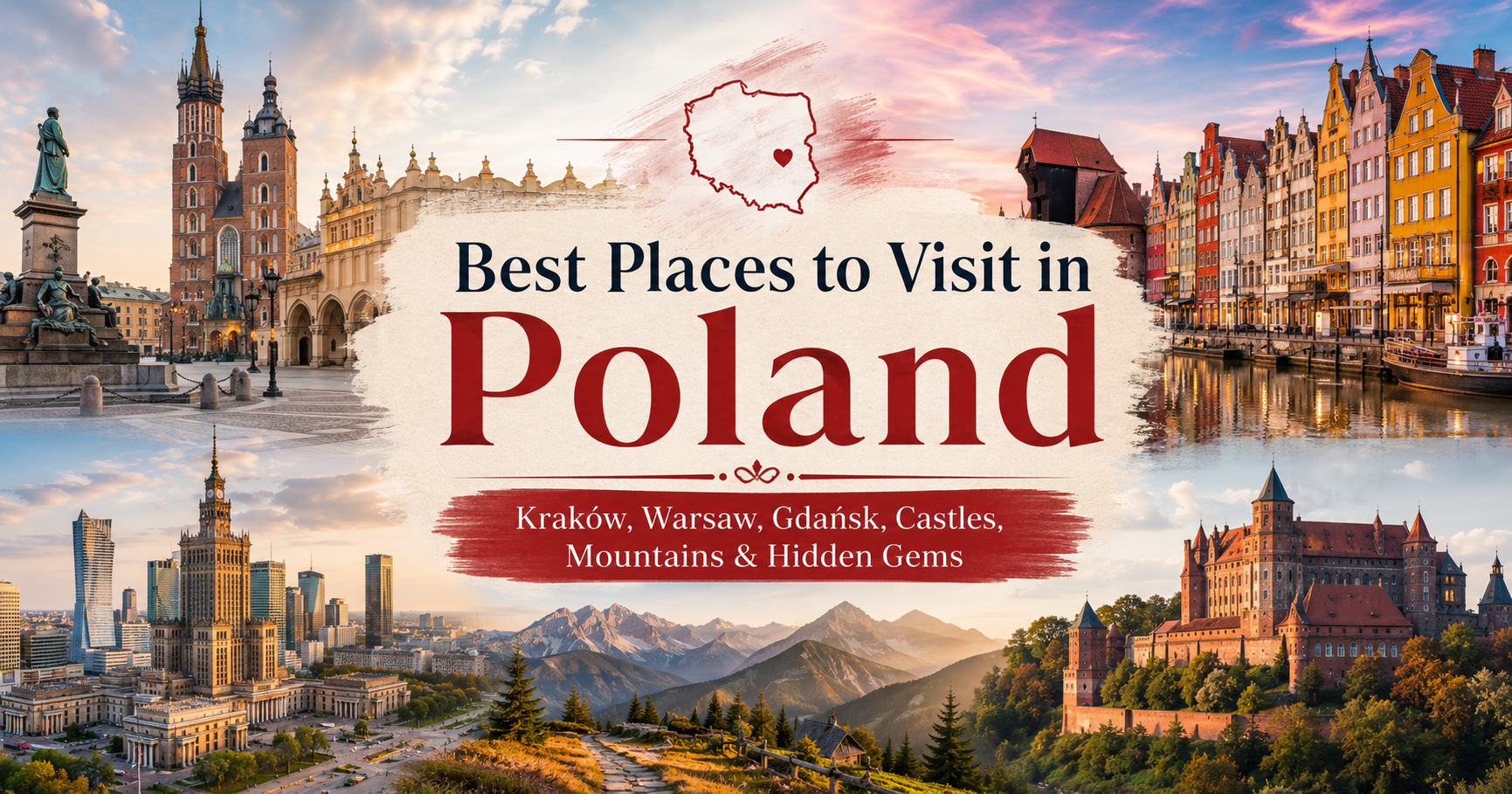
Poland is one of those countries that gives you far more variety than you might expect from one trip. You can start in a grand medieval square, wander through royal castle grounds, follow riverside streets in colorful old towns, step inside enormous brick fortresses, visit salt mines carved deep underground, and still have Baltic beaches, mountain villages, lake districts, primeval forests, and quiet artist towns waiting for another day.
For a first trip, Poland’s big anchors are wonderfully rewarding. Kraków has the classic old-world beauty, Warsaw brings capital-city energy and powerful museums, Gdańsk adds Baltic coast charm, and Wrocław feels colorful, romantic, and full of personality. But Poland also becomes more interesting when you add special-interest stops: castle regions, Renaissance towns, wooden churches, archaeology sites, river villages, mountain escapes, lake country, and places that feel a little more tucked away from the obvious route.
Whether you are planning a classic Poland itinerary, a city-and-castles trip, a culture-heavy route, a summer lake escape, a winter mountain break, or a deeper trip built around history, food, architecture, and hidden gems, these are some of the best places to visit in Poland.

Quick Travel Notes for Poland
- Best first-time bases: Kraków, Warsaw, Gdańsk, Wrocław
- Best for historic city beauty: Kraków, Toruń, Gdańsk, Zamość
- Best for museums and deeper history: Warsaw, Kraków, Lublin, Gdańsk
- Best for castles: Malbork Castle, Wawel Castle, Książ Castle
- Best for mountain scenery: Zakopane and the Tatra Mountains, Bieszczady Mountains
- Best for Baltic coast atmosphere: Gdańsk, Sopot, Gdynia
- Best for small-town charm: Kazimierz Dolny, Toruń, Zamość
- Best for nature: Białowieża Forest, Masurian Lakes, Tatra Mountains, Bieszczady Mountains
- Best for special interests: Wieliczka Salt Mine, Churches of Peace, Wooden Architecture Route, Krzemionki Flint Mines, Łódź
- Best route idea for first-timers: Kraków, Warsaw, Gdańsk, and Wrocław
- Best route idea for deeper travelers: Wrocław, Książ Castle, Churches of Peace, Kraków, Wooden Architecture Route, and Zakopane
1. Kraków
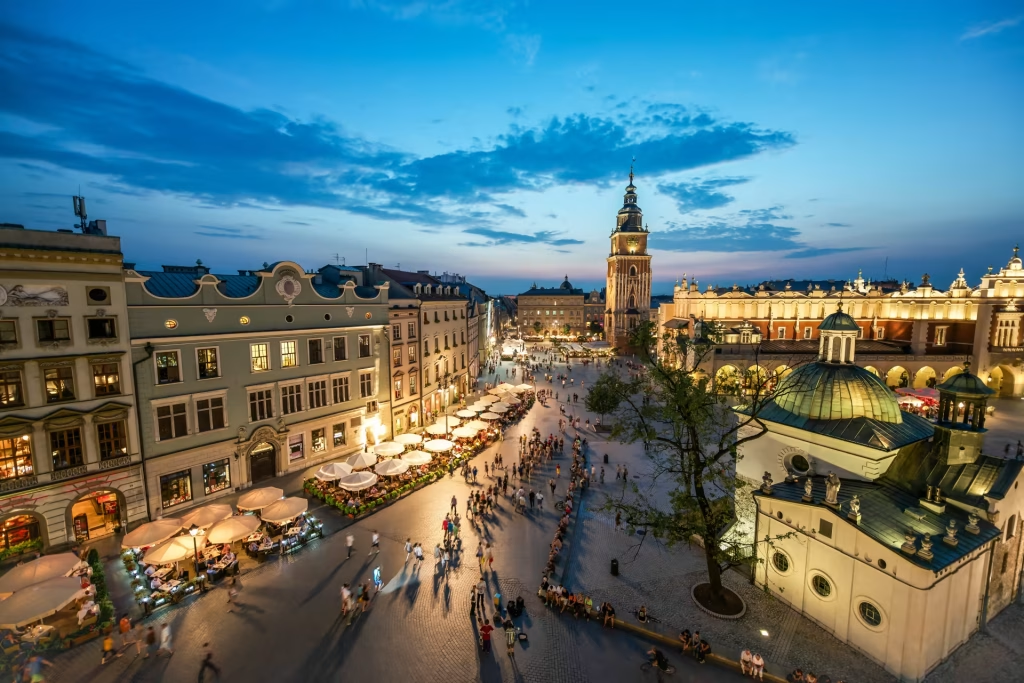
Region notes: Southern Poland, in Lesser Poland. Kraków is one of the country’s most beloved first-time bases, with a walkable historic center, strong train connections, and some of Poland’s most popular day trips nearby.
What kind of place it is: A historic royal city with a huge medieval market square, castle views, old churches, Jewish heritage, cellar restaurants, cafés, museums, and easy access to salt mines, memorial sites, and mountain day trips.
Best for: First-time visitors, couples, food lovers, history travelers, culture-focused trips, easy city breaks, and travelers who want a beautiful base with lots of day trip options.
Kraków is one of the easiest places to fall in love with in Poland. It has the classic old European atmosphere many travelers picture before they go: cobbled streets, church towers, carriage rides, market square cafés, castle walls, and long evenings that feel made for wandering.
The heart of the city is Rynek Główny, Kraków’s grand main square. From there, you can walk to St. Mary’s Basilica, the Cloth Hall, old university streets, and the route toward Wawel Castle, which rises above the Vistula River with one of the prettiest royal-city settings in Poland.
Kraków also works beautifully as a base because it gives you both city atmosphere and strong day trip potential. You can spend one day exploring the Old Town and Wawel, another in Kazimierz, and then add places like Wieliczka Salt Mine, Auschwitz-Birkenau, or Zakopane depending on the kind of trip you want.
Main Highlights
- Rynek Główny: Kraków’s grand main square, surrounded by historic buildings, restaurants, churches, cafés, and street life.
- Wawel Castle: A royal castle complex above the Vistula River with architecture, history, and beautiful city views.
- St. Mary’s Basilica: One of Kraków’s most recognizable landmarks, standing right on the main square.
- Kazimierz: The historic Jewish quarter, now filled with cafés, restaurants, cultural spaces, galleries, and evening atmosphere.
- Vistula River walks: A scenic way to slow down between castle visits, restaurants, and old-town sightseeing.
- Wieliczka Salt Mine: One of the most popular and memorable day trips from Kraków.
- Auschwitz-Birkenau: A major historical memorial and museum often visited from Kraków.
Why I Recommend It
Kraków is the best place to begin if you want Poland to feel beautiful, historic, and easy to enjoy right away. It has enough major sights to fill several days, but it also has the kind of atmosphere that rewards slow wandering, long meals, and unscheduled discoveries. It is especially useful for first-time visitors because you can keep the city as your base and build a rich southern Poland itinerary around it.
Don’t Miss
- Wandering Rynek Główny early in the morning or later in the evening when the square feels especially atmospheric.
- Spending time in Kazimierz for food, history, cafés, and a different mood from the Old Town.
- Walking near Wawel Castle and the Vistula River for one of the prettiest views in the city.
- Adding at least one day trip if Kraków is your main southern Poland base.
- Leaving time for a relaxed dinner in a cellar restaurant or cozy old-town dining room.
Good to Know / Side Notes
- Kraków is one of the easiest Poland bases for first-time visitors because the historic center is compact and very walkable.
- It works especially well for travelers who want a pretty city with strong restaurants, cultural sights, and organized day trip options.
- The Old Town is convenient for classic sightseeing, while Kazimierz gives the trip a more local, cultural, evening-friendly feel.
- Kraków pairs naturally with Wieliczka Salt Mine, Auschwitz-Birkenau, Zakopane, and other southern Poland stops.
- If you only have time for one Polish city and want the most classic historic atmosphere, Kraków is usually the easiest choice.
2. Warsaw

Region notes: Central-eastern Poland. Warsaw is Poland’s capital and one of the country’s most important transportation, museum, business, and cultural hubs.
What kind of place it is: A large capital city with a reconstructed Old Town, royal streets, major museums, parks, modern restaurants, shopping, nightlife, and a strong sense of past and present existing side by side.
Best for: Museum lovers, history travelers, business travelers, city-break travelers, food-focused travelers, and anyone who wants to understand modern Poland beyond its postcard towns.
Warsaw has a different energy from Kraków. It is bigger, more modern, more layered, and more emotionally complex. You come here for the capital-city experience: museums, palaces, elegant streets, green parks, reconstructed old-town beauty, glassy modern architecture, and neighborhoods that feel creative and current.
The Old Town is one of the most meaningful places in the city because of how carefully it was rebuilt after World War II. Around it, you can visit the Royal Castle, walk the Royal Route, spend time in Łazienki Park, and explore museums that tell some of the most important stories in Polish history.
Warsaw is also a strong practical base. It has excellent train connections, plenty of hotels, a serious food scene, and the kind of urban variety that makes it work for both first-time visitors and travelers who like deeper city exploring.
Main Highlights
- Warsaw Old Town: A colorful reconstructed historic center with a market square, castle views, and atmospheric streets.
- Royal Castle: A major landmark at the edge of the Old Town.
- Royal Route: A beautiful route linking historic churches, palaces, monuments, and elegant streets.
- Łazienki Park: A graceful park with gardens, monuments, walking paths, and palace scenery.
- POLIN Museum of the History of Polish Jews: One of Warsaw’s most important cultural museums.
- Palace of Culture and Science: A striking city landmark with panoramic view potential.
- Praga district: A more creative, atmospheric area across the river with a different side of the city.
Why I Recommend It
Warsaw is one of the best places to understand Poland as a living, modern country rather than only a historic destination. It gives you museums, memory, food, parks, architecture, and city energy in one place. If Kraków feels like the classic beauty stop, Warsaw feels like the capital that helps the whole trip make more sense.
Don’t Miss
- Walking through the Old Town and around Castle Square.
- Following part of the Royal Route for one of the city’s most elegant sightseeing stretches.
- Spending time in Łazienki Park, especially if you want a quieter break from the city.
- Choosing at least one major museum that fits your interests.
- Looking for modern Warsaw through its restaurants, cafés, rooftop views, and neighborhoods beyond the Old Town.
Good to Know / Side Notes
- Warsaw is more spread out than Kraków, so it helps to plan your days by neighborhood or sightseeing area.
- The city works well for travelers who like museums and context, not just pretty streets.
- Warsaw is a strong arrival or departure city because of its transportation connections.
- It pairs well with Kraków by train for a classic two-city Poland itinerary.
- If you usually like capital cities with a mix of history, food, parks, and modern urban life, Warsaw deserves more than a quick pass-through.
3. Gdańsk

Region notes: Northern Poland, on the Baltic coast. Gdańsk is part of the Tricity area with Sopot and Gdynia, making it a strong base for both historic sightseeing and seaside exploring.
What kind of place it is: A colorful port city with a beautiful historic center, maritime history, waterfront walks, amber shops, museums, restaurants, and easy access to Baltic coast towns.
Best for: Coastal travelers, summer trips, history lovers, architecture lovers, photographers, couples, and travelers who want Poland with a northern European feel.
Gdańsk is one of the most beautiful cities in Poland and one of the best places to add a coastal chapter to your itinerary. It feels different from Kraków and Warsaw, with tall colorful facades, harbor views, brick churches, maritime history, amber shops, and a Baltic Sea atmosphere that gives the city its own identity.
The historic center is especially lovely around Long Market, Neptune’s Fountain, and the Motława River waterfront. It is the kind of place where you can spend the day sightseeing and then slow down into a waterside dinner, a sunset walk, or a visit to one of the city’s excellent museums.
Gdańsk also makes a fantastic northern base because you can pair it with Sopot for beach-town energy, Gdynia for a more modern coastal feel, and Malbork Castle for one of the most impressive castle day trips in Poland.
Main Highlights
- Long Market: The colorful heart of historic Gdańsk, lined with beautiful facades and lively restaurants.
- Neptune’s Fountain: One of the city’s most recognizable landmarks.
- Motława River waterfront: A scenic area for walks, photos, boat views, and evening meals.
- St. Mary’s Church: A massive brick church and major Gdańsk landmark.
- European Solidarity Centre: An important museum connected to Poland’s modern history.
- Amber shops: A signature part of Gdańsk’s identity.
- Sopot: A nearby seaside resort town with a beach and pier.
Why I Recommend It
Gdańsk is perfect when you want Poland to feel colorful, coastal, and atmospheric. It works for city travelers, history travelers, couples, summer visitors, and anyone who wants a beautiful northern base with easy add-ons. It also adds variety to a Poland trip because the Baltic setting feels so distinct from the inland cities.
Don’t Miss
- Walking the Motława River waterfront near dusk.
- Spending time around Long Market and the historic center.
- Visiting at least one museum connected to Gdańsk’s maritime or modern history.
- Pairing Gdańsk with Sopot if you want a beach-town contrast.
- Considering Malbork Castle as a day trip from Gdańsk.
Good to Know / Side Notes
- Gdańsk is one of the best Poland bases if you want city sightseeing and coastal atmosphere in the same trip.
- It is especially appealing in warmer months, but its museums, restaurants, and historic center make it worthwhile outside summer too.
- The Tricity area gives you more variety than staying in Gdańsk alone, especially if you like beaches, piers, and seaside promenades.
- Gdańsk pairs naturally with Malbork Castle, Sopot, Gdynia, and Baltic coast routes.
- It is a great choice for travelers who want a Poland itinerary that feels different from the Kraków-Warsaw classic route.
4. Wrocław

Region notes: Western Poland, in Lower Silesia. Wrocław is one of the best city bases for exploring castles, churches, palaces, and heritage sites in southwestern Poland.
What kind of place it is: A colorful city of bridges, islands, riverside walks, historic squares, university life, playful dwarf statues, and access to Lower Silesian castles and day trips.
Best for: Couples, friend trips, architecture lovers, photographers, relaxed city breaks, castle day trips, and travelers who want a beautiful city that feels a little less obvious.
Wrocław is bright, charming, and full of personality. It has one of Poland’s prettiest market squares, a romantic old island district, riverside views, bridges, cafés, and tiny bronze dwarf statues hidden throughout the city. It feels historic and playful at the same time.
The city’s atmosphere is one of its biggest strengths. You can wander through the Market Square, cross bridges toward Ostrów Tumski, look for dwarfs, sit at outdoor cafés, and enjoy a slower pace than some of Poland’s more famous first-trip cities.
Wrocław also shines as a base for Lower Silesia. From here, travelers can add Książ Castle, the Churches of Peace, mountain towns, palaces, and heritage stops that make the region especially rewarding for special-interest travelers.
Main Highlights
- Market Square: A colorful central square with restaurants, historic buildings, and lively street life.
- Ostrów Tumski: The oldest part of Wrocław, known for churches, old streets, and romantic evening atmosphere.
- Wrocław’s dwarfs: Small bronze statues scattered around the city.
- Riverside walks: Scenic paths, bridges, islands, and city views.
- Centennial Hall: A major modernist landmark and UNESCO-listed site.
- Lower Silesia day trips: Książ Castle, Churches of Peace, and regional heritage towns.
Why I Recommend It
Wrocław is one of the best Poland cities for travelers who want beauty, charm, and personality without only following the most obvious route. It gives you colorful city sightseeing and easy access to a region filled with castles, churches, and unusual heritage stops.
Don’t Miss
- Exploring the Market Square from more than one angle.
- Visiting Ostrów Tumski in the evening for a more romantic historic mood.
- Looking for the city’s dwarf statues as you wander.
- Taking a riverside walk across a few of the city’s bridges.
- Using Wrocław as a base for at least one Lower Silesia day trip if you have time.
Good to Know / Side Notes
- Wrocław is a strong choice for travelers who have already seen Kraków or Warsaw and want another beautiful Polish city.
- It works well for couples and friend trips because it has pretty streets, restaurants, cafés, and a relaxed sightseeing pace.
- Lower Silesia is one of the best regions in Poland for castle and heritage-focused itineraries.
- Wrocław pairs especially well with Książ Castle, Jawor, Świdnica, and other southwestern Poland stops.
- The city is easy to enjoy without overplanning, which makes it a nice balance to more museum-heavy destinations.
5. Zakopane and the Tatra Mountains

Region notes: Southern Poland, near the Slovak border. Zakopane is the country’s best-known mountain town and the main gateway to the Polish Tatra Mountains.
What kind of place it is: A lively mountain resort town with wooden highland architecture, hiking trails, viewpoints, winter sports, hearty food, thermal bath access, and dramatic mountain scenery.
Best for: Nature lovers, hikers, winter travelers, mountain-view seekers, scenic day trips from Kraków, and travelers who want alpine-style scenery in Poland.
Zakopane is where Poland shifts into mountain mode. Instead of market squares and riverfront streets, you get wooden houses, mountain ridges, hearty highland food, hiking routes, snowy winter scenes, and views toward the Tatras.
For many travelers, Zakopane is the easiest way to add dramatic natural scenery to a Poland itinerary. It can be visited as a long day trip from Kraków, but staying overnight gives the experience more room to breathe. You can enjoy the town, ride up to viewpoints, visit nearby thermal baths, or plan a hike if the season and weather are right.
The Tatra Mountains give southern Poland a completely different mood: active, scenic, cozy, and outdoorsy.
Main Highlights
- Tatra Mountains: Poland’s most dramatic mountain scenery.
- Krupówki Street: Zakopane’s main pedestrian street with shops, restaurants, and mountain-town energy.
- Gubałówka: A popular viewpoint over Zakopane and the surrounding mountains.
- Morskie Oko: One of the region’s most famous mountain lakes.
- Wooden highland architecture: A signature part of Zakopane’s look and feel.
- Thermal baths nearby: A relaxing addition after hiking, sightseeing, or winter activities.
- Winter sports: A major draw during snowy months.
Why I Recommend It
Zakopane is the best place to add mountain beauty to a first or second Poland trip. It works for active hikers, casual viewpoint travelers, winter visitors, and anyone who wants a scenic contrast to Kraków’s historic streets.
Don’t Miss
- Taking in a mountain viewpoint, even if you are not planning a serious hike.
- Trying local highland food after a day outside.
- Looking for Zakopane’s distinctive wooden architecture.
- Considering nearby thermal baths as a relaxing add-on.
- Planning extra time if you want to visit Morskie Oko or do a more involved hiking day.
Good to Know / Side Notes
- Zakopane is very popular during holidays, winter weekends, and summer hiking season, so lodging and transportation can book up quickly.
- A day trip from Kraków is possible, but staying overnight makes the mountain experience feel much more relaxed.
- The area works in both summer and winter, but the trip style changes a lot depending on the season.
- Travelers who want serious hiking should check trail conditions and weather carefully.
- Zakopane pairs naturally with Kraków, Wieliczka Salt Mine, and other southern Poland stops.
6. Malbork Castle

Region notes: Northern Poland, southeast of Gdańsk. Malbork is one of the easiest and most impressive castle day trips from the Baltic coast.
What kind of place it is: A massive medieval brick fortress, museum complex, UNESCO World Heritage Site, and one of the most memorable castle experiences in Poland.
Best for: Castle lovers, history travelers, photographers, families, medieval architecture fans, and travelers using Gdańsk as a base.
Malbork Castle is one of the great castle stops in Europe. Built by the Teutonic Knights, it is enormous, atmospheric, and visually unforgettable, with brick walls, courtyards, towers, halls, and river views that make it feel like a full medieval world rather than just a quick monument.
It is especially useful because it pairs so well with Gdańsk. You can spend a few days on the Baltic coast and still add one of Poland’s most important historic sites without reshaping your whole itinerary.
For travelers who love castles, Malbork is one of the clearest “make time for it” stops in Poland.
Main Highlights
- Castle of the Teutonic Order: A vast medieval brick fortress and UNESCO World Heritage Site.
- Courtyards and halls: Atmospheric spaces that make the complex feel immersive.
- Museum exhibits: Context on the castle, the Teutonic Knights, architecture, and regional history.
- Nogat River views: Scenic angles of the castle exterior.
- Gdańsk day trip potential: A practical and rewarding add-on from the coast.
- Medieval architecture: One of the strongest castle experiences in the country.
Why I Recommend It
Malbork is perfect for travelers who want a castle that feels grand, immersive, and historically important. It is not just a pretty photo stop; it is a large complex that can anchor a full sightseeing day and add real depth to a northern Poland itinerary.
Don’t Miss
- Giving yourself enough time to explore the castle without rushing.
- Viewing the exterior from across the river for one of the best perspectives.
- Exploring the courtyards as well as the interiors.
- Pairing Malbork with Gdańsk if you want a strong city-and-castle combination.
- Taking photos of the brick architecture from different angles as the light changes.
Good to Know / Side Notes
- Malbork is one of the best day trips from Gdańsk and a natural fit for northern Poland itineraries.
- The castle complex is large, so comfortable walking time matters.
- It is especially rewarding for travelers who like medieval history, fortresses, museums, and architecture.
- Families with older kids or teens who enjoy castles may find it very memorable.
- If your Poland trip already includes Wawel Castle, Malbork gives you a completely different kind of castle experience.
7. Toruń

Region notes: North-central Poland, on the Vistula River. Toruń is a smaller historic city that works well as a charming stop between larger Polish destinations.
What kind of place it is: A medieval old town known for Gothic architecture, gingerbread traditions, river views, and its connection to astronomer Nicolaus Copernicus.
Best for: Small-city travelers, architecture lovers, food-interest travelers, history lovers, couples, and anyone who enjoys charming old towns with a clear local identity.
Toruń is one of Poland’s prettiest smaller cities, and it has a personality that is easy to understand right away. It is a city of brick Gothic buildings, medieval streets, gingerbread shops, river views, and Copernicus history.
The old town feels compact and atmospheric, making it a good choice for travelers who want a beautiful stop that is easier to absorb than a large capital. You can wander the historic center, visit a gingerbread museum or shop, see Copernicus-related sites, and enjoy the Vistula River setting.
Toruń is especially appealing because it feels distinct. It is not just another pretty old town; the gingerbread and Copernicus connections give it a memorable story.
Main Highlights
- Medieval Old Town: A beautifully preserved historic center with Gothic architecture and atmospheric streets.
- Gingerbread traditions: Toruń is famous for pierniki, Polish gingerbread.
- Copernicus House: A museum connected to the famous astronomer.
- Old Town Hall: A major landmark in the historic center.
- Vistula River views: Scenic walks and photo spots.
- Brick Gothic architecture: Churches, gates, and historic buildings that define the city’s look.
Why I Recommend It
Toruń is a wonderful choice when you want a smaller Polish city with beauty, charm, and a strong sense of place. It adds a sweet, historic, and very walkable stop to a Poland itinerary.
Don’t Miss
- Trying Toruń gingerbread or visiting a gingerbread-focused attraction.
- Walking through the medieval old town without rushing.
- Visiting a Copernicus-related site if you enjoy science or history.
- Spending time near the Vistula River for a different view of the city.
- Looking up at the Gothic brick details throughout the old town.
Good to Know / Side Notes
- Toruń works well as an overnight stop or a slower day in a broader Poland itinerary.
- It is a great pick for travelers who like smaller cities with food traditions and historic character.
- The city pairs well with northern or central Poland routes.
- Toruń is especially nice if you want a break from bigger city sightseeing.
- It can also appeal to families because the gingerbread angle gives the city a fun, memorable hook.
8. Poznań

Region notes: Western Poland. Poznań is a lively historic city with strong food traditions, colorful architecture, student energy, and good connections to other western Polish destinations.
What kind of place it is: A colorful city-break destination with an old market square, regional pastries, historic islands, restaurants, museums, and a more local-feeling rhythm than some of Poland’s biggest tourist stops.
Best for: Food lovers, friend trips, city-break travelers, repeat Poland visitors, students, and travelers who like lively but manageable cities.
Poznań is bright, energetic, and very easy to enjoy. Its old market square gives travelers the colorful architecture they want from a Polish city break, while its food traditions and student life keep it feeling lively and lived-in.
The city is especially known for St. Martin’s croissants, a beloved regional pastry with its own local story. Poznań also has historic areas like Ostrów Tumski, museums, cafés, restaurants, and green spaces that make it a pleasant base for a relaxed city stay.
It may not always be the first city people think of for Poland, but that makes it a great addition for travelers who want somewhere appealing, practical, and a little less predictable.
Main Highlights
- Old Market Square: A colorful central square with historic buildings, restaurants, and city life.
- Town Hall goats: A charming daily tradition connected to the town hall clock.
- St. Martin’s croissants: Poznań’s famous regional pastry.
- Ostrów Tumski: A historic island area with cathedral heritage.
- Lake Malta: A recreation area for walking, outdoor time, and family-friendly activities.
- Museums and cafés: Good options for a relaxed city break.
Why I Recommend It
Poznań is a great choice for travelers who like colorful squares, regional food traditions, and cities that feel fun without being overwhelming. It is especially appealing if you want another Polish city beyond the obvious first-trip trio.
Don’t Miss
- Seeing the old market square and town hall area.
- Trying a St. Martin’s croissant.
- Visiting Ostrów Tumski for a deeper historic layer.
- Spending time in cafés or restaurants to enjoy the city’s local rhythm.
- Adding Poznań to a western Poland route with Wrocław or Toruń.
Good to Know / Side Notes
- Poznań is a good option for travelers who want a city break with food, history, and a manageable sightseeing pace.
- It works well for repeat visitors to Poland or first-timers who want more than the standard stops.
- The city’s food identity gives it an easy travel hook, especially for travelers who enjoy local specialties.
- Poznań can pair nicely with Wrocław, Toruń, or other western Poland destinations.
- It is a practical stop if your route naturally moves across western or central Poland.
9. Białowieża Forest

Region notes: Eastern Poland, near the Belarus border. Białowieża Forest is one of Poland’s most important nature destinations and a major special-interest stop for wildlife and forest lovers.
What kind of place it is: A primeval forest destination known for ancient woodland, European bison, guided nature experiences, quiet trails, and a slower rural atmosphere.
Best for: Nature lovers, wildlife travelers, conservation-minded travelers, slow travelers, photographers, and people who want Poland beyond cities and castles.
Białowieża Forest gives Poland a completely different kind of travel experience. Instead of old towns, castles, and museums, this is about ancient woodland, wildlife, quiet trails, forest atmosphere, and the chance to connect with one of Europe’s most significant natural landscapes.
The forest is especially known for its connection to the European bison, which gives the region a strong wildlife identity. Travelers come here for guided walks, nature education, peaceful stays, and the feeling of stepping into a much older landscape.
This is a slower and more intentional stop, best for travelers who truly want nature to be part of the trip.
Main Highlights
- Ancient forest landscapes: One of Europe’s most famous primeval forest areas.
- European bison: The region’s iconic wildlife connection.
- Nature trails: Forest walks and guided routes.
- Białowieża village: A small base for exploring the area.
- UNESCO natural heritage: Part of what makes the forest globally significant.
- Slow travel atmosphere: Peaceful, green, rural, and very different from Poland’s cities.
Why I Recommend It
Białowieża Forest is one of the best places to visit in Poland if you want nature with real depth. It gives the itinerary a quieter, wilder chapter and works beautifully for travelers interested in forests, wildlife, conservation, and slow travel.
Don’t Miss
- Taking a guided forest experience if you want more context.
- Learning about the European bison connection.
- Spending time on slower forest walks rather than rushing the visit.
- Staying long enough to feel the quiet atmosphere of the area.
- Pairing the forest with a broader eastern Poland route if you have time.
Good to Know / Side Notes
- Białowieża is best for travelers who genuinely want nature as part of the trip, not just a quick scenic stop.
- It takes more planning than a city destination, especially if you are relying on public transportation.
- Guided experiences can make the forest much more meaningful because the landscape’s importance is not always obvious at a glance.
- This is a strong choice for wildlife and conservation travelers.
- It pairs best with a slower eastern Poland itinerary rather than a fast first-time city route.
10. Masurian Lakes

Region notes: Northeastern Poland. The Masurian Lakes are one of Poland’s classic warm-weather escapes, known for water, forests, boating, and slow vacation days.
What kind of place it is: A lake district with sailing, kayaking, small towns, forests, countryside stays, summer resorts, and a relaxed outdoor rhythm.
Best for: Summer travelers, families, couples, outdoor travelers, lake lovers, slow travelers, and anyone who wants a softer nature break in Poland.
The Masurian Lakes show a peaceful, outdoorsy side of Poland. This region is all about water, forests, boats, summer air, and easy days that revolve around being outside. It is a wonderful contrast to Poland’s historic cities and castle routes.
Travelers come here for sailing, kayaking, swimming, lakeside meals, small towns, and a slower pace. It is especially appealing in warm weather, when the region feels like Poland’s lake-country vacation escape.
Masuria works beautifully when you want to balance city sightseeing with time in nature. After days in museums and old towns, the lake district gives the trip a more relaxed, restorative chapter.
Main Highlights
- Great Masurian Lakes: A scenic lake region with boating and water activities.
- Sailing and kayaking: Popular ways to enjoy the water.
- Lake towns: Small bases for relaxed stays.
- Forests and countryside: Great for walking, cycling, and fresh air.
- Summer atmosphere: A classic warm-weather Poland escape.
- Family-friendly outdoor time: Easy days built around water and nature.
Why I Recommend It
The Masurian Lakes are perfect for travelers who want Poland to feel slower, greener, and more outdoorsy. They add a beautiful summer escape to an itinerary and are especially rewarding for people who enjoy lake vacations, boating, and countryside stays.
Don’t Miss
- Planning at least one boat, sailing, or kayaking experience.
- Choosing a lake town that fits the pace of trip you want.
- Leaving room for slow mornings or evenings by the water.
- Pairing lake time with a city itinerary for variety.
- Enjoying the region as a stay, not just a quick drive-through.
Good to Know / Side Notes
- Masuria is best in warmer months when water activities and lake-town atmosphere are at their strongest.
- A car can make the region easier to explore, especially if you want flexibility between towns and lakes.
- This is better for slow travel than a packed sightseeing itinerary.
- It works well for families, couples, and travelers who want an outdoor break after city touring.
- The Masurian Lakes are a great reminder that Poland is not only historic cities and castles.
11. Łódź

Region notes: Central Poland, southwest of Warsaw. Łódź is a creative city with industrial heritage, film culture, murals, and revitalized factory spaces.
What kind of place it is: An urban special-interest city with street art, film history, industrial architecture, long central streets, creative spaces, restaurants, and a city-reinvention feel.
Best for: Film lovers, street art travelers, architecture fans, creative-city travelers, repeat Poland visitors, and people who enjoy cities with a strong industrial-to-cultural transformation story.
Łódź is one of Poland’s most interesting off-the-beaten-path city picks. It has a very different personality from Kraków, Warsaw, or Gdańsk. Instead of medieval romance or coastal beauty, Łódź gives you factory architecture, murals, cinema history, revitalized spaces, and a creative urban edge.
The city’s long central street, Piotrkowska, is one of its main social and cultural spines. Around it, you can find restaurants, shops, courtyards, murals, and pieces of the city’s industrial past. Manufaktura, a major revitalized factory complex, shows how Łódź has turned former industrial spaces into shopping, dining, and cultural destinations.
This is a great stop for travelers who like cities that feel creative, evolving, and full of visual character.
Main Highlights
- Piotrkowska Street: A long central street with restaurants, shops, nightlife, and city life.
- Film culture: Łódź has a major connection to Polish cinema.
- Street art and murals: One of the city’s strongest visual draws.
- Manufaktura: A large revitalized factory complex with shopping, dining, and cultural spaces.
- Industrial architecture: Former textile factories and 19th-century city history.
- Creative atmosphere: A different, more modern-feeling Poland stop.
Why I Recommend It
Łódź is ideal for travelers who like special-interest cities with a strong creative identity. It adds variety to a Poland itinerary and gives you a side of the country that feels artistic, industrial, and contemporary.
Don’t Miss
- Walking part of Piotrkowska Street.
- Looking for large-scale murals and street art.
- Visiting Manufaktura to see the city’s industrial-reuse side.
- Exploring the city through its film, design, or creative culture.
- Adding Łódź if you want something different from Poland’s more polished historic centers.
Good to Know / Side Notes
- Łódź is especially good for repeat Poland travelers or first-timers with a strong interest in film, street art, or industrial history.
- It has a more urban and creative feel than a classic pretty old-town destination.
- The city pairs well with Warsaw because of its central location.
- It is a good choice for travelers who enjoy cities with transformation stories.
- Łódź works best when you approach it for what it is: creative, visual, industrial, and distinctive.
12. Lublin

Region notes: Eastern Poland. Lublin is a historic city with a beautiful old town, castle, cultural heritage, and a strong sense of regional identity.
What kind of place it is: A culture-rich eastern Polish city with old streets, castle views, Jewish heritage, courtyards, churches, museums, and a quieter atmosphere than the largest tourist cities.
Best for: History lovers, cultural travelers, slower city breaks, eastern Poland itineraries, architecture lovers, and travelers who want a meaningful city beyond the obvious route.
Lublin is a beautiful and rewarding city for travelers who want to go deeper into Poland. It has a charming Old Town, a castle, historic gates, churches, courtyards, and layers of cultural history that give the city a thoughtful, atmospheric feel.
The city’s location in eastern Poland makes it feel different from the western and coastal stops. It is a wonderful option for travelers who have time to move beyond the most famous route and want a place with history, beauty, and a quieter pace.
Lublin is the kind of city that rewards slow walking. Its streets, corners, courtyards, and viewpoints feel best when you are not rushing from one landmark to the next.
Main Highlights
- Lublin Old Town: A charming historic center with colorful buildings and atmospheric streets.
- Lublin Castle: A major city landmark with history and views.
- Chapel of the Holy Trinity: Known for its beautiful historic frescoes.
- Grodzka Gate: A cultural and historical site connected to the city’s Jewish heritage.
- Historic courtyards: Part of the city’s old-town character.
- Eastern Poland atmosphere: A different regional feel from the biggest tourist cities.
Why I Recommend It
Lublin is one of the best Poland picks for travelers who like history-rich cities that feel a little more tucked away. It is beautiful, meaningful, and easy to appreciate at a slower pace.
Don’t Miss
- Wandering the Old Town without over-scheduling.
- Visiting the castle area for history and views.
- Looking for courtyards and side streets that give Lublin its atmosphere.
- Making time for a cultural or heritage-focused stop.
- Considering Lublin as part of a deeper eastern Poland route.
Good to Know / Side Notes
- Lublin is a strong choice for travelers who want more than the classic Kraków-Warsaw-Gdańsk route.
- It works best for visitors who enjoy cultural history, old towns, and slower city exploring.
- The city has a more intimate feel than Poland’s major tourist anchors.
- Lublin can pair with other southeastern or eastern Poland stops if you are building a longer route.
- It is especially rewarding for travelers interested in Jewish heritage, regional history, and atmospheric old towns.
13. Kazimierz Dolny

Region notes: Eastern-central Poland, on the Vistula River. Kazimierz Dolny is a small historic town known for its art scene, river setting, market square, and romantic atmosphere.
What kind of place it is: A pretty river town with galleries, historic houses, castle ruins, scenic viewpoints, restaurants, and a slow, artistic mood.
Best for: Couples, artists, photographers, slow travelers, romantic weekends, small-town lovers, and travelers who want a peaceful stop between bigger destinations.
Kazimierz Dolny is one of Poland’s loveliest small-town escapes. Set along the Vistula River, it has a charming market square, old houses, art galleries, castle ruins, river views, and a gentle atmosphere that feels made for slow travel.
This is not a place you visit for a packed list of major monuments. You come for the mood: walking through the town, browsing galleries, sitting down for a long meal, climbing up for views, and enjoying a softer side of Poland.
It is especially appealing for travelers who want a romantic or creative stop that breaks up a larger itinerary.
Main Highlights
- Market Square: A charming center with historic houses, restaurants, and small-town atmosphere.
- Vistula River setting: Scenic walks and peaceful views.
- Castle ruins: A historic viewpoint above town.
- Art galleries: Part of the town’s creative identity.
- Renaissance granaries: A reminder of the town’s trading history.
- Romantic small-town feel: Ideal for slower itineraries and couples’ trips.
Why I Recommend It
Kazimierz Dolny is perfect when you want Poland to feel intimate, pretty, and unhurried. It gives the trip a softer chapter and works especially well for travelers who love small towns, art, rivers, and romantic views.
Don’t Miss
- Walking through the market square and surrounding streets.
- Climbing up for views over the town and river.
- Browsing galleries or local creative shops.
- Taking time for a relaxed meal instead of rushing through.
- Enjoying the Vistula River setting as part of the town’s charm.
Good to Know / Side Notes
- Kazimierz Dolny is best for travelers who enjoy slow travel and small-town atmosphere.
- It is more of a mood-and-scenery destination than a checklist sightseeing stop.
- The town works well for couples, photographers, and creative travelers.
- It can be a lovely overnight stay if you want the town after day visitors thin out.
- Kazimierz Dolny pairs naturally with Lublin or other eastern-central Poland routes.
14. Zamość

Region notes: Southeastern Poland. Zamość is a UNESCO-listed Renaissance town known for its planned layout, colorful square, arcaded buildings, and elegant architectural harmony.
What kind of place it is: A beautifully designed historic town with Renaissance architecture, a grand market square, arcades, fortifications, and a polished special-interest feel.
Best for: Architecture lovers, history travelers, photographers, UNESCO travelers, road trippers, and travelers who enjoy distinctive planned towns.
Zamość is one of Poland’s most beautiful special-interest towns. It was designed as an ideal Renaissance city, and that sense of planning gives it a very different feeling from Poland’s medieval old towns.
The Great Market Square is the heart of the visit, with colorful buildings, arcades, and a striking town hall. The town feels balanced, elegant, and unusually harmonious, which makes it especially rewarding for travelers who notice architecture and urban design.
Zamość is a fantastic choice when you want a place that feels refined and memorable without being one of Poland’s most obvious first-time stops.
Main Highlights
- Great Market Square: A colorful, harmonious Renaissance square.
- Arcaded houses: One of the town’s signature architectural features.
- Town Hall: A striking central landmark with a beautiful staircase and tower.
- Old fortifications: Historic defensive features around the town.
- UNESCO status: Recognized for its Renaissance urban planning.
- Southeastern Poland route potential: A strong stop for travelers exploring beyond the main cities.
Why I Recommend It
Zamość is a gem for travelers who love architecture, symmetry, and historic towns with a clear design story. It adds polish and variety to a Poland itinerary and feels especially satisfying for travelers who enjoy places that are beautiful because of their overall layout, not just one famous landmark.
Don’t Miss
- Spending time in the Great Market Square from several angles.
- Looking closely at the arcaded houses.
- Taking photos of the town hall and colorful facades.
- Walking the old fortification areas if time allows.
- Pairing Zamość with a deeper southeastern Poland route.
Good to Know / Side Notes
- Zamość is best for travelers who appreciate architecture, historic planning, and smaller cities.
- It is more of a deliberate route-building stop than a quick add-on from Poland’s biggest bases.
- The town works well for road trips or longer southeastern Poland itineraries.
- It is a strong hidden-gem choice for travelers who like UNESCO towns.
- Zamość pairs well with Lublin or other eastern and southeastern Poland stops.
15. Książ Castle and Lower Silesia

Region notes: Southwestern Poland, near Wałbrzych in Lower Silesia. Książ Castle is one of the region’s most dramatic landmarks and an excellent add-on from Wrocław.
What kind of place it is: A grand castle and regional heritage area with terraces, gardens, forested hills, historic interiors, and easy pairing with other Lower Silesian sites.
Best for: Castle lovers, history travelers, photographers, Wrocław-based travelers, road trippers, and travelers who want a dramatic castle beyond the most famous Poland stops.
Książ Castle is one of Poland’s most striking castles, set above forested hills in Lower Silesia. With its towers, terraces, grand rooms, and scenic surroundings, it has the kind of castle drama that makes a day trip feel special.
The castle is also part of a broader regional story. Lower Silesia is one of Poland’s best areas for travelers who love castles, palaces, churches, spa towns, and unusual heritage stops. If Wrocław is your base, Książ is one of the most natural ways to expand the trip beyond the city.
This is a particularly strong stop for anyone who wants Poland to include grand architecture and a little mystery.
Main Highlights
- Książ Castle: A dramatic castle with towers, terraces, and scenic surroundings.
- Terraces and gardens: Beautiful outdoor areas around the castle.
- Forested setting: Part of what makes the castle feel so atmospheric.
- Historic interiors: Rooms and exhibits that add context to the visit.
- Lower Silesian castles and palaces: A region full of grand historic properties.
- Wrocław day trip potential: One of the best add-ons from the city.
Why I Recommend It
Książ Castle is one of the best Poland stops for travelers who want a grand castle experience beyond the usual first-trip highlights. It adds drama, scenery, and a regional Lower Silesia layer that makes the itinerary feel more curated.
Don’t Miss
- Seeing the castle exterior from the terraces and viewpoints.
- Giving yourself time for both the interiors and the grounds.
- Pairing the castle with Wrocław if you are staying in Lower Silesia.
- Looking into other nearby regional stops if you have a car.
- Enjoying the castle as a full experience, not just a quick photo stop.
Good to Know / Side Notes
- Książ Castle is one of the strongest day trips from Wrocław.
- It is especially rewarding for castle lovers and photographers.
- Lower Silesia has enough nearby sites to support a longer regional itinerary.
- The castle pairs well with Churches of Peace in Świdnica and Jawor.
- If you like dramatic architecture and scenic settings, this is one of the most satisfying castle stops in Poland.
16. Churches of Peace in Jawor and Świdnica

Region notes: Lower Silesia, southwestern Poland. The Churches of Peace in Jawor and Świdnica are special-interest UNESCO sites that pair especially well with Wrocław and Książ Castle.
What kind of place it is: Rare wooden church heritage with remarkable interiors, timber construction, religious history, and quiet architectural significance.
Best for: Architecture lovers, UNESCO travelers, religious heritage travelers, history lovers, Lower Silesia road trips, and travelers who enjoy unusual cultural sites.
The Churches of Peace in Jawor and Świdnica are among the most fascinating special-interest stops in Poland. These large wooden churches are remarkable for their scale, construction, interiors, and historical context.
They are exactly the kind of places that make a Poland itinerary feel more personal and thoughtful. They may not be the first stop for every traveler, but for people who love architecture, heritage, churches, craftsmanship, or UNESCO sites, they can be incredibly rewarding.
Because they sit in Lower Silesia, they pair beautifully with Wrocław and Książ Castle, making them a strong addition to a southwestern Poland route.
Main Highlights
- Jawor Church of Peace: A major wooden church with historic interiors.
- Świdnica Church of Peace: Another extraordinary timber-framed church with rich decoration.
- UNESCO status: Recognized for architectural and historical importance.
- Wooden construction: A rare and impressive feature at this scale.
- Lower Silesia pairing: Easy to combine with Wrocław, Książ Castle, and regional towns.
- Quiet special-interest appeal: A meaningful stop away from the busiest tourist route.
Why I Recommend It
The Churches of Peace are perfect for travelers who want to see something highly distinctive. They add depth to a Lower Silesia itinerary and make the trip feel more curated than a city-only route.
Don’t Miss
- Looking closely at the interiors, not just the exterior structure.
- Visiting both churches if your route allows.
- Pairing them with Książ Castle for a varied Lower Silesia day.
- Reading a little about their history before visiting.
- Taking time to notice the timber-framed construction and decorative details.
Good to Know / Side Notes
- These churches are best visited as part of a Lower Silesia itinerary rather than as standalone first-trip stops.
- They are especially appealing to travelers who love architecture, churches, UNESCO sites, or religious heritage.
- Wrocław is the most natural base for visiting them.
- A car or organized regional planning can make the visit easier.
- They are a wonderful example of why Poland’s hidden-gem stops can be just as memorable as its major cities.
17. Bieszczady Mountains

Region notes: Far southeastern Poland. The Bieszczady Mountains are one of Poland’s quieter, wilder mountain regions and feel very different from the busier Tatra area around Zakopane.
What kind of place it is: A remote mountain and nature region with forests, open ridgelines, hiking trails, small villages, scenic roads, and a peaceful off-the-beaten-path feel.
Best for: Hikers, nature lovers, solitude seekers, road trippers, repeat Poland visitors, and travelers who want a quieter mountain escape.
The Bieszczady Mountains are one of the best places in Poland for travelers who want nature to feel spacious and unhurried. While Zakopane and the Tatras are the more famous mountain choice, Bieszczady offers a quieter, wilder, more remote atmosphere.
This region is known for forests, mountain meadows, open ridgelines, scenic roads, and the feeling of being far from the main tourist circuit. It is ideal for travelers who like slower days, fresh air, and mountain landscapes without needing a big resort-town atmosphere.
Bieszczady is not the easiest quick add-on, but for the right traveler, that is exactly what makes it special.
Main Highlights
- Mountain hiking: Trails with wide views and peaceful landscapes.
- Połoniny ridges: Open mountain meadows and scenic walking routes.
- Remote atmosphere: A quieter alternative to Poland’s busier mountain areas.
- Forests and wildlife: A strong nature-focused region.
- Small villages: Good for slow travel and regional atmosphere.
- Road trip potential: Best explored with time and flexibility.
Why I Recommend It
Bieszczady is ideal for travelers who want Poland to feel wild, quiet, and deeply scenic. It is one of the best choices for a slower nature-focused trip and a wonderful option for people who have already done the more classic city-and-castle route.
Don’t Miss
- Planning a hike with open ridge views if the weather allows.
- Allowing enough time for slow drives and scenic stops.
- Staying overnight instead of treating the region as a quick detour.
- Enjoying the quiet atmosphere as part of the appeal.
- Pairing Bieszczady with a broader southeastern Poland route.
Good to Know / Side Notes
- Bieszczady is best for travelers who are comfortable with slower, more independent travel.
- It works better as a dedicated nature escape than a quick add-on from the main cities.
- The region is especially rewarding for hikers and road trippers.
- Weather and season matter, so outdoor plans should stay flexible.
- This is a strong pick for repeat Poland visitors or travelers who prefer quieter mountain destinations.
18. Wooden Architecture Route in Southern Poland

Region notes: Southern Poland, especially Lesser Poland and nearby regions. The Wooden Architecture Route links wooden churches, chapels, manor houses, open-air museums, and traditional village buildings.
What kind of place it is: A heritage route rather than one single destination, focused on craftsmanship, rural architecture, wooden churches, village scenery, and small-town or countryside exploring.
Best for: Architecture lovers, heritage travelers, photographers, road trippers, religious heritage travelers, and people who like special-interest routes.
The Wooden Architecture Route is one of Poland’s most beautiful niche travel ideas. Instead of one big city or landmark, it invites you to explore a series of wooden churches, chapels, old houses, open-air museums, and village buildings across southern Poland.
This is a wonderful addition for travelers who enjoy craftsmanship, historic churches, rural scenery, and quiet places that feel connected to regional identity. It pairs naturally with Kraków, Zakopane, and southern Poland road trips.
You do not need to do the entire route for it to be worthwhile. Even adding one or two wooden architecture stops can make a Poland itinerary feel more textured and personal.
Main Highlights
- Wooden churches: Beautiful historic churches with distinctive regional styles.
- Village architecture: A look at traditional building methods and rural design.
- Open-air museums: Helpful for seeing preserved buildings and regional heritage.
- Southern Poland scenery: Countryside, villages, and mountain-edge landscapes.
- UNESCO-connected wooden churches: Some wooden church sites in southern Poland are especially significant.
- Flexible route-building: Easy to add a few stops instead of trying to cover everything.
Why I Recommend It
The Wooden Architecture Route is perfect for travelers who want Poland to feel more intimate and regional. It adds a quiet beauty to the trip and gives you a reason to look beyond city centers into villages, churches, and landscapes shaped by local craftsmanship.
Don’t Miss
- Choosing a few stops that naturally fit your route.
- Looking closely at the woodwork, interiors, and painted details.
- Pairing the route with Kraków, Zakopane, or southern Poland countryside stays.
- Visiting an open-air museum if you want more context.
- Treating the route as a slow heritage experience rather than a checklist.
Good to Know / Side Notes
- A car makes this route much easier and more flexible.
- It is best for travelers who enjoy architecture, churches, village scenery, and road trips.
- The route can be sampled in small pieces rather than completed all at once.
- It pairs especially well with southern Poland itineraries.
- This is a great special-interest layer for travelers who want hidden gems without straying too far from Kraków or Zakopane.
19. Wieliczka and Bochnia Salt Mines

Region notes: Southern Poland, near Kraków. Wieliczka is one of the most popular day trips from Kraków, while Bochnia adds another historic salt-mining layer nearby.
What kind of place it is: An underground heritage experience with salt-carved chambers, chapels, corridors, sculptures, mining history, and one of the most unusual sightseeing experiences in Poland.
Best for: First-time visitors, history lovers, families, unusual sightseeing fans, Kraków-based travelers, and people who enjoy underground attractions.
The Wieliczka Salt Mine is one of Poland’s most memorable and unusual experiences. Instead of another castle or old town, you go underground into a world of salt-carved chambers, chapels, corridors, sculptures, and mining history.
For many travelers, Wieliczka is the easiest way to add something truly distinctive to a Kraków itinerary. It is close enough to be practical, famous enough to be easy to plan, and different enough that it stands out from the rest of the trip.
Bochnia Salt Mine adds another historic salt-mining option for travelers who are especially interested in underground heritage or want to understand the broader regional story.
Main Highlights
- Underground chambers: Large spaces carved within the salt mine.
- Salt chapel: One of Wieliczka’s most famous and memorable sights.
- Mining history: A look at centuries of salt production.
- Sculptures and corridors: Salt-carved details throughout the route.
- Kraków day trip: One of the easiest major excursions from the city.
- Bochnia Salt Mine: Another historic salt mine option in the region.
Why I Recommend It
Wieliczka is one of those rare experiences that is easy to add and genuinely different from normal city sightseeing. It works especially well for travelers who want a memorable half-day or day trip from Kraków without needing a complicated route.
Don’t Miss
- Seeing the underground chapel and larger salt chambers.
- Paying attention to the scale of the underground spaces.
- Learning about the mining history instead of treating it only as a photo stop.
- Pairing Wieliczka with Kraków for an easy southern Poland itinerary.
- Considering Bochnia if you are especially interested in salt mine heritage.
Good to Know / Side Notes
- Wieliczka is one of the most convenient and popular day trips from Kraków.
- The visit involves stairs and underground walking, so it helps to check tour details if mobility or claustrophobia is a concern.
- This is a strong family-friendly and first-time visitor option because it feels so different from standard sightseeing.
- It pairs naturally with Kraków and other southern Poland attractions.
- Booking ahead can be helpful during busy travel periods.
20. Krzemionki Prehistoric Flint Mines

Region notes: South-central Poland, in the Świętokrzyskie region. Krzemionki is a UNESCO-listed prehistoric mining region and one of Poland’s most interesting archaeology-focused stops.
What kind of place it is: A prehistoric flint mining landscape with ancient underground structures, archaeology exhibits, and a much older chapter of Polish history than the country’s castles and medieval towns.
Best for: Archaeology lovers, history nerds, UNESCO travelers, road trippers, ancient-history fans, and travelers who like highly specific hidden gems.
Krzemionki is one of the most niche and fascinating places on this list. It takes Poland’s travel story far beyond royal castles and medieval squares into the Neolithic and Bronze Age world of prehistoric striped flint mining.
This is not a standard first-time Poland stop, and that is part of its appeal. For travelers who love archaeology, ancient history, human ingenuity, and unusual UNESCO sites, Krzemionki offers a fascinating look at a much older side of Poland.
It is a special-interest destination, but the right traveler will remember it because it feels so different from everything else on the route.
Main Highlights
- Prehistoric flint mines: Ancient mining structures connected to striped flint extraction.
- Archaeological landscape: A rare look at Neolithic and Bronze Age industry.
- UNESCO status: Recognized for prehistoric mining significance.
- Underground route: A distinctive way to experience the site.
- Świętokrzyskie region: A less obvious area for deeper Poland exploring.
- Special-interest appeal: Ideal for travelers who love ancient history.
Why I Recommend It
Krzemionki is a brilliant hidden-gem pick for archaeology-focused travelers. It reveals a prehistoric side of Poland that feels completely different from the country’s castles, old towns, and modern history sites.
Don’t Miss
- Taking time to understand the prehistoric context.
- Visiting the underground mining route if available during your trip.
- Looking at the site as part of a much older human story.
- Pairing it with other regional stops if you are road tripping.
- Adding it only if archaeology and ancient history genuinely interest you.
Good to Know / Side Notes
- Krzemionki is best for special-interest travelers rather than casual first-time visitors.
- It works best as part of a road trip or regional itinerary.
- The site is especially rewarding if you enjoy archaeology, UNESCO places, and ancient industry.
- It is a good example of how Poland has meaningful history far beyond its medieval and modern stories.
- This is one of the most niche stops on the list, which makes it a great fit for travelers who like unusual places.
Simple Poland Packing Note
For a Poland trip, pack for comfortable sightseeing days, train travel, old-town walking, castle visits, and weather that can shift between seasons and regions. A few practical items can make the trip easier:
- Portable power bank for long sightseeing days, train rides, castle visits, museum days, and day trips.
- Small crossbody or secure day bag for cities, markets, stations, museums, and busy squares.
- Compact umbrella for sudden showers.
- Reusable water bottle for walking-heavy days.
- Sunglasses and sunscreen for summer city squares, lake days, river walks, and mountain trips.
Final Thoughts on Visiting Poland
Poland is a country that rewards both classic sightseeing and curiosity. You can build an easy first trip around Kraków, Warsaw, Gdańsk, and Wrocław, or you can shape the itinerary around castles, mountains, lakes, forests, Jewish heritage, industrial cities, wooden churches, salt mines, archaeology, and beautiful small towns.
That variety is what makes Poland such a satisfying destination. One trip might be full of royal streets, pierogi, market squares, and castle walls. Another might be mountain air, lake mornings, forest walks, and quiet villages. The best Poland itinerary is the one that gives you a few famous places you have always wanted to see and a few unexpected stops that make the trip feel like your own.