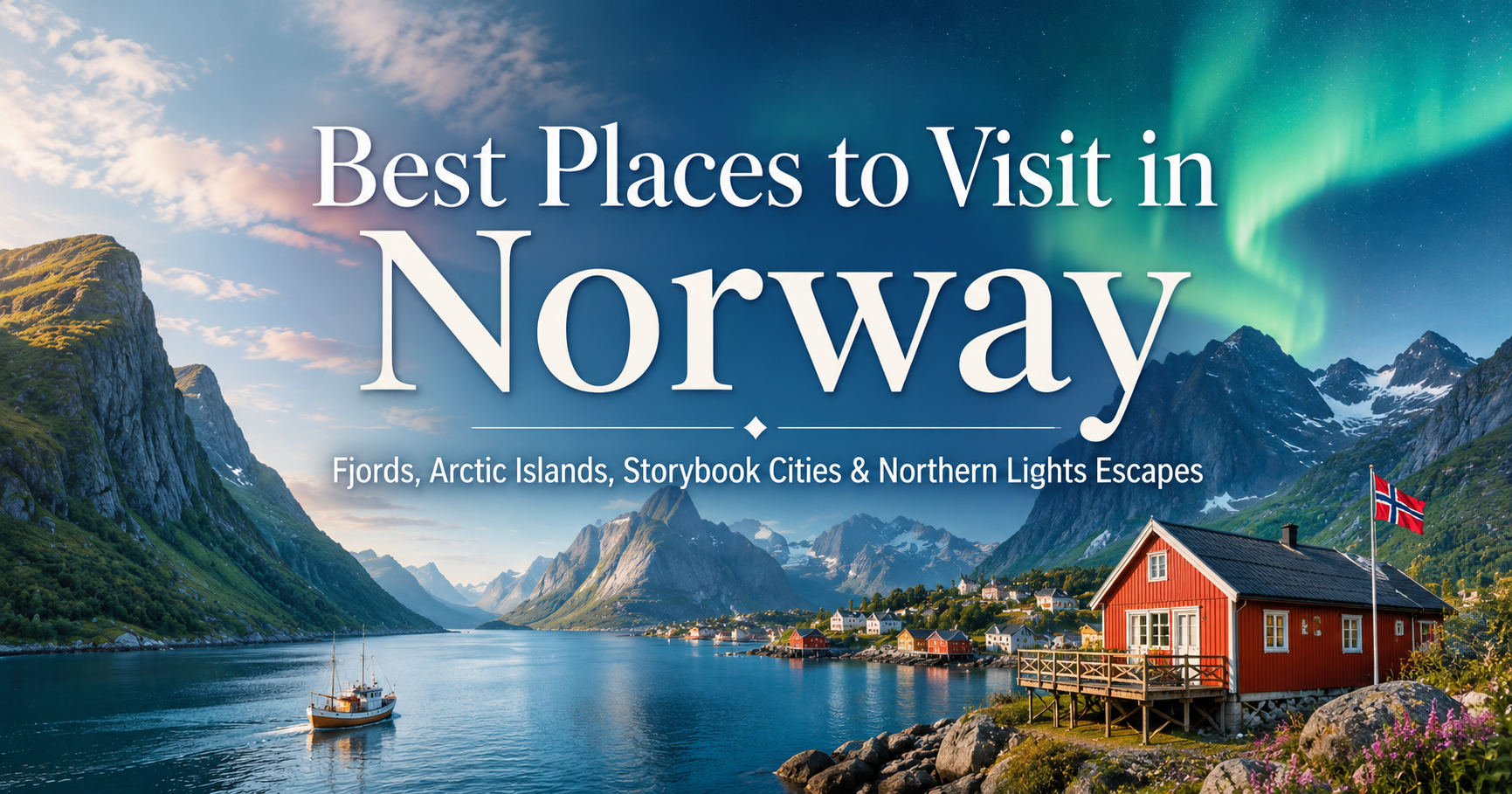
Norway is one of those countries that feels almost impossible to describe without sounding dramatic. The landscapes really are that big, that blue, that steep, that icy, that cinematic. It is a place of deep fjords, painted fishing villages, Arctic islands, mountain railways, waterfall valleys, cozy harbor cities, midnight sun summers, and winter skies that can suddenly glow green with the northern lights.
It is also a country where the mood changes completely depending on where you go. One trip can mean museums, coffee shops, and waterfront architecture in Oslo; another can mean ferry rides through fjords, red cabins in Lofoten, glacier views, snowy Arctic nights in Tromsø, or a slow coastal drive where the road seems to float between sea and sky.
Norway is wonderful for travelers who love scenery, but it is not only a “stand and look at mountains” destination. It can be a romantic trip, a family nature trip, a cruise route, a hiking adventure, a train journey, an Arctic bucket-list escape, a Christmas-season trip, or a slower coastal itinerary built around small towns, good views, and peaceful days near the water.
Here are the best places to visit in Norway if you want fjords, Arctic islands, colorful harbor towns, mountain landscapes, northern lights, scenic rail journeys, and some of the most beautiful natural scenery in Europe.

Oslo

Region notes: Southeastern Norway, at the head of the Oslofjord. Oslo is Norway’s capital and the country’s main international arrival city, making it one of the easiest places to begin or end a Norway itinerary.
What kind of place it is: A modern waterfront capital with museums, islands, parks, restaurants, design, royal history, contemporary architecture, and easy access to both city culture and outdoor scenery.
Best for: Couples, solo travelers, families, museum lovers, food lovers, design travelers, easy arrival days, and travelers who want a softer landing before heading into fjords, mountains, or the Arctic.
Oslo is the practical starting point for many Norway trips, but it is also worth enjoying as a real destination. This is where Norway’s sleek modern side comes through most clearly: waterfront promenades, floating saunas, glassy architecture, island ferries, excellent museums, and neighborhoods that feel calm, clean, and easy to explore.
The city has a lovely balance of culture and fresh air. You can spend the morning in a museum, walk along the harbor in the afternoon, take a ferry to nearby islands, and still feel like you are getting a taste of Norway’s nature without leaving the capital.
Main highlights:
- Oslo Opera House: One of the city’s most recognizable modern landmarks, with a walkable roof and beautiful waterfront views.
- MUNCH: A major art museum dedicated to Edvard Munch and a strong stop for travelers who love art, design, and modern museum spaces.
- Vigeland Sculpture Park: A large open-air sculpture park that gives Oslo one of its most memorable city experiences.
- Bygdøy museums: A museum-rich peninsula with maritime, polar, and cultural history.
- Oslofjord islands: Easy ferry trips that add a softer, summery side to the capital.
Why I recommend it: Oslo works beautifully as the opening chapter of a Norway trip. It gives you culture, comfort, good food, and waterfront beauty before the country turns wilder, steeper, and more remote.
Don’t miss:
- Walking along the waterfront around the Opera House and MUNCH.
- Taking a ferry if you have good weather and want a simple Oslofjord experience.
- Giving yourself time for at least one major museum instead of treating Oslo as only a transit stop.
- Enjoying the city’s café and restaurant scene before heading into smaller towns.
Good to Know / Side Notes:
- Oslo is one of the easiest places in Norway for arrival, departure, and train connections.
- It is a good first stop if you want a smooth start before heading toward Bergen, Flåm, Trondheim, Tromsø, or the fjords.
- The city is spread out enough that hotel location matters, especially if you want to walk easily.
- Oslo can be expensive, so it helps to plan meals and museum days thoughtfully.
Bergen

Region notes: Western Norway, on the coast between mountains and fjords. Bergen is one of Norway’s most important gateway cities for fjord trips and coastal itineraries.
What kind of place it is: A colorful harbor city known for Bryggen’s historic wooden buildings, mountain views, seafood, rainy atmosphere, and easy access to some of Norway’s most famous fjord scenery.
Best for: Couples, photographers, cruise travelers, food lovers, history lovers, fjord itineraries, train travelers, and anyone who wants a classic Norway city with instant atmosphere.
Bergen feels like Norway wrapped in color, rain, mountains, and harbor light. The city sits between the sea and steep green hills, with colorful wooden buildings along the waterfront and a cozy maritime mood that makes cloudy weather feel like part of the charm.
This is one of the best places in Norway for travelers who want city atmosphere and fjord access in the same stop. Bergen has enough museums, restaurants, seafood, shops, and viewpoints to justify a stay, but it also works beautifully as a launching point for fjord cruises, scenic rail routes, and deeper western Norway adventures.
Main highlights:
- Bryggen: Bergen’s famous historic waterfront, with colorful wooden buildings and old Hanseatic trading history.
- Fløibanen funicular: An easy ride up Mount Fløyen for city, harbor, and mountain views.
- Fish market and seafood restaurants: A natural fit in a coastal city with strong maritime roots.
- Bergenhus Fortress: A historic area near the harbor that adds another layer to the city.
- Fjord access: Bergen is one of the easiest bases for exploring western Norway’s fjords.
Why I recommend it: Bergen is one of Norway’s most rewarding city stays because it feels both practical and romantic. It gives you a real city, a beautiful harbor, historic architecture, mountain views, and direct access to the fjord landscapes many travelers come to Norway to see.
Don’t miss:
- Walking Bryggen early or later in the day when it feels calmer.
- Riding up Mount Fløyen if the weather is clear enough for views.
- Trying seafood or a cozy harbor meal.
- Building at least one fjord day around Bergen if your itinerary allows.
Good to Know / Side Notes:
- Bergen is famously rainy, so bring a real rain jacket and shoes that can handle wet streets.
- The city pairs beautifully with Flåm, Nærøyfjord, Hardangerfjord, and the Norway in a Nutshell-style rail/fjord route.
- Staying near the harbor can make sightseeing easier and more atmospheric.
- Bergen is especially useful if you want a trip that blends city comfort with big scenery.
Geirangerfjord

Region notes: Western Norway, in the Sunnmøre region of Møre og Romsdal. Geirangerfjord is one of Norway’s most famous fjords and a major scenic highlight on many cruise and road-trip itineraries.
What kind of place it is: A dramatic fjord landscape with steep cliffs, waterfalls, tiny farms, deep blue water, viewpoints, and classic Norway postcard scenery.
Best for: Couples, photographers, cruise travelers, scenic road trips, nature lovers, fjord lovers, bucket-list travelers, and anyone who wants one of Norway’s most iconic views.
Geirangerfjord is the kind of place people picture when they imagine Norway at its most dramatic. The fjord is narrow, steep, and intensely scenic, with waterfalls dropping down the cliffs and mountains rising almost straight from the water. It feels grand in a way that is hard to fake.
This is one of the best places in Norway for pure visual impact. You do not need a complicated plan for Geirangerfjord to impress you. The whole point is the setting: the water, the cliffs, the curves of the road, the viewpoints, and that feeling of being very small in a landscape that is doing all the talking.
Main highlights:
- Seven Sisters Waterfall: One of the fjord’s signature sights, especially beautiful from the water.
- Geiranger village: A small fjord-side base surrounded by dramatic scenery.
- Ørnesvingen viewpoint: A classic overlook with sweeping views down the fjord.
- Flydalsjuvet viewpoint: One of the most famous viewpoints above Geiranger.
- Scenic drives: The roads around Geiranger add just as much drama as the fjord itself.
Why I recommend it: Geirangerfjord belongs on a Norway list because it gives travelers that full “I cannot believe this is real” fjord moment. It is famous, yes, but it delivers the scale, beauty, and drama people hope for when planning a Norway trip.
Don’t miss:
- Seeing the fjord from a viewpoint, not only from the water.
- Taking a fjord cruise or boat ride if your schedule allows.
- Leaving time for the road views around Geiranger.
- Watching the light change over the cliffs if you stay overnight.
Good to Know / Side Notes:
- Geiranger can be busy during cruise season, so timing matters.
- Roads and access can be seasonal, especially around higher mountain routes.
- Staying overnight gives you a quieter experience than a rushed cruise or day stop.
- This is a scenery-first destination, so weather can change the mood of the whole visit.
Nærøyfjord & Flåm

Region notes: Western Norway, in the Sognefjord region. Flåm sits at the end of Aurlandsfjord, close to Nærøyfjord, and is one of Norway’s most popular scenic rail-and-fjord gateways.
What kind of place it is: A compact fjord village and scenic travel hub known for the Flåm Railway, fjord cruises, mountain scenery, waterfalls, and classic Norway rail-and-boat itineraries.
Best for: Train lovers, fjord lovers, couples, older travelers who want scenery without extreme hiking, families, cruise travelers, photographers, and anyone who wants a very accessible fjord experience.
Flåm is small, but it sits in one of the most beautiful travel corridors in Norway. This is where rail journeys, fjord cruises, mountain views, and easy logistics come together in a way that makes Norway feel beautifully doable. For many travelers, Flåm is the place where the trip suddenly becomes the Norway they dreamed about.
Nærøyfjord is the showpiece here: narrow, steep, and incredibly atmospheric, with cliffs and mountains pressing close to the water. Paired with the Flåm Railway, this area is one of the best places in Norway for travelers who want huge scenery without needing to plan a rugged outdoor expedition.
Main highlights:
- Flåm Railway: One of Norway’s most famous scenic train rides, climbing between fjord and mountain scenery.
- Nærøyfjord: A narrow, dramatic fjord with steep walls and beautiful water-level views.
- Aurlandsfjord: The fjord arm around Flåm, with calm water and mountain scenery.
- Stegastein viewpoint: A dramatic overlook above Aurlandsfjord.
- Fjord cruises: An easy way to experience the scale and mood of the landscape.
Why I recommend it: Nærøyfjord and Flåm are ideal for travelers who want Norway’s fjord magic in a format that is scenic, memorable, and relatively easy to organize. It is popular because it works.
Don’t miss:
- Riding the Flåm Railway if it fits your route.
- Seeing Nærøyfjord from the water.
- Going up to Stegastein viewpoint for a big fjord perspective.
- Giving yourself enough time so this area does not feel like a transportation checklist.
Good to Know / Side Notes:
- Flåm is small and popular, so lodging can book up early.
- This area pairs naturally with Bergen, Oslo, Voss, and Sognefjord routes.
- It is a great pick for travelers who want fjord scenery without needing a car for every moment.
- The experience can feel very different depending on season, weather, and cruise traffic.
Lofoten Islands

Region notes: Northern Norway, above the Arctic Circle. The Lofoten Islands stretch into the Norwegian Sea and are known for fishing villages, mountains, beaches, and dramatic Arctic coastal scenery.
What kind of place it is: A breathtaking Arctic island chain with red fishing cabins, sharp mountains, white-sand beaches, tiny villages, fishing culture, road-trip views, summer midnight sun, and winter northern lights potential.
Best for: Photographers, couples, road-trippers, outdoor travelers, hikers, beach lovers who do not need tropical water, northern lights travelers, midnight sun travelers, and anyone who wants Norway at its most wildly beautiful.
Lofoten is one of the most magical places in Norway. It has the kind of scenery that feels unreal even when you are standing inside it: jagged mountains rising from the sea, red rorbuer cabins along the water, fishing racks, glassy bays, white beaches, and tiny villages tucked between rock and ocean.
This is a dream destination for travelers who love dramatic landscapes but still want cozy places to stay and villages with real character. Lofoten feels remote and cinematic, but also deeply human because of its fishing culture, cabins, harbors, and small communities. It is Norway with wild edges and a beating heart.
Main highlights:
- Reine: One of Lofoten’s most iconic villages, surrounded by mountains and water.
- Hamnøy: A postcard-famous fishing village with classic red cabin views.
- Henningsvær: A lively island village known for galleries, cafés, harbor life, and dramatic setting.
- Arctic beaches: White-sand beaches like Haukland and Uttakleiv give Lofoten a surreal sea-and-mountain beauty.
- Scenic drives: The islands are full of road-trip views that make even simple transfers feel special.
Why I recommend it: Lofoten is one of Norway’s most unforgettable regions because it combines Arctic drama, coastal culture, village charm, and astonishing scenery in one place. It is the kind of destination that can become the emotional center of a Norway trip.
Don’t miss:
- Staying in or near a fishing village if you can.
- Planning time for slow drives and photo stops.
- Seeing at least one beach, even if you are visiting in cold weather.
- Choosing your season intentionally: summer for midnight sun energy, winter for snow and northern lights possibilities.
Good to Know / Side Notes:
- Lofoten rewards slow travel; rushing through it can make the logistics feel bigger than the joy.
- Weather changes quickly, so flexible plans help.
- Renting a car makes the islands much easier to experience.
- Summer is gorgeous and popular; winter is moodier, quieter, and more weather-dependent.
Tromsø

Region notes: Northern Norway, above the Arctic Circle. Tromsø sits in Arctic Norway and is one of the country’s most popular bases for northern lights trips and winter experiences.
What kind of place it is: A lively Arctic city with northern lights access, fjord scenery, museums, restaurants, winter tours, Sami culture experiences, whale-watching season, and a surprisingly energetic city feel.
Best for: Northern lights travelers, winter trips, couples, friend trips, solo travelers, Arctic bucket-list trips, food lovers, soft-adventure travelers, and anyone who wants an Arctic experience with city comfort.
Tromsø is one of the best places in Norway for travelers who want the Arctic without feeling completely isolated. It has snow, fjords, mountains, polar history, and northern lights potential, but it also has restaurants, cafés, hotels, museums, shops, and a lively city rhythm that makes winter feel exciting instead of intimidating.
This is a wonderful base for guided Arctic experiences. You can chase the northern lights, take a fjord tour, learn about polar exploration, ride the cable car, try winter activities, and still come back to a real city at the end of the day. Tromsø makes the far north feel thrilling and surprisingly accessible.
Main highlights:
- Northern lights tours: Tromsø is one of Norway’s best-known bases for aurora chasing.
- Fjellheisen cable car: A classic viewpoint over the city, islands, mountains, and water.
- Arctic Cathedral: One of Tromsø’s most recognizable architectural landmarks.
- Polar history: Museums and local history connect the city to Arctic exploration.
- Winter experiences: Dog sledding, reindeer visits, snow activities, fjord tours, and whale-season trips can all fit into a Tromsø itinerary.
Why I recommend it: Tromsø is one of Norway’s best Arctic gateways because it gives travelers both adventure and comfort. You can have a snowy, bucket-list northern lights trip without giving up restaurants, hotels, and city ease.
Don’t miss:
- Building in more than one night for northern lights chances.
- Taking the cable car if the weather is clear.
- Leaving room for one meaningful Arctic experience instead of overbooking every day.
- Enjoying Tromsø as a city, not only as a tour departure point.
Good to Know / Side Notes:
- Northern lights are never guaranteed, so multiple nights help.
- Winter weather can affect tours and visibility.
- Tromsø is also interesting in summer, when the midnight sun gives the city a completely different mood.
- Warm layers matter here, especially if you plan to stand outside at night waiting for auroras.
Svalbard

Region notes: Far northern Norway, between mainland Norway and the North Pole. Svalbard is an Arctic archipelago with Longyearbyen as the main settlement for travelers.
What kind of place it is: A remote polar destination with glaciers, tundra, polar night, midnight sun, expedition-style tours, wildlife, snowmobiles, and a true edge-of-the-world feeling.
Best for: Bucket-list travelers, adventurous couples, photographers, polar travelers, wildlife lovers, expedition-cruise travelers, northern lights travelers, and anyone who wants a rare Arctic experience.
Svalbard is Norway at its most extreme. This is not just a pretty northern destination; it is a true polar world of glaciers, snow, wide-open tundra, dark winter skies, summer midnight sun, and a sense of remoteness that feels completely different from mainland Norway.
Longyearbyen gives travelers a practical base, but the real draw is the landscape beyond town. Svalbard is for travelers who want to feel the edge of the map: frozen valleys, boat trips, snowmobile routes, wildlife possibilities, and light that changes the entire mood of the place depending on the season.
Main highlights:
- Longyearbyen: The main town and travel base, with hotels, restaurants, museums, and tour operators.
- Polar landscapes: Glaciers, mountains, tundra, fjords, and snowfields create a stark Arctic beauty.
- Midnight sun and polar night: Svalbard’s light cycles make the same destination feel completely different by season.
- Wildlife-focused excursions: Guided trips may focus on birds, walrus, Arctic fox, reindeer, or polar bear safety landscapes.
- Expedition-style tours: Boat trips, snowmobile tours, ice cave visits, and guided outdoor experiences define many Svalbard itineraries.
Why I recommend it: Svalbard is one of the most unforgettable places connected to Norway because it feels genuinely different from almost anywhere else travelers are likely to go. It is wild, strange, beautiful, and deeply atmospheric.
Don’t miss:
- Choosing your season carefully based on the experience you want.
- Visiting the local museum to understand the place before heading out on tours.
- Booking guided excursions rather than treating the landscape casually.
- Taking time to notice the light, silence, and scale of the Arctic environment.
Good to Know / Side Notes:
- You cannot explore outside Longyearbyen casually because of polar bear safety rules and Arctic conditions.
- Svalbard is best approached as a guided, expedition-style destination.
- Weather and seasonal light make a huge difference in what you can do.
- This is a bucket-list add-on, not a simple “while I’m nearby” stop.
Ålesund

Region notes: Western Norway, on the coast in Møre og Romsdal. Ålesund sits across several islands and is a natural base for exploring nearby fjord and coastal scenery.
What kind of place it is: A stylish coastal city known for Art Nouveau architecture, island views, seafood, harbor scenery, and access to some of Norway’s most beautiful western landscapes.
Best for: Couples, photographers, architecture lovers, coastal road-trippers, seafood lovers, cruise travelers, and anyone who wants a beautiful small city with a different look from Bergen or Oslo.
Ålesund is one of Norway’s prettiest coastal cities. It has a very specific visual identity thanks to its Art Nouveau architecture, harbor setting, and island layout. Instead of feeling like a generic small city, Ålesund feels elegant, salty, scenic, and easy to love.
This is a wonderful place to include if you want Norway’s coastal side with more polish and architectural detail. The city has beautiful viewpoints, a handsome center, good seafood energy, and easy access to dramatic scenery in the wider Sunnmøre region.
Main highlights:
- Art Nouveau architecture: Ålesund’s central streets give the city a distinctive, elegant look.
- Aksla viewpoint: A classic overlook with views of the town, islands, water, and mountains.
- Harbor atmosphere: The city’s relationship with the sea is part of its charm.
- Seafood and coastal dining: Ålesund is a natural fit for travelers who love fresh coastal food.
- Fjord and island access: The surrounding region adds big scenic value to a stay here.
Why I recommend it: Ålesund adds a refined coastal-city stop to a Norway itinerary. It is beautiful, manageable, scenic, and distinctive enough to stand apart from the country’s larger or more obvious city stops.
Don’t miss:
- Going up to Aksla viewpoint for the full city-and-islands view.
- Walking the Art Nouveau center slowly enough to notice the details.
- Eating seafood if you enjoy coastal food.
- Using Ålesund as a base if your route includes Sunnmøre scenery or Geirangerfjord.
Good to Know / Side Notes:
- Ålesund works well for travelers who want a smaller city with strong atmosphere.
- It pairs nicely with Geirangerfjord, coastal driving routes, and western Norway itineraries.
- The viewpoint involves stairs if you walk up, though there are easier ways to access views depending on your plan.
- This is a good stop for travelers who care about both scenery and architecture.
Stavanger & Lysefjord

Region notes: Southwestern Norway, along the coast. Stavanger is a historic coastal city and a major base for visiting Lysefjord and Preikestolen.
What kind of place it is: A charming coastal city with old wooden houses, harbor life, restaurants, street art, oil history, and easy access to one of Norway’s most famous fjord viewpoints.
Best for: Hikers, couples, friend trips, cruise travelers, photographers, food lovers, coastal city stays, and travelers who want a mix of town charm and outdoor drama.
Stavanger gives you a different kind of Norway experience: coastal, colorful, and a little warmer in mood. The old town has white wooden houses and pretty streets, the harbor gives the city a lively edge, and the restaurant scene makes it a good place to linger rather than only pass through.
The big scenic draw is Lysefjord, especially Preikestolen, the famous cliff viewpoint above the fjord. But Stavanger itself also deserves attention. It is an attractive city base with enough charm, food, history, and waterfront atmosphere to make the fjord adventure feel anchored in a real place.
Main highlights:
- Gamle Stavanger: The old town area with charming white wooden houses and cobbled streets.
- Stavanger harbor: A lively waterfront area with restaurants, boats, and city energy.
- Lysefjord: A dramatic fjord landscape close to Stavanger.
- Preikestolen: One of Norway’s most famous cliff viewpoints for travelers who want an iconic hike.
- Street art and museums: Stavanger has creative and cultural layers beyond its outdoor access.
Why I recommend it: Stavanger is one of the best places in Norway for travelers who want a city stay and a major nature experience in the same route. It gives you coastal charm, good food, and access to one of Norway’s most recognizable fjord views.
Don’t miss:
- Walking Gamle Stavanger.
- Spending time around the harbor.
- Planning Lysefjord or Preikestolen carefully if that is a priority.
- Giving Stavanger enough time to feel like a stay, not only a staging point.
Good to Know / Side Notes:
- Preikestolen is a real hike and should be planned with weather, footwear, and fitness in mind.
- Stavanger works well for cruise travelers and road-trippers.
- The city has a strong food scene for travelers who want a more urban coastal stop.
- Lysefjord scenery can be enjoyed in different ways, including by boat if hiking is not the goal.
Trondheim

Region notes: Central Norway, on the Trøndelag coast. Trondheim sits between southern Norway and the far north, making it a meaningful cultural and geographic stop on longer itineraries.
What kind of place it is: A historic city with a major cathedral, colorful riverside warehouses, student energy, cozy neighborhoods, food culture, and a strong sense of Norwegian heritage.
Best for: History lovers, food lovers, couples, solo travelers, train travelers, slower itineraries, architecture lovers, and anyone who wants a Norwegian city with depth and character.
Trondheim is one of Norway’s most rewarding historic cities. It has a softer, older feeling than Oslo and a more relaxed rhythm than some of the big fjord gateways. The city is known for Nidaros Cathedral, colorful wooden buildings along the river, and a lively student population that keeps it from feeling too formal.
This is a great stop for travelers who want Norway’s cultural story, not only its landscapes. Trondheim has history, architecture, food, cafés, neighborhoods, and enough warmth to make it feel like a real lived-in city rather than a checklist destination.
Main highlights:
- Nidaros Cathedral: One of Norway’s most important religious and historic landmarks.
- Bakklandet: A charming neighborhood with wooden houses, cafés, and cozy streets.
- Old Town Bridge: A classic city view over the river and colorful warehouses.
- Trøndelag food culture: Trondheim is a strong choice for travelers who care about food.
- Student-city energy: The university presence gives the city a youthful, lively feel.
Why I recommend it: Trondheim adds historical depth and warmth to a Norway itinerary. It is especially good for travelers who want a city that feels charming, meaningful, and very Norwegian without being only about scenery.
Don’t miss:
- Visiting or at least seeing Nidaros Cathedral.
- Walking through Bakklandet.
- Crossing the Old Town Bridge for the classic river view.
- Making time for a good meal or café stop.
Good to Know / Side Notes:
- Trondheim pairs well with train travel, coastal routes, and longer north-south itineraries.
- It is a good city for travelers who like atmosphere but do not want a giant urban stop.
- The city is very seasonal in mood, with cozy winter charm and long-light summer energy.
- It can work as a smart break between fjord country and Arctic Norway.
Røros

Region notes: Central Norway, inland in Trøndelag near the Swedish border. Røros is a historic mountain town known for mining heritage, wooden buildings, and winter atmosphere.
What kind of place it is: A preserved historic town with colorful wooden houses, mining history, snowy streets, artisan shops, cozy cafés, and a strong old-Norway feeling.
Best for: Winter travelers, history lovers, photographers, couples, Christmas-market travelers, slow travelers, road-trippers, and anyone who loves atmospheric small towns.
Røros feels like stepping into a Nordic winter story, especially when snow covers the streets and wooden houses glow with warm light. It is one of Norway’s most atmospheric small towns, with a strong sense of history and a cozy, handmade quality that feels very different from fjords and big-city waterfronts.
This is a wonderful choice for travelers who like heritage towns, craft shops, old streets, and places that reward slow wandering. Røros is not about dramatic cliffs or huge fjord views. Its magic is quieter: wooden buildings, mountain air, mining history, and that feeling of being somewhere preserved with care.
Main highlights:
- Historic wooden town center: Røros is known for its beautifully preserved old buildings and streets.
- Mining heritage: The town’s history gives it a distinct identity and cultural depth.
- Winter atmosphere: Snow makes Røros especially magical.
- Artisan shops and cafés: A good fit for slow travelers who like browsing and cozy stops.
- Mountain setting: The inland location gives Røros a different landscape mood from coastal Norway.
Why I recommend it: Røros gives a Norway itinerary texture. It adds small-town charm, heritage, winter beauty, and a slower pace that balances the fjords, cities, and Arctic icons.
Don’t miss:
- Walking the historic center slowly.
- Visiting in winter if you want the most atmospheric version of the town.
- Learning a little about the mining history so the place feels more meaningful.
- Leaving time for cafés, shops, and quiet streets.
Good to Know / Side Notes:
- Røros is especially appealing in winter and around seasonal markets.
- Its inland location means it fits best into specific routes rather than every Norway itinerary.
- Weather can be cold and snowy, so pack accordingly.
- This is a mood-and-history destination more than a big-sightseeing checklist stop.
Hardangerfjord

Region notes: Western Norway, southeast of Bergen. Hardangerfjord is one of Norway’s major fjord regions, known for orchards, waterfalls, villages, mountains, and scenic drives.
What kind of place it is: A beautiful fjord region with fruit orchards, waterfalls, mountain views, small towns, spring blossoms, summer scenery, and a softer alternative to Norway’s most famous fjord corridors.
Best for: Couples, road-trippers, photographers, slow travelers, nature lovers, food-and-scenery trips, spring travelers, and anyone who wants fjord beauty with a gentler rhythm.
Hardangerfjord is one of the loveliest places in Norway for travelers who want fjord scenery with a slightly softer, more pastoral feeling. The landscapes are still dramatic, but the orchards, villages, waterfalls, and seasonal blossoms give the region a more romantic, lived-in quality.
This is a beautiful area for slower travel. Instead of racing from one famous viewpoint to another, Hardangerfjord invites you to drive, stop, look across the water, visit small communities, taste local fruit products, and enjoy the way fjord scenery changes with the light.
Main highlights:
- Fjord views: Hardangerfjord gives travelers classic western Norway water-and-mountain scenery.
- Fruit orchards: The region is especially known for apples, cider, and blossom-season beauty.
- Waterfalls: Hardanger has several dramatic waterfalls that add power to the landscape.
- Small towns and villages: The area works well for travelers who like scenic bases instead of only major cities.
- Scenic drives: Roads around the fjord make the journey part of the experience.
Why I recommend it: Hardangerfjord is a wonderful fjord-region pick because it feels beautiful, romantic, and a little more relaxed. It is especially good for travelers who want scenery without making every day feel like a bucket-list sprint.
Don’t miss:
- Visiting during blossom season if your timing works.
- Planning a scenic drive with enough time for stops.
- Trying local cider or fruit products if that appeals to you.
- Pairing Hardangerfjord with Bergen or a wider western Norway itinerary.
Good to Know / Side Notes:
- A car makes Hardangerfjord much easier to enjoy at your own pace.
- Spring and summer are especially beautiful here.
- This is a strong choice for travelers who like landscapes, villages, food, and slower days.
- Some roads and mountain routes can be seasonal, so check routes when planning.
Senja

Region notes: Northern Norway, above the Arctic Circle. Senja is an island between Tromsø and the Vesterålen/Lofoten region, known for wild coastal scenery and dramatic roads.
What kind of place it is: A rugged Arctic island with mountains, beaches, fishing villages, scenic viewpoints, winding roads, and a wilder, quieter feeling than Norway’s most famous island destinations.
Best for: Road-trippers, photographers, couples, outdoor travelers, Arctic scenery lovers, northern lights travelers, midnight sun travelers, and anyone who wants a raw, cinematic Norway experience.
Senja is one of Norway’s most spectacular island destinations. It has the sharp mountains, beaches, fjords, and wild Arctic coastline travelers dream about, but with a quieter rhythm that makes the scenery feel even more powerful. This is a place for road trips, viewpoints, weather, and wide-open views.
The island is sometimes described as Norway in miniature, and that makes sense when you see how much variety is packed into one place. You can move from dramatic coast to mountain road to fishing village to beach view without feeling like you are repeating the same landscape all day.
Main highlights:
- Norwegian Scenic Route Senja: A beautiful driving route with viewpoints, coastal scenery, and mountain views.
- Bergsbotn viewing platform: A dramatic overlook with sweeping views of mountains and water.
- Tungeneset: A striking coastal viewpoint with views toward jagged peaks.
- Arctic beaches: Senja’s beaches feel wild, cold, and beautiful rather than tropical.
- Fishing villages and quiet coastal stops: Small communities give the island texture and atmosphere.
Why I recommend it: Senja is a fantastic Norway pick for travelers who want Arctic beauty with a little more breathing room. It feels wild, scenic, and deeply atmospheric in a way that can make a trip feel more personal.
Don’t miss:
- Driving the scenic route slowly.
- Stopping at viewpoints even when the weather is moody.
- Planning for changing conditions instead of overloading the day.
- Considering Senja as an add-on to Tromsø or a longer northern Norway route.
Good to Know / Side Notes:
- A car is strongly recommended for Senja.
- Weather can change quickly and affect visibility.
- Senja works beautifully in summer for road trips and in winter for snowy Arctic mood.
- It is best for travelers who are comfortable with quieter, more nature-focused travel.
Jotunheimen National Park

Region notes: Southern Norway, inland between Oslo, Bergen, and Trondheim route corridors. Jotunheimen is one of Norway’s most important mountain regions.
What kind of place it is: A high mountain national park with peaks, valleys, lakes, glaciers, hiking routes, scenic roads, and some of Norway’s most impressive alpine landscapes.
Best for: Hikers, active travelers, photographers, road-trippers, nature lovers, mountain travelers, summer adventure trips, and anyone who wants Norway beyond the fjords.
Jotunheimen is Norway in giant mode. The name means “home of the giants,” and the landscape lives up to it: high peaks, deep valleys, cold lakes, glaciers, and roads that make you feel like you have entered a much wilder version of Scandinavia.
This is one of the best places in Norway for travelers who want mountains as the main event. It is especially rewarding in summer, when hiking routes open up and the landscape becomes a playground for active travelers. Even if you are not planning a major trek, the scenery itself is worth building into a road trip.
Main highlights:
- Besseggen ridge: One of Norway’s famous hiking routes, known for dramatic lake and mountain views.
- Galdhøpiggen area: The region includes Norway’s highest mountain area.
- Mountain roads: Scenic routes through and around Jotunheimen make the journey memorable.
- Lakes and valleys: The park’s landscapes are varied and deeply photogenic.
- Hiking lodges and mountain stays: A good fit for travelers who want a more outdoorsy Norway experience.
Why I recommend it: Jotunheimen adds big mountain drama to a Norway itinerary. It is ideal for travelers who love hiking, alpine scenery, and the feeling of being surrounded by rugged landscapes.
Don’t miss:
- Planning hikes according to your actual fitness and the weather.
- Building in scenic drives even if you are not doing a major trek.
- Staying near the mountains if you want sunrise, sunset, or less rushed scenery.
- Bringing proper layers, even in summer.
Good to Know / Side Notes:
- Jotunheimen is seasonal for many travelers, with summer being the easiest hiking period.
- Weather can be serious in the mountains, so casual city clothing is not enough.
- This is a destination where planning matters more than in easy city stops.
- It pairs well with road trips between Oslo, Bergen, and central Norway.
The Atlantic Road

Region notes: Western Norway, along the coast in Møre og Romsdal. The Atlantic Road connects small islands and skerries between the Molde and Kristiansund area.
What kind of place it is: A dramatic coastal driving route with bridges, ocean views, rocky islands, sea spray, fishing spots, and a road-trip feeling that is completely different from Norway’s fjord valleys.
Best for: Road-trippers, photographers, couples, coastal scenery lovers, architecture-and-engineering fans, slow travelers, and anyone who wants one of Norway’s most memorable drives.
The Atlantic Road is short, but it has a big personality. This is Norway where the road feels stitched across the sea, curving over bridges and islands with open water on every side. On calm days, it is beautiful and peaceful. In stormy weather, it can feel wildly cinematic.
This is a great place to include in a western Norway road trip because it gives a different kind of scenery from the fjords. Instead of steep cliffs and narrow water, you get the open Atlantic, low rocky islands, bridges, waves, and that feeling of traveling at the edge of the ocean.
Main highlights:
- Storseisundet Bridge: The most famous bridge along the route, known for its dramatic curve.
- Coastal viewpoints: Pull-offs and paths let you stop and take in the sea views.
- Ocean scenery: The Atlantic setting gives the drive a wild, exposed feeling.
- Nearby towns: Molde and Kristiansund can help anchor the route.
- Road-trip atmosphere: The journey itself is the main highlight.
Why I recommend it: The Atlantic Road is one of Norway’s most memorable scenic drives because it feels so different from the fjord landscapes. It adds ocean drama, movement, and a strong sense of place to a coastal itinerary.
Don’t miss:
- Driving it slowly instead of treating it as a quick checkmark.
- Stopping at viewpoints and walking areas when weather allows.
- Pairing it with Ålesund, Molde, Kristiansund, or a wider coastal route.
- Seeing how different it feels in calm weather versus wild weather.
Good to Know / Side Notes:
- The Atlantic Road is relatively short, so it works best as part of a larger road trip.
- Weather shapes the experience in a big way.
- This is a road-and-scenery stop, not a full multi-day destination by itself for most travelers.
- It is a good add-on for travelers who want Norway’s coastal drama beyond fjords.
Kristiansand & Southern Norway

Region notes: Southern Norway, along the Skagerrak coast. Kristiansand is one of the main cities in Norway’s sunnier south and works as a gateway to coastal towns, islands, beaches, and family-friendly summer travel.
What kind of place it is: A relaxed southern coastal city with beaches, islands, harbor life, family attractions, summer energy, and a softer seaside feel than Norway’s dramatic western and northern landscapes.
Best for: Families, summer travelers, beach-and-coast lovers, road-trippers, slower trips, travelers with kids, and anyone who wants a gentler Norwegian seaside experience.
Kristiansand and southern Norway show a softer side of the country. This is not the Norway of towering fjord cliffs or Arctic islands. It is Norway with summer light, harbors, islands, beaches, wooden houses, family-friendly attractions, and an easier coastal rhythm.
This area is especially appealing in summer, when the south feels bright, relaxed, and outdoorsy. It is a good reminder that Norway is not only dramatic landscapes. It can also be charming, sunny, coastal, and very easy to enjoy with children or travelers who want slower days by the water.
Main highlights:
- Kristiansand waterfront: A pleasant coastal city setting with harbor areas, restaurants, and summer atmosphere.
- Bystranda beach: A city beach that adds an easy seaside element to a stay.
- Posebyen: Kristiansand’s old town area with traditional wooden houses.
- Nearby islands and coastal towns: Southern Norway is made for slow coastal exploring.
- Family attractions: Kristiansand is one of Norway’s easier family-friendly city bases.
Why I recommend it: Kristiansand adds variety to a Norway itinerary. It gives travelers a warmer, more relaxed coastal experience and works especially well for summer trips, families, and anyone who wants Norway to feel gentle for a few days.
Don’t miss:
- Walking Posebyen for old wooden-house charm.
- Spending time near the waterfront.
- Exploring nearby coastal towns or islands if you have a car.
- Letting this part of Norway be slower and more summery.
Good to Know / Side Notes:
- Southern Norway is strongest as a summer or warm-weather coastal trip.
- This region pairs well with road trips and family itineraries.
- It is a good contrast to fjord, mountain, and Arctic destinations.
- Kristiansand can be especially useful if you want a Norway trip that is not only intense scenery and long transfers.
Bodø & Saltstraumen

Region notes: Northern Norway, just above the Arctic Circle. Bodø sits on the coast and is a gateway to Lofoten, Arctic landscapes, ferries, and the powerful Saltstraumen maelstrom.
What kind of place it is: A northern coastal city with ferry connections, sea views, street art, Arctic light, access to Lofoten, and one of the world’s strongest tidal currents nearby.
Best for: Lofoten travelers, road-trippers, ferry travelers, photographers, Arctic coast lovers, nature travelers, and anyone who wants a practical northern base with a memorable natural side trip.
Bodø is often used as a gateway, but it has more going on than travelers sometimes expect. It sits in a dramatic northern coastal setting, with big skies, sea air, mountain views, and easy access to ferries, scenic routes, and Arctic adventures.
The standout nearby experience is Saltstraumen, where powerful tidal currents create whirlpools and rushing water. It is a reminder that Norway’s nature is not only about pretty views. Sometimes it is about raw force: water moving with astonishing speed, Arctic light shifting across the sea, and a landscape that feels alive.
Main highlights:
- Saltstraumen: A powerful tidal current and one of the most memorable natural sights near Bodø.
- Lofoten access: Bodø is a major gateway for travelers heading toward the islands.
- Coastal views: The city has a strong northern sea-and-sky atmosphere.
- Street art and cultural stops: Bodø has creative layers that reward travelers who spend a little time here.
- Arctic light: Long summer days and moody winter skies give the region a strong seasonal personality.
Why I recommend it: Bodø is a smart addition for travelers building a northern Norway route. It is practical, scenic, and more interesting than a simple transit point, especially if you make time for Saltstraumen.
Don’t miss:
- Timing a visit to Saltstraumen around the strongest tidal movement.
- Considering Bodø as part of a Lofoten route.
- Taking in the coastal views instead of rushing straight through.
- Leaving room for weather changes if ferries or flights are involved.
Good to Know / Side Notes:
- Bodø is especially useful for travelers connecting to Lofoten.
- Saltstraumen timing matters, so check the tidal schedule before going.
- The city works best as part of a larger northern Norway itinerary.
- It can be a good option if you want Arctic scenery with easier transport connections.
Alta

Region notes: Northern Norway, in Finnmark. Alta sits far north but is more inland and open in feeling than coastal Tromsø, with strong northern lights, Sami culture, and prehistoric rock art connections.
What kind of place it is: A northern lights and Arctic culture destination with rock carvings, winter experiences, wide landscapes, ice/snow activities, and a quieter far-north atmosphere.
Best for: Northern lights travelers, winter travelers, culture lovers, couples, photographers, slower Arctic trips, and travelers interested in Sami culture and ancient history.
Alta is a wonderful far-north choice for travelers who want Arctic Norway with a quieter, more spacious feeling. It does not have Tromsø’s larger city energy, but that is part of the appeal. Alta feels open, snowy, and deeply connected to the northern landscape.
This is one of the best places in Norway for combining northern lights possibilities with culture and history. The rock carvings add a prehistoric layer, Sami culture gives the region living depth, and winter experiences make Alta feel like a true Arctic escape rather than only a place to sleep between tours.
Main highlights:
- Northern lights experiences: Alta is strongly associated with aurora viewing and winter skies.
- Rock carvings: The Alta Museum area connects travelers to ancient northern history.
- Sami culture experiences: A meaningful part of understanding the region.
- Winter activities: Dog sledding, snow-based tours, and Arctic outdoor experiences can shape a visit.
- Wide northern landscapes: Alta has a spacious, far-north beauty that feels different from fjord cities.
Why I recommend it: Alta adds cultural depth to a northern Norway itinerary. It is a strong choice for travelers who want the Arctic to feel quieter, older, and more connected to the land.
Don’t miss:
- Visiting the rock carvings if they are accessible during your season.
- Planning more than one night if northern lights are a priority.
- Choosing at least one cultural or nature-based experience that gives the trip meaning beyond aurora chasing.
- Packing properly for winter if visiting in cold months.
Good to Know / Side Notes:
- Alta is quieter than Tromsø and works best for travelers who like slower, more spacious destinations.
- Seasonal conditions affect what you can see and do.
- Winter is a major draw, but summer has its own long-light appeal.
- Guided experiences can make the region much easier to understand.
Helgeland Coast

Region notes: Northern Norway, south of Bodø and below or around the Arctic Circle depending on your route. The Helgeland Coast stretches along a beautiful island-filled coastline that many international travelers overlook.
What kind of place it is: A scenic coastal region with islands, ferries, mountains, beaches, coastal roads, fishing villages, kayaking, cycling, and a slower island-hopping feel.
Best for: Road-trippers, cyclists, kayakers, photographers, slow travelers, island lovers, coastal scenery fans, and anyone who wants a Norway route that feels special without relying only on the biggest-name stops.
The Helgeland Coast is one of Norway’s most appealing under-the-radar coastal regions. It has islands, ferries, sea views, mountains rising from the water, beaches, and a gentle adventure feeling that makes it ideal for travelers who like moving slowly through beautiful places.
This is a great choice if you want a Norway itinerary with more texture and fewer obvious checklist moments. The joy of the Helgeland Coast is the route itself: ferry crossings, coastal roads, small communities, island views, and that peaceful sense of traveling through a landscape shaped by the sea.
Main highlights:
- Island-hopping routes: Ferries and coastal roads make the journey part of the experience.
- Seven Sisters mountains: A dramatic mountain range and one of the region’s visual anchors.
- Coastal villages: Small settlements add charm and local feeling to the route.
- Beaches and kayaking: The coast has beautiful water-level experiences for active travelers.
- Scenic cycling and driving: This region is ideal for slow movement rather than rushed sightseeing.
Why I recommend it: The Helgeland Coast gives Norway a more personal, less obvious coastal chapter. It is perfect for travelers who want beauty, islands, and sea air without building the entire trip around the most famous places.
Don’t miss:
- Planning ferry connections carefully.
- Leaving enough time for slow coastal travel.
- Stopping for island views, beaches, and small villages.
- Considering this region if Lofoten feels too logistically intense for your trip.
Good to Know / Side Notes:
- This region works best with thoughtful route planning.
- Ferries can shape your schedule, so flexibility helps.
- Summer is especially appealing for island-hopping, kayaking, cycling, and long days.
- It is a beautiful choice for travelers who like quieter coastal travel.
Urnes Stave Church & Sognefjord

Region notes: Western Norway, in the Sognefjord region. Urnes Stave Church sits near the Lustrafjord, a branch of Sognefjord, surrounded by fjord and mountain scenery.
What kind of place it is: A historic stave church destination set in a beautiful fjord landscape, combining medieval wood architecture, cultural heritage, quiet scenery, and old Norway atmosphere.
Best for: History lovers, architecture lovers, couples, slow travelers, photographers, road-trippers, and anyone who wants Norway’s cultural heritage woven into the fjord experience.
Urnes Stave Church is one of those places that adds soul to a Norway itinerary. The fjords are spectacular on their own, but pairing that scenery with medieval wooden architecture makes the landscape feel older, deeper, and more human.
This is a wonderful stop for travelers who like quiet cultural treasures rather than only big viewpoints. The church’s carved wood, age, setting, and sense of preservation make it feel intimate and meaningful. It is the kind of place that reminds you Norway’s beauty is not only natural; it is also built into the way people lived with these landscapes for centuries.
Main highlights:
- Urnes Stave Church: A remarkable medieval wooden church and one of Norway’s most important heritage sites.
- Lustrafjord setting: The church sits in a scenic branch of the larger Sognefjord region.
- Wood-carved details: The architecture gives travelers a close look at Norway’s old craftsmanship.
- Quiet fjord atmosphere: This area feels peaceful and deeply scenic.
- Sognefjord routes: Urnes can fit into a wider fjord itinerary with villages, viewpoints, and scenic roads.
Why I recommend it: Urnes Stave Church adds cultural richness to a fjord trip. It is ideal for travelers who want Norway to feel historic and atmospheric, not only visually spectacular.
Don’t miss:
- Taking time to notice the carved details.
- Pairing the church with nearby fjord scenery instead of treating it as a quick stop.
- Visiting as part of a slower Sognefjord route.
- Checking seasonal opening details before building a day around it.
Good to Know / Side Notes:
- Access can require careful planning depending on your route.
- This is best for travelers who appreciate history, architecture, and quiet places.
- The surrounding fjord scenery is part of the experience.
- Urnes works well as a niche, memorable stop in a larger western Norway itinerary.
What to Pack for Norway
Norway is a layers-and-weather country, even in months that look mild on paper. For fjord days, city walks, scenic rail trips, ferry rides, northern lights nights, and Arctic viewpoints, these are the practical pieces that make the trip easier:
- Lightweight rain jacket
- Compact warm layer or packable puffer
- Compact scarf or wrap
- Warm hat and gloves for colder seasons or northern Norway
- Power bank for long sightseeing days, ferry rides, road trips, and train journeys
- Day bag
- Sunglasses for bright fjord, snow, water, and midnight sun conditions
Best Places to Visit in Norway: Final Thoughts
Norway is a country that rewards travelers who choose their route thoughtfully. You do not have to see every fjord, every island, every Arctic town, or every mountain road in one trip. In fact, Norway is often better when you let each region breathe.
For a classic first Norway route, Oslo, Bergen, Flåm, Nærøyfjord, and one major fjord region make a beautiful starting point. For Arctic magic, Tromsø, Lofoten, Senja, Alta, Bodø, or Svalbard can turn the trip into something much more dramatic. For slower travelers, places like Hardangerfjord, Ålesund, Røros, the Helgeland Coast, and southern Norway add texture, charm, and a sense of discovery.
The best Norway itinerary is not the one that checks off the most places. It is the one that matches the kind of trip you actually want: fjord views, northern lights, coastal roads, mountain hikes, cozy cities, family-friendly summer days, or a once-in-a-lifetime Arctic escape. Norway gives you all of those possibilities. You just have to decide which version of the country is calling you first.