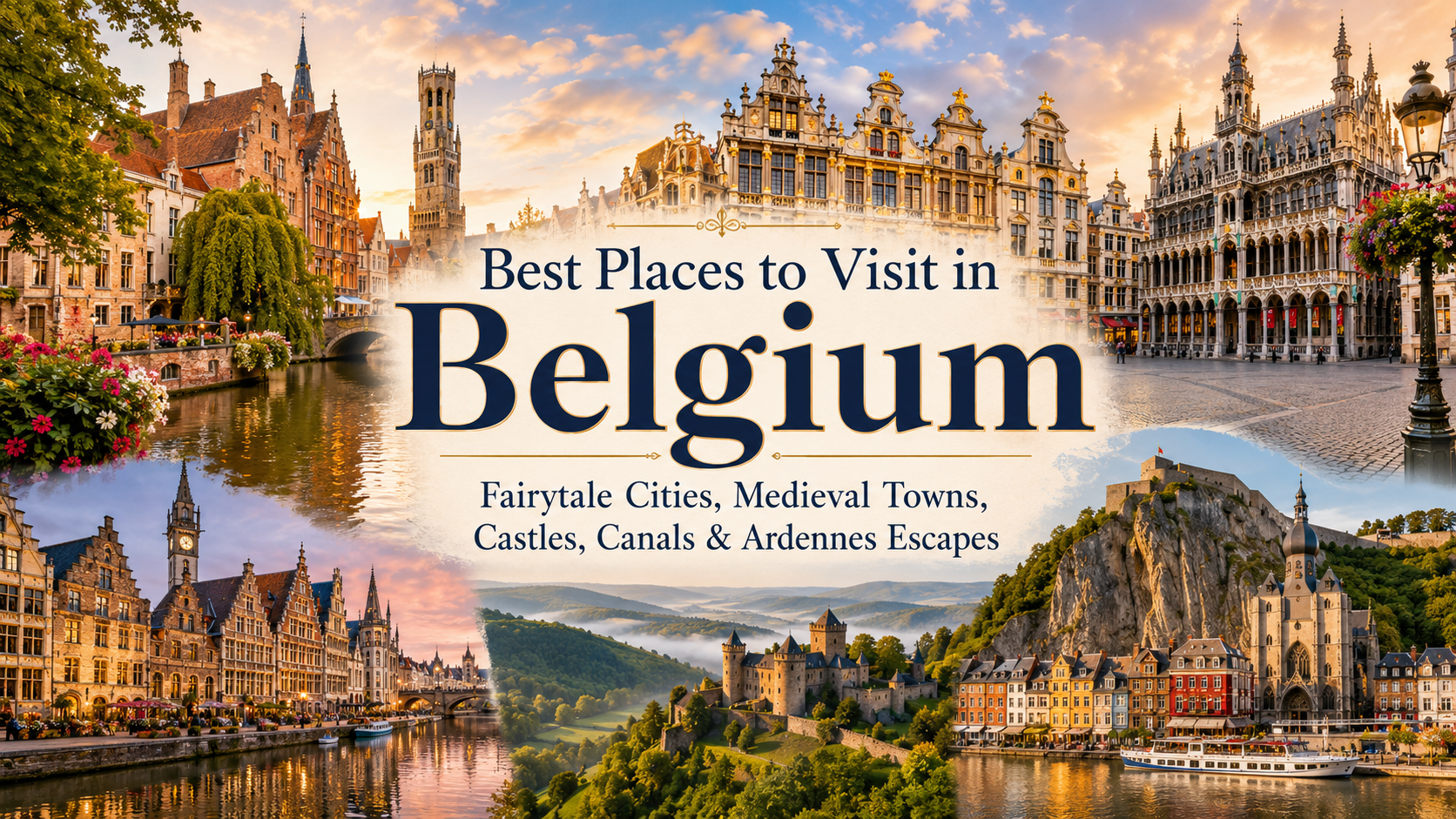
Belgium is one of those European countries that can surprise you if you only think of it as Brussels, Bruges, chocolate, waffles, and beer. Those things are absolutely part of the fun, but Belgium has much more texture than that. You can wander through canal cities that feel almost unreal, visit medieval towers and Gothic squares, follow World War I history through Flanders Fields, explore forested Ardennes towns, soak up old-world spa culture, and still be close enough to move around by train without turning the trip into a logistical puzzle.
It is also a wonderful country for travelers who like variety. Belgium can be a romantic city break, a food trip, a history-heavy itinerary, a castle-and-cobblestone escape, a museum trip, a train-friendly Europe stop, or a deeper route through smaller towns that many travelers skip.
Here are the best places to visit in Belgium if you want fairytale cities, medieval towns, atmospheric squares, castles, canals, forests, and a few wonderfully niche European gems.
Bruges

Region notes: Northwestern Belgium, in West Flanders. Bruges sits in the Flemish part of Belgium and is one of the country’s most famous historic cities, close enough to reach from Brussels, Ghent, Antwerp, or the Belgian coast by train.
What kind of place it is: A fairytale canal city known for medieval streets, romantic bridges, step-gabled buildings, market squares, chocolate shops, and old-world atmosphere.
Best for: Couples, first-time Belgium travelers, photographers, romantic trips, Christmas market travelers, food lovers, history lovers, and anyone who wants the classic fairytale Belgium experience.
Bruges is the Belgium many travelers dream about before they ever arrive. It is all canals, cobblestones, towers, quiet courtyards, horse-drawn carriages, chocolate windows, and medieval buildings reflected in the water. Yes, it is popular. Yes, parts of it can feel busy. But Bruges is famous for a reason.
This is one of the best places in Belgium for travelers who want beauty without having to work too hard for it. The historic center is compact, walkable, and deeply atmospheric, with one pretty street leading into another. Early mornings and evenings are especially lovely, when the day-trippers thin out and the canals feel softer and more romantic.
Main highlights:
- The Markt: Bruges’ main square, surrounded by colorful historic buildings, restaurants, and the city’s famous belfry.
- The Belfry of Bruges: A medieval bell tower that gives the city one of its most recognizable silhouettes.
- Canal views: Bruges is often called the “Venice of the North,” and the best way to understand that nickname is simply to wander beside the water.
- Burg Square: A smaller but deeply historic square with some of the city’s most beautiful architecture.
- Chocolate shops and cozy cafés: Bruges is one of the easiest places in Belgium to turn sightseeing into a slow, delicious afternoon.
Why I recommend it:
Bruges is the obvious pick, but it still belongs at the top of a Belgium itinerary. It gives travelers that instant “I am in old Europe” feeling, and even if you visit only once, it is the kind of place that stays in your memory.
Don’t miss:
- Walking along the canals early in the morning before the busiest part of the day.
- Seeing the Markt lit up in the evening.
- Leaving the busiest streets for quieter lanes and hidden corners.
- Trying Belgian chocolate here, even if you already plan to eat chocolate in Brussels or Ghent.
Good to Know / Side Notes:
- Bruges is very popular, so staying overnight is often better than visiting only as a day trip.
- The city is compact, but cobblestones can make long walks tiring.
- It pairs beautifully with Ghent, Brussels, or the Belgian coast.
- Bruges is especially atmospheric in winter and during Christmas market season.
Brussels

Region notes: Central Belgium, in the Brussels-Capital Region. Brussels sits between Flanders and Wallonia and works as a practical arrival point, train hub, and base for exploring the rest of the country.
What kind of place it is: A major European capital with grand squares, museums, chocolate shops, comic-book culture, Art Nouveau architecture, politics, food, and a more layered personality than travelers sometimes expect.
Best for: First-time Belgium travelers, museum lovers, food lovers, train travelers, business travelers, families, solo travelers, architecture lovers, and anyone who wants a practical base with strong day-trip options.
Brussels is sometimes treated as a transit city, but it deserves more credit than that. It is not as immediately storybook as Bruges or as effortlessly cool as Antwerp, but Brussels has real depth: grand architecture, serious museums, excellent food, comic-book whimsy, elegant shopping arcades, and neighborhoods that feel very different from one another.
The Grand Place alone is worth making time for. It is one of Europe’s most spectacular city squares, with ornate guild houses, a dramatic town hall, and a sense of scale that can stop you in your tracks. But Brussels is also a city for chocolate, waffles, fries, beer, Art Nouveau details, surrealist art, and little oddball moments that make it more interesting than a simple “capital city” stop.
Main highlights:
- Grand Place: Brussels’ showpiece square, surrounded by gilded historic guild houses and some of the city’s most dramatic architecture.
- Royal Saint-Hubert Galleries: An elegant covered arcade with shops, cafés, chocolate boutiques, and old-world city atmosphere.
- Magritte Museum and major art museums: A strong stop for travelers interested in Belgian art, surrealism, and European culture.
- Atomium: A futuristic landmark that adds a completely different visual side to the city.
- Belgian food stops: Waffles, fries, chocolate, mussels, beer, and casual brasserie meals are part of the Brussels experience.
Why I recommend it:
Brussels is the practical and cultural anchor of a Belgium trip. It gives you major-city energy, easy rail connections, and enough food, art, history, and architecture to justify more than a rushed stop.
Don’t miss:
- Seeing Grand Place both during the day and after dark.
- Looking for Art Nouveau details around the city.
- Trying chocolate from more than one shop rather than treating it as a one-and-done purchase.
- Using Brussels as a base if you want easy train access to several Belgian cities.
Good to Know / Side Notes:
- Brussels is a real capital city, not a polished theme-park version of Belgium.
- Stay aware in busy transit areas, nightlife zones, and crowded tourist spots, especially around major stations and popular squares. Belgium is currently listed as Level 2 by the U.S. State Department, with advice to stay alert in tourist spots.
- Canada’s travel advice also notes increased caution around violent crime in the Brussels-Capital Region and other major cities, so normal city awareness matters here.
- Brussels is one of the easiest places to start a Belgium trip if you are arriving by air or international train.
Ghent

Region notes: Northwestern Belgium, in East Flanders. Ghent sits between Brussels and Bruges, making it one of the easiest cities to include on a classic Belgium train route.
What kind of place it is: A historic canal city with medieval architecture, a castle, lively student energy, art, nightlife, and a slightly less polished feel than Bruges.
Best for: Couples, friend trips, solo travelers, photographers, food lovers, art lovers, younger travelers, and anyone who wants canal-city beauty with more local energy.
Ghent is one of the best places in Belgium for travelers who want beauty, history, and a little edge in the same stop. It has canals and medieval buildings like Bruges, but it feels more lived-in, creative, and energetic. Instead of feeling like a city preserved under glass, Ghent feels like a real place where people study, work, eat, drink, and still happen to be surrounded by gorgeous old architecture.
This is a great city for wandering. The waterfront areas are beautiful, the castle gives the city a dramatic medieval center, and the mix of students, cafés, restaurants, and evening lights makes Ghent especially appealing if you like places that feel atmospheric without being too precious.
Main highlights:
- Graslei and Korenlei: Historic waterfront streets along the river, lined with beautiful guild houses and some of Ghent’s most photogenic views.
- Gravensteen Castle: A medieval castle right in the city, giving Ghent a strong fortress-and-fairytale feeling.
- Saint Bavo’s Cathedral: An important religious and artistic site, especially for travelers interested in the Ghent Altarpiece.
- Canal walks: Ghent’s waterways make the city feel romantic, moody, and easy to explore on foot.
- Student-city energy: Restaurants, cafés, bars, and evening life keep Ghent from feeling like a museum city.
Why I recommend it:
Ghent might be the best Belgium city for travelers who want the beauty of Bruges but with more edge, more energy, and fewer “everyone is here for the same postcard” moments.
Don’t miss:
- Walking the canals at sunset or after dark.
- Seeing Gravensteen from the outside even if you do not tour the interior.
- Spending time around Graslei and Korenlei instead of rushing through.
- Giving Ghent at least one evening if your itinerary allows.
Good to Know / Side Notes:
- Ghent works beautifully as a day trip, but it is better overnight.
- It pairs well with Bruges, Brussels, Antwerp, and Mechelen.
- The city is walkable, but cobblestones and bridge crossings can add up.
- Ghent is a strong choice for travelers who want a little more nightlife and dining energy than Bruges.
Antwerp

Region notes: Northern Belgium, in Flanders, close to the Dutch border. Antwerp is a major port city and one of Belgium’s most stylish urban destinations.
What kind of place it is: A fashion-forward, art-rich city known for diamonds, design, port history, shopping, museums, architecture, and a cooler big-city feel.
Best for: Fashion lovers, art lovers, couples, friend trips, design travelers, shopping trips, food lovers, return visitors to Belgium, and travelers who want a less fairytale but more stylish city.
Antwerp is Belgium with polish, creativity, and attitude. It is not the soft canal romance of Bruges or the capital-city sprawl of Brussels. Antwerp feels sharper: a port city with fashion, diamonds, museums, restaurants, bold architecture, and enough historic beauty to still feel deeply Belgian.
This is a great place for travelers who like cities with style. Antwerp has grand squares and cathedral views, but it also has concept shops, fashion history, cool cafés, and a more urban rhythm. It is one of the best places in Belgium if you want your trip to feel less like a medieval postcard and more like a stylish European city break.
Main highlights:
- Grote Markt: Antwerp’s historic main square, surrounded by ornate guild houses and the city hall.
- Cathedral of Our Lady: A major Gothic landmark and one of the city’s most important sights.
- Diamond district: Antwerp has long been associated with the diamond trade, giving the city a very specific global identity.
- Fashion and design scene: Antwerp is one of Belgium’s strongest cities for shopping, fashion, and creative energy.
- Port-city atmosphere: The city’s relationship with the water and trade gives it a different feel from Belgium’s smaller historic towns.
Why I recommend it:
Antwerp adds a completely different flavor to a Belgium itinerary. It is stylish, urban, artistic, and grown-up, while still giving travelers enough historic architecture to feel rooted in place.
Don’t miss:
- Wandering around Grote Markt and the cathedral area.
- Exploring Antwerp’s fashion and shopping streets if that is your thing.
- Making time for at least one museum or design-focused stop.
- Seeing how different Antwerp feels from Bruges and Ghent.
Good to Know / Side Notes:
- Antwerp is a strong choice for travelers who like cities more than tiny towns.
- It pairs easily with Brussels, Mechelen, Leuven, or Ghent by train.
- This is a good Belgium pick for friend trips and stylish couples’ trips.
- Antwerp has more big-city energy, so choose your hotel area thoughtfully if you want a calmer stay.
Leuven

Region notes: Central Belgium, in Flemish Brabant, east of Brussels. Leuven is close enough to Brussels to work as an easy day trip, but it has its own strong identity.
What kind of place it is: A historic university city with an ornate town hall, lively squares, beer culture, student energy, and a compact old center.
Best for: Beer lovers, students-at-heart, couples, solo travelers, easy day trips from Brussels, architecture lovers, and travelers who want a lively but manageable Flemish city.
Leuven is one of those Belgian cities that feels easy to like. It has beautiful architecture, a youthful rhythm, a major university, a lively dining and drinking scene, and one of the most impressive town halls in the country. It is smaller and less famous than Brussels, Bruges, Ghent, or Antwerp, but that is part of its appeal.
This is a great place to include if you want Belgium to feel more layered. Leuven gives you gorgeous buildings and historic squares, but it also feels alive in a very everyday way. Students fill the cafés, terraces spill into squares, and the whole city has a friendly, energetic feel.
Main highlights:
- Leuven Town Hall: An ornate Gothic landmark covered in sculptural detail, and one of the city’s most memorable sights.
- Old Market Square: A lively square known for cafés, terraces, and student-city atmosphere.
- University heritage: Leuven’s identity is strongly shaped by its historic university.
- Beer culture: Leuven is an excellent stop for travelers interested in Belgian beer without building the whole trip around breweries.
- Compact city center: The best parts of Leuven are easy to enjoy without needing a complicated plan.
Why I recommend it:
Leuven is a wonderful add-on for travelers who want another Flemish city but do not want to repeat the exact Bruges/Ghent experience. It is beautiful, lively, and easy to fold into a Belgium itinerary.
Don’t miss:
- Standing in front of the town hall long enough to notice the details.
- Sitting at a terrace on or near the Old Market.
- Visiting as an easy day trip from Brussels if you are short on time.
- Letting Leuven be relaxed rather than over-scheduled.
Good to Know / Side Notes:
- Leuven is very train-friendly from Brussels.
- The student population gives the city a lively feel, especially during the academic year.
- It is a good choice if you want a smaller city that still has restaurants, cafés, and atmosphere.
- Leuven can work well for travelers who find Brussels too big but still want an energetic city base.
Mechelen

Region notes: Northern-central Belgium, in Flanders, between Brussels and Antwerp. Mechelen is one of the easiest underrated Belgian cities to reach by train.
What kind of place it is: A compact historic city with a cathedral tower, pretty squares, canals, Burgundian history, family-friendly stops, and a quieter feel than Belgium’s biggest-name destinations.
Best for: Return visitors to Belgium, families, easy day trips, slow travelers, history lovers, photographers, and travelers who like underrated cities that do not feel too overwhelming.
Mechelen is one of Belgium’s best “why doesn’t everyone talk about this more?” cities. It has historic architecture, a lovely old center, a major cathedral tower, pretty streets, and a calm, manageable feel that makes it easy to enjoy without fighting crowds all day.
Because it sits between Brussels and Antwerp, Mechelen is also practical. It can be a day trip, a quieter base, or a smart stop for travelers who want to go beyond the most obvious Belgium route. It feels polished enough to be pretty, but not so famous that it loses its local rhythm.
Main highlights:
- St. Rumbold’s Cathedral and tower: The city’s major landmark and one of Mechelen’s strongest visual anchors.
- Grote Markt: A handsome central square surrounded by historic buildings.
- Canal and riverside areas: Small waterside corners give Mechelen a softer, photogenic feel.
- Burgundian history: Mechelen has a rich past that adds depth beyond “cute old city.”
- Family-friendly attractions: The city has enough variety to work well for travelers with kids.
Why I recommend it:
Mechelen gives Belgium depth without making the itinerary harder. Mechelen is pretty, accessible, underrated, and exactly the kind of city that helps travelers see Belgium beyond the usual top-five stops.
Don’t miss:
- Spending time around Grote Markt.
- Looking up at St. Rumbold’s Tower from different streets.
- Pairing Mechelen with Antwerp or Brussels.
- Using it as a softer alternative if you want a quieter Flemish city.
Good to Know / Side Notes:
- Mechelen is especially useful for train-based itineraries.
- It is less famous than Bruges and Ghent, which can make it feel more relaxed.
- The city works well as a half-day or full-day stop.
- It is a good choice for travelers who like attractive small cities but do not want a village-level itinerary.
Dinant

Region notes: Southern Belgium, in Wallonia, along the Meuse River. Dinant sits in a dramatic river valley and is one of the most scenic towns in the French-speaking part of Belgium.
What kind of place it is: A cliffside river town known for its citadel, dramatic setting, colorful waterfront, and saxophone history.
Best for: Photographers, couples, road-trippers, river-view lovers, history lovers, Wallonia itineraries, and travelers who want one of Belgium’s most visually dramatic small towns.
Dinant is small, but it makes a huge visual impression. The town sits between the Meuse River and steep cliffs, with a citadel high above and a striking church below. It is one of the best places in Belgium if you want scenery that feels different from Flemish canal cities and big historic squares.
This is the kind of place that immediately tells you Belgium is not only Bruges and Brussels. Dinant feels more rugged, more vertical, and more southern. It is beautiful in a compact, cinematic way, especially when you see the town from across the river.
Main highlights:
- The citadel: A hilltop fortress overlooking the town and river valley.
- Collegiate Church of Notre-Dame: A striking church set against the cliffs, creating one of Dinant’s most iconic views.
- The Meuse River: The river gives Dinant its shape, scenery, and relaxed waterfront atmosphere.
- Saxophone connection: Dinant is the birthplace of Adolphe Sax, inventor of the saxophone, giving the town a fun musical hook.
- Cliffside views: The dramatic geography is the real star here.
Why I recommend it:
Dinant is one of Belgium’s best small-town scenery stops. It gives the post variety, and it is exactly the kind of place that helps readers understand how different Wallonia can feel from Flanders.
Don’t miss:
- Seeing the classic view of Dinant from across the Meuse.
- Going up to the citadel if you want the full perspective.
- Walking along the riverfront.
- Pairing Dinant with Namur or other Meuse Valley stops.
Good to Know / Side Notes:
- Dinant is compact, so it works well as a day trip or short overnight.
- The setting is more dramatic than the town is large.
- It is a strong choice for photographers and scenic road-trip routes.
- This is one of the best Belgium stops for travelers who want river valleys, cliffs, and castles instead of only city squares.
Namur

Region notes: Southern-central Belgium, in Wallonia. Namur sits where the Sambre and Meuse rivers meet and works as a gateway to the Ardennes and Meuse Valley.
What kind of place it is: A relaxed riverside city with a major citadel, Walloon atmosphere, old streets, cafés, and a softer pace than Belgium’s larger cities.
Best for: Slow travelers, couples, Wallonia itineraries, river views, history lovers, older travelers who prefer manageable cities, and travelers using Namur as a gateway to southern Belgium.
Namur is one of Belgium’s most pleasant underrated cities. It does not have the instant fame of Bruges or Brussels, but it has rivers, a citadel, a walkable center, and an easygoing Walloon feel that makes it a nice contrast to Flanders.
The city sits at an important river confluence, which gives it both history and scenery. The citadel rises above the city, cafés and streets spread below, and the pace feels more relaxed than in Belgium’s bigger urban centers. Namur is also useful as a base if you want to explore more of Wallonia.
Main highlights:
- Citadel of Namur: A large hilltop fortress complex with views over the rivers and city.
- Sambre and Meuse rivers: The river setting gives Namur its geography and atmosphere.
- Old town streets: A pleasant area for wandering, cafés, and a slower city break.
- Walloon culture: Namur is a good place to feel the French-speaking side of Belgium.
- Gateway location: The city works well for travelers heading toward Dinant, the Ardennes, or other southern Belgium stops.
Why I recommend it:
Namur is not flashy, and that is part of its charm. It is a good Belgium place for travelers who like real cities with history, scenery, and breathing room.
Don’t miss:
- Going up to the citadel for views.
- Walking near the rivers.
- Letting Namur be a relaxed stop rather than trying to make it compete with Bruges.
- Using it as part of a Wallonia route with Dinant and the Ardennes.
Good to Know / Side Notes:
- Namur is a good choice for travelers who want Wallonia without jumping straight into tiny towns.
- It can work as a day trip, but it is also a practical overnight base.
- The citadel area involves elevation, so plan accordingly.
- Namur pairs naturally with Dinant, Liège, Durbuy, and the Ardennes.
Liège

Region notes: Eastern Belgium, in Wallonia, along the Meuse River. Liège is close to the borders with the Netherlands and Germany and has a more industrial, urban personality than many Belgian postcard towns.
What kind of place it is: A gritty, historic, food-loving Walloon city with river views, dramatic staircases, lively neighborhoods, and a strong local identity.
Best for: Return visitors, food lovers, urban travelers, train travelers, history lovers, travelers who like less-polished cities, and anyone who wants Belgium beyond the obvious pretty stops.
Liège is not the place I would send someone who only wants soft fairytale Belgium. It is more layered than that: historic, industrial, lively, a little rough around the edges, and full of local character. That makes it one of the more interesting Belgium stops if you like cities that feel real rather than overly curated.
This is a city with strong Walloon identity, a river setting, big staircases, food traditions, and neighborhoods that do not look like Bruges, Ghent, or Antwerp. It gives a Belgium itinerary a different texture, especially for travelers who are curious enough to go beyond the prettiest places.
Main highlights:
- Montagne de Bueren: A dramatic staircase that has become one of Liège’s most recognizable sights.
- Meuse River: The river runs through the city and helps shape its urban feel.
- Local food culture: Liège is known for hearty regional flavors, including the famous Liège-style waffle.
- Historic center: Churches, squares, and older streets reveal the city’s long history.
- Urban Wallonia atmosphere: Liège feels proudly different from Belgium’s Flemish cities.
Why I recommend it:
Liège adds honesty and depth to a Belgium trip. It is not the most polished place on this list, but it is one of the best choices for travelers who enjoy cities with real personality.
Don’t miss:
- Trying a Liège waffle in the city it is named for.
- Climbing or at least seeing Montagne de Bueren.
- Walking near the river to get a feel for the city’s layout.
- Approaching Liège as a character city, not a fairytale town.
Good to Know / Side Notes:
- Liège is better for travelers who like real urban texture than for those seeking a purely pretty escape.
- It can be a good train stop between Belgium and nearby cross-border routes.
- The city has hills and staircases, so it may not be the easiest stop for everyone.
- Liège pairs well with Spa, Namur, and eastern Belgium itineraries.
Tournai

Region notes: Western Belgium, in Wallonia, near the French border. Tournai is one of Belgium’s oldest cities and has a French-border feel that makes it different from the Flemish art cities.
What kind of place it is: A historic Walloon city known for its cathedral, belfry, old streets, river setting, and deep medieval roots.
Best for: History lovers, architecture lovers, return visitors, slow travelers, France-Belgium itineraries, and travelers who like older cities with fewer crowds.
Tournai is one of Belgium’s best deeper cuts. It has the kind of history that should make it more famous than it is, but it tends to sit quietly in the background while Bruges, Ghent, and Brussels get most of the attention. That makes it especially appealing for travelers who like old European cities without the same level of tourist pressure.
The city’s cathedral and belfry give it serious historic weight, while the streets and squares offer a calmer, more local-feeling experience. Tournai is also a good reminder that Wallonia has its own travel rhythm and architectural personality.
Main highlights:
- Cathedral of Notre-Dame: A major historic landmark and one of Tournai’s defining sights.
- Belfry of Tournai: A medieval tower that adds to the city’s skyline and heritage.
- Grand Place: A central square with cafés, historic buildings, and a relaxed city feel.
- Scheldt River setting: The river gives the city another layer of atmosphere.
- French-border character: Tournai feels culturally and geographically distinct from northern Belgium.
Why I recommend it:
Tournai is one of the best places in Belgium for travelers who want history without the obvious itinerary. It feels substantial, beautiful, and underrated.
Don’t miss:
- Seeing the cathedral from different angles.
- Spending time in the Grand Place.
- Walking near the river.
- Considering Tournai if you are combining Belgium with northern France.
Good to Know / Side Notes:
- Tournai is best for travelers who enjoy historic cities more than high-energy nightlife.
- It is less famous internationally, which can make it feel calmer.
- This is a good “deeper Belgium” stop for a second trip or a slower itinerary.
- It can pair with Mons or Lille-style cross-border travel planning.
Mons

Region notes: Southwestern Belgium, in Wallonia, not far from the French border. Mons is the capital of Hainaut province and has a distinctive cultural and folklore identity.
What kind of place it is: An underrated Walloon city with a handsome central square, UNESCO-listed belfry, folklore traditions, museums, and a strong local personality.
Best for: Culture lovers, history lovers, return visitors to Belgium, festival travelers, slow travelers, and anyone who enjoys cities with local traditions and a less obvious tourist path.
Mons is one of those Belgian cities that rewards travelers who like places with layers. It is not a “show up, take one postcard photo, leave” destination. Its appeal is in the square, the belfry, the local traditions, the museums, and the sense that you have found a place with its own rhythm.
This is a good choice if you want Belgium to feel less predictable. Mons has historic beauty, but it also has folklore and cultural identity that make it stand apart from the more familiar Flemish city circuit.
Main highlights:
- Grand Place: The city’s central square and a natural starting point for exploring Mons.
- Belfry of Mons: A landmark tower and one of the city’s most important sights.
- Local folklore: Mons is known for strong traditions, especially around its famous dragon-related festival heritage.
- Museums and cultural sites: The city has enough cultural depth for travelers who like more than surface-level sightseeing.
- Walloon atmosphere: Mons gives travelers another window into French-speaking Belgium.
Why I recommend it:
Mons belongs in this post because it keeps Belgium from feeling too obvious. It is a strong pick for travelers who want character, folklore, and a city that feels genuinely local.
Don’t miss:
- Spending time in the Grand Place.
- Looking for the belfry views and skyline moments.
- Reading up on local folklore before visiting so the city feels more meaningful.
- Pairing Mons with Tournai or other western Wallonia stops.
Good to Know / Side Notes:
- Mons is a better fit for slow travelers than checklist travelers.
- It can be especially interesting if your trip overlaps with local events.
- It is less immediately famous than Bruges or Ghent, so frame it as a cultural deep cut.
- Mons works well for travelers who like history, folklore, and regional identity.
The Ardennes

Region notes: Southeastern Belgium, extending across forested hills, river valleys, villages, castles, caves, and nature areas. The Belgian Ardennes are mostly associated with Wallonia and feel very different from Belgium’s major cities.
What kind of place it is: A forested, outdoorsy region with castles, rivers, caves, villages, hiking, kayaking, winter scenery, and some of Belgium’s most peaceful landscapes.
Best for: Nature lovers, road-trippers, families, couples, hikers, castle lovers, outdoor travelers, autumn trips, winter escapes, and anyone who wants Belgium beyond cities and canals.
The Ardennes are where Belgium opens up. Instead of grand squares and train-station city breaks, this region gives you forests, river bends, castles, stone villages, caves, trails, and a much greener, slower side of the country. It is one of the best places in Belgium if you want your trip to include nature without leaving the country.
This is also where several of Belgium’s smaller gems make the most sense. Places like Durbuy, Bouillon, Spa, and parts of the Meuse or Semois valleys all connect naturally to the Ardennes feeling. You do not come here for one single sight as much as for the region’s atmosphere. The Ardennes are known for forest-covered hills, historic villages, castles, hiking, fishing, skiing, and outdoor scenery.
Main highlights:
- Forested hills: The Ardennes give Belgium a greener, more outdoorsy feel.
- Castles and villages: Historic towns and fortresses add culture to the landscape.
- River valleys: The Meuse, Semois, and other rivers create some of the region’s prettiest scenery.
- Outdoor activities: Hiking, kayaking, cycling, and nature walks are part of the Ardennes appeal.
- Seasonal atmosphere: Autumn, winter, and spring can all be especially atmospheric here.
Why I recommend it:
The Ardennes are essential because they show a completely different side of Belgium. If Bruges and Ghent are canal-city Belgium, the Ardennes are forest, stone, river, castle, and fresh air Belgium.
Don’t miss:
- Including at least one Ardennes town if you have time beyond the main cities.
- Choosing a base based on whether you want castles, nature, wellness, or river scenery.
- Considering a rental car if you want to explore smaller villages and landscapes more freely.
- Visiting in autumn if you love forests and cozy travel.
Good to Know / Side Notes:
- The Ardennes are easier with a car than the major Belgian cities.
- Train access exists to some towns, but small villages and nature stops can be harder without driving.
- This region is especially good for travelers who want a slower Belgium itinerary.
- The Ardennes pair naturally with Dinant, Namur, Durbuy, Bouillon, Spa, and Liège.
Durbuy

Region notes: Southeastern Belgium, in Wallonia, within the Ardennes. Durbuy sits in a scenic area of forested hills, stone buildings, and river landscapes.
What kind of place it is: A tiny, storybook Ardennes town known for cobbled lanes, stone houses, restaurants, romantic atmosphere, and small-town charm.
Best for: Couples, slow travelers, road-trippers, photographers, cozy weekend trips, Ardennes itineraries, and travelers who like niche fairytale towns.
Durbuy is small, but that is exactly the point. It is one of Belgium’s prettiest little towns, with stone houses, narrow lanes, restaurants, and a cozy Ardennes atmosphere that feels very different from the big-city Belgium route.
This is not the kind of place you visit for a long checklist of sights. You visit Durbuy because it is charming, compact, and atmospheric. It works especially well as part of an Ardennes trip where the whole appeal is wandering, eating, seeing pretty villages, and slowing the trip down.
Main highlights:
- Stone old town streets: Durbuy’s lanes and buildings give it a storybook feel.
- Ardennes setting: Forested hills and countryside make the town feel like a nature-adjacent escape.
- Restaurants and terraces: Durbuy is a pleasant place to linger over food rather than rush.
- Romantic small-town atmosphere: This is one of the better Belgium picks for a cozy couples’ stop.
- Nearby outdoor activities: The surrounding Ardennes add hiking, viewpoints, and countryside options.
Why I recommend it:
Durbuy gives Belgium that niche storybook charm travelers often hope to find in smaller European towns. It is a place, a mood, and a good reason to go deeper into Wallonia.
Don’t miss:
- Wandering slowly instead of treating it like a checklist stop.
- Visiting as part of a broader Ardennes route.
- Staying for a meal if you have time.
- Seeing it as a romantic small-town stop rather than a major city substitute.
Good to Know / Side Notes:
- Durbuy is tiny, so expectations matter.
- It works best with a car or as part of a regional itinerary.
- This is a better choice for travelers who like atmosphere than travelers who need major museums.
- Durbuy pairs well with the Ardennes, Namur, Spa, and other Walloon towns.
Bouillon

Region notes: Southeastern Belgium, in Wallonia, near the French border and the Semois River. Bouillon is one of the Ardennes’ most atmospheric castle towns.
What kind of place it is: A riverside fortress town known for its dramatic medieval castle, wooded hills, river bends, and crusader-era history.
Best for: Castle lovers, history lovers, families, photographers, road-trippers, Ardennes itineraries, and travelers who want a more dramatic small-town stop.
Bouillon is one of the best places in Belgium for travelers who want castles and scenery together. The town sits in a bend of the Semois River, watched over by a fortress that gives the whole place a medieval, storybook feeling. It is not just “a castle near a town.” The castle shapes the town’s identity.
This is a strong Ardennes stop because it combines several things travelers actually want: a dramatic landmark, pretty views, a river setting, and enough history to make the place feel memorable. Bouillon Castle is described as a major Ardennes attraction, with fortress history connected to Godefroy de Bouillon and views over the Semois River.
Main highlights:
- Bouillon Castle: A large medieval fortress above the town and river.
- Semois River: The river bends around the town and adds to Bouillon’s scenery.
- Crusader history: Bouillon has historic associations that give the town extra narrative depth.
- Ardennes landscapes: Forested hills and river views make the setting especially pretty.
- Small-town atmosphere: Bouillon feels like a real destination rather than just one attraction.
Why I recommend it:
Bouillon is one of the best Belgium picks for travelers who want a castle town that feels dramatic, historic, and scenic. It makes the Ardennes section of the post much stronger.
Don’t miss:
- Seeing the castle from town and from higher viewpoints.
- Walking near the river for the full setting.
- Giving yourself enough time to enjoy the town, not just the fortress.
- Pairing Bouillon with other Ardennes stops if you are driving.
Good to Know / Side Notes:
- Bouillon is easiest as part of a road trip or regional Ardennes itinerary.
- The castle involves slopes, stairs, and old fortress surfaces.
- This is a strong family pick if kids enjoy castles and medieval history.
- Bouillon gives Belgium a very different feeling from Bruges, Brussels, or Antwerp.
Ypres & Flanders Fields

Region notes: Western Belgium, in West Flanders, close to the French border. Ypres is one of the most important places for travelers interested in World War I history and remembrance.
What kind of place it is: A rebuilt historic city and remembrance destination connected to the World War I battlefields, cemeteries, memorials, and museums of Flanders Fields.
Best for: History lovers, thoughtful travelers, families with older kids or teens, battlefield visitors, genealogy trips, remembrance travel, and anyone who wants a more serious but meaningful Belgium stop.
Ypres and Flanders Fields bring a very different tone to a Belgium itinerary. This is not the romantic canal-city side of the country or the cozy Ardennes side. It is a place of memory, loss, resilience, and history. For travelers who care about World War I, it can be one of the most meaningful places to visit in Belgium.
Ypres itself has a historic center that was rebuilt after wartime destruction, but the wider region is just as important. Cemeteries, memorials, preserved landscapes, and museums help visitors understand how deeply this area was shaped by the war. Visit Flanders highlights Flanders Fields as a major place of remembrance connected to World War I, with many memorial sites now recognized by UNESCO.
Main highlights:
- In Flanders Fields Museum: A major museum that helps explain the region’s World War I history.
- Menin Gate: One of the most important memorial sites in Ypres.
- Battlefield landscapes: The surrounding area adds context beyond the city itself.
- War cemeteries and memorials: These sites make the history personal and deeply sobering.
- Rebuilt historic center: Ypres is also a city that shows recovery and reconstruction.
Why I recommend it:
Ypres belongs in a Belgium best-places post because it is not just interesting; it is important. It gives the country’s story emotional depth and reminds travelers that beauty and history are not always light.
Don’t miss:
- Making time for the In Flanders Fields Museum if you are visiting for history.
- Attending the Last Post ceremony at Menin Gate if your timing allows.
- Visiting at least one cemetery or battlefield site outside the center.
- Approaching the region with respect rather than treating it as a quick photo stop.
Good to Know / Side Notes:
- This is one of the most meaningful stops in Belgium, but it is emotionally heavier than the other places on this list.
- A guided tour can help if you want to understand the wider battlefield landscape.
- Ypres works best as a full-day or overnight stop, not a rushed add-on.
- This is a good place to include if your Belgium trip has space for history beyond beautiful cities.
Spa

Region notes: Eastern Belgium, in Wallonia, near the Ardennes and not far from Liège. Spa is set in a green, hilly area known for mineral springs, wellness history, and old-world resort-town atmosphere.
What kind of place it is: A historic wellness town associated with mineral waters, thermal culture, forested surroundings, elegant architecture, and the travel trivia that helped make “spa” a word travelers understand around the world.
Best for: Wellness travelers, couples, slow travelers, Ardennes itineraries, history lovers, road-trippers, and anyone who likes elegant old resort towns.
Spa is niche, but in the best way. It gives Belgium a wellness chapter, and it is easy to remember because the town’s name is tied to spa culture itself. Instead of canals, castles, or big squares, Spa offers mineral-spring history, green surroundings, thermal baths, and that slightly faded-but-charming European resort-town feeling.
This is a good place to include if you want Belgium to feel more layered. Spa is not trying to be Bruges or Brussels. It is its own thing: a wellness town with history, forests nearby, and a slower travel rhythm.
Main highlights:
- Thermal and mineral-water heritage: Spa’s identity is built around wellness and water.
- Old resort-town atmosphere: Elegant buildings and a historic health-travel tradition give the town a distinct feel.
- Ardennes-adjacent scenery: Forests and hills make Spa feel greener and calmer than Belgium’s major cities.
- Slow travel appeal: This is a place for unwinding, not rushing.
- Nearby regional connections: Spa pairs naturally with Liège, the Ardennes, and eastern Belgium routes.
Why I recommend it:
Spa gives this Belgium post a memorable niche angle. It is not one of the generic stops every traveler already knows, but it is historically meaningful, easy to explain, and useful for travelers who want a softer, wellness-oriented Belgium stop.
Don’t miss:
- Leaning into the wellness history instead of treating Spa like a standard sightseeing town.
- Pairing Spa with Liège or the Ardennes.
- Considering it for a slower overnight if you want a break from city-hopping.
- Looking at the forested surroundings as part of the appeal.
Good to Know / Side Notes:
- Spa is best for travelers who enjoy relaxation, history, and atmosphere.
- It is not as attraction-dense as Bruges or Brussels.
- This is a good add-on for a road trip or eastern Belgium itinerary.
- Spa adds wellness history and old resort-town character to a Belgium trip.
What to Pack for Belgium
Belgium is one of those countries where packing should be practical but not overcomplicated. You may be walking cobblestone streets in Bruges, taking trains between cities, visiting museums in Brussels, climbing citadels in Wallonia, wandering war memorials around Flanders Fields, or spending time in the forested Ardennes.
A few practical things travelers may want to bring:
- A compact umbrella or lightweight rain layer for changeable weather.
- A anti-theft crossbody day bag for Brussels, train stations, markets, museums, and busy tourist areas.
- A lightweight scarf or extra layer for cool evenings, churches, museums, trains, and shoulder-season weather.
- A portable charger for train days, day trips, photo-heavy city walks, and longer sightseeing routes.
Final Thoughts
Belgium is a small country with a surprisingly rich travel personality. You can start with Bruges’ canals, Brussels’ grand squares, Ghent’s medieval-meets-student-city energy, and Antwerp’s fashion-forward polish, then go deeper into Wallonia’s river towns, Ardennes castles, old spa culture, folklore cities, and World War I remembrance sites.
For a first trip, Bruges, Brussels, Ghent, and Antwerp make a strong foundation. But if you have more time, Belgium becomes much more interesting when you add places like Dinant, Namur, Durbuy, Bouillon, Spa, Ypres, or Mechelen.
This is one of the best countries in Europe for travelers who like beauty, history, food, easy train travel, and a little bit of “how did I not know about this place already?” magic.