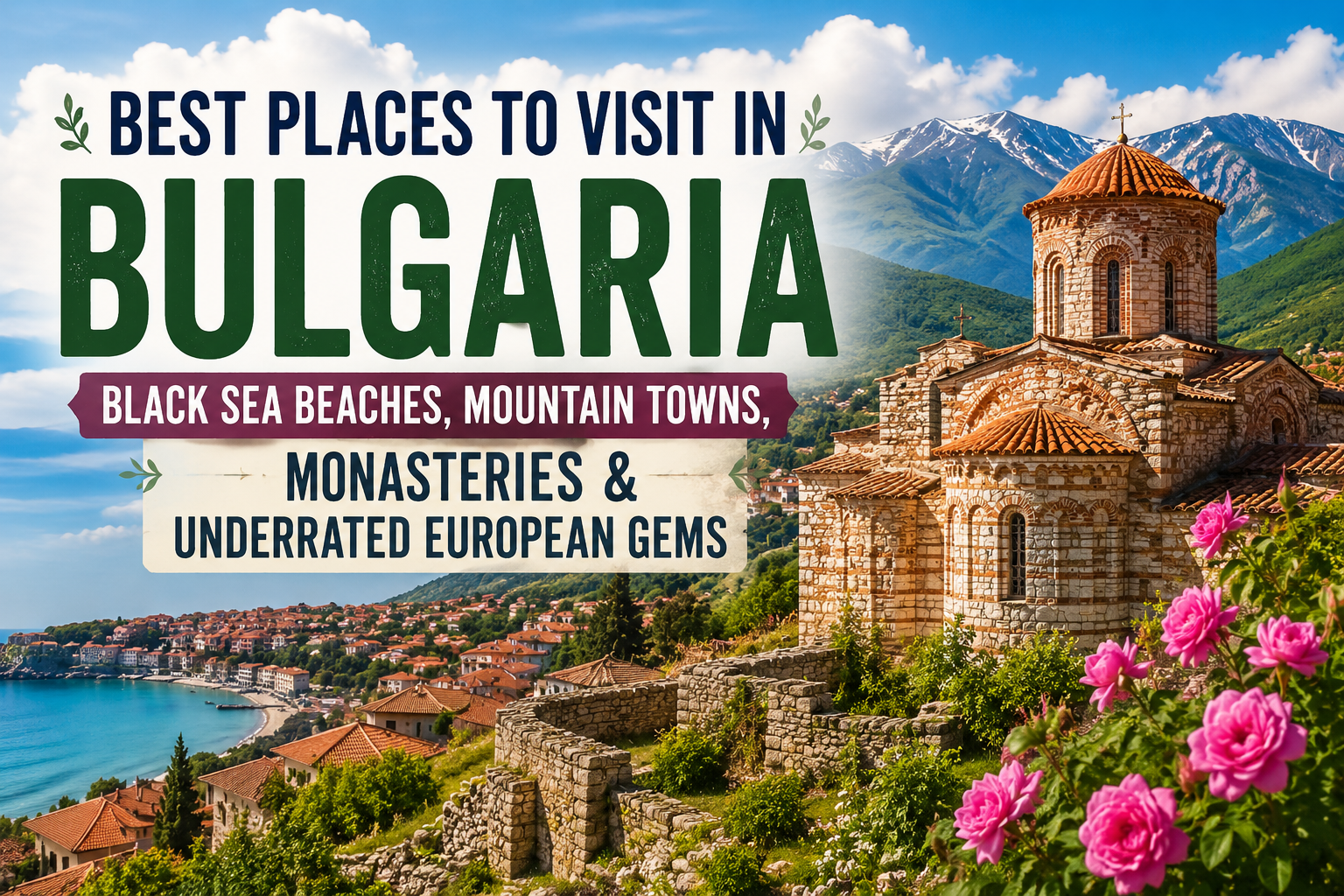
Bulgaria is one of those European destinations that feels like it should be much more famous than it is. You can wander through Roman ruins in the middle of a modern city, visit a painted mountain monastery, hike around glacial lakes, explore colorful old towns, relax on the Black Sea coast, taste wine in tiny historic villages, and still feel like you have found somewhere a little more surprising than the usual Europe itinerary.
This is a country with layers. Bulgaria has Thracian tombs, Orthodox monasteries, Ottoman-era streets, mountain villages, ski towns, beach resorts, rose fields, Roman amphitheaters, and cities where old stone ruins sit right beside cafés and everyday life.
It is also a smart choice for travelers who want Europe with variety. Bulgaria can work for a city break, a Black Sea summer trip, a mountain escape, a cultural itinerary, a road trip, or a more affordable-feeling European adventure with a lot of texture.
Here are the best places to visit in Bulgaria if you want a trip filled with history, scenery, old towns, beaches, mountains, and a few wonderfully underrated surprises.
Sofia

Region notes: Western Bulgaria, near the Vitosha Mountain range and close to the borders with Serbia and North Macedonia. Sofia is Bulgaria’s capital and the easiest international arrival point for many travelers, making it a natural starting place for a first Bulgaria trip.
What kind of place it is: A layered capital city with Roman ruins, Orthodox churches, broad boulevards, museums, mountain views, parks, cafés, and easy access to day trips.
Best for: First-time Bulgaria travelers, city-break travelers, history lovers, solo travelers, couples, museum visitors, food travelers, and anyone who wants a practical base for exploring western Bulgaria.
Sofia is one of the best places to start a Bulgaria itinerary because it immediately shows how many eras are layered into the country. You can see Roman ruins, Ottoman influence, Orthodox churches, communist-era architecture, modern restaurants, and mountain scenery without leaving the city.
The city does not always have the polished postcard feel of some European capitals, but that is part of what makes it interesting. Sofia feels lived-in, historic, and practical, with enough sights to fill a few days and enough day-trip options to make it useful as a base.
Main highlights:
- Alexander Nevsky Cathedral: One of Bulgaria’s most recognizable landmarks, with golden domes, a dramatic interior, and the kind of scale that makes it feel like the symbolic heart of the capital.
- Ancient Serdica ruins: Roman remains scattered through the city center, giving Sofia that wonderful “old history under modern streets” feeling.
- Vitosha Boulevard: A pedestrian shopping and dining street with cafés, restaurants, people-watching, and mountain views on clear days.
- Boyana Church: A small but important medieval church near Sofia, known for its frescoes and UNESCO World Heritage status.
- Vitosha Mountain: A close-to-the-city nature escape where travelers can hike, enjoy viewpoints, or simply understand why Sofia feels different from flatter capital cities.
Why I recommend it:
Sofia is useful, interesting, and underrated. It gives travelers a softer landing into Bulgaria while still offering big cultural payoff. It is also one of the easiest places to pair with Rila Monastery, Boyana Church, Vitosha Mountain, Plovdiv, or other western Bulgaria stops.
Don’t miss:
- Seeing Alexander Nevsky Cathedral early or late in the day: The light and quieter atmosphere can make the cathedral feel much more memorable.
- Walking through the city center slowly: Sofia rewards travelers who notice layers, from Roman ruins to churches to old civic buildings.
- Adding Boyana Church if you like medieval art: It is smaller than many travelers expect, but historically important and worth considering.
- Spending time on Vitosha Boulevard: It is one of the easiest places to settle into the everyday rhythm of the capital.
Good to Know / Side Notes:
- Sofia works well as a first stop because it gives travelers airport access, hotels, restaurants, transportation options, and day-trip possibilities.
- The city sits near mountains, so the setting feels more dramatic than travelers may expect from a capital.
- Sofia is a good base for Rila Monastery if you do not want to rent a car.
- Roman Serdica is one of the reasons Sofia feels older and more layered than it first appears.
- The city is best approached as a real, working capital rather than a perfectly polished fairy-tale city.
Plovdiv

Region notes: South-central Bulgaria, in the Thracian Plain. Plovdiv sits east of Sofia and works beautifully as a second city stop, especially for travelers who want Roman ruins, colorful old-town streets, and a more romantic historic atmosphere.
What kind of place it is: An ancient city with Roman ruins, a colorful Old Town, cobbled lanes, hilltop views, creative neighborhoods, cafés, galleries, and one of Bulgaria’s most charming urban centers.
Best for: Couples, culture lovers, photographers, history travelers, café wanderers, solo travelers, friend trips, and anyone who wants one of Bulgaria’s prettiest city experiences.
Plovdiv is one of the most lovable places in Bulgaria. It has the kind of old-city atmosphere travelers want from Europe: cobblestone streets, painted historic houses, Roman ruins, leafy squares, cafés, and hilltop views.
The city feels softer and more atmospheric than Sofia, especially around the Old Town. It is a place to wander rather than rush. You can visit the Roman theatre, stroll through restored Revival-era houses, browse the creative Kapana district, and let the city unfold slowly.
Main highlights:
- Roman Theatre of Philippopolis: A dramatic ancient theatre built into the hillside, still one of Plovdiv’s most iconic sights.
- Plovdiv Old Town: A beautiful historic district filled with cobblestone streets, colorful Bulgarian Revival houses, museums, gates, and viewpoints.
- Kapana Creative District: A lively area of cafés, small shops, restaurants, street art, and creative energy near the historic center.
- Ancient Stadium of Philippopolis: Roman remains that show how deeply ancient history runs through the modern city.
- Nebet Tepe: A hilltop area with ruins and views over Plovdiv, especially lovely around golden hour.
Why I recommend it:
Plovdiv is the Bulgaria stop that often wins people over emotionally. It is historic, walkable, colorful, and atmospheric without feeling overbuilt. For many travelers, it may become the place that makes Bulgaria feel like a true hidden gem.
Don’t miss:
- Walking the Old Town without overplanning: The streets, houses, and views are part of the experience.
- Seeing the Roman theatre: It is one of the most memorable ancient sites in Bulgaria and gives Plovdiv a strong sense of place.
- Spending time in Kapana: This gives the trip a more modern, local, food-and-café side.
- Watching the light change from one of the hills: Plovdiv’s layered landscape is part of its charm.
Good to Know / Side Notes:
- Plovdiv is one of Europe’s oldest continuously inhabited cities, which helps explain why it feels so layered.
- The Old Town has cobblestones and slopes, so comfortable shoes matter.
- Plovdiv is a strong overnight choice, not just a day trip.
- The city works especially well for couples and friend trips because it has atmosphere without needing a packed itinerary.
- Plovdiv is a great contrast to Sofia: prettier, slower, and more romantic, while Sofia is larger and more practical.
Rila Monastery

Region notes: Southwestern Bulgaria, in the Rila Mountains south of Sofia. Rila Monastery is often visited as a day trip from Sofia, but it feels completely different from the capital because of its mountain setting.
What kind of place it is: A historic Orthodox monastery surrounded by mountains, known for frescoes, arches, striped stonework, religious history, and one of Bulgaria’s most iconic cultural settings.
Best for: Culture travelers, history lovers, photographers, spiritual-site visitors, couples, older travelers, day-trippers from Sofia, and anyone who wants one of Bulgaria’s most important landmarks.
Rila Monastery is one of Bulgaria’s signature sights, and it has the kind of setting that makes the visit feel bigger than a normal historic stop. The monastery sits in the mountains, surrounded by forested slopes, with painted walls, arches, frescoes, courtyards, and a sense of deep religious and national importance.
This is not just a pretty building. Rila Monastery is one of the places that helps explain Bulgarian identity, faith, art, and history. Even travelers who do not normally plan around monasteries may find it moving because the combination of architecture, mountain air, and fresco-covered spaces is so striking.
Main highlights:
- The monastery courtyard: A dramatic enclosed space with striped arches, painted walls, balconies, and mountain views that make the whole complex feel cinematic.
- The main church: A richly decorated Orthodox church with frescoes, icons, and religious detail that gives the monastery its emotional center.
- Mountain setting: The Rila Mountains make the monastery feel peaceful, protected, and far removed from city life.
- Historic monastic atmosphere: Rila Monastery has been tied to Bulgarian spirituality, education, and cultural identity for centuries.
- Photography and architectural details: The arches, frescoes, woodwork, stonework, and layered balconies make it one of Bulgaria’s most photogenic places.
Why I recommend it:
Rila Monastery is one of the places travelers should prioritize on a first Bulgaria trip. It combines history, faith, architecture, mountains, and national identity in a way that feels deeply tied to the country itself.
Don’t miss:
- Standing quietly in the courtyard: This is one of those places where the overall atmosphere matters as much as any single detail.
- Looking closely at the frescoes: The painted scenes are a major part of what makes the monastery so visually powerful.
- Taking in the mountain setting: The location is not background scenery; it is part of why the monastery feels so special.
- Pairing the visit with a nature stop if time allows: The Rila region has some of Bulgaria’s most beautiful mountain landscapes.
Good to Know / Side Notes:
- Rila Monastery is UNESCO-listed and one of Bulgaria’s most important cultural sites.
- It can be visited from Sofia, but the journey takes time, so it is best treated as a real day trip.
- Dress respectfully since it is an active religious site.
- The monastery is often paired with the Seven Rila Lakes by ambitious travelers, though that can make for a long day.
- This is one of the best places in Bulgaria for travelers who want beauty and meaning in the same stop.
Seven Rila Lakes

Region notes: Southwestern Bulgaria, in the Rila Mountains. The Seven Rila Lakes are northwest of Rila Monastery and are usually reached from the Panichishte / Sapareva Banya area rather than directly from the monastery itself.
What kind of place it is: A high-mountain hiking destination known for a chain of glacial lakes, alpine scenery, ridgelines, fresh air, and some of Bulgaria’s most famous natural views.
Best for: Hikers, nature lovers, photographers, active travelers, couples, summer mountain travelers, and anyone who wants a dramatic outdoor experience in Bulgaria.
The Seven Rila Lakes are one of Bulgaria’s most beautiful natural sights. This is the mountain chapter of a Bulgaria trip: open air, glacial lakes, ridges, trails, changing weather, and views that feel very different from the country’s cities, monasteries, and Black Sea towns.
The lakes sit at high elevation, and each one has its own shape and personality. Travelers come here for hiking, photography, and that classic “I did something memorable outdoors” feeling. It is not the easiest stop logistically, but it can be one of the most rewarding.
Main highlights:
- The glacial lakes: Seven mountain lakes arranged at different elevations, creating one of Bulgaria’s most recognizable hiking landscapes.
- Panoramic viewpoints: Higher trails offer sweeping views over the lakes and surrounding mountains.
- Alpine scenery: Open slopes, rocky paths, wildflowers in season, and crisp mountain air make this feel like a true nature escape.
- Summer hiking: The lakes are especially popular in warmer months when trails are more accessible.
- Nearby Sapareva Banya: A spa town known for hot springs, often used as a practical base for the region.
Why I recommend it:
The Seven Rila Lakes show a completely different side of Bulgaria. If Sofia and Plovdiv give you history and Rila Monastery gives you culture, the lakes give you the country’s wild mountain beauty.
Don’t miss:
- Starting early: The lakes are popular, and earlier starts can make the experience smoother.
- Going high enough for the classic views if your fitness allows: The higher perspectives are what make the landscape feel truly dramatic.
- Bringing layers even in summer: Mountain weather can change quickly.
- Pairing the lakes with a slower mountain overnight: This can make the experience feel less rushed than a long day trip from Sofia.
Good to Know / Side Notes:
- This is a hiking destination, not a simple roadside viewpoint.
- The chairlift area and trail conditions can affect how easy the visit feels.
- Weather matters a lot here; clouds, wind, or storms can change the day quickly.
- The lakes are one of Bulgaria’s most famous nature experiences, so expect company in peak season.
- Travelers who want mountain beauty without intense hiking may prefer to research shorter routes or viewpoints carefully.
Veliko Tarnovo

Region notes: North-central Bulgaria, set along the Yantra River in a dramatic hilly landscape. Veliko Tarnovo is inland, northeast of Sofia and north of the Balkan Mountains, making it a strong stop for travelers exploring beyond Bulgaria’s two biggest city bases.
What kind of place it is: A historic hillside city and former medieval capital known for fortress ruins, river views, steep streets, old houses, craft lanes, and a dramatic setting.
Best for: History lovers, photographers, couples, road-trippers, medieval-history fans, slow travelers, and anyone who wants one of Bulgaria’s most atmospheric inland towns.
Veliko Tarnovo looks and feels different from Bulgaria’s flatter city stops. The town rises and curves around hills and river bends, with old houses clinging to slopes and fortress walls watching over the landscape.
The main attraction is Tsarevets Fortress, but the whole city has a sense of drama. It is a place where Bulgaria’s medieval history feels close, especially when you are looking out over the hills, walking old streets, or imagining the city as a former capital.
Main highlights:
- Tsarevets Fortress: A large medieval fortress complex with walls, gates, ruins, views, and a powerful sense of Bulgaria’s past.
- Yantra River views: The winding river and hilly setting make Veliko Tarnovo one of Bulgaria’s most scenic towns.
- Samovodska Charshia: A historic craft street with shops, artisan touches, and old-town atmosphere.
- Old houses and hillside streets: The steep lanes and layered rooftops give the town its distinctive visual character.
- Nearby Arbanasi: A historic village close to Veliko Tarnovo, known for old houses, churches, and a quieter cultural stop.
Why I recommend it:
Veliko Tarnovo gives Bulgaria a medieval, storybook layer. It is not just another pretty town; it has a dramatic setting and a strong connection to Bulgarian history, which makes it a great addition to a deeper itinerary.
Don’t miss:
- Walking Tsarevets Fortress with time for the views: The setting is part of the experience, not just the ruins themselves.
- Exploring the old craft streets: This is where the town feels more intimate and less like a checklist stop.
- Looking back at the town from across the river or higher viewpoints: Veliko Tarnovo is one of those places where the shape of the town matters.
- Considering nearby Arbanasi: It adds another historic layer and works well if you have a car or driver.
Good to Know / Side Notes:
- Veliko Tarnovo has steep streets, stairs, and uneven surfaces, so it is not the easiest town for low-mobility travelers.
- The city works best as an overnight or slower stop rather than a rushed detour.
- Tsarevets Fortress can feel exposed in hot weather, so timing matters in summer.
- This is one of Bulgaria’s best places for travelers who enjoy medieval atmosphere.
- The town’s hillside setting is a major reason it feels so memorable.
Nessebar

Region notes: Eastern Bulgaria, on the Black Sea coast. Nessebar sits on a small peninsula near Sunny Beach and works well for travelers who want a historic coastal stop instead of only a beach resort.
What kind of place it is: A historic seaside town with ancient ruins, churches, stone lanes, wooden houses, Black Sea views, restaurants, and a compact old-town peninsula.
Best for: Couples, history lovers, beach travelers, photographers, cruise travelers, families, Black Sea summer trips, and travelers who want old-town atmosphere by the water.
Nessebar is one of Bulgaria’s most beautiful coastal towns because it gives you history and sea views together. The old town sits on a small peninsula, with narrow streets, historic churches, stone walls, wooden houses, and views of the Black Sea around the edges.
It can be busy, especially because it is close to major beach resort areas, but the setting is special. Nessebar is the kind of place where you can wander through old lanes, stop for seafood, look at church ruins, and still feel like you are on a summer coast trip.
Main highlights:
- Old Nessebar peninsula: A compact historic area surrounded by water, filled with lanes, ruins, restaurants, and sea views.
- Medieval churches and ruins: Nessebar is known for its many historic churches, some preserved as ruins and some still showing beautiful architectural details.
- Black Sea views: The coastline and peninsula setting give the town a scenic, salty-air charm.
- Traditional wooden houses: The old houses add warmth and character to the stone streets.
- Easy access from beach resorts: Nessebar can add culture to a Black Sea beach vacation without requiring a major inland detour.
Why I recommend it:
Nessebar is one of the best places in Bulgaria for travelers who want history but still want to feel like they are on the coast. It is not just a beach stop and not just an old town; it is both at once.
Don’t miss:
- Wandering the old peninsula slowly: Nessebar’s charm is in the lanes, churches, views, and small discoveries.
- Seeing the church ruins: They are one of the reasons the town feels so old and distinctive.
- Staying into the evening if possible: Once day-trippers thin out, the old town can feel more atmospheric.
- Pairing it with a Black Sea beach stay: Nessebar works especially well when combined with nearby coastal relaxation.
Good to Know / Side Notes:
- Nessebar’s ancient city is UNESCO-listed.
- It can feel crowded in summer, especially because of nearby resort traffic.
- The old town is compact, so it is easy to explore on foot, but surfaces may be uneven.
- This is one of Bulgaria’s best coastal choices for travelers who want more than sand and sun.
- Nessebar is a strong fit for a Black Sea itinerary even if you are not a big beach-resort person.
Varna

Region notes: Northeastern Bulgaria, on the Black Sea coast. Varna is one of Bulgaria’s major coastal cities and works as a practical base for beaches, museums, seaside promenades, and northern Black Sea day trips.
What kind of place it is: A Black Sea city with beaches, gardens, museums, restaurants, nightlife, seaside walking areas, and access to nearby coastal resorts.
Best for: Beach travelers, families, friend trips, summer travelers, coastal city lovers, museum visitors, and anyone who wants a more urban Black Sea base.
Varna is Bulgaria’s big Black Sea city, which makes it a different kind of coastal stop from Nessebar or Sozopol. Instead of a small old-town peninsula, Varna gives travelers city energy, beaches, restaurants, parks, museums, and practical transport connections.
It is especially useful if you want a beach trip that still has enough going on beyond the sand. You can walk through the Sea Garden, visit museums, enjoy the waterfront, take day trips, and use Varna as a base for the northern coast.
Main highlights:
- Sea Garden: A large seaside park and one of Varna’s signature places for walking, relaxing, and enjoying the coastal setting.
- City beaches: Easy beach access gives Varna a summer-vacation feel without needing to stay in a separate resort.
- Archaeological Museum: A strong stop for travelers interested in Bulgaria’s ancient history and the famous Varna Gold.
- Seaside restaurants and promenades: Varna’s coastal atmosphere is one of its biggest appeals.
- Day-trip access: The city works well for exploring nearby beach areas, monasteries, or northern Black Sea stops.
Why I recommend it:
Varna is the practical Black Sea choice. It gives travelers beaches and coastal atmosphere with the convenience of a real city, which can be especially helpful for families, friend trips, or travelers who do not want to feel isolated in a resort.
Don’t miss:
- Walking the Sea Garden: It is one of the easiest and most enjoyable ways to feel Varna’s coastal rhythm.
- Building in beach time: Varna is not only a sightseeing city; the Black Sea setting is the point.
- Visiting the Archaeological Museum if you like ancient history: It adds depth to a coastal itinerary.
- Using Varna as a base if you want flexibility: It is more practical than smaller beach towns for transportation and services.
Good to Know / Side Notes:
- Varna is more urban than romantic little coastal towns like Nessebar or Sozopol.
- Summer is the main season for beach energy.
- The city can work well for travelers who want restaurants, nightlife, and beach access in one place.
- Varna is a good option for a longer Black Sea stay because it has more infrastructure.
- The coast north and south of Varna has additional beach areas if you want to explore.
Sozopol

Region notes: Southeastern Bulgaria, on the southern Black Sea coast south of Burgas. Sozopol is a historic seaside town that feels smaller and more relaxed than Varna and often more vacation-like than inland cultural stops.
What kind of place it is: A coastal old town with wooden houses, sea views, beaches, restaurants, harbor atmosphere, and a slower Black Sea holiday feeling.
Best for: Couples, beach travelers, families, summer trips, relaxed friend trips, photographers, seafood lovers, and travelers who want a charming coastal town.
Sozopol is one of Bulgaria’s prettiest Black Sea towns. It has the old wooden-house charm, coastal lanes, sea views, beaches, and a more relaxed feel than some of the busier resort-heavy areas.
This is a place for a slower seaside trip. You can walk the old town, swim, eat by the water, watch the light over the Black Sea, and enjoy a version of Bulgaria that feels sun-warmed and easy.
Main highlights:
- Sozopol Old Town: A compact historic area with narrow streets, traditional wooden houses, sea views, and restaurants.
- Black Sea beaches: Sozopol gives travelers beach time without losing the charm of an older town.
- Harbor and waterfront walks: The sea-facing paths and harbor areas make the town especially pleasant in the evening.
- Seafood restaurants: A natural part of the coastal experience, especially for travelers who like long, relaxed meals by the water.
- Nearby coastal escapes: Sozopol can be used as a base for beaches and nature areas along the southern coast.
Why I recommend it:
Sozopol is one of the best Bulgaria picks for travelers who want the Black Sea but do not want the trip to feel only like a resort vacation. It has beach appeal and old-town charm in the same place.
Don’t miss:
- Walking the old town near sunset: The wooden houses and sea views are especially atmospheric in softer light.
- Leaving time for a beach day: Sozopol is not a place to only “see” quickly; it is better when you actually relax.
- Eating near the water: The coastal setting is part of the experience.
- Comparing it with Nessebar if you love old seaside towns: Both are worthwhile, but they feel different.
Good to Know / Side Notes:
- Sozopol is a strong summer choice, especially for travelers who want beach plus atmosphere.
- It can still be busy in peak season, but it often feels more relaxed than the biggest resort zones.
- The old town is walkable but has uneven streets.
- Sozopol pairs well with Burgas-area travel.
- This is one of Bulgaria’s nicest coastal stops for couples and slower travelers.
Bansko

Region notes: Southwestern Bulgaria, at the foot of the Pirin Mountains. Bansko is south of Sofia and close to Pirin National Park, making it one of Bulgaria’s most famous mountain towns.
What kind of place it is: A mountain town known for skiing, hiking, old-town streets, taverns, mountain views, spa hotels, and access to Pirin National Park.
Best for: Ski travelers, hikers, mountain lovers, couples, families, digital nomads, wellness travelers, winter trips, and summer outdoor travelers.
Bansko is best known as a ski town, but it is more than a winter resort. The old town has stone houses, traditional taverns, cobbled lanes, mountain views, and a rustic charm that makes it appealing outside ski season too.
In winter, Bansko is one of Bulgaria’s biggest names for skiing. In summer and early fall, the Pirin Mountains bring hiking, fresh air, and mountain scenery. This makes Bansko one of Bulgaria’s most versatile year-round destinations.
Main highlights:
- Pirin Mountain scenery: Dramatic peaks, alpine landscapes, and hiking access make the area feel wild and beautiful.
- Ski resort atmosphere: In winter, Bansko becomes one of Bulgaria’s main ski destinations.
- Old Town Bansko: Traditional houses, stone streets, churches, and taverns give the town more character than a purely modern resort.
- Mehanas: Traditional Bulgarian taverns where travelers can enjoy hearty mountain food and local atmosphere.
- Spa and wellness hotels: The region has a strong relaxation angle, especially for travelers pairing mountains with comfort.
Why I recommend it:
Bansko is one of the best places in Bulgaria for travelers who want mountains with real infrastructure. It works for winter sports, summer hiking, food, spa time, and a slower mountain-town stay.
Don’t miss:
- Exploring the old town, not just the resort area: This is where Bansko feels most Bulgarian.
- Eating in a traditional mehana: The food and atmosphere are a major part of the mountain experience.
- Using Bansko for Pirin access: The surrounding nature is one of the biggest reasons to come.
- Considering shoulder seasons: Outside peak ski weeks, the town can feel calmer and more affordable.
Good to Know / Side Notes:
- Bansko is popular with winter sports travelers, but it is also useful in summer for mountain trips.
- The resort side and old-town side can feel different, so location matters.
- Pirin National Park is UNESCO-listed as one of Bulgaria’s natural World Heritage sites.
- Bansko has become known among digital nomads as well as vacation travelers.
- This is one of the best Bulgaria stops for people who want Europe mountain vibes without only focusing on the Alps.
Koprivshtitsa

Region notes: Central Bulgaria, in the Sredna Gora mountains east of Sofia. Koprivshtitsa is an inland mountain town that works well for travelers interested in Bulgarian Revival architecture, history, and quieter village atmosphere.
What kind of place it is: A colorful historic town known for painted Revival-era houses, cobblestone streets, museums, mountain surroundings, and Bulgarian national history.
Best for: Culture lovers, photographers, slow travelers, history travelers, couples, architecture fans, and anyone who wants a quieter old-town experience.
Koprivshtitsa feels like stepping into a preserved chapter of Bulgarian history. The town is filled with colorful houses, wooden gates, cobbled lanes, small museums, and a mountain setting that makes it feel peaceful and tucked away.
This is not a place for big-city energy or dramatic nightlife. It is best for travelers who like old houses, local history, quiet streets, and the feeling of discovering a place that still has a strong sense of identity.
Main highlights:
- Bulgarian Revival houses: Colorful historic homes with painted facades, wooden details, and museum interiors.
- Cobblestone streets: The town’s lanes give it a slow, preserved atmosphere.
- House museums: Many of the historic homes connect to Bulgarian cultural and revolutionary history.
- Mountain setting: The surrounding hills make Koprivshtitsa feel peaceful and self-contained.
- Traditional architecture: This is one of the best places to see the visual character of Bulgaria’s National Revival period.
Why I recommend it:
Koprivshtitsa adds intimacy to a Bulgaria itinerary. After larger cities, monasteries, and beach towns, this is the place that feels small, colorful, and deeply tied to Bulgarian identity.
Don’t miss:
- Visiting at least one house museum: The interiors and stories make the town more meaningful.
- Walking slowly through the streets: Koprivshtitsa is not about rushing from sight to sight.
- Looking at the architectural details: Gates, windows, painted walls, and courtyards are part of the charm.
- Staying overnight if you like quiet towns: Evenings can feel much more peaceful than daytime visits.
Good to Know / Side Notes:
- Koprivshtitsa is a strong choice for travelers who like historic villages more than big cities.
- The town has uneven surfaces and cobblestones, so comfortable shoes matter.
- It is especially photogenic in good weather.
- This is not a major resort town; its appeal is history, atmosphere, and architecture.
- Koprivshtitsa can be a refreshing contrast to Sofia, Plovdiv, or the Black Sea coast.
Rose Valley & Kazanlak

Region notes: Central Bulgaria, between the Balkan Mountains and Sredna Gora range. The Rose Valley region is especially associated with Kazanlak, rose fields, Thracian heritage, and spring-to-early-summer travel.
What kind of place it is: A valley region known for rose oil, rose fields, festivals, Thracian tombs, mountain backdrops, and one of Bulgaria’s most distinctive seasonal travel experiences.
Best for: Spring and early summer travelers, flower lovers, culture travelers, photographers, history lovers, couples, slow travelers, and anyone interested in Bulgaria’s rose traditions.
The Rose Valley is one of Bulgaria’s most romantic-sounding regions, and it is not just a name. This area is tied to rose oil production, rose harvests, floral traditions, and the kind of seasonal travel experience that feels very specific to place.
Kazanlak is also important for history. The region is associated with Thracian heritage, including tombs and archaeological sites that remind travelers Bulgaria’s ancient story goes far beyond medieval towns and Orthodox monasteries.
Main highlights:
- Rose fields: The region is famous for roses, especially when the fields are blooming and the harvest season is active.
- Kazanlak: A practical center for exploring the Rose Valley and nearby cultural sites.
- Thracian Tomb of Kazanlak: A UNESCO-listed ancient tomb associated with Bulgaria’s Thracian heritage.
- Rose Festival season: A lively seasonal event connected to rose harvest traditions, performances, and local pride.
- Valley and mountain scenery: The setting between mountain ranges gives the region a beautiful geographic frame.
Why I recommend it:
The Rose Valley gives Bulgaria a softer and more unusual travel angle. It is floral, cultural, seasonal, and historic all at once, which makes it a lovely addition for travelers who want something beyond the standard city-and-coast route.
Don’t miss:
- Timing your visit carefully if you want roses: The region is most special when the rose season is active.
- Learning about rose oil: It is one of the details that makes this part of Bulgaria feel distinctive.
- Visiting Kazanlak’s Thracian heritage sites: They add ancient history to what might otherwise seem like only a pretty flower stop.
- Pairing the region with mountain or small-town travel: The valley works well as part of a broader central Bulgaria route.
Good to Know / Side Notes:
- Rose season is seasonal, so do not expect blooming fields year-round.
- The Rose Festival usually makes the area more festive but also busier.
- Kazanlak is a good anchor point for the region.
- Bulgaria is famous for rose oil, and this area is one of the best places to understand that tradition.
- The Thracian history here gives the valley more depth than travelers might expect.
Melnik

Region notes: Southwestern Bulgaria, near the Greek border and close to the Pirin Mountains. Melnik is Bulgaria’s smallest town and sits in a striking landscape of sandstone formations and wine country.
What kind of place it is: A tiny historic wine town known for sandstone pyramids, traditional houses, red wine, monastery access, and a sunny southern-Bulgaria atmosphere.
Best for: Wine travelers, couples, road-trippers, photographers, slow travelers, history lovers, and travelers who like tiny towns with a strong sense of place.
Melnik is small, but it has a memorable personality. The town is surrounded by strange sandstone formations that look almost sculpted, giving the landscape a golden, otherworldly feel. Add old houses, wine cellars, monastery excursions, and a near-Greek-border setting, and it becomes one of Bulgaria’s most distinctive stops.
This is not a place for a packed sightseeing list. Melnik is best for wandering, tasting, looking at the landscape, and enjoying the feeling of being somewhere tiny but special.
Main highlights:
- Melnik sandstone pyramids: Unusual natural formations that give the area its striking visual identity.
- Local wine: Melnik is one of Bulgaria’s best-known wine areas, especially for red wines.
- Historic houses: Traditional architecture gives the town a preserved, old-world feeling.
- Rozhen Monastery: A nearby monastery that pairs well with a visit to Melnik.
- Southern Bulgaria atmosphere: The warmer, drier landscape feels different from the mountains and northern towns.
Why I recommend it:
Melnik is one of Bulgaria’s best small-town surprises. It has wine, landscape, history, and character in a very compact package, making it ideal for travelers who like places that feel specific rather than generic.
Don’t miss:
- Seeing the sandstone formations from a viewpoint or walking route: The landscape is what makes Melnik visually unforgettable.
- Trying local wine: Wine is central to the town’s identity.
- Visiting Rozhen Monastery if time allows: It adds a cultural and scenic layer to the stop.
- Staying slow: Melnik is better as a linger-and-look place than a rushed checkbox.
Good to Know / Side Notes:
- Melnik is very small, so it is best paired with other stops in southwestern Bulgaria.
- The surrounding landscape can feel hot and exposed in summer.
- Wine lovers should give the area more time than a quick photo stop.
- Melnik pairs naturally with Bansko, Pirin, or Rila-region travel.
- This is one of Bulgaria’s most atmospheric little places for travelers who like wine towns.
Belogradchik Rocks

Region notes: Northwestern Bulgaria, near the town of Belogradchik and not far from the Serbian border. This region is farther from Bulgaria’s most common Sofia-Plovdiv-Black Sea route, so it works best for road-trippers or travelers building a deeper Bulgaria itinerary.
What kind of place it is: A dramatic rock-and-fortress landscape known for towering red rock formations, panoramic views, hiking, photography, and one of Bulgaria’s most unusual natural settings.
Best for: Road-trippers, photographers, geology lovers, hikers, adventurous travelers, couples, and anyone who wants an off-the-main-route Bulgaria stop.
Belogradchik Rocks are one of Bulgaria’s most striking landscapes. The formations rise in strange towers and shapes, with a fortress built into the rocks, creating a place that feels part nature wonder, part medieval stronghold, and part fantasy landscape.
Because it is in northwestern Bulgaria, Belogradchik is not always included on first-time itineraries. But for travelers who are willing to go out of the way, it offers one of the country’s most dramatic visual payoffs.
Main highlights:
- Belogradchik Rocks: Tall red rock formations that create one of Bulgaria’s most unusual and photogenic landscapes.
- Belogradchik Fortress: A fortress built into and around the rocks, blending human history with natural drama.
- Panoramic viewpoints: The area offers sweeping views over the rock formations and surrounding countryside.
- Hiking and walking routes: Travelers can experience the landscape from different angles depending on fitness and time.
- Off-the-usual-route feeling: This region gives travelers a less obvious Bulgaria experience.
Why I recommend it:
Belogradchik is the kind of place that makes travelers say, “Wait, this is in Bulgaria?” It adds a dramatic, unexpected landscape to the country’s mix of monasteries, cities, mountains, and beaches.
Don’t miss:
- Visiting the fortress: The combination of stone walls and natural rock formations is the main experience.
- Looking for multiple viewpoints: The rocks change character depending on where you stand.
- Planning logistics carefully: This is not as simple as hopping between Sofia and Plovdiv.
- Bringing a camera: The shapes, colors, and scale are a major part of the appeal.
Good to Know / Side Notes:
- Belogradchik is best for travelers with a car, driver, or a carefully planned tour.
- It is farther from Bulgaria’s most common tourist route, so build in travel time.
- The area can feel hot and exposed in summer.
- This is a strong pick for photographers and travelers who like unusual landscapes.
- Belogradchik can help a Bulgaria itinerary feel much more surprising and adventurous.
Pirin National Park

Region notes: Southwestern Bulgaria, surrounding the Pirin Mountains near Bansko. Pirin National Park is one of Bulgaria’s major mountain regions and works especially well for travelers staying in or near Bansko.
What kind of place it is: A high-mountain national park with peaks, lakes, forests, hiking trails, alpine scenery, wildlife, and some of Bulgaria’s most impressive natural landscapes.
Best for: Hikers, mountain lovers, photographers, active travelers, summer nature trips, ski travelers, couples, and anyone who wants Bulgaria’s wilder alpine side.
Pirin National Park is one of the best places in Bulgaria for serious mountain scenery. The landscape is rugged and beautiful, with peaks, lakes, forests, and trails that feel much more alpine than many travelers expect from Bulgaria.
Bansko is the easiest gateway for many visitors, but the park itself is the real reason nature lovers should pay attention. In winter, the region connects naturally to skiing. In warmer months, it becomes one of Bulgaria’s strongest hiking and outdoor destinations.
Main highlights:
- Pirin Mountains: Dramatic peaks and alpine landscapes that make this one of Bulgaria’s most beautiful mountain regions.
- Hiking trails: Routes range from gentler walks to more demanding mountain adventures depending on experience and conditions.
- Glacial lakes: High-mountain lakes add to the park’s scenic appeal.
- Forests and wildlife: Pirin has a wilder, more protected feeling than ordinary resort landscapes.
- Bansko access: The nearby town gives travelers hotels, restaurants, and practical infrastructure.
Why I recommend it:
Pirin National Park is one of the best places to understand that Bulgaria is not only cities and beaches. The mountain scenery is genuinely impressive, and the combination of Bansko plus Pirin makes this region useful for both comfort and adventure.
Don’t miss:
- Choosing hikes realistically: Mountain routes can be more demanding than they look on a map.
- Using Bansko as a practical base: It makes the park much easier to experience.
- Going beyond the resort image: Pirin is not only for ski season.
- Watching the weather: Conditions can change quickly in the mountains.
Good to Know / Side Notes:
- Pirin National Park is UNESCO-listed.
- Summer and early fall are especially appealing for hiking.
- Winter travelers usually come for skiing around Bansko.
- This is one of Bulgaria’s best outdoor regions, but it requires more planning than a city stop.
- Mountain travelers should bring layers, sun protection, water, and realistic expectations.
What to Pack for Bulgaria
Bulgaria is one of those destinations where packing depends heavily on where you are going. A Sofia and Plovdiv city trip is very different from a Black Sea beach vacation, a Rila Lakes hike, or a winter stay in Bansko.
A few practical things travelers may want to bring:
- A lightweight scarf or cover-up for churches and monasteries.
- A day bag for Sofia, Plovdiv, Rila Monastery, hiking days, and Black Sea outings.
- A rain layer if visiting mountains, forests, or shoulder-season destinations.
- Sun protection for the Black Sea coast, rose fields, exposed ruins, and mountain hikes.
- A portable power bank for long day trips, hiking days, train or bus travel, and old-town exploring.
Final Thoughts
Bulgaria is one of Europe’s most underrated travel surprises because it gives you so many different kinds of trips in one country. You can start with Sofia’s city layers, fall in love with Plovdiv’s old-town charm, visit Rila Monastery in the mountains, hike around glacial lakes, relax on the Black Sea, and still have time for rose valleys, wine towns, medieval fortresses, and colorful villages.
For a first Bulgaria trip, Sofia, Plovdiv, Rila Monastery, and either the Black Sea coast or the Rila / Pirin Mountains make a strong foundation. But the more time you have, the more Bulgaria opens up.
This is a country for travelers who like Europe with history, texture, scenery, and a little bit of “why isn’t everyone talking about this yet?” energy.