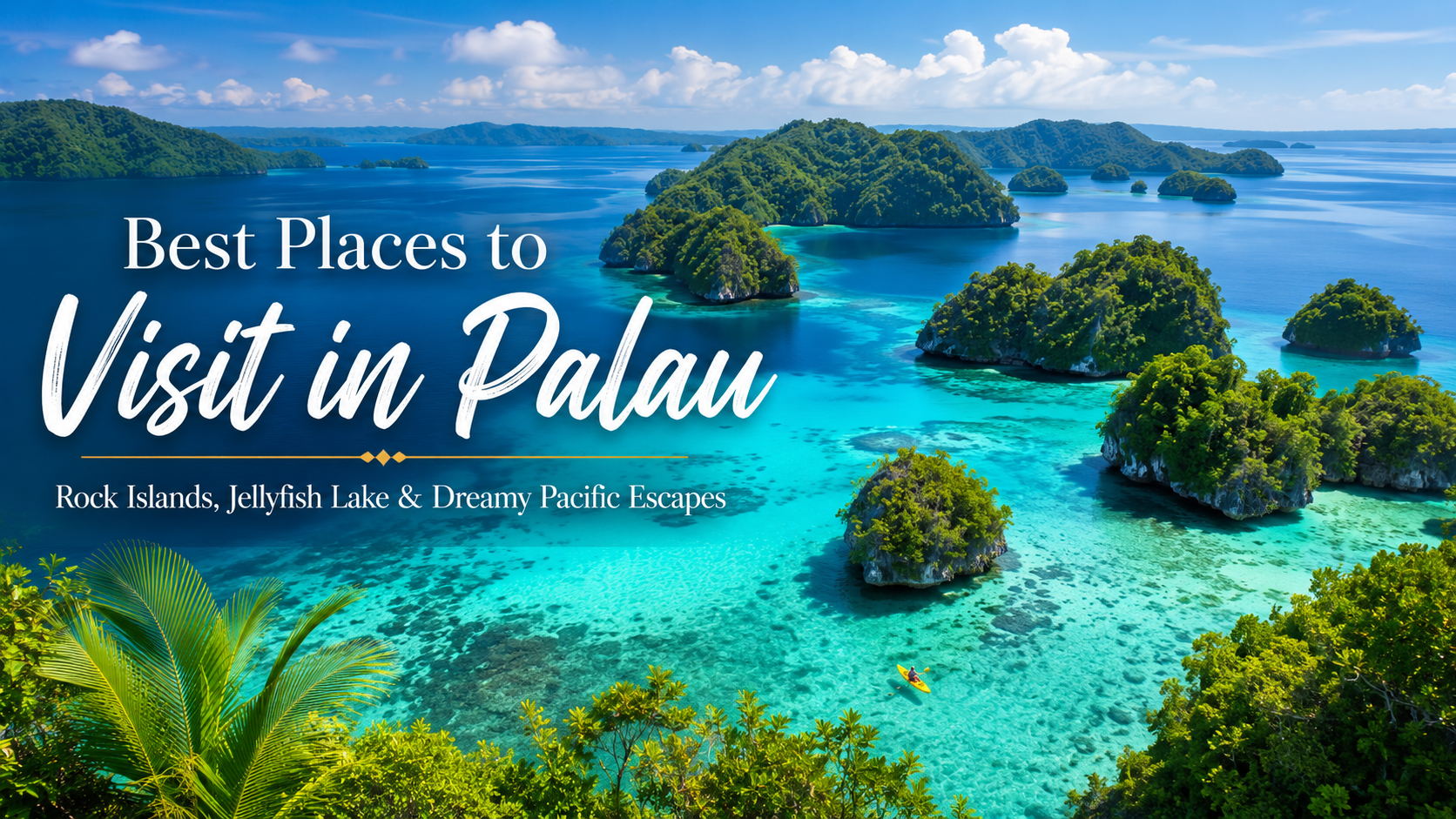
Palau feels like one of those places that should be impossible: glowing blue lagoons, jungle-covered limestone islands, stingless jellyfish, WWII history, waterfalls, coral reefs, quiet beach stops, and water so clear it can make a boat look like it is floating in the air.
This is not the kind of island destination where you simply pick one beach and stay put. Palau rewards travelers who get out on the water, look below the surface, learn a little history, and let the islands slowly reveal themselves. One day might be turquoise lagoons and snorkeling. Another might be waterfalls, ancient stone monoliths, or a sobering visit to Peleliu.
For divers, snorkelers, nature lovers, history travelers, and anyone who wants a Pacific trip that feels genuinely different, Palau is unforgettable.
Here are the best places to visit in Palau, from the famous Rock Islands and Jellyfish Lake to waterfalls, cultural sites, northern atolls, and WWII history.
Rock Islands Southern Lagoon

Region notes:
Central Palau, spread across the lagoon south of Koror and north of Peleliu. This is the classic Palau island-hopping area, where many of the country’s most famous boat tours, snorkeling stops, beaches, and lagoon views are found.
What kind of place it is:
A dreamy maze of limestone islands, turquoise water, hidden beaches, snorkeling spots, marine lakes, and boat-tour scenery.
Best for:
First-time visitors, couples, snorkelers, divers, photographers, boat tours, bucket-list island scenery.
Why travelers should care:
If you have seen one photo of Palau that made you stop scrolling, there is a good chance it was taken somewhere in the Rock Islands. This is the place where Palau’s fantasy-island beauty comes together: jungle-covered limestone islands rising out of glowing blue water, quiet coves tucked between cliffs, and little beaches that feel like they belong in a travel dream.
The Rock Islands are not just pretty background scenery either. They are the core of many Palau itineraries. This is where travelers go for lagoon tours, snorkeling, kayaking, beach stops, Jellyfish Lake, the Milky Way, and that full “I cannot believe this water is real” Palau feeling.
Even if you are not a diver, this is the place that makes Palau feel worth the long journey.
Main highlights:
- Mushroom-shaped limestone islands — the iconic Palau landscape, with green island tops and undercut limestone bases shaped by water and time.
- Lagoon boat tours — the easiest way to see multiple islands, beaches, snorkeling stops, and hidden corners in one day.
- Snorkeling stops — coral gardens, tropical fish, and clear-water reef areas that let non-divers experience Palau’s marine life.
- Kayaking routes — a slower way to slip through quiet channels, coves, and mangrove-fringed water.
- Tiny beach stops — small sandy pauses where the whole scene feels almost too perfect to be real.
Why I recommend it:
The Rock Islands are the Palau experience most travelers should build around. They give you the scenery, the water, the sense of remoteness, and the pure visual magic that makes Palau different from a standard tropical beach trip.
Side notes:
- The Rock Islands have that famous “mushroom” look because the limestone has been carved and worn away over time, especially near the waterline.
- This area is one of the big reasons Palau feels so cinematic; the lagoon changes color constantly depending on depth, sun, clouds, and sand.
- Many of Palau’s most famous experiences are not separate trips as much as different stops within this larger lagoon world.
- Access is usually by guided boat tour from Koror, and permits are part of the normal visitor logistics.
Jellyfish Lake

Region notes:
Inside the Rock Islands area, on Eil Malk / Mecherchar Island. Travelers usually reach it by boat from Koror as part of a Rock Islands day trip.
What kind of place it is:
A marine lake famous for its golden, mostly stingless jellyfish.
Best for:
Bucket-list travelers, nature lovers, snorkelers, photographers, couples, once-in-a-lifetime experiences.
Why travelers should care:
Jellyfish Lake is one of Palau’s strangest and most unforgettable natural experiences. It sounds almost unreal: a lake hidden inside a limestone island where golden jellyfish drift through the water around you.
This is not a loud, high-adrenaline adventure. It is quiet, surreal, and delicate. The magic is in floating slowly, looking around, and realizing you are having an experience that does not feel like anywhere else.
For many travelers, this is one of the main reasons Palau is on the dream-trip list. It is weird, beautiful, peaceful, and completely specific to the destination.
Main highlights:
- Golden jellyfish — the famous lake residents and the reason travelers come here.
- Hidden island setting — the lake sits inland, so reaching it feels like stepping into a secret natural world.
- Short access walk — most visits include a small inland walk from the boat landing to the lake.
- Rock Islands tour pairing — often combined with lagoon stops, snorkeling, the Milky Way, or beach time.
- Surreal photography — best captured gently and respectfully, without treating the lake like a theme park.
Why I recommend it:
Jellyfish Lake gives Palau one of its most memorable “only here” moments. It is the kind of travel experience people remember years later because it is not just beautiful — it is genuinely unusual.
Side notes:
- The jellyfish are often described as stingless, but the more careful way to think about them is that their sting is extremely mild and not usually felt by swimmers.
- Access to Jellyfish Lake can change depending on environmental conditions, so it is worth being flexible if this is one of your main reasons for visiting Palau.
- This is a fragile natural place, not a normal swimming lake, which is why guide instructions matter so much here.
- The lake gives Palau that wonderful “nature is stranger than fiction” feeling.
Koror

Region notes:
Central Palau, near the main visitor infrastructure and connected to nearby islands by roads and bridges. This is the main base for many travelers.
What kind of place it is:
Palau’s practical travel hub, with hotels, restaurants, tour operators, dive shops, museums, shops, and boat departures.
Best for:
First-time visitors, divers, tour-based trips, restaurants, easy logistics, arrival and departure days.
Why travelers should care:
Koror may not be the empty-island fantasy people picture when they imagine Palau, but it is the place that makes the fantasy easier to reach. This is where many travelers sleep, eat, book tours, meet dive operators, head out for Rock Islands trips, and organize the practical parts of the journey.
It also gives Palau more shape as a real destination. Between the museums, restaurants, waterfront activity, shops, and tour docks, Koror helps travelers see the country as more than just a collection of blue-water photos.
If you are visiting Palau for the first time, Koror is usually the easiest and most sensible base.
Main highlights:
- Boat tour departures — many Rock Islands, snorkeling, kayaking, and Jellyfish Lake trips begin from the Koror area.
- Dive shops and operators — ideal for travelers building a dive-heavy Palau itinerary.
- Belau National Museum — a useful cultural stop for understanding Palau beyond the lagoons.
- Etpison Museum — another strong place to learn more about Palauan history, culture, and island life.
- Restaurants and shops — helpful for relaxed evenings, rest days, and practical errands.
Why I recommend it:
Koror is the best base for keeping a Palau trip smooth. It puts you close to tours, food, dive logistics, cultural stops, and the water without making every day complicated.
Side notes:
- Koror was once Palau’s capital, and it still feels like the country’s main visitor center even though the official capital is now in Ngerulmud on Babeldaob.
- This is where Palau’s dreamy trip photos meet real travel logistics: tour check-ins, boat docks, dive gear, dinner plans, and last-minute sunscreen runs.
- Koror is not the place to judge Palau’s beauty by itself. Think of it as the launchpad for the wider trip.
- Museum stops here help balance all the water-based days with cultural context.
Milky Way Lagoon

Region notes:
In the Rock Islands area, usually visited by boat from Koror on lagoon tours.
What kind of place it is:
A shallow turquoise lagoon known for its pale white limestone mud.
Best for:
Couples, friend trips, fun boat days, photographers, relaxed travelers, first-time Palau visitors.
Why travelers should care:
The Milky Way is one of Palau’s most playful stops. It is not a grand historical site or a serious wildlife encounter. It is a bright blue lagoon where travelers scoop up soft white limestone mud, cover themselves in it, laugh at how ridiculous they look, and rinse off in the water.
That may sound silly, and honestly, it is. But that is part of the charm. Palau has plenty of awe-inspiring moments, and the Milky Way adds a lighter, more playful memory to the trip.
It is the kind of stop people may not expect to love, but they often remember.
Main highlights:
- White limestone mud — the signature feature that makes this lagoon stop famous.
- Bright turquoise water — beautiful even before the mud moment begins.
- Boat-tour pairing — usually easy to combine with Rock Islands, Jellyfish Lake, snorkeling, or beach stops.
- Fun photo moment — especially good for couples and friend groups.
- Low-pressure vacation energy — a break from more serious, fragile, or history-heavy sites.
Why I recommend it:
The Milky Way adds joy to a Palau itinerary. Not every travel memory has to be profound. Sometimes the best moments are the silly ones in beautiful places.
Side notes:
- This is one of those Palau experiences that sounds like a gimmick until you are actually there in the glowing blue water.
- The pale mud is part of the limestone landscape, which connects the experience back to the same geology that shapes the Rock Islands.
- It pairs nicely with Jellyfish Lake because one stop feels surreal and delicate, while the other feels playful and vacation-y.
- The exact experience can vary by tour, tide, and conditions.
Peleliu Island

Region notes:
Southwest Palau, south of the Rock Islands. It is more remote than Koror and often visited by boat, special tour, or as part of a more intentionally planned itinerary.
What kind of place it is:
A historically significant island known for WWII battle sites, memorials, relics, quiet landscapes, beaches, and nearby dive areas.
Best for:
History lovers, WWII travelers, divers, thoughtful travelers, returning visitors, people who want depth beyond scenery.
Why travelers should care:
Peleliu is beautiful, but it is not just a pretty island. It is one of Palau’s most emotionally significant places, shaped by one of the Pacific’s brutal WWII battles.
Visiting Peleliu gives travelers a very different kind of Palau experience. Instead of only lagoons, coral, and beach stops, you see old tanks, aircraft remains, caves, memorials, battlefield sites, and quiet landscapes where history still feels close.
It is a sobering stop, but an important one. Palau’s beauty is real, but so is its history, and Peleliu helps travelers understand both.
Main highlights:
- WWII battlefield sites — the main reason many travelers visit Peleliu.
- Old military relics — tanks, aircraft remains, bunkers, and other remnants tied to the island’s wartime history.
- Memorials — places to pause and understand the scale of what happened here.
- Quiet island landscapes — a slower, less developed feeling than Koror.
- Nearby dive sites — appealing for travelers who want Palau’s history and underwater world in the same broader itinerary.
Why I recommend it:
Peleliu gives Palau emotional weight. It keeps the trip from becoming only pretty water and shows travelers a deeper, more complicated side of the islands.
Side notes:
- The Battle of Peleliu is one of those WWII Pacific stories that many casual travelers do not know much about before visiting Palau.
- The contrast between the island’s natural beauty and its wartime past can feel intense, which is why a guide can make the visit much more meaningful.
- Peleliu works best when travelers go in knowing it is not just a scenic island excursion.
- This is a rare place where military history, island life, and dive travel can all overlap in one destination.
Babeldaob Island

Region notes:
Palau’s largest island, north of Koror, connected by bridge and road. This is where travelers go for a more land-based look at Palau.
What kind of place it is:
A large, lush island with waterfalls, villages, cultural sites, scenic roads, forests, coastlines, and archaeological stops.
Best for:
Road trips, culture lovers, nature travelers, waterfall seekers, repeat visitors, travelers who want more than boat tours.
Why travelers should care:
Babeldaob shows travelers that Palau is not only about the Rock Islands. It gives the country a more grounded, road-trip side: green hills, jungle roads, waterfalls, ancient sites, coastal views, villages, and quieter landscapes away from the main tour docks.
This is the part of Palau that helps a trip feel fuller. After several days on the water, Babeldaob gives you a different rhythm. You can drive, stop, look around, visit cultural sites, see waterfalls, and start to understand the islands as lived-in places, not just beautiful backdrops.
Main highlights:
- Scenic island drives — a good way to see Palau’s lush interior and quieter coastal areas.
- Ngardmau Waterfall — one of Palau’s best-known inland nature stops.
- Badrulchau Stone Monoliths — an ancient cultural site that adds mystery and depth to the trip.
- Traditional and cultural stops — useful for understanding Palau beyond marine tourism.
- Ngerulmud — Palau’s modern capital area, located on Babeldaob rather than in Koror.
Why I recommend it:
Babeldaob makes Palau feel more complete. It gives travelers a break from boats while adding culture, scenery, history, and inland nature to the itinerary.
Side notes:
- Babeldaob is much larger than many travelers expect, especially if they only think of Palau as tiny islands and lagoons.
- The island’s road-trip feeling can be a nice reset after several active water days.
- Palau’s official capital, Ngerulmud, is on Babeldaob, which surprises many travelers who assume Koror still holds that role.
- This is where Palau starts to feel less like a vacation image and more like a layered island country.
Ngardmau Waterfall

Region notes:
On Babeldaob Island, in northern Palau. It is one of the most popular inland nature stops for travelers exploring beyond Koror.
What kind of place it is:
A tropical waterfall reached by trail, surrounded by Palau’s lush green interior.
Best for:
Nature lovers, waterfall seekers, soft adventure, photographers, travelers who want a land-based day.
Why travelers should care:
Ngardmau Waterfall gives Palau a completely different kind of water experience. Instead of reefs, lagoons, and boat tours, this is jungle greenery, flowing freshwater, trail scenery, and the sound of a waterfall tucked into the island landscape.
It is especially rewarding if your Palau trip has been very ocean-heavy. A waterfall day adds variety and gives you a reason to explore Babeldaob instead of spending every day leaving from the docks.
This is also a nice reminder that Palau’s beauty does not stop at the shoreline.
Main highlights:
- Tropical waterfall scenery — a lush inland contrast to Palau’s lagoons and reefs.
- Trail experience — part of the appeal is the walk through the landscape before reaching the falls.
- Freshwater setting — a totally different mood from the saltwater days around Koror.
- Babeldaob pairing — easy to combine with a broader island drive.
- Photography — especially for travelers who want green jungle views as well as blue water.
Why I recommend it:
Ngardmau Waterfall keeps the itinerary balanced. It gives travelers a beautiful reason to go inland and see Palau’s green, jungle side.
Side notes:
- Palau’s inland scenery can feel surprisingly lush if you arrive expecting only beaches and reefs.
- This is the kind of stop that helps a Palau itinerary breathe a little between boat-heavy days.
- Waterfall conditions can change with weather, so it is best approached with some flexibility.
- It works nicely as part of a Babeldaob day rather than as a standalone full-day plan for most travelers.
Badrulchau Stone Monoliths

Region notes:
Northern Babeldaob, in Ngarchelong State. This is one of Palau’s most notable ancient cultural sites and fits well into a northern island drive.
What kind of place it is:
An archaeological and cultural site with large stone monoliths set in an open landscape.
Best for:
Culture lovers, history travelers, road-trippers, photographers, travelers who like mysterious ancient sites.
Why travelers should care:
The Badrulchau Stone Monoliths give Palau a very different kind of atmosphere. After lagoons, reefs, and beaches, this site feels older, quieter, and more mysterious.
The stones stand in an open landscape, giving the place a sense of space and age. It is not a flashy stop, but that is part of its appeal. It reminds travelers that Palau’s story did not begin with dive tourism, WWII history, or modern island-hopping trips. There are deeper cultural layers here.
For travelers who like ancient places and little mysteries, Badrulchau is one of the most interesting stops on Babeldaob.
Main highlights:
- Ancient stone monoliths — the main feature of the site and one of Palau’s strongest archaeological stops.
- Open scenic setting — the landscape around the stones adds to the atmosphere.
- Northern Babeldaob location — good for pairing with other island stops.
- Cultural depth — a reminder that Palau has a long history beyond its famous marine beauty.
- Quiet, contemplative feel — best for travelers who appreciate slower cultural sites.
Why I recommend it:
Badrulchau adds mystery and age to the Palau itinerary. It helps balance the water-focused parts of the trip with something ancient, cultural, and quietly powerful.
Side notes:
- This is one of those places where the setting matters almost as much as the stones themselves.
- Ancient stone sites can be especially interesting in island destinations because they hint at older movement, settlement, power, and community life.
- It is a good stop for travelers who like the “what was this place like hundreds of years ago?” feeling.
- The site is more rewarding if you read a little context beforehand or visit with someone who can explain it.
Airai Bai

Region notes:
In Airai, near the route between Koror and Babeldaob. It is one of the easier cultural stops to fit into a Palau itinerary.
What kind of place it is:
A traditional Palauan meeting house and cultural site.
Best for:
Culture lovers, first-time visitors, families, history travelers, arrival or departure day sightseeing.
Why travelers should care:
Airai Bai gives travelers a more human and cultural view of Palau. The carved structure, traditional design, and community meaning make it a useful stop if you want to understand the islands beyond their natural beauty.
It is also an easy cultural layer to add without turning the day into a major expedition. Because it is relatively convenient, it can fit well into a lighter sightseeing day, a Babeldaob route, or a day when you do not want to commit to a full boat tour.
This is the kind of stop that quietly improves a trip because it gives the destination more identity.
Main highlights:
- Traditional Palauan architecture — a strong visual introduction to local building styles and community spaces.
- Carved details — interesting for travelers who like symbolism, storytelling, and cultural design.
- Convenient location — easier to include than many more remote sites.
- Cultural context — a good counterbalance to Palau’s water-heavy itinerary.
- Short visit potential — useful when you want meaningful sightseeing without filling an entire day.
Why I recommend it:
Airai Bai helps travelers see Palau as a culture, not just a landscape. It is a simple but worthwhile stop that adds context to the rest of the trip.
Side notes:
- A bai is traditionally more than just a building; it is tied to community life, leadership, gathering, and storytelling.
- The carved details are part of what makes the site memorable, especially if you like visual culture.
- This is a good reminder that “cultural stops” do not always need to be huge museums to be worthwhile.
- It works especially well when paired with Koror museums or a Babeldaob driving day.
Blue Corner and German Channel

Region notes:
In Palau’s famous reef and lagoon dive areas, reached by boat from Koror. These are underwater places rather than traditional land attractions.
What kind of place it is:
Two of Palau’s most famous marine sites, especially important for divers.
Best for:
Experienced divers, marine-life lovers, underwater photographers, scuba-focused trips, adventurous travelers.
Why travelers should care:
Palau is one of the world’s legendary dive destinations, and Blue Corner and German Channel are a big part of that reputation. These are not sightseeing stops in the usual sense. You do not go here to walk around, shop, or sit under a palm tree. You go because Palau’s underwater world is one of its greatest treasures.
Blue Corner is famous for exciting reef action and big marine life, while German Channel is known as a major marine-life route where divers may hope for manta ray encounters depending on conditions and timing.
Even for non-divers, these names matter because they explain why Palau has such a powerful pull for scuba travelers.
Main highlights:
- Blue Corner — one of Palau’s signature dive sites, known for dramatic underwater action.
- German Channel — a famous marine-life area with strong appeal for divers and underwater photographers.
- Reef life — coral, fish, currents, and the kind of underwater energy that makes Palau special.
- Big marine-life potential — one of the reasons divers dream about coming here.
- Boat-based access — part of the broader Palau dive-tour rhythm from Koror.
Why I recommend it:
Blue Corner and German Channel are worth including because for many travelers, Palau’s reefs are the whole reason to come. These sites are not casual beach stops, but they are central to Palau’s identity.
Side notes:
- Palau is not just “good for diving.” For many serious divers, it is a bucket-list dive destination.
- These are places where conditions, currents, experience level, and operator choice really matter.
- German Channel’s name comes from a channel created during the German colonial period, which is one of those odd historical fingerprints still attached to the landscape.
- Non-divers can still appreciate the importance of these sites because they are part of why Palau is so famous worldwide.
Kayangel Atoll

Region notes:
Far northern Palau, beyond Babeldaob. This is one of the more remote-feeling places in the country and takes more planning than standard Koror-based sightseeing.
What kind of place it is:
A quiet northern atoll with pale sand, lagoon scenery, remote island atmosphere, and a far-from-everything feel.
Best for:
Remote-island dreamers, photographers, beach lovers, returning visitors, travelers with extra time, off-the-main-route explorers.
Why travelers should care:
Kayangel is the kind of place that makes map-lovers curious. It sits farther north than the main visitor circuit, giving it a more remote, edge-of-the-map feeling than Koror or the Rock Islands.
This is not the easiest Palau stop, and that is part of its appeal. Kayangel is for travelers who want pale sand, bright water, quiet island scenery, and the feeling of going beyond the standard itinerary.
For a first trip, it may not be essential. But for travelers with more time, a special interest in remote islands, or a desire to see a quieter side of Palau, Kayangel adds something special.
Main highlights:
- Northern atoll scenery — a different island feeling from the Rock Islands’ limestone lagoon landscape.
- Quiet beaches — the appeal is more remote and peaceful than busy or activity-packed.
- Bright lagoon water — classic Pacific blues with a more far-flung mood.
- Photography — especially for travelers who love wide-open water, sand, and sky.
- Beyond-the-usual-route appeal — best for travelers who do not want only the obvious stops.
Why I recommend it:
Kayangel gives Palau more range. It shows that the country is not only Koror and the Rock Islands, and it gives adventurous travelers something quieter and farther out to dream about.
Side notes:
- Kayangel is Palau’s northernmost state, which gives it that “farther out” appeal.
- This is the kind of place where logistics are part of the decision, not an afterthought.
- Weather and sea conditions can matter a lot more when you are dealing with more remote island access.
- It is better for travelers with extra time than for someone trying to squeeze Palau into a very short trip.
Long Beach and Rock Islands Beach Stops

Region notes:
Within the Rock Islands area, usually visited by boat from Koror. Exact stops depend on the tour route, tides, weather, and access rules.
What kind of place it is:
Small beaches, sandbar-style stops, picnic islands, and quiet places to pause during Rock Islands tours.
Best for:
Couples, friend trips, families, photographers, beach lovers, relaxed boat days.
Why travelers should care:
Not every Palau experience needs to be dramatic, historic, or famous by name. Some of the best moments are the simple ones: stepping off a boat onto pale sand, looking around at blue water and green islands, and realizing the scenery really does look like the photos.
These beach stops are what make a Rock Islands day feel like a true island escape. They give travelers time to slow down between snorkeling, kayaking, Jellyfish Lake, or the Milky Way. They are also perfect for lunch stops, photos, swimming breaks, and that quiet “this is exactly why I came to Palau” feeling.
Main highlights:
- Small sandy beaches — peaceful pauses between bigger Rock Islands activities.
- Sandbar-style scenery — depending on tide and route, some stops have that dreamy bright-sand-and-blue-water look.
- Picnic stops — many tours use beach breaks as a natural pause in the day.
- Swimming breaks — gentle water time when conditions are right.
- Classic Palau photos — blue lagoon, green islands, pale sand, and almost no visual clutter.
Why I recommend it:
These beach stops add softness to the itinerary. They are not always the headline reason to visit Palau, but they are often the moments that make the trip feel dreamy and relaxed instead of just busy.
Side notes:
- Some of Palau’s most beautiful beach moments are not attached to famous names. They happen as part of the boat day.
- The exact beach you visit may depend on tides, weather, permits, and your guide’s route.
- These stops are a reminder that the best travel memories are not always the most complicated ones.
- Palau’s beach scenery often feels more special because it is surrounded by lagoon and limestone island views rather than long resort-lined shorelines.
Shortlist Packing Notes for Palau
Palau is not the place to overpack, but a few smart items can make the trip much easier. This is especially true if you are doing Rock Islands boat tours, snorkeling, diving, waterfall walks, lagoon stops, or beach breaks.
Pack:
- Sunscreen
- UPF rash guard
- Dry bag
- Waterproof phone pouch
- Water shoes
- Reusable water bottle
- Compact quick-dry towel
- Insect repellent wipes or spray
- Motion-sickness help
Final Thoughts
Palau is small on the map, but it has a huge travel personality. The Rock Islands and Jellyfish Lake may be the headline experiences, but the destination becomes much richer when you also make room for Koror, Babeldaob, waterfalls, cultural sites, Peleliu, and the underwater places that have made Palau legendary with divers.
For a first trip, the best approach is usually a mix: stay near Koror for easier logistics, spend serious time on the water, add at least one land-based Babeldaob day, and decide whether Peleliu or Kayangel fits your time, budget, and travel style.
Palau is not just a beach escape. It is a lagoon, reef, history, culture, and nature trip all woven together — and that is exactly what makes it worth the long journey.