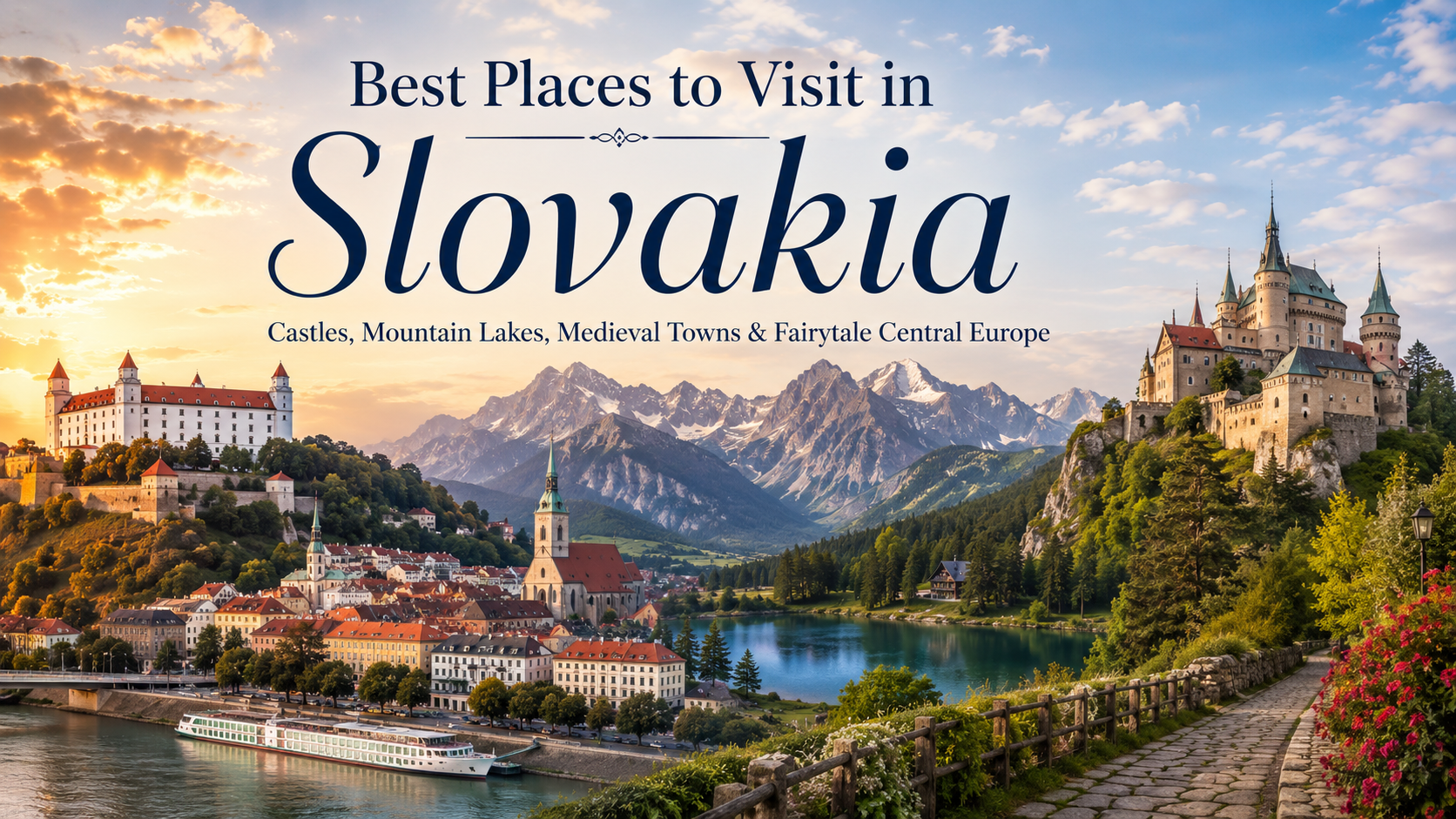
Slovakia is one of Central Europe’s most underrated travel surprises. It has the kind of variety that makes a country feel much bigger than it looks on a map: fairytale castles, alpine lakes, medieval town squares, wooden folk villages, dramatic caves, spa towns, forest trails, and mountain scenery that does not need to shout to be beautiful.
A lot of travelers know Bratislava as an easy side trip from Vienna, and it absolutely can be that. But Slovakia deserves more than a quick capital-city stop. Once you start looking beyond Bratislava, the country opens up into something richer and more layered: the High Tatras for mountain views, Spiš Castle for medieval drama, Banská Štiavnica for romantic old-town atmosphere, Slovak Paradise for adventurous gorge hikes, and Košice for a more local-feeling city break in the east.
This is a country for travelers who like castles but also want nature, who enjoy historic towns but do not want every destination to feel overrun, and who love the idea of finding places that still feel a little under-discovered.
Here are some of the best places to visit in Slovakia, from easy city stops to mountain escapes, castle country, and heritage towns worth building a trip around.
Bratislava

Region notes: Western Slovakia, on the Danube River near the Austrian and Hungarian borders.
What kind of place it is: Slovakia’s capital city, with a compact old town, castle views, cafés, museums, riverfront walks, and easy train access from nearby Central European cities.
Best for: First Slovakia trips, couples, solo travelers, weekend breaks, Danube itineraries, history lovers, easy city wandering.
Bratislava is the easiest place to start a Slovakia trip, especially if you are arriving from Vienna, Budapest, or Prague. It has a walkable old town, pretty squares, cobbled streets, cafés, churches, and a castle above the Danube, which gives the city a classic Central European look without the scale or intensity of bigger capitals.
The city works well for travelers who want atmosphere without overcomplication. You can wander the old town, walk up toward Bratislava Castle, sit by the river, stop for coffee, and still feel like you have room to breathe. It is not the biggest city in Europe, and that is part of its charm.
Main highlights:
- Bratislava Castle: The white hilltop castle overlooking the Danube and the old town. It is one of the city’s defining landmarks and gives travelers one of the best views over Bratislava.
- Old Town: A compact historic center with pastel buildings, cafés, churches, squares, statues, and winding streets that are easy to explore on foot.
- St. Martin’s Cathedral: A Gothic cathedral tied to Bratislava’s coronation history, especially from the era when the city was part of the Kingdom of Hungary.
- Michael’s Gate: A medieval city gate and one of the most recognizable entry points into the old town.
- Danube riverfront: A good area for walks, views, restaurants, and a different perspective on the city.
Why I recommend it:
Bratislava is the best soft landing for Slovakia. It gives travelers an easy introduction to the country without requiring a complicated itinerary, and it is especially useful for anyone pairing Slovakia with Austria, Hungary, or Czechia. It also helps readers understand that Slovakia is not just mountain villages and castles — it has a real capital-city experience, just in a smaller, more manageable package.
Good to know:
- Bratislava works well as a first or last stop in Slovakia.
- It is especially convenient if you are coming from Vienna.
- The old town is very walkable, but the castle area does involve uphill walking.
- Cobblestones are common, so comfortable shoes make a difference.
High Tatras

Region notes: Northern Slovakia, along the border with Poland.
What kind of place it is: Slovakia’s dramatic alpine mountain region, with lakes, peaks, cable cars, ski towns, hiking trails, forests, and national park scenery.
Best for: Hikers, photographers, couples, active families, nature lovers, winter travelers, mountain escapes, scenic road trips.
The High Tatras are one of the biggest reasons to build a real Slovakia itinerary instead of only visiting Bratislava. This is where Slovakia becomes alpine: sharp peaks, mountain lakes, forest trails, cable cars, ski villages, and views that feel much grander than many travelers expect.
You do not have to be a hardcore hiker to enjoy the High Tatras. Travelers can base themselves in mountain towns, walk around lakes, ride cable cars, take easier trails, or simply enjoy the scenery. But if you do love hiking, the region gives Slovakia one of its strongest outdoor travel hooks.
Main highlights:
- Štrbské Pleso: A mountain lake and resort area with walking paths, hotels, views, and easy access to High Tatras scenery.
- Tatranská Lomnica: A popular mountain base with cable car access and views toward Lomnický štít, one of the region’s famous peaks.
- Starý Smokovec: A classic High Tatras base with transport connections, mountain atmosphere, and access to nearby trails.
- Hrebienok: A mountain area reached by funicular from Starý Smokovec, useful for easier access to trails, waterfalls, and viewpoints.
- Poprad: A practical gateway town for reaching the High Tatras by train or road.
Why I recommend it:
The High Tatras give Slovakia its strongest mountain identity. They make the country feel bigger, wilder, and more dramatic, and they are a major reason travelers should consider spending several days in Slovakia instead of treating it as a quick side trip. This is the place that helps Slovakia compete emotionally with better-known European mountain destinations while still feeling more under-the-radar.
Good to know:
- Weather can change quickly in the mountains.
- Some trails are seasonal or affected by snow.
- Cable cars and easier lake walks make the region appealing even for travelers who do not want strenuous hikes.
- Summer and winter feel very different here, so match your plans to the season.
Spiš Castle & Levoča

Region notes: Eastern Slovakia, in the Spiš region between the High Tatras and Košice.
What kind of place it is: A powerful castle-and-medieval-town pairing, with one of Slovakia’s most impressive castle ruins and a historic town tied to UNESCO heritage.
Best for: Castle lovers, history travelers, photographers, medieval Europe fans, road trips, culture-focused itineraries.
Spiš Castle is one of Slovakia’s great showstopper sights. It sits high above the surrounding countryside, not as a delicate palace but as a huge, atmospheric castle ruin that feels like it still commands the landscape around it.
Pairing the castle with nearby Levoča makes this part of Slovakia even stronger. Spiš Castle gives you the drama; Levoča gives you the preserved medieval-town experience, with a historic square, churches, old walls, and architecture that helps the region feel like more than a single photo stop.
Main highlights:
- Spiš Castle: A massive hilltop castle ruin with sweeping countryside views and a strong medieval atmosphere.
- Spišské Podhradie: The town below the castle, useful for seeing the wider castle landscape and getting a sense of the area.
- Spišská Kapitula: A historic church settlement near the castle, adding religious and architectural context to the region.
- Levoča Old Town: A preserved medieval town with a beautiful main square, historic buildings, and old-town character.
- Basilica of St. James in Levoča: Known for its remarkable wooden altar by Master Paul of Levoča.
Why I recommend it:
This is one of the strongest history pairings in Slovakia. Spiš Castle has the visual power travelers want from a castle stop, while Levoča adds depth, charm, and context. Together, they make eastern Slovakia feel worth the journey and help the itinerary move beyond “pretty places” into real Central European heritage.
Good to know:
- Try to see Spiš Castle from below before going up, because the castle’s position in the landscape is part of the experience.
- This area pairs well with the High Tatras, Košice, or Slovak Paradise.
- Expect open spaces and uneven ground at the castle.
- Levoča deserves time instead of being treated as a rushed add-on.
Banská Štiavnica

Region notes: Central Slovakia, in a hilly former mining region.
What kind of place it is: A romantic historic mining town with old streets, churches, hilltop views, mining heritage, and nearby lakes.
Best for: Couples, photographers, slow travelers, history lovers, romantic weekends, travelers who love atmospheric small towns.
Banská Štiavnica is one of Slovakia’s most beautiful small towns, and it has a different mood from Bratislava, Košice, or the mountain regions. It sits in a hilly landscape shaped by mining history, with old houses, churches, steep lanes, and a romantic, slightly timeworn beauty.
This is the kind of place where the town itself is the experience. You come for the atmosphere: wandering the streets, climbing toward viewpoints, stopping for coffee, noticing the hills around you, and feeling how history and landscape sit together.
Main highlights:
- Old Town: A charming historic center with sloping streets, colorful buildings, cafés, churches, and mining-town atmosphere.
- Old Castle: A fortified historic complex that helps explain the town’s religious and defensive history.
- New Castle: A hilltop landmark with views over Banská Štiavnica and the surrounding landscape.
- Calvary of Banská Štiavnica: A striking religious complex on a hill above town, with chapels and panoramic views.
- Tajchy lakes: Historic artificial lakes originally connected to the mining system, now used for scenery, swimming, and local recreation.
Why I recommend it:
Banská Štiavnica is the romantic small-town pick. It gives Slovakia softness, beauty, and atmosphere in a way that balances the bigger castle and mountain stops. For readers who love places that feel layered rather than flashy, this is one of the strongest reasons to slow down in central Slovakia.
Good to know:
- This is a strong overnight stop, not just a quick pass-through.
- The town is hilly, so pacing matters.
- It is especially appealing for couples and slow travelers.
- The surrounding lakes can add a nature break to a town-focused visit.
Slovak Paradise National Park

Region notes: Eastern Slovakia, south of the High Tatras.
What kind of place it is: A national park known for gorges, waterfalls, forest trails, ladders, metal steps, bridges, and adventurous hiking routes.
Best for: Active travelers, hikers, adventure lovers, outdoorsy couples, photographers, nature-focused road trips.
Slovak Paradise is one of Slovakia’s most exciting outdoor areas, especially for travelers who want trails that feel more active than a gentle scenic walk. This is the park for gorges, waterfalls, ladders, narrow passages, and routes that make the hike itself part of the adventure.
It is beautiful, but it is not a place to treat casually. Some of the most famous routes include ladders, metal steps, chains, wet sections, or one-way trail systems, so choosing the right hike for your comfort level matters.
Main highlights:
- Suchá Belá Gorge: One of the park’s best-known gorge routes, with waterfalls, ladders, and adventurous trail features.
- Prielom Hornádu: A scenic canyon route along the Hornád River, with metal steps and dramatic river sections.
- Tomášovský Viewpoint: A rocky viewpoint with sweeping views over the forested landscape.
- Dobšinská Ice Cave: A famous ice cave in the broader region, useful for travelers who want a natural wonder beyond hiking.
- Podlesok: A common base area for accessing several Slovak Paradise trails.
Why I recommend it:
Slovak Paradise adds true adventure to the post. It keeps the Slovakia guide from becoming only castles, towns, and scenic mountains, and it gives active travelers a reason to get excited. This is the pick for readers who want their Slovakia trip to feel physical, memorable, and a little more adventurous.
Good to know:
- This is not the place for casual sandals or “we’ll just wing it” hiking.
- Some routes are one-way and physically demanding.
- Trails can be slippery after rain.
- Check current trail conditions before setting out.
Košice

Region notes: Eastern Slovakia, not far from the Hungarian border.
What kind of place it is: Slovakia’s major eastern city, with a beautiful historic center, cathedral, cafés, architecture, culture, and a more local-feeling city experience than Bratislava.
Best for: City breaks, culture travelers, architecture lovers, solo travelers, café lovers, eastern Slovakia itineraries.
Košice is one of the best places to visit in Slovakia if you want to go beyond the capital. It has a long, elegant main street, a major cathedral, fountains, theaters, cafés, and a historic center that feels lively without being overwhelming.
It also makes a smart base for eastern Slovakia. From Košice, travelers can connect to places like Spiš Castle, Levoča, Slovak Paradise, the High Tatras, and northeastern historic towns, which makes it more useful than many travelers realize at first glance.
Main highlights:
- St. Elisabeth Cathedral: A grand Gothic cathedral and one of Košice’s most important landmarks.
- Hlavná ulica: The city’s long main street, lined with historic buildings, cafés, restaurants, fountains, and public spaces.
- Singing Fountain: A central fountain near the cathedral that adds a playful city-center stop.
- State Theatre Košice: A beautiful theater building that adds to the city’s cultured atmosphere.
- East Slovak Museum: A useful stop for travelers who want more regional history and context.
Why I recommend it:
Košice keeps Slovakia from feeling too Bratislava-centered. It gives eastern Slovakia a strong city anchor and makes deeper itineraries feel more realistic. For travelers who like cities but do not necessarily want the biggest or most obvious option, Košice is a very satisfying stop.
Good to know:
- Košice works well as an eastern Slovakia base.
- The historic center is walkable and atmospheric.
- It pairs well with Spiš, Levoča, Slovak Paradise, and the High Tatras.
- It is a good choice for travelers who want a city experience with fewer big-capital crowds.
Bojnice Castle

Region notes: Central-western Slovakia, near the town of Prievidza.
What kind of place it is: A romantic fairytale-style castle with towers, pale stone, ornate interiors, gardens, and strong visual appeal.
Best for: Couples, families, castle lovers, photographers, romantic trips, travelers who want a classic fairytale castle stop.
Bojnice Castle is one of Slovakia’s most storybook-looking places. If Spiš Castle feels dramatic and medieval, Bojnice feels romantic and fairytale-like, with towers, curves, pale walls, and a castle-park setting that makes it instantly appealing.
This is the kind of castle that sells itself visually. It is polished, pretty, and easy to imagine in a fairytale itinerary, which makes it especially appealing for couples, families, and travelers who love romantic European architecture.
Main highlights:
- Bojnice Castle: A romantic castle with towers, ornate interiors, and one of Slovakia’s most recognizable fairytale silhouettes.
- Castle Park: A pleasant area around the castle for strolling and photos.
- Bojnice town center: A small, easy town setting that makes the castle feel approachable.
- Bojnice Zoo: A family-friendly add-on near the castle, useful for travelers with kids.
Why I recommend it:
Bojnice Castle is the fairytale castle pick. It is different enough from Spiš and Orava to earn its own place, because it gives readers romance, polish, and visual beauty rather than rugged ruin or cliffside drama. It is also one of the easiest Slovakia stops to understand immediately from a photo.
Good to know:
- Bojnice is especially strong for families and couples.
- It is more polished and romantic than rugged.
- This is a good visual contrast to Spiš Castle and Orava Castle.
- Check opening times before planning a castle-focused day.
Orava Castle

Region notes: Northern Slovakia, in the Orava region near the Polish border.
What kind of place it is: A dramatic cliffside castle built high above the Orava River.
Best for: Castle lovers, photographers, road trips, history travelers, gothic atmosphere, travelers who like moody scenery.
Orava Castle is one of Slovakia’s most dramatic castles. It rises in layers from a rocky cliff above the river, giving it a darker, more cinematic feeling than many softer European castles.
This is the castle for travelers who like atmosphere: stone walls, steep angles, high viewpoints, and the sense that the castle is watching over the whole valley below. It pairs especially well with northern Slovakia road trips and mountain-region itineraries.
Main highlights:
- Upper Castle: The highest part of the castle complex, with some of the strongest views.
- Middle and Lower Castle sections: Layers of historic rooms, courtyards, and fortifications that show how the castle grew over time.
- Orava River setting: The river and cliffside position make the castle especially photogenic from below.
- Oravský Podzámok: The village below the castle, useful for arrival, views, and exploring the immediate area.
Why I recommend it:
Orava Castle is the dramatic castle pick. It brings a moody, cinematic quality that is very different from Bojnice’s fairytale prettiness and Spiš Castle’s vast ruined landscape. Including all three castles is not repetitive because each one gives travelers a completely different version of Slovakia’s castle appeal.
Good to know:
- Expect stairs and elevation changes inside the castle complex.
- The view of the castle from below is part of the experience.
- It works well on a northern Slovakia road trip.
- It has a more gothic, atmospheric feeling than many other Slovakia castles.
Vlkolínec

Region notes: Northern-central Slovakia, near Ružomberok and the Low Tatras / Greater Fatra region.
What kind of place it is: A preserved mountain folk village known for traditional wooden houses, rural Slovak heritage, and a peaceful village setting.
Best for: Culture travelers, photographers, slow travelers, folk architecture lovers, heritage stops, road trips.
Vlkolínec is small, but it adds an important layer to a Slovakia itinerary. Instead of a castle, city, or mountain resort, this is a preserved folk village with traditional wooden houses, mountain surroundings, and a quiet rural character.
This is not a place where you need a huge checklist. The village itself is the experience: the colors, the wooden architecture, the setting, and the feeling of seeing a different side of Slovak heritage.
Main highlights:
- Traditional wooden houses: Colorful preserved homes that show historic rural building styles.
- Village setting: A mountain-area location that makes the village feel peaceful and scenic.
- Folk architecture: A good stop for travelers who want culture beyond castles and capitals.
- Small-scale wandering: The experience is more about walking slowly and looking closely than checking off major attractions.
Why I recommend it:
Vlkolínec gives the post cultural texture. Without it, Slovakia can look like castles, capitals, and mountains only. This village helps readers see the rural and folk-heritage side of the country, which makes the overall guide feel more complete and more distinctly Slovak.
Good to know:
- This is a short atmospheric stop rather than a full-day destination for most travelers.
- It pairs well with northern or central Slovakia road trips.
- Be respectful because this is a heritage village, not a theme park.
- It is best for travelers who enjoy slow, quiet, detail-focused stops.
Bardejov

Region notes: Northeastern Slovakia, near the Polish border.
What kind of place it is: A preserved medieval town known for its historic square, town walls, churches, and old-world atmosphere.
Best for: History lovers, photographers, architecture fans, road trips, deeper eastern Slovakia itineraries.
Bardejov is one of Slovakia’s strongest historic-town stops, especially for travelers who like medieval squares and preserved old-town character. It feels quieter and more tucked away than Bratislava or Košice, which is exactly why it can be so rewarding.
The heart of the visit is the main square, where historic buildings, religious architecture, and the town’s preserved layout create a strong sense of place. It is the kind of stop that makes a Slovakia itinerary feel more layered and less obvious.
Main highlights:
- Bardejov Town Square: A beautiful historic square surrounded by old burgher houses and town architecture.
- Basilica of St. Egidius: A major church on the main square and one of the town’s defining landmarks.
- Town Hall: A historic building in the square that helps anchor the old-town setting.
- Town fortifications: Preserved walls and defensive features that show Bardejov’s medieval importance.
- Bardejovské Kúpele: A nearby spa area that can add a wellness or slower-travel element to the visit.
Why I recommend it:
Bardejov is the deeper-cut medieval town pick. It rewards travelers who are willing to go beyond the most obvious Slovakia stops, and it gives northeastern Slovakia a reason to matter in the itinerary. It is especially useful for readers who love historic squares, preserved town centers, and quieter places with real character.
Good to know:
- Bardejov is best for travelers with enough time to go deeper into eastern Slovakia.
- It pairs well with Košice or a broader northeast Slovakia route.
- The nearby spa area can add a gentler contrast to the historic town.
- This is a good choice for slow travelers and history-focused itineraries.
Demänovská Valley & the Low Tatras

Region notes: Central Slovakia, in the Low Tatras region near Liptovský Mikuláš.
What kind of place it is: A mountain valley known for caves, ski areas, hiking, scenery, and year-round outdoor travel.
Best for: Nature lovers, families, cave visitors, hikers, winter travelers, road trips, travelers who want mountains beyond the High Tatras.
The Demänovská Valley is one of the best places to visit in Slovakia if you want mountain scenery with caves, outdoor activities, and a slightly different feel from the High Tatras. It sits in the Low Tatras region, which can work well for travelers who want nature without building the whole trip around Slovakia’s most famous alpine area.
This area is especially useful because it has appeal in more than one season. In warmer months, travelers come for caves, trails, and mountain scenery. In winter, the region becomes important for skiing and snow-focused trips.
Main highlights:
- Demänovská Cave of Liberty: A major cave system known for underground formations, chambers, and dramatic natural scenery.
- Demänovská Ice Cave: Another important cave in the valley, with ice formations depending on conditions and season.
- Jasná: A major mountain resort area in the Low Tatras, especially known for skiing and outdoor activities.
- Chopok: A mountain peak and viewpoint area associated with the Low Tatras and Jasná.
- Liptovský Mikuláš: A practical nearby town for basing in the region and accessing nature, caves, and activities.
Why I recommend it:
Demänovská Valley gives Slovakia a strong caves-and-mountains combination. It also keeps the nature coverage from leaning only on the High Tatras. For readers planning a fuller Slovakia itinerary, this area adds variety, flexibility, and year-round appeal.
Good to know:
- Cave access can depend on opening schedules and conditions.
- Winter and summer trips feel very different here.
- This area can work well for families because it offers multiple types of activities.
- It pairs naturally with central and northern Slovakia itineraries.
Piešťany

Region notes: Western Slovakia, northeast of Bratislava, along the Váh River.
What kind of place it is: A classic Slovak spa town known for wellness travel, thermal treatments, river scenery, and a slower pace.
Best for: Wellness travelers, older travelers, couples, slower trips, recovery days, gentle itineraries.
Piešťany adds a different kind of Slovakia experience. After castles, hiking, cities, and medieval towns, a spa town gives travelers permission to slow down. This is a place where the appeal is not rushing from sight to sight but settling into a gentler rhythm.
For travelers who like wellness, historic spa culture, riverside walks, and restful travel days, Piešťany can make a Slovakia itinerary feel more balanced. It is especially useful if your trip includes a lot of walking, hiking, or road-tripping and you want a softer stop in the middle.
Main highlights:
- Spa Island: The heart of Piešťany’s spa identity, with wellness facilities, park-like surroundings, and a slower travel atmosphere.
- Váh River setting: River scenery and walking areas that help give the town its relaxed feeling.
- Colonnade Bridge: A recognizable bridge and symbol of the town’s spa heritage.
- Town parks and promenades: Gentle walking areas that make Piešťany feel calm and easy.
- Wellness and spa treatments: The main reason many travelers come here, especially for a slower or restorative stay.
Why I recommend it:
Piešťany adds the wellness angle Slovakia needs. Not every traveler wants every day to be castles, hikes, and old towns. This is the place that makes the itinerary feel gentler and more rounded, especially for older travelers, couples, or anyone who wants a restorative stop.
Good to know:
- Piešťany is better for slow travel than fast sightseeing.
- It can work well after active mountain days.
- This is a good fit for travelers who enjoy spa towns and wellness culture.
- It is also easier to pair with western Slovakia than some deeper eastern stops.
Wooden Churches of Northeastern Slovakia

Region notes: Northeastern Slovakia, mostly in smaller towns and villages near the Carpathian region and the Polish / Ukrainian border areas.
What kind of place it is: A cultural and religious heritage route featuring historic wooden churches, traditional architecture, and quiet rural settings.
Best for: Culture travelers, architecture lovers, photographers, road trips, travelers interested in religious heritage, deeper Slovakia itineraries.
The wooden churches of northeastern Slovakia are a beautiful reminder that some of the country’s most meaningful places are not giant castles or big cities. These churches are smaller, quieter, and more scattered, but they add a rich cultural layer to a Slovakia trip.
They are especially interesting for travelers who enjoy architecture, religious heritage, and regional identity. The appeal is not only in the buildings themselves but also in the landscapes and villages around them.
Main highlights:
- Wooden church architecture: Historic timber construction that looks and feels very different from stone cathedrals or city churches.
- Rural village settings: Many churches sit in quiet communities, giving travelers a slower and more local-feeling experience.
- Religious heritage: These churches reflect different traditions and histories in Slovakia’s northeastern regions.
- Carpathian atmosphere: The wider setting adds to the sense that this is a distinct cultural corner of the country.
Why I recommend it:
The wooden churches give Slovakia depth and specificity. They are not the easiest sights for every first-time visitor, but they are valuable for travelers who want the country’s heritage to feel real, regional, and layered. They also make the guide stronger by including a cultural route that is not just another town or castle.
Good to know:
- These churches are scattered, so they are easiest with a car or carefully planned route.
- Opening access may vary.
- This is best for travelers who enjoy slower cultural travel.
- Be respectful, especially if visiting active religious sites.
What to Pack for Slovakia
Slovakia is easy to enjoy with a light bag, but a few small travel essentials can make castle days, cave visits, mountain towns, and national park outings much smoother.
Bring:
- Compact power bank for long sightseeing days, train rides, castle visits, mountain towns, and heavy map/photo use.
- European plug adapter for keeping your phone, camera batteries, and chargers powered in Slovakia.
- Packable rain jacket or mini travel umbrella for quick weather changes, especially around the High Tatras, castles, and national parks.
- Lightweight day bag for carrying water, snacks, sunscreen, rain protection, and small essentials on castle days or mountain outings.
- Reusable water bottle Especially useful for hiking areas, mountain towns, castle visits, and long sightseeing days.
Final Thoughts on the Best Places to Visit in Slovakia
Slovakia is easy to underestimate, but that is part of what makes it so rewarding. It has the capital-city charm of Bratislava, the alpine beauty of the High Tatras, the castle drama of Spiš and Orava, the fairytale prettiness of Bojnice, the romantic small-town feel of Banská Štiavnica, and the adventurous trails of Slovak Paradise.
For a first Slovakia trip, Bratislava and the High Tatras are the most obvious starting points. But if you have more time, the country gets better when you add places like Spiš Castle, Levoča, Košice, Banská Štiavnica, Bardejov, and the Demänovská Valley.
The best Slovakia itinerary is not just about seeing one famous place. It is about mixing the country’s personalities: city, castle, mountain, village, spa town, cave, and medieval square. That is where Slovakia really starts to feel special.