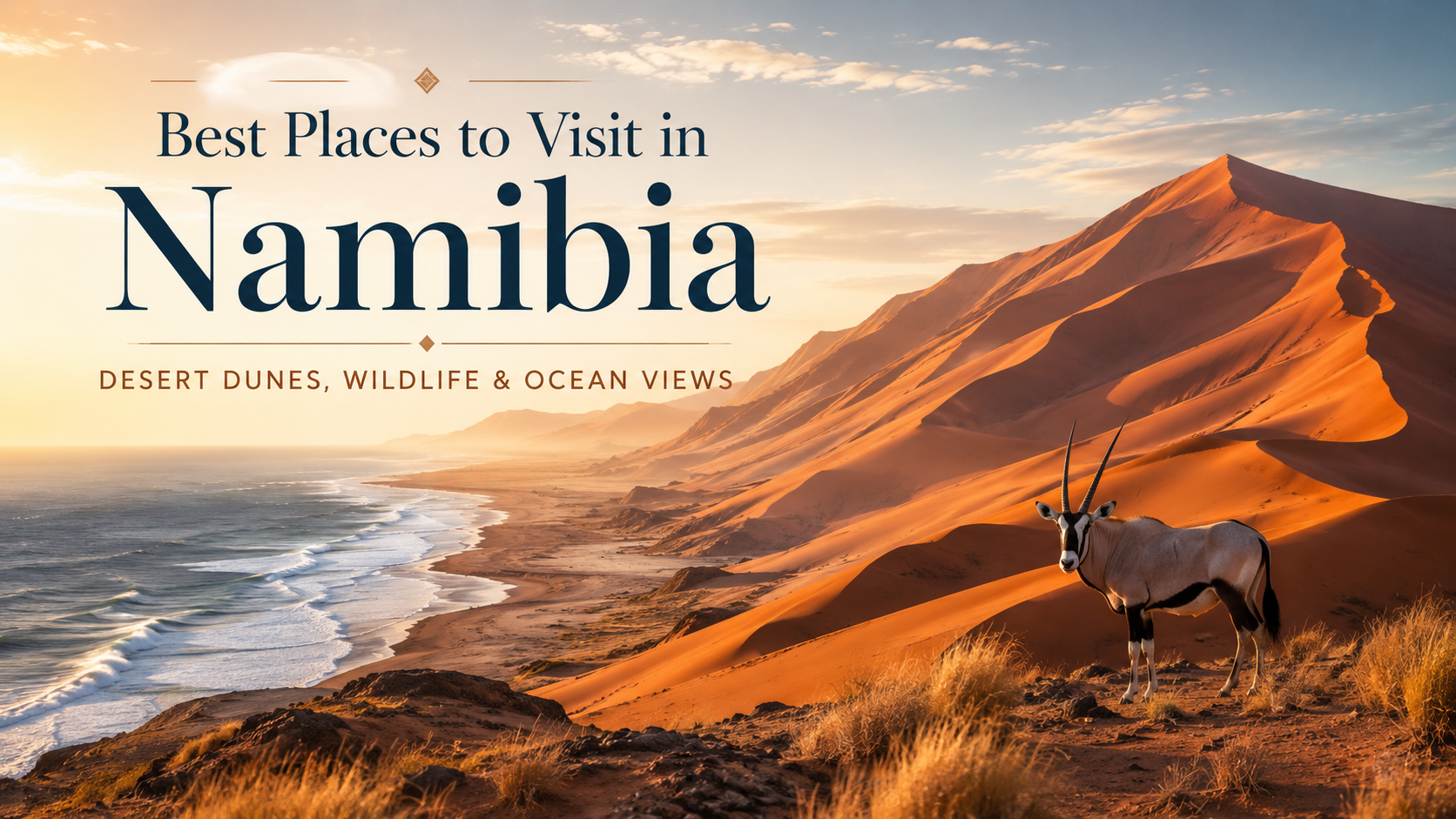
Namibia is one of those countries that almost does not look real.
This is where giant red dunes rise out of the desert, ancient dead trees stand in white clay pans, wild Atlantic waves crash against one of the oldest deserts on earth, and a coastline called the Skeleton Coast still carries shipwreck stories, seal colonies, fog, sand, and edge-of-the-world atmosphere.
But Namibia is not only desert.
It has wildlife waterholes, dramatic canyons, coastal adventure towns, ancient rock art, remote lodges, salt pans, desert-adapted animals, German-influenced architecture, stargazing skies, and road-trip landscapes so vast they make the journey feel like part of the destination.
That scale matters when you plan a trip.
Namibia is not a country where you casually see everything in one quick visit. Distances are long, roads can be remote, fuel stops matter, and some places are much easier with a guided itinerary, lodge circuit, or carefully planned self-drive route. But that is also part of what makes Namibia unforgettable. It still feels wide open in a way many destinations do not.
For travelers who want Africa but are looking for something different from the classic safari circuit, Namibia is one of the strongest choices. You can build a trip around red dunes and desert lodges, wildlife and waterholes, Atlantic coast towns, remote road trips, or dramatic landscapes that feel like they belong on another planet.
So this guide starts with Sossusvlei, because those red dunes are the image that opens the door for many travelers. But Namibia does not stop there.
A Quick Look at Namibia’s Major Travel Regions
Before you start choosing places, it helps to understand how spread out Namibia really is. This is a big, dry, remote country where route planning matters.
Central Namibia includes Windhoek, the capital and main arrival point for many travelers. It is often where road trips begin, supplies are organized, rental cars are picked up, and guided itineraries start.
Southern Namibia is known for wide desert landscapes, Fish River Canyon, Lüderitz, Kolmanskop, and routes that can connect naturally with South Africa.
The Namib Desert and Sossusvlei region is one of the country’s most famous areas, with red dunes, Deadvlei, Sesriem Canyon, desert lodges, and some of Namibia’s most iconic photography spots.
The central coast includes Swakopmund and Walvis Bay, where desert, Atlantic air, adventure tours, flamingos, seals, dunes, and coastal-town energy come together.
The Skeleton Coast is Namibia’s wild, foggy, remote northwestern coastline, known for shipwreck atmosphere, seal colonies, desert scenery, and a much more isolated feel.
Damaraland sits inland from the Skeleton Coast and southwest of Etosha. It is rugged, rocky, and culturally important, with ancient rock engravings, desert-adapted wildlife, and dramatic lodge scenery.
Northern Namibia includes Etosha National Park, the country’s most famous wildlife area and one of the easiest places to build a classic Namibia safari experience.
The Zambezi Region is in the far northeast and feels very different from desert Namibia. It is greener, river-based, and more connected to the safari landscapes of Botswana, Zambia, and Zimbabwe.
Best Places to Visit in Namibia
1. Sossusvlei & Deadvlei

Region notes: Sossusvlei and Deadvlei are in southwestern Namibia, inside Namib-Naukluft National Park. This is one of the most famous desert regions in the country and one of Namibia’s strongest first-trip highlights.
What kind of place it is: red-dune desert landscape with white clay pans, ancient dead trees, dramatic sunrise views, desert lodges, and some of Namibia’s most iconic scenery
Best for: first-time Namibia travelers, photographers, couples, road trippers, desert lovers, bucket-list travelers, luxury lodge travelers, and anyone who wants Namibia’s most recognizable landscapes
Why travelers should care
Sossusvlei is the Namibia many travelers dream about first. It has the giant red dunes, endless desert silence, deep sunrise shadows, and surreal landscapes that make the country feel almost otherworldly.
Deadvlei is the showstopper. Dark, dead camel thorn trees stand frozen in a pale clay pan, surrounded by towering orange dunes and open desert sky. It is stark, strange, beautiful, and unforgettable in the way only Namibia can be.
This is not just a quick photo stop. The whole region has a mood: early wake-ups, desert drives, cold mornings, hot afternoons, dry air, stargazing, and landscapes that change completely as the light moves across the dunes.
Main highlights
Sossusvlei and Deadvlei highlights include:
- Deadvlei — The famous white clay pan with ancient dead trees surrounded by red dunes.
- Big Daddy — One of the most dramatic dunes in the area and a major challenge for travelers who want the climb.
- Dune 45 — A popular sunrise dune stop with classic Namibia views.
- Sesriem Canyon — A narrow canyon near the park entrance that adds a different desert landscape to the area.
- Sossusvlei pan — The broader desert basin that gives the region its name.
- Desert lodges — Some of Namibia’s most memorable stays are scattered through this region.
- Stargazing — Clear desert skies make this a beautiful place for night-sky viewing.
Natural points of interest
This is part of the Namib Desert, one of the oldest desert landscapes on earth. The scenery may look empty at first glance, but the region is shaped by extreme dryness, wind, sand movement, rare rainfall, and desert-adapted plants and animals.
Don’t miss
- Sunrise in the dunes — The morning light is what makes the landscape glow.
- Deadvlei — This is the place most travelers remember long after the trip.
- A realistic early start — Heat, distance, and park logistics matter.
- Time to simply stand still — The silence is part of the experience.
Why I recommend it
Sossusvlei and Deadvlei are the strongest starting point for a Namibia trip because they give travelers the visual drama that makes Namibia feel so different from other African destinations.
Side notes / good to know
- Stay close to the park entrance if sunrise access matters to you.
- The desert can be cold in the morning and hot later in the day.
- Bring water, sun protection, and patience.
- Do not underestimate driving times in this region.
2. Etosha National Park

Region notes: Etosha National Park is in northern Namibia. It is the country’s most famous wildlife park and one of the easiest places to add a safari experience to a Namibia itinerary.
What kind of place it is: large wildlife park with salt pans, waterholes, self-drive routes, lodge stays, and classic safari animals
Best for: safari travelers, wildlife photographers, families, first-time Africa visitors, older travelers who want easier game viewing, road trippers, and travelers combining desert scenery with wildlife
Why travelers should care
Etosha gives Namibia its classic safari chapter, but it does not feel like every other safari destination. The huge salt pan, dry landscapes, open views, and waterhole-based wildlife viewing give the park a very distinct personality.
During the dry season, animals often gather around waterholes, which can make wildlife viewing feel more focused and less random. Instead of constantly searching through dense bush, travelers can sometimes sit, wait, and watch the landscape come alive.
Elephants, giraffes, zebras, springbok, oryx, lions, rhinos, and many other animals can be seen here, depending on timing, route, luck, and season. It is one of the best places in Namibia to experience wildlife without giving up the country’s wide-open desert feeling.
Main highlights
Etosha highlights include:
- Etosha Pan — The enormous salt pan that gives the park its stark, open look.
- Waterhole wildlife viewing — One of the easiest and most rewarding ways to experience the park.
- Elephants — Often one of the most memorable animals to see in Etosha.
- Lions and predators — Sightings vary, but predators are a major reason many travelers visit.
- Rhinos — Etosha is one of Namibia’s important rhino areas.
- Self-drive routes — A practical option for confident travelers with the right planning.
- Lodge and rest-camp stays — Useful for travelers who want easier access to the park.
Natural points of interest
Etosha’s landscape is shaped by dryness, open plains, mopane woodland, waterholes, and the massive salt pan. That combination makes it visually different from greener safari destinations and helps concentrate wildlife in certain areas during drier months.
Don’t miss
- Time at waterholes — Some of the best sightings happen when you stop rushing.
- Early and late game drives — Wildlife activity is often better outside the hottest part of the day.
- Binoculars — Even when animals are visible, distances can be deceptive.
- A flexible attitude — Safari is never guaranteed, and that is part of the reality.
Why I recommend it
Etosha adds wildlife depth to a Namibia trip without making the whole itinerary safari-only. It pairs beautifully with Sossusvlei, Swakopmund, Damaraland, and the Skeleton Coast.
Side notes / good to know
- Dry season is usually the easiest time for wildlife viewing.
- Distances inside and around the park can still be long.
- Check current park, road, and lodge conditions before finalizing plans.
- Do not treat wildlife like a theme park. Stay in your vehicle where required and follow park rules.
3. Swakopmund

Region notes: Swakopmund is on Namibia’s central Atlantic coast, west of Windhoek and north of Walvis Bay. It is one of the country’s most popular coastal bases.
What kind of place it is: coastal desert town with Atlantic air, German-influenced architecture, restaurants, adventure tours, beach walks, and easy access to nearby dunes and marine activities
Best for: friend trips, families, adventure travelers, road trippers, food lovers, photographers, travelers who want a break between desert and safari stops, and anyone who likes unusual coastal towns
Why travelers should care
Swakopmund is where Namibia changes mood.
After desert roads, remote lodges, and hot inland landscapes, Swakopmund brings cooler air, Atlantic fog, seaside walks, cafes, bakeries, restaurants, and a much easier town-based rhythm. It feels like a reset button in the middle of a Namibia trip.
It is also one of the best bases for adventure activities. Travelers can use Swakopmund for sandboarding, quad biking, scenic flights, desert tours, kayaking trips nearby, or day trips toward Walvis Bay and Sandwich Harbour.
The contrast is what makes it special. This is not a tropical beach town. It is a desert-coast town where fog, dunes, Atlantic water, colonial-era architecture, and adventure travel all sit strangely side by side.
Main highlights
Swakopmund highlights include:
- Coastal promenade — Good for an easier walk and a change of pace.
- German-influenced architecture — Part of the town’s unusual visual character.
- Cafes and bakeries — A practical and pleasant break during a road trip.
- Sandboarding and quad biking — Popular desert adventure activities nearby.
- Scenic flights — A splurge option for seeing desert and coastline from above.
- Day trips to Walvis Bay — Easy access to flamingos, kayaking, lagoon scenery, and Sandwich Harbour tours.
- Cooler coastal weather — A welcome contrast after hot desert areas.
Cultural and historical points of interest
Swakopmund’s architecture and town layout reflect Namibia’s German colonial history, which is visible in several coastal towns. That history is complicated, but it is part of the country’s story and part of why Swakopmund feels so visually distinct from other Namibia stops.
Don’t miss
- A slower coastal day — Swakopmund is useful because it lets you breathe.
- A desert adventure activity — This is one of the easiest places to add one.
- Dinner or coffee in town — Small comforts matter during a remote road trip.
- A weather reality check — The coast can be cooler, foggier, and windier than expected.
Why I recommend it
Swakopmund is one of the best balancing points in a Namibia itinerary. It gives travelers comfort, food, activities, coastal air, and easier logistics between more remote desert and wildlife regions.
Side notes / good to know
- This is not a warm tropical beach destination.
- Bring a layer for cool coastal evenings.
- Book adventure tours with reputable operators.
- Swakopmund works especially well as a two-night reset stop.
4. Walvis Bay & Sandwich Harbour

Region notes: Walvis Bay is on Namibia’s central coast, just south of Swakopmund. Sandwich Harbour is nearby, where massive dunes meet the Atlantic Ocean.
What kind of place it is: coastal lagoon and desert-ocean adventure area with flamingos, seals, kayaking, dunes, 4×4 tours, and some of Namibia’s most dramatic scenery
Best for: photographers, birders, adventure travelers, ocean lovers, desert lovers, couples, friend trips, and travelers who want the “desert meets sea” Namibia experience
Why travelers should care
Walvis Bay and Sandwich Harbour show one of Namibia’s most extraordinary contrasts: desert and ocean pressed directly against each other.
The lagoon around Walvis Bay is known for birdlife, including flamingos and pelicans, while nearby marine trips and kayaking experiences can bring travelers close to seals and coastal wildlife. But the biggest visual prize is Sandwich Harbour, where towering dunes appear to drop straight into the Atlantic.
This is one of the places that makes travelers understand why Namibia is not just another safari destination. It has landscapes that feel impossible until you are standing there looking at them.
Main highlights
Walvis Bay and Sandwich Harbour highlights include:
- Sandwich Harbour — The dramatic dune-and-ocean landscape that makes this area famous.
- Walvis Bay Lagoon — Known for flamingos, pelicans, and coastal birdlife.
- Kayaking tours — A popular way to experience seals and marine life.
- 4×4 dune tours — The practical way to reach more dramatic coastal dune scenery.
- Flamingo viewing — One of the area’s easiest wildlife experiences.
- Photography stops — Especially strong when dunes, fog, ocean, and birds line up.
- Day-trip access from Swakopmund — Easy to combine with a coastal stay.
Natural points of interest
This area is shaped by the meeting of desert, ocean, wind, fog, tides, and lagoon ecosystems. That mix creates one of Namibia’s most distinctive coastal environments.
Don’t miss
- A Sandwich Harbour tour — This is the signature experience.
- Flamingos at the lagoon — Easy, beautiful, and very Namibia-coast.
- A reputable operator — Sand, tides, and route conditions are not casual details.
- Extra camera storage — This is one of Namibia’s most photogenic areas.
Why I recommend it
Walvis Bay and Sandwich Harbour give Namibia one of its strongest visual hooks: dunes meeting the Atlantic. It is one of the best additions to a Swakopmund stay.
Side notes / good to know
- Do not attempt difficult sand routes without proper experience and equipment.
- Coastal weather can change the feel of the landscape quickly.
- Morning and afternoon light can completely change the photos.
- This area works well even for travelers who do not want intense hiking.
5. Skeleton Coast

Region notes: The Skeleton Coast runs along Namibia’s remote northwestern Atlantic coastline. Some sections are easier to visit by road, while more remote northern areas usually require specialized planning or fly-in lodge arrangements.
What kind of place it is: wild, foggy, remote desert coastline known for shipwreck atmosphere, seal colonies, dunes, wind, isolation, and dramatic Atlantic scenery
Best for: photographers, luxury travelers, adventure travelers, remote-lodge travelers, landscape lovers, and anyone drawn to eerie, edge-of-the-world places
Why travelers should care
The Skeleton Coast is not a soft beach escape. It is harsh, foggy, windswept, and haunting in the best possible way.
This is a place of shipwreck stories, crashing Atlantic water, desert sand, seal colonies, and long empty stretches that feel far from ordinary life. The name alone creates expectations, but the landscape lives up to the drama.
For some travelers, the Skeleton Coast is a scenic add-on. For others, it becomes one of the most memorable parts of Namibia because it feels so unlike anywhere else. It is not about beach lounging. It is about atmosphere, remoteness, and the strange beauty of desert meeting cold ocean.
Main highlights
Skeleton Coast highlights include:
- Remote Atlantic coastline — Wild, foggy, and dramatic.
- Shipwreck atmosphere — One of the reasons the region feels so legendary.
- Cape Cross seal colony area — A major wildlife stop along the coast.
- Desert and ocean scenery — Stark, strange, and incredibly photogenic.
- Remote lodge stays — Especially in more isolated northern areas.
- Scenic flights — One of the best ways to understand the scale of the coastline.
- Desert-adapted wildlife in the broader region — Depending on itinerary and location.
Natural and historical points of interest
The Skeleton Coast’s name comes from the dangers this coastline posed to ships and travelers. Fog, rough seas, strong currents, isolation, and desert conditions all shaped its reputation. Today, that same harshness is what gives the region its unforgettable atmosphere.
Don’t miss
- The mood of the place — This is not a checklist destination.
- Seal colonies if your route allows — They add wildlife drama to the coast.
- A realistic route plan — Remote areas are not for improvising.
- A sense of scale — The emptiness is part of what makes it powerful.
Why I recommend it
The Skeleton Coast gives Namibia a darker, wilder, more mysterious side. It is one of the best places for travelers who want landscapes with real atmosphere.
Side notes / good to know
- This is not a casual beach destination.
- Some areas require permits, guided access, or specialized logistics.
- Weather can be foggy, windy, and cool.
- Remote travel should be planned carefully.
6. Damaraland

Region notes: Damaraland is in northwestern Namibia, inland from the Skeleton Coast and southwest of Etosha. It is one of the best regions for rugged desert scenery, ancient rock art, and desert-adapted wildlife.
What kind of place it is: rocky desert region with mountains, dry riverbeds, ancient engravings, remote lodges, desert-adapted animals, and wide-open landscapes
Best for: culture lovers, photographers, wildlife travelers, geology lovers, road trippers, slower travelers, and anyone who wants Namibia beyond the obvious icons
Why travelers should care
Damaraland is where Namibia starts to feel deeper.
This is not the instant-icon scenery of Deadvlei or the classic wildlife setup of Etosha. It is rugged, dry, rocky, and layered with ancient history, desert wildlife, and landscapes that reward travelers who slow down.
The region is known for Twyfelfontein’s rock engravings, desert-adapted elephants, dramatic lodges, dry riverbeds, and scenery that shifts between mountains, plains, and stone formations. It is one of the best places to understand that Namibia is not just dunes and safari. It has ancient human history, fragile desert ecosystems, and a much older story written into the rocks.
Main highlights
Damaraland highlights include:
- Twyfelfontein — One of Namibia’s most important rock-art sites.
- Desert-adapted elephants — A major reason many travelers visit the region.
- Rugged lodge scenery — Some accommodations feel beautifully woven into the landscape.
- Organ Pipes — A striking geological formation.
- Burnt Mountain — A colorful and unusual landscape stop.
- Dry riverbeds — Important corridors for wildlife and desert scenery.
- Mountain-and-desert views — Wide, quiet, and very different from the dunes.
Cultural and historical points of interest
Twyfelfontein is one of Namibia’s most important cultural heritage sites, with ancient rock engravings that connect travelers to the long human history of the region. It gives Damaraland a depth that goes far beyond scenery.
Don’t miss
- Twyfelfontein — It is one of the strongest cultural stops in Namibia.
- A guided wildlife or nature drive — Local knowledge matters in desert landscapes.
- Time at your lodge — Many Damaraland stays are part of the experience.
- Slow travel — This region is better when you do not rush through it.
Why I recommend it
Damaraland is one of the best places to add meaning and texture to a Namibia route. It connects the coast, desert, wildlife, geology, and cultural history in a way that makes the country feel richer.
Side notes / good to know
- Wildlife sightings are never guaranteed.
- Distances and road conditions matter.
- This region works beautifully between Swakopmund/Skeleton Coast and Etosha.
- Guided experiences can make the landscape much more meaningful.
7. Windhoek

Region notes: Windhoek is in central Namibia and is the country’s capital. For many travelers, it is the main arrival and departure point.
What kind of place it is: practical capital city, road-trip launch point, first-night stop, supply base, and gateway to Namibia’s desert, coast, and wildlife regions
Best for: arrival nights, departure nights, road-trip logistics, guided-tour starts, first-time visitors, travelers renting a car, and anyone who needs an easier landing before heading remote
Why travelers should care
Windhoek is not usually the reason travelers dream about Namibia, but it is often the place that makes the rest of the trip work.
This is where many travelers pick up rental cars, meet guides, buy supplies, recover from long flights, and organize themselves before heading into much more remote parts of the country. It can also be a useful final-night stop before flying home.
The key is not to expect Windhoek to compete with Sossusvlei, Etosha, or the Skeleton Coast. Its value is practical. It gives travelers a softer landing before the distances, gravel roads, desert lodges, and early starts begin.
Main highlights
Windhoek highlights include:
- Arrival and departure logistics — The main reason most travelers pass through.
- Restaurants and cafes — Useful before and after remote travel.
- Markets and local shopping — Good for a short city stop.
- Museums and historic buildings — Helpful for travelers who want more context.
- Rental car pickup — A common starting point for self-drive routes.
- Guided-tour departures — Many itineraries begin here.
- Supply stops — Useful before heading into remote regions.
Cultural and historical points of interest
Windhoek reflects several layers of Namibian history, including Indigenous, colonial, independence-era, and modern influences. For travelers who want more context before heading into the landscapes, a short city stay can help frame the country beyond scenery.
Don’t miss
- A calm arrival night — Do not land tired and immediately start a difficult drive.
- A supply check — Water, snacks, maps, chargers, and essentials matter in Namibia.
- A realistic departure plan — Long return drives can be more tiring than expected.
- Basic city caution — Treat valuables and parking the way you would in any capital.
Why I recommend it
Windhoek is the practical backbone of many Namibia trips. It may not be the emotional highlight, but it helps make the rest of the itinerary smoother.
Side notes / good to know
- Plan your first and last nights carefully.
- Do not underestimate jet lag before a self-drive trip.
- Keep valuables secure in the city.
- Windhoek works best as a launchpad, not the main event.
8. Fish River Canyon

Region notes: Fish River Canyon is in southern Namibia, not far from the South African border. It works best for longer Namibia itineraries, southern routes, or trips that connect with South Africa.
What kind of place it is: massive canyon landscape with viewpoints, desert scenery, hiking routes, and a remote southern Namibia feel
Best for: road trippers, photographers, hikers, southern Africa itineraries, travelers combining Namibia with South Africa, and anyone who loves huge natural landscapes
Why travelers should care
Fish River Canyon gives Namibia another kind of scale.
Instead of red dunes, Atlantic fog, or wildlife waterholes, this is about looking down into a vast canyon carved through dry southern landscapes. It feels ancient, quiet, and enormous.
For travelers with enough time, Fish River Canyon can be a powerful addition to a Namibia itinerary, especially if the route already includes southern Namibia or a connection with South Africa. Even if you are not doing the full hike, the viewpoints can be spectacular.
Main highlights
Fish River Canyon highlights include:
- Canyon viewpoints — The easiest way for most travelers to experience the landscape.
- Desert lodge stays — A good way to slow down in southern Namibia.
- Hiking routes — Best for experienced, prepared travelers in the right season.
- Sunrise and sunset views — Strong light can make the canyon feel even more dramatic.
- Southern Namibia road-trip scenery — Long, dry, open, and atmospheric.
- Cross-border route potential — Useful for some Namibia-South Africa trips.
Natural points of interest
Fish River Canyon is one of southern Africa’s great canyon landscapes. Its size, dryness, rock formations, and remote setting make it feel very different from Namibia’s better-known dune and safari regions.
Don’t miss
- A canyon viewpoint at good light — Early or late light makes the scenery more powerful.
- A realistic route plan — This is far from many classic Namibia stops.
- Water and sun protection — The environment is dry and exposed.
- Extra time if hiking — This is not a casual last-minute activity.
Why I recommend it
Fish River Canyon is a strong choice for travelers who want Namibia beyond the standard first-trip loop. It adds southern scale, drama, and a different kind of desert beauty.
Side notes / good to know
- Do not add this casually to a short trip unless the route makes sense.
- The full hike is seasonal and requires serious planning.
- This area works better for longer itineraries.
- Distances in southern Namibia can feel huge.
9. Lüderitz & Kolmanskop

Region notes: Lüderitz is on Namibia’s southwestern coast. Kolmanskop is a nearby abandoned diamond-mining settlement that has become one of the country’s most photogenic ghost towns.
What kind of place it is: remote coastal town and sand-filled ghost town with history, architecture, Atlantic atmosphere, and eerie desert beauty
Best for: photographers, history lovers, road trippers, unusual-stay travelers, ghost-town fans, and anyone who likes places that feel strange and memorable
Why travelers should care
Lüderitz and Kolmanskop show Namibia’s weird, haunting, historic side.
Lüderitz feels remote because it is remote. It has colorful architecture, Atlantic weather, coastal views, and a far-southwest atmosphere that feels very different from Swakopmund. Nearby Kolmanskop is the real reason many travelers make the journey.
Kolmanskop was once a diamond-mining settlement. Today, sand pours through abandoned rooms, climbs staircases, and fills old buildings with desert light. It is eerie, beautiful, and incredibly photogenic.
Main highlights
Lüderitz and Kolmanskop highlights include:
- Kolmanskop — The famous ghost town being slowly swallowed by sand.
- Sand-filled rooms — The classic photography experience.
- Lüderitz architecture — Colorful buildings and a distinct coastal look.
- Diaz Point — A dramatic coastal stop near Lüderitz.
- Atlantic views — Wild, cool, and remote.
- Southern Namibia road-trip scenery — A huge part of the experience.
- Photography tours or early visits — Useful if photos are a priority.
Cultural and historical points of interest
Kolmanskop connects travelers to Namibia’s diamond-mining history and the rise-and-fall nature of remote resource towns. It is visually beautiful, but it also reflects a more complicated historical story.
Don’t miss
- Kolmanskop early in the day — The light matters.
- Time for photography — This is not a place to rush.
- A realistic driving plan — Lüderitz is not close to everything.
- Coastal weather layers — The Atlantic side can feel chilly and windy.
Why I recommend it
Lüderitz and Kolmanskop are not essential for every first Namibia trip, but they are fantastic for travelers who want something unusual, atmospheric, and visually unforgettable.
Side notes / good to know
- This area fits best into a southern Namibia itinerary.
- Kolmanskop access and hours should be checked before you go.
- Wind and sand are part of the experience.
- It is a long detour if your main route is only Sossusvlei, Swakopmund, and Etosha.
10. Zambezi Region

Region notes: The Zambezi Region is in far northeastern Namibia, stretching toward the borders with Angola, Zambia, Botswana, and Zimbabwe. It feels very different from the desert regions most travelers associate with Namibia.
What kind of place it is: greener, river-based wildlife region with lodges, birdlife, national parks, wetlands, and easy connections toward Botswana, Zambia, Zimbabwe, and Victoria Falls
Best for: safari travelers, birders, river-lodge travelers, repeat Namibia visitors, multi-country southern Africa trips, and travelers connecting Namibia with Botswana or Victoria Falls
Why travelers should care
The Zambezi Region reminds travelers that Namibia is not only desert.
This part of the country is greener, wetter, and more river-focused, with a landscape that feels closer to Botswana, Zambia, and Zimbabwe than to Sossusvlei or the Skeleton Coast. It can add a completely different mood to a longer Namibia trip.
For travelers building a bigger southern Africa route, the region can make logistical sense because it connects naturally toward Chobe, the Okavango, Victoria Falls, and other wildlife-heavy areas. For birders and river-lodge travelers, it can be especially appealing.
Main highlights
Zambezi Region highlights include:
- River lodges — A different style of stay from desert Namibia.
- Bwabwata National Park — One of the region’s major protected areas.
- Mahango area — Known for wildlife and birdlife.
- Birdwatching — One of the strongest reasons to visit.
- Multi-country route connections — Useful for Botswana, Zambia, Zimbabwe, and Victoria Falls itineraries.
- Greener safari scenery — A major contrast to the desert.
- Boat-based experiences — Depending on lodge and route.
Natural points of interest
The Zambezi Region is shaped by rivers, wetlands, floodplains, and wildlife corridors. Its environment is very different from Namibia’s desert heart, which is why it can feel almost like a separate chapter of the country.
Don’t miss
- A river-lodge stay if the region fits your route.
- Birdlife and boat-based scenery.
- Careful border and routing checks.
- Enough time — This is not a quick add-on from central Namibia.
Why I recommend it
The Zambezi Region is best for travelers who want to connect Namibia with a broader southern Africa safari route. It adds water, rivers, greenery, and wildlife variety to a country many people imagine as only desert.
Side notes / good to know
- This is far from Namibia’s classic central and western route.
- Border logistics matter if connecting to nearby countries.
- Check current regional conditions before planning a multi-country trip.
- It works best for longer itineraries, not rushed first visits.
How to Choose the Best Places in Namibia for Your Trip
Namibia is not a destination where every traveler should follow the same route. The best places depend on how much time you have, whether you want to self-drive or use a guided itinerary, and whether your dream trip is more desert, wildlife, coast, or road trip.
For a first Namibia trip
A strong first-trip route usually focuses on:
- Windhoek
- Sossusvlei and Deadvlei
- Swakopmund
- Walvis Bay and Sandwich Harbour
- Damaraland
- Etosha National Park
This gives you the classic Namibia mix: desert dunes, Atlantic coast, rugged landscapes, wildlife, and enough variety to understand why the country is so special.
For desert and coast scenery
Focus on:
- Sossusvlei and Deadvlei
- Swakopmund
- Walvis Bay and Sandwich Harbour
- Skeleton Coast
- Damaraland
This is the best style of trip if your main reason for visiting Namibia is the surreal desert-meets-ocean landscape.
For wildlife and safari
Focus on:
- Etosha National Park
- Damaraland
- Zambezi Region
- Possibly Botswana or Zambia as a longer southern Africa extension
This works well for travelers who want Namibia’s wildlife but may also want a broader safari route.
For southern Namibia
Focus on:
- Fish River Canyon
- Lüderitz
- Kolmanskop
- Sossusvlei
- Windhoek
This route is better for travelers with more time, repeat visitors, or anyone connecting Namibia with South Africa.
What to Pack for Namibia
Namibia is dry, sunny, dusty, remote, and full of long travel days. The most useful packing items are the things that help with sun, dust, dehydration, driving, photos, and weak signal.
- High-SPF sunscreen
- Lip balm
- Sunglasses
- Wide-brim hat
- Refillable filtered water bottle
- Electrolyte packets
- Power bank
- Binoculars
- Small first-aid kit
- Travel flashlight
- Moisturizer for dry desert air
- Insect repellent for greener regions
- Lightweight scarf or buff for dust and sun
Final Thoughts on the Best Places to Visit in Namibia
Namibia is one of Africa’s most visually unforgettable countries because it does not feel like anywhere else.
It is not only a safari destination, not only a desert destination, and not only a road-trip destination. It is all of those things at once, with a raw, cinematic, wide-open feeling that makes even the drives feel like part of the adventure.
The magic is in the contrasts: red dunes and white pans, Atlantic fog and desert heat, wildlife waterholes and empty roads, ghost towns and luxury lodges, ancient rock art and modern adventure travel.
For travelers who want Africa but are looking for something different from the classic safari route, Namibia is one of the strongest choices. Choose your route carefully, respect the distances, plan around the realities of remote travel, and give the landscapes enough time to work their way under your skin.