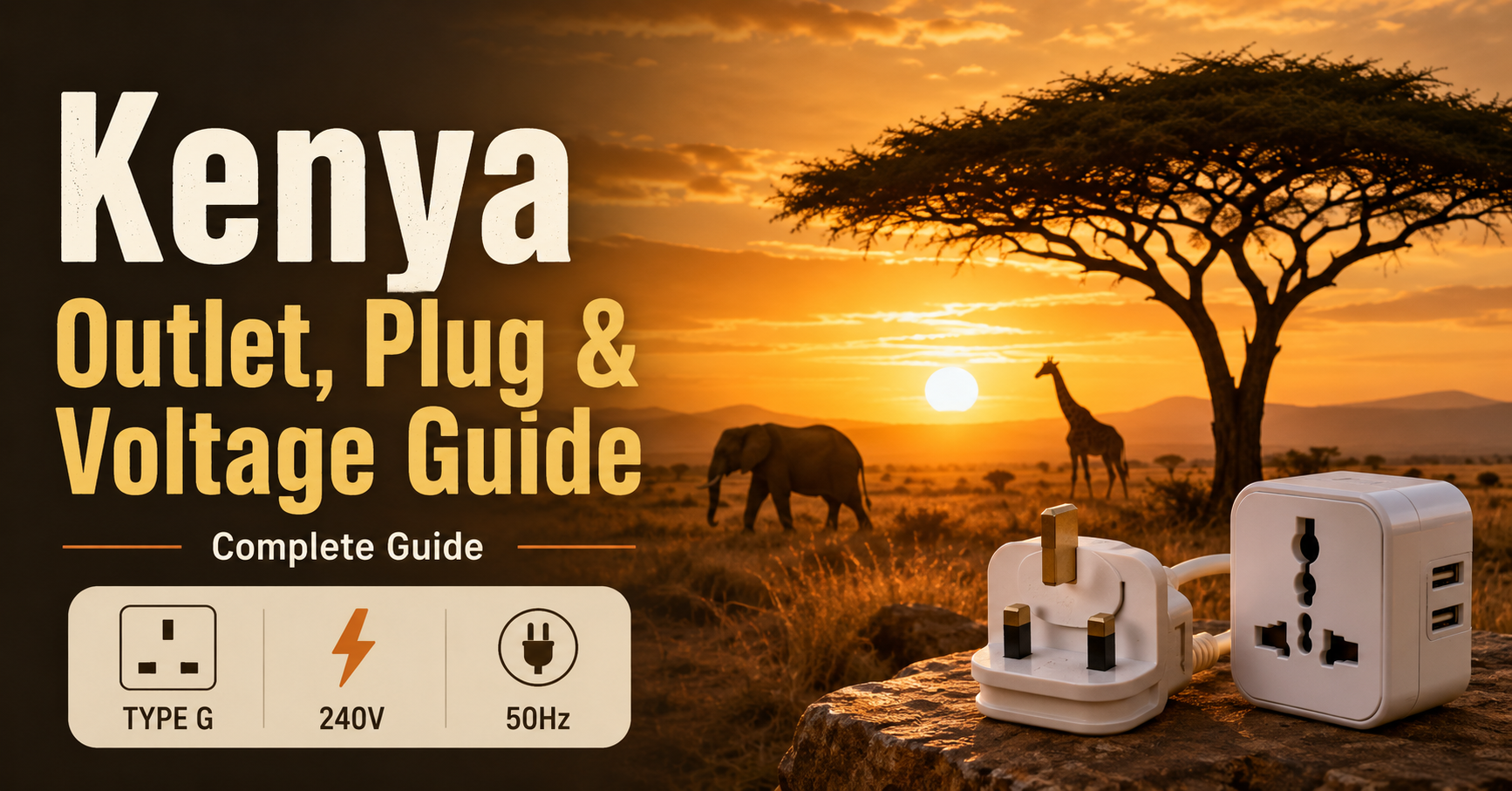
Planning a trip to Kenya? You are in for safari plains, acacia trees, big cats, elephants, giraffes, flamingos, mountain views, Indian Ocean beaches, national parks, conservancies, coffee culture, city stays, coastal history, and some of the most unforgettable wildlife experiences in Africa.
Whether you are headed to Nairobi, the Maasai Mara, Amboseli, Tsavo, Lake Nakuru, Lake Naivasha, Mount Kenya, Samburu, Lamu, Mombasa, Watamu, Diani Beach, or a safari-and-coast itinerary, your phone and travel tech are going to matter.
You may be using your phone for safari photos, lodge confirmations, airport transfers, domestic flight details, park entry information, maps, WhatsApp messages, tour confirmations, camera charging, translation help, eSIM setup, weather checks, beach plans, hotel details, and keeping your travel group organized.
And that is exactly why your charging setup matters.
Kenya uses Type G outlets, with 240V electricity and a 50Hz frequency. Type G is the three-rectangular-pin plug style also used in the United Kingdom.
The good news is that Kenya is fairly straightforward from a power standpoint. The country mainly uses one plug type and one standard voltage, so once you know your plug shape and whether your devices are dual-voltage, the rest is pretty easy.
The big thing to understand is this: a plug adapter only changes the shape of the plug. It does not change the voltage.
That matters most if you are packing hair tools, steamers, electric razors, heating pads, travel kettles, or anything that is not dual-voltage.
This guide breaks it all down clearly, so you know exactly what to pack for Kenya based on where you are traveling from — no guessing, no frying your favorite hair tool, and no realizing too late that your safari lodge, beach hotel, city apartment, or countryside stay has fewer convenient outlets than you expected.

⚡ Quick Overview: What You Need for Kenya
✔ Plug Adapter
Kenya uses Type G outlets.
Type G plugs have three rectangular pins in a triangular pattern. This is the same general plug setup used in the United Kingdom, Ireland, Malta, Singapore, Malaysia, and several other destinations.
If you are traveling from the United States, Canada, Mexico, most of Europe, Australia, New Zealand, Japan, much of South America, or many other parts of the world, you will usually need a plug adapter for Kenya.
If you are traveling from the UK, Ireland, Malta, Singapore, Malaysia, Hong Kong, the United Arab Emirates, or another country that already uses Type G plugs, your plug shape may already fit, but you should still check your specific devices before you leave.
✔ Dual-Voltage Electronics
Phones, laptops, tablets, cameras, e-readers, power banks, earbuds, and most modern USB chargers are usually dual-voltage.
Look for small print that says:
Input: 100–240V, 50/60Hz
If your charger says that, it can usually handle Kenya’s voltage. You only need the correct plug adapter if your plug shape does not match.
✔ Single-Voltage Small Appliances May Need a Converter
This is where travelers can get into trouble.
Kenya uses 240V electricity, which is much higher than the standard voltage in countries like the United States, Canada, Mexico, and Japan. Kenya also runs on 50Hz frequency.
If your appliance is labeled only for 110V, 120V, or 127V, do not plug it into a Kenyan outlet with only a plug adapter.
This especially matters for:
- Hair dryers
- Curling irons
- Straighteners
- Steamers
- Electric shavers
- Heating pads
- Travel kettles
- Any older or cheap charger
- Any appliance that is not dual-voltage
For hair tools, the easiest solution is usually to pack a dual-voltage travel version or use the hotel hair dryer if one is available.
✔ Multi-Port USB Charger
A multi-port USB charger is extremely useful in Kenya, especially if you are traveling with a phone, camera, earbuds, smartwatch, tablet, Kindle, portable fan, or multiple rechargeable devices.
Hotel rooms, safari lodges, tented camps, beach resorts, guesthouses, apartments, older properties, and remote stays may not always have as many convenient outlets as you want. A multi-port charger turns one outlet into a much better charging station.
✔ Travel Power Strip
A compact travel power strip can be a huge help in Kenya, especially for couples, families, friend trips, photographers, safari travelers, beach travelers, and anyone with multiple devices.
Just make sure it is travel-friendly and rated for 240V use.
✔ Power Bank
A power bank is worth packing for Kenya.
You may want it for airport days, long-haul flights, domestic flights, safari drives, long transfers, national park days, beach days, boat trips, Nairobi sightseeing, camera-heavy wildlife viewing, eSIM use, WhatsApp coordination, and any long day where your phone is doing everything.
✔ Electronics Organizer
This keeps your adapters, cords, chargers, backup battery, earbuds, camera batteries, memory cards, and little tech pieces from turning into a tangled suitcase mess.
Travel Hack:
A plug adapter + travel power strip + multi-port USB charger gives you a simple charging setup for almost any Kenya hotel room, safari lodge, tented camp, apartment stay, beach resort, road trip, or longer safari-and-coast itinerary.
Kenya Electrical Basics
Plug Types Used:
Type G – Three rectangular pins in a triangular pattern
Kenya uses Type G outlets. This is the main outlet type travelers should plan around.
Voltage: 240V
Frequency: 50Hz
✔ Safe With Only an Adapter
These are usually fine if the charger or device is labeled 100–240V:
- Phones
- Laptops
- Tablets
- Cameras
- Power banks
- E-readers / Kindles
- Bluetooth headphones / earbuds
- Smartwatches
- Most modern USB chargers
Not Always Safe
Be more careful with:
- Hair dryers
- Curling irons
- Straighteners
- Steamers
- Heating pads
- Electric kettles
- Electric razors
- Cheap or older chargers
- Any appliance that is not dual-voltage
Kenya is fairly straightforward from a power standpoint because the country mainly uses one plug type and a standard 240V system. The voltage is still the part that can surprise travelers from lower-voltage countries.
A normal phone or laptop charger that says 100–240V is usually fine with the right adapter. A single-voltage appliance is where you need to be much more careful.
Check the Voltage Label Before You Pack
Look at the small print on each charger or device:
“100–240V” → Safe in Kenya.
You only need a plug adapter if the plug shape does not fit.
“110V,” “120V,” or “127V only” → Not safe with only a plug adapter.
You need a voltage converter, a dual-voltage replacement, or you should leave it at home.
“220V,” “230V,” or “240V only” → Usually compatible with Kenya’s voltage.
You may still need a plug adapter if the plug shape does not match.
Because Kenya uses 240V power, travelers from lower-voltage countries should be especially careful with single-voltage heat tools and small appliances.
Frequency Note
Kenya uses 50Hz.
That matches many countries in Europe, Asia, Africa, Oceania, and parts of South America. It is different from the 60Hz used in the United States, Canada, Mexico, and much of the Americas.
For phones, laptops, cameras, tablets, and most USB-powered electronics, this usually is not an issue. Motor-based or heat-based appliances are the ones more likely to be affected.
Consistency
Kenya’s electrical setup is fairly consistent.
The main outlet type is Type G, the voltage is 240V, and the frequency is 50Hz. That makes Kenya easier to plan for than destinations with highly mixed voltages or unpredictable outlet systems.
The main thing is knowing whether your device is dual-voltage. If your electronics say 100–240V, you are usually fine with the right adapter. If your appliance is single-voltage and made for 110–120V countries, do not assume it is safe in Kenya.
Outlet placement can still vary in hotels, safari lodges, tented camps, guesthouses, apartments, older buildings, beach resorts, and remote accommodations. Even if your plug and voltage are handled, you may still want a simple charging setup so you are not fighting over one awkward outlet near the bed.
Traveling around East Africa too?
Kenya uses Type G plugs and 240V power at 50Hz, but not every East Africa itinerary is identical from a plug-planning standpoint.
If you are combining Kenya with Tanzania, Uganda, Rwanda, Ethiopia, Zanzibar, South Africa, the UAE, Qatar, Turkey, or a longer safari-and-beach itinerary, do not assume one setup covers every stop perfectly.
A universal adapter is the easiest baseline, but it is still smart to check every country on your itinerary before you leave.
⚡ Quick Jump to Your Region
- 🌎 North America
- 🌎 Central America & Caribbean
- 🌎 South America
- 🌏 Oceania
- 🌍 Europe
- 🌏 Asia
- 🌍 Africa
- ✅ Universal Packing Checklist
- 🎒 Final Tips for Kenya
🌎 North America

🇺🇸 United States
Home: 120V, 60 Hz, Type A/B.
Vs. Kenya: Kenya uses Type G plugs and runs on 240V, 50Hz power. U.S. travelers need a plug adapter for Kenya.
Most phones, laptops, tablets, cameras, and USB chargers are fine with an adapter if they say 100–240V. Be careful with single-voltage 110–120V appliances, especially hair tools, steamers, heating pads, travel kettles, and anything that heats up. Kenya’s voltage is much higher than standard U.S. voltage, so do not plug U.S.-only appliances into a Kenyan outlet with only a plug adapter.
What to pack:
- Plug adapter for Kenya / Type G
- Travel power strip
- Power bank for airport days, long-haul flights, Nairobi sightseeing, safari drives, Maasai Mara game drives, Amboseli elephant viewing, Lake Nakuru stops, Mount Kenya travel days, Diani Beach days, Mombasa exploring, domestic flights, long transfers, lodge stays, camera-heavy wildlife days, eSIM use, WhatsApp coordination, and heavy phone-use travel days
- Voltage converter only for single-voltage 110–120V appliances you truly need
- Multi-port USB charger
- Electronics organizer
🇨🇦 Canada
Home: 120V, 60 Hz, Type A/B.
Vs. Kenya: Kenya uses Type G plugs and 240V, 50Hz power. Canadian travelers need a plug adapter for Kenya.
Most modern travel electronics are fine with an adapter if they say 100–240V. Be careful with single-voltage 110–120V appliances because Kenya’s 240V power is much higher than Canadian household voltage.
What to pack:
- Plug adapter for Kenya / Type G
- Travel power strip
- Power bank for airport days, long-haul flights, Nairobi sightseeing, safari drives, Maasai Mara game drives, Amboseli elephant viewing, Lake Nakuru stops, Mount Kenya travel days, Diani Beach days, Mombasa exploring, domestic flights, long transfers, lodge stays, camera-heavy wildlife days, eSIM use, WhatsApp coordination, and heavy phone-use travel days
- Voltage converter only for single-voltage 110–120V appliances you truly need
- Multi-port USB charger
- Electronics organizer
🇲🇽 Mexico
Home: 127V, 60 Hz, Type A/B.
Vs. Kenya: Mexico uses lower-voltage 127V power and Type A/B plugs, while Kenya uses Type G plugs and 240V, 50Hz power. Mexican travelers need a plug adapter for Kenya.
Most modern electronics are fine with an adapter if they say 100–240V. Be careful with single-voltage 127V appliances because Kenya’s 240V power is significantly higher.
What to pack:
- Plug adapter for Kenya / Type G
- Travel power strip
- Power bank for airport days, long-haul flights, Nairobi sightseeing, safari drives, Maasai Mara game drives, Amboseli elephant viewing, Lake Nakuru stops, Mount Kenya travel days, Diani Beach days, Mombasa exploring, domestic flights, long transfers, lodge stays, camera-heavy wildlife days, eSIM use, WhatsApp coordination, and heavy phone-use travel days
- Voltage converter only for single-voltage 110–120V appliances you truly need
- Multi-port USB charger
- Electronics organizer
🇬🇱 Greenland
Home: 220–230V, 50 Hz, Type C/E/F/K.
Vs. Kenya: Greenland’s voltage and frequency are close to Kenya’s 240V, 50Hz power, but Kenya uses Type G outlets. Greenland travelers need a plug adapter for Kenya unless their device already has a Type G plug.
Most modern electronics are fine with an adapter if they say 100–240V. Many 220–240V appliances are voltage-compatible with Kenya, but you still need the correct plug fit, and you should always check the label before packing.
What to pack:
- Plug adapter for Kenya / Type G
- Travel power strip
- Power bank for airport days, long-haul flights, Nairobi sightseeing, safari drives, Maasai Mara game drives, Amboseli elephant viewing, Lake Nakuru stops, Mount Kenya travel days, Diani Beach days, Mombasa exploring, domestic flights, long transfers, lodge stays, camera-heavy wildlife days, eSIM use, WhatsApp coordination, and heavy phone-use travel days
- Multi-port USB charger
- Electronics organizer
🌎 Central America & Caribbean

🔌 110–127V / 50–60 Hz Countries
⚠️ Plug Adapter Needed — Be Careful With Kenya’s Higher Voltage
Travelers from these countries are used to a lower-voltage electrical system, but Kenya uses 240V power. That means plug shape and voltage both matter.
➡️ Dual-voltage electronics are fine with the right plug adapter
➡️ Most travelers will need a Kenya plug adapter / Type G adapter
➡️ Single-voltage 110–127V appliances are not safe in Kenya with only a plug adapter
🇧🇿 Belize
Home: 110V / 220V mix, 60 Hz, Type A / B / G.
Vs. Kenya: Belize travelers will need to pay attention to both plug shape and voltage. Kenya uses Type G outlets and runs on 240V, 50Hz power.
If your device uses Type A or Type B, you should bring a plug adapter for Kenya. If your device already uses Type G, the plug shape may fit, but you should still check the voltage label carefully. Dual-voltage electronics labeled 100–240V are usually fine with the right plug setup.
For single-voltage appliances from Belize, check the label carefully. A 110V appliance is not safe in Kenya with only a plug adapter. A 220–240V appliance may be voltage-compatible, but you should still check frequency-sensitive devices carefully.
What to pack:
- Plug adapter for Kenya / Type G
- Travel power strip
- Power bank for airport days, long-haul flights, Nairobi sightseeing, safari drives, Maasai Mara game drives, Amboseli elephant viewing, Lake Nakuru stops, Mount Kenya travel days, Diani Beach days, Mombasa exploring, domestic flights, long transfers, lodge stays, camera-heavy wildlife days, eSIM use, WhatsApp coordination, and heavy phone-use travel days
- Voltage converter only for single-voltage 110–120V appliances you truly need
- Multi-port USB charger
- Electronics organizer
💡 Dual-voltage devices labeled 100–240V are fine with the right plug setup.
🇨🇷 Costa Rica
Home: 120V, 60 Hz, Type A / B.
Vs. Kenya: Costa Rica uses Type A and Type B plugs with 120V power, while Kenya uses Type G plugs and 240V, 50Hz power. Costa Rican travelers need a plug adapter for Kenya.
Most phones, laptops, tablets, cameras, and USB chargers are fine with an adapter if they say 100–240V. Be careful with single-voltage 110–120V appliances because Kenya’s 240V power is much higher.
What to pack:
- Plug adapter for Kenya / Type G
- Travel power strip
- Power bank for airport days, long-haul flights, Nairobi sightseeing, safari drives, Maasai Mara game drives, Amboseli elephant viewing, Lake Nakuru stops, Mount Kenya travel days, Diani Beach days, Mombasa exploring, domestic flights, long transfers, lodge stays, camera-heavy wildlife days, eSIM use, WhatsApp coordination, and heavy phone-use travel days
- Voltage converter only for single-voltage 110–120V appliances you truly need
- Multi-port USB charger
- Electronics organizer
💡 Dual-voltage devices labeled 100–240V are fine with the right plug setup.
🇸🇻 El Salvador
Home: 115V, 60 Hz, Type A / B.
Vs. Kenya: El Salvador uses Type A and Type B plugs with lower-voltage power, while Kenya uses Type G outlets and 240V, 50Hz electricity.
Salvadoran travelers should bring a plug adapter for Kenya. Most modern electronics are fine if they say 100–240V, but single-voltage 110–120V appliances are not safe in Kenya with only a plug adapter.
What to pack:
- Plug adapter for Kenya / Type G
- Travel power strip
- Power bank for airport days, long-haul flights, Nairobi sightseeing, safari drives, Maasai Mara game drives, Amboseli elephant viewing, Lake Nakuru stops, Mount Kenya travel days, Diani Beach days, Mombasa exploring, domestic flights, long transfers, lodge stays, camera-heavy wildlife days, eSIM use, WhatsApp coordination, and heavy phone-use travel days
- Voltage converter only for single-voltage 110–120V appliances you truly need
- Multi-port USB charger
- Electronics organizer
💡 Dual-voltage devices labeled 100–240V are fine with the right plug setup.
🇬🇹 Guatemala
Home: 120V, 60 Hz, Type A / B.
Vs. Kenya: Guatemala uses Type A and Type B plugs, while Kenya uses Type G. Guatemalan travelers need a plug adapter for Kenya.
Kenya’s voltage is also much higher than Guatemala’s. Dual-voltage electronics are usually fine, but single-voltage 110–120V appliances need caution and should not be used with only a plug adapter.
What to pack:
- Plug adapter for Kenya / Type G
- Travel power strip
- Power bank for airport days, long-haul flights, Nairobi sightseeing, safari drives, Maasai Mara game drives, Amboseli elephant viewing, Lake Nakuru stops, Mount Kenya travel days, Diani Beach days, Mombasa exploring, domestic flights, long transfers, lodge stays, camera-heavy wildlife days, eSIM use, WhatsApp coordination, and heavy phone-use travel days
- Voltage converter only for single-voltage 110–120V appliances you truly need
- Multi-port USB charger
- Electronics organizer
💡 Dual-voltage devices labeled 100–240V are fine with the right plug setup.
🇭🇳 Honduras
Home: 120V, 60 Hz, Type A / B.
Vs. Kenya: Honduras uses Type A and Type B plugs with 120V power. Kenya uses Type G outlets and 240V, 50Hz power.
Honduran travelers need a plug adapter for Kenya. Most modern travel electronics are fine if labeled 100–240V, but be careful with single-voltage 110–120V appliances because Kenya’s voltage is much higher.
What to pack:
- Plug adapter for Kenya / Type G
- Travel power strip
- Power bank for airport days, long-haul flights, Nairobi sightseeing, safari drives, Maasai Mara game drives, Amboseli elephant viewing, Lake Nakuru stops, Mount Kenya travel days, Diani Beach days, Mombasa exploring, domestic flights, long transfers, lodge stays, camera-heavy wildlife days, eSIM use, WhatsApp coordination, and heavy phone-use travel days
- Voltage converter only for single-voltage 110–120V appliances you truly need
- Multi-port USB charger
- Electronics organizer
💡 Dual-voltage devices labeled 100–240V are fine with the right plug setup.
🇳🇮 Nicaragua
Home: 120V, 60 Hz, Type A / B.
Vs. Kenya: Nicaragua uses Type A and Type B plugs, while Kenya uses Type G plugs. Nicaraguan travelers should bring a plug adapter.
Kenya’s 240V power is much higher than Nicaragua’s 120V system. Dual-voltage electronics are fine with an adapter. Single-voltage 110–120V appliances should not be used in Kenya with only a plug adapter.
What to pack:
- Plug adapter for Kenya / Type G
- Travel power strip
- Power bank for airport days, long-haul flights, Nairobi sightseeing, safari drives, Maasai Mara game drives, Amboseli elephant viewing, Lake Nakuru stops, Mount Kenya travel days, Diani Beach days, Mombasa exploring, domestic flights, long transfers, lodge stays, camera-heavy wildlife days, eSIM use, WhatsApp coordination, and heavy phone-use travel days
- Voltage converter only for single-voltage 110–120V appliances you truly need
- Multi-port USB charger
- Electronics organizer
💡 Dual-voltage devices labeled 100–240V are fine with the right plug setup.
🇵🇦 Panama
Home: 120V, 60 Hz, Type A / B.
Vs. Kenya: Panama uses Type A and Type B plugs with 120V power, while Kenya uses Type G plugs and 240V, 50Hz electricity.
Panamanian travelers need a plug adapter for Kenya. Most modern electronics are fine if labeled 100–240V. Single-voltage 110–120V appliances are not safe in Kenya with only a plug adapter.
What to pack:
- Plug adapter for Kenya / Type G
- Travel power strip
- Power bank for airport days, long-haul flights, Nairobi sightseeing, safari drives, Maasai Mara game drives, Amboseli elephant viewing, Lake Nakuru stops, Mount Kenya travel days, Diani Beach days, Mombasa exploring, domestic flights, long transfers, lodge stays, camera-heavy wildlife days, eSIM use, WhatsApp coordination, and heavy phone-use travel days
- Voltage converter only for single-voltage 110–120V appliances you truly need
- Multi-port USB charger
- Electronics organizer
💡 Dual-voltage devices labeled 100–240V are fine with the right plug setup.
🇧🇸 Bahamas
Home: 120V, 60 Hz, Type A / B.
Vs. Kenya: The Bahamas uses Type A and Type B plugs, while Kenya uses Type G. Bahamian travelers should bring a plug adapter for Kenya.
Kenya also uses 240V power, which is much higher than the Bahamas’ 120V system. Dual-voltage electronics are usually fine, but single-voltage 110–120V appliances need caution.
What to pack:
- Plug adapter for Kenya / Type G
- Travel power strip
- Power bank for airport days, long-haul flights, Nairobi sightseeing, safari drives, Maasai Mara game drives, Amboseli elephant viewing, Lake Nakuru stops, Mount Kenya travel days, Diani Beach days, Mombasa exploring, domestic flights, long transfers, lodge stays, camera-heavy wildlife days, eSIM use, WhatsApp coordination, and heavy phone-use travel days
- Voltage converter only for single-voltage 110–120V appliances you truly need
- Multi-port USB charger
- Electronics organizer
💡 Dual-voltage devices labeled 100–240V are fine with the right plug setup.
🇧🇧 Barbados
Home: 115V, 50 Hz, Type A / B.
Vs. Kenya: Barbados and Kenya use different plug setups. Kenya uses Type G, so Barbadian travelers should bring a plug adapter.
Kenya uses 240V power, which is much higher than Barbados’ 115V system. The frequency is the same at 50Hz, but voltage still matters. Most modern electronics are fine if labeled 100–240V, 50/60Hz. Be more careful with single-voltage or heat-based appliances.
What to pack:
- Plug adapter for Kenya / Type G
- Travel power strip
- Power bank for airport days, long-haul flights, Nairobi sightseeing, safari drives, Maasai Mara game drives, Amboseli elephant viewing, Lake Nakuru stops, Mount Kenya travel days, Diani Beach days, Mombasa exploring, domestic flights, long transfers, lodge stays, camera-heavy wildlife days, eSIM use, WhatsApp coordination, and heavy phone-use travel days
- Voltage converter only for single-voltage 110–120V appliances you truly need
- Multi-port USB charger
- Electronics organizer
💡 Dual-voltage devices labeled 100–240V, 50/60Hz are fine with the right plug setup.
🇨🇺 Cuba
Home: 110V / 220V mix, 60 Hz, Type A / B / C / L.
Vs. Kenya: Cuba has a mixed voltage system, so Cuban travelers should check each device label carefully. Kenya uses Type G plugs and runs on 240V, 50Hz power.
You should bring a plug adapter for Kenya if your plug shape does not fit Type G. Dual-voltage electronics are usually fine, but single-voltage appliances need to match Kenya’s higher voltage. A 110V-only appliance is not safe in Kenya with only a plug adapter.
What to pack:
- Plug adapter for Kenya / Type G
- Travel power strip
- Power bank for airport days, long-haul flights, Nairobi sightseeing, safari drives, Maasai Mara game drives, Amboseli elephant viewing, Lake Nakuru stops, Mount Kenya travel days, Diani Beach days, Mombasa exploring, domestic flights, long transfers, lodge stays, camera-heavy wildlife days, eSIM use, WhatsApp coordination, and heavy phone-use travel days
- Voltage converter only for single-voltage 110–120V appliances you truly need
- Multi-port USB charger
- Electronics organizer
💡 Dual-voltage devices labeled 100–240V are fine with the right plug setup.
🇩🇴 Dominican Republic
Home: 110–120V, 60 Hz, Type A / B.
Vs. Kenya: The Dominican Republic uses Type A and Type B plugs, while Kenya uses Type G. Dominican travelers should bring a plug adapter for Kenya.
Kenya’s voltage is much higher at 240V. Most modern electronics are fine if labeled 100–240V. Be careful with single-voltage 110–120V appliances because they are not safe in Kenya with only a plug adapter.
What to pack:
- Plug adapter for Kenya / Type G
- Travel power strip
- Power bank for airport days, long-haul flights, Nairobi sightseeing, safari drives, Maasai Mara game drives, Amboseli elephant viewing, Lake Nakuru stops, Mount Kenya travel days, Diani Beach days, Mombasa exploring, domestic flights, long transfers, lodge stays, camera-heavy wildlife days, eSIM use, WhatsApp coordination, and heavy phone-use travel days
- Voltage converter only for single-voltage 110–120V appliances you truly need
- Multi-port USB charger
- Electronics organizer
💡 Dual-voltage devices labeled 100–240V are fine with the right plug setup.
🇭🇹 Haiti
Home: 110V, 60 Hz, Type A / B.
Vs. Kenya: Haiti uses Type A and Type B plugs, while Kenya uses Type G. Haitian travelers should bring a plug adapter.
Kenya’s 240V power is much higher than Haiti’s 110V system. Most modern electronics are fine if labeled 100–240V. Be careful with single-voltage 110V appliances because they are not safe in Kenya with only a plug adapter.
What to pack:
- Plug adapter for Kenya / Type G
- Travel power strip
- Power bank for airport days, long-haul flights, Nairobi sightseeing, safari drives, Maasai Mara game drives, Amboseli elephant viewing, Lake Nakuru stops, Mount Kenya travel days, Diani Beach days, Mombasa exploring, domestic flights, long transfers, lodge stays, camera-heavy wildlife days, eSIM use, WhatsApp coordination, and heavy phone-use travel days
- Voltage converter only for single-voltage 110–120V appliances you truly need
- Multi-port USB charger
- Electronics organizer
💡 Dual-voltage devices labeled 100–240V are fine with the right plug setup.
🇯🇲 Jamaica
Home: 110V, 50 Hz, Type A / B.
Vs. Kenya: Jamaica and Kenya use different plug setups. Kenya uses Type G plugs, so Jamaican travelers need a plug adapter.
Kenya also uses 240V power, which is much higher than Jamaica’s 110V system. The frequency is the same at 50Hz, but voltage is still the bigger issue. Dual-voltage electronics labeled 100–240V, 50/60Hz are usually fine. Be more careful with older, motor-based, heat-based, or single-voltage appliances.
What to pack:
- Plug adapter for Kenya / Type G
- Travel power strip
- Power bank for airport days, long-haul flights, Nairobi sightseeing, safari drives, Maasai Mara game drives, Amboseli elephant viewing, Lake Nakuru stops, Mount Kenya travel days, Diani Beach days, Mombasa exploring, domestic flights, long transfers, lodge stays, camera-heavy wildlife days, eSIM use, WhatsApp coordination, and heavy phone-use travel days
- Voltage converter only for single-voltage 110–120V appliances you truly need
- Multi-port USB charger
- Electronics organizer
💡 Dual-voltage devices labeled 100–240V, 50/60Hz are fine with the right plug setup.
🇹🇹 Trinidad and Tobago
Home: 115V, 60 Hz, Type A / B.
Vs. Kenya: Trinidad and Tobago uses Type A and Type B plugs, while Kenya uses Type G. Travelers from Trinidad and Tobago should bring a plug adapter.
Kenya uses 240V, 50Hz power. Most modern electronics are fine if labeled 100–240V. Single-voltage 110–120V appliances are not safe in Kenya with only a plug adapter.
What to pack:
- Plug adapter for Kenya / Type G
- Travel power strip
- Power bank for airport days, long-haul flights, Nairobi sightseeing, safari drives, Maasai Mara game drives, Amboseli elephant viewing, Lake Nakuru stops, Mount Kenya travel days, Diani Beach days, Mombasa exploring, domestic flights, long transfers, lodge stays, camera-heavy wildlife days, eSIM use, WhatsApp coordination, and heavy phone-use travel days
- Voltage converter only for single-voltage 110–120V appliances you truly need
- Multi-port USB charger
- Electronics organizer
💡 Dual-voltage devices labeled 100–240V are fine with the right plug setup.
🔌 220–240V / 50–60 Hz Countries
⚠️ Plug Adapter May Be Needed — Voltage Is Usually Compatible
Travelers from these countries are already used to higher-voltage electrical systems, so Kenya’s 240V power is usually familiar. The main issue is plug shape.
➡️ Dual-voltage electronics are fine with a plug adapter only
➡️ Many 220–240V appliances are voltage-compatible with Kenya
➡️ Plug shape still matters because Kenya uses Type G
➡️ Frequency-sensitive appliances should still be checked if they are 60Hz-only
🇦🇬 Antigua and Barbuda
Home: 230V, 60 Hz, Type A / B.
Vs. Kenya: Antigua and Barbuda uses Type A and Type B plugs, while Kenya uses Type G. Travelers should bring a plug adapter for Kenya.
The voltage is generally compatible, but the frequency is different. Dual-voltage electronics are usually fine with the right adapter. For single-voltage 230V appliances, check whether the device can handle 50Hz if it is motor-based or frequency-sensitive.
What to pack:
- Plug adapter for Kenya / Type G
- Travel power strip
- Power bank for airport days, long-haul flights, Nairobi sightseeing, safari drives, Maasai Mara game drives, Amboseli elephant viewing, Lake Nakuru stops, Mount Kenya travel days, Diani Beach days, Mombasa exploring, domestic flights, long transfers, lodge stays, camera-heavy wildlife days, eSIM use, WhatsApp coordination, and heavy phone-use travel days
- Multi-port USB charger
- Electronics organizer
💡 Dual-voltage devices labeled 100–240V do not need a voltage converter.
🇩🇲 Dominica
Home: 230V, 50 Hz, Type G.
Vs. Kenya: Dominica and Kenya both use Type G plugs, and both use 230–240V, 50Hz power.
Dominican travelers usually have one of the easiest setups for Kenya. The plug shape is the same, and the voltage and frequency are generally compatible. Dual-voltage electronics are usually fine, and many 220–240V appliances are voltage-compatible, but you should still check each device label before packing.
What to pack:
- Plug adapter for Kenya / Type G
- Travel power strip
- Power bank for airport days, long-haul flights, Nairobi sightseeing, safari drives, Maasai Mara game drives, Amboseli elephant viewing, Lake Nakuru stops, Mount Kenya travel days, Diani Beach days, Mombasa exploring, domestic flights, long transfers, lodge stays, camera-heavy wildlife days, eSIM use, WhatsApp coordination, and heavy phone-use travel days
- Multi-port USB charger
- Electronics organizer
💡 Dual-voltage devices labeled 100–240V should not need an adapter or converter if the plug is already Type G.
🇬🇩 Grenada
Home: 230V, 50 Hz, Type G.
Vs. Kenya: Grenada and Kenya both use Type G plugs, and both use 230–240V, 50Hz power.
Grenadian travelers usually do not need a plug adapter for Kenya if their device already has a Type G plug. Dual-voltage electronics are usually fine, and many 220–240V appliances are voltage-compatible, but you should still check the label before packing.
What to pack:
- Travel power strip
- Power bank for airport days, long-haul flights, Nairobi sightseeing, safari drives, Maasai Mara game drives, Amboseli elephant viewing, Lake Nakuru stops, Mount Kenya travel days, Diani Beach days, Mombasa exploring, domestic flights, long transfers, lodge stays, camera-heavy wildlife days, eSIM use, WhatsApp coordination, and heavy phone-use travel days
- Multi-port USB charger
- Electronics organizer
💡 Dual-voltage devices labeled 100–240V should not need an adapter or converter if the plug is already Type G.
🇰🇳 Saint Kitts and Nevis
Home: 230V, 60 Hz, Type A / B / G / D.
Vs. Kenya: Saint Kitts and Nevis has a mixed plug setup, while Kenya uses Type G. Travelers may need a plug adapter for Kenya unless their device already has a Type G plug.
Kenya uses 240V, 50Hz power. Dual-voltage electronics are usually fine with the right plug setup. Single-voltage 220–240V appliances may be voltage-compatible, but check frequency-sensitive items carefully because Kenya uses 50Hz.
What to pack:
- Plug adapter for Kenya / Type G
- Travel power strip
- Power bank for airport days, long-haul flights, Nairobi sightseeing, safari drives, Maasai Mara game drives, Amboseli elephant viewing, Lake Nakuru stops, Mount Kenya travel days, Diani Beach days, Mombasa exploring, domestic flights, long transfers, lodge stays, camera-heavy wildlife days, eSIM use, WhatsApp coordination, and heavy phone-use travel days
- Multi-port USB charger
- Electronics organizer
💡 Dual-voltage devices labeled 100–240V are fine with the right plug setup.
🇱🇨 Saint Lucia
Home: 240V, 50 Hz, Type A / B / G.
Vs. Kenya: Saint Lucia has a mixed plug setup, while Kenya uses Type G. Saint Lucian travelers may need a plug adapter for Kenya unless their device already has a Type G plug.
Kenya uses 240V, 50Hz power, so the voltage and frequency are generally compatible. Dual-voltage electronics are usually fine. Many 220–240V appliances are voltage-compatible, but the plug shape still needs to be handled if your device does not use Type G.
What to pack:
- Plug adapter for Kenya / Type G
- Travel power strip
- Power bank for airport days, long-haul flights, Nairobi sightseeing, safari drives, Maasai Mara game drives, Amboseli elephant viewing, Lake Nakuru stops, Mount Kenya travel days, Diani Beach days, Mombasa exploring, domestic flights, long transfers, lodge stays, camera-heavy wildlife days, eSIM use, WhatsApp coordination, and heavy phone-use travel days
- Multi-port USB charger
- Electronics organizer
💡 Dual-voltage devices labeled 100–240V are fine with the right plug setup.
🇻🇨 Saint Vincent and the Grenadines
Home: 230V, 50 Hz, Type A / B / G.
Vs. Kenya: Saint Vincent and the Grenadines has a mixed plug setup, while Kenya uses Type G. Travelers may need a plug adapter for Kenya unless their device already has a Type G plug.
Kenya uses 240V, 50Hz power, so the voltage and frequency are generally compatible. Dual-voltage electronics are usually fine with the right plug setup, and many 220–240V appliances should be voltage-compatible, but you still need the right plug shape.
What to pack:
- Plug adapter for Kenya / Type G
- Travel power strip
- Power bank for airport days, long-haul flights, Nairobi sightseeing, safari drives, Maasai Mara game drives, Amboseli elephant viewing, Lake Nakuru stops, Mount Kenya travel days, Diani Beach days, Mombasa exploring, domestic flights, long transfers, lodge stays, camera-heavy wildlife days, eSIM use, WhatsApp coordination, and heavy phone-use travel days
- Multi-port USB charger
- Electronics organizer
💡 Dual-voltage devices labeled 100–240V are fine with the right plug setup.
🌎 South America

🔌 220–240V / 50–60 Hz Countries
⚠️ Plug Adapter May Be Needed — Voltage Is Usually Compatible
Travelers from these countries are already used to higher-voltage electrical systems, so Kenya’s 240V power is usually familiar. The main issue is plug shape.
➡️ Dual-voltage electronics are fine with a plug adapter only
➡️ Many 220–240V appliances are voltage-compatible with Kenya
➡️ Plug shape still matters because Kenya uses Type G
➡️ Frequency-sensitive appliances should still be checked if they are 60Hz-only
🇦🇷 Argentina
Home: 220–240V, 50 Hz, Type C / I.
Vs. Kenya: Argentina and Kenya both use higher-voltage power. Kenya runs on 240V, 50Hz power and uses Type G outlets.
Argentinian travelers need a plug adapter for Kenya. Dual-voltage electronics are usually fine, and many 220–240V appliances are voltage-compatible with Kenya’s power system, but the plug shape is different.
What to pack:
- Plug adapter for Kenya / Type G
- Travel power strip
- Power bank for airport days, long-haul flights, Nairobi sightseeing, safari drives, Maasai Mara game drives, Amboseli elephant viewing, Lake Nakuru stops, Mount Kenya travel days, Diani Beach days, Mombasa exploring, domestic flights, long transfers, lodge stays, camera-heavy wildlife days, eSIM use, WhatsApp coordination, and heavy phone-use travel days
- Multi-port USB charger
- Electronics organizer
🇧🇴 Bolivia
Home: 230V, 50 Hz, Type A / C.
Vs. Kenya: Bolivia uses higher-voltage 230V, 50Hz power, which is generally compatible with Kenya’s 240V, 50Hz system. The plug shape is the main issue because Kenya uses Type G outlets.
Bolivian travelers need a plug adapter for Kenya. Dual-voltage electronics are usually fine with the right adapter, and many 220–240V appliances are voltage-compatible.
What to pack:
- Plug adapter for Kenya / Type G
- Travel power strip
- Power bank for airport days, long-haul flights, Nairobi sightseeing, safari drives, Maasai Mara game drives, Amboseli elephant viewing, Lake Nakuru stops, Mount Kenya travel days, Diani Beach days, Mombasa exploring, domestic flights, long transfers, lodge stays, camera-heavy wildlife days, eSIM use, WhatsApp coordination, and heavy phone-use travel days
- Multi-port USB charger
- Electronics organizer
🇨🇱 Chile
Home: 220–230V, 50 Hz, Type C / L.
Vs. Kenya: Chile and Kenya both use higher-voltage power at 50Hz. Kenya uses Type G outlets and 240V power.
Chilean travelers need a plug adapter for Kenya. Dual-voltage electronics are usually fine, and many 220–240V appliances are voltage-compatible with Kenya’s 240V power.
What to pack:
- Plug adapter for Kenya / Type G
- Travel power strip
- Power bank for airport days, long-haul flights, Nairobi sightseeing, safari drives, Maasai Mara game drives, Amboseli elephant viewing, Lake Nakuru stops, Mount Kenya travel days, Diani Beach days, Mombasa exploring, domestic flights, long transfers, lodge stays, camera-heavy wildlife days, eSIM use, WhatsApp coordination, and heavy phone-use travel days
- Multi-port USB charger
- Electronics organizer
🇵🇾 Paraguay
Home: 220V, 50 Hz, Type C.
Vs. Kenya: Paraguay uses 220V / 50Hz power and Type C plugs, while Kenya uses Type G outlets with 240V, 50Hz power.
Paraguayan travelers need a plug adapter for Kenya. Dual-voltage electronics are usually fine. Many single-voltage 220–240V appliances are voltage-compatible with Kenya, but plug shape and grounding still need to be checked.
What to pack:
- Plug adapter for Kenya / Type G
- Travel power strip
- Power bank for airport days, long-haul flights, Nairobi sightseeing, safari drives, Maasai Mara game drives, Amboseli elephant viewing, Lake Nakuru stops, Mount Kenya travel days, Diani Beach days, Mombasa exploring, domestic flights, long transfers, lodge stays, camera-heavy wildlife days, eSIM use, WhatsApp coordination, and heavy phone-use travel days
- Multi-port USB charger
- Electronics organizer
🇵🇪 Peru
Home: 220V, 60 Hz, Type A / B / C.
Vs. Kenya: Peru uses 220V power, while Kenya uses 240V power. The plug shape is different because Kenya uses Type G, and the frequency is different because Kenya uses 50Hz.
Peruvian travelers need a plug adapter for Kenya. Dual-voltage electronics are usually fine. Many 220–240V appliances are voltage-compatible, but frequency-sensitive 60Hz-only appliances should be checked carefully.
What to pack:
- Plug adapter for Kenya / Type G
- Travel power strip
- Power bank for airport days, long-haul flights, Nairobi sightseeing, safari drives, Maasai Mara game drives, Amboseli elephant viewing, Lake Nakuru stops, Mount Kenya travel days, Diani Beach days, Mombasa exploring, domestic flights, long transfers, lodge stays, camera-heavy wildlife days, eSIM use, WhatsApp coordination, and heavy phone-use travel days
- Multi-port USB charger
- Electronics organizer
🇺🇾 Uruguay
Home: 220–230V, 50 Hz, Type C / F / I / L.
Vs. Kenya: Uruguay and Kenya both use higher-voltage 50Hz power. Kenya uses Type G outlets and 240V, 50Hz power.
Uruguayan travelers should bring a plug adapter for Kenya. Dual-voltage electronics are usually fine, and many 220–240V appliances are voltage-compatible.
What to pack:
- Plug adapter for Kenya / Type G
- Travel power strip
- Power bank for airport days, long-haul flights, Nairobi sightseeing, safari drives, Maasai Mara game drives, Amboseli elephant viewing, Lake Nakuru stops, Mount Kenya travel days, Diani Beach days, Mombasa exploring, domestic flights, long transfers, lodge stays, camera-heavy wildlife days, eSIM use, WhatsApp coordination, and heavy phone-use travel days
- Multi-port USB charger
- Electronics organizer
🔌 110–127V / 60 Hz or Mixed-Voltage Countries
⚠️ Plug Adapter Needed — Be Careful With Kenya’s Higher Voltage
Travelers from these countries are used to lower-voltage power, but Kenya uses 240V. That means voltage matters, not just plug shape.
➡️ Dual-voltage electronics are fine with the right plug adapter
➡️ Single-voltage 110–127V appliances are not safe in Kenya with only a plug adapter
➡️ Plug shape still matters because Kenya uses Type G
🇨🇴 Colombia
Home: 110V, 60 Hz, Type A / B.
Vs. Kenya: Colombia uses lower-voltage 110V power and Type A / B plugs, while Kenya uses Type G plugs and 240V, 50Hz power.
Colombian travelers should bring a plug adapter for Kenya. Most modern electronics are fine if labeled 100–240V. Single-voltage 110V appliances are not safe in Kenya with only a plug adapter.
What to pack:
- Plug adapter for Kenya / Type G
- Travel power strip
- Power bank for airport days, long-haul flights, Nairobi sightseeing, safari drives, Maasai Mara game drives, Amboseli elephant viewing, Lake Nakuru stops, Mount Kenya travel days, Diani Beach days, Mombasa exploring, domestic flights, long transfers, lodge stays, camera-heavy wildlife days, eSIM use, WhatsApp coordination, and heavy phone-use travel days
- Voltage converter only for single-voltage 110–120V appliances you truly need
- Multi-port USB charger
- Electronics organizer
🇪🇨 Ecuador
Home: 120–127V, 60 Hz, Type A / B.
Vs. Kenya: Ecuador uses lower-voltage 120–127V power and Type A / B plugs, while Kenya uses Type G plugs and 240V, 50Hz power.
Ecuadorian travelers should bring a plug adapter for Kenya. Dual-voltage electronics are usually fine. Single-voltage 120–127V appliances are not safe in Kenya with only a plug adapter.
What to pack:
- Plug adapter for Kenya / Type G
- Travel power strip
- Power bank for airport days, long-haul flights, Nairobi sightseeing, safari drives, Maasai Mara game drives, Amboseli elephant viewing, Lake Nakuru stops, Mount Kenya travel days, Diani Beach days, Mombasa exploring, domestic flights, long transfers, lodge stays, camera-heavy wildlife days, eSIM use, WhatsApp coordination, and heavy phone-use travel days
- Voltage converter only for single-voltage 110–120V appliances you truly need
- Multi-port USB charger
- Electronics organizer
🇧🇷 Brazil
Home: 127V / 220V mix, 60 Hz, Type N.
Vs. Kenya: Brazil uses mixed 127V / 220V power and mainly Type N plugs, while Kenya uses Type G plugs and 240V, 50Hz power.
Brazilian travelers should bring a plug adapter for Kenya. Dual-voltage electronics are usually fine if labeled 100–240V. Single-voltage 127V appliances are not safe in Kenya with only a plug adapter. Single-voltage 220V appliances may be voltage-compatible, but frequency-sensitive devices should still be checked carefully because Kenya uses 50Hz.
What to pack:
- Plug adapter for Kenya / Type G
- Travel power strip
- Power bank for airport days, long-haul flights, Nairobi sightseeing, safari drives, Maasai Mara game drives, Amboseli elephant viewing, Lake Nakuru stops, Mount Kenya travel days, Diani Beach days, Mombasa exploring, domestic flights, long transfers, lodge stays, camera-heavy wildlife days, eSIM use, WhatsApp coordination, and heavy phone-use travel days
- Voltage converter only for single-voltage 110–120V appliances you truly need
- Multi-port USB charger
- Electronics organizer
💡 Dual-voltage devices labeled 100–240V are fine with the right plug setup.
🇬🇾 Guyana
Home: 120V / 240V mix, 60 Hz, Type A / B / D / G.
Vs. Kenya: Guyana has a mixed-voltage system, while Kenya uses 240V, 50Hz power and Type G plugs.
Guyanese travelers may not need a plug adapter if their device already uses Type G, but should bring one if their device uses Type A, Type B, or Type D. Dual-voltage electronics are usually fine. Single-voltage appliances need to be checked carefully: 120V-only appliances are not safe in Kenya with only a plug adapter, while 220–240V appliances may be voltage-compatible.
What to pack:
- Plug adapter for Kenya / Type G
- Travel power strip
- Power bank for airport days, long-haul flights, Nairobi sightseeing, safari drives, Maasai Mara game drives, Amboseli elephant viewing, Lake Nakuru stops, Mount Kenya travel days, Diani Beach days, Mombasa exploring, domestic flights, long transfers, lodge stays, camera-heavy wildlife days, eSIM use, WhatsApp coordination, and heavy phone-use travel days
- Voltage converter only for single-voltage 110–120V appliances you truly need
- Multi-port USB charger
- Electronics organizer
🇸🇷 Suriname
Home: 127V, 60 Hz, Type A / B / C.
Vs. Kenya: Suriname uses lower-voltage 127V power and Type A / B / C plugs, while Kenya uses Type G outlets and 240V, 50Hz power.
Surinamese travelers should bring a plug adapter for Kenya. Dual-voltage electronics are usually fine. Single-voltage 127V appliances are not safe in Kenya with only a plug adapter.
What to pack:
- Plug adapter for Kenya / Type G
- Travel power strip
- Power bank for airport days, long-haul flights, Nairobi sightseeing, safari drives, Maasai Mara game drives, Amboseli elephant viewing, Lake Nakuru stops, Mount Kenya travel days, Diani Beach days, Mombasa exploring, domestic flights, long transfers, lodge stays, camera-heavy wildlife days, eSIM use, WhatsApp coordination, and heavy phone-use travel days
- Voltage converter only for single-voltage 110–120V appliances you truly need
- Multi-port USB charger
- Electronics organizer
🇻🇪 Venezuela
Home: 120V, 60 Hz, Type A / B.
Vs. Kenya: Venezuela uses lower-voltage 120V power and Type A / B plugs, while Kenya uses Type G outlets and 240V, 50Hz electricity.
Venezuelan travelers should bring a plug adapter for Kenya. Most modern electronics are fine if labeled 100–240V. Single-voltage 120V appliances are not safe in Kenya with only a plug adapter.
What to pack:
- Plug adapter for Kenya / Type G
- Travel power strip
- Power bank for airport days, long-haul flights, Nairobi sightseeing, safari drives, Maasai Mara game drives, Amboseli elephant viewing, Lake Nakuru stops, Mount Kenya travel days, Diani Beach days, Mombasa exploring, domestic flights, long transfers, lodge stays, camera-heavy wildlife days, eSIM use, WhatsApp coordination, and heavy phone-use travel days
- Voltage converter only for single-voltage 110–120V appliances you truly need
- Multi-port USB charger
- Electronics organizer
🌏 Oceania

🔌 220–240V / 50 Hz Countries
⚠️ Plug Adapter Needed — Voltage Is Usually Compatible
Travelers from these countries are already used to higher-voltage electrical systems, so Kenya’s 240V power is usually familiar. The main question is plug shape.
➡️ Dual-voltage electronics are fine with the right plug adapter
➡️ Many 220–240V appliances are voltage-compatible with Kenya
➡️ Type I plugs will not fit Kenya’s Type G outlets without an adapter
➡️ Travelers using Type G plugs may not need an adapter, but should still check their device labels
🇦🇺 Australia
Home: 230V, 50 Hz, Type I.
Vs. Kenya: Australia and Kenya both use higher-voltage 50Hz power, but the plug shapes are different. Australia uses Type I plugs, while Kenya uses Type G outlets.
Australian travelers need a plug adapter for Kenya. Dual-voltage electronics are usually fine with the right adapter, and many 220–240V appliances are voltage-compatible with Kenya’s 240V power.
What to pack:
- Plug adapter for Kenya / Type G
- Travel power strip
- Power bank for airport days, long-haul flights, Nairobi sightseeing, safari drives, Maasai Mara game drives, Amboseli elephant viewing, Lake Nakuru stops, Mount Kenya travel days, Diani Beach days, Mombasa exploring, domestic flights, long transfers, lodge stays, camera-heavy wildlife days, eSIM use, WhatsApp coordination, and heavy phone-use travel days
- Multi-port USB charger
- Electronics organizer
🇫🇯 Fiji
Home: 240V, 50 Hz, Type I.
Vs. Kenya: Fiji and Kenya both use higher-voltage 50Hz power, but the plug shapes are different. Fiji uses Type I plugs, while Kenya uses Type G outlets.
Fijian travelers need a plug adapter for Kenya. Dual-voltage electronics are usually fine, and many 220–240V appliances are voltage-compatible.
What to pack:
- Plug adapter for Kenya / Type G
- Travel power strip
- Power bank for airport days, long-haul flights, Nairobi sightseeing, safari drives, Maasai Mara game drives, Amboseli elephant viewing, Lake Nakuru stops, Mount Kenya travel days, Diani Beach days, Mombasa exploring, domestic flights, long transfers, lodge stays, camera-heavy wildlife days, eSIM use, WhatsApp coordination, and heavy phone-use travel days
- Multi-port USB charger
- Electronics organizer
🇰🇮 Kiribati
Home: 240V, 50 Hz, Type I.
Vs. Kenya: Kiribati and Kenya both use higher-voltage 50Hz power, but the plug shapes are different. Kiribati uses Type I plugs, while Kenya uses Type G outlets.
Travelers from Kiribati need a plug adapter for Kenya. Dual-voltage electronics are usually fine, and many 220–240V appliances are voltage-compatible.
What to pack:
- Plug adapter for Kenya / Type G
- Travel power strip
- Power bank for airport days, long-haul flights, Nairobi sightseeing, safari drives, Maasai Mara game drives, Amboseli elephant viewing, Lake Nakuru stops, Mount Kenya travel days, Diani Beach days, Mombasa exploring, domestic flights, long transfers, lodge stays, camera-heavy wildlife days, eSIM use, WhatsApp coordination, and heavy phone-use travel days
- Multi-port USB charger
- Electronics organizer
🇳🇷 Nauru
Home: 240V, 50 Hz, Type I.
Vs. Kenya: Nauru and Kenya both use higher-voltage 50Hz power, but the plug shapes are different. Nauru uses Type I plugs, while Kenya uses Type G outlets.
Nauruan travelers need a plug adapter for Kenya. Dual-voltage electronics are usually fine, and many 220–240V appliances are voltage-compatible.
What to pack:
- Plug adapter for Kenya / Type G
- Travel power strip
- Power bank for airport days, long-haul flights, Nairobi sightseeing, safari drives, Maasai Mara game drives, Amboseli elephant viewing, Lake Nakuru stops, Mount Kenya travel days, Diani Beach days, Mombasa exploring, domestic flights, long transfers, lodge stays, camera-heavy wildlife days, eSIM use, WhatsApp coordination, and heavy phone-use travel days
- Multi-port USB charger
- Electronics organizer
🇳🇿 New Zealand
Home: 230V, 50 Hz, Type I.
Vs. Kenya: New Zealand and Kenya both use higher-voltage 50Hz power, but the plug shapes are different. New Zealand uses Type I plugs, while Kenya uses Type G outlets.
New Zealand travelers need a plug adapter for Kenya. Dual-voltage electronics are fine, and many New Zealand appliances should be voltage-compatible with Kenya’s 240V power.
What to pack:
- Plug adapter for Kenya / Type G
- Travel power strip
- Power bank for airport days, long-haul flights, Nairobi sightseeing, safari drives, Maasai Mara game drives, Amboseli elephant viewing, Lake Nakuru stops, Mount Kenya travel days, Diani Beach days, Mombasa exploring, domestic flights, long transfers, lodge stays, camera-heavy wildlife days, eSIM use, WhatsApp coordination, and heavy phone-use travel days
- Multi-port USB charger
- Electronics organizer
🇵🇬 Papua New Guinea
Home: 240V, 50 Hz, Type I.
Vs. Kenya: Papua New Guinea and Kenya both use higher-voltage 50Hz power, but the plug shapes are different. Papua New Guinea uses Type I plugs, while Kenya uses Type G outlets.
Travelers from Papua New Guinea need a plug adapter for Kenya. Dual-voltage electronics are usually fine, and many 220–240V appliances are voltage-compatible.
What to pack:
- Plug adapter for Kenya / Type G
- Travel power strip
- Power bank for airport days, long-haul flights, Nairobi sightseeing, safari drives, Maasai Mara game drives, Amboseli elephant viewing, Lake Nakuru stops, Mount Kenya travel days, Diani Beach days, Mombasa exploring, domestic flights, long transfers, lodge stays, camera-heavy wildlife days, eSIM use, WhatsApp coordination, and heavy phone-use travel days
- Multi-port USB charger
- Electronics organizer
🇼🇸 Samoa
Home: 230V, 50 Hz, Type I.
Vs. Kenya: Samoa and Kenya both use higher-voltage 50Hz power, but the plug shapes are different. Samoa uses Type I plugs, while Kenya uses Type G outlets.
Samoan travelers need a plug adapter for Kenya. Dual-voltage electronics are usually fine, and many 220–240V appliances are voltage-compatible.
What to pack:
- Plug adapter for Kenya / Type G
- Travel power strip
- Power bank for airport days, long-haul flights, Nairobi sightseeing, safari drives, Maasai Mara game drives, Amboseli elephant viewing, Lake Nakuru stops, Mount Kenya travel days, Diani Beach days, Mombasa exploring, domestic flights, long transfers, lodge stays, camera-heavy wildlife days, eSIM use, WhatsApp coordination, and heavy phone-use travel days
- Multi-port USB charger
- Electronics organizer
🇸🇧 Solomon Islands
Home: 220–230V, 50 Hz, Type I, some Type G.
Vs. Kenya: Solomon Islands and Kenya use similar voltage and frequency. Type I plugs will not fit Kenya’s Type G outlets, but some Solomon Islands travelers using Type G plugs may already have the right plug shape.
Solomon Islands travelers need a plug adapter for Kenya if their device uses Type I. Dual-voltage electronics are usually fine. Many 220–240V appliances are voltage-compatible with Kenya, but plug shape still matters.
What to pack:
- Plug adapter for Kenya / Type G
- Travel power strip
- Power bank for airport days, long-haul flights, Nairobi sightseeing, safari drives, Maasai Mara game drives, Amboseli elephant viewing, Lake Nakuru stops, Mount Kenya travel days, Diani Beach days, Mombasa exploring, domestic flights, long transfers, lodge stays, camera-heavy wildlife days, eSIM use, WhatsApp coordination, and heavy phone-use travel days
- Multi-port USB charger
- Electronics organizer
🇹🇴 Tonga
Home: 240V, 50 Hz, Type I.
Vs. Kenya: Tonga and Kenya both use higher-voltage 50Hz power, but the plug shapes are different. Tonga uses Type I plugs, while Kenya uses Type G outlets.
Tongan travelers need a plug adapter for Kenya. Dual-voltage electronics are usually fine, and many 220–240V appliances are voltage-compatible.
What to pack:
- Plug adapter for Kenya / Type G
- Travel power strip
- Power bank for airport days, long-haul flights, Nairobi sightseeing, safari drives, Maasai Mara game drives, Amboseli elephant viewing, Lake Nakuru stops, Mount Kenya travel days, Diani Beach days, Mombasa exploring, domestic flights, long transfers, lodge stays, camera-heavy wildlife days, eSIM use, WhatsApp coordination, and heavy phone-use travel days
- Multi-port USB charger
- Electronics organizer
🇹🇻 Tuvalu
Home: 230V, 50 Hz, Type I.
Vs. Kenya: Tuvalu and Kenya both use higher-voltage 50Hz power, but the plug shapes are different. Tuvalu uses Type I plugs, while Kenya uses Type G outlets.
Tuvaluan travelers need a plug adapter for Kenya. Dual-voltage electronics are usually fine, and many 220–240V appliances are voltage-compatible.
What to pack:
- Plug adapter for Kenya / Type G
- Travel power strip
- Power bank for airport days, long-haul flights, Nairobi sightseeing, safari drives, Maasai Mara game drives, Amboseli elephant viewing, Lake Nakuru stops, Mount Kenya travel days, Diani Beach days, Mombasa exploring, domestic flights, long transfers, lodge stays, camera-heavy wildlife days, eSIM use, WhatsApp coordination, and heavy phone-use travel days
- Multi-port USB charger
- Electronics organizer
🇻🇺 Vanuatu
Home: 220V, 50 Hz, Type I.
Vs. Kenya: Vanuatu and Kenya use similar voltage and frequency, but the plug shapes are different. Vanuatu uses Type I plugs, while Kenya uses Type G outlets.
Travelers from Vanuatu need a plug adapter for Kenya. Dual-voltage electronics are usually fine, and many 220–240V appliances are voltage-compatible.
What to pack:
- Plug adapter for Kenya / Type G
- Travel power strip
- Power bank for airport days, long-haul flights, Nairobi sightseeing, safari drives, Maasai Mara game drives, Amboseli elephant viewing, Lake Nakuru stops, Mount Kenya travel days, Diani Beach days, Mombasa exploring, domestic flights, long transfers, lodge stays, camera-heavy wildlife days, eSIM use, WhatsApp coordination, and heavy phone-use travel days
- Multi-port USB charger
- Electronics organizer
🔌 120V / 60 Hz Countries
⚠️ Plug Adapter Needed — Be Careful With Kenya’s Higher Voltage
Travelers from these countries are used to lower-voltage power, but Kenya uses 240V. That means plug shape and voltage both matter.
➡️ Dual-voltage electronics are fine with the right plug adapter
➡️ Single-voltage 120V appliances are not safe in Kenya with only a plug adapter
➡️ Type A/B plugs will not fit Kenya’s Type G outlets without an adapter
🇦🇸 American Samoa
Home: 120V, 60 Hz, Type A / B / F / I.
Vs. Kenya: American Samoa uses lower-voltage 120V power and a mixed plug setup. Kenya uses 240V, 50Hz power and Type G outlets.
American Samoan travelers need a plug adapter for Kenya if their plug shape does not already fit Type G. Dual-voltage electronics are usually fine. Single-voltage 120V appliances are not safe in Kenya with only a plug adapter.
What to pack:
- Plug adapter for Kenya / Type G
- Travel power strip
- Power bank for airport days, long-haul flights, Nairobi sightseeing, safari drives, Maasai Mara game drives, Amboseli elephant viewing, Lake Nakuru stops, Mount Kenya travel days, Diani Beach days, Mombasa exploring, domestic flights, long transfers, lodge stays, camera-heavy wildlife days, eSIM use, WhatsApp coordination, and heavy phone-use travel days
- Voltage converter only for single-voltage 110–120V appliances you truly need
- Multi-port USB charger
- Electronics organizer
🇲🇭 Marshall Islands
Home: 120V, 60 Hz, Type A / B.
Vs. Kenya: Marshall Islands travelers are used to 120V / 60Hz power, while Kenya uses 240V / 50Hz power and Type G outlets.
Travelers from the Marshall Islands need a plug adapter for Kenya. Dual-voltage electronics are fine. Single-voltage 120V appliances are not safe in Kenya with only a plug adapter.
What to pack:
- Plug adapter for Kenya / Type G
- Travel power strip
- Power bank for airport days, long-haul flights, Nairobi sightseeing, safari drives, Maasai Mara game drives, Amboseli elephant viewing, Lake Nakuru stops, Mount Kenya travel days, Diani Beach days, Mombasa exploring, domestic flights, long transfers, lodge stays, camera-heavy wildlife days, eSIM use, WhatsApp coordination, and heavy phone-use travel days
- Voltage converter only for single-voltage 110–120V appliances you truly need
- Multi-port USB charger
- Electronics organizer
🇫🇲 Micronesia
Home: 120V, 60 Hz, Type A / B.
Vs. Kenya: Micronesia uses 120V, 60Hz power and Type A / B plugs, while Kenya uses Type G outlets and 240V, 50Hz power.
Micronesian travelers need a plug adapter for Kenya. Most modern electronics are fine if labeled 100–240V. Single-voltage 120V appliances are not safe in Kenya with only a plug adapter.
What to pack:
- Plug adapter for Kenya / Type G
- Travel power strip
- Power bank for airport days, long-haul flights, Nairobi sightseeing, safari drives, Maasai Mara game drives, Amboseli elephant viewing, Lake Nakuru stops, Mount Kenya travel days, Diani Beach days, Mombasa exploring, domestic flights, long transfers, lodge stays, camera-heavy wildlife days, eSIM use, WhatsApp coordination, and heavy phone-use travel days
- Voltage converter only for single-voltage 110–120V appliances you truly need
- Multi-port USB charger
- Electronics organizer
🇵🇼 Palau
Home: 120V, 60 Hz, Type A / B.
Vs. Kenya: Palau uses Type A and Type B plugs, while Kenya uses Type G outlets. Palauan travelers need a plug adapter for Kenya.
Kenya also uses 240V, 50Hz power, which is much higher than Palau’s 120V system. Dual-voltage electronics are fine, but single-voltage 120V appliances need caution and should not be used with only a plug adapter.
What to pack:
- Plug adapter for Kenya / Type G
- Travel power strip
- Power bank for airport days, long-haul flights, Nairobi sightseeing, safari drives, Maasai Mara game drives, Amboseli elephant viewing, Lake Nakuru stops, Mount Kenya travel days, Diani Beach days, Mombasa exploring, domestic flights, long transfers, lodge stays, camera-heavy wildlife days, eSIM use, WhatsApp coordination, and heavy phone-use travel days
- Voltage converter only for single-voltage 110–120V appliances you truly need
- Multi-port USB charger
- Electronics organizer
🌍 Europe

🔌 220–240V / 50 Hz Countries
⚠️ Plug Adapter May Be Needed — Voltage Is Usually Compatible
Most European travelers are already used to higher-voltage electrical systems, so Kenya’s 240V / 50Hz power is usually familiar. The main issue is plug shape.
➡️ Dual-voltage electronics labeled 100–240V are fine with a plug adapter only
➡️ Many single-voltage 220–240V appliances are voltage-compatible with Kenya
➡️ Type G plugs usually fit Kenya’s outlets
➡️ Type C, E, F, J, K, L, and other European plug types may still need an adapter
➡️ Always check the label on heat-based or motor-based appliances before packing
🇦🇱 Albania
Home: 230V, 50 Hz, Type C / F.
Vs. Kenya: Albania uses 230V / 50Hz power and Type C/F plugs. Kenya uses Type G outlets and 240V / 50Hz power.
Albanian travelers need a plug adapter for Kenya. Dual-voltage electronics are usually fine, and many 220–240V appliances are voltage-compatible. The main issue is plug shape because Type C and Type F plugs will not fit Kenya’s Type G outlets without an adapter.
What to pack:
- Plug adapter for Kenya / Type G
- Travel power strip
- Power bank for airport days, long-haul flights, Nairobi sightseeing, safari drives, Maasai Mara game drives, Amboseli elephant viewing, Lake Nakuru stops, Mount Kenya travel days, Diani Beach days, Mombasa exploring, domestic flights, long transfers, lodge stays, camera-heavy wildlife days, eSIM use, WhatsApp coordination, and heavy phone-use travel days
- Multi-port USB charger
- Electronics organizer
🇦🇩 Andorra
Home: 230V, 50 Hz, Type C / F.
Vs. Kenya: Andorra uses 230V / 50Hz power and Type C/F plugs. Kenya uses Type G outlets and 240V / 50Hz power.
Andorran travelers need a plug adapter for Kenya. Dual-voltage electronics are usually fine, and many 220–240V appliances are voltage-compatible. The main issue is plug shape because Type C and Type F plugs will not fit Kenya’s Type G outlets without an adapter.
What to pack:
- Plug adapter for Kenya / Type G
- Travel power strip
- Power bank for airport days, long-haul flights, Nairobi sightseeing, safari drives, Maasai Mara game drives, Amboseli elephant viewing, Lake Nakuru stops, Mount Kenya travel days, Diani Beach days, Mombasa exploring, domestic flights, long transfers, lodge stays, camera-heavy wildlife days, eSIM use, WhatsApp coordination, and heavy phone-use travel days
- Multi-port USB charger
- Electronics organizer
🇦🇹 Austria
Home: 230V, 50 Hz, Type C / F.
Vs. Kenya: Austria uses Type C/F plugs and 230V / 50Hz power, while Kenya uses Type G outlets and 240V / 50Hz power.
Austrian travelers need a plug adapter for Kenya. Dual-voltage electronics are usually fine with the right plug setup, and many 220–240V appliances are voltage-compatible. The main issue is plug shape.
What to pack:
- Plug adapter for Kenya / Type G
- Travel power strip
- Power bank for airport days, long-haul flights, Nairobi sightseeing, safari drives, Maasai Mara game drives, Amboseli elephant viewing, Lake Nakuru stops, Mount Kenya travel days, Diani Beach days, Mombasa exploring, domestic flights, long transfers, lodge stays, camera-heavy wildlife days, eSIM use, WhatsApp coordination, and heavy phone-use travel days
- Multi-port USB charger
- Electronics organizer
🇧🇪 Belgium
Home: 230V, 50 Hz, Type C / E.
Vs. Kenya: Belgium uses Type C/E plugs and 230V / 50Hz power. Kenya uses Type G outlets and 240V / 50Hz power.
Belgian travelers need a plug adapter for Kenya. Dual-voltage electronics are usually fine, and many 220–240V appliances are voltage-compatible. The main issue is plug shape because Type C and Type E plugs will not fit Kenya’s Type G outlets without an adapter.
What to pack:
- Plug adapter for Kenya / Type G
- Travel power strip
- Power bank for airport days, long-haul flights, Nairobi sightseeing, safari drives, Maasai Mara game drives, Amboseli elephant viewing, Lake Nakuru stops, Mount Kenya travel days, Diani Beach days, Mombasa exploring, domestic flights, long transfers, lodge stays, camera-heavy wildlife days, eSIM use, WhatsApp coordination, and heavy phone-use travel days
- Multi-port USB charger
- Electronics organizer
🇧🇦 Bosnia and Herzegovina
Home: 230V, 50 Hz, Type C / F.
Vs. Kenya: Bosnia and Herzegovina uses Type C/F plugs and 230V / 50Hz power. Kenya uses Type G outlets and 240V / 50Hz power.
Travelers from Bosnia and Herzegovina need a plug adapter for Kenya. Dual-voltage electronics are usually fine, and many 220–240V appliances are voltage-compatible. The main issue is plug shape because Type C and Type F plugs will not fit Kenya’s Type G outlets without an adapter.
What to pack:
- Plug adapter for Kenya / Type G
- Travel power strip
- Power bank for airport days, long-haul flights, Nairobi sightseeing, safari drives, Maasai Mara game drives, Amboseli elephant viewing, Lake Nakuru stops, Mount Kenya travel days, Diani Beach days, Mombasa exploring, domestic flights, long transfers, lodge stays, camera-heavy wildlife days, eSIM use, WhatsApp coordination, and heavy phone-use travel days
- Multi-port USB charger
- Electronics organizer
🇧🇬 Bulgaria
Home: 230V, 50 Hz, Type C / F.
Vs. Kenya: Bulgaria uses Type C/F plugs, while Kenya uses Type G outlets. Both use higher-voltage 50Hz power.
Bulgarian travelers need a plug adapter for Kenya. Dual-voltage electronics are usually fine, and many 220–240V appliances are voltage-compatible. The main issue is plug shape because Type C and Type F plugs will not fit Kenya’s Type G outlets without an adapter.
What to pack:
- Plug adapter for Kenya / Type G
- Travel power strip
- Power bank for airport days, long-haul flights, Nairobi sightseeing, safari drives, Maasai Mara game drives, Amboseli elephant viewing, Lake Nakuru stops, Mount Kenya travel days, Diani Beach days, Mombasa exploring, domestic flights, long transfers, lodge stays, camera-heavy wildlife days, eSIM use, WhatsApp coordination, and heavy phone-use travel days
- Multi-port USB charger
- Electronics organizer
🇭🇷 Croatia
Home: 230V, 50 Hz, Type C / F.
Vs. Kenya: Croatia uses Type C/F plugs and 230V / 50Hz power. Kenya uses Type G outlets and 240V / 50Hz power.
Croatian travelers need a plug adapter for Kenya. Dual-voltage electronics are usually fine, and many 220–240V appliances are voltage-compatible. The main issue is plug shape because Type C and Type F plugs will not fit Kenya’s Type G outlets without an adapter.
What to pack:
- Plug adapter for Kenya / Type G
- Travel power strip
- Power bank for airport days, long-haul flights, Nairobi sightseeing, safari drives, Maasai Mara game drives, Amboseli elephant viewing, Lake Nakuru stops, Mount Kenya travel days, Diani Beach days, Mombasa exploring, domestic flights, long transfers, lodge stays, camera-heavy wildlife days, eSIM use, WhatsApp coordination, and heavy phone-use travel days
- Multi-port USB charger
- Electronics organizer
🇨🇿 Czechia
Home: 230V, 50 Hz, Type C / E.
Vs. Kenya: Czechia uses Type C/E plugs and 230V / 50Hz power. Kenya uses Type G outlets and 240V / 50Hz power.
Czech travelers need a plug adapter for Kenya. Dual-voltage electronics are usually fine, and many 220–240V appliances are voltage-compatible. The main issue is plug shape because Type C and Type E plugs will not fit Kenya’s Type G outlets without an adapter.
What to pack:
- Plug adapter for Kenya / Type G
- Travel power strip
- Power bank for airport days, long-haul flights, Nairobi sightseeing, safari drives, Maasai Mara game drives, Amboseli elephant viewing, Lake Nakuru stops, Mount Kenya travel days, Diani Beach days, Mombasa exploring, domestic flights, long transfers, lodge stays, camera-heavy wildlife days, eSIM use, WhatsApp coordination, and heavy phone-use travel days
- Multi-port USB charger
- Electronics organizer
🇩🇰 Denmark
Home: 230V, 50 Hz, Type C / E / F / K.
Vs. Kenya: Denmark uses several European plug types and 230V / 50Hz power. Kenya uses Type G outlets and 240V / 50Hz power.
Danish travelers need a plug adapter for Kenya unless their device already uses Type G. Dual-voltage electronics are usually fine, and many 220–240V appliances are voltage-compatible. The main issue is plug shape because Type C, Type E, Type F, and Type K plugs will not fit Kenya’s Type G outlets without an adapter.
What to pack:
- Plug adapter for Kenya / Type G
- Travel power strip
- Power bank for airport days, long-haul flights, Nairobi sightseeing, safari drives, Maasai Mara game drives, Amboseli elephant viewing, Lake Nakuru stops, Mount Kenya travel days, Diani Beach days, Mombasa exploring, domestic flights, long transfers, lodge stays, camera-heavy wildlife days, eSIM use, WhatsApp coordination, and heavy phone-use travel days
- Multi-port USB charger
- Electronics organizer
🇪🇪 Estonia
Home: 230V, 50 Hz, Type C / F.
Vs. Kenya: Estonia uses Type C/F plugs and 230V / 50Hz power. Kenya uses Type G outlets and 240V / 50Hz power.
Estonian travelers need a plug adapter for Kenya. Dual-voltage electronics are usually fine, and many 220–240V appliances are voltage-compatible. The main issue is plug shape because Type C and Type F plugs will not fit Kenya’s Type G outlets without an adapter.
What to pack:
- Plug adapter for Kenya / Type G
- Travel power strip
- Power bank for airport days, long-haul flights, Nairobi sightseeing, safari drives, Maasai Mara game drives, Amboseli elephant viewing, Lake Nakuru stops, Mount Kenya travel days, Diani Beach days, Mombasa exploring, domestic flights, long transfers, lodge stays, camera-heavy wildlife days, eSIM use, WhatsApp coordination, and heavy phone-use travel days
- Multi-port USB charger
- Electronics organizer
🇫🇮 Finland
Home: 230V, 50 Hz, Type C / F.
Vs. Kenya: Finland uses Type C/F plugs and 230V / 50Hz power. Kenya uses Type G outlets and 240V / 50Hz power.
Finnish travelers need a plug adapter for Kenya. Dual-voltage electronics are usually fine, and many 220–240V appliances are voltage-compatible. The main issue is plug shape because Type C and Type F plugs will not fit Kenya’s Type G outlets without an adapter.
What to pack:
- Plug adapter for Kenya / Type G
- Travel power strip
- Power bank for airport days, long-haul flights, Nairobi sightseeing, safari drives, Maasai Mara game drives, Amboseli elephant viewing, Lake Nakuru stops, Mount Kenya travel days, Diani Beach days, Mombasa exploring, domestic flights, long transfers, lodge stays, camera-heavy wildlife days, eSIM use, WhatsApp coordination, and heavy phone-use travel days
- Multi-port USB charger
- Electronics organizer
🇫🇷 France
Home: 230V, 50 Hz, Type C / E.
Vs. Kenya: France uses Type C/E plugs and 230V / 50Hz power. Kenya uses Type G outlets and 240V / 50Hz power.
French travelers need a plug adapter for Kenya. Dual-voltage electronics are usually fine, and many 220–240V appliances are voltage-compatible. The main issue is plug shape because Type C and Type E plugs will not fit Kenya’s Type G outlets without an adapter.
What to pack:
- Plug adapter for Kenya / Type G
- Travel power strip
- Power bank for airport days, long-haul flights, Nairobi sightseeing, safari drives, Maasai Mara game drives, Amboseli elephant viewing, Lake Nakuru stops, Mount Kenya travel days, Diani Beach days, Mombasa exploring, domestic flights, long transfers, lodge stays, camera-heavy wildlife days, eSIM use, WhatsApp coordination, and heavy phone-use travel days
- Multi-port USB charger
- Electronics organizer
🇩🇪 Germany
Home: 230V, 50 Hz, Type C / F.
Vs. Kenya: Germany uses Type C/F plugs and 230V / 50Hz power. Kenya uses Type G outlets and 240V / 50Hz power.
German travelers need a plug adapter for Kenya. Dual-voltage electronics are usually fine, and many 220–240V appliances are voltage-compatible. The main issue is plug shape because Type C and Type F plugs will not fit Kenya’s Type G outlets without an adapter.
What to pack:
- Plug adapter for Kenya / Type G
- Travel power strip
- Power bank for airport days, long-haul flights, Nairobi sightseeing, safari drives, Maasai Mara game drives, Amboseli elephant viewing, Lake Nakuru stops, Mount Kenya travel days, Diani Beach days, Mombasa exploring, domestic flights, long transfers, lodge stays, camera-heavy wildlife days, eSIM use, WhatsApp coordination, and heavy phone-use travel days
- Multi-port USB charger
- Electronics organizer
🇬🇷 Greece
Home: 230V, 50 Hz, Type C / F.
Vs. Kenya: Greece uses Type C/F plugs and 230V / 50Hz power. Kenya uses Type G outlets and 240V / 50Hz power.
Greek travelers need a plug adapter for Kenya. Dual-voltage electronics are usually fine, and many 220–240V appliances are voltage-compatible. The main issue is plug shape because Type C and Type F plugs will not fit Kenya’s Type G outlets without an adapter.
What to pack:
- Plug adapter for Kenya / Type G
- Travel power strip
- Power bank for airport days, long-haul flights, Nairobi sightseeing, safari drives, Maasai Mara game drives, Amboseli elephant viewing, Lake Nakuru stops, Mount Kenya travel days, Diani Beach days, Mombasa exploring, domestic flights, long transfers, lodge stays, camera-heavy wildlife days, eSIM use, WhatsApp coordination, and heavy phone-use travel days
- Multi-port USB charger
- Electronics organizer
🇭🇺 Hungary
Home: 230V, 50 Hz, Type C / F.
Vs. Kenya: Hungary uses Type C/F plugs and 230V / 50Hz power. Kenya uses Type G outlets and 240V / 50Hz power.
Hungarian travelers need a plug adapter for Kenya. Dual-voltage electronics are usually fine, and many 220–240V appliances are voltage-compatible. The main issue is plug shape because Type C and Type F plugs will not fit Kenya’s Type G outlets without an adapter.
What to pack:
- Plug adapter for Kenya / Type G
- Travel power strip
- Power bank for airport days, long-haul flights, Nairobi sightseeing, safari drives, Maasai Mara game drives, Amboseli elephant viewing, Lake Nakuru stops, Mount Kenya travel days, Diani Beach days, Mombasa exploring, domestic flights, long transfers, lodge stays, camera-heavy wildlife days, eSIM use, WhatsApp coordination, and heavy phone-use travel days
- Multi-port USB charger
- Electronics organizer
🇮🇸 Iceland
Home: 230V, 50 Hz, Type C / F.
Vs. Kenya: Iceland uses Type C/F plugs and 230V / 50Hz power. Kenya uses Type G outlets and 240V / 50Hz power.
Icelandic travelers need a plug adapter for Kenya. Dual-voltage electronics are usually fine, and many 220–240V appliances are voltage-compatible. The main issue is plug shape because Type C and Type F plugs will not fit Kenya’s Type G outlets without an adapter.
What to pack:
- Plug adapter for Kenya / Type G
- Travel power strip
- Power bank for airport days, long-haul flights, Nairobi sightseeing, safari drives, Maasai Mara game drives, Amboseli elephant viewing, Lake Nakuru stops, Mount Kenya travel days, Diani Beach days, Mombasa exploring, domestic flights, long transfers, lodge stays, camera-heavy wildlife days, eSIM use, WhatsApp coordination, and heavy phone-use travel days
- Multi-port USB charger
- Electronics organizer
🇮🇪 Ireland
Home: 230V, 50 Hz, Type G.
Vs. Kenya: Ireland uses Type G plugs and 230V / 50Hz power. Kenya uses Type G outlets and 240V / 50Hz power.
Irish travelers usually do not need a plug adapter for Kenya if their device already uses Type G. Dual-voltage electronics are usually fine, and many 220–240V appliances are voltage-compatible. The plug shape is usually already compatible, but travelers should still check device labels before packing.
What to pack:
- Travel power strip
- Power bank for airport days, long-haul flights, Nairobi sightseeing, safari drives, Maasai Mara game drives, Amboseli elephant viewing, Lake Nakuru stops, Mount Kenya travel days, Diani Beach days, Mombasa exploring, domestic flights, long transfers, lodge stays, camera-heavy wildlife days, eSIM use, WhatsApp coordination, and heavy phone-use travel days
- Multi-port USB charger
- Electronics organizer
🇮🇹 Italy
Home: 230V, 50 Hz, Type C / F / L.
Vs. Kenya: Italy uses Type C/F/L plugs and 230V / 50Hz power. Kenya uses Type G outlets and 240V / 50Hz power.
Italian travelers need a plug adapter for Kenya unless their device already uses Type G. Dual-voltage electronics are usually fine, and many 220–240V appliances are voltage-compatible. The main issue is plug shape because Type C, Type F, and Type L plugs will not fit Kenya’s Type G outlets without an adapter.
What to pack:
- Plug adapter for Kenya / Type G
- Travel power strip
- Power bank for airport days, long-haul flights, Nairobi sightseeing, safari drives, Maasai Mara game drives, Amboseli elephant viewing, Lake Nakuru stops, Mount Kenya travel days, Diani Beach days, Mombasa exploring, domestic flights, long transfers, lodge stays, camera-heavy wildlife days, eSIM use, WhatsApp coordination, and heavy phone-use travel days
- Multi-port USB charger
- Electronics organizer
🇱🇻 Latvia
Home: 230V, 50 Hz, Type C / F.
Vs. Kenya: Latvia uses Type C/F plugs and 230V / 50Hz power. Kenya uses Type G outlets and 240V / 50Hz power.
Latvian travelers need a plug adapter for Kenya. Dual-voltage electronics are usually fine, and many 220–240V appliances are voltage-compatible. The main issue is plug shape because Type C and Type F plugs will not fit Kenya’s Type G outlets without an adapter.
What to pack:
- Plug adapter for Kenya / Type G
- Travel power strip
- Power bank for airport days, long-haul flights, Nairobi sightseeing, safari drives, Maasai Mara game drives, Amboseli elephant viewing, Lake Nakuru stops, Mount Kenya travel days, Diani Beach days, Mombasa exploring, domestic flights, long transfers, lodge stays, camera-heavy wildlife days, eSIM use, WhatsApp coordination, and heavy phone-use travel days
- Multi-port USB charger
- Electronics organizer
🇱🇹 Lithuania
Home: 230V, 50 Hz, Type C / F.
Vs. Kenya: Lithuania uses Type C/F plugs and 230V / 50Hz power. Kenya uses Type G outlets and 240V / 50Hz power.
Lithuanian travelers need a plug adapter for Kenya. Dual-voltage electronics are usually fine, and many 220–240V appliances are voltage-compatible. The main issue is plug shape because Type C and Type F plugs will not fit Kenya’s Type G outlets without an adapter.
What to pack:
- Plug adapter for Kenya / Type G
- Travel power strip
- Power bank for airport days, long-haul flights, Nairobi sightseeing, safari drives, Maasai Mara game drives, Amboseli elephant viewing, Lake Nakuru stops, Mount Kenya travel days, Diani Beach days, Mombasa exploring, domestic flights, long transfers, lodge stays, camera-heavy wildlife days, eSIM use, WhatsApp coordination, and heavy phone-use travel days
- Multi-port USB charger
- Electronics organizer
🇱🇺 Luxembourg
Home: 230V, 50 Hz, Type C / F.
Vs. Kenya: Luxembourg uses Type C/F plugs and 230V / 50Hz power. Kenya uses Type G outlets and 240V / 50Hz power.
Luxembourg travelers need a plug adapter for Kenya. Dual-voltage electronics are usually fine, and many 220–240V appliances are voltage-compatible. The main issue is plug shape because Type C and Type F plugs will not fit Kenya’s Type G outlets without an adapter.
What to pack:
- Plug adapter for Kenya / Type G
- Travel power strip
- Power bank for airport days, long-haul flights, Nairobi sightseeing, safari drives, Maasai Mara game drives, Amboseli elephant viewing, Lake Nakuru stops, Mount Kenya travel days, Diani Beach days, Mombasa exploring, domestic flights, long transfers, lodge stays, camera-heavy wildlife days, eSIM use, WhatsApp coordination, and heavy phone-use travel days
- Multi-port USB charger
- Electronics organizer
🇲🇹 Malta
Home: 230V, 50 Hz, Type G.
Vs. Kenya: Malta uses Type G plugs and 230V / 50Hz power. Kenya uses Type G outlets and 240V / 50Hz power.
Maltese travelers usually do not need a plug adapter for Kenya if their device already uses Type G. Dual-voltage electronics are usually fine, and many 220–240V appliances are voltage-compatible. The plug shape is usually already compatible, but travelers should still check device labels before packing.
What to pack:
- Travel power strip
- Power bank for airport days, long-haul flights, Nairobi sightseeing, safari drives, Maasai Mara game drives, Amboseli elephant viewing, Lake Nakuru stops, Mount Kenya travel days, Diani Beach days, Mombasa exploring, domestic flights, long transfers, lodge stays, camera-heavy wildlife days, eSIM use, WhatsApp coordination, and heavy phone-use travel days
- Multi-port USB charger
- Electronics organizer
🇲🇩 Moldova
Home: 230V, 50 Hz, Type C / F.
Vs. Kenya: Moldova uses Type C/F plugs and 230V / 50Hz power. Kenya uses Type G outlets and 240V / 50Hz power.
Moldovan travelers need a plug adapter for Kenya. Dual-voltage electronics are usually fine, and many 220–240V appliances are voltage-compatible. The main issue is plug shape because Type C and Type F plugs will not fit Kenya’s Type G outlets without an adapter.
What to pack:
- Plug adapter for Kenya / Type G
- Travel power strip
- Power bank for airport days, long-haul flights, Nairobi sightseeing, safari drives, Maasai Mara game drives, Amboseli elephant viewing, Lake Nakuru stops, Mount Kenya travel days, Diani Beach days, Mombasa exploring, domestic flights, long transfers, lodge stays, camera-heavy wildlife days, eSIM use, WhatsApp coordination, and heavy phone-use travel days
- Multi-port USB charger
- Electronics organizer
🇲🇨 Monaco
Home: 230V, 50 Hz, Type C / E / F.
Vs. Kenya: Monaco uses Type C/E/F plugs and 230V / 50Hz power. Kenya uses Type G outlets and 240V / 50Hz power.
Travelers from Monaco need a plug adapter for Kenya unless their device already uses Type G. Dual-voltage electronics are usually fine, and many 220–240V appliances are voltage-compatible. The main issue is plug shape because Type C, Type E, and Type F plugs will not fit Kenya’s Type G outlets without an adapter.
What to pack:
- Plug adapter for Kenya / Type G
- Travel power strip
- Power bank for airport days, long-haul flights, Nairobi sightseeing, safari drives, Maasai Mara game drives, Amboseli elephant viewing, Lake Nakuru stops, Mount Kenya travel days, Diani Beach days, Mombasa exploring, domestic flights, long transfers, lodge stays, camera-heavy wildlife days, eSIM use, WhatsApp coordination, and heavy phone-use travel days
- Multi-port USB charger
- Electronics organizer
🇲🇪 Montenegro
Home: 230V, 50 Hz, Type C / F.
Vs. Kenya: Montenegro uses Type C/F plugs and 230V / 50Hz power. Kenya uses Type G outlets and 240V / 50Hz power.
Montenegrin travelers need a plug adapter for Kenya. Dual-voltage electronics are usually fine, and many 220–240V appliances are voltage-compatible. The main issue is plug shape because Type C and Type F plugs will not fit Kenya’s Type G outlets without an adapter.
What to pack:
- Plug adapter for Kenya / Type G
- Travel power strip
- Power bank for airport days, long-haul flights, Nairobi sightseeing, safari drives, Maasai Mara game drives, Amboseli elephant viewing, Lake Nakuru stops, Mount Kenya travel days, Diani Beach days, Mombasa exploring, domestic flights, long transfers, lodge stays, camera-heavy wildlife days, eSIM use, WhatsApp coordination, and heavy phone-use travel days
- Multi-port USB charger
- Electronics organizer
🇳🇱 Netherlands
Home: 230V, 50 Hz, Type C / F.
Vs. Kenya: The Netherlands uses Type C/F plugs and 230V / 50Hz power. Kenya uses Type G outlets and 240V / 50Hz power.
Dutch travelers need a plug adapter for Kenya. Dual-voltage electronics are usually fine, and many 220–240V appliances are voltage-compatible. The main issue is plug shape because Type C and Type F plugs will not fit Kenya’s Type G outlets without an adapter.
What to pack:
- Plug adapter for Kenya / Type G
- Travel power strip
- Power bank for airport days, long-haul flights, Nairobi sightseeing, safari drives, Maasai Mara game drives, Amboseli elephant viewing, Lake Nakuru stops, Mount Kenya travel days, Diani Beach days, Mombasa exploring, domestic flights, long transfers, lodge stays, camera-heavy wildlife days, eSIM use, WhatsApp coordination, and heavy phone-use travel days
- Multi-port USB charger
- Electronics organizer
🇲🇰 North Macedonia
Home: 230V, 50 Hz, Type C / F.
Vs. Kenya: North Macedonia uses Type C/F plugs and 230V / 50Hz power. Kenya uses Type G outlets and 240V / 50Hz power.
Travelers from North Macedonia need a plug adapter for Kenya. Dual-voltage electronics are usually fine, and many 220–240V appliances are voltage-compatible. The main issue is plug shape because Type C and Type F plugs will not fit Kenya’s Type G outlets without an adapter.
What to pack:
- Plug adapter for Kenya / Type G
- Travel power strip
- Power bank for airport days, long-haul flights, Nairobi sightseeing, safari drives, Maasai Mara game drives, Amboseli elephant viewing, Lake Nakuru stops, Mount Kenya travel days, Diani Beach days, Mombasa exploring, domestic flights, long transfers, lodge stays, camera-heavy wildlife days, eSIM use, WhatsApp coordination, and heavy phone-use travel days
- Multi-port USB charger
- Electronics organizer
🇳🇴 Norway
Home: 230V, 50 Hz, Type C / F.
Vs. Kenya: Norway uses Type C/F plugs and 230V / 50Hz power. Kenya uses Type G outlets and 240V / 50Hz power.
Norwegian travelers need a plug adapter for Kenya. Dual-voltage electronics are usually fine, and many 220–240V appliances are voltage-compatible. The main issue is plug shape because Type C and Type F plugs will not fit Kenya’s Type G outlets without an adapter.
What to pack:
- Plug adapter for Kenya / Type G
- Travel power strip
- Power bank for airport days, long-haul flights, Nairobi sightseeing, safari drives, Maasai Mara game drives, Amboseli elephant viewing, Lake Nakuru stops, Mount Kenya travel days, Diani Beach days, Mombasa exploring, domestic flights, long transfers, lodge stays, camera-heavy wildlife days, eSIM use, WhatsApp coordination, and heavy phone-use travel days
- Multi-port USB charger
- Electronics organizer
🇵🇱 Poland
Home: 230V, 50 Hz, Type C / E.
Vs. Kenya: Poland uses Type C/E plugs and 230V / 50Hz power. Kenya uses Type G outlets and 240V / 50Hz power.
Polish travelers need a plug adapter for Kenya. Dual-voltage electronics are usually fine, and many 220–240V appliances are voltage-compatible. The main issue is plug shape because Type C and Type E plugs will not fit Kenya’s Type G outlets without an adapter.
What to pack:
- Plug adapter for Kenya / Type G
- Travel power strip
- Power bank for airport days, long-haul flights, Nairobi sightseeing, safari drives, Maasai Mara game drives, Amboseli elephant viewing, Lake Nakuru stops, Mount Kenya travel days, Diani Beach days, Mombasa exploring, domestic flights, long transfers, lodge stays, camera-heavy wildlife days, eSIM use, WhatsApp coordination, and heavy phone-use travel days
- Multi-port USB charger
- Electronics organizer
🇵🇹 Portugal
Home: 230V, 50 Hz, Type C / F.
Vs. Kenya: Portugal uses Type C/F plugs and 230V / 50Hz power. Kenya uses Type G outlets and 240V / 50Hz power.
Portuguese travelers need a plug adapter for Kenya. Dual-voltage electronics are usually fine, and many 220–240V appliances are voltage-compatible. The main issue is plug shape because Type C and Type F plugs will not fit Kenya’s Type G outlets without an adapter.
What to pack:
- Plug adapter for Kenya / Type G
- Travel power strip
- Power bank for airport days, long-haul flights, Nairobi sightseeing, safari drives, Maasai Mara game drives, Amboseli elephant viewing, Lake Nakuru stops, Mount Kenya travel days, Diani Beach days, Mombasa exploring, domestic flights, long transfers, lodge stays, camera-heavy wildlife days, eSIM use, WhatsApp coordination, and heavy phone-use travel days
- Multi-port USB charger
- Electronics organizer
🇷🇴 Romania
Home: 230V, 50 Hz, Type C / F.
Vs. Kenya: Romania uses Type C/F plugs and 230V / 50Hz power. Kenya uses Type G outlets and 240V / 50Hz power.
Romanian travelers need a plug adapter for Kenya. Dual-voltage electronics are usually fine, and many 220–240V appliances are voltage-compatible. The main issue is plug shape because Type C and Type F plugs will not fit Kenya’s Type G outlets without an adapter.
What to pack:
- Plug adapter for Kenya / Type G
- Travel power strip
- Power bank for airport days, long-haul flights, Nairobi sightseeing, safari drives, Maasai Mara game drives, Amboseli elephant viewing, Lake Nakuru stops, Mount Kenya travel days, Diani Beach days, Mombasa exploring, domestic flights, long transfers, lodge stays, camera-heavy wildlife days, eSIM use, WhatsApp coordination, and heavy phone-use travel days
- Multi-port USB charger
- Electronics organizer
🇷🇺 Russia
Home: 220–230V, 50 Hz, Type C / F.
Vs. Kenya: Russia uses Type C/F plugs and 220–230V / 50Hz power. Kenya uses Type G outlets and 240V / 50Hz power.
Russian travelers need a plug adapter for Kenya. Dual-voltage electronics are usually fine, and many 220–240V appliances are voltage-compatible. The main issue is plug shape because Type C and Type F plugs will not fit Kenya’s Type G outlets without an adapter.
What to pack:
- Plug adapter for Kenya / Type G
- Travel power strip
- Power bank for airport days, long-haul flights, Nairobi sightseeing, safari drives, Maasai Mara game drives, Amboseli elephant viewing, Lake Nakuru stops, Mount Kenya travel days, Diani Beach days, Mombasa exploring, domestic flights, long transfers, lodge stays, camera-heavy wildlife days, eSIM use, WhatsApp coordination, and heavy phone-use travel days
- Multi-port USB charger
- Electronics organizer
🇷🇸 Serbia
Home: 230V, 50 Hz, Type C / F.
Vs. Kenya: Serbia uses Type C/F plugs and 230V / 50Hz power. Kenya uses Type G outlets and 240V / 50Hz power.
Serbian travelers need a plug adapter for Kenya. Dual-voltage electronics are usually fine, and many 220–240V appliances are voltage-compatible. The main issue is plug shape because Type C and Type F plugs will not fit Kenya’s Type G outlets without an adapter.
What to pack:
- Plug adapter for Kenya / Type G
- Travel power strip
- Power bank for airport days, long-haul flights, Nairobi sightseeing, safari drives, Maasai Mara game drives, Amboseli elephant viewing, Lake Nakuru stops, Mount Kenya travel days, Diani Beach days, Mombasa exploring, domestic flights, long transfers, lodge stays, camera-heavy wildlife days, eSIM use, WhatsApp coordination, and heavy phone-use travel days
- Multi-port USB charger
- Electronics organizer
🇸🇰 Slovakia
Home: 230V, 50 Hz, Type C / E.
Vs. Kenya: Slovakia uses Type C/E plugs and 230V / 50Hz power. Kenya uses Type G outlets and 240V / 50Hz power.
Slovak travelers need a plug adapter for Kenya. Dual-voltage electronics are usually fine, and many 220–240V appliances are voltage-compatible. The main issue is plug shape because Type C and Type E plugs will not fit Kenya’s Type G outlets without an adapter.
What to pack:
- Plug adapter for Kenya / Type G
- Travel power strip
- Power bank for airport days, long-haul flights, Nairobi sightseeing, safari drives, Maasai Mara game drives, Amboseli elephant viewing, Lake Nakuru stops, Mount Kenya travel days, Diani Beach days, Mombasa exploring, domestic flights, long transfers, lodge stays, camera-heavy wildlife days, eSIM use, WhatsApp coordination, and heavy phone-use travel days
- Multi-port USB charger
- Electronics organizer
🇸🇮 Slovenia
Home: 230V, 50 Hz, Type C / F.
Vs. Kenya: Slovenia uses Type C/F plugs and 230V / 50Hz power. Kenya uses Type G outlets and 240V / 50Hz power.
Slovenian travelers need a plug adapter for Kenya. Dual-voltage electronics are usually fine, and many 220–240V appliances are voltage-compatible. The main issue is plug shape because Type C and Type F plugs will not fit Kenya’s Type G outlets without an adapter.
What to pack:
- Plug adapter for Kenya / Type G
- Travel power strip
- Power bank for airport days, long-haul flights, Nairobi sightseeing, safari drives, Maasai Mara game drives, Amboseli elephant viewing, Lake Nakuru stops, Mount Kenya travel days, Diani Beach days, Mombasa exploring, domestic flights, long transfers, lodge stays, camera-heavy wildlife days, eSIM use, WhatsApp coordination, and heavy phone-use travel days
- Multi-port USB charger
- Electronics organizer
🇪🇸 Spain
Home: 230V, 50 Hz, Type C / F.
Vs. Kenya: Spain uses Type C/F plugs and 230V / 50Hz power. Kenya uses Type G outlets and 240V / 50Hz power.
Spanish travelers need a plug adapter for Kenya. Dual-voltage electronics are usually fine, and many 220–240V appliances are voltage-compatible. The main issue is plug shape because Type C and Type F plugs will not fit Kenya’s Type G outlets without an adapter.
What to pack:
- Plug adapter for Kenya / Type G
- Travel power strip
- Power bank for airport days, long-haul flights, Nairobi sightseeing, safari drives, Maasai Mara game drives, Amboseli elephant viewing, Lake Nakuru stops, Mount Kenya travel days, Diani Beach days, Mombasa exploring, domestic flights, long transfers, lodge stays, camera-heavy wildlife days, eSIM use, WhatsApp coordination, and heavy phone-use travel days
- Multi-port USB charger
- Electronics organizer
🇸🇪 Sweden
Home: 230V, 50 Hz, Type C / F.
Vs. Kenya: Sweden uses Type C/F plugs and 230V / 50Hz power. Kenya uses Type G outlets and 240V / 50Hz power.
Swedish travelers need a plug adapter for Kenya. Dual-voltage electronics are usually fine, and many 220–240V appliances are voltage-compatible. The main issue is plug shape because Type C and Type F plugs will not fit Kenya’s Type G outlets without an adapter.
What to pack:
- Plug adapter for Kenya / Type G
- Travel power strip
- Power bank for airport days, long-haul flights, Nairobi sightseeing, safari drives, Maasai Mara game drives, Amboseli elephant viewing, Lake Nakuru stops, Mount Kenya travel days, Diani Beach days, Mombasa exploring, domestic flights, long transfers, lodge stays, camera-heavy wildlife days, eSIM use, WhatsApp coordination, and heavy phone-use travel days
- Multi-port USB charger
- Electronics organizer
🇨🇭 Switzerland
Home: 230V, 50 Hz, Type C / J.
Vs. Kenya: Switzerland uses Type C/J plugs and 230V / 50Hz power. Kenya uses Type G outlets and 240V / 50Hz power.
Swiss travelers need a plug adapter for Kenya. Dual-voltage electronics are usually fine, and many 220–240V appliances are voltage-compatible. The main issue is plug shape because Type C and Type J plugs will not fit Kenya’s Type G outlets without an adapter.
What to pack:
- Plug adapter for Kenya / Type G
- Travel power strip
- Power bank for airport days, long-haul flights, Nairobi sightseeing, safari drives, Maasai Mara game drives, Amboseli elephant viewing, Lake Nakuru stops, Mount Kenya travel days, Diani Beach days, Mombasa exploring, domestic flights, long transfers, lodge stays, camera-heavy wildlife days, eSIM use, WhatsApp coordination, and heavy phone-use travel days
- Multi-port USB charger
- Electronics organizer
🇺🇦 Ukraine
Home: 230V, 50 Hz, Type C / F.
Vs. Kenya: Ukraine uses Type C/F plugs and 230V / 50Hz power. Kenya uses Type G outlets and 240V / 50Hz power.
Ukrainian travelers need a plug adapter for Kenya. Dual-voltage electronics are usually fine, and many 220–240V appliances are voltage-compatible. The main issue is plug shape because Type C and Type F plugs will not fit Kenya’s Type G outlets without an adapter.
What to pack:
- Plug adapter for Kenya / Type G
- Travel power strip
- Power bank for airport days, long-haul flights, Nairobi sightseeing, safari drives, Maasai Mara game drives, Amboseli elephant viewing, Lake Nakuru stops, Mount Kenya travel days, Diani Beach days, Mombasa exploring, domestic flights, long transfers, lodge stays, camera-heavy wildlife days, eSIM use, WhatsApp coordination, and heavy phone-use travel days
- Multi-port USB charger
- Electronics organizer
🇬🇧 United Kingdom
Home: 230V, 50 Hz, Type G.
Vs. Kenya: The United Kingdom uses Type G plugs and 230V / 50Hz power. Kenya uses Type G outlets and 240V / 50Hz power.
UK travelers usually do not need a plug adapter for Kenya if their device already uses Type G. Dual-voltage electronics are usually fine, and many 220–240V appliances are voltage-compatible. The plug shape is usually already compatible, but travelers should still check device labels before packing.
What to pack:
- Travel power strip
- Power bank for airport days, long-haul flights, Nairobi sightseeing, safari drives, Maasai Mara game drives, Amboseli elephant viewing, Lake Nakuru stops, Mount Kenya travel days, Diani Beach days, Mombasa exploring, domestic flights, long transfers, lodge stays, camera-heavy wildlife days, eSIM use, WhatsApp coordination, and heavy phone-use travel days
- Multi-port USB charger
- Electronics organizer
🇻🇦 Vatican City
Home: 230V, 50 Hz, Type C / F / L.
Vs. Kenya: Vatican City uses Type C/F/L plugs and 230V / 50Hz power. Kenya uses Type G outlets and 240V / 50Hz power.
Travelers from Vatican City need a plug adapter for Kenya unless their device already uses Type G. Dual-voltage electronics are usually fine, and many 220–240V appliances are voltage-compatible. The main issue is plug shape because Type C, Type F, and Type L plugs will not fit Kenya’s Type G outlets without an adapter.
What to pack:
- Plug adapter for Kenya / Type G
- Travel power strip
- Power bank for airport days, long-haul flights, Nairobi sightseeing, safari drives, Maasai Mara game drives, Amboseli elephant viewing, Lake Nakuru stops, Mount Kenya travel days, Diani Beach days, Mombasa exploring, domestic flights, long transfers, lodge stays, camera-heavy wildlife days, eSIM use, WhatsApp coordination, and heavy phone-use travel days
- Multi-port USB charger
- Electronics organizer
🌏 Asia

🔌 220–240V / 50–60 Hz Countries
⚠️ Plug Adapter May Be Needed — Voltage Is Usually Compatible
Most travelers from these countries are already used to higher-voltage electrical systems, so Kenya’s 240V / 50Hz power is usually familiar. The main issue is plug shape.
➡️ Dual-voltage electronics labeled 100–240V are fine with a plug adapter only
➡️ Many single-voltage 220–240V appliances are voltage-compatible with Kenya
➡️ Type G plugs usually fit Kenya’s outlets
➡️ Plug shapes vary widely across Asia, so check your plug type before you pack
➡️ Frequency-sensitive appliances should still be checked if they are 60Hz-only
🇦🇫 Afghanistan
Home: 220V, 50 Hz, Type C / F.
Vs. Kenya: Afghanistan uses 220V / 50Hz power and Type C/F plugs. Kenya uses Type G outlets and 240V / 50Hz power.
Afghan travelers need a plug adapter for Kenya. Dual-voltage electronics are usually fine, and many 220–240V appliances are voltage-compatible. The main issue is plug shape because Type C and Type F plugs will not fit Kenya’s Type G outlets without an adapter.
What to pack:
- Plug adapter for Kenya / Type G
- Travel power strip
- Power bank for airport days, long-haul flights, Nairobi sightseeing, safari drives, Maasai Mara game drives, Amboseli elephant viewing, Lake Nakuru stops, Mount Kenya travel days, Diani Beach days, Mombasa exploring, domestic flights, long transfers, lodge stays, camera-heavy wildlife days, eSIM use, WhatsApp coordination, and heavy phone-use travel days
- Multi-port USB charger
- Electronics organizer
🇦🇲 Armenia
Home: 220V, 50 Hz, Type C / F.
Vs. Kenya: Armenia uses 220V / 50Hz power and Type C/F plugs. Kenya uses Type G outlets and 240V / 50Hz power.
Armenian travelers need a plug adapter for Kenya. Dual-voltage electronics are usually fine, and many 220–240V appliances are voltage-compatible. The main issue is plug shape because Type C and Type F plugs will not fit Kenya’s Type G outlets without an adapter.
What to pack:
- Plug adapter for Kenya / Type G
- Travel power strip
- Power bank for airport days, long-haul flights, Nairobi sightseeing, safari drives, Maasai Mara game drives, Amboseli elephant viewing, Lake Nakuru stops, Mount Kenya travel days, Diani Beach days, Mombasa exploring, domestic flights, long transfers, lodge stays, camera-heavy wildlife days, eSIM use, WhatsApp coordination, and heavy phone-use travel days
- Multi-port USB charger
- Electronics organizer
🇦🇿 Azerbaijan
Home: 220V, 50 Hz, Type C / F.
Vs. Kenya: Azerbaijan uses Type C/F plugs and 220V / 50Hz power. Kenya uses Type G outlets and 240V / 50Hz power.
Azerbaijani travelers need a plug adapter for Kenya. Dual-voltage electronics are usually fine, and many 220–240V appliances are voltage-compatible. The main issue is plug shape because Type C and Type F plugs will not fit Kenya’s Type G outlets without an adapter.
What to pack:
- Plug adapter for Kenya / Type G
- Travel power strip
- Power bank for airport days, long-haul flights, Nairobi sightseeing, safari drives, Maasai Mara game drives, Amboseli elephant viewing, Lake Nakuru stops, Mount Kenya travel days, Diani Beach days, Mombasa exploring, domestic flights, long transfers, lodge stays, camera-heavy wildlife days, eSIM use, WhatsApp coordination, and heavy phone-use travel days
- Multi-port USB charger
- Electronics organizer
🇧🇭 Bahrain
Home: 230V, 50 Hz, Type G.
Vs. Kenya: Bahrain uses Type G plugs and 230V / 50Hz power. Kenya uses Type G outlets and 240V / 50Hz power.
Bahraini travelers usually do not need a plug adapter for Kenya if their device already uses Type G. Dual-voltage electronics are usually fine, and many 220–240V appliances are voltage-compatible. The plug shape is usually already compatible, but travelers should still check device labels before packing.
What to pack:
- Travel power strip
- Power bank for airport days, long-haul flights, Nairobi sightseeing, safari drives, Maasai Mara game drives, Amboseli elephant viewing, Lake Nakuru stops, Mount Kenya travel days, Diani Beach days, Mombasa exploring, domestic flights, long transfers, lodge stays, camera-heavy wildlife days, eSIM use, WhatsApp coordination, and heavy phone-use travel days
- Multi-port USB charger
- Electronics organizer
🇧🇩 Bangladesh
Home: 220–230V, 50 Hz, Type C / D / G / K.
Vs. Kenya: Bangladesh uses higher voltage and several plug types. Kenya uses Type G outlets and 240V / 50Hz power.
Bangladeshi travelers may not need a plug adapter for Kenya if their device already uses Type G. If your device uses Type C, Type D, or Type K, you should bring a plug adapter for Kenya. Dual-voltage electronics are usually fine, and many 220–240V appliances are voltage-compatible.
What to pack:
- Plug adapter for Kenya / Type G
- Travel power strip
- Power bank for airport days, long-haul flights, Nairobi sightseeing, safari drives, Maasai Mara game drives, Amboseli elephant viewing, Lake Nakuru stops, Mount Kenya travel days, Diani Beach days, Mombasa exploring, domestic flights, long transfers, lodge stays, camera-heavy wildlife days, eSIM use, WhatsApp coordination, and heavy phone-use travel days
- Multi-port USB charger
- Electronics organizer
🇧🇹 Bhutan
Home: 230V, 50 Hz, Type C / D / G / M.
Vs. Kenya: Bhutan uses 230V / 50Hz power with Type C/D/G/M plugs. Kenya uses Type G outlets and 240V / 50Hz power.
Bhutanese travelers may not need a plug adapter for Kenya if their device already uses Type G. If your device uses Type C, Type D, or Type M, you should bring a plug adapter for Kenya. Dual-voltage electronics are usually fine, and many 220–240V appliances are voltage-compatible.
What to pack:
- Plug adapter for Kenya / Type G
- Travel power strip
- Power bank for airport days, long-haul flights, Nairobi sightseeing, safari drives, Maasai Mara game drives, Amboseli elephant viewing, Lake Nakuru stops, Mount Kenya travel days, Diani Beach days, Mombasa exploring, domestic flights, long transfers, lodge stays, camera-heavy wildlife days, eSIM use, WhatsApp coordination, and heavy phone-use travel days
- Multi-port USB charger
- Electronics organizer
🇧🇳 Brunei
Home: 240V, 50 Hz, Type G.
Vs. Kenya: Brunei uses Type G plugs and 240V / 50Hz power. Kenya uses Type G outlets and 240V / 50Hz power.
Bruneian travelers usually do not need a plug adapter for Kenya if their device already uses Type G. Dual-voltage electronics are usually fine, and many 220–240V appliances are voltage-compatible. The plug shape, voltage, and frequency are generally already aligned.
What to pack:
- Travel power strip
- Power bank for airport days, long-haul flights, Nairobi sightseeing, safari drives, Maasai Mara game drives, Amboseli elephant viewing, Lake Nakuru stops, Mount Kenya travel days, Diani Beach days, Mombasa exploring, domestic flights, long transfers, lodge stays, camera-heavy wildlife days, eSIM use, WhatsApp coordination, and heavy phone-use travel days
- Multi-port USB charger
- Electronics organizer
🇰🇭 Cambodia
Home: 230V, 50 Hz, Type A / C / G.
Vs. Kenya: Cambodia uses higher voltage and a mixed plug setup. Kenya uses Type G outlets and 240V / 50Hz power.
Cambodian travelers may not need a plug adapter for Kenya if their device already uses Type G. If your device uses Type A or Type C, you should bring a plug adapter for Kenya. Dual-voltage electronics are usually fine, and many 220–240V appliances are voltage-compatible.
What to pack:
- Plug adapter for Kenya / Type G
- Travel power strip
- Power bank for airport days, long-haul flights, Nairobi sightseeing, safari drives, Maasai Mara game drives, Amboseli elephant viewing, Lake Nakuru stops, Mount Kenya travel days, Diani Beach days, Mombasa exploring, domestic flights, long transfers, lodge stays, camera-heavy wildlife days, eSIM use, WhatsApp coordination, and heavy phone-use travel days
- Multi-port USB charger
- Electronics organizer
🇨🇳 China
Home: 220V, 50 Hz, Type A / C / I.
Vs. Kenya: China uses 220V / 50Hz power with Type A/C/I plugs. Kenya uses Type G outlets and 240V / 50Hz power.
Chinese travelers should bring a plug adapter for Kenya. Dual-voltage electronics are usually fine, and many 220–240V appliances are voltage-compatible. The main issue is plug shape because Type A, Type C, and Type I plugs will not fit Kenya’s Type G outlets without an adapter.
What to pack:
- Plug adapter for Kenya / Type G
- Travel power strip
- Power bank for airport days, long-haul flights, Nairobi sightseeing, safari drives, Maasai Mara game drives, Amboseli elephant viewing, Lake Nakuru stops, Mount Kenya travel days, Diani Beach days, Mombasa exploring, domestic flights, long transfers, lodge stays, camera-heavy wildlife days, eSIM use, WhatsApp coordination, and heavy phone-use travel days
- Multi-port USB charger
- Electronics organizer
🇨🇾 Cyprus
Home: 230V, 50 Hz, Type G.
Vs. Kenya: Cyprus uses Type G plugs and 230V / 50Hz power. Kenya uses Type G outlets and 240V / 50Hz power.
Cypriot travelers usually do not need a plug adapter for Kenya if their device already uses Type G. Dual-voltage electronics are usually fine, and many 220–240V appliances are voltage-compatible. The plug shape is usually already compatible, but travelers should still check device labels before packing.
What to pack:
- Travel power strip
- Power bank for airport days, long-haul flights, Nairobi sightseeing, safari drives, Maasai Mara game drives, Amboseli elephant viewing, Lake Nakuru stops, Mount Kenya travel days, Diani Beach days, Mombasa exploring, domestic flights, long transfers, lodge stays, camera-heavy wildlife days, eSIM use, WhatsApp coordination, and heavy phone-use travel days
- Multi-port USB charger
- Electronics organizer
🇬🇪 Georgia
Home: 220V, 50 Hz, Type C / F.
Vs. Kenya: Georgia uses Type C/F plugs and 220V / 50Hz power. Kenya uses Type G outlets and 240V / 50Hz power.
Georgian travelers need a plug adapter for Kenya. Dual-voltage electronics are usually fine, and many 220–240V appliances are voltage-compatible. The main issue is plug shape because Type C and Type F plugs will not fit Kenya’s Type G outlets without an adapter.
What to pack:
- Plug adapter for Kenya / Type G
- Travel power strip
- Power bank for airport days, long-haul flights, Nairobi sightseeing, safari drives, Maasai Mara game drives, Amboseli elephant viewing, Lake Nakuru stops, Mount Kenya travel days, Diani Beach days, Mombasa exploring, domestic flights, long transfers, lodge stays, camera-heavy wildlife days, eSIM use, WhatsApp coordination, and heavy phone-use travel days
- Multi-port USB charger
- Electronics organizer
🇮🇳 India
Home: 230V, 50 Hz, Type C / D / M.
Vs. Kenya: India uses Type C/D/M plugs and 230V / 50Hz power. Kenya uses Type G outlets and 240V / 50Hz power.
Indian travelers should bring a plug adapter for Kenya. Dual-voltage electronics are usually fine, and many 220–240V appliances are voltage-compatible. The main issue is plug shape because Type C, Type D, and Type M plugs will not fit Kenya’s Type G outlets without an adapter.
What to pack:
- Plug adapter for Kenya / Type G
- Travel power strip
- Power bank for airport days, long-haul flights, Nairobi sightseeing, safari drives, Maasai Mara game drives, Amboseli elephant viewing, Lake Nakuru stops, Mount Kenya travel days, Diani Beach days, Mombasa exploring, domestic flights, long transfers, lodge stays, camera-heavy wildlife days, eSIM use, WhatsApp coordination, and heavy phone-use travel days
- Multi-port USB charger
- Electronics organizer
🇮🇩 Indonesia
Home: 220V, 50 Hz, Type C / F.
Vs. Kenya: Indonesia uses Type C/F plugs and 220V / 50Hz power. Kenya uses Type G outlets and 240V / 50Hz power.
Indonesian travelers need a plug adapter for Kenya. Dual-voltage electronics are usually fine, and many 220–240V appliances are voltage-compatible. The main issue is plug shape because Type C and Type F plugs will not fit Kenya’s Type G outlets without an adapter.
What to pack:
- Plug adapter for Kenya / Type G
- Travel power strip
- Power bank for airport days, long-haul flights, Nairobi sightseeing, safari drives, Maasai Mara game drives, Amboseli elephant viewing, Lake Nakuru stops, Mount Kenya travel days, Diani Beach days, Mombasa exploring, domestic flights, long transfers, lodge stays, camera-heavy wildlife days, eSIM use, WhatsApp coordination, and heavy phone-use travel days
- Multi-port USB charger
- Electronics organizer
🇮🇷 Iran
Home: 220V, 50 Hz, Type C / F.
Vs. Kenya: Iran uses 220V / 50Hz power and Type C/F plugs. Kenya uses Type G outlets and 240V / 50Hz power.
Iranian travelers need a plug adapter for Kenya. Dual-voltage electronics are usually fine, and many 220–240V appliances are voltage-compatible. The main issue is plug shape because Type C and Type F plugs will not fit Kenya’s Type G outlets without an adapter.
What to pack:
- Plug adapter for Kenya / Type G
- Travel power strip
- Power bank for airport days, long-haul flights, Nairobi sightseeing, safari drives, Maasai Mara game drives, Amboseli elephant viewing, Lake Nakuru stops, Mount Kenya travel days, Diani Beach days, Mombasa exploring, domestic flights, long transfers, lodge stays, camera-heavy wildlife days, eSIM use, WhatsApp coordination, and heavy phone-use travel days
- Multi-port USB charger
- Electronics organizer
🇮🇶 Iraq
Home: 230V, 50 Hz, Type C / D / G.
Vs. Kenya: Iraq uses Type C/D/G plugs and 230V / 50Hz power. Kenya uses Type G outlets and 240V / 50Hz power.
Iraqi travelers may not need a plug adapter for Kenya if their device already uses Type G. If your device uses Type C or Type D, you should bring a plug adapter for Kenya. Dual-voltage electronics are usually fine, and many 220–240V appliances are voltage-compatible.
What to pack:
- Plug adapter for Kenya / Type G
- Travel power strip
- Power bank for airport days, long-haul flights, Nairobi sightseeing, safari drives, Maasai Mara game drives, Amboseli elephant viewing, Lake Nakuru stops, Mount Kenya travel days, Diani Beach days, Mombasa exploring, domestic flights, long transfers, lodge stays, camera-heavy wildlife days, eSIM use, WhatsApp coordination, and heavy phone-use travel days
- Multi-port USB charger
- Electronics organizer
🇮🇱 Israel
Home: 230V, 50 Hz, Type C / H.
Vs. Kenya: Israel uses Type C/H plugs and 230V / 50Hz power. Kenya uses Type G outlets and 240V / 50Hz power.
Israeli travelers should bring a plug adapter for Kenya. Dual-voltage electronics are usually fine, and many 220–240V appliances are voltage-compatible. The main issue is plug shape because Type C and Type H plugs will not fit Kenya’s Type G outlets without an adapter.
What to pack:
- Plug adapter for Kenya / Type G
- Travel power strip
- Power bank for airport days, long-haul flights, Nairobi sightseeing, safari drives, Maasai Mara game drives, Amboseli elephant viewing, Lake Nakuru stops, Mount Kenya travel days, Diani Beach days, Mombasa exploring, domestic flights, long transfers, lodge stays, camera-heavy wildlife days, eSIM use, WhatsApp coordination, and heavy phone-use travel days
- Multi-port USB charger
- Electronics organizer
🇯🇴 Jordan
Home: 230V, 50 Hz, Type C / F / G.
Vs. Kenya: Jordan uses Type C/F/G plugs and 230V / 50Hz power. Kenya uses Type G outlets and 240V / 50Hz power.
Jordanian travelers may not need a plug adapter for Kenya if their device already uses Type G. If your device uses Type C or Type F, you should bring a plug adapter for Kenya. Dual-voltage electronics are usually fine, and many 220–240V appliances are voltage-compatible.
What to pack:
- Plug adapter for Kenya / Type G
- Travel power strip
- Power bank for airport days, long-haul flights, Nairobi sightseeing, safari drives, Maasai Mara game drives, Amboseli elephant viewing, Lake Nakuru stops, Mount Kenya travel days, Diani Beach days, Mombasa exploring, domestic flights, long transfers, lodge stays, camera-heavy wildlife days, eSIM use, WhatsApp coordination, and heavy phone-use travel days
- Multi-port USB charger
- Electronics organizer
🇰🇿 Kazakhstan
Home: 220V, 50 Hz, Type C / F.
Vs. Kenya: Kazakhstan uses Type C/F plugs and 220V / 50Hz power. Kenya uses Type G outlets and 240V / 50Hz power.
Kazakh travelers need a plug adapter for Kenya. Dual-voltage electronics are usually fine, and many 220–240V appliances are voltage-compatible. The main issue is plug shape because Type C and Type F plugs will not fit Kenya’s Type G outlets without an adapter.
What to pack:
- Plug adapter for Kenya / Type G
- Travel power strip
- Power bank for airport days, long-haul flights, Nairobi sightseeing, safari drives, Maasai Mara game drives, Amboseli elephant viewing, Lake Nakuru stops, Mount Kenya travel days, Diani Beach days, Mombasa exploring, domestic flights, long transfers, lodge stays, camera-heavy wildlife days, eSIM use, WhatsApp coordination, and heavy phone-use travel days
- Multi-port USB charger
- Electronics organizer
🇰🇼 Kuwait
Home: 240V, 50 Hz, Type G.
Vs. Kenya: Kuwait uses Type G plugs and 240V / 50Hz power. Kenya uses Type G outlets and 240V / 50Hz power.
Kuwaiti travelers usually do not need a plug adapter for Kenya if their device already uses Type G. Dual-voltage electronics are usually fine, and many 220–240V appliances are voltage-compatible. The plug shape, voltage, and frequency are generally already aligned.
What to pack:
- Travel power strip
- Power bank for airport days, long-haul flights, Nairobi sightseeing, safari drives, Maasai Mara game drives, Amboseli elephant viewing, Lake Nakuru stops, Mount Kenya travel days, Diani Beach days, Mombasa exploring, domestic flights, long transfers, lodge stays, camera-heavy wildlife days, eSIM use, WhatsApp coordination, and heavy phone-use travel days
- Multi-port USB charger
- Electronics organizer
🇰🇬 Kyrgyzstan
Home: 220V, 50 Hz, Type C / F.
Vs. Kenya: Kyrgyzstan uses Type C/F plugs and 220V / 50Hz power. Kenya uses Type G outlets and 240V / 50Hz power.
Kyrgyz travelers need a plug adapter for Kenya. Dual-voltage electronics are usually fine, and many 220–240V appliances are voltage-compatible. The main issue is plug shape because Type C and Type F plugs will not fit Kenya’s Type G outlets without an adapter.
What to pack:
- Plug adapter for Kenya / Type G
- Travel power strip
- Power bank for airport days, long-haul flights, Nairobi sightseeing, safari drives, Maasai Mara game drives, Amboseli elephant viewing, Lake Nakuru stops, Mount Kenya travel days, Diani Beach days, Mombasa exploring, domestic flights, long transfers, lodge stays, camera-heavy wildlife days, eSIM use, WhatsApp coordination, and heavy phone-use travel days
- Multi-port USB charger
- Electronics organizer
🇱🇦 Laos
Home: 230V, 50 Hz, Type A / B / C / E / F.
Vs. Kenya: Laos uses 230V / 50Hz power and a mixed plug setup. Kenya uses Type G outlets and 240V / 50Hz power.
Lao travelers should bring a plug adapter for Kenya. Dual-voltage electronics are usually fine, and many 220–240V appliances are voltage-compatible. The main issue is plug shape because Type A, Type B, Type C, Type E, and Type F plugs will not fit Kenya’s Type G outlets without an adapter.
What to pack:
- Plug adapter for Kenya / Type G
- Travel power strip
- Power bank for airport days, long-haul flights, Nairobi sightseeing, safari drives, Maasai Mara game drives, Amboseli elephant viewing, Lake Nakuru stops, Mount Kenya travel days, Diani Beach days, Mombasa exploring, domestic flights, long transfers, lodge stays, camera-heavy wildlife days, eSIM use, WhatsApp coordination, and heavy phone-use travel days
- Multi-port USB charger
- Electronics organizer
🇱🇧 Lebanon
Home: 230V, 50 Hz, Type C / F / G.
Vs. Kenya: Lebanon uses Type C/F/G plugs and 230V / 50Hz power. Kenya uses Type G outlets and 240V / 50Hz power.
Lebanese travelers may not need a plug adapter for Kenya if their device already uses Type G. If your device uses Type C or Type F, you should bring a plug adapter for Kenya. Dual-voltage electronics are usually fine, and many 220–240V appliances are voltage-compatible.
What to pack:
- Plug adapter for Kenya / Type G
- Travel power strip
- Power bank for airport days, long-haul flights, Nairobi sightseeing, safari drives, Maasai Mara game drives, Amboseli elephant viewing, Lake Nakuru stops, Mount Kenya travel days, Diani Beach days, Mombasa exploring, domestic flights, long transfers, lodge stays, camera-heavy wildlife days, eSIM use, WhatsApp coordination, and heavy phone-use travel days
- Multi-port USB charger
- Electronics organizer
🇲🇾 Malaysia
Home: 240V, 50 Hz, Type G.
Vs. Kenya: Malaysia uses Type G plugs and 240V / 50Hz power. Kenya uses Type G outlets and 240V / 50Hz power.
Malaysian travelers usually do not need a plug adapter for Kenya if their device already uses Type G. Dual-voltage electronics are usually fine, and many 220–240V appliances are voltage-compatible. The plug shape, voltage, and frequency are generally already aligned.
What to pack:
- Travel power strip
- Power bank for airport days, long-haul flights, Nairobi sightseeing, safari drives, Maasai Mara game drives, Amboseli elephant viewing, Lake Nakuru stops, Mount Kenya travel days, Diani Beach days, Mombasa exploring, domestic flights, long transfers, lodge stays, camera-heavy wildlife days, eSIM use, WhatsApp coordination, and heavy phone-use travel days
- Multi-port USB charger
- Electronics organizer
🇲🇻 Maldives
Home: 230V, 50 Hz, Type G.
Vs. Kenya: Maldives uses Type G plugs and 230V / 50Hz power. Kenya uses Type G outlets and 240V / 50Hz power.
Maldivian travelers usually do not need a plug adapter for Kenya if their device already uses Type G. Dual-voltage electronics are usually fine, and many 220–240V appliances are voltage-compatible. The plug shape is usually already compatible, but travelers should still check device labels before packing.
What to pack:
- Travel power strip
- Power bank for airport days, long-haul flights, Nairobi sightseeing, safari drives, Maasai Mara game drives, Amboseli elephant viewing, Lake Nakuru stops, Mount Kenya travel days, Diani Beach days, Mombasa exploring, domestic flights, long transfers, lodge stays, camera-heavy wildlife days, eSIM use, WhatsApp coordination, and heavy phone-use travel days
- Multi-port USB charger
- Electronics organizer
🇲🇳 Mongolia
Home: 220V, 50 Hz, Type C / E.
Vs. Kenya: Mongolia uses Type C/E plugs and 220V / 50Hz power. Kenya uses Type G outlets and 240V / 50Hz power.
Mongolian travelers need a plug adapter for Kenya. Dual-voltage electronics are usually fine, and many 220–240V appliances are voltage-compatible. The main issue is plug shape because Type C and Type E plugs will not fit Kenya’s Type G outlets without an adapter.
What to pack:
- Plug adapter for Kenya / Type G
- Travel power strip
- Power bank for airport days, long-haul flights, Nairobi sightseeing, safari drives, Maasai Mara game drives, Amboseli elephant viewing, Lake Nakuru stops, Mount Kenya travel days, Diani Beach days, Mombasa exploring, domestic flights, long transfers, lodge stays, camera-heavy wildlife days, eSIM use, WhatsApp coordination, and heavy phone-use travel days
- Multi-port USB charger
- Electronics organizer
🇲🇲 Myanmar
Home: 230V, 50 Hz, Type A / B / C / D / G.
Vs. Kenya: Myanmar uses 230V / 50Hz power with several plug types. Kenya uses Type G outlets and 240V / 50Hz power.
Travelers from Myanmar may not need a plug adapter for Kenya if their device already uses Type G. If your device uses Type A, Type B, Type C, or Type D, you should bring a plug adapter for Kenya. Dual-voltage electronics are usually fine, and many 220–240V appliances are voltage-compatible.
What to pack:
- Plug adapter for Kenya / Type G
- Travel power strip
- Power bank for airport days, long-haul flights, Nairobi sightseeing, safari drives, Maasai Mara game drives, Amboseli elephant viewing, Lake Nakuru stops, Mount Kenya travel days, Diani Beach days, Mombasa exploring, domestic flights, long transfers, lodge stays, camera-heavy wildlife days, eSIM use, WhatsApp coordination, and heavy phone-use travel days
- Multi-port USB charger
- Electronics organizer
🇳🇵 Nepal
Home: 230V, 50 Hz, Type C / D / M.
Vs. Kenya: Nepal uses Type C/D/M plugs and 230V / 50Hz power. Kenya uses Type G outlets and 240V / 50Hz power.
Nepalese travelers should bring a plug adapter for Kenya. Dual-voltage electronics are usually fine, and many 220–240V appliances are voltage-compatible. The main issue is plug shape because Type C, Type D, and Type M plugs will not fit Kenya’s Type G outlets without an adapter.
What to pack:
- Plug adapter for Kenya / Type G
- Travel power strip
- Power bank for airport days, long-haul flights, Nairobi sightseeing, safari drives, Maasai Mara game drives, Amboseli elephant viewing, Lake Nakuru stops, Mount Kenya travel days, Diani Beach days, Mombasa exploring, domestic flights, long transfers, lodge stays, camera-heavy wildlife days, eSIM use, WhatsApp coordination, and heavy phone-use travel days
- Multi-port USB charger
- Electronics organizer
🇴🇲 Oman
Home: 240V, 50 Hz, Type G.
Vs. Kenya: Oman uses Type G plugs and 240V / 50Hz power. Kenya uses Type G outlets and 240V / 50Hz power.
Omani travelers usually do not need a plug adapter for Kenya if their device already uses Type G. Dual-voltage electronics are usually fine, and many 220–240V appliances are voltage-compatible. The plug shape, voltage, and frequency are generally already aligned.
What to pack:
- Travel power strip
- Power bank for airport days, long-haul flights, Nairobi sightseeing, safari drives, Maasai Mara game drives, Amboseli elephant viewing, Lake Nakuru stops, Mount Kenya travel days, Diani Beach days, Mombasa exploring, domestic flights, long transfers, lodge stays, camera-heavy wildlife days, eSIM use, WhatsApp coordination, and heavy phone-use travel days
- Multi-port USB charger
- Electronics organizer
🇵🇰 Pakistan
Home: 230V, 50 Hz, Type C / D / M.
Vs. Kenya: Pakistan uses Type C/D/M plugs and 230V / 50Hz power. Kenya uses Type G outlets and 240V / 50Hz power.
Pakistani travelers should bring a plug adapter for Kenya. Dual-voltage electronics are usually fine, and many 220–240V appliances are voltage-compatible. The main issue is plug shape because Type C, Type D, and Type M plugs will not fit Kenya’s Type G outlets without an adapter.
What to pack:
- Plug adapter for Kenya / Type G
- Travel power strip
- Power bank for airport days, long-haul flights, Nairobi sightseeing, safari drives, Maasai Mara game drives, Amboseli elephant viewing, Lake Nakuru stops, Mount Kenya travel days, Diani Beach days, Mombasa exploring, domestic flights, long transfers, lodge stays, camera-heavy wildlife days, eSIM use, WhatsApp coordination, and heavy phone-use travel days
- Multi-port USB charger
- Electronics organizer
🇵🇭 Philippines
Home: 220V, 60 Hz, Type A / B / C.
Vs. Kenya: The Philippines uses 220V / 60Hz power, while Kenya uses 240V / 50Hz power and Type G outlets.
Filipino travelers should bring a plug adapter for Kenya. Dual-voltage electronics are usually fine. Many 220–240V appliances are voltage-compatible, but frequency-sensitive 60Hz-only devices should be checked carefully. The main issue is plug shape because Type A, Type B, and Type C plugs will not fit Kenya’s Type G outlets without an adapter.
What to pack:
- Plug adapter for Kenya / Type G
- Travel power strip
- Power bank for airport days, long-haul flights, Nairobi sightseeing, safari drives, Maasai Mara game drives, Amboseli elephant viewing, Lake Nakuru stops, Mount Kenya travel days, Diani Beach days, Mombasa exploring, domestic flights, long transfers, lodge stays, camera-heavy wildlife days, eSIM use, WhatsApp coordination, and heavy phone-use travel days
- Multi-port USB charger
- Electronics organizer
🇶🇦 Qatar
Home: 240V, 50 Hz, Type G.
Vs. Kenya: Qatar uses Type G plugs and 240V / 50Hz power. Kenya uses Type G outlets and 240V / 50Hz power.
Qatari travelers usually do not need a plug adapter for Kenya if their device already uses Type G. Dual-voltage electronics are usually fine, and many 220–240V appliances are voltage-compatible. The plug shape, voltage, and frequency are generally already aligned.
What to pack:
- Travel power strip
- Power bank for airport days, long-haul flights, Nairobi sightseeing, safari drives, Maasai Mara game drives, Amboseli elephant viewing, Lake Nakuru stops, Mount Kenya travel days, Diani Beach days, Mombasa exploring, domestic flights, long transfers, lodge stays, camera-heavy wildlife days, eSIM use, WhatsApp coordination, and heavy phone-use travel days
- Multi-port USB charger
- Electronics organizer
🇸🇦 Saudi Arabia
Home: 220–240V, 60 Hz, Type G.
Vs. Kenya: Saudi Arabia uses 220–240V / 60Hz power and Type G plugs. Kenya uses Type G outlets and 240V / 50Hz power.
Saudi travelers usually do not need a plug adapter for Kenya if their device already uses Type G. Dual-voltage electronics are usually fine. Many 220–240V appliances are voltage-compatible, but frequency-sensitive 60Hz-only devices should be checked carefully because Kenya uses 50Hz.
What to pack:
- Travel power strip
- Power bank for airport days, long-haul flights, Nairobi sightseeing, safari drives, Maasai Mara game drives, Amboseli elephant viewing, Lake Nakuru stops, Mount Kenya travel days, Diani Beach days, Mombasa exploring, domestic flights, long transfers, lodge stays, camera-heavy wildlife days, eSIM use, WhatsApp coordination, and heavy phone-use travel days
- Multi-port USB charger
- Electronics organizer
🇸🇬 Singapore
Home: 230V, 50 Hz, Type G.
Vs. Kenya: Singapore uses Type G plugs and 230V / 50Hz power. Kenya uses Type G outlets and 240V / 50Hz power.
Singaporean travelers usually do not need a plug adapter for Kenya if their device already uses Type G. Dual-voltage electronics are usually fine, and many 220–240V appliances are voltage-compatible. The plug shape is usually already compatible, but travelers should still check device labels before packing.
What to pack:
- Travel power strip
- Power bank for airport days, long-haul flights, Nairobi sightseeing, safari drives, Maasai Mara game drives, Amboseli elephant viewing, Lake Nakuru stops, Mount Kenya travel days, Diani Beach days, Mombasa exploring, domestic flights, long transfers, lodge stays, camera-heavy wildlife days, eSIM use, WhatsApp coordination, and heavy phone-use travel days
- Multi-port USB charger
- Electronics organizer
🇰🇷 South Korea
Home: 220V, 60 Hz, Type C / F.
Vs. Kenya: South Korea uses 220V / 60Hz power and Type C/F plugs. Kenya uses Type G outlets and 240V / 50Hz power.
South Korean travelers need a plug adapter for Kenya. Dual-voltage electronics are usually fine. Many 220–240V appliances are voltage-compatible, but frequency-sensitive 60Hz-only devices should be checked carefully. The main issue is plug shape because Type C and Type F plugs will not fit Kenya’s Type G outlets without an adapter.
What to pack:
- Plug adapter for Kenya / Type G
- Travel power strip
- Power bank for airport days, long-haul flights, Nairobi sightseeing, safari drives, Maasai Mara game drives, Amboseli elephant viewing, Lake Nakuru stops, Mount Kenya travel days, Diani Beach days, Mombasa exploring, domestic flights, long transfers, lodge stays, camera-heavy wildlife days, eSIM use, WhatsApp coordination, and heavy phone-use travel days
- Multi-port USB charger
- Electronics organizer
🇱🇰 Sri Lanka
Home: 230V, 50 Hz, Type D / G / M.
Vs. Kenya: Sri Lanka uses Type D/G/M plugs and 230V / 50Hz power. Kenya uses Type G outlets and 240V / 50Hz power.
Sri Lankan travelers may not need a plug adapter for Kenya if their device already uses Type G. If your device uses Type D or Type M, you should bring a plug adapter for Kenya. Dual-voltage electronics are usually fine, and many 220–240V appliances are voltage-compatible.
What to pack:
- Plug adapter for Kenya / Type G
- Travel power strip
- Power bank for airport days, long-haul flights, Nairobi sightseeing, safari drives, Maasai Mara game drives, Amboseli elephant viewing, Lake Nakuru stops, Mount Kenya travel days, Diani Beach days, Mombasa exploring, domestic flights, long transfers, lodge stays, camera-heavy wildlife days, eSIM use, WhatsApp coordination, and heavy phone-use travel days
- Multi-port USB charger
- Electronics organizer
🇸🇾 Syria
Home: 220V, 50 Hz, Type C / E / L.
Vs. Kenya: Syria uses Type C/E/L plugs and 220V / 50Hz power. Kenya uses Type G outlets and 240V / 50Hz power.
Syrian travelers should bring a plug adapter for Kenya. Dual-voltage electronics are usually fine, and many 220–240V appliances are voltage-compatible. The main issue is plug shape because Type C, Type E, and Type L plugs will not fit Kenya’s Type G outlets without an adapter.
What to pack:
- Plug adapter for Kenya / Type G
- Travel power strip
- Power bank for airport days, long-haul flights, Nairobi sightseeing, safari drives, Maasai Mara game drives, Amboseli elephant viewing, Lake Nakuru stops, Mount Kenya travel days, Diani Beach days, Mombasa exploring, domestic flights, long transfers, lodge stays, camera-heavy wildlife days, eSIM use, WhatsApp coordination, and heavy phone-use travel days
- Multi-port USB charger
- Electronics organizer
🇹🇯 Tajikistan
Home: 220V, 50 Hz, Type C / F.
Vs. Kenya: Tajikistan uses Type C/F plugs and 220V / 50Hz power. Kenya uses Type G outlets and 240V / 50Hz power.
Tajik travelers need a plug adapter for Kenya. Dual-voltage electronics are usually fine, and many 220–240V appliances are voltage-compatible. The main issue is plug shape because Type C and Type F plugs will not fit Kenya’s Type G outlets without an adapter.
What to pack:
- Plug adapter for Kenya / Type G
- Travel power strip
- Power bank for airport days, long-haul flights, Nairobi sightseeing, safari drives, Maasai Mara game drives, Amboseli elephant viewing, Lake Nakuru stops, Mount Kenya travel days, Diani Beach days, Mombasa exploring, domestic flights, long transfers, lodge stays, camera-heavy wildlife days, eSIM use, WhatsApp coordination, and heavy phone-use travel days
- Multi-port USB charger
- Electronics organizer
🇹🇭 Thailand
Home: 220–230V, 50 Hz, Type A / B / C / F / O.
Vs. Kenya: Thailand uses 220–230V / 50Hz power and several plug types. Kenya uses Type G outlets and 240V / 50Hz power.
Thai travelers should bring a plug adapter for Kenya. Dual-voltage electronics are usually fine, and many 220–240V appliances are voltage-compatible. The main issue is plug shape because Type A, Type B, Type C, Type F, and Type O plugs will not fit Kenya’s Type G outlets without an adapter.
What to pack:
- Plug adapter for Kenya / Type G
- Travel power strip
- Power bank for airport days, long-haul flights, Nairobi sightseeing, safari drives, Maasai Mara game drives, Amboseli elephant viewing, Lake Nakuru stops, Mount Kenya travel days, Diani Beach days, Mombasa exploring, domestic flights, long transfers, lodge stays, camera-heavy wildlife days, eSIM use, WhatsApp coordination, and heavy phone-use travel days
- Multi-port USB charger
- Electronics organizer
🇹🇱 Timor-Leste
Home: 220V, 50 Hz, Type C / F / I.
Vs. Kenya: Timor-Leste uses Type C/F/I plugs and 220V / 50Hz power. Kenya uses Type G outlets and 240V / 50Hz power.
Travelers from Timor-Leste should bring a plug adapter for Kenya. Dual-voltage electronics are usually fine, and many 220–240V appliances are voltage-compatible. The main issue is plug shape because Type C, Type F, and Type I plugs will not fit Kenya’s Type G outlets without an adapter.
What to pack:
- Plug adapter for Kenya / Type G
- Travel power strip
- Power bank for airport days, long-haul flights, Nairobi sightseeing, safari drives, Maasai Mara game drives, Amboseli elephant viewing, Lake Nakuru stops, Mount Kenya travel days, Diani Beach days, Mombasa exploring, domestic flights, long transfers, lodge stays, camera-heavy wildlife days, eSIM use, WhatsApp coordination, and heavy phone-use travel days
- Multi-port USB charger
- Electronics organizer
🇹🇷 Turkey
Home: 230V, 50 Hz, Type C / F.
Vs. Kenya: Turkey uses Type C/F plugs and 230V / 50Hz power. Kenya uses Type G outlets and 240V / 50Hz power.
Turkish travelers need a plug adapter for Kenya. Dual-voltage electronics are usually fine, and many 220–240V appliances are voltage-compatible. The main issue is plug shape because Type C and Type F plugs will not fit Kenya’s Type G outlets without an adapter.
What to pack:
- Plug adapter for Kenya / Type G
- Travel power strip
- Power bank for airport days, long-haul flights, Nairobi sightseeing, safari drives, Maasai Mara game drives, Amboseli elephant viewing, Lake Nakuru stops, Mount Kenya travel days, Diani Beach days, Mombasa exploring, domestic flights, long transfers, lodge stays, camera-heavy wildlife days, eSIM use, WhatsApp coordination, and heavy phone-use travel days
- Multi-port USB charger
- Electronics organizer
🇹🇲 Turkmenistan
Home: 220V, 50 Hz, Type C / F.
Vs. Kenya: Turkmenistan uses Type C/F plugs and 220V / 50Hz power. Kenya uses Type G outlets and 240V / 50Hz power.
Turkmen travelers need a plug adapter for Kenya. Dual-voltage electronics are usually fine, and many 220–240V appliances are voltage-compatible. The main issue is plug shape because Type C and Type F plugs will not fit Kenya’s Type G outlets without an adapter.
What to pack:
- Plug adapter for Kenya / Type G
- Travel power strip
- Power bank for airport days, long-haul flights, Nairobi sightseeing, safari drives, Maasai Mara game drives, Amboseli elephant viewing, Lake Nakuru stops, Mount Kenya travel days, Diani Beach days, Mombasa exploring, domestic flights, long transfers, lodge stays, camera-heavy wildlife days, eSIM use, WhatsApp coordination, and heavy phone-use travel days
- Multi-port USB charger
- Electronics organizer
🇦🇪 United Arab Emirates
Home: 220–240V, 50 Hz, Type G.
Vs. Kenya: The United Arab Emirates uses Type G plugs and 220–240V / 50Hz power. Kenya uses Type G outlets and 240V / 50Hz power.
UAE travelers usually do not need a plug adapter for Kenya if their device already uses Type G. Dual-voltage electronics are usually fine, and many 220–240V appliances are voltage-compatible. The plug shape, voltage, and frequency are generally already aligned.
What to pack:
- Travel power strip
- Power bank for airport days, long-haul flights, Nairobi sightseeing, safari drives, Maasai Mara game drives, Amboseli elephant viewing, Lake Nakuru stops, Mount Kenya travel days, Diani Beach days, Mombasa exploring, domestic flights, long transfers, lodge stays, camera-heavy wildlife days, eSIM use, WhatsApp coordination, and heavy phone-use travel days
- Multi-port USB charger
- Electronics organizer
🇺🇿 Uzbekistan
Home: 220V, 50 Hz, Type C / F.
Vs. Kenya: Uzbekistan uses Type C/F plugs and 220V / 50Hz power. Kenya uses Type G outlets and 240V / 50Hz power.
Uzbek travelers need a plug adapter for Kenya. Dual-voltage electronics are usually fine, and many 220–240V appliances are voltage-compatible with Kenya’s 240V power. The main issue is plug shape because Type C and Type F plugs will not fit Kenya’s Type G outlets without an adapter.
What to pack:
- Plug adapter for Kenya / Type G
- Travel power strip
- Power bank for airport days, long-haul flights, Nairobi sightseeing, safari drives, Maasai Mara game drives, Amboseli elephant viewing, Lake Nakuru stops, Mount Kenya travel days, Diani Beach days, Mombasa exploring, domestic flights, long transfers, lodge stays, camera-heavy wildlife days, eSIM use, WhatsApp coordination, and heavy phone-use travel days
- Multi-port USB charger
- Electronics organizer
🇻🇳 Vietnam
Home: 220V, 50 Hz, Type A / B / C.
Vs. Kenya: Vietnam uses 220V / 50Hz power with Type A/B/C plugs. Kenya uses Type G outlets and 240V / 50Hz power.
Vietnamese travelers should bring a plug adapter for Kenya. Dual-voltage electronics are usually fine, and many 220–240V appliances are voltage-compatible. The main issue is plug shape because Type A, Type B, and Type C plugs will not fit Kenya’s Type G outlets without an adapter.
What to pack:
- Plug adapter for Kenya / Type G
- Travel power strip
- Power bank for airport days, long-haul flights, Nairobi sightseeing, safari drives, Maasai Mara game drives, Amboseli elephant viewing, Lake Nakuru stops, Mount Kenya travel days, Diani Beach days, Mombasa exploring, domestic flights, long transfers, lodge stays, camera-heavy wildlife days, eSIM use, WhatsApp coordination, and heavy phone-use travel days
- Multi-port USB charger
- Electronics organizer
🇾🇪 Yemen
Home: 230V, 50 Hz, Type A / C / D / G.
Vs. Kenya: Yemen uses 230V / 50Hz power with Type A/C/D/G plugs. Kenya uses Type G outlets and 240V / 50Hz power.
Yemeni travelers may not need a plug adapter for Kenya if their device already uses Type G. If your device uses Type A, Type C, or Type D, you should bring a plug adapter for Kenya. Dual-voltage electronics are usually fine, and many 220–240V appliances are voltage-compatible.
What to pack:
- Plug adapter for Kenya / Type G
- Travel power strip
- Power bank for airport days, long-haul flights, Nairobi sightseeing, safari drives, Maasai Mara game drives, Amboseli elephant viewing, Lake Nakuru stops, Mount Kenya travel days, Diani Beach days, Mombasa exploring, domestic flights, long transfers, lodge stays, camera-heavy wildlife days, eSIM use, WhatsApp coordination, and heavy phone-use travel days
- Multi-port USB charger
- Electronics organizer
🔌 100–120V Countries
⚠️ Plug Adapter Needed — Be Careful With Kenya’s Higher Voltage
Travelers from these countries are used to lower-voltage power, but Kenya uses 240V. That means plug shape and voltage both matter.
➡️ Dual-voltage electronics are fine with a plug adapter
➡️ Single-voltage 100–120V appliances are not safe in Kenya with only a plug adapter
➡️ Plug needs depend on the plug shape used at home
🇯🇵 Japan
Home: 100V, 50/60 Hz, Type A / B.
Vs. Kenya: Japan uses Type A/B plugs and lower voltage. Kenya uses Type G outlets and 240V / 50Hz power.
Japanese travelers should bring a plug adapter for Kenya. Dual-voltage electronics are usually fine. Be careful with single-voltage 100V appliances because they are not safe in Kenya with only a plug adapter.
What to pack:
- Plug adapter for Kenya / Type G
- Travel power strip
- Power bank for airport days, long-haul flights, Nairobi sightseeing, safari drives, Maasai Mara game drives, Amboseli elephant viewing, Lake Nakuru stops, Mount Kenya travel days, Diani Beach days, Mombasa exploring, domestic flights, long transfers, lodge stays, camera-heavy wildlife days, eSIM use, WhatsApp coordination, and heavy phone-use travel days
- Voltage converter only for single-voltage 110–120V appliances you truly need
- Multi-port USB charger
- Electronics organizer
🇹🇼 Taiwan
Home: 110V, 60 Hz, Type A / B.
Vs. Kenya: Taiwan uses Type A/B plugs and lower-voltage 110V power. Kenya uses Type G outlets and 240V / 50Hz power.
Taiwanese travelers should bring a plug adapter for Kenya. Dual-voltage electronics are usually fine. Single-voltage 110V appliances are not safe in Kenya with only a plug adapter.
What to pack:
- Plug adapter for Kenya / Type G
- Travel power strip
- Power bank for airport days, long-haul flights, Nairobi sightseeing, safari drives, Maasai Mara game drives, Amboseli elephant viewing, Lake Nakuru stops, Mount Kenya travel days, Diani Beach days, Mombasa exploring, domestic flights, long transfers, lodge stays, camera-heavy wildlife days, eSIM use, WhatsApp coordination, and heavy phone-use travel days
- Voltage converter only for single-voltage 110–120V appliances you truly need
- Multi-port USB charger
- Electronics organizer
🌍 Africa

🔌 220–240V / 50 Hz Countries
⚠️ Plug Adapter May Be Needed — Voltage Is Usually Compatible
Most travelers from these countries are already used to higher-voltage electrical systems, so Kenya’s 240V / 50Hz power is usually familiar. The main issue is plug shape.
➡️ Dual-voltage electronics labeled 100–240V are fine with a plug adapter only
➡️ Many single-voltage 220–240V appliances are voltage-compatible with Kenya
➡️ Plug shapes vary across Africa, so check your plug type before you pack
➡️ Type G plugs usually fit Kenya’s outlets
➡️ Type C, D, E, F, J, L, M, N, and other plug types may still need an adapter
🇩🇿 Algeria
Home: 230V, 50 Hz, Type C / F.
Vs. Kenya: Algeria uses 230V / 50Hz power and Type C/F plugs. Kenya uses Type G outlets and 240V / 50Hz power.
Algerian travelers need a plug adapter for Kenya. Dual-voltage electronics are usually fine, and many 220–240V appliances are voltage-compatible. The main issue is plug shape because Type C and Type F plugs will not fit Kenya’s Type G outlets without an adapter.
What to pack:
- Plug adapter for Kenya / Type G
- Travel power strip
- Power bank for airport days, long-haul flights, Nairobi sightseeing, safari drives, Maasai Mara game drives, Amboseli elephant viewing, Lake Nakuru stops, Mount Kenya travel days, Diani Beach days, Mombasa exploring, domestic flights, long transfers, lodge stays, camera-heavy wildlife days, eSIM use, WhatsApp coordination, and heavy phone-use travel days
- Multi-port USB charger
- Electronics organizer
🇦🇴 Angola
Home: 220V, 50 Hz, Type C.
Vs. Kenya: Angola uses 220V / 50Hz power and Type C plugs. Kenya uses Type G outlets and 240V / 50Hz power.
Angolan travelers need a plug adapter for Kenya. Dual-voltage electronics are usually fine, and many 220–240V appliances are voltage-compatible. The main issue is plug shape because Type C plugs will not fit Kenya’s Type G outlets without an adapter.
What to pack:
- Plug adapter for Kenya / Type G
- Travel power strip
- Power bank for airport days, long-haul flights, Nairobi sightseeing, safari drives, Maasai Mara game drives, Amboseli elephant viewing, Lake Nakuru stops, Mount Kenya travel days, Diani Beach days, Mombasa exploring, domestic flights, long transfers, lodge stays, camera-heavy wildlife days, eSIM use, WhatsApp coordination, and heavy phone-use travel days
- Multi-port USB charger
- Electronics organizer
🇧🇯 Benin
Home: 220V, 50 Hz, Type C / E.
Vs. Kenya: Benin uses Type C/E plugs and 220V / 50Hz power. Kenya uses Type G outlets and 240V / 50Hz power.
Beninese travelers need a plug adapter for Kenya. Dual-voltage electronics are usually fine, and many 220–240V appliances are voltage-compatible. The main issue is plug shape because Type C and Type E plugs will not fit Kenya’s Type G outlets without an adapter.
What to pack:
- Plug adapter for Kenya / Type G
- Travel power strip
- Power bank for airport days, long-haul flights, Nairobi sightseeing, safari drives, Maasai Mara game drives, Amboseli elephant viewing, Lake Nakuru stops, Mount Kenya travel days, Diani Beach days, Mombasa exploring, domestic flights, long transfers, lodge stays, camera-heavy wildlife days, eSIM use, WhatsApp coordination, and heavy phone-use travel days
- Multi-port USB charger
- Electronics organizer
🇧🇼 Botswana
Home: 230V, 50 Hz, Type D / G / M.
Vs. Kenya: Botswana uses 230V / 50Hz power and Type D/G/M plugs. Kenya uses Type G outlets and 240V / 50Hz power.
Botswana travelers may not need a plug adapter for Kenya if their device already uses Type G. If your device uses Type D or Type M, you should bring a plug adapter for Kenya. Dual-voltage electronics are usually fine, and many 220–240V appliances are voltage-compatible.
What to pack:
- Plug adapter for Kenya / Type G
- Travel power strip
- Power bank for airport days, long-haul flights, Nairobi sightseeing, safari drives, Maasai Mara game drives, Amboseli elephant viewing, Lake Nakuru stops, Mount Kenya travel days, Diani Beach days, Mombasa exploring, domestic flights, long transfers, lodge stays, camera-heavy wildlife days, eSIM use, WhatsApp coordination, and heavy phone-use travel days
- Multi-port USB charger
- Electronics organizer
🇧🇫 Burkina Faso
Home: 220V, 50 Hz, Type C / E.
Vs. Kenya: Burkina Faso uses Type C/E plugs and 220V / 50Hz power. Kenya uses Type G outlets and 240V / 50Hz power.
Travelers from Burkina Faso need a plug adapter for Kenya. Dual-voltage electronics are usually fine, and many 220–240V appliances are voltage-compatible. The main issue is plug shape because Type C and Type E plugs will not fit Kenya’s Type G outlets without an adapter.
What to pack:
- Plug adapter for Kenya / Type G
- Travel power strip
- Power bank for airport days, long-haul flights, Nairobi sightseeing, safari drives, Maasai Mara game drives, Amboseli elephant viewing, Lake Nakuru stops, Mount Kenya travel days, Diani Beach days, Mombasa exploring, domestic flights, long transfers, lodge stays, camera-heavy wildlife days, eSIM use, WhatsApp coordination, and heavy phone-use travel days
- Multi-port USB charger
- Electronics organizer
🇧🇮 Burundi
Home: 220V, 50 Hz, Type C / E.
Vs. Kenya: Burundi uses Type C/E plugs and 220V / 50Hz power. Kenya uses Type G outlets and 240V / 50Hz power.
Burundian travelers need a plug adapter for Kenya. Dual-voltage electronics are usually fine, and many 220–240V appliances are voltage-compatible. The main issue is plug shape because Type C and Type E plugs will not fit Kenya’s Type G outlets without an adapter.
What to pack:
- Plug adapter for Kenya / Type G
- Travel power strip
- Power bank for airport days, long-haul flights, Nairobi sightseeing, safari drives, Maasai Mara game drives, Amboseli elephant viewing, Lake Nakuru stops, Mount Kenya travel days, Diani Beach days, Mombasa exploring, domestic flights, long transfers, lodge stays, camera-heavy wildlife days, eSIM use, WhatsApp coordination, and heavy phone-use travel days
- Multi-port USB charger
- Electronics organizer
🇨🇲 Cameroon
Home: 220V, 50 Hz, Type C / E.
Vs. Kenya: Cameroon uses Type C/E plugs and 220V / 50Hz power. Kenya uses Type G outlets and 240V / 50Hz power.
Cameroonian travelers need a plug adapter for Kenya. Dual-voltage electronics are usually fine, and many 220–240V appliances are voltage-compatible. The main issue is plug shape because Type C and Type E plugs will not fit Kenya’s Type G outlets without an adapter.
What to pack:
- Plug adapter for Kenya / Type G
- Travel power strip
- Power bank for airport days, long-haul flights, Nairobi sightseeing, safari drives, Maasai Mara game drives, Amboseli elephant viewing, Lake Nakuru stops, Mount Kenya travel days, Diani Beach days, Mombasa exploring, domestic flights, long transfers, lodge stays, camera-heavy wildlife days, eSIM use, WhatsApp coordination, and heavy phone-use travel days
- Multi-port USB charger
- Electronics organizer
🇨🇫 Central African Republic
Home: 220V, 50 Hz, Type C / E.
Vs. Kenya: The Central African Republic uses Type C/E plugs and 220V / 50Hz power. Kenya uses Type G outlets and 240V / 50Hz power.
Travelers from the Central African Republic need a plug adapter for Kenya. Dual-voltage electronics are usually fine, and many 220–240V appliances are voltage-compatible. The main issue is plug shape because Type C and Type E plugs will not fit Kenya’s Type G outlets without an adapter.
What to pack:
- Plug adapter for Kenya / Type G
- Travel power strip
- Power bank for airport days, long-haul flights, Nairobi sightseeing, safari drives, Maasai Mara game drives, Amboseli elephant viewing, Lake Nakuru stops, Mount Kenya travel days, Diani Beach days, Mombasa exploring, domestic flights, long transfers, lodge stays, camera-heavy wildlife days, eSIM use, WhatsApp coordination, and heavy phone-use travel days
- Multi-port USB charger
- Electronics organizer
🇹🇩 Chad
Home: 220V, 50 Hz, Type C / E / F.
Vs. Kenya: Chad uses Type C/E/F plugs and 220V / 50Hz power. Kenya uses Type G outlets and 240V / 50Hz power.
Chadian travelers need a plug adapter for Kenya. Dual-voltage electronics are usually fine, and many 220–240V appliances are voltage-compatible. The main issue is plug shape because Type C, Type E, and Type F plugs will not fit Kenya’s Type G outlets without an adapter.
What to pack:
- Plug adapter for Kenya / Type G
- Travel power strip
- Power bank for airport days, long-haul flights, Nairobi sightseeing, safari drives, Maasai Mara game drives, Amboseli elephant viewing, Lake Nakuru stops, Mount Kenya travel days, Diani Beach days, Mombasa exploring, domestic flights, long transfers, lodge stays, camera-heavy wildlife days, eSIM use, WhatsApp coordination, and heavy phone-use travel days
- Multi-port USB charger
- Electronics organizer
🇰🇲 Comoros
Home: 220V, 50 Hz, Type C / E.
Vs. Kenya: Comoros uses Type C/E plugs and 220V / 50Hz power. Kenya uses Type G outlets and 240V / 50Hz power.
Travelers from Comoros need a plug adapter for Kenya. Dual-voltage electronics are usually fine, and many 220–240V appliances are voltage-compatible. The main issue is plug shape because Type C and Type E plugs will not fit Kenya’s Type G outlets without an adapter.
What to pack:
- Plug adapter for Kenya / Type G
- Travel power strip
- Power bank for airport days, long-haul flights, Nairobi sightseeing, safari drives, Maasai Mara game drives, Amboseli elephant viewing, Lake Nakuru stops, Mount Kenya travel days, Diani Beach days, Mombasa exploring, domestic flights, long transfers, lodge stays, camera-heavy wildlife days, eSIM use, WhatsApp coordination, and heavy phone-use travel days
- Multi-port USB charger
- Electronics organizer
🇨🇬 Congo / Republic of the Congo
Home: 230V, 50 Hz, Type C / E.
Vs. Kenya: Congo uses Type C/E plugs and 230V / 50Hz power. Kenya uses Type G outlets and 240V / 50Hz power.
Travelers from Congo need a plug adapter for Kenya. Dual-voltage electronics are usually fine, and many 220–240V appliances are voltage-compatible. The main issue is plug shape because Type C and Type E plugs will not fit Kenya’s Type G outlets without an adapter.
What to pack:
- Plug adapter for Kenya / Type G
- Travel power strip
- Power bank for airport days, long-haul flights, Nairobi sightseeing, safari drives, Maasai Mara game drives, Amboseli elephant viewing, Lake Nakuru stops, Mount Kenya travel days, Diani Beach days, Mombasa exploring, domestic flights, long transfers, lodge stays, camera-heavy wildlife days, eSIM use, WhatsApp coordination, and heavy phone-use travel days
- Multi-port USB charger
- Electronics organizer
🇨🇩 Democratic Republic of the Congo
Home: 220V, 50 Hz, Type C.
Vs. Kenya: The Democratic Republic of the Congo uses Type C plugs and 220V / 50Hz power. Kenya uses Type G outlets and 240V / 50Hz power.
Travelers from the Democratic Republic of the Congo need a plug adapter for Kenya. Dual-voltage electronics are usually fine, and many 220–240V appliances are voltage-compatible. The main issue is plug shape because Type C plugs will not fit Kenya’s Type G outlets without an adapter.
What to pack:
- Plug adapter for Kenya / Type G
- Travel power strip
- Power bank for airport days, long-haul flights, Nairobi sightseeing, safari drives, Maasai Mara game drives, Amboseli elephant viewing, Lake Nakuru stops, Mount Kenya travel days, Diani Beach days, Mombasa exploring, domestic flights, long transfers, lodge stays, camera-heavy wildlife days, eSIM use, WhatsApp coordination, and heavy phone-use travel days
- Multi-port USB charger
- Electronics organizer
🇩🇯 Djibouti
Home: 220V, 50 Hz, Type C / E.
Vs. Kenya: Djibouti uses Type C/E plugs and 220V / 50Hz power. Kenya uses Type G outlets and 240V / 50Hz power.
Djiboutian travelers need a plug adapter for Kenya. Dual-voltage electronics are usually fine, and many 220–240V appliances are voltage-compatible. The main issue is plug shape because Type C and Type E plugs will not fit Kenya’s Type G outlets without an adapter.
What to pack:
- Plug adapter for Kenya / Type G
- Travel power strip
- Power bank for airport days, long-haul flights, Nairobi sightseeing, safari drives, Maasai Mara game drives, Amboseli elephant viewing, Lake Nakuru stops, Mount Kenya travel days, Diani Beach days, Mombasa exploring, domestic flights, long transfers, lodge stays, camera-heavy wildlife days, eSIM use, WhatsApp coordination, and heavy phone-use travel days
- Multi-port USB charger
- Electronics organizer
🇪🇬 Egypt
Home: 220V, 50 Hz, Type C / F.
Vs. Kenya: Egypt uses Type C/F plugs and 220V / 50Hz power. Kenya uses Type G outlets and 240V / 50Hz power.
Egyptian travelers need a plug adapter for Kenya. Dual-voltage electronics are usually fine, and many 220–240V appliances are voltage-compatible. The main issue is plug shape because Type C and Type F plugs will not fit Kenya’s Type G outlets without an adapter.
What to pack:
- Plug adapter for Kenya / Type G
- Travel power strip
- Power bank for airport days, long-haul flights, Nairobi sightseeing, safari drives, Maasai Mara game drives, Amboseli elephant viewing, Lake Nakuru stops, Mount Kenya travel days, Diani Beach days, Mombasa exploring, domestic flights, long transfers, lodge stays, camera-heavy wildlife days, eSIM use, WhatsApp coordination, and heavy phone-use travel days
- Multi-port USB charger
- Electronics organizer
🇬🇶 Equatorial Guinea
Home: 220V, 50 Hz, Type C / E.
Vs. Kenya: Equatorial Guinea uses Type C/E plugs and 220V / 50Hz power. Kenya uses Type G outlets and 240V / 50Hz power.
Travelers from Equatorial Guinea need a plug adapter for Kenya. Dual-voltage electronics are usually fine, and many 220–240V appliances are voltage-compatible. The main issue is plug shape because Type C and Type E plugs will not fit Kenya’s Type G outlets without an adapter.
What to pack:
- Plug adapter for Kenya / Type G
- Travel power strip
- Power bank for airport days, long-haul flights, Nairobi sightseeing, safari drives, Maasai Mara game drives, Amboseli elephant viewing, Lake Nakuru stops, Mount Kenya travel days, Diani Beach days, Mombasa exploring, domestic flights, long transfers, lodge stays, camera-heavy wildlife days, eSIM use, WhatsApp coordination, and heavy phone-use travel days
- Multi-port USB charger
- Electronics organizer
🇪🇷 Eritrea
Home: 220V, 50 Hz, Type C.
Vs. Kenya: Eritrea uses Type C plugs and 220V / 50Hz power. Kenya uses Type G outlets and 240V / 50Hz power.
Eritrean travelers need a plug adapter for Kenya. Dual-voltage electronics are usually fine, and many 220–240V appliances are voltage-compatible. The main issue is plug shape because Type C plugs will not fit Kenya’s Type G outlets without an adapter.
What to pack:
- Plug adapter for Kenya / Type G
- Travel power strip
- Power bank for airport days, long-haul flights, Nairobi sightseeing, safari drives, Maasai Mara game drives, Amboseli elephant viewing, Lake Nakuru stops, Mount Kenya travel days, Diani Beach days, Mombasa exploring, domestic flights, long transfers, lodge stays, camera-heavy wildlife days, eSIM use, WhatsApp coordination, and heavy phone-use travel days
- Multi-port USB charger
- Electronics organizer
🇸🇿 Eswatini / Swaziland
Home: 230V, 50 Hz, Type M.
Vs. Kenya: Eswatini uses Type M plugs and 230V / 50Hz power. Kenya uses Type G outlets and 240V / 50Hz power.
Travelers from Eswatini need a plug adapter for Kenya. Dual-voltage electronics are usually fine, and many 220–240V appliances are voltage-compatible. The main issue is plug shape because Type M plugs will not fit Kenya’s Type G outlets without an adapter.
What to pack:
- Plug adapter for Kenya / Type G
- Travel power strip
- Power bank for airport days, long-haul flights, Nairobi sightseeing, safari drives, Maasai Mara game drives, Amboseli elephant viewing, Lake Nakuru stops, Mount Kenya travel days, Diani Beach days, Mombasa exploring, domestic flights, long transfers, lodge stays, camera-heavy wildlife days, eSIM use, WhatsApp coordination, and heavy phone-use travel days
- Multi-port USB charger
- Electronics organizer
🇪🇹 Ethiopia
Home: 220V, 50 Hz, Type C / F / L.
Vs. Kenya: Ethiopia uses Type C/F/L plugs and 220V / 50Hz power. Kenya uses Type G outlets and 240V / 50Hz power.
Ethiopian travelers need a plug adapter for Kenya. Dual-voltage electronics are usually fine, and many 220–240V appliances are voltage-compatible. The main issue is plug shape because Type C, Type F, and Type L plugs will not fit Kenya’s Type G outlets without an adapter.
What to pack:
- Plug adapter for Kenya / Type G
- Travel power strip
- Power bank for airport days, long-haul flights, Nairobi sightseeing, safari drives, Maasai Mara game drives, Amboseli elephant viewing, Lake Nakuru stops, Mount Kenya travel days, Diani Beach days, Mombasa exploring, domestic flights, long transfers, lodge stays, camera-heavy wildlife days, eSIM use, WhatsApp coordination, and heavy phone-use travel days
- Multi-port USB charger
- Electronics organizer
🇬🇦 Gabon
Home: 220V, 50 Hz, Type C.
Vs. Kenya: Gabon uses Type C plugs and 220V / 50Hz power. Kenya uses Type G outlets and 240V / 50Hz power.
Gabonese travelers need a plug adapter for Kenya. Dual-voltage electronics are usually fine, and many 220–240V appliances are voltage-compatible. The main issue is plug shape because Type C plugs will not fit Kenya’s Type G outlets without an adapter.
What to pack:
- Plug adapter for Kenya / Type G
- Travel power strip
- Power bank for airport days, long-haul flights, Nairobi sightseeing, safari drives, Maasai Mara game drives, Amboseli elephant viewing, Lake Nakuru stops, Mount Kenya travel days, Diani Beach days, Mombasa exploring, domestic flights, long transfers, lodge stays, camera-heavy wildlife days, eSIM use, WhatsApp coordination, and heavy phone-use travel days
- Multi-port USB charger
- Electronics organizer
🇬🇲 Gambia
Home: 230V, 50 Hz, Type G.
Vs. Kenya: The Gambia uses Type G plugs and 230V / 50Hz power. Kenya uses Type G outlets and 240V / 50Hz power.
Gambian travelers usually do not need a plug adapter for Kenya if their device already uses Type G. Dual-voltage electronics are usually fine, and many 220–240V appliances are voltage-compatible. The plug shape is usually already compatible, but travelers should still check device labels before packing.
What to pack:
- Travel power strip
- Power bank for airport days, long-haul flights, Nairobi sightseeing, safari drives, Maasai Mara game drives, Amboseli elephant viewing, Lake Nakuru stops, Mount Kenya travel days, Diani Beach days, Mombasa exploring, domestic flights, long transfers, lodge stays, camera-heavy wildlife days, eSIM use, WhatsApp coordination, and heavy phone-use travel days
- Multi-port USB charger
- Electronics organizer
🇬🇭 Ghana
Home: 230V, 50 Hz, Type D / G.
Vs. Kenya: Ghana uses Type D/G plugs and 230V / 50Hz power. Kenya uses Type G outlets and 240V / 50Hz power.
Ghanaian travelers may not need a plug adapter for Kenya if their device already uses Type G. If your device uses Type D, you should bring a plug adapter for Kenya. Dual-voltage electronics are usually fine, and many 220–240V appliances are voltage-compatible.
What to pack:
- Plug adapter for Kenya / Type G
- Travel power strip
- Power bank for airport days, long-haul flights, Nairobi sightseeing, safari drives, Maasai Mara game drives, Amboseli elephant viewing, Lake Nakuru stops, Mount Kenya travel days, Diani Beach days, Mombasa exploring, domestic flights, long transfers, lodge stays, camera-heavy wildlife days, eSIM use, WhatsApp coordination, and heavy phone-use travel days
- Multi-port USB charger
- Electronics organizer
🇬🇳 Guinea
Home: 220V, 50 Hz, Type C / F.
Vs. Kenya: Guinea uses Type C/F plugs and 220V / 50Hz power. Kenya uses Type G outlets and 240V / 50Hz power.
Travelers from Guinea need a plug adapter for Kenya. Dual-voltage electronics are usually fine, and many 220–240V appliances are voltage-compatible. The main issue is plug shape because Type C and Type F plugs will not fit Kenya’s Type G outlets without an adapter.
What to pack:
- Plug adapter for Kenya / Type G
- Travel power strip
- Power bank for airport days, long-haul flights, Nairobi sightseeing, safari drives, Maasai Mara game drives, Amboseli elephant viewing, Lake Nakuru stops, Mount Kenya travel days, Diani Beach days, Mombasa exploring, domestic flights, long transfers, lodge stays, camera-heavy wildlife days, eSIM use, WhatsApp coordination, and heavy phone-use travel days
- Multi-port USB charger
- Electronics organizer
🇬🇼 Guinea-Bissau
Home: 220V, 50 Hz, Type C.
Vs. Kenya: Guinea-Bissau uses Type C plugs and 220V / 50Hz power. Kenya uses Type G outlets and 240V / 50Hz power.
Travelers from Guinea-Bissau need a plug adapter for Kenya. Dual-voltage electronics are usually fine, and many 220–240V appliances are voltage-compatible. The main issue is plug shape because Type C plugs will not fit Kenya’s Type G outlets without an adapter.
What to pack:
- Plug adapter for Kenya / Type G
- Travel power strip
- Power bank for airport days, long-haul flights, Nairobi sightseeing, safari drives, Maasai Mara game drives, Amboseli elephant viewing, Lake Nakuru stops, Mount Kenya travel days, Diani Beach days, Mombasa exploring, domestic flights, long transfers, lodge stays, camera-heavy wildlife days, eSIM use, WhatsApp coordination, and heavy phone-use travel days
- Multi-port USB charger
- Electronics organizer
🇱🇸 Lesotho
Home: 220V, 50 Hz, Type M.
Vs. Kenya: Lesotho uses Type M plugs and 220V / 50Hz power. Kenya uses Type G outlets and 240V / 50Hz power.
Travelers from Lesotho need a plug adapter for Kenya. Dual-voltage electronics are usually fine, and many 220–240V appliances are voltage-compatible. The main issue is plug shape because Type M plugs will not fit Kenya’s Type G outlets without an adapter.
What to pack:
- Plug adapter for Kenya / Type G
- Travel power strip
- Power bank for airport days, long-haul flights, Nairobi sightseeing, safari drives, Maasai Mara game drives, Amboseli elephant viewing, Lake Nakuru stops, Mount Kenya travel days, Diani Beach days, Mombasa exploring, domestic flights, long transfers, lodge stays, camera-heavy wildlife days, eSIM use, WhatsApp coordination, and heavy phone-use travel days
- Multi-port USB charger
- Electronics organizer
🇱🇾 Libya
Home: 230V, 50 Hz, Type C / F / L.
Vs. Kenya: Libya uses Type C/F/L plugs and 230V / 50Hz power. Kenya uses Type G outlets and 240V / 50Hz power.
Libyan travelers need a plug adapter for Kenya. Dual-voltage electronics are usually fine, and many 220–240V appliances are voltage-compatible. The main issue is plug shape because Type C, Type F, and Type L plugs will not fit Kenya’s Type G outlets without an adapter.
What to pack:
- Plug adapter for Kenya / Type G
- Travel power strip
- Power bank for airport days, long-haul flights, Nairobi sightseeing, safari drives, Maasai Mara game drives, Amboseli elephant viewing, Lake Nakuru stops, Mount Kenya travel days, Diani Beach days, Mombasa exploring, domestic flights, long transfers, lodge stays, camera-heavy wildlife days, eSIM use, WhatsApp coordination, and heavy phone-use travel days
- Multi-port USB charger
- Electronics organizer
🇲🇼 Malawi
Home: 230V, 50 Hz, Type G.
Vs. Kenya: Malawi uses Type G plugs and 230V / 50Hz power. Kenya uses Type G outlets and 240V / 50Hz power.
Malawian travelers usually do not need a plug adapter for Kenya if their device already uses Type G. Dual-voltage electronics are usually fine, and many 220–240V appliances are voltage-compatible. The plug shape is usually already compatible, but travelers should still check device labels before packing.
What to pack:
- Travel power strip
- Power bank for airport days, long-haul flights, Nairobi sightseeing, safari drives, Maasai Mara game drives, Amboseli elephant viewing, Lake Nakuru stops, Mount Kenya travel days, Diani Beach days, Mombasa exploring, domestic flights, long transfers, lodge stays, camera-heavy wildlife days, eSIM use, WhatsApp coordination, and heavy phone-use travel days
- Multi-port USB charger
- Electronics organizer
🇲🇱 Mali
Home: 220V, 50 Hz, Type C / E.
Vs. Kenya: Mali uses Type C/E plugs and 220V / 50Hz power. Kenya uses Type G outlets and 240V / 50Hz power.
Malian travelers need a plug adapter for Kenya. Dual-voltage electronics are usually fine, and many 220–240V appliances are voltage-compatible. The main issue is plug shape because Type C and Type E plugs will not fit Kenya’s Type G outlets without an adapter.
What to pack:
- Plug adapter for Kenya / Type G
- Travel power strip
- Power bank for airport days, long-haul flights, Nairobi sightseeing, safari drives, Maasai Mara game drives, Amboseli elephant viewing, Lake Nakuru stops, Mount Kenya travel days, Diani Beach days, Mombasa exploring, domestic flights, long transfers, lodge stays, camera-heavy wildlife days, eSIM use, WhatsApp coordination, and heavy phone-use travel days
- Multi-port USB charger
- Electronics organizer
🇲🇷 Mauritania
Home: 220V, 50 Hz, Type C.
Vs. Kenya: Mauritania uses Type C plugs and 220V / 50Hz power. Kenya uses Type G outlets and 240V / 50Hz power.
Mauritanian travelers need a plug adapter for Kenya. Dual-voltage electronics are usually fine, and many 220–240V appliances are voltage-compatible. The main issue is plug shape because Type C plugs will not fit Kenya’s Type G outlets without an adapter.
What to pack:
- Plug adapter for Kenya / Type G
- Travel power strip
- Power bank for airport days, long-haul flights, Nairobi sightseeing, safari drives, Maasai Mara game drives, Amboseli elephant viewing, Lake Nakuru stops, Mount Kenya travel days, Diani Beach days, Mombasa exploring, domestic flights, long transfers, lodge stays, camera-heavy wildlife days, eSIM use, WhatsApp coordination, and heavy phone-use travel days
- Multi-port USB charger
- Electronics organizer
🇲🇺 Mauritius
Home: 230V, 50 Hz, Type C / E / G.
Vs. Kenya: Mauritius uses Type C/E/G plugs and 230V / 50Hz power. Kenya uses Type G outlets and 240V / 50Hz power.
Mauritian travelers may not need a plug adapter for Kenya if their device already uses Type G. If your device uses Type C or Type E, you should bring a plug adapter for Kenya. Dual-voltage electronics are usually fine, and many 220–240V appliances are voltage-compatible.
What to pack:
- Plug adapter for Kenya / Type G
- Travel power strip
- Power bank for airport days, long-haul flights, Nairobi sightseeing, safari drives, Maasai Mara game drives, Amboseli elephant viewing, Lake Nakuru stops, Mount Kenya travel days, Diani Beach days, Mombasa exploring, domestic flights, long transfers, lodge stays, camera-heavy wildlife days, eSIM use, WhatsApp coordination, and heavy phone-use travel days
- Multi-port USB charger
- Electronics organizer
🇲🇦 Morocco
Home: 220V, 50 Hz, Type C / E.
Vs. Kenya: Morocco uses Type C/E plugs and 220V / 50Hz power. Kenya uses Type G outlets and 240V / 50Hz power.
Moroccan travelers need a plug adapter for Kenya. Dual-voltage electronics are usually fine, and many 220–240V appliances are voltage-compatible. The main issue is plug shape because Type C and Type E plugs will not fit Kenya’s Type G outlets without an adapter.
What to pack:
- Plug adapter for Kenya / Type G
- Travel power strip
- Power bank for airport days, long-haul flights, Nairobi sightseeing, safari drives, Maasai Mara game drives, Amboseli elephant viewing, Lake Nakuru stops, Mount Kenya travel days, Diani Beach days, Mombasa exploring, domestic flights, long transfers, lodge stays, camera-heavy wildlife days, eSIM use, WhatsApp coordination, and heavy phone-use travel days
- Multi-port USB charger
- Electronics organizer
🇲🇿 Mozambique
Home: 220V, 50 Hz, Type C / F / M.
Vs. Kenya: Mozambique uses Type C/F/M plugs and 220V / 50Hz power. Kenya uses Type G outlets and 240V / 50Hz power.
Mozambican travelers need a plug adapter for Kenya. Dual-voltage electronics are usually fine, and many 220–240V appliances are voltage-compatible. The main issue is plug shape because Type C, Type F, and Type M plugs will not fit Kenya’s Type G outlets without an adapter.
What to pack:
- Plug adapter for Kenya / Type G
- Travel power strip
- Power bank for airport days, long-haul flights, Nairobi sightseeing, safari drives, Maasai Mara game drives, Amboseli elephant viewing, Lake Nakuru stops, Mount Kenya travel days, Diani Beach days, Mombasa exploring, domestic flights, long transfers, lodge stays, camera-heavy wildlife days, eSIM use, WhatsApp coordination, and heavy phone-use travel days
- Multi-port USB charger
- Electronics organizer
🇳🇦 Namibia
Home: 220V, 50 Hz, Type M.
Vs. Kenya: Namibia uses Type M plugs and 220V / 50Hz power. Kenya uses Type G outlets and 240V / 50Hz power.
Namibian travelers need a plug adapter for Kenya. Dual-voltage electronics are usually fine, and many 220–240V appliances are voltage-compatible. The main issue is plug shape because Type M plugs will not fit Kenya’s Type G outlets without an adapter.
What to pack:
- Plug adapter for Kenya / Type G
- Travel power strip
- Power bank for airport days, long-haul flights, Nairobi sightseeing, safari drives, Maasai Mara game drives, Amboseli elephant viewing, Lake Nakuru stops, Mount Kenya travel days, Diani Beach days, Mombasa exploring, domestic flights, long transfers, lodge stays, camera-heavy wildlife days, eSIM use, WhatsApp coordination, and heavy phone-use travel days
- Multi-port USB charger
- Electronics organizer
🇳🇪 Niger
Home: 220V, 50 Hz, Type C / E.
Vs. Kenya: Niger uses Type C/E plugs and 220V / 50Hz power. Kenya uses Type G outlets and 240V / 50Hz power.
Travelers from Niger need a plug adapter for Kenya. Dual-voltage electronics are usually fine, and many 220–240V appliances are voltage-compatible. The main issue is plug shape because Type C and Type E plugs will not fit Kenya’s Type G outlets without an adapter.
What to pack:
- Plug adapter for Kenya / Type G
- Travel power strip
- Power bank for airport days, long-haul flights, Nairobi sightseeing, safari drives, Maasai Mara game drives, Amboseli elephant viewing, Lake Nakuru stops, Mount Kenya travel days, Diani Beach days, Mombasa exploring, domestic flights, long transfers, lodge stays, camera-heavy wildlife days, eSIM use, WhatsApp coordination, and heavy phone-use travel days
- Multi-port USB charger
- Electronics organizer
🇳🇬 Nigeria
Home: 230V, 50 Hz, Type D / G.
Vs. Kenya: Nigeria uses Type D/G plugs and 230V / 50Hz power. Kenya uses Type G outlets and 240V / 50Hz power.
Nigerian travelers may not need a plug adapter for Kenya if their device already uses Type G. If your device uses Type D, you should bring a plug adapter for Kenya. Dual-voltage electronics are usually fine, and many 220–240V appliances are voltage-compatible.
What to pack:
- Plug adapter for Kenya / Type G
- Travel power strip
- Power bank for airport days, long-haul flights, Nairobi sightseeing, safari drives, Maasai Mara game drives, Amboseli elephant viewing, Lake Nakuru stops, Mount Kenya travel days, Diani Beach days, Mombasa exploring, domestic flights, long transfers, lodge stays, camera-heavy wildlife days, eSIM use, WhatsApp coordination, and heavy phone-use travel days
- Multi-port USB charger
- Electronics organizer
🇷🇼 Rwanda
Home: 230V, 50 Hz, Type C / J.
Vs. Kenya: Rwanda uses Type C/J plugs and 230V / 50Hz power. Kenya uses Type G outlets and 240V / 50Hz power.
Rwandan travelers need a plug adapter for Kenya. Dual-voltage electronics are usually fine, and many 220–240V appliances are voltage-compatible. The main issue is plug shape because Type C and Type J plugs will not fit Kenya’s Type G outlets without an adapter.
What to pack:
- Plug adapter for Kenya / Type G
- Travel power strip
- Power bank for airport days, long-haul flights, Nairobi sightseeing, safari drives, Maasai Mara game drives, Amboseli elephant viewing, Lake Nakuru stops, Mount Kenya travel days, Diani Beach days, Mombasa exploring, domestic flights, long transfers, lodge stays, camera-heavy wildlife days, eSIM use, WhatsApp coordination, and heavy phone-use travel days
- Multi-port USB charger
- Electronics organizer
🇸🇹 São Tomé and Príncipe
Home: 220V, 50 Hz, Type C / F.
Vs. Kenya: São Tomé and Príncipe uses Type C/F plugs and 220V / 50Hz power. Kenya uses Type G outlets and 240V / 50Hz power.
Travelers from São Tomé and Príncipe need a plug adapter for Kenya. Dual-voltage electronics are usually fine, and many 220–240V appliances are voltage-compatible. The main issue is plug shape because Type C and Type F plugs will not fit Kenya’s Type G outlets without an adapter.
What to pack:
- Plug adapter for Kenya / Type G
- Travel power strip
- Power bank for airport days, long-haul flights, Nairobi sightseeing, safari drives, Maasai Mara game drives, Amboseli elephant viewing, Lake Nakuru stops, Mount Kenya travel days, Diani Beach days, Mombasa exploring, domestic flights, long transfers, lodge stays, camera-heavy wildlife days, eSIM use, WhatsApp coordination, and heavy phone-use travel days
- Multi-port USB charger
- Electronics organizer
🇸🇳 Senegal
Home: 230V, 50 Hz, Type C / D / E.
Vs. Kenya: Senegal uses Type C/D/E plugs and 230V / 50Hz power. Kenya uses Type G outlets and 240V / 50Hz power.
Senegalese travelers need a plug adapter for Kenya. Dual-voltage electronics are usually fine, and many 220–240V appliances are voltage-compatible. The main issue is plug shape because Type C, Type D, and Type E plugs will not fit Kenya’s Type G outlets without an adapter.
What to pack:
- Plug adapter for Kenya / Type G
- Travel power strip
- Power bank for airport days, long-haul flights, Nairobi sightseeing, safari drives, Maasai Mara game drives, Amboseli elephant viewing, Lake Nakuru stops, Mount Kenya travel days, Diani Beach days, Mombasa exploring, domestic flights, long transfers, lodge stays, camera-heavy wildlife days, eSIM use, WhatsApp coordination, and heavy phone-use travel days
- Multi-port USB charger
- Electronics organizer
🇸🇨 Seychelles
Home: 240V, 50 Hz, Type G.
Vs. Kenya: Seychelles uses Type G plugs and 240V / 50Hz power. Kenya uses Type G outlets and 240V / 50Hz power.
Travelers from Seychelles usually do not need a plug adapter for Kenya if their device already uses Type G. Dual-voltage electronics are usually fine, and many 220–240V appliances are voltage-compatible. The plug shape, voltage, and frequency are generally already aligned.
What to pack:
- Travel power strip
- Power bank for airport days, long-haul flights, Nairobi sightseeing, safari drives, Maasai Mara game drives, Amboseli elephant viewing, Lake Nakuru stops, Mount Kenya travel days, Diani Beach days, Mombasa exploring, domestic flights, long transfers, lodge stays, camera-heavy wildlife days, eSIM use, WhatsApp coordination, and heavy phone-use travel days
- Multi-port USB charger
- Electronics organizer
🇸🇱 Sierra Leone
Home: 230V, 50 Hz, Type D / G.
Vs. Kenya: Sierra Leone uses Type D/G plugs and 230V / 50Hz power. Kenya uses Type G outlets and 240V / 50Hz power.
Sierra Leonean travelers may not need a plug adapter for Kenya if their device already uses Type G. If your device uses Type D, you should bring a plug adapter for Kenya. Dual-voltage electronics are usually fine, and many 220–240V appliances are voltage-compatible.
What to pack:
- Plug adapter for Kenya / Type G
- Travel power strip
- Power bank for airport days, long-haul flights, Nairobi sightseeing, safari drives, Maasai Mara game drives, Amboseli elephant viewing, Lake Nakuru stops, Mount Kenya travel days, Diani Beach days, Mombasa exploring, domestic flights, long transfers, lodge stays, camera-heavy wildlife days, eSIM use, WhatsApp coordination, and heavy phone-use travel days
- Multi-port USB charger
- Electronics organizer
🇸🇴 Somalia
Home: 220V, 50 Hz, Type C / G.
Vs. Kenya: Somalia uses Type C/G plugs and 220V / 50Hz power. Kenya uses Type G outlets and 240V / 50Hz power.
Somali travelers may not need a plug adapter for Kenya if their device already uses Type G. If your device uses Type C, you should bring a plug adapter for Kenya. Dual-voltage electronics are usually fine, and many 220–240V appliances are voltage-compatible.
What to pack:
- Plug adapter for Kenya / Type G
- Travel power strip
- Power bank for airport days, long-haul flights, Nairobi sightseeing, safari drives, Maasai Mara game drives, Amboseli elephant viewing, Lake Nakuru stops, Mount Kenya travel days, Diani Beach days, Mombasa exploring, domestic flights, long transfers, lodge stays, camera-heavy wildlife days, eSIM use, WhatsApp coordination, and heavy phone-use travel days
- Multi-port USB charger
- Electronics organizer
🇿🇦 South Africa
Home: 220–230V, 50 Hz, Type C / D / M / N.
Vs. Kenya: South Africa uses 220–230V / 50Hz power and Type C/D/M/N plugs. Kenya uses Type G outlets and 240V / 50Hz power.
South African travelers need a plug adapter for Kenya. Dual-voltage electronics are usually fine, and many 220–240V appliances are voltage-compatible. The voltage is familiar, but the plug shape still needs to be checked carefully because Type C, Type D, Type M, and Type N plugs will not fit Kenya’s Type G outlets without an adapter.
What to pack:
- Plug adapter for Kenya / Type G
- Travel power strip
- Power bank for airport days, long-haul flights, Nairobi sightseeing, safari drives, Maasai Mara game drives, Amboseli elephant viewing, Lake Nakuru stops, Mount Kenya travel days, Diani Beach days, Mombasa exploring, domestic flights, long transfers, lodge stays, camera-heavy wildlife days, eSIM use, WhatsApp coordination, and heavy phone-use travel days
- Multi-port USB charger
- Electronics organizer
🇸🇸 South Sudan
Home: 230V, 50 Hz, Type C.
Vs. Kenya: South Sudan uses Type C plugs and 230V / 50Hz power. Kenya uses Type G outlets and 240V / 50Hz power.
Travelers from South Sudan need a plug adapter for Kenya. Dual-voltage electronics are usually fine, and many 220–240V appliances are voltage-compatible. The main issue is plug shape because Type C plugs will not fit Kenya’s Type G outlets without an adapter.
What to pack:
- Plug adapter for Kenya / Type G
- Travel power strip
- Power bank for airport days, long-haul flights, Nairobi sightseeing, safari drives, Maasai Mara game drives, Amboseli elephant viewing, Lake Nakuru stops, Mount Kenya travel days, Diani Beach days, Mombasa exploring, domestic flights, long transfers, lodge stays, camera-heavy wildlife days, eSIM use, WhatsApp coordination, and heavy phone-use travel days
- Multi-port USB charger
- Electronics organizer
🇸🇩 Sudan
Home: 230V, 50 Hz, Type C / D.
Vs. Kenya: Sudan uses Type C/D plugs and 230V / 50Hz power. Kenya uses Type G outlets and 240V / 50Hz power.
Sudanese travelers need a plug adapter for Kenya. Dual-voltage electronics are usually fine, and many 220–240V appliances are voltage-compatible. The main issue is plug shape because Type C and Type D plugs will not fit Kenya’s Type G outlets without an adapter.
What to pack:
- Plug adapter for Kenya / Type G
- Travel power strip
- Power bank for airport days, long-haul flights, Nairobi sightseeing, safari drives, Maasai Mara game drives, Amboseli elephant viewing, Lake Nakuru stops, Mount Kenya travel days, Diani Beach days, Mombasa exploring, domestic flights, long transfers, lodge stays, camera-heavy wildlife days, eSIM use, WhatsApp coordination, and heavy phone-use travel days
- Multi-port USB charger
- Electronics organizer
🇹🇿 Tanzania
Home: 230V, 50 Hz, Type D / G.
Vs. Kenya: Tanzania uses Type D/G plugs and 230V / 50Hz power. Kenya uses Type G outlets and 240V / 50Hz power.
Tanzanian travelers may not need a plug adapter for Kenya if their device already uses Type G. If your device uses Type D, you should bring a plug adapter for Kenya. Dual-voltage electronics are usually fine, and many 220–240V appliances are voltage-compatible.
What to pack:
- Plug adapter for Kenya / Type G
- Travel power strip
- Power bank for airport days, long-haul flights, Nairobi sightseeing, safari drives, Maasai Mara game drives, Amboseli elephant viewing, Lake Nakuru stops, Mount Kenya travel days, Diani Beach days, Mombasa exploring, domestic flights, long transfers, lodge stays, camera-heavy wildlife days, eSIM use, WhatsApp coordination, and heavy phone-use travel days
- Multi-port USB charger
- Electronics organizer
🇹🇬 Togo
Home: 220V, 50 Hz, Type C.
Vs. Kenya: Togo uses Type C plugs and 220V / 50Hz power. Kenya uses Type G outlets and 240V / 50Hz power.
Togolese travelers need a plug adapter for Kenya. Dual-voltage electronics are usually fine, and many 220–240V appliances are voltage-compatible. The main issue is plug shape because Type C plugs will not fit Kenya’s Type G outlets without an adapter.
What to pack:
- Plug adapter for Kenya / Type G
- Travel power strip
- Power bank for airport days, long-haul flights, Nairobi sightseeing, safari drives, Maasai Mara game drives, Amboseli elephant viewing, Lake Nakuru stops, Mount Kenya travel days, Diani Beach days, Mombasa exploring, domestic flights, long transfers, lodge stays, camera-heavy wildlife days, eSIM use, WhatsApp coordination, and heavy phone-use travel days
- Multi-port USB charger
- Electronics organizer
🇹🇳 Tunisia
Home: 230V, 50 Hz, Type C / E.
Vs. Kenya: Tunisia uses Type C/E plugs and 230V / 50Hz power. Kenya uses Type G outlets and 240V / 50Hz power.
Tunisian travelers need a plug adapter for Kenya. Dual-voltage electronics are usually fine, and many 220–240V appliances are voltage-compatible. The main issue is plug shape because Type C and Type E plugs will not fit Kenya’s Type G outlets without an adapter.
What to pack:
- Plug adapter for Kenya / Type G
- Travel power strip
- Power bank for airport days, long-haul flights, Nairobi sightseeing, safari drives, Maasai Mara game drives, Amboseli elephant viewing, Lake Nakuru stops, Mount Kenya travel days, Diani Beach days, Mombasa exploring, domestic flights, long transfers, lodge stays, camera-heavy wildlife days, eSIM use, WhatsApp coordination, and heavy phone-use travel days
- Multi-port USB charger
- Electronics organizer
🇺🇬 Uganda
Home: 240V, 50 Hz, Type G.
Vs. Kenya: Uganda uses Type G plugs and 240V / 50Hz power. Kenya uses Type G outlets and 240V / 50Hz power.
Ugandan travelers usually do not need a plug adapter for Kenya if their device already uses Type G. Dual-voltage electronics are usually fine, and many 220–240V appliances are voltage-compatible. The plug shape, voltage, and frequency are generally already aligned.
What to pack:
- Travel power strip
- Power bank for airport days, long-haul flights, Nairobi sightseeing, safari drives, Maasai Mara game drives, Amboseli elephant viewing, Lake Nakuru stops, Mount Kenya travel days, Diani Beach days, Mombasa exploring, domestic flights, long transfers, lodge stays, camera-heavy wildlife days, eSIM use, WhatsApp coordination, and heavy phone-use travel days
- Multi-port USB charger
- Electronics organizer
🇿🇲 Zambia
Home: 230V, 50 Hz, Type C / D / G.
Vs. Kenya: Zambia uses Type C/D/G plugs and 230V / 50Hz power. Kenya uses Type G outlets and 240V / 50Hz power.
Zambian travelers may not need a plug adapter for Kenya if their device already uses Type G. If your device uses Type C or Type D, you should bring a plug adapter for Kenya. Dual-voltage electronics are usually fine, and many 220–240V appliances are voltage-compatible.
What to pack:
- Plug adapter for Kenya / Type G
- Travel power strip
- Power bank for airport days, long-haul flights, Nairobi sightseeing, safari drives, Maasai Mara game drives, Amboseli elephant viewing, Lake Nakuru stops, Mount Kenya travel days, Diani Beach days, Mombasa exploring, domestic flights, long transfers, lodge stays, camera-heavy wildlife days, eSIM use, WhatsApp coordination, and heavy phone-use travel days
- Multi-port USB charger
- Electronics organizer
🇿🇼 Zimbabwe
Home: 220V, 50 Hz, Type D / G.
Vs. Kenya: Zimbabwe uses Type D/G plugs and 220V / 50Hz power. Kenya uses Type G outlets and 240V / 50Hz power.
Zimbabwean travelers may not need a plug adapter for Kenya if their device already uses Type G. If your device uses Type D, you should bring a plug adapter for Kenya. Dual-voltage electronics are usually fine, and many 220–240V appliances are voltage-compatible.
What to pack:
- Plug adapter for Kenya / Type G
- Travel power strip
- Power bank for airport days, long-haul flights, Nairobi sightseeing, safari drives, Maasai Mara game drives, Amboseli elephant viewing, Lake Nakuru stops, Mount Kenya travel days, Diani Beach days, Mombasa exploring, domestic flights, long transfers, lodge stays, camera-heavy wildlife days, eSIM use, WhatsApp coordination, and heavy phone-use travel days
- Multi-port USB charger
- Electronics organizer
🔌 120V or Mixed-Voltage Countries
⚠️ Plug Adapter Needed — Be Careful With Kenya’s Higher Voltage
Travelers from these countries may use lower-voltage or mixed-voltage systems, but Kenya uses 240V. That means voltage and plug shape both matter.
➡️ Dual-voltage electronics labeled 100–240V are fine with the right plug adapter
➡️ Single-voltage 110–120V appliances are not safe in Kenya with only a plug adapter
➡️ Mixed-voltage countries require extra label-checking
➡️ Plug shape still matters because Kenya uses Type G
🇱🇷 Liberia
Home: 120V, 60 Hz, Type A / B / C.
Vs. Kenya: Liberia uses 120V / 60Hz power with Type A/B/C plugs. Kenya uses Type G outlets and 240V / 50Hz power.
Liberian travelers should bring a plug adapter for Kenya. Most modern electronics are fine if labeled 100–240V. Single-voltage 120V appliances are not safe in Kenya with only a plug adapter.
What to pack:
- Plug adapter for Kenya / Type G
- Travel power strip
- Power bank for airport days, long-haul flights, Nairobi sightseeing, safari drives, Maasai Mara game drives, Amboseli elephant viewing, Lake Nakuru stops, Mount Kenya travel days, Diani Beach days, Mombasa exploring, domestic flights, long transfers, lodge stays, camera-heavy wildlife days, eSIM use, WhatsApp coordination, and heavy phone-use travel days
- Voltage converter only for single-voltage 110–120V appliances you truly need
- Multi-port USB charger
- Electronics organizer
🇲🇬 Madagascar
Home: 127V / 220V mix, 50 Hz, Type C / E.
Vs. Kenya: Madagascar has a mixed-voltage system and uses Type C/E plugs. Kenya uses Type G outlets and 240V / 50Hz power.
Madagascan travelers should bring a plug adapter for Kenya. Dual-voltage electronics are usually fine. Single-voltage appliances need to be checked carefully: 127V appliances are not safe in Kenya with only a plug adapter, while 220V appliances may be voltage-compatible.
What to pack:
- Plug adapter for Kenya / Type G
- Travel power strip
- Power bank for airport days, long-haul flights, Nairobi sightseeing, safari drives, Maasai Mara game drives, Amboseli elephant viewing, Lake Nakuru stops, Mount Kenya travel days, Diani Beach days, Mombasa exploring, domestic flights, long transfers, lodge stays, camera-heavy wildlife days, eSIM use, WhatsApp coordination, and heavy phone-use travel days
- Voltage converter only for single-voltage 110–120V appliances you truly need
- Multi-port USB charger
- Electronics organizer
✅ Universal Packing Checklist
Use this checklist no matter where you’re traveling from. Adjust only adapter vs converter based on your home country, plug type, and the devices you personally plan to bring.
Essential Power Gear
- Universal adapter — especially useful if you are traveling from outside the Type G plug world or combining Kenya with Tanzania, Uganda, Rwanda, Ethiopia, Zanzibar, South Africa, the UAE, Qatar, Turkey, Europe, or a longer safari / East Africa / Indian Ocean itinerary
- Travel power strip
- Multi-port USB charger
- Power bank, especially for airport days, long-haul flights, Nairobi sightseeing, safari drives, Maasai Mara game drives, Amboseli elephant viewing, Lake Nakuru stops, Mount Kenya travel days, Diani Beach days, Mombasa exploring, domestic flights, long transfers, lodge stays, beach days, camera-heavy wildlife days, eSIM use, WhatsApp coordination, and heavy phone-use travel days
Conditional — Only If Needed
Plug adapter
Required if your home plug does not fit Kenya’s Type G outlets.
Voltage converter
Required only if you bring a single-voltage appliance or specialty device that does not match Kenya’s 240V power.
Organization & Protection
- Electronics organizer for cords, adapters, chargers, backup batteries, and small tech pieces
Quick Safety Check
Look for “100–240V” printed on chargers and devices. Kenya uses Type G plugs and operates on 240V, 50Hz.
For travelers from countries with 100–127V power:
- ✔ Plug adapter usually needed
- ⚠ Voltage converter may be needed if you bring a single-voltage 100–127V appliance
For travelers from 220–240V countries:
- ✔ Plug adapter may be needed unless your plug already fits Type G outlets
- ✔ Voltage converter usually not needed for voltage-compatible 220–240V devices
- ⚠ Frequency-sensitive devices should still be checked if they are not rated for 50Hz
For everyone:
- ✔ Dual-voltage electronics labeled 100–240V usually only need the right plug adapter
- ⚠ Single-voltage appliances need extra checking because Kenya uses 240V power
🎒 Final Tips for Kenya
For travelers from the United States, Canada, Mexico, Japan, Taiwan, and other lower-voltage countries, Kenya is not as simple as just packing a plug adapter and forgetting about it. Kenya uses Type G outlets and 240V power, so you will usually need an adapter, and single-voltage 100–127V appliances are not safe with only a plug adapter.
For travelers from the United Kingdom, Ireland, Malta, Singapore, Malaysia, the UAE, Qatar, Bahrain, Oman, Uganda, and other Type G / 220–240V countries, Kenya’s plug shape and voltage may feel familiar. You may not need a plug adapter if your device already uses a Type G plug, but you should still check the voltage label carefully before you pack.
For travelers from Europe, much of Asia, much of Africa, Oceania, and many 220–240V countries, Kenya’s voltage will feel familiar, but the plug shape may not. If your device does not already use Type G, assume you need an adapter for Kenya.
For travelers from countries that use Type A/B, Type C, Type E, Type F, Type I, Type D, Type M, Type N, Type J, Type K, Type L, or other plug types, assume you need an adapter for Kenya unless you already know your exact plug fits Type G outlets.
Adapters change plug shape, not voltage. If your device does not match Kenya’s 240V power and is not dual-voltage, a plug adapter alone does not solve the problem.
Kenya’s setup is easy once you know the two big rules: Type G plugs and 240V power. That means your phone charger is probably fine if it says 100–240V, but your hair dryer, curling iron, straightener, steamer, kettle, or heating pad needs more attention.
Outlet voltage is generally straightforward in Kenya, which makes it simpler than countries with heavily mixed-voltage systems. The main risk is bringing a single-voltage appliance from a lower-voltage country and assuming a plug adapter is enough.
Outlets can still be limited. Hotels, safari lodges, tented camps, guesthouses, apartments, beach resorts, older buildings, remote stays, and longer safari-and-coast itineraries may not always have enough conveniently placed outlets near the bed, desk, mirror, or luggage area. A travel power strip makes charging much easier.
USB ports are not guaranteed. Do not assume your hotel room, airport gate, transfer van, safari vehicle, tour vehicle, rental apartment, guesthouse, lodge, tented camp, beach resort, or bedside lamp will have built-in USB charging.
Hair tools are still the biggest risk. If yours is not dual-voltage and does not match Kenya’s 240V power, either bring the correct voltage converter, use hotel-provided tools, buy or borrow a local-compatible option, or switch to a dual-voltage travel version.
Power banks are incredibly useful. Long-haul flights, airport delays, Nairobi sightseeing, safari drives, Maasai Mara game drives, Amboseli elephant viewing, Lake Nakuru stops, Mount Kenya travel days, Diani Beach days, Mombasa exploring, domestic flights, long transfers, lodge stays, beach days, wildlife photography days, eSIM use, WhatsApp coordination, and heavy photo/video days can drain your phone fast.
Kenya’s power setup is manageable once you know what you are dealing with. The main things to remember are Type G outlets, 240V power, and 50Hz frequency. Once your charging setup is ready, you are set for Nairobi, safari lodges, wildlife drives, national parks, Rift Valley views, Mount Kenya, Diani Beach, Mombasa, coastal escapes, and all those unforgettable Kenya travel moments.
Power outages are not something most travelers build a trip around, but occasional interruptions can happen anywhere. Devices with batteries like phones, laptops, Kindles, cameras, and power banks make that much less annoying when they do.