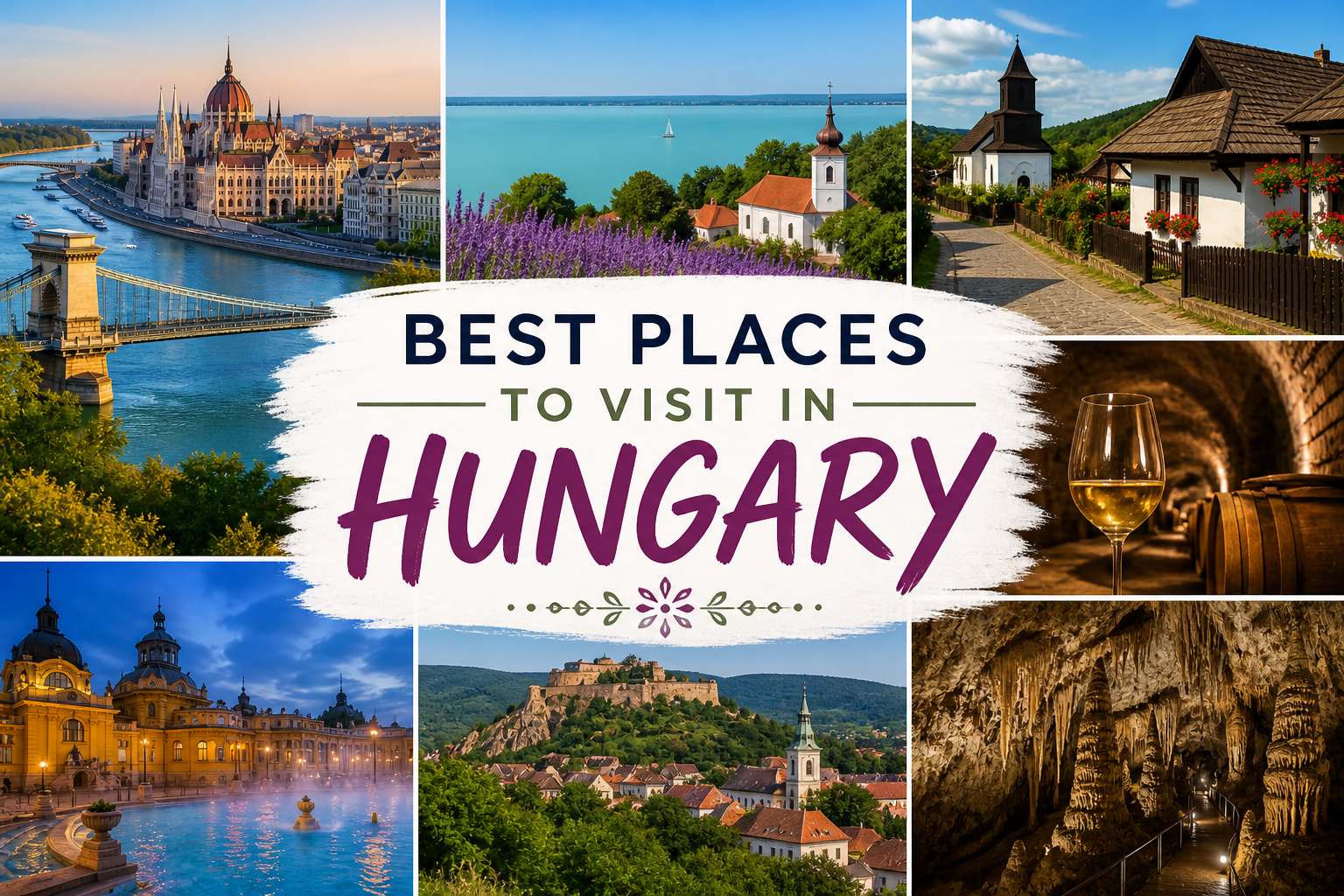
Hungary is one of those countries that proves size on a map has very little to do with cultural weight. It may look compact compared with some of its neighbors, but Hungary has an enormous legacy: thermal baths, grand cafés, wine, paprika, folk traditions, music, mathematics, science, medicine, architecture, river cities, old royal towns, painted villages, and landscapes that feel completely different from one region to the next.
Budapest may be the place most travelers picture first, and honestly, it deserves the attention. Few European capitals make such a dramatic first impression. But Hungary is much more than one beautiful capital city. This is a country where you can move from Danube views and glowing bridges to wine cellars, lavender fields, monastery towns, lake resorts, Ottoman traces, Roman ruins, cathedral cities, open plains, and spa towns built around thermal water.
If you only visit Budapest, you can still have a wonderful trip. But if you want to understand Hungary more deeply, leave room for the places beyond the capital. Hungary rewards travelers who slow down, follow the Danube, taste the wine, soak in the baths, walk the smaller towns, and let the country’s older layers come into focus.
Budapest

Budapest, Hungary
Central Hungary: Along the Danube River, with Buda on the hillier western side and Pest spreading across the flatter eastern side.
What kind of place it is
Budapest is Hungary’s grand capital: dramatic, elegant, historic, romantic, and full of architectural showstoppers.
It is the city of glowing Danube views, thermal baths, ruin bars, coffeehouse culture, bridges, castle hills, market halls, museums, and some of the most beautiful nighttime scenery in Europe.
Budapest can feel polished and gritty at the same time, which is part of its appeal. One moment you are standing in front of a grand imperial façade, and the next you are tucked into a courtyard bar, a steaming bathhouse, or a café that feels like it belongs to another century.
Best for
First trips to Hungary, architecture lovers, thermal bath travelers, café culture, romantic city breaks, nightlife, food lovers, history lovers, and travelers who want one of Europe’s most atmospheric capitals.
Why travelers should care
Budapest is not just the obvious place to start in Hungary. It is one of the great European capitals, and it gives travelers a powerful first impression of the country’s beauty, complexity, and old-world weight.
The Parliament building along the Danube, the Chain Bridge, Buda Castle, Fisherman’s Bastion, Matthias Church, and the city’s bathhouses all create that unmistakable Budapest feeling: grand, slightly moody, deeply historic, and completely memorable.
It is also one of the best places to experience several major parts of Hungarian culture in one trip. You can soak in thermal water, eat something paprika-rich, wander a historic market, sit in a grand café, walk along the Danube at sunset, and end the night in a ruin bar without ever leaving the city.
Main highlights
Budapest’s biggest highlights include the Hungarian Parliament Building, Buda Castle, Fisherman’s Bastion, Matthias Church, the Chain Bridge, Great Market Hall, Andrássy Avenue, the Jewish Quarter, and the city’s famous thermal baths.
Széchenyi is the big iconic bath experience, while Gellért is especially beautiful if you care about architecture. The Danube riverfront is unforgettable at night, especially when the city lights reflect across the water.
Don’t miss
- Hungarian Parliament Building — one of Europe’s most recognizable riverfront landmarks.
- Fisherman’s Bastion — fairytale-like terraces with sweeping views over Pest.
- Matthias Church — colorful, historic, and one of the most beautiful sights in Buda.
- Széchenyi Thermal Bath — the classic Budapest thermal bath experience.
- Great Market Hall — paprika, food stalls, souvenirs, and Hungarian food culture.
- The Danube at night — one of the simplest and most memorable Budapest experiences.
Side notes
- Budapest deserves at least three full days if you want more than a rushed landmark checklist.
- Buda is hillier and more historic-feeling, while Pest is flatter, livelier, and easier for nightlife, restaurants, and cafés.
- Thermal baths each have their own rules and mood, so choose based on the experience you actually want.
- Hotel location matters because Budapest’s neighborhoods can shape the whole feel of the trip.
- For easy planning you can use my Where to Stay in Budapest guide
Szentendre

Szentendre, Hungary
Danube Bend: North of Budapest along the Danube, close enough for one of the easiest day trips from the capital.
What kind of place it is
Szentendre is a colorful riverside art town with cobblestone lanes, pastel buildings, churches, galleries, small museums, cafés, and a softer pace than Budapest.
It is charming without needing to be complicated. This is the kind of place where you wander, browse, stop for coffee, look at the river, and let the town unfold slowly instead of racing from one major landmark to the next.
Best for
Easy Budapest day trips, art lovers, cobblestone wandering, café stops, low-stress travel days, photographers, and travelers who want a smaller-town contrast after the capital.
Why travelers should care
Szentendre is one of the best ways to add a gentler side of Hungary to a Budapest-based itinerary. It gives travelers a taste of the Danube Bend without requiring a difficult travel day or a major time commitment.
The town’s charm is not about one huge attraction. It is about texture: narrow lanes, colorful façades, little shops, church towers, art galleries, and river views. After Budapest’s grand scale, Szentendre feels intimate and easy.
It is especially useful if you want a day that still feels cultural but does not drain you. You can go for a few hours, have a meal, walk the old streets, and come back to Budapest feeling like you actually saw a different side of Hungary.
Main highlights
Szentendre’s highlights are its old streets, riverside promenade, art galleries, small museums, churches, cafés, and relaxed Danube Bend atmosphere. It is less about checking off monuments and more about enjoying the town as a whole.
Don’t miss
- Old Town streets — colorful, cobbled, and perfect for slow wandering.
- Riverside promenade — a peaceful place to pause between cafés and galleries.
- Art galleries and small museums — Szentendre has a strong creative identity.
- Church towers and historic façades — part of what gives the town its layered look.
- A relaxed café stop — this is exactly the kind of town where slowing down makes it better.
Side notes
- Szentendre works well as a half-day or full-day trip from Budapest.
- It can be combined with other Danube Bend stops, but it is also satisfying on its own.
- The town is popular, so go earlier in the day if you want it to feel calmer.
- It is a good choice when you want a beautiful outing without committing to a long travel day.
Visegrád

Visegrád, Hungary
Danube Bend: North of Budapest, set along one of the most scenic curves of the Danube River.
What kind of place it is
Visegrád is a small historic town with big scenery. It is known for castle ruins, hilltop views, wooded slopes, and sweeping panoramas over the Danube Bend.
It feels more dramatic than Szentendre. Where Szentendre is colorful and artistic, Visegrád is about height, history, river curves, and the feeling of looking out over an older Central European landscape.
Best for
Castle lovers, Danube Bend scenery, historic day trips, viewpoints, photographers, travelers who like hilltop views, and anyone who wants Hungary beyond Budapest without going too far.
Why travelers should care
Visegrád helps travelers understand the Danube Bend as more than a pretty day-trip region. This area has a royal and strategic feeling, with the river cutting through hills and the castle watching over the landscape from above.
It is one of the best places near Budapest for that “wow, this country is beautiful” moment. The views are the reason to come, but the history gives those views more weight.
Visegrád is especially good if you like scenic stops that do not feel purely decorative. You get the castle atmosphere, the river, the hills, and the sense that this place mattered.
Main highlights
The main draw is the Visegrád Citadel and its views over the Danube Bend. The town also has royal history, palace ruins, nearby hiking, and easy pairing potential with Szentendre and Esztergom.
Don’t miss
- Visegrád Citadel — the classic viewpoint over the Danube Bend.
- Danube Bend panoramas — some of the prettiest river views near Budapest.
- Royal Palace area — a reminder of Visegrád’s medieval importance.
- Scenic drives or river approaches — the landscape is part of the experience.
- Nearby hiking or forested viewpoints — ideal if you want fresh air with history.
Side notes
- Visegrád is best if you are willing to go uphill for the views.
- It pairs naturally with Szentendre and Esztergom on a fuller Danube Bend itinerary.
- Travelers with mobility concerns should check access details carefully before planning castle-heavy sightseeing.
- This is more of a scenery-and-history stop than a café-wandering town.
Esztergom

Esztergom, Hungary
Danube Bend / Northern Hungary: On the Danube near the Slovak border, north of Budapest.
What kind of place it is
Esztergom is a cathedral city with enormous historic and spiritual weight. Its basilica dominates the skyline and gives the city a sense of scale that feels much larger than its size.
This is not a flimsy pretty-town stop. Esztergom feels foundational. The river, the basilica, the borderland setting, and the city’s place in Hungarian history all make it feel serious, rooted, and worth the trip.
Best for
Religious history, cathedral architecture, Danube views, historic towns, day trips from Budapest, borderland geography, and travelers interested in the older foundations of Hungary.
Why travelers should care
Esztergom matters because it helps travelers understand Hungary beyond Budapest’s capital-city glamour. It has a deep historic role and a spiritual presence that makes it feel different from the smaller towns along the Danube Bend.
The basilica alone is worth seeing, but the setting makes it even better. The Danube, the views, and the sense of standing near an old frontier give Esztergom a powerful atmosphere.
If you like cities that feel important rather than merely charming, Esztergom belongs on your Hungary list.
Main highlights
Esztergom’s main highlight is its massive basilica, but the surrounding river views, historic center, castle area, and bridge toward Slovakia all add to the experience. It works especially well as part of a Danube Bend route.
Don’t miss
- Esztergom Basilica — the city’s defining landmark and one of Hungary’s most important religious sites.
- Views from the basilica area — wide Danube views that help explain the city’s setting.
- Historic center — a good place for a slower walk after the main sight.
- The bridge and borderland views — a reminder of Esztergom’s position near Slovakia.
- Danube Bend route pairing — Esztergom is even better when combined with Visegrád or Szentendre.
Side notes
- Esztergom can be visited as a day trip from Budapest.
- It is a stronger stop for history and architecture than for nightlife or shopping.
- The basilica area involves some elevation, so plan accordingly.
- If you are doing the Danube Bend properly, Esztergom deserves more than a rushed photo stop.
Lake Balaton

Lake Balaton, Hungary
Western Hungary: A large freshwater lake region southwest of Budapest, known for resort towns, vineyards, beaches, and summer holidays.
What kind of place it is
Lake Balaton is Hungary’s great lake escape: resort towns, beaches, promenades, ferries, vineyards, old villas, family holidays, and soft summer evenings by the water.
It is not one single destination so much as a whole region. Different towns around the lake can feel lively, romantic, family-friendly, wine-focused, elegant, or relaxed depending on where you stay.
Best for
Summer trips, families, couples, lake vacations, wine lovers, relaxed holidays, cycling, swimming, slower itineraries, and travelers who want Hungary beyond Budapest.
Why travelers should care
Lake Balaton is essential because it shows a completely different side of Hungary. After Budapest’s architecture and city intensity, Balaton gives you water, breezes, vineyards, resort energy, and a slower holiday rhythm.
It is also one of the best places in Hungary to make a trip feel like a vacation instead of a sightseeing marathon. You can swim, eat by the lake, visit wine towns, take ferries, explore pretty villages, and let the days breathe.
Balaton is especially useful for summer itineraries. If you are visiting Hungary in warm weather, this is where the country’s vacation culture becomes much easier to understand.
Main highlights
Lake Balaton’s highlights include lakeside beaches, Balatonfüred, Tihany, Keszthely, north shore wine towns, south shore resort areas, ferries, cycling routes, and sunset views over the water.
The north shore is especially good for scenery and wine, while the south shore often feels more classic beach-holiday and family-friendly.
Don’t miss
- Tihany — one of the prettiest and most recognizable places on the lake.
- Balatonfüred — a classic lakeside resort town with promenade appeal.
- Keszthely — elegant, historic, and useful for pairing Balaton with palace sightseeing.
- North shore wine towns — beautiful for food, views, and vineyard stops.
- A ferry or boat ride — one of the simplest ways to enjoy the lake properly.
Side notes
- Lake Balaton changes a lot depending on where you stay, so pick your base carefully.
- Summer is the classic season, but it can be busy.
- The lake is better with at least one or two nights, not just a rushed day trip.
- If you want wine, scenery, and a more romantic feel, look closely at the north shore.
Tihany

Tihany, Hungary
Lake Balaton: On a peninsula along the northern shore of Lake Balaton.
What kind of place it is
Tihany is one of Lake Balaton’s prettiest and most distinctive stops. It is known for its abbey, lavender, lake views, old village streets, and peninsula scenery.
It feels softer and more romantic than many lake towns. This is the kind of place where the setting does a lot of the work: blue water, gentle hills, lavender details, and views that make Balaton feel special rather than just summery.
Best for
Couples, photographers, lake views, lavender lovers, slower Balaton itineraries, romantic stops, relaxed wandering, and travelers who want a scenic town rather than only a beach base.
Why travelers should care
Tihany is important because it gives Lake Balaton a clear visual identity. Even if you only have a short time around the lake, Tihany helps the region feel memorable.
The abbey and village are lovely, but the views are the real magic. From Tihany, Balaton opens up in a way that feels expansive and peaceful, which is exactly the kind of contrast many travelers need after Budapest.
It is also one of the best Balaton stops for people who do not necessarily want a full beach vacation. You can visit for the scenery, the village, a meal, lavender shops, and a more elevated lake-town atmosphere.
Main highlights
Tihany’s highlights include Tihany Abbey, lake viewpoints, lavender fields and shops, old village lanes, peninsula walks, and ferry access across Lake Balaton.
Don’t miss
- Tihany Abbey — the landmark sight and one of the best-known images of the town.
- Lake viewpoints — the reason Tihany feels so special.
- Lavender shops and seasonal lavender atmosphere — a signature part of the town’s identity.
- Old village streets — small, charming, and good for a relaxed wander.
- The peninsula setting — especially beautiful if you are exploring Balaton by car.
Side notes
- Tihany can be visited as a short stop, but it is better if you do not rush it.
- Lavender season adds extra charm, but the town is worth visiting outside that window too.
- Parking and crowds can be annoying in peak summer.
- It is a strong choice for travelers who want Balaton scenery without basing themselves in the busiest beach areas.
Keszthely

Keszthely, Hungary
Western Lake Balaton: On the western end of Lake Balaton, close to Hévíz.
What kind of place it is
Keszthely is an elegant western Balaton town with palace architecture, gardens, lake access, museums, and a more old-world atmosphere than a simple beach resort.
It feels refined, historic, and practical at the same time. You can use it for lake time, but it also gives you a proper cultural anchor.
Best for
Palace lovers, western Balaton stays, couples, older travelers, culture plus lake time, relaxed sightseeing, and travelers pairing Lake Balaton with Hévíz.
Why travelers should care
Keszthely is a great reminder that Lake Balaton is not only about swimming and summer holidays. It also has aristocratic history, grand architecture, gardens, and cultural depth.
The Festetics Palace gives Keszthely a strong reason to visit even if the weather is not perfect for lake time. That makes it especially useful for travelers who want Balaton to feel like more than a seasonal beach stop.
Keszthely also works well because of its location. Being near Hévíz makes it easy to combine lake scenery with thermal wellness, which is one of Hungary’s great travel pleasures.
Main highlights
Keszthely’s main highlight is Festetics Palace, but the town also has lakefront areas, museums, gardens, old streets, and easy access to Hévíz and western Balaton.
Don’t miss
- Festetics Palace — the grand landmark that makes Keszthely stand out.
- Palace gardens — peaceful and pretty for a slower walk.
- Lakefront area — useful for adding Balaton scenery to the visit.
- Nearby Hévíz — one of Hungary’s strongest wellness add-ons.
- Western Balaton atmosphere — quieter and more elegant than some busier lake areas.
Side notes
- Keszthely is a very practical base if you want both Balaton and Hévíz.
- It is better for culture, elegance, and relaxed lake time than wild nightlife.
- The western end of the lake can feel less hectic than some of the classic summer resort towns.
- This is a good choice for travelers who want a softer, more comfortable Balaton stay.
Eger

Eger, Hungary
Northern Hungary: Northeast of Budapest, in a historic wine region known for castles, baroque streets, and cellar culture.
What kind of place it is
Eger is a romantic historic town with a castle, baroque architecture, churches, wine cellars, thermal bath culture, and Ottoman traces.
It has that wonderful smaller-city feeling where you can actually enjoy the place instead of just pushing through crowds. The streets are pretty, the history is visible, and the wine culture gives the town a strong identity.
Best for
Wine lovers, couples, castle lovers, historic towns, baroque architecture, food-focused travelers, weekend escapes, and people who want a meaningful stop outside Budapest.
Why travelers should care
Eger has many of the things that make Hungary rewarding in one compact place: history, wine, architecture, thermal water, and a strong sense of regional identity.
It is famous for Egri Bikavér, often known as Bull’s Blood, but you do not need to be a wine expert to enjoy Eger. The cellar areas, old town, castle, churches, and cafés make it appealing even if wine is just one part of your trip.
Eger also gives travelers a softer, more romantic alternative to Budapest. It is historic without being overwhelming, beautiful without feeling too polished, and lively without becoming chaotic.
Main highlights
Eger’s main highlights include Eger Castle, the Valley of the Beautiful Women wine cellars, Eger Basilica, the old town, the Ottoman minaret, thermal baths, and baroque squares.
Don’t miss
- Eger Castle — the town’s major historic landmark.
- Valley of the Beautiful Women — wine cellars and tasting culture in one easy area.
- Eger Basilica — a major architectural sight in the city.
- Old Town streets — baroque, walkable, and full of atmosphere.
- Ottoman minaret — a visible reminder of Hungary’s layered history.
Side notes
- Eger works well as an overnight or two-night stop.
- Wine tasting is easier if you are not driving yourself.
- The town is walkable, but some sights involve hills or uneven surfaces.
- It is one of the best choices if you want history and wine without planning a complicated rural itinerary.
Tokaj

Tokaj, Hungary
Northeastern Hungary: In Hungary’s famous Tokaj wine region, near the meeting of the Tisza and Bodrog rivers.
What kind of place it is
Tokaj is historic wine country: vineyards, cellars, small towns, rivers, slow meals, and a landscape shaped by one of Hungary’s most famous culinary legacies.
It is quieter than Budapest, less obvious than Balaton, and best for travelers who like places that reward attention.
Best for
Wine travelers, couples, slow countryside trips, food-focused itineraries, heritage travel, vineyard scenery, and repeat visitors who want Hungary beyond the first-trip highlights.
Why travelers should care
Tokaj is not just another wine stop. It is one of the most important wine regions in Hungary and one of the country’s great cultural landscapes.
The region is especially famous for Tokaji wines, including sweet wines that have long been associated with prestige and celebration. Even if you are not a serious wine person, Tokaj helps you understand how deeply wine belongs to Hungarian identity.
This is a place to slow down. Tokaj is not meant to be raced through as a checkbox. It is better when you have time for a tasting, a meal, a walk, and a little space to enjoy the countryside.
Main highlights
Tokaj’s highlights include wine tastings, historic cellars, vineyard scenery, riverside views, small-town wandering, and regional food. The broader wine region is the real destination, not just one quick stop.
Don’t miss
- Tokaji wine tasting — the central experience of the region.
- Historic wine cellars — atmospheric and tied to the region’s identity.
- Vineyard views — gentle countryside that feels very different from Budapest.
- Riverside scenery — part of Tokaj’s calm, slow-travel appeal.
- A proper food-and-wine meal — this is the kind of region where lingering matters.
Side notes
- Tokaj is best with at least one night if you can manage it.
- This is a slow-travel destination, not a high-energy sightseeing stop.
- If wine is a major focus of your Hungary trip, Tokaj deserves serious consideration.
- Transportation can require more planning than easy Budapest day trips.
Pécs

Pécs, Hungary
Southern Hungary: Near the Mecsek Hills, with a warmer, more southern-feeling atmosphere than many travelers expect.
What kind of place it is
Pécs is a cultural city with Roman history, Ottoman traces, colorful architecture, ceramics, museums, churches, cafés, and a relaxed student-city energy.
It feels layered in a way that makes it especially rewarding for travelers who like history but do not want every city to feel heavy. Pécs has depth, but it also has warmth.
Best for
Culture lovers, Roman history, Ottoman history, art, ceramics, southern Hungary, slower city breaks, students-at-heart, and travelers who want something beyond the obvious.
Why travelers should care
Pécs is one of Hungary’s most interesting cities because so many layers are visible at once. Roman heritage, early Christian sites, Ottoman architecture, churches, art, and ceramic traditions all sit together in a city that still feels livable and relaxed.
It also gives a Hungary itinerary regional variety. Pécs does not feel like Budapest, Balaton, Eger, or the Great Plain. It has its own southern mood, with a softer climate and a strong cultural identity.
For travelers who like cities with personality rather than only famous landmarks, Pécs is one of the best places to consider.
Main highlights
Pécs’s highlights include the Early Christian Necropolis, Pécs Cathedral, the Mosque of Pasha Qasim, Széchenyi Square, the Zsolnay Cultural Quarter, museums, cafés, and nearby Mecsek Hill scenery.
Don’t miss
- Early Christian Necropolis — one of the city’s most important historic sites.
- Pécs Cathedral — a major landmark with deep atmosphere.
- Mosque of Pasha Qasim — one of the clearest Ottoman traces in the city.
- Zsolnay Cultural Quarter — art, ceramics, and cultural spaces.
- Széchenyi Square — the heart of the city and a beautiful place to linger.
Side notes
- Pécs is far enough from Budapest that it works better as an overnight stay than a rushed day trip.
- It is a strong pick for travelers who like culture, architecture, and slower city wandering.
- The city pairs well with southern Hungary itineraries.
- If you want Hungary to feel more varied, Pécs helps a lot.
Szeged

Szeged, Hungary
Southern Hungary: Along the Tisza River, near the Serbian and Romanian borders.
What kind of place it is
Szeged is bright, elegant, lively, and southern-feeling. It is associated with sunshine, paprika, university life, riverside walks, grand squares, and beautiful architecture.
It has a warmer mood than many travelers expect from Hungary. The city feels open, approachable, and full of everyday life.
Best for
Food lovers, architecture fans, paprika culture, southern Hungary, student-city energy, sunny city breaks, riverside walks, and travelers who like elegant but less obvious cities.
Why travelers should care
Szeged is a strong choice because it gives Hungary another regional flavor. It is not Budapest, and that is the point. The city has a bright, almost cheerful atmosphere, with handsome squares, wide streets, river scenery, and a food identity that makes it especially memorable.
If you care about Hungarian food, Szeged is worth knowing. Paprika is part of the city’s identity, and that alone gives it a special place in the broader story of Hungarian cuisine.
Szeged also works well for travelers who like cities that are beautiful without being overwhelming. It has enough architecture and culture to feel rewarding, but it does not usually have the same intensity as the capital.
Main highlights
Szeged’s highlights include the Votive Church, Dóm Square, Tisza River walks, Art Nouveau architecture, local food culture, paprika, university energy, and warm-weather city life.
Don’t miss
- Votive Church of Szeged — one of the city’s defining landmarks.
- Dóm Square — grand, open, and central to the city’s atmosphere.
- Tisza River walks — a good way to slow down and enjoy the setting.
- Paprika and local food culture — a key part of Szeged’s identity.
- Art Nouveau architecture — beautiful details throughout the city.
Side notes
- Szeged is a good choice if you want to see southern Hungary.
- It can be hot in summer, so plan sightseeing with shade and breaks.
- The city works better as an overnight than as a rushed side trip from Budapest.
- It is especially appealing for travelers who like food, architecture, and relaxed city energy.
Debrecen

Debrecen, Hungary
Eastern Hungary: One of Hungary’s major cities outside Budapest, close to the Great Plain and Hortobágy.
What kind of place it is
Debrecen is a major eastern Hungarian city with Reformed heritage, broad squares, museums, parks, university life, and access to the Great Plain.
It is not as instantly dramatic as Budapest, but it helps fill in the eastern side of Hungary’s map and identity.
Best for
Eastern Hungary, religious history, regional city breaks, travelers pairing city culture with Hortobágy, repeat visitors, and people who want Hungary beyond the usual first-trip circuit.
Why travelers should care
Debrecen matters because it gives travelers a fuller picture of Hungary. If Budapest is the grand capital and Balaton is the lake escape, Debrecen is a gateway into eastern Hungary and the Great Plain.
The city has its own history and civic identity, especially around the Great Reformed Church and its role in Hungarian religious and political life. It also gives practical structure to an itinerary that includes Hortobágy.
Debrecen is best for travelers who want to understand Hungary as a whole country rather than only its most photogenic stops.
Main highlights
Debrecen’s highlights include the Great Reformed Church, Kossuth Square, Déri Museum, the Great Forest area, university atmosphere, and access to Hortobágy National Park.
Don’t miss
- Great Reformed Church — Debrecen’s signature landmark.
- Kossuth Square — the central gathering place and historic heart.
- Déri Museum — useful for cultural and historical context.
- Nagyerdő / Great Forest area — green space and a local recreation zone.
- Hortobágy access — one of the best reasons to include Debrecen in a broader route.
Side notes
- Debrecen is best for fuller Hungary itineraries, not just quick first trips.
- It works well as a practical base for visiting Hortobágy.
- The city is more understated than Budapest, so go for regional depth rather than spectacle.
- It is a good choice if you want to see eastern Hungary without feeling completely rural.
Hortobágy National Park

Hortobágy National Park, Hungary
Eastern Hungary / Great Plain: West of Debrecen, in Hungary’s vast puszta landscape.
What kind of place it is
Hortobágy is open, flat, traditional, spacious, and completely different from Hungary’s cities, wine towns, and lake resorts.
This is the Great Plain: enormous skies, pastoral heritage, horse culture, wetlands, wildlife, and a sense of landscape that feels central to Hungary’s identity.
Best for
Nature lovers, cultural landscapes, horse culture, birdwatching, open skies, photographers, Great Plain scenery, and travelers who want a side of Hungary that feels completely different.
Why travelers should care
Hortobágy matters because it shows travelers a Hungary that is not built around architecture or cafés. This is a landscape destination, but it is also cultural. The puszta is tied to pastoral traditions, open land, animals, and a way of life that feels very different from Budapest or Balaton.
It also adds contrast to a Hungary itinerary. After thermal baths, castles, wine cellars, and city squares, Hortobágy gives you space. The horizon stretches out, the sky becomes part of the experience, and the country feels bigger than expected.
This is not the place to go for cute streets. It is the place to go for atmosphere, nature, tradition, and a landscape that belongs deeply to Hungary.
Main highlights
Hortobágy’s highlights include the puszta landscape, traditional horse culture, birdlife, wetlands, the Nine-Arch Bridge, pastoral heritage, and wide-open Great Plain scenery.
Don’t miss
- The puszta landscape — the defining reason to go.
- Traditional horse culture — one of the area’s signature experiences.
- Nine-Arch Bridge — a recognizable Hortobágy landmark.
- Birdlife and wetlands — especially interesting for nature-focused travelers.
- Open-sky views — completely different from city-based Hungary.
Side notes
- Hortobágy is not a pretty-town stop; go for landscape, culture, and contrast.
- It pairs naturally with Debrecen.
- Weather and season can shape the experience, especially if you care about wildlife or outdoor activities.
- This is a good choice for travelers who want Hungary to feel deeper and less obvious.
Hévíz

Hévíz, Hungary
Western Hungary: Near Keszthely and Lake Balaton, known for its thermal lake and spa culture.
What kind of place it is
Hévíz is a wellness town built around thermal water. It is calm, restorative, spa-focused, and especially appealing if your trip needs a real pause.
Instead of Budapest’s grand bathhouse energy, Hévíz gives you something slower and more resort-like. It is about soaking, resting, walking, and letting the itinerary breathe.
Best for
Spa travel, wellness trips, older travelers, couples, rest days, thermal bathing, Balaton add-ons, and travelers who want recovery time built into the trip.
Why travelers should care
Hungary’s thermal culture is one of the country’s great pleasures, and Hévíz lets you experience it in a completely different way from Budapest.
The town’s thermal lake is the main draw, but the larger value is the pace. Hévíz is where you can stop pushing, stop sightseeing so hard, and actually rest without feeling like you wasted a day.
It is especially useful if you are building a longer itinerary. After Budapest, wine regions, castle towns, or Lake Balaton, Hévíz can give the trip a gentle reset.
Main highlights
Hévíz’s main highlight is its thermal lake, but the town also has spa hotels, wellness services, walking areas, nearby Keszthely, and easy access to western Lake Balaton.
Don’t miss
- Thermal Lake Hévíz — the central experience of the town.
- Spa hotels and wellness stays — ideal if you want a slower trip.
- Nearby Keszthely — easy palace culture and Lake Balaton access.
- Western Balaton region — useful for pairing relaxation with sightseeing.
- A true rest day — Hévíz is one of the best places in Hungary to build one in.
Side notes
- Hévíz is especially practical if you are already visiting Keszthely or western Balaton.
- This is more of a wellness stop than a fast-paced sightseeing destination.
- Check bath rules, opening times, and health guidance before planning your day.
- It is a strong option for travelers who want a gentler, more restorative Hungary trip.
Sopron

Sopron, Hungary
Northwestern Hungary: Near the Austrian border, west of Budapest and close to the Lake Fertő / Neusiedlersee region.
What kind of place it is
Sopron is a historic borderland city with medieval streets, wine culture, old towers, atmospheric squares, and an Austrian-Hungarian feel.
It is charming, layered, and slightly tucked away from the most obvious Hungary routes. The city feels connected to both Hungary and the wider Central European world around it.
Best for
Medieval streets, wine, western Hungary, borderland history, travelers pairing Hungary with Austria, architecture lovers, and people who enjoy smaller historic cities.
Why travelers should care
Sopron is worth considering because it feels different from Budapest, different from Balaton, and different from eastern Hungary. Its location near Austria gives it a distinct atmosphere, and the old town has the kind of streets that reward aimless wandering.
It is also a good choice for travelers who like historic cities but do not want to fight through the most obvious crowds. Sopron gives you towers, squares, wine, and atmosphere in a manageable package.
For a broader Hungary itinerary, Sopron adds western texture and helps the country feel connected to the old Austro-Hungarian world.
Main highlights
Sopron’s highlights include its Firewatch Tower, old town streets, historic squares, medieval façades, wine culture, and access to the Fertő / Neusiedlersee region.
Don’t miss
- Firewatch Tower — one of Sopron’s signature landmarks.
- Old Town streets — medieval atmosphere and charming corners.
- Historic squares and façades — ideal for slow wandering.
- Local wine culture — an important part of the region’s appeal.
- Nearby Lake Fertő region — useful if you want nature and cultural landscape travel.
Side notes
- Sopron is a strong add-on if you are connecting Hungary with Austria.
- It is better for atmosphere, history, and wine than major blockbuster attractions.
- The city works well for a slower overnight stop.
- It is a good choice if you want Hungary’s western edge to feel more vivid.
Győr

Győr, Hungary
Northwestern Hungary: Between Budapest and Vienna, near the meeting of several rivers.
What kind of place it is
Győr is a baroque city with rivers, churches, squares, old streets, and a convenient location between two major capitals.
It is pretty, manageable, and easy to underestimate. This is not the kind of city that shouts for attention, but it rewards travelers who like elegant historic centers without needing everything to be world-famous.
Best for
Baroque architecture, western Hungary, Budapest-to-Vienna routes, relaxed city stops, history lovers, river towns, and travelers who like attractive cities without overwhelming crowds.
Why travelers should care
Győr is useful because it fits so naturally into Central European travel. If you are moving between Budapest and Vienna, it gives you a meaningful stop instead of turning the route into pure transit.
The city’s old town is attractive, walkable, and full of architectural detail. It is not as dramatic as Budapest, but that is part of the appeal. Győr feels more relaxed and manageable while still giving you history, churches, squares, and a strong sense of place.
It also pairs beautifully with Pannonhalma, which adds major monastery heritage nearby.
Main highlights
Győr’s highlights include its baroque old town, river setting, churches, central squares, historic streets, and easy access to Pannonhalma Archabbey.
Don’t miss
- Győr Old Town — baroque streets, squares, and historic buildings.
- Riverside setting — part of what gives the city its pleasant layout.
- Central squares — good for cafés, wandering, and architectural detail.
- Churches and historic façades — reminders of the city’s layered past.
- Pannonhalma day trip — one of the best reasons to spend extra time nearby.
Side notes
- Győr is very practical if you are traveling between Budapest and Vienna.
- It works well as a one-night stop or slower day stop.
- The city is more about atmosphere and architecture than huge headline sights.
- Pair it with Pannonhalma if you want the stop to feel more substantial.
Pannonhalma

Pannonhalma, Hungary
Northwestern Hungary: Southeast of Győr, known for its historic Benedictine archabbey and hilltop setting.
What kind of place it is
Pannonhalma is a monastery town with deep religious and cultural heritage. The archabbey sits above the surrounding landscape and gives the area a peaceful, serious, historic feeling.
This is not a busy city stop. It is quieter, more contemplative, and best appreciated by travelers who like places with depth.
Best for
Monastery heritage, religious history, architecture, quiet cultural stops, western Hungary, travelers staying in Győr, and people who want a meaningful heritage site beyond the capital.
Why travelers should care
Pannonhalma matters because it carries a kind of long memory. It is one of Hungary’s most important monastic sites and adds a very different tone to an itinerary.
After Budapest’s grandeur or Balaton’s vacation mood, Pannonhalma feels still and rooted. It gives you architecture, spiritual heritage, views, and a quieter kind of beauty.
It also makes Győr and northwestern Hungary feel much more substantial. Instead of simply passing through western Hungary, you can stop and experience one of the region’s major cultural landmarks.
Main highlights
Pannonhalma’s highlights include the archabbey, basilica, library, hilltop views, monastic heritage, gardens, and the quiet atmosphere of the surrounding area.
Don’t miss
- Pannonhalma Archabbey — the central reason to visit.
- The basilica — historic, spiritual, and atmospheric.
- The library — one of the most memorable parts of the abbey complex.
- Hilltop views — peaceful and beautiful in clear weather.
- A slow visit — this is a place that benefits from not rushing.
Side notes
- Pannonhalma pairs best with Győr.
- Check visiting hours before going because access can vary.
- This is a quieter heritage stop, not a high-energy sightseeing destination.
- It is a strong choice for travelers who care about cultural depth.
Hollókő

Hollókő, Hungary
Northern Hungary: A traditional village in the Cserhát Hills, northeast of Budapest.
What kind of place it is
Hollókő is a preserved traditional village with whitewashed houses, folk architecture, rural heritage, and a storybook quality that feels very different from Hungary’s cities.
It is small, but it has a strong identity. This is the kind of place you visit to understand traditional village life, not to fill a full day with nonstop attractions.
Best for
Traditional villages, folk culture, heritage travel, photographers, slow countryside stops, travelers who like preserved historic places, and people who want a rural contrast to Budapest.
Why travelers should care
Hollókő is important because it shows a side of Hungary that many visitors miss entirely. Budapest, Balaton, and wine towns are all wonderful, but Hollókő brings in rural heritage and traditional architecture.
It also adds texture to a Hungary itinerary. The village is small, but that is part of its point. You are not coming for scale; you are coming for atmosphere, folk identity, and a glimpse of older village patterns.
For travelers who care about cultural heritage beyond palaces and cathedrals, Hollókő is one of the most distinctive stops in Hungary.
Main highlights
Hollókő’s highlights include its preserved village streets, traditional houses, folk heritage, small museums, castle ruins nearby, and seasonal festivals or cultural events when timing lines up.
Don’t miss
- The old village streets — the heart of the experience.
- Traditional whitewashed houses — the visual identity of Hollókő.
- Folk museums and craft details — useful for understanding the village’s heritage.
- Nearby castle ruins — a scenic add-on if you have time.
- Seasonal cultural events — especially meaningful if your visit lines up with one.
Side notes
- Hollókő is small, so do not expect a big-city sightseeing day.
- It is best for travelers who appreciate heritage, architecture, and atmosphere.
- A car makes visiting easier.
- Check seasonal opening patterns before building your whole day around it.
Aggtelek National Park

Aggtelek National Park, Hungary
Northern Hungary: Along the Slovak border, known for karst landscapes and extensive cave systems.
What kind of place it is
Aggtelek is a cave and karst landscape destination, completely different from Hungary’s cities, lake towns, and wine regions.
It is cool, geological, unusual, and ideal for travelers who like adding a natural wonder to a culture-heavy itinerary.
Best for
Caves, geology, nature lovers, unusual landscapes, families with older kids, travelers with a car, and anyone who wants a very different kind of Hungary stop.
Why travelers should care
Aggtelek proves that Hungary is not only about cities, baths, wine, and villages. The cave systems here add a dramatic natural element to the country’s travel map.
It is especially appealing if you like places that break up an itinerary. After several days of architecture, cafés, and old towns, going underground into a cave system feels like a genuine change of pace.
Aggtelek is also a reminder that some of Hungary’s most interesting places are not the most obvious ones. It takes more planning than Budapest or Szentendre, but that is part of why it can feel special.
Main highlights
Aggtelek’s highlights include Baradla Cave, guided cave visits, karst scenery, border-region nature, walking trails, and a completely different landscape from the rest of the country.
Don’t miss
- Baradla Cave — the major cave experience in the area.
- Guided cave tours — the best way to actually understand what you are seeing.
- Karst scenery — unusual and distinct from Hungary’s more famous landscapes.
- Nature walks — useful if you want to spend time above ground too.
- The borderland setting — northern Hungary feels different from Budapest and Balaton.
Side notes
- Cave visits usually require planning around tour times.
- Wear practical shoes and bring a layer because caves can feel cool.
- This is easier with a car or as part of a more deliberate northern Hungary route.
- It is a great add-on for travelers who want nature, not just towns.
How Many Days Do You Need in Hungary?
You can visit Budapest in a long weekend, but Hungary as a country deserves more time than that.
For a first trip, five to seven days gives you enough time for Budapest plus one or two nearby add-ons. A simple route could include Budapest, Szentendre or the Danube Bend, and either Eger or Lake Balaton.
For a fuller Hungary trip, ten to fourteen days is much better. That gives you room for Budapest, the Danube Bend, Eger, Tokaj, Lake Balaton, Pécs, and either eastern Hungary or western Hungary depending on your route.
If you like slow travel, Hungary is especially rewarding because distances are manageable, but the regions do not all feel the same. You can build a trip around baths, wine, architecture, food, villages, lake towns, monasteries, and countryside without feeling like every stop repeats the last one.
What to Pack for Hungary
Hungary is not especially difficult to pack for, but your list should match the kind of trip you are taking. Budapest, thermal baths, wine towns, churches, castles, lake resorts, caves, and countryside stops all have different little packing needs.
- Light scarf or cover-up for churches, cooler evenings, and easy layering.
- Compact umbrella or rain jacket depending on the season.
- Day bag for Budapest sightseeing, Danube Bend day trips, wine-region outings, and lake days.
- Portable charger because city days and day trips can become very phone-heavy.
- Small coin pouch — handy for lockers, public toilets, markets, transit odds and ends, and small purchases.
For full no brainer packing lists check out my Hungary in Summer, and Hungary Outlet & Plug Voltage Guide
Things Nobody Tells You About Visiting Hungary
Budapest Is Not the Whole Story
Budapest is extraordinary, but it can accidentally swallow the whole trip. If you have the time, add at least one place outside the capital. Even a simple Danube Bend day trip changes the way Hungary feels.
Hungary Has Serious Wine Culture
Wine is not just a pleasant extra here. Eger, Tokaj, Balaton, Sopron, Villány, and other regions all bring something different. If you care about food and wine, build wine time into your itinerary instead of treating it as an afterthought.
Thermal Baths Are Not Only in Budapest

Budapest is famous for baths, but Hungary’s thermal culture reaches far beyond the capital. Hévíz, Eger, Hajdúszoboszló, Bük, Sárvár, and other spa destinations can add a completely different kind of wellness experience to your trip.
The Country Feels More Varied Than People Expect
Budapest, Lake Balaton, the Danube Bend, Pécs, Tokaj, Hortobágy, and Sopron do not feel interchangeable. Hungary may be compact, but the mood changes a lot from region to region.
Some of the Best Stops Are About Atmosphere, Not Giant Attractions
Szentendre, Tihany, Sopron, and smaller wine towns are not always about one massive must-see landmark. They are about walking, eating, looking around, and letting the setting do the work.
Summer Can Be Hot
Do not assume Central Europe always means mild weather. Budapest, Szeged, Lake Balaton, and the Great Plain can feel properly hot in summer, especially when you are walking on pavement or sightseeing in open squares.
Churches, Baths, Castles, Caves, and Cafés Require Different Outfits
Hungary can easily take you from a bathhouse to a basilica to a wine cellar to a cave tour to a nicer dinner. Packing a few flexible pieces makes the trip much easier.
Best Time to Visit Hungary
Hungary can work year-round, but the best timing depends on what kind of trip you want.
Spring
Spring is beautiful for Budapest, Danube Bend towns, gardens, walking-heavy sightseeing, and café days. It is a good time if you want fewer summer crowds and more comfortable temperatures.
Summer
Summer is best for Lake Balaton, outdoor dining, festivals, long evenings, and warm-weather travel. It can be hot, so plan sightseeing with shade, water, and slower afternoons.
Fall
Fall is one of the best times for Hungary if you care about wine regions, golden city light, cooler walking weather, and a more romantic atmosphere. Eger, Tokaj, Budapest, and the countryside are especially appealing.
Winter
Winter works well for Budapest, thermal baths, cafés, Christmas markets, museums, concerts, and cozy city travel. It is less ideal for lake vacations or countryside-heavy itineraries, but it can be magical if you want an atmospheric city break.
Final Thoughts: Is Hungary Worth Visiting?
Hungary is absolutely worth visiting, and it deserves to be treated as more than a quick Budapest stopover. Budapest may be the obvious starting point, but the country’s real richness comes from the way its regions build on each other: thermal baths, wine cellars, royal towns, old villages, monasteries, lake resorts, open plains, cathedral cities, cave systems, and café culture.
This is a country with deep heritage and a long cultural shadow. It has influenced food, music, science, design, medicine, mathematics, spa culture, and Central European history in ways many travelers do not fully realize before they go.
Come for Budapest if that is what first catches your attention. But leave room for the rest of Hungary. The country becomes much more interesting when you let it be bigger than its capital.