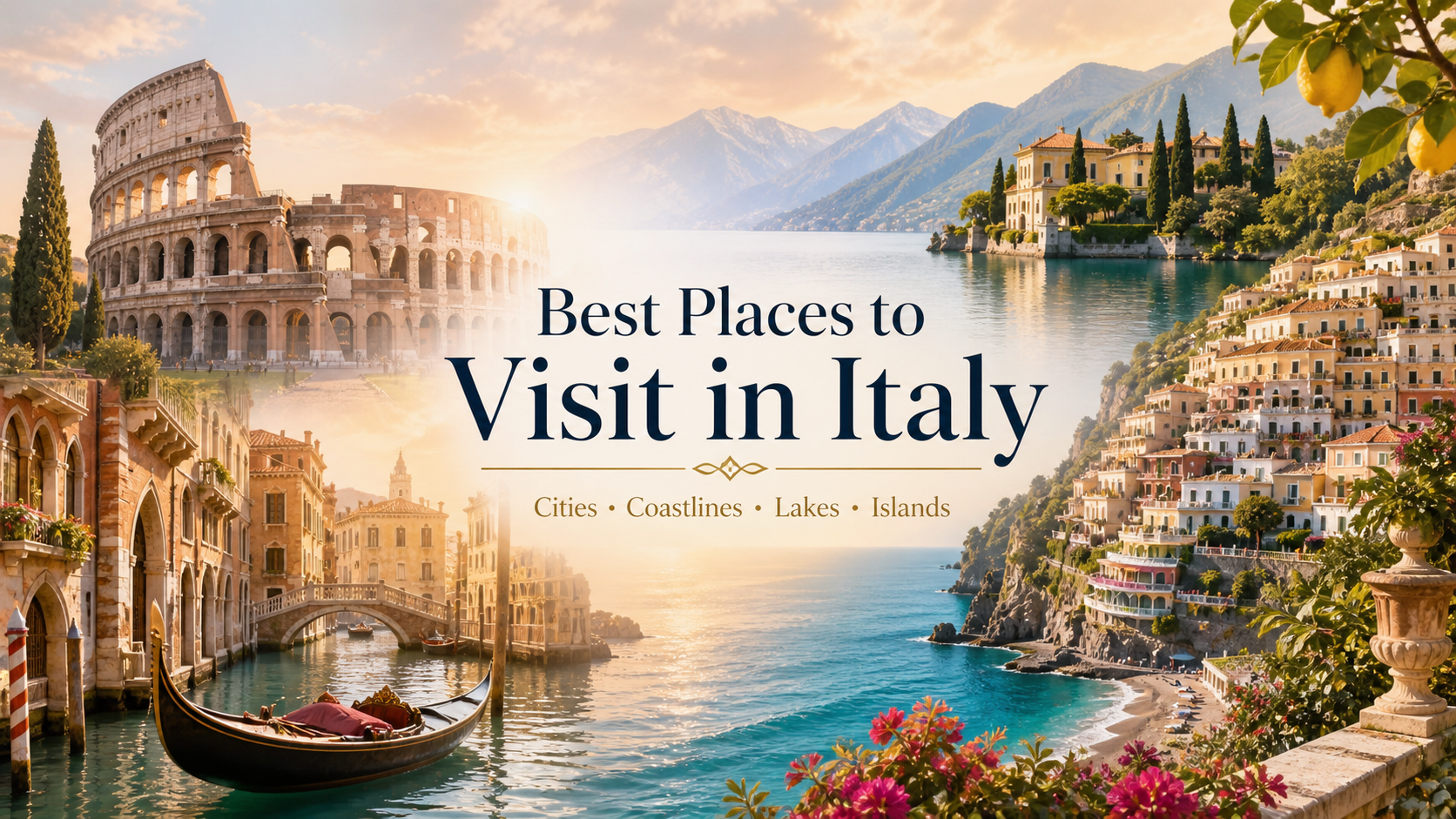
Italy is one of those countries that almost feels unfair to compare with anywhere else.
You can come for ancient ruins and end up crying over pizza. You can come for Renaissance art and find yourself daydreaming about lemon trees, turquoise coves, mountain villages, lakefront villas, vineyards, islands, markets, or a bowl of pasta that ruins you for all future pasta. Italy is not one kind of trip. It is many trips layered on top of each other.
That is also what makes planning Italy so hard.
Rome, Florence, and Venice are famous for good reason, and I would never tell a first Italy traveler to ignore them just to be different. But Italy is much bigger than its most famous cities. There are dramatic coastlines, alpine landscapes, wine regions, food capitals, glamorous lakes, southern towns, volcanic islands, and beach escapes that all deserve attention.
This guide is not meant to include every wonderful place in Italy. That would be impossible. Instead, these are the best places to visit in Italy if you want a strong, beautiful, well-rounded trip — the places that help explain why travelers fall so completely in love with this country.
If you’re still in the early planning stage, you may also want to start with my guide to what to do after booking Italy. It’s a helpful next step once Italy moves from “dream trip” to “this is actually happening.” I’m booked for Italy, now what?
Rome

Country / Central Italy: Lazio, western central Italy
What kind of place it is
Rome is Italy’s grand, chaotic, ancient, beautiful capital — a city where normal modern life unfolds around ruins, fountains, churches, piazzas, trattorias, traffic, gelato shops, and some of the most recognizable landmarks in the world.
This is not a polished museum city. Rome is louder, dustier, more layered, and more alive than that. Part of the magic is that the ancient world does not feel locked away. It sits right in the middle of the city, surrounded by scooters, espresso bars, laundry lines, restaurants, and people trying to get through their day.
Best for
History lovers, first Italy trips, couples, food travelers, Catholic and religious travelers, ancient-world obsessives, city walkers, and anyone who wants the “I am really in Italy” feeling.
Why travelers should care
Rome is one of the best places to begin understanding Italy because it gives you the big picture fast. Ancient Rome, the Catholic Church, Renaissance and Baroque art, neighborhood food culture, piazza life, and modern Italian chaos all collide here.
It is also one of those cities where the famous things are genuinely worth seeing. The Colosseum, Roman Forum, Pantheon, Trevi Fountain, Spanish Steps, Vatican Museums, St. Peter’s Basilica, and Piazza Navona are not overhyped because they are boring. They are crowded because they are extraordinary.
Main highlights
Rome is a city of layers. You can spend one morning walking through the Roman Forum, the afternoon inside St. Peter’s Basilica, and the evening eating cacio e pepe in Trastevere. You can toss a coin in the Trevi Fountain, wander narrow streets near the Pantheon, tour underground ruins, or sit in a piazza with a coffee and watch the city perform around you.
Rome also works well as a first stop because it gives travelers a strong Italian foundation before heading to Florence, Venice, Naples, the Amalfi Coast, Tuscany, or beyond.
Rome can feel overwhelming on paper, but it gets much easier when you separate where to stay from what you want to do each day. If Rome is part of your itinerary, I have a dedicated Rome hotel guide to help you choose the right base for your travel style. Where to Stay in Rome: My Best Hotel Picks for Couples, Solo Travelers, Friend Trips, Families, Older Travelers, and Every Budget
Don’t miss
- The Colosseum and Roman Forum — the classic ancient Rome pairing and still one of the most powerful sightseeing experiences in Italy.
- The Pantheon — one of Rome’s most astonishing ancient buildings, tucked into a lively piazza.
- St. Peter’s Basilica — massive, emotional, and worth seeing even if you are not especially religious.
- Trastevere — one of the best areas for evening wandering, food, and neighborhood atmosphere.
- Trevi Fountain early or late — it is famous, crowded, and still worth seeing when you time it well.
For a deeper Rome planning guide, I also have a full things-to-do post with my favorite ways to experience the city beyond simply checking off the famous sights. Things to do in Rome
Side notes
- Rome rewards early starts more than almost anywhere in Italy.
- Stay central if this is your first visit; saving money far outside the center can cost you time, energy, and enjoyment.
- Build in breaks. Rome sightseeing is intense, especially in summer heat.
Florence

Country / Central Italy: Tuscany, inland along the Arno River
What kind of place it is
Florence is the heart of Renaissance Italy — compact, walkable, art-filled, beautiful, and deeply romantic in a way that feels different from Rome or Venice.
Where Rome feels ancient and layered, Florence feels artistic and concentrated. It is a city of domes, bridges, frescoes, sculpture, leather shops, wine bars, golden light, and streets that still feel connected to the people who changed Western art forever.
Best for
Art lovers, couples, food and wine travelers, history lovers, first-time Italy visitors, slow wanderers, and anyone who wants Tuscany without skipping a major city.
Why travelers should care
Florence is one of the easiest big Italian destinations to love because so much of what travelers come to see is close together. The Duomo, Uffizi, Ponte Vecchio, Palazzo Vecchio, Santa Croce, and Accademia are all part of the city’s natural walking rhythm.
It is also a perfect bridge between city travel and countryside travel. From Florence, you can easily start thinking about Tuscany, Chianti, Siena, San Gimignano, Lucca, Pisa, and wine-country day trips.
Florence is compact, but where you stay still matters because museum days, dinner plans, river walks, and day trips can feel very different depending on your base. I have a dedicated Florence hotel guide if you want help narrowing that down. Where to Stay in Florence: My Best Hotel Picks for Couples, Solo Travelers, Friend Trips, Families, Older Travelers, and Every Budget
Main highlights
Florence is famous for art, but it is not only for museum people. The entire city feels like a living composition — the cathedral dome rising above terracotta rooftops, the Arno reflecting sunset, the Ponte Vecchio glowing at golden hour, and narrow streets opening suddenly into grand piazzas.
It is also a strong food destination, especially if you love pasta, steak, wine, gelato, markets, and the kind of simple Italian cooking that depends on good ingredients more than fuss.
Don’t miss
- The Duomo and Brunelleschi’s dome — Florence’s skyline-defining landmark.
- The Uffizi Gallery — one of the most important art museums in Italy.
- The Accademia — home of Michelangelo’s David.
- Piazzale Michelangelo — the classic panoramic view over Florence.
- The Oltrarno — a slightly calmer area for workshops, restaurants, and evening wandering.
If Florence is more than a quick stop on your trip, my Florence things-to-do guide goes deeper into museums, food experiences, views, gardens, and day trip ideas. Best Things to Do in Florence: My Favorite Tours, Food Experiences, Day Trips, and Not-to-Miss Activities
Side notes
- Florence is walkable, but the stone streets can be tiring.
- Book major art sights ahead when possible.
- Florence makes a fantastic base if you want city culture plus Tuscan day trips.
Venice

Country / Northeastern Italy: Veneto, lagoon city on the Adriatic
What kind of place it is
Venice is unlike anywhere else in Italy — and honestly, unlike almost anywhere else in the world. It is a city built on water, made of canals, bridges, palaces, churches, alleyways, boats, and reflections.
Venice can feel crowded and touristy in the wrong places at the wrong times, but it can also feel completely magical once you step away from the most congested routes. The key is to let Venice be Venice. Do not treat it like a checklist. Wander. Get lost. Cross bridges. Follow quiet canals. Watch the light change on the water.
Best for
Romantic trips, art and architecture lovers, photographers, couples, slow wanderers, first Italy trips, luxury travelers, and anyone who wants a place that feels truly singular.
Why travelers should care
Venice is one of the few places where the setting itself is the main attraction. Yes, there are famous sights, but the real reason to go is the whole impossible mood of the city: palaces rising from canals, gondolas sliding under bridges, church bells, water taxis, marble facades, and tiny lanes that suddenly open onto the Grand Canal.
It is fragile, beautiful, frustrating, expensive, unforgettable, and absolutely worth experiencing.
Main highlights
Venice’s big sights include St. Mark’s Square, St. Mark’s Basilica, Doge’s Palace, the Rialto Bridge, the Grand Canal, and the islands of Murano and Burano. But the best Venice moments often happen between the major sights: a quiet canal in Cannaregio, a cicchetti stop, a vaporetto ride at sunset, or an early morning walk before the day-trippers arrive.
Don’t miss
- St. Mark’s Basilica — one of the most visually rich churches in Italy.
- Doge’s Palace — grand, political, artistic, and atmospheric.
- The Grand Canal by vaporetto — one of the best “budget sightseeing rides” in Europe.
- Rialto Market area — especially if you like food, morning walks, and canal life.
- Burano — colorful, photogenic, and a nice change of pace from central Venice.
Side notes
- Stay overnight if you can. Venice is very different after day-trippers leave.
- Pack light. Bridges and luggage are not a cute combination.
- Venice is best when you slow down and stop trying to conquer it.
Venice is one of those cities where the right hotel location can make the trip feel magical instead of exhausting. If you’re deciding where to base yourself, I have a full Venice hotel guide broken down by travel style, including couples, solo travelers, families, honeymooners, easier arrival and departure, and different budgets. Where to Stay in Venice: My Best Hotel Picks for Couples, Solo Travelers, Friend Trips, Families, Older Travelers, Honeymooners, Easy Arrival and Departure, and Every Budget
Amalfi Coast

Country / Southern Italy: Campania, south of Naples along the Tyrrhenian Sea
What kind of place it is
The Amalfi Coast is Italy at its most cinematic: steep cliffs, lemon trees, pastel towns, sea views, winding roads, beach clubs, terraces, boats, and villages that seem to cling to the mountainside.
It is glamorous, romantic, expensive, crowded in peak season, and still absolutely one of the most beautiful coastal destinations in Italy.
Best for
Couples, honeymooners, luxury travelers, scenic road trip lovers, boat days, beach clubs, photographers, and travelers who want a dreamy coastal Italy experience.
Why travelers should care
The Amalfi Coast is not just “a pretty beach place.” It is a vertical coastline with dramatic geography, famous towns, deep blue water, and that unmistakable southern Italian sense of sun, food, and scenery.
It also pairs well with Naples, Pompeii, Capri, Sorrento, and Rome, which makes it easier to fit into a larger Italy itinerary than some travelers realize.
Main highlights
The best-known towns are Positano, Amalfi, and Ravello, but the coast is full of smaller stops, sea views, churches, gardens, restaurants, and boat routes. Positano gives you the postcard view. Amalfi gives you history and a more central coastal base. Ravello gives you gardens, views, and a quieter hilltop mood.
Don’t miss
- Positano — the iconic cliffside town everyone pictures.
- Ravello — elegant, scenic, and calmer than the coastal road towns.
- Amalfi town — historic, central, and home to the cathedral.
- A boat day — one of the best ways to understand the coastline.
- Lemon desserts and seafood — this is the place to lean into both.
Side notes
- The Amalfi Coast is not the easiest destination for low-mobility travelers.
- Roads are narrow and winding, and traffic can be intense in high season.
- Staying in the right town matters a lot because transportation can shape the whole trip.
Lake Como

Country / Northern Italy: Lombardy, north of Milan near the Alps
What kind of place it is
Lake Como is polished, romantic, and deeply scenic — a lake destination of mountains, villas, gardens, ferry rides, elegant towns, and old-world glamour.
It feels less chaotic than Italy’s biggest cities and more refined than many coastal destinations. This is where you go for slow beauty: lake views, long lunches, gardens, boat rides, and towns that feel built for lingering.
Best for
Couples, luxury travelers, honeymooners, older travelers, slow travelers, lake lovers, photographers, and anyone who wants elegance with mountain scenery.
Why travelers should care
Lake Como gives Italy a completely different mood. After Rome, Florence, Venice, or the Amalfi Coast, Como feels cooler, greener, calmer, and more graceful. It is still famous and can be expensive, but the atmosphere is very different from southern coastal Italy.
It is also extremely useful for itineraries because it pairs naturally with Milan and northern Italy.
Main highlights
The classic Lake Como experience includes Bellagio, Varenna, Menaggio, lakeside villas, gardens, ferries, and long meals with water and mountain views. The lake is shaped in a way that makes transportation part of the charm. Ferry rides are not just practical — they are part of the experience.
Don’t miss
- Bellagio — the famous lake town with steep lanes, views, and classic Como atmosphere.
- Varenna — romantic, colorful, and often easier to love than people expect.
- Villa del Balbianello — one of the most beautiful villa settings on the lake.
- Villa Carlotta — gardens, lake views, and a graceful old-world feel.
- A ferry ride across the lake — essential for scenery and town-hopping.
Side notes
- Lake Como is not only for luxury travelers, but the best-positioned stays can be pricey.
- Ferries are part of the planning, not an afterthought.
- It is a wonderful choice if you want Italy without constant big-city intensity.
Cinque Terre

Country / Northwestern Italy: Liguria, coastal villages along the Italian Riviera
What kind of place it is
Cinque Terre is a string of five colorful coastal villages built into rugged cliffs above the Ligurian Sea. It is famous, photogenic, and very popular, but it still offers a special kind of Italian coastal charm when you approach it with realistic expectations.
This is not a resort destination with wide beaches and easy roads. It is more about village views, steep paths, train-hopping, seafood, pesto, sunset, and dramatic coastline.
Best for
Hikers, photographers, couples, scenic travelers, train travelers, coastal village lovers, and anyone who wants colorful Italy by the sea.
Why travelers should care
Cinque Terre is one of the most visually memorable places in Italy. The villages — Monterosso al Mare, Vernazza, Corniglia, Manarola, and Riomaggiore — each have their own personality, and the coastline between them is part of the appeal.
It works especially well for travelers who like compact destinations with big visual payoff.
Main highlights
Cinque Terre is best experienced by train, foot, and occasional boat when conditions allow. Monterosso has the most traditional beach feel. Vernazza and Manarola are the postcard stars. Corniglia sits higher and feels different because it is not directly at sea level. Riomaggiore has steep streets and dramatic harbor views.
Don’t miss
- Vernazza harbor — one of the classic Cinque Terre views.
- Manarola at sunset — especially beautiful from the scenic viewpoint.
- Monterosso al Mare — the best choice if you want more beach time.
- The coastal trails — when open and appropriate for your fitness level.
- Pesto and seafood — Liguria is the place to enjoy both.
Side notes
- This is not a luggage-friendly destination.
- Trail closures happen, so do not build your entire trip around one specific hike.
- Cinque Terre is best with at least one overnight, not just a rushed day trip.
Tuscany Countryside

Country / Central Italy: Tuscany, outside Florence and the major cities
What kind of place it is
The Tuscan countryside is the Italy of rolling hills, vineyards, cypress trees, stone villages, farmhouses, olive groves, long lunches, wine, and golden light.
It is not one single destination. Tuscany is a region full of towns, landscapes, and food-and-wine routes, which is why it works so beautifully as a second layer after Florence.
Best for
Couples, wine lovers, slow travelers, road trippers, photographers, food travelers, countryside stays, and travelers who want a softer, dreamier Italy trip.
Why travelers should care
Tuscany is one of the best places in Italy to slow down. If Rome and Florence are full of major sights, the countryside is where the trip starts to breathe.
This is where you linger over lunch, stop in hill towns, taste wine, wander stone streets, and understand why so many travelers fantasize about renting a villa in Italy someday.
Main highlights
The Tuscan countryside includes famous areas and towns like Chianti, Val d’Orcia, Siena, San Gimignano, Montepulciano, Montalcino, Pienza, and Lucca. Some travelers visit as day trips from Florence. Others rent a car and stay in the countryside for a few nights.
Don’t miss
- Siena — a beautiful medieval city with one of Italy’s most striking central squares.
- Val d’Orcia — the classic rolling Tuscan landscape.
- San Gimignano — famous for its medieval towers.
- Montepulciano and Montalcino — excellent for wine-focused travelers.
- Lucca — charming, walkable, and easier-going than some of the more famous stops.
Side notes
- A car helps enormously for the countryside.
- Do not overpack the schedule; Tuscany is better when you leave room for wandering.
- Florence plus countryside is one of the strongest Italy combinations.
Milan

Country / Northern Italy: Lombardy, Italy’s fashion and business capital
What kind of place it is
Milan is sleek, stylish, practical, and often misunderstood. It does not have the same obvious ancient romance as Rome, Florence, or Venice, but it plays a different role in Italy.
This is the city of fashion, design, shopping, finance, grand architecture, aperitivo, modern Italy, and one of the most famous cathedrals in Europe.
Best for
Fashion lovers, luxury shoppers, design travelers, business travelers, opera lovers, northern Italy itineraries, Lake Como pairings, and travelers who like polished cities.
Why travelers should care
Milan is not always the place people fall in love with first, but it is much more useful and interesting than travelers often give it credit for. It has major flight and train connections, easy access to Lake Como, strong shopping, excellent restaurants, and important cultural sights.
It is also a nice contrast to Italy’s more romanticized destinations. Milan feels like Italy working, dressing well, doing business, and heading out for drinks after.
Main highlights
Milan’s biggest landmark is the Duomo, but the city also has Galleria Vittorio Emanuele II, La Scala, Sforza Castle, the Brera district, Navigli canals, luxury shopping streets, and Leonardo da Vinci’s Last Supper.
Don’t miss
- Milan Duomo — especially the rooftop if you want the full effect.
- Galleria Vittorio Emanuele II — elegant, central, and very Milan.
- The Last Supper — book ahead if this matters to you.
- Brera — one of the best areas for atmosphere, art, and restaurants.
- Navigli — good for evening aperitivo and canal-side energy.
Side notes
- Milan is a smart arrival or departure city for northern Italy.
- It pairs beautifully with Lake Como.
- It is not the place to judge by one rushed train-station-area overnight.
Naples

Country / Southern Italy: Campania, on the Bay of Naples
What kind of place it is
Naples is intense, historic, delicious, gritty, loud, emotional, and unforgettable. It is not polished Italy. It is street life, scooters, churches, markets, laundry, espresso, underground history, sea views, and pizza that can make you question every pizza you have ever eaten.
Some travelers are overwhelmed by Naples. Others fall hard for it.
Best for
Food travelers, pizza lovers, history lovers, adventurous city travelers, Pompeii visitors, southern Italy itineraries, and travelers who like places with edge and personality.
Why travelers should care
Naples matters because it gives travelers a completely different Italy from the north and central tourist circuit. It is also one of the best bases for Pompeii, Herculaneum, Capri, Sorrento, and the Amalfi Coast.
If you want Italy to feel alive rather than curated, Naples delivers.
Main highlights
Naples has an extraordinary historic center, famous pizzerias, churches, underground sites, museums, castles, waterfront views, and easy access to some of Italy’s most important archaeological destinations. The city’s energy is part of the experience, so this is not the place to expect calm perfection.
Don’t miss
- Neapolitan pizza — this is not optional if you love food.
- Spaccanapoli — the historic center’s famous narrow street spine.
- Naples National Archaeological Museum — especially useful if you are visiting Pompeii.
- Castel dell’Ovo waterfront area — sea views and a different mood from the historic center.
- Underground Naples — layers of history below the city.
Side notes
- Naples requires more street awareness than some other Italian destinations.
- It is a fantastic food city.
- Do not treat it as merely a pass-through unless you truly have no time.
Pompeii and Herculaneum

Country / Southern Italy: Campania, near Naples and Mount Vesuvius
What kind of place it is
Pompeii and Herculaneum are two of Italy’s most important ancient sites, preserved by the eruption of Mount Vesuvius in AD 79.
Pompeii is larger and more famous. Herculaneum is smaller, often easier to manage, and incredibly powerful in its own way. Together, they create one of the most vivid windows into the ancient Roman world.
Best for
History lovers, ancient Rome travelers, families with older kids, archaeology fans, Naples or Amalfi Coast itineraries, and anyone who wants a sightseeing experience that feels genuinely unforgettable.
Why travelers should care
These sites are not just piles of ruins. They are streets, houses, shops, courtyards, frescoes, bathhouses, and daily-life details from a world that was violently stopped in time.
Pompeii gives you scale. Herculaneum gives you intimacy. If you have the time and interest, seeing both is worthwhile.
Main highlights
Pompeii can take several hours because it is a large archaeological city. Herculaneum is more compact, which can make it easier in hot weather or on a tighter schedule. Both can be visited from Naples, Sorrento, or the Amalfi Coast area depending on your itinerary.
Don’t miss
- Pompeii’s streets and houses — the scale is what makes the site so striking.
- The Forum at Pompeii — one of the most important orientation points.
- Herculaneum’s preserved buildings — smaller but incredibly atmospheric.
- Mount Vesuvius views — the volcano is part of the emotional impact.
- A guide or audio guide — context makes these sites much more meaningful.
Side notes
- Summer heat can be brutal at Pompeii.
- Wear real walking shoes; this is not a delicate sandal day.
- Bring water, sun protection, and patience.
Sicily

Country / Southern Italy: large island off the toe of mainland Italy
What kind of place it is
Sicily is not just “more Italy.” It is its own world: volcanic landscapes, Greek ruins, baroque towns, beaches, markets, islands, seafood, Arab-Norman architecture, street food, and a layered history shaped by many cultures.
It is big enough to deserve its own trip, not just a side note.
Best for
Food travelers, history lovers, road trippers, beach travelers, island lovers, archaeology fans, adventurous travelers, and people who want Italy with more heat, drama, and cultural complexity.
Why travelers should care
Sicily gives Italy a different texture. It is ancient, sunny, flavorful, and geographically diverse. You can see Greek temples, climb or view Mount Etna, eat street food in Palermo, wander baroque towns, swim in clear water, and visit dramatic coastal towns all in one island trip.
It is one of the best choices for travelers who have already done the classic Rome-Florence-Venice route and want Italy to feel fresh again.
Main highlights
Sicily’s major places include Palermo, Catania, Taormina, Mount Etna, Syracuse/Ortigia, Agrigento’s Valley of the Temples, Noto, Ragusa, Modica, Cefalù, and the Aeolian Islands. The island is large, so choosing a region matters.
Don’t miss
- Palermo — markets, street food, churches, and layered history.
- Taormina — beautiful, scenic, and famous for good reason.
- Mount Etna — one of Sicily’s defining landscapes.
- Ortigia — atmospheric, walkable, and gorgeous by the sea.
- Valley of the Temples — one of the island’s major ancient highlights.
Side notes
- Sicily is bigger than many travelers expect.
- Renting a car can help, but city driving is not for everyone.
- It works best when you choose a region instead of trying to see the whole island too fast.
Puglia

Country / Southern Italy: heel of the boot, between the Adriatic and Ionian Seas
What kind of place it is
Puglia is southern Italy with whitewashed towns, olive groves, beaches, sea caves, trulli houses, old ports, relaxed food culture, and a slightly less polished feel than Italy’s most famous tourist routes.
It has become more popular, but it still feels different from the Rome-Florence-Venice circuit.
Best for
Beach travelers, road trippers, food lovers, couples, slower Italy trips, repeat visitors, and travelers who want southern Italy without only doing Amalfi or Sicily.
Why travelers should care
Puglia is one of the best places to see a softer, sun-baked, coastal side of Italy. It is beautiful without feeling as vertically dramatic as the Amalfi Coast, and it offers a mix of towns, countryside, and beaches.
It also has excellent food, especially if you love simple southern Italian cooking, olive oil, seafood, vegetables, and pasta.
Main highlights
Popular stops include Alberobello, Ostuni, Polignano a Mare, Monopoli, Lecce, Bari, Matera nearby in Basilicata, and the Salento peninsula. Puglia is especially good for travelers willing to rent a car and move slowly.
Don’t miss
- Alberobello — famous for its trulli houses.
- Polignano a Mare — dramatic sea views and a postcard coastal setting.
- Ostuni — the white city on a hill.
- Lecce — baroque architecture and southern charm.
- Monopoli — seaside atmosphere with a more relaxed feel.
Side notes
- Puglia is easier with a car.
- Summer can be hot and busy, especially near the coast.
- It is a strong choice for travelers who want Italy beyond the most obvious itinerary.
Dolomites

Country / Northern Italy: mountain region in the Alps
What kind of place it is
The Dolomites are Italy’s dramatic mountain escape: jagged peaks, alpine villages, lakes, cable cars, hiking trails, ski areas, meadows, and scenery that feels completely different from coastal or city Italy.
This is where Italy meets the Alps.
Best for
Hikers, nature lovers, photographers, skiers, road trippers, active couples, families who love the outdoors, and travelers who want mountain scenery.
Why travelers should care
The Dolomites prove that Italy is not only art cities, beaches, and pasta. The landscapes here are enormous and cinematic, with some of the most striking mountain scenery in Europe.
They are especially useful for travelers who want to combine Italy with Austria, northern lakes, Venice, or a broader alpine itinerary.
Main highlights
The Dolomites include famous areas such as Cortina d’Ampezzo, Val Gardena, Alta Badia, Tre Cime di Lavaredo, Lago di Braies, Seceda, and Alpe di Siusi. Summer is wonderful for hiking and scenic drives. Winter is for skiing and snow trips.
Don’t miss
- Tre Cime di Lavaredo — one of the most iconic mountain views.
- Lago di Braies — famous and very photogenic.
- Seceda — dramatic ridgeline views.
- Cortina d’Ampezzo — a classic mountain base.
- Alpe di Siusi — alpine meadows and huge scenery.
Side notes
- Weather changes quickly in the mountains.
- A car can make planning easier, depending on where you stay.
- This is a very different Italy trip, and that is exactly the point.
Bologna and Emilia-Romagna

Country / Northern Italy: Emilia-Romagna, between Florence, Venice, and Milan routes
What kind of place it is
Bologna is one of Italy’s great food cities — warm, porticoed, historic, university-filled, and deeply satisfying for travelers who care about eating well.
The wider Emilia-Romagna region is a dream for food lovers, with cities and towns connected to pasta, balsamic vinegar, Parmigiano Reggiano, prosciutto, fast cars, and some of the most beloved flavors in Italy.
Best for
Food travelers, repeat Italy visitors, train travelers, city wanderers, culinary trips, and people who want a less obvious but highly rewarding Italian city.
Why travelers should care
Bologna gives you Italy without the same pressure as Rome, Florence, or Venice. It is historic and beautiful, but its strongest pull is the food culture. This is one of the best places in Italy to plan a trip around meals.
It also sits in a practical location, making it easy to combine with Florence, Venice, Milan, Parma, Modena, or Ravenna.
Main highlights
Bologna is known for its porticoes, towers, university life, markets, piazzas, and food. From there, travelers can branch into Modena, Parma, Ravenna, and other Emilia-Romagna stops.
Don’t miss
- Bologna’s porticoes — practical, beautiful, and central to the city’s atmosphere.
- Piazza Maggiore — the main civic heart of Bologna.
- The food markets — ideal for grazing and browsing.
- Modena — especially for balsamic vinegar and food-focused day trips.
- Parma — a strong choice for travelers who love cheese, ham, and slower food travel.
Side notes
- Bologna is excellent by train.
- It is a fantastic place to eat well without making every meal fancy.
- It is especially good for travelers who have already done the classic Italy big three.
Verona

Country / Northern Italy: Veneto, between Milan and Venice
What kind of place it is
Verona is romantic, elegant, historic, and easier to manage than Italy’s most famous cities. It is known for Romeo and Juliet associations, but it is much more than that.
This is a city of Roman ruins, pretty piazzas, river views, opera, old streets, and a graceful northern Italian atmosphere.
Best for
Couples, romantic trips, opera lovers, slower city breaks, northern Italy itineraries, and travelers who want charm without Venice-level intensity.
Why travelers should care
Verona is one of the best “not too big, not too small” Italian cities. It has enough history and beauty to feel important, but it is not as overwhelming as Rome or as logistically odd as Venice.
It also works beautifully as part of a northern Italy itinerary with Venice, Lake Garda, Milan, or the Dolomites.
Main highlights
Verona’s highlights include the Roman Arena, Piazza delle Erbe, Castelvecchio, the Adige River, Juliet-related sights, and lovely old streets that are easy to enjoy without a rigid schedule.
Don’t miss
- Verona Arena — the city’s famous Roman amphitheater.
- Piazza delle Erbe — one of the prettiest central squares in northern Italy.
- Castelvecchio — castle, bridge, and river atmosphere.
- Adige River views — especially around golden hour.
- An evening walk through the historic center — Verona is lovely after dark.
Side notes
- Verona can work as a day trip, but it is better with an overnight.
- It is a smart romantic alternative if Venice feels too crowded or expensive.
- Pair it with Lake Garda if you want city plus water.
Lake Garda

Country / Northern Italy: between Lombardy, Veneto, and Trentino-Alto Adige
What kind of place it is
Lake Garda is Italy’s largest lake and has a different feel from Lake Como. It is broad, varied, sunny, and more family-friendly in many areas, with lakeside towns, beaches, ferries, castles, mountain views, and resort energy.
It can be elegant, outdoorsy, relaxed, or active depending on where you stay.
Best for
Families, lake lovers, road trippers, outdoor travelers, couples, summer trips, and northern Italy itineraries.
Why travelers should care
Lake Como often gets more international glamour, but Lake Garda is incredibly useful for travelers who want a lake destination with more variety. You can have beaches, boat rides, theme parks, mountain scenery, historic towns, wine areas, and easy links to Verona, Venice, Milan, and the Dolomites.
Main highlights
Popular towns include Sirmione, Riva del Garda, Malcesine, Limone sul Garda, Bardolino, Garda, and Desenzano del Garda. The southern lake feels easier and warmer, while the northern lake becomes more dramatic and mountainous.
Don’t miss
- Sirmione — famous for its castle, peninsula setting, and lake views.
- Malcesine — beautiful town with mountain access nearby.
- Riva del Garda — dramatic northern lake scenery.
- Limone sul Garda — lemon-themed, scenic, and photogenic.
- A ferry ride — one of the best ways to enjoy the lake.
Side notes
- Lake Garda is large, so choose your base carefully.
- It is often better for families than Lake Como.
- The north and south ends feel quite different.
Capri

Country / Southern Italy: island in the Bay of Naples
What kind of place it is
Capri is glamorous, rocky, blue-water Italy — an island of cliffs, designer shops, gardens, sea caves, viewpoints, boat rides, and old-school Mediterranean luxury.
It can be crowded and expensive, especially as a day trip, but it is still one of Italy’s most beautiful island experiences.
Best for
Couples, luxury travelers, boat lovers, honeymooners, photographers, Amalfi Coast itineraries, and travelers who want a glamorous island day or overnight.
Why travelers should care
Capri has a very specific kind of magic: steep lanes, bright flowers, sea views, whitewashed buildings, dramatic rocks, and water so blue it almost looks unreal.
The best version of Capri is slower than the rushed day-trip version. If you can stay overnight, the island becomes much more enjoyable after the biggest daytime crowds leave.
Main highlights
Capri highlights include the Blue Grotto, Faraglioni rocks, Gardens of Augustus, Marina Grande, Capri town, Anacapri, Monte Solaro, and boat tours around the island.
Don’t miss
- A boat tour around the island — the best way to appreciate Capri’s cliffs and water.
- Faraglioni views — Capri’s classic rock formations.
- Anacapri — calmer and higher than Capri town.
- Monte Solaro — sweeping island and sea views.
- Gardens of Augustus — easy, beautiful, and very photogenic.
Side notes
- Capri is much better if you do not rush it.
- It is expensive, so plan with realistic expectations.
- Sea conditions can affect boat plans.
Sardinia

Country / Western Mediterranean: large Italian island west of mainland Italy
What kind of place it is
Sardinia is one of Italy’s best beach and island destinations, known for clear water, coves, rugged coastlines, mountain interiors, archaeological sites, and a strong identity that feels distinct from mainland Italy.
It is glamorous in some areas and wild in others.
Best for
Beach travelers, island lovers, road trippers, luxury travelers, families, couples, and travelers who want some of the most beautiful water in Italy.
Why travelers should care
If your Italy dream includes beaches and turquoise water, Sardinia deserves serious attention. The island has a more spacious, rugged feel than Capri or the Amalfi Coast, and it is large enough to support a full vacation.
It is especially appealing for travelers who want Italy but also want a true beach-and-island trip.
Main highlights
Sardinia’s best-known areas include Costa Smeralda, La Maddalena Archipelago, Alghero, Cagliari, Cala Gonone, Baunei Coast, Villasimius, and inland mountain areas. It is a large island, so you should not try to see everything in one short trip.
Don’t miss
- La Maddalena Archipelago — clear water and island-hopping beauty.
- Costa Smeralda — glamorous, polished, and expensive.
- Cala Gonone / Gulf of Orosei — dramatic coves and boat trips.
- Alghero — historic, coastal, and atmospheric.
- Cagliari — useful for city energy and southern beaches.
Side notes
- Sardinia is best with a car.
- Do not underestimate distances.
- It deserves more than a rushed add-on.
Matera

Country / Southern Italy: Basilicata, inland near Puglia
What kind of place it is
Matera is one of Italy’s most visually striking cities, famous for its ancient cave dwellings, stone streets, ravines, churches, and cinematic atmosphere.
It feels old in a way that is hard to describe until you see it.
Best for
History lovers, photographers, couples, architecture lovers, Puglia itineraries, and travelers who want somewhere unforgettable and unusual.
Why travelers should care
Matera is the kind of place that expands your idea of Italy. It does not look like Rome, Florence, Venice, or the Amalfi Coast. It feels carved from stone and time.
It is especially useful as a pairing with Puglia, because many travelers can fit it into a southern Italy route.
Main highlights
Matera’s Sassi districts are the core experience, with cave hotels, churches, viewpoints, stairways, and stone lanes. The city is especially beautiful at golden hour and after dark when the cave-like neighborhoods glow.
Don’t miss
- The Sassi di Matera — the historic cave districts.
- Rock churches — an important part of Matera’s story.
- Belvedere viewpoints — the views are essential here.
- An overnight stay — Matera is much more atmospheric after day visitors leave.
- Evening wandering — the city becomes magical when lit up.
Side notes
- Matera has lots of stairs and uneven walking.
- It is not ideal for travelers who need very easy mobility unless lodging is chosen carefully.
- It pairs beautifully with Puglia.
Pisa and Lucca

Country / Central Italy: Tuscany, west of Florence
What kind of place it is
Pisa and Lucca are two classic Tuscan stops that work beautifully together. Pisa is famous for the Leaning Tower, while Lucca is a calmer, walled city with a charming historic center and a slower pace.
Together, they make a great day trip or short overnight combination from Florence or elsewhere in Tuscany.
Best for
Tuscany travelers, families, train travelers, architecture lovers, slower city wanderers, and people who want an easy add-on beyond Florence.
Why travelers should care
Pisa is famous for one major reason, and that reason is still worth seeing. But Lucca is often the place people enjoy more than expected because it feels relaxed, pretty, and livable.
This pairing gives travelers a practical way to add more Tuscany without committing to a full countryside road trip.
Main highlights
Pisa’s Piazza dei Miracoli is the star, with the Leaning Tower, cathedral, baptistery, and surrounding green space. Lucca offers Renaissance walls, quiet streets, churches, piazzas, bike rides, and a more local-feeling Tuscan rhythm.
Don’t miss
- Leaning Tower of Pisa — iconic and still fun to see in person.
- Pisa Cathedral and Baptistery — do not only look at the tower.
- Lucca’s city walls — walk or bike them if you can.
- Piazza dell’Anfiteatro — Lucca’s distinctive oval piazza.
- A slow meal in Lucca — this is the place to linger.
Side notes
- Pisa can be a short visit unless you are especially interested in the city.
- Lucca is a wonderful calmer counterbalance.
- This is an easy Tuscany add-on by train.
Italian Riviera and Portofino

Country / Northwestern Italy: Liguria, along the Mediterranean coast
What kind of place it is
The Italian Riviera is a coastal stretch of Liguria with seaside towns, harbors, pastel buildings, seafood, cliffs, beaches, and a softer Mediterranean elegance. Cinque Terre is part of Liguria’s coastal fame, but it is not the only place worth seeing.
Portofino is the glamorous postcard name, while towns like Santa Margherita Ligure, Rapallo, Camogli, and Genoa add more variety.
Best for
Coastal travelers, couples, seafood lovers, luxury travelers, train travelers, and people who want Riviera scenery beyond Cinque Terre.
Why travelers should care
The Italian Riviera gives you another version of coastal Italy. It is not as vertical and dramatic as Amalfi, not as village-concentrated as Cinque Terre, and not as beach-island focused as Sardinia. It has its own graceful, pastel, harbor-side identity.
It is also useful for northern Italy itineraries, especially if you are moving between Milan, Genoa, Cinque Terre, and Tuscany.
Main highlights
Portofino is the famous jewel, but Santa Margherita Ligure makes a practical and lovely base. Camogli is beautiful and atmospheric. Genoa adds a bigger city layer with history, food, and port culture.
Don’t miss
- Portofino harbor — glamorous, compact, and very photogenic.
- Santa Margherita Ligure — a more practical base with classic Riviera charm.
- Camogli — colorful, coastal, and easier to love than many travelers expect.
- Genoa — historic, gritty, food-rich, and underrated.
- A coastal boat ride — when weather and routes cooperate.
Side notes
- Portofino is beautiful but expensive and small.
- Staying nearby can be more practical.
- Liguria is an excellent region for seafood and pesto.
Umbria

Country / Central Italy: inland region east of Tuscany
What kind of place it is
Umbria is often described as Tuscany’s quieter neighbor, but it deserves to be seen as its own destination. It has hill towns, vineyards, olive groves, medieval streets, churches, countryside, and a slower inland Italian rhythm.
It feels spiritual, earthy, scenic, and less internationally flashy than Tuscany.
Best for
Slow travelers, repeat Italy visitors, hill-town lovers, food and wine travelers, road trippers, spiritual travelers, and people who want countryside Italy with fewer crowds.
Why travelers should care
Umbria is a wonderful choice when you want central Italy’s beauty but do not want to feel like every village is already on every itinerary. It offers the hill-town experience, but with a different mood from Tuscany.
It is also excellent for travelers who want a deeper Italy trip after seeing the most famous places.
Main highlights
Top Umbria stops include Assisi, Perugia, Orvieto, Spoleto, Gubbio, Spello, Todi, and countryside stays. Assisi brings spiritual and artistic weight, while Orvieto is one of the easiest and most rewarding hill towns to include from Rome or Florence routes.
Don’t miss
- Assisi — one of Italy’s most meaningful spiritual destinations.
- Orvieto — dramatic hilltop setting and a beautiful cathedral.
- Perugia — historic, lively, and useful as a regional base.
- Spello — pretty, floral, and charming.
- Gubbio — medieval atmosphere with a strong sense of place.
Side notes
- Umbria is best with a car if you want multiple smaller towns.
- It is excellent for slower itineraries.
- It is a good “second Italy trip” region, but first-timers can love it too.
Short Italy-Specific Packing List
For a broad Italy trip, I’d make room for these extras:
- Lightweight scarf or wrap — useful for churches, sun, chilly trains, breezy evenings, and sudden AC.
- Secure crossbody bag — especially helpful in Rome, Florence, Venice, Milan, Naples, train stations, markets, and crowded piazzas.
- Portable phone charger — you’ll burn battery on maps, train tickets, photos, restaurant searches, museum reservations, and ferry schedules.
- European plug adapter / universal adapter — plus a compact multi-port charger if you’ll be charging several devices.
- Refillable water bottle — especially useful for hot walking days, Rome fountains, Pompeii, hill towns, and summer trips.
- Packable sun hat and sunscreen — essential for Rome, Pompeii, Tuscany, Sicily, Puglia, Amalfi, Capri, Sardinia, and lake/coastal days.
- Small rain layer or compact umbrella — especially for spring, fall, Venice, Florence, Milan, Lake Como, Tuscany, and the Dolomites.
Italy packing reality: keep it light, walk-ready, church-ready, sun-ready, and train-friendly. Italy rewards travelers who can move easily.
More Italy Travel Planning Help
Once you have a better sense of where you want to go in Italy, the next step is making the trip easier on the ground. Italy usually means a mix of walking days, trains, churches, old streets, seasonal weather, hotel logistics, and plenty of phone charging for maps, tickets, photos, and reservations. These Italy planning guides can help with the practical side.
- Italy Outlet, Plug & Voltage Guide for Travelers (Complete Edition)
For adapters, voltage, converters, and what to know before packing chargers or hot tools. - No-Brainer Carry-On Only Packing List for Italy in Spring
For March, April, and May trips with city walking, light layers, church visits, and shoulder-season weather. - What to Pack for Italy in Summer (Carry-On Only, No Guesswork)
For June, July, and August trips with heat, sun, long sightseeing days, coastlines, islands, and crowded peak-season travel.
Final Thoughts
Italy is not a destination you “finish.”
You can go once and see Rome, Florence, and Venice. You can go again for the Amalfi Coast, Naples, Pompeii, and Capri. You can return for Lake Como, Milan, and the Dolomites. You can plan another trip around Sicily, Puglia, Sardinia, Tuscany, Umbria, Bologna, or the Italian Riviera.
That is the beauty of Italy. The famous places are famous for good reason, but they are only the beginning.
For a first trip, Rome, Florence, Venice, and either Tuscany or the Amalfi Coast make a strong classic route. For romance, look at Venice, Lake Como, the Amalfi Coast, Tuscany, Capri, and Verona. For food, think Naples, Bologna, Sicily, Tuscany, and Puglia. For scenery, Lake Como, the Dolomites, Cinque Terre, Sardinia, and the Amalfi Coast all deliver. For a deeper repeat trip, Sicily, Puglia, Umbria, Matera, and Emilia-Romagna are especially rewarding.
Italy gives you art, ruins, coastlines, islands, mountains, lakes, food, fashion, faith, villages, wine, and that hard-to-explain feeling that life should probably include more long lunches and better views.
And honestly, that is exactly why people keep going back.