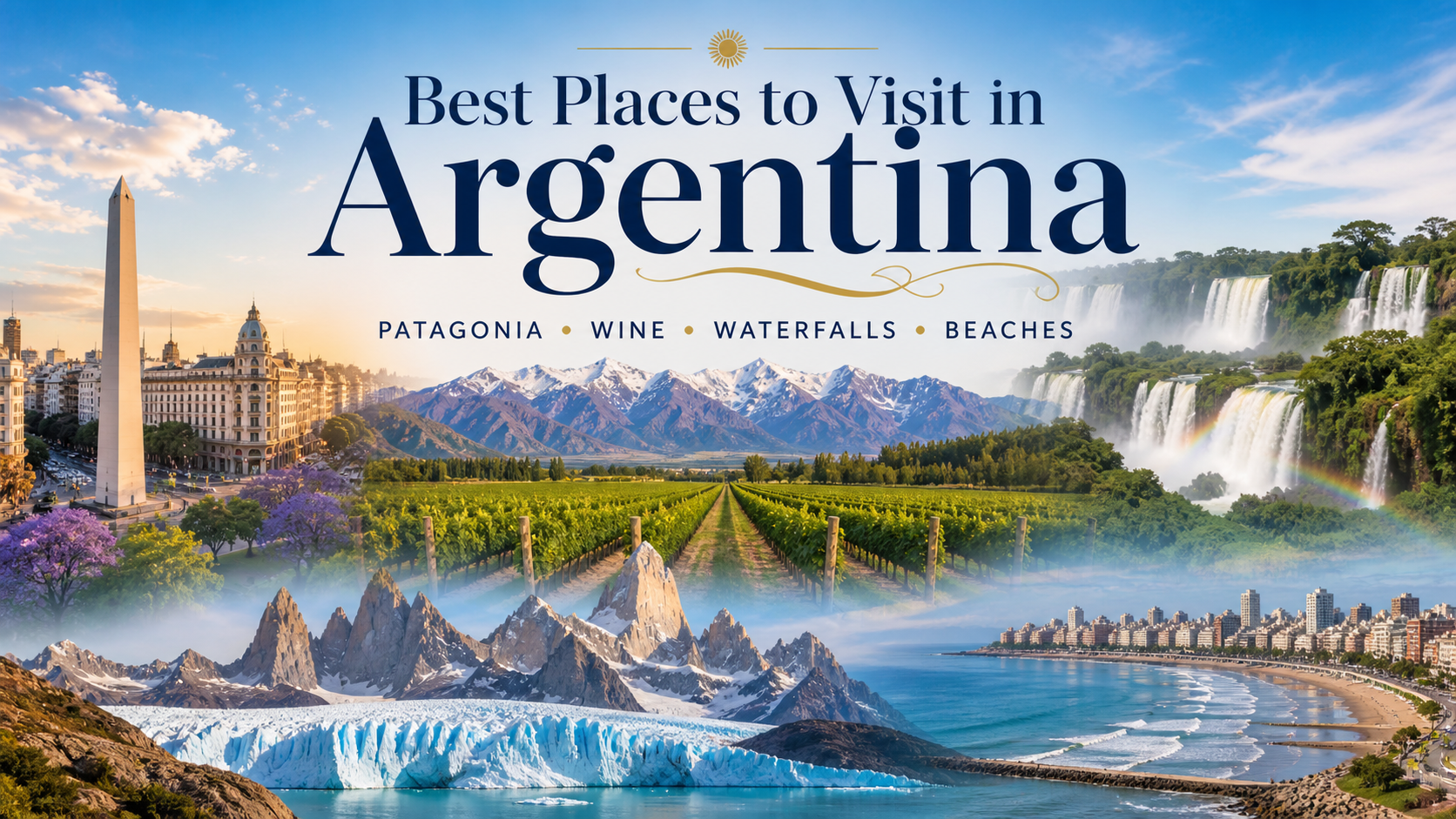
Argentina is one of those countries that refuses to be reduced to one simple travel idea. It is tango and steak dinners in Buenos Aires, yes — but it is also blue glaciers, wild Patagonia, high-altitude wine valleys, red-rock desert scenery, rainforest waterfalls, Atlantic beaches, alpine-style lake towns, penguins, whales, and the kind of wide-open landscapes that make you feel very small in the best possible way.
This is also a country where distances matter. Argentina is enormous, and the “best” trip depends heavily on what kind of traveler you are. Some people come for Buenos Aires and wine country. Some come almost entirely for Patagonia. Some want Iguazú Falls. Some want road trips, wildlife, beaches, or that strange mix of European-feeling towns and South American wilderness that Argentina does so well.
If you are planning your first Argentina trip, this list is a strong place to start. It includes the famous bucket-list stops, the wine regions, the Patagonia heavy hitters, the northwest landscapes, the wildlife areas, and a classic beach city so the country’s long Atlantic coastline does not get ignored.
1. Buenos Aires

Country / Argentina region: Argentina / central-eastern Argentina, near the Río de la Plata
What kind of place it is: Argentina’s capital and cultural gateway, full of grand architecture, tango, cafés, neighborhoods, steak dinners, bookstores, markets, and late-night energy.
Best for: First-time visitors, couples, solo travelers, food lovers, city travelers, culture lovers, architecture lovers, and anyone who wants the classic Argentina starting point.
Why travelers should care
Buenos Aires is the place where Argentina usually begins to make sense. It is elegant, moody, intense, romantic, chaotic, and beautiful all at once. The city has European-style boulevards, leafy plazas, colorful neighborhoods, old cafés, dramatic cemeteries, tango halls, bookstores, markets, and some of the most satisfying meals you can build a trip around.
It is also the easiest place to start an Argentina itinerary because so many trips naturally pass through it. Even if your real dream is Patagonia, Mendoza, Iguazú, or the northwest, Buenos Aires gives you the cultural foundation first. It is where you feel the music, food, history, politics, architecture, and daily rhythm of the country before heading into the landscapes.
Main highlights
Buenos Aires is a city of neighborhoods. Recoleta feels polished and grand, with elegant buildings, museums, and the famous cemetery. Palermo is larger, greener, trendier, and full of restaurants, cafés, parks, boutiques, and nightlife. San Telmo brings cobblestones, antiques, tango atmosphere, and older-city charm. La Boca is colorful and iconic, especially around Caminito, though it is also a place where travelers need to stay aware and not wander carelessly.
The city is also one of the best places in Argentina to eat. Steak is the obvious classic, but Buenos Aires is also about empanadas, pizza, ice cream, Italian influence, wine bars, neighborhood cafés, bakeries, and long dinners that start later than many visitors expect. This is not a rush-through-it city. It rewards travelers who slow down, walk, eat, sit, look up at the buildings, and let the city unfold.
Historical points of interest
Buenos Aires has layers of Spanish colonial history, immigration history, political history, and literary history. Plaza de Mayo is one of the city’s most important symbolic spaces, surrounded by buildings tied to government, protest, and national identity. Recoleta Cemetery is not just famous because Eva Perón is buried there; it is also a dense, dramatic record of Argentina’s elite families, political figures, and artistic funerary architecture.
The city’s neighborhoods also show Argentina’s immigrant story. Italian, Spanish, French, and other European influences shaped the city’s food, architecture, language rhythms, cafés, and cultural personality. That European influence is real, but Buenos Aires is not simply “Paris in South America.” It is its own thing: emotional, proud, complicated, stylish, and deeply Argentine.
Don’t miss
- Recoleta Cemetery — A dramatic, maze-like cemetery filled with ornate mausoleums and one of the city’s most famous historic stops.
- San Telmo Market — A lively place for food, antiques, people-watching, and old Buenos Aires atmosphere.
- Palermo — A huge neighborhood area with parks, restaurants, cafés, shopping, nightlife, and a very usable travel base.
- Teatro Colón — One of the grandest opera houses in the world and a beautiful stop even if you are not attending a performance.
- A tango show or milonga — Tango is part of the city’s identity, and seeing it in person gives Buenos Aires a different emotional layer.
Why I recommend it
Buenos Aires is not just a “fly in and leave” city. Even if your dream Argentina trip is mostly about Patagonia or wine country, it is worth giving Buenos Aires real time. It gives the whole trip context.
I also like that Buenos Aires works for different types of travelers. Couples can make it romantic. Solo travelers can build days around cafés, museums, markets, and walking neighborhoods. Food lovers can absolutely plan the trip around meals. It is one of the strongest city anchors in South America.
Side notes / good to know
- Buenos Aires is large, so choosing the right neighborhood matters.
- Dinner often happens later than many travelers are used to.
- La Boca is iconic, but stick to the main visitor areas and be smart about valuables.
- This is a great place to begin or end an Argentina trip because flight routes are usually easiest here.
- If you are planning a long Argentina itinerary, do not treat Buenos Aires as an afterthought.
2. Iguazú Falls

Country / Argentina region: Argentina / far northeast Argentina, near the borders with Brazil and Paraguay
What kind of place it is: A massive rainforest waterfall destination and one of the most dramatic natural sights in South America.
Best for: Nature lovers, photographers, bucket-list travelers, families, couples, waterfall lovers, and anyone who wants a big “wow” moment without needing a rugged hiking trip.
Why travelers should care
Iguazú Falls is one of those places that makes ordinary waterfall language feel useless. It is not one simple waterfall. It is a wide, roaring, mist-filled system of falls surrounded by subtropical rainforest, walkways, viewpoints, wildlife, and constant sound. You do not just look at Iguazú; you feel it in the air.
For many travelers, Iguazú is one of the easiest “big nature” additions to an Argentina trip. It does not require trekking in Patagonia or long mountain logistics. You can fly in, visit the falls, and experience one of South America’s great natural wonders in a relatively short stop. That makes it extremely useful for travelers who want drama without building the whole trip around wilderness.
Main highlights
The Argentina side of Iguazú gives travelers a close, immersive experience. Walkways take you through different angles of the falls, from panoramic views to close-up misty sections where the power of the water feels almost unreal. The most famous area is usually the Devil’s Throat, where water crashes down with so much force that the spray rises like smoke.
The surrounding rainforest is part of the experience too. You may see coatis, birds, butterflies, and dense greenery along the trails. The falls can be hot, wet, slippery, and crowded, but that is part of the energy. It is a place where practical preparation matters: good shoes, sun protection, water, and quick-dry clothing make the day much easier.
Historical points of interest
Iguazú sits in a region shaped by Indigenous Guaraní history, colonial borderlands, Jesuit missions, and modern national park protection. The name itself is commonly connected to Guaraní language roots, and the falls are part of a much older cultural landscape than the modern tourist infrastructure suggests.
The border location also matters. This is one of those places where geography explains tourism. Argentina, Brazil, and Paraguay all sit close together in this region, and many travelers pair the Argentina side with the Brazil side for different perspectives. The Argentina side is usually more immersive and walkway-heavy, while the Brazil side is famous for sweeping panoramic views.
Don’t miss
- Devil’s Throat — The most powerful and unforgettable section of the falls.
- Upper Circuit — Great for broad views and seeing the falls from above.
- Lower Circuit — A more immersive route with closer angles and more mist.
- Rainforest wildlife — Coatis and birds are part of the experience, but do not feed or touch wildlife.
- Brazil side add-on — If your itinerary allows, crossing over gives a very different view of the falls.
Why I recommend it
Iguazú gives Argentina a completely different kind of natural drama than Patagonia. Patagonia is cold, vast, rocky, and glacial. Iguazú is humid, green, roaring, and alive. That contrast makes Argentina feel much bigger and more varied.
It is also one of the best choices for travelers who want a bucket-list nature stop but are not necessarily hikers. You still need to walk, and it can be hot, but it is much more accessible than some of Argentina’s remote mountain landscapes.
Side notes / good to know
- Expect heat, humidity, mist, and wet walkways.
- Waterproof protection for your phone or camera is smart.
- Do not feed the coatis, even if they look cute.
- Many travelers visit both the Argentina and Brazil sides if time allows.
- Iguazú is far from Buenos Aires, so flying usually makes more sense than overland travel for most itineraries.
3. Mendoza

Country / Argentina region: Argentina / western Argentina, near the Andes
What kind of place it is: Argentina’s most famous wine region, known for Malbec, vineyard stays, mountain views, food, and relaxed luxury.
Best for: Wine lovers, couples, food travelers, slow travelers, luxury travelers, road-trippers, and anyone who wants Andes scenery without a hard-core adventure trip.
Why travelers should care
Mendoza is one of the biggest reasons to go to Argentina. If Patagonia is the country’s wild landscape fantasy, Mendoza is its wine-and-Andes dream. This is where you come for vineyard lunches, Malbec, mountain backdrops, olive oil, long meals, beautiful hotel stays, and that slower travel rhythm where the day revolves around scenery and food.
It is also one of Argentina’s most appealing “trip softeners.” If your itinerary includes busy Buenos Aires or rugged Patagonia, Mendoza gives you a different pace. You can still be active with bike rides, day trips, and mountain excursions, but the main feeling is more relaxed: wine, views, sunshine, and lingering lunches.
Main highlights
The heart of Mendoza travel is the wine country surrounding the city, especially areas like Luján de Cuyo, Maipú, and the Uco Valley. The Uco Valley is particularly stunning because the Andes feel close and dramatic, creating that postcard combination of vineyards and mountains. Even travelers who are not wine experts can appreciate the setting.
Mendoza is also a good base for Andes excursions. Depending on the season and your itinerary, you can explore mountain roads, viewpoints, and high-altitude scenery. This is not the same as Patagonia, but it gives travelers a powerful sense of Argentina’s western edge and the enormous presence of the Andes.
Historical points of interest
Mendoza’s identity has long been tied to irrigation, agriculture, and its position near the Andes. The region’s wine culture developed through a mix of European immigrant influence, local adaptation, and the very specific conditions of dry climate, altitude, sun, and mountain-fed water systems.
The area also has historic importance connected to routes across the Andes. General José de San Martín, one of South America’s major independence figures, organized part of his campaign from this region before crossing the Andes into Chile. That gives Mendoza more depth than just wine tourism; it sits in a landscape that shaped both agriculture and history.
Don’t miss
- Uco Valley — One of the most scenic wine areas, with vineyards backed by the Andes.
- Luján de Cuyo — A classic Mendoza wine area strongly associated with Malbec.
- A long vineyard lunch — One of the best ways to experience Mendoza properly.
- Parque General San Martín — A major city park and a good place to understand Mendoza’s urban side.
- Andes day trip — Mountain scenery adds a completely different layer to a wine-country stay.
Why I recommend it
Mendoza should not be treated like a minor add-on. Wine is one of Argentina’s strongest travel identities, and Mendoza is the country’s obvious wine anchor. For many travelers, it may be the most enjoyable part of the trip.
It also pairs beautifully with other regions. Buenos Aires plus Mendoza makes a strong city-and-wine trip. Mendoza plus Patagonia creates a dramatic landscape itinerary. Mendoza plus Salta/Cafayate creates a wine-and-northwest route with a lot more variety than people expect.
Side notes / good to know
- Wine tastings and vineyard lunches are often best planned ahead.
- The Uco Valley is farther from Mendoza city than some travelers expect.
- Hiring a driver or joining a wine tour is usually smarter than trying to self-drive between tastings.
- Mendoza can feel very different depending on the season.
- This is a good place to slow down instead of rushing through one night.
4. Cafayate

Country / Argentina region: Argentina / northwest Argentina, in Salta Province
What kind of place it is: A high-altitude wine town surrounded by desert scenery, colorful rock formations, and dramatic northwest landscapes.
Best for: Wine lovers, road-trippers, photographers, couples, slow travelers, and travelers who want a more unusual alternative or addition to Mendoza.
Why travelers should care
Cafayate is where Argentina’s wine story starts to feel wilder and more unexpected. Mendoza is the famous wine region, but Cafayate has a completely different mood: high-altitude vineyards, dry air, red rock, desert colors, small-town charm, and a road-trip setting that feels cinematic.
This is the kind of place that makes Argentina feel less predictable. Many travelers arrive thinking Argentina means Buenos Aires, Patagonia, wine, and Iguazú. Cafayate adds another layer: northwest desert wine country with landscapes that look nothing like the green vineyards people may picture when they imagine a wine trip.
Main highlights
The wine here is strongly associated with Torrontés, Argentina’s aromatic white grape, along with reds grown in high-altitude conditions. The town itself is walkable and relaxed, making it a nice place to slow down between road-trip days. You can visit wineries, eat well, and enjoy a much quieter wine-country experience than the larger Mendoza region.
The drive to Cafayate is a major part of the appeal. Quebrada de las Conchas, with its sculpted red rock formations, is one of the most beautiful road-trip landscapes in northwest Argentina. The scenery feels dry, ancient, and dramatic, with natural amphitheaters, canyons, and rock shapes that make the journey feel like part of the destination.
Historical points of interest
Cafayate sits within a region shaped by Indigenous history, Spanish colonial routes, and long-standing agricultural traditions adapted to high-altitude desert conditions. The surrounding Calchaquí Valleys have deep cultural roots and a very different identity from Buenos Aires or Patagonia.
The wine history here is tied to altitude, climate, and isolation. The vineyards are not just scenic; they are part of a specific regional adaptation to dry conditions, strong sun, and mountain air. That gives Cafayate a distinct place in Argentina’s wine map.
Don’t miss
- Quebrada de las Conchas — A stunning red-rock route between Salta and Cafayate.
- High-altitude wineries — A completely different wine experience from Mendoza.
- Torrontés tasting — Cafayate is one of the best places to try this Argentine white wine.
- The town plaza — A relaxed place to walk, eat, and enjoy the slower rhythm.
- Rock formations like the Amphitheater and Devil’s Throat — Natural formations that make the drive unforgettable.
Why I recommend it
Cafayate is worth including because Argentina’s wine story should not be only Mendoza. If wine is one of the main reasons you want to visit Argentina, Cafayate gives you a second wine destination with a totally different personality.
It also makes the northwest feel even more compelling. Salta and Jujuy are beautiful, but Cafayate adds wine, desert scenery, and road-trip energy in a way that feels very useful for itinerary planning.
Side notes / good to know
- Cafayate works especially well as part of a northwest road trip.
- The desert sun can be strong, so sun protection matters.
- Distances in the northwest can feel longer than they look on a map because you will want to stop constantly for scenery.
- This is not a high-speed itinerary destination; it is better when you have time to linger.
- If you love wine but want something less obvious than Mendoza, Cafayate is a strong choice.
5. Bariloche and the Lake District

Country / Argentina region: Argentina / northern Patagonia, in Río Negro Province
What kind of place it is: A mountain-and-lake destination with alpine scenery, chocolate shops, ski-resort energy, forests, road trips, and strong Central European influences.
Best for: Nature lovers, road-trippers, couples, families, hikers, lake travelers, chocolate lovers, winter travelers, and anyone curious about Argentina’s alpine-feeling side.
Why travelers should care
Bariloche is one of Argentina’s most fascinating surprises. It does not look or feel like the Argentina many travelers imagine. Instead, it has deep blue lakes, forested mountains, alpine-style buildings, ski-town energy, chocolate shops, beer culture, and an atmosphere that feels partly Patagonian and partly Central European.
This is also one of the best places to understand that Patagonia is not only glaciers and extreme wilderness. Northern Patagonia can be softer, greener, more lake-filled, and easier to enjoy without committing to a major trekking trip. Bariloche gives travelers Patagonia beauty with more comfort, food, scenery, and classic vacation-town structure.
Main highlights
Nahuel Huapi Lake is the centerpiece, and the surrounding scenery is the reason travelers come. Viewpoints, boat trips, scenic drives, hikes, and lakeside stops all make Bariloche feel like a place where the landscape keeps opening in different directions. The Circuito Chico route is one of the most popular ways to get a taste of the area’s lakes, forests, and viewpoints.
The town itself adds another layer. Bariloche is famous for chocolate, mountain lodges, ski-season travel, and an alpine look that reflects Swiss, German, Austrian, and broader Central European influences. That architectural and cultural blend makes it one of the more unusual stops in Argentina.
Historical points of interest
Bariloche’s European-influenced look is not just decorative travel-poster charm. The region has a layered history involving immigration, settlement, tourism development, and a complicated postwar reputation. Some Nazi fugitives did live in Argentina after World War II, and Bariloche in particular has been associated with that darker history.
That said, Bariloche should not be reduced only to that one chapter. The area is also part of a broader Patagonian landscape shaped by Indigenous history, national park development, mountain tourism, borderland movement, and Argentina’s long fascination with the lake district as a vacation and adventure region.
Don’t miss
- Nahuel Huapi Lake — The huge lake that gives Bariloche much of its beauty and atmosphere.
- Circuito Chico — A classic scenic loop with lakes, forests, viewpoints, and easy stops.
- Cerro Campanario — One of the best viewpoints for that sweeping lake-and-mountain panorama.
- Chocolate shops — A very Bariloche experience and part of the town’s travel identity.
- Llao Llao area — One of the most scenic and iconic parts of the region.
Why I recommend it
Bariloche is a must for travelers who want Patagonia but do not only want the harsh, glacier-heavy version of Patagonia. It is scenic, comfortable, flexible, and easy to love.
It also adds one of Argentina’s strangest and most interesting cultural layers. The alpine look, chocolate culture, ski-town feeling, and complicated European/postwar associations make it a destination with both beauty and depth.
Side notes / good to know
- Bariloche can be popular in both summer and winter, but the experience changes a lot by season.
- The area is excellent for scenic drives, so having transport or tours helps.
- This is a good Patagonia choice for travelers who want beauty without intense trekking.
- The Nazi-history angle is real, but it is only one part of a much broader regional story.
- If you want mountain scenery with good food and comfortable bases, Bariloche is one of Argentina’s best choices.
6. San Martín de los Andes and the Seven Lakes Route

Country / Argentina region: Argentina / northern Patagonia, in Neuquén Province
What kind of place it is: A quieter lake-and-mountain destination known for scenic drives, forests, cabins, mountain-town charm, and the famous Seven Lakes Route.
Best for: Road-trippers, couples, families, nature lovers, slower travelers, photographers, and anyone who wants a softer Patagonia experience.
Why travelers should care
San Martín de los Andes gives northern Patagonia a quieter, more intimate feel than Bariloche. It still has lakes, forests, mountain views, and alpine-style charm, but it often feels calmer and more relaxed. If Bariloche is the famous lake district hub, San Martín de los Andes is the place that makes you want to rent a cabin and stay longer.
The Seven Lakes Route is the big reason many travelers include it. This road trip connects some of Argentina’s prettiest lake scenery, with forests, viewpoints, blue water, mountain backdrops, and that peaceful Patagonia feeling that does not require glaciers or extreme weather to be memorable.
Main highlights
Lácar Lake gives San Martín de los Andes its immediate scenic appeal. The town sits beautifully against the water and mountains, making it a very pleasant base for walking, eating, and easing into the landscape. Nearby Lanín National Park adds more outdoor possibilities, including forests, lakes, volcano views, and hiking routes.
The Seven Lakes Route between San Martín de los Andes and Villa La Angostura is one of the most famous scenic drives in Argentina. It is the kind of route where the journey is the point. You stop for viewpoints, water, trees, and quiet moments rather than rushing from one attraction to the next.
Historical points of interest
This region is part of northern Patagonia’s long cultural and environmental story, including Indigenous Mapuche presence, mountain settlement, national park creation, and the development of lake tourism. The natural beauty can make it feel like a simple vacation region, but the land has much deeper roots.
San Martín de los Andes itself grew into a mountain resort-style town, shaped by its setting near lakes, forests, and protected landscapes. Its architecture and travel atmosphere fit into the broader alpine-feeling side of Argentina’s Patagonia.
Don’t miss
- Seven Lakes Route — One of Argentina’s most scenic road trips.
- Lácar Lake — The lake that gives San Martín de los Andes its postcard setting.
- Lanín National Park — Forests, lakes, hiking, and volcano scenery.
- Villa La Angostura — A beautiful nearby lake town often paired with the route.
- Viewpoint stops along the drive — The road is best enjoyed slowly, not as a rushed transfer.
Why I recommend it
I like San Martín de los Andes because it gives Argentina’s Patagonia coverage more balance. Not every traveler wants only glaciers, trekking, and extreme weather. Some want lakes, cabins, scenic roads, and peaceful mountain-town days.
It also pairs naturally with Bariloche. If you are already in the Lake District, adding the Seven Lakes Route makes the northern Patagonia part of your trip feel much richer.
Side notes / good to know
- This is one of the best areas in Argentina for a scenic road trip.
- Weather can shift, so layers are still important even in warmer months.
- Do not rush the Seven Lakes Route if you can avoid it.
- It works well for travelers who want Patagonia scenery with less intensity.
- San Martín de los Andes is quieter than Bariloche, which may be exactly the point.
7. El Calafate and Perito Moreno Glacier

Country / Argentina region: Argentina / southern Patagonia, in Santa Cruz Province
What kind of place it is: A glacier-focused Patagonia destination and the main gateway to Perito Moreno Glacier.
Best for: Bucket-list travelers, photographers, couples, families, older travelers who want Patagonia without major hiking, and anyone who wants a dramatic glacier experience.
Why travelers should care
El Calafate is one of the most important Patagonia bases in Argentina because it gives travelers access to Perito Moreno Glacier. This glacier is not just beautiful; it is enormous, blue, loud, alive-feeling, and surprisingly accessible compared with many great wilderness sights.
For travelers who dream of Patagonia but are not necessarily hikers, this is one of the best choices. You can experience huge glacier scenery from walkways and viewpoints without needing a serious trekking background. That makes El Calafate one of the most practical big-wow destinations in Argentine Patagonia.
Main highlights
Perito Moreno Glacier is the main event. The viewing platforms allow you to see the glacier from multiple angles, and the scale is difficult to understand until you are standing in front of it. The ice glows in shades of blue and white, and if you are lucky, you may hear cracks, groans, or see chunks calve into the water.
El Calafate itself is a tourist base, not the wildest or most atmospheric town in Patagonia, but it works. It has hotels, restaurants, tour operators, shops, and the infrastructure travelers need. From here, you can also take boat trips, visit other glacier areas, or connect onward to El Chaltén.
Historical points of interest
Perito Moreno Glacier sits within Los Glaciares National Park, one of Argentina’s most important protected landscapes. The region’s history is tied to exploration, glaciology, national park development, ranching, and Argentina’s broader relationship with Patagonia as a remote but symbolically powerful part of the country.
The name Perito Moreno honors Francisco Moreno, an explorer and expert connected to Argentina’s territorial and scientific history. The glacier itself, of course, is far older than any human naming of it, and standing there is a reminder that Patagonia’s deepest history is geological.
Don’t miss
- Perito Moreno Glacier walkways — The easiest and most essential way to experience the glacier.
- Boat views of the glacier — A different perspective from the water.
- Glacier mini-trekking, if appropriate for you — A more active way to experience the ice.
- Lago Argentino — The huge lake system that shapes the region.
- Day trip to El Chaltén, if short on time — Not ideal as a rushed visit, but possible if your itinerary is tight.
Why I recommend it
El Calafate is one of Argentina’s strongest “this is why I came” destinations. Even if travelers only see one place in Patagonia, Perito Moreno Glacier is often the one that makes the deepest impression.
It is also practical. Patagonia can be logistically challenging, but El Calafate is one of the easier ways to access a truly spectacular landscape without building the whole trip around hardcore adventure.
Side notes / good to know
- The glacier area can be cold and windy even when other parts of Argentina are warm.
- Bring layers, sun protection, and shoes that work on walkways.
- El Calafate is a base town; the glacier is the main reason to go.
- This pairs very well with El Chaltén if you have enough time.
- Do not underestimate travel distances in Patagonia.
8. El Chaltén

Country / Argentina region: Argentina / southern Patagonia, in Santa Cruz Province
What kind of place it is: Argentina’s hiking capital, known for Mount Fitz Roy, raw mountain scenery, trails, wind, and rugged Patagonia energy.
Best for: Hikers, adventure travelers, photographers, backpackers, outdoorsy couples, and anyone who wants the mountain version of Patagonia.
Why travelers should care
El Chaltén is the Patagonia stop for travelers who want to earn the view. It is smaller, more rugged, and more trail-focused than El Calafate. The big draw is Mount Fitz Roy, one of the most iconic mountain silhouettes in South America, along with the hiking routes, lakes, glaciers, and wild weather that make this part of Patagonia feel so alive.
This is the place where Patagonia stops being just something you look at and becomes something you move through. You wake up early, check the weather, pack layers, walk into the mountains, and hope the clouds cooperate. When they do, the reward is unforgettable.
Main highlights
The classic highlight is the hike toward Laguna de los Tres, with views of Fitz Roy if the weather allows. It is a serious day hike for many travelers, not a casual stroll, but it is one of the most famous hikes in Argentina. Other routes, like Laguna Torre, offer more mountain and glacier scenery with a different feel.
The town of El Chaltén is small and outdoorsy, built around hikers, gear, weather reports, bakeries, simple restaurants, and trail access. It does not need to be polished because that is not the point. The point is the landscape.
Historical points of interest
El Chaltén is a relatively young town by Argentine standards, created in the 1980s in a region shaped by border concerns, national park development, and the growing importance of Patagonia tourism. The area sits within Los Glaciares National Park, connecting it naturally with the broader El Calafate and Perito Moreno region.
The name Chaltén comes from Indigenous Tehuelche language associations with the mountain, often linked to the idea of a smoking mountain because clouds gather around the peak. That makes the famous Fitz Roy view even more interesting: what travelers now chase for photography had long been understood through local landscape knowledge.
Don’t miss
- Laguna de los Tres — The classic Fitz Roy hike and one of Argentina’s most famous mountain views.
- Laguna Torre — Another major hike with glacier and mountain scenery.
- Mirador de los Cóndores — A shorter viewpoint option near town.
- Fitz Roy sunrise views — If the weather cooperates, this can be magical.
- Trail-town cafés and bakeries — Simple but very welcome after long hikes.
Why I recommend it
El Chaltén is essential because Patagonia is one of the biggest reasons people go to Argentina, and this is one of the best places to feel Patagonia on foot. It is not just pretty; it is immersive.
I would not recommend it to every traveler equally, though. If you do not want hiking, wind, changing weather, or outdoorsy logistics, El Calafate may be the better southern Patagonia choice. But for hikers, El Chaltén is a dream.
Side notes / good to know
- Weather can change quickly and completely alter your plans.
- Build in extra time if Fitz Roy views matter to you.
- Trails vary in difficulty, so be honest about your fitness and gear.
- This is not the place to pack only cute travel clothes.
- El Chaltén pairs naturally with El Calafate, but it deserves more than a rushed day if you can manage it.
9. Ushuaia and Tierra del Fuego

Country / Argentina region: Argentina / Tierra del Fuego, far southern Argentina
What kind of place it is: A remote “End of the World” destination with mountains, cold-water channels, southern forests, wildlife, and Antarctica-gateway energy.
Best for: Adventure travelers, photographers, cruise travelers, nature lovers, bucket-list travelers, cold-weather scenery lovers, and anyone drawn to remote edges of the map.
Why travelers should care
Ushuaia has one of the most powerful location identities in Argentina. It is famous as a southernmost-city, end-of-the-world destination, and that alone gives it a pull. But the appeal is not just the phrase. The setting is genuinely dramatic: mountains, cold water, wind, forests, boats, and that strange feeling of being very far south.
For travelers who are drawn to remote places, Ushuaia is deeply satisfying. It is also the gateway for many Antarctica cruises, which gives the city a special expedition atmosphere. Even if you are not going to Antarctica, you can feel that edge-of-the-world energy in the harbor, the weather, and the landscape.
Main highlights
The Beagle Channel is one of the main experiences here, with boat trips that may include sea lions, birds, lighthouses, and views back toward the mountains. Tierra del Fuego National Park gives travelers access to forests, water, trails, and that far-southern scenery that feels very different from the rest of Argentina.
Ushuaia itself is practical and tourist-oriented, with hotels, restaurants, shops, museums, and tour operators. It is not always conventionally beautiful as a town, but its setting does the heavy lifting. The surrounding landscape is what makes it unforgettable.
Historical points of interest
Tierra del Fuego has deep Indigenous history, especially connected to peoples such as the Yaghan/Yámana and Selk’nam, whose lives were profoundly affected by colonization, missionary activity, disease, displacement, and violence. The region’s modern travel identity as “the end of the world” should not erase that human history.
Ushuaia also has a penal colony history, and the former prison is one of the city’s most important historic sites. Like many remote places, its location shaped how it was used by the state, how it developed, and how it later became part of Argentina’s tourism imagination.
Don’t miss
- Beagle Channel boat trip — One of the classic Ushuaia experiences.
- Tierra del Fuego National Park — Forests, water, trails, and far-southern landscapes.
- Maritime Museum / former prison — A key historic stop in town.
- End of the World Train — A touristy but atmospheric way to connect with the area’s penal history.
- Harbor views — Especially if Antarctica expedition ships are in port.
Why I recommend it
Ushuaia is not always the easiest or most efficient Argentina stop, but it has a sense of place that is hard to duplicate. It feels like an edge, and that matters.
It also adds another side of Patagonia. El Calafate gives glaciers. El Chaltén gives hiking. Bariloche gives lakes. Ushuaia gives the far-southern, cold-water, end-of-the-world feeling.
Side notes / good to know
- Ushuaia can be cold, windy, and changeable even when other parts of Argentina feel mild.
- It is far away, so flights and timing matter.
- This is a natural add-on for Antarctica cruises.
- Do not expect tropical “southern” weather just because it is in South America.
- Pack layers, rain protection, and realistic shoes.
10. Puerto Madryn and Península Valdés

Country / Argentina region: Argentina / Atlantic Patagonia, in Chubut Province
What kind of place it is: A coastal wildlife destination known for whales, penguins, sea lions, elephant seals, and rugged Atlantic scenery.
Best for: Wildlife lovers, families, photographers, nature travelers, marine-life enthusiasts, and anyone who wants a different side of Patagonia.
Why travelers should care
Puerto Madryn and Península Valdés show that Patagonia is not only mountains and glaciers. This is coastal Patagonia, where the big draw is wildlife. Depending on the season, travelers may come for southern right whales, penguins, sea lions, elephant seals, orcas, birds, and wide-open Atlantic landscapes.
This is a great reminder that Argentina’s coastline matters. The country has a huge Atlantic edge, and while not every coastal destination is a warm beach vacation, the marine wildlife here is one of Argentina’s most memorable natural experiences.
Main highlights
Península Valdés is the main wildlife area, with a raw, windswept, remote feeling. Whale-watching is one of the biggest draws in season, especially around Puerto Pirámides. Seeing whales in this part of Argentina can be incredibly moving because the animals come close enough to make the experience feel personal and powerful.
Penguins are another major reason to visit the broader region, especially if your trip lines up with the right season. Punta Tombo, though farther from Puerto Madryn, is one of the famous penguin sites travelers often consider as part of a wildlife itinerary.
Historical points of interest
This area has Indigenous history, Welsh settlement history in Chubut Province, and a modern conservation identity tied to marine wildlife. The Welsh influence in parts of Chubut is one of Argentina’s more unexpected cultural layers, especially in towns like Trelew and Gaiman.
The wildlife history is also important. Península Valdés has become globally known for conservation and marine-life viewing, especially southern right whales. The region shows how Argentina’s natural heritage extends far beyond its most famous mountain landscapes.
Don’t miss
- Whale watching from Puerto Pirámides — A major seasonal highlight.
- Península Valdés wildlife drives — Good for sea lions, elephant seals, birds, and coastal scenery.
- Punta Tombo penguins — A famous penguin experience if your route and season make sense.
- Puerto Madryn waterfront — A practical coastal base with sea views.
- Gaiman tea houses — A Welsh-Argentine cultural side trip if you want something different.
Why I recommend it
Puerto Madryn and Península Valdés are important because they broaden the idea of Patagonia. Not every traveler thinks of whales and penguins when they think of Argentina, but they should.
This area is especially good for families and wildlife-focused travelers. Some travelers may not want to hike Fitz Roy or deal with glacier weather, but marine wildlife could be the thing that makes Argentina irresistible.
Side notes / good to know
- Wildlife viewing is seasonal, so timing matters a lot.
- Distances between wildlife sites can be long.
- Wind is part of the coastal Patagonia experience.
- This is not a tropical beach destination; it is a wildlife coast.
- If whales are your main reason to go, plan around the correct season instead of assuming they will be there year-round.
11. Salta

Country / Argentina region: Argentina / northwest Argentina
What kind of place it is: A colonial northwest city and road-trip base with historic architecture, regional food, mountain scenery, and access to some of Argentina’s most striking landscapes.
Best for: Culture lovers, road-trippers, food travelers, photographers, history lovers, and travelers who want a very different Argentina from Buenos Aires and Patagonia.
Why travelers should care
Salta gives Argentina a completely different flavor. The city has colonial architecture, plazas, churches, museums, regional food, and a slower northwest rhythm. It feels far removed from Buenos Aires, Mendoza, and Patagonia, which is exactly why it belongs in a best places list.
This is also one of the best bases for exploring the northwest. From Salta, travelers can head toward Cafayate, Cachi, Jujuy, Purmamarca, and Quebrada de Humahuaca. The city works as both a destination and a launch point for some of Argentina’s most dramatic road-trip scenery.
Main highlights
Salta’s center is charming, with colonial buildings, churches, balconies, museums, and a main plaza that gives travelers an easy place to orient themselves. The city is known for regional food, including empanadas salteñas, which are a serious reason to be happy at lunchtime.
The surrounding region is what elevates Salta from nice city to essential trip base. Roads lead into valleys, mountains, red-rock formations, cactus landscapes, high-altitude towns, and colorful desert scenery. This is one of the best areas in Argentina for travelers who like road trips with constant visual payoff.
Historical points of interest
Salta has deep colonial history and a strong regional identity. Its churches, plazas, and preserved architecture reflect its role in northern Argentina’s historic development. It also sits in a broader Andean cultural zone, where Indigenous history and Spanish colonial influence are both part of the landscape.
The city is also connected to Argentina’s independence-era history, including figures and military campaigns tied to the northwest. Museums and historic buildings help give context, but even walking through the city center gives travelers a sense that this is an older, more traditional-feeling Argentina than many visitors expect.
Don’t miss
- Plaza 9 de Julio — The heart of the historic center.
- Cathedral and colonial buildings — Key parts of Salta’s architectural charm.
- MAAM museum — One of the city’s most important cultural stops.
- Cerro San Bernardo — A viewpoint over the city and surrounding area.
- Empanadas salteñas — Regional food is part of the reason to come.
Why I recommend it
Salta is one of the best places to include because it breaks the “Argentina equals Buenos Aires, wine, Patagonia” pattern. Those are wonderful, but they are not the whole country.
It also gives travelers an excellent base for a more adventurous but still culturally rich itinerary. If someone wants road trips, food, history, and desert-mountain scenery, Salta belongs high on the list.
Side notes / good to know
- Salta works best if you also explore beyond the city.
- The northwest can involve altitude changes, long drives, and intense sun.
- Regional food is a highlight, so do not treat meals as an afterthought.
- Renting a car can make the area easier, but tours are useful if you do not want mountain-road logistics.
- This is one of Argentina’s best regions for travelers who want culture and landscape together.
12. Quebrada de Humahuaca and Jujuy

Country / Argentina region: Argentina / northwest Argentina, in Jujuy Province
What kind of place it is: A colorful Andean desert landscape of mountains, villages, markets, high-altitude scenery, and deep cultural history.
Best for: Photographers, road-trippers, culture lovers, landscape travelers, hikers, and anyone who wants Argentina’s most colorful northwest scenery.
Why travelers should care
Quebrada de Humahuaca and Jujuy feel like another world compared with Buenos Aires or Patagonia. This is Argentina’s high, colorful northwest, where desert mountains, Indigenous culture, adobe villages, markets, and dramatic rock layers create a completely different travel experience.
If you have ever seen photos of rainbow-colored hills in Argentina, there is a good chance they came from this region. But the area is not just a photo stop. It has history, culture, altitude, small towns, and a strong sense of place that makes it one of the most memorable parts of the country.
Main highlights
Purmamarca and the Hill of Seven Colors are among the most famous stops, and for good reason. The landscape is instantly recognizable, with layered colors rising behind a small village setting. Humahuaca itself gives the region a historic anchor, while Tilcara, Maimará, and other towns add more opportunities to explore.
The scenery changes constantly as you move through the quebrada. Roads pass through dry valleys, mountains, cactus landscapes, villages, and viewpoints. This is a place where the drive itself is a major part of the experience, but travelers should also slow down enough to respect the altitude and the communities they are visiting.
Historical points of interest
Quebrada de Humahuaca has been a major cultural and trade corridor for thousands of years. Its importance did not begin with tourism. Indigenous history, pre-Columbian routes, colonial movement, and regional exchange all shaped the area long before travelers started coming for the colorful hills.
The region’s villages, archaeological sites, churches, markets, and roadways all reflect that layered past. This is one of Argentina’s best places to understand that the country’s identity is not only European-influenced cities and Patagonia wilderness; it also has deep Andean roots.
Don’t miss
- Purmamarca — A beautiful village backed by the famous Hill of Seven Colors.
- Hill of Seven Colors — One of Argentina’s most recognizable landscapes.
- Tilcara — A good base with culture, food, and access to nearby sites.
- Humahuaca — A historic town and important regional stop.
- Serranía de Hornocal — A spectacular striped mountain viewpoint if your itinerary allows.
Why I recommend it
This is one of the strongest visual destinations in Argentina. It gives the post color, culture, altitude, and a completely different kind of landscape drama.
It also pairs very well with Salta and Cafayate. Together, they create a northwest itinerary that can compete with the better-known Argentina routes, especially for travelers who love road trips and cultural depth.
Side notes / good to know
- Altitude can affect travelers, so take it seriously.
- Sun protection is essential.
- Distances can feel longer because you will want to stop often.
- This region is best approached with respect for local culture, not just as a photo backdrop.
- If you are prone to motion sickness or altitude issues, plan routes and pacing carefully.
13. Esteros del Iberá

Country / Argentina region: Argentina / northeast Argentina, mainly in Corrientes Province
What kind of place it is: A vast wetlands region known for wildlife, quiet nature travel, capybaras, caimans, marshes, birds, and conservation-focused tourism.
Best for: Wildlife lovers, birders, nature travelers, photographers, slow travelers, families with older kids, and anyone who wants a quieter alternative to Argentina’s more famous landscapes.
Why travelers should care
Esteros del Iberá is one of the best places in Argentina for travelers who want wildlife without the crowds and intensity of the most famous stops. Instead of glaciers, waterfalls, or mountains, this is a watery world of wetlands, reeds, lagoons, birds, capybaras, caimans, deer, and quiet boat rides.
It is also a useful reminder that Argentina’s nature is not only Patagonia and Iguazú. Iberá gives the country a completely different ecological identity. It feels slower, softer, and more hidden, which can make it deeply appealing for travelers who like places that still feel a little under the radar internationally.
Main highlights
Wildlife viewing is the main reason to go. Capybaras are often one of the most charming sightings, but the wetlands are also home to caimans, marsh deer, birds, and other animals depending on where you go and when you visit. Boat trips, guided walks, and quiet lodge stays are the usual rhythm.
Colonia Carlos Pellegrini is one of the better-known access points, but Iberá is large and tourism infrastructure varies by gateway. This is not a place to treat casually at the last second. It rewards planning, patience, and a willingness to slow down.
Historical points of interest
Esteros del Iberá has a conservation story that is increasingly important in Argentina. The region has been shaped by ranching, wetland protection, rewilding efforts, and the growing recognition that these landscapes are ecologically valuable.
The area also sits within the cultural world of Corrientes, with traditions, music, rural life, and regional identity that differ from Argentina’s big cities and Patagonia tourism hubs. Visiting Iberá can feel like entering a quieter, less packaged side of the country.
Don’t miss
- Boat safari through the wetlands — One of the best ways to see wildlife.
- Capybara sightings — A highlight for many travelers.
- Birdwatching — Iberá is excellent for birds, even if you are not a serious birder.
- Caiman viewing — Common in many wetland areas.
- A lodge-style stay — Staying near the wetlands makes the experience much richer.
Why I recommend it
Iberá gives the Argentina post something important: variety. Without it, the list could lean heavily toward city, wine, mountains, and dramatic landmarks. Iberá adds quiet, wildlife-rich, wetland nature.
It is especially good for travelers who have already seen some of Argentina’s obvious icons or who prefer slower, nature-focused travel. It may not be the first place everyone chooses, but it belongs in a well-rounded Argentina guide.
Side notes / good to know
- This is a nature destination, so guides and lodging choices matter.
- Wildlife sightings are never guaranteed, but the area is rich with animals.
- Mosquito protection can be important.
- Travel logistics require more planning than Buenos Aires or Mendoza.
- Iberá is a good choice if you want wildlife without turning the trip into a Patagonia-only itinerary.
14. Córdoba

Country / Argentina region: Argentina / central Argentina
What kind of place it is: A historic university city with colonial architecture, Jesuit heritage, lively culture, and nearby sierras.
Best for: History lovers, students, culture travelers, road-trippers, domestic-travel curious visitors, and travelers who want a central Argentina stop beyond Buenos Aires.
Why travelers should care
Córdoba is one of Argentina’s most important cities, but it often gets overlooked by international travelers rushing between Buenos Aires, Mendoza, Iguazú, and Patagonia. That is a shame because Córdoba has history, architecture, student energy, churches, museums, nightlife, and access to the surrounding sierras.
It is not the flashiest Argentina destination, but it adds depth. Córdoba gives travelers a look at central Argentina and a different kind of city experience from Buenos Aires. It feels younger, more local, and less internationally obvious.
Main highlights
The historic center includes colonial-era buildings, churches, plazas, and Jesuit sites. The city’s university presence gives it a lively feel, with cafés, nightlife, and cultural activity. Córdoba is also a good base for exploring nearby mountain towns and countryside in the Sierras de Córdoba.
The surrounding region is important because it gives Córdoba more itinerary value. Travelers can combine city history with nature, small towns, scenic drives, and a slower inland Argentina experience. It works especially well for people who like less obvious destinations.
Historical points of interest
Córdoba has some of Argentina’s most important colonial and Jesuit heritage. The Jesuit Block and related sites connect the city to education, religion, architecture, and colonial-era development. This is one of the best places in Argentina to understand the Spanish colonial and religious layers of the country’s history.
The city’s university history also matters. Córdoba has long been associated with education, students, intellectual life, and political energy. That gives it a different atmosphere from destinations that are mainly built around tourism.
Don’t miss
- Jesuit Block — One of Córdoba’s most important historic areas.
- Córdoba Cathedral — A major landmark in the city center.
- Plaza San Martín — A natural starting point for exploring the historic core.
- Nueva Córdoba — A lively area connected to student and nightlife energy.
- Sierras de Córdoba — A scenic add-on outside the city.
Why I recommend it
Córdoba is worth considering because Argentina is not only its most obvious international icons. This is a major city with real history and a strong regional identity.
It also gives travelers a more local-feeling option. Not everyone wants the same route, and Córdoba is a good choice for people who enjoy cities with history, culture, and nearby countryside rather than only headline attractions.
Side notes / good to know
- Córdoba works best for travelers who like history and local city life.
- It may not have the instant wow factor of Iguazú or Patagonia, but it has depth.
- The sierras add a lot to the experience if you have extra time.
- It can be a useful inland stop depending on your route.
- Do not expect Córdoba to feel like a smaller Buenos Aires; it has its own personality.
15. Mar del Plata

Country / Argentina region: Argentina / Atlantic Coast, southeast of Buenos Aires
What kind of place it is: Argentina’s classic beach-city escape, with Atlantic beaches, seafood, summer crowds, coastal walks, and domestic-vacation energy.
Best for: Beach travelers, families, seafood lovers, local-culture travelers, summer travelers, regional travelers, and anyone who wants a coastal reset during a longer Argentina trip.
Why travelers should care
Mar del Plata may not be the first image many international travelers associate with Argentina, but it belongs in the conversation. Argentina has an enormous Atlantic coastline, and beach towns are part of the country’s vacation culture, especially for Argentine travelers and visitors from nearby countries.
It also makes practical sense in a long itinerary. Argentina can be intense in the best possible way: glaciers, mountain weather, long distances, wine tastings, city days, waterfalls, and dramatic road trips. A beach stop gives the trip a different rhythm. If you have been deep in Patagonia or moving through big sightseeing regions, Mar del Plata can be a warmer, looser, more relaxed reset.
Main highlights
The beaches are the main draw, especially in summer, when Mar del Plata becomes one of Argentina’s classic seaside escapes. Expect Atlantic beach energy rather than tropical Caribbean fantasy. This is a city beach destination with crowds, seafood, promenades, cafés, and a strong domestic travel feel.
Beyond the sand, Mar del Plata has restaurants, coastal walks, nightlife, architecture, and city amenities. It is not just a remote beach; it is a full coastal city. That makes it useful for families, regional travelers, and people who want beach time without giving up restaurants and infrastructure.
Historical points of interest
Mar del Plata grew into one of Argentina’s most famous seaside resort cities, especially as beach travel became part of national vacation culture. Its architecture, hotels, and urban development reflect different eras of Argentine leisure, class, tourism, and domestic travel.
The city also has a fishing and port identity, which adds more substance than just beach tourism. Seafood is part of the experience, and the Atlantic setting gives Mar del Plata a very different feel from Argentina’s inland and mountain destinations.
Don’t miss
- The beaches — The main reason to come, especially in warm-weather months.
- Seafood restaurants — A natural part of the coastal experience.
- The waterfront — Good for walking, people-watching, and getting the city’s rhythm.
- Mar del Plata port area — Adds fishing-city character beyond the beach.
- Historic resort architecture — A reminder of the city’s long role in Argentine vacation culture.
Why I recommend it
I would not sell Mar del Plata as Argentina’s main international bucket-list stop, but leaving beaches out of an Argentina trip can miss an important part of the country’s vacation culture. The country has too much coastline for that.
Mar del Plata gives travelers a realistic look at Argentina’s Atlantic beach and coastal culture. It is especially useful for Argentine readers, neighboring-country travelers, families, and anyone building a longer trip who wants a break from Patagonia, cities, wine, and waterfalls.
Side notes / good to know
- This is an Atlantic beach city, not a tropical turquoise-water island destination.
- Summer is the classic beach season and can be busy.
- It is a strong domestic vacation destination, which is part of its appeal.
- If you want a beach reset between heavier itinerary stops, this can make sense.
- Travelers focused only on first-time international icons may prioritize Patagonia, Mendoza, Iguazú, and Buenos Aires first.
What to Pack for Argentina Specifically
Argentina can mean Patagonia wind, Buenos Aires city days, Mendoza wine country, Iguazú humidity, northwest desert sun, and Atlantic beach time all in one trip. A few smart extras make the country much easier to handle.
- Packable insulated jacket — Especially for Patagonia, Bariloche, El Calafate, El Chaltén, and Ushuaia.
- Light rain shell / windbreaker — Useful for Patagonia wind and Iguazú mist.
- Sun hat, sunglasses, and high-SPF sunscreen — The sun can be strong in Mendoza, Cafayate, Jujuy, Patagonia, and beach areas.
- Bug spray or mosquito wipes — Especially for Iguazú Falls and Esteros del Iberá.
- Swimsuit — For Mar del Plata, hotel pools, spa stays, and warm-weather stops.
- Universal travel adapter — Argentina commonly uses Type C and Type I outlets, so a universal adapter is the easiest choice.
- Portable power bank — Helpful for long travel days, tours, hikes, boat rides, and photo-heavy sightseeing.
Final Thoughts
Argentina is one of the most rewarding countries in South America because it gives travelers so many completely different trips inside one border. You can build a city-and-wine itinerary around Buenos Aires and Mendoza, a full Patagonia adventure through Bariloche, El Calafate, El Chaltén, Ushuaia, and Puerto Madryn, or a northern route through Salta, Cafayate, and Jujuy. You can chase waterfalls at Iguazú, wildlife in Iberá, history in Córdoba, or beach energy in Mar del Plata.
The biggest mistake is assuming Argentina is one simple destination. It is not. It is a country of huge distances, extreme landscapes, strong regional identities, and very different travel moods.
For a first trip, I would choose a few regions and do them well rather than trying to see everything at once. Argentina rewards travelers who understand scale. Pick your anchors — Patagonia, wine, Buenos Aires, Iguazú, the northwest, wildlife, or beach time — and let the itinerary breathe.