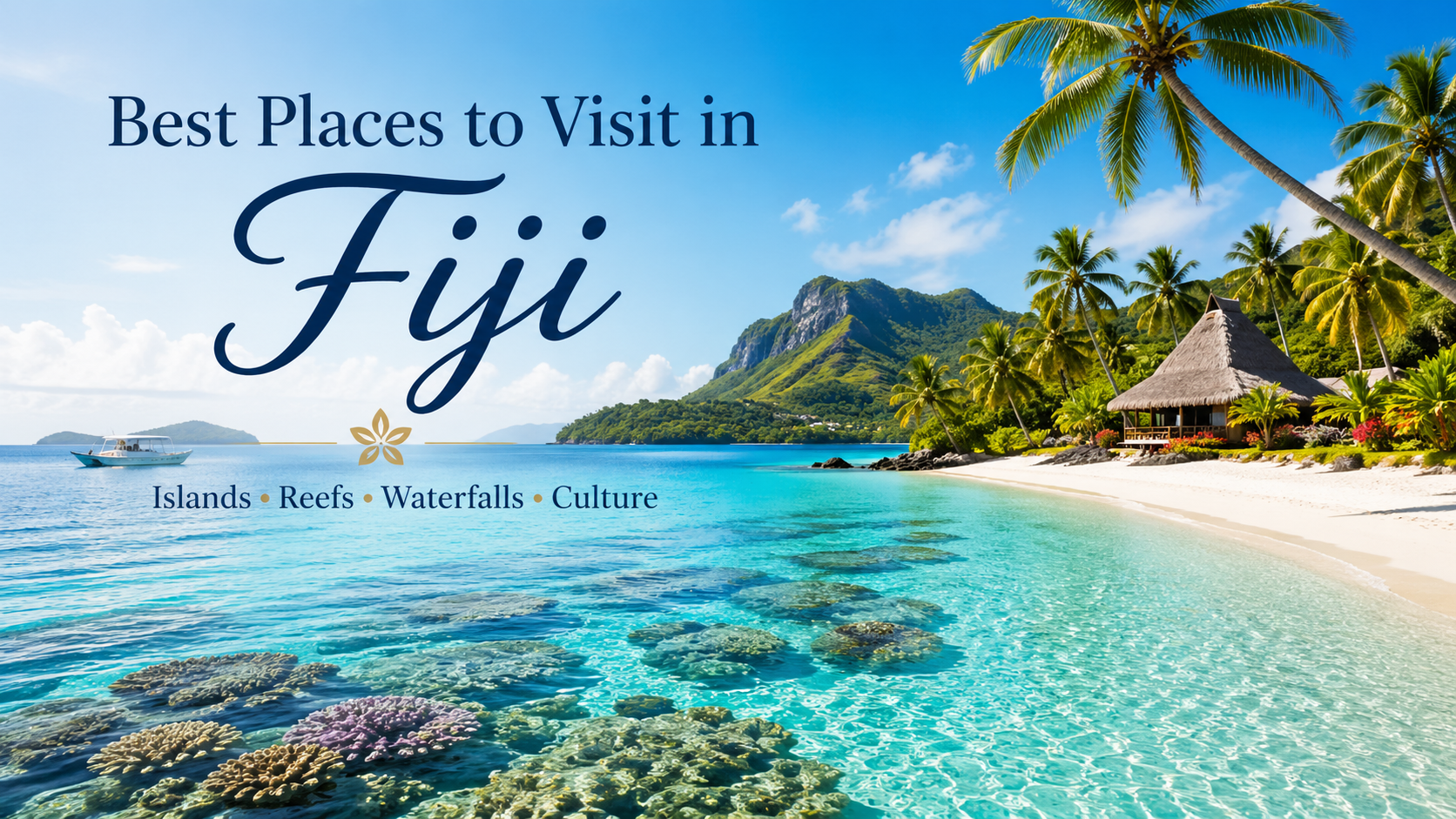
Fiji is the kind of destination that feels almost unreal before you ever arrive. Turquoise water, palm trees, coral reefs, white sand, warm island welcomes, tropical flowers, boat rides, and sunsets that make the whole world feel softer.
But Fiji is not just one beach destination.
That is the first thing travelers need to understand. Fiji is made up of many islands and regions, and each one gives you a different kind of trip. Some places are polished and resort-friendly. Some are remote and wild. Some are better for diving, some for waterfalls, some for families, some for culture, and some for that dreamy “please leave me alone somewhere beautiful” feeling.
You can have an easy Fiji trip based around Denarau, the Mamanuca Islands, or the Coral Coast. You can build a greener, more adventurous trip around Taveuni, Kadavu, or Vanua Levu. You can add capital-city culture in Suva, adventure near Pacific Harbour, or faraway island dreaming in the Lau Islands.
The best Fiji trip is not about seeing everything. It is about choosing the version of Fiji that matches the trip you actually want.
Here are my top picks for the best places to visit in Fiji, from classic island escapes to rainforest waterfalls, reef-rich diving areas, city culture, and remote islands that feel like they belong at the edge of the map.
Mamanuca Islands

Country / Fiji region: Western Fiji, off the coast of Viti Levu near Nadi and Denarau
What kind of place it is: A postcard-perfect island group with bright blue water, resort islands, snorkeling, beach days, and easy boat access from Denarau.
Best for: Honeymooners, couples, families, beach lovers, first-time visitors, resort travelers, snorkelers, and travelers who want the classic Fiji island fantasy without difficult logistics.
Why travelers should care
The Mamanuca Islands are one of the easiest ways to get the Fiji dream without making the trip complicated. This is the Fiji many travelers picture first: small islands, clear water, white sand, palm trees, boat transfers, beach resorts, and that instant “we are really in the South Pacific” feeling.
This region works especially well if you want the island experience but do not want to spend half your trip managing difficult transportation. You can fly into Nadi, transfer through Denarau, and be on a beautiful island without building a complex itinerary. For a first Fiji trip, honeymoon, anniversary trip, or family vacation, that convenience matters.
Main highlights
The Mamanucas are all about easy island beauty. The water is the star here, with snorkeling, swimming, boat trips, sandbars, and reef scenery all playing into the experience. Some resorts feel polished and romantic, while others are more casual and family-friendly, so the exact mood depends on where you stay.
This is also a great region for travelers who want to slow down. Fiji does not have to be a checklist destination. In the Mamanucas, some of the best moments are simple ones: walking barefoot to breakfast, watching the water change color, taking a boat out for the day, or sitting on the beach while the sun drops behind the islands.
Historical points of interest
The Mamanuca Islands are better known for resort vacations than formal historic sites, but they still sit within Fiji’s broader maritime and island-culture story. These islands are part of a Pacific world shaped by ocean travel, fishing, reefs, village life, weather, and the constant relationship between land and sea.
For travelers, the historical interest here is less about museums and more about context. These islands are not just scenery. They are part of Fiji’s long island-based way of life, even though tourism has made several of them famous as vacation escapes. Understanding that helps the region feel less like a backdrop and more like a real place.
Don’t miss
- Island boat transfers from Denarau — The ride itself is part of the experience. As the mainland fades and the water turns brighter, the trip starts to feel like Fiji.
- Snorkeling or reef trips — Even casual snorkelers can enjoy clear water, tropical fish, and reef scenery around the islands.
- A proper beach day — Do not over-schedule every minute. The Mamanucas are made for slowing down.
- Sunset by the water — Fiji sunsets can turn a simple evening into the kind of travel memory that stays with you.
- Choosing the right resort island — The Mamanucas can be romantic, family-friendly, social, quiet, luxe, or barefoot depending on the island and property.
Why I recommend it
The Mamanuca Islands are one of the best places to start with Fiji because they give travelers a huge amount of beauty with relatively easy logistics. You get the island fantasy without needing to be an expert at South Pacific travel.
This is especially useful if your trip is short, if you are traveling with kids, if you are planning a honeymoon, or if you simply want the first part of your Fiji trip to feel smooth and gorgeous.
Side notes / good to know
- The Mamanucas are convenient by Fiji standards, but you still need to plan around boat schedules.
- Some islands are more resort-developed than others, so choose carefully.
- This is one of the best regions for a first Fiji trip.
- If you want remote, wild, and less polished, the Yasawas, Taveuni, Kadavu, or Vanua Levu may suit you better.
Yasawa Islands

Country / Fiji region: Western Fiji, northwest of Viti Levu and beyond the Mamanuca Islands
What kind of place it is: A more remote island chain with dramatic scenery, blue lagoons, volcanic islands, caves, beaches, snorkeling, and island-hopping energy.
Best for: Island-hopping, snorkelers, couples, backpackers, adventurous families, beach lovers, travelers who want a more remote island feel, and anyone who wants Fiji to feel farther from the ordinary world.
Why travelers should care
The Yasawa Islands are where Fiji starts to feel more remote and cinematic. The islands stretch out beyond the easier resort zones, with long volcanic shapes, quiet beaches, blue lagoons, reef-fringed water, and a stronger sense of distance from everyday life.
If the Mamanucas are the easy version of the Fiji fantasy, the Yasawas are the “let’s go farther” version. They still have resorts and traveler infrastructure, but the mood is more adventurous. This is a better fit for travelers who want island scenery to feel a little wilder, less immediate, and more like a journey.
Main highlights
The Yasawas are excellent for island-hopping. Instead of staying in one place and calling it done, you can build a trip that moves through different islands, beaches, lagoons, and views. That gives the region a sense of discovery that is different from a single-resort vacation.
The water is also a huge reason to come here. Snorkeling, swimming, boat trips, caves, and lagoon excursions are central to the experience. The Yasawas are not just pretty from the shore. They are a place where you want to get out on the water and let the islands unfold around you.
Historical points of interest
The Yasawa Islands are part of Fiji’s long story of island communities, ocean travel, traditional village life, and connections across water. Their remoteness is part of their identity, but these islands are not empty vacation scenery. They have villages, customs, family ties, and generations of life shaped by the sea.
For travelers, the cultural and historical interest comes through the setting itself: village visits, local welcomes, boat routes, island geography, and the way communities remain connected across scattered islands. The Yasawas remind you that Fiji is not one island or one resort zone, but a whole ocean-linked country.
Don’t miss
- Sawa-i-Lau Caves — One of the most memorable experiences in the Yasawas, with limestone scenery, swimming, and a sense of island adventure.
- Blue lagoon scenery — This region has the kind of bright water and quiet island views travelers dream about before coming to Fiji.
- Snorkeling trips — The Yasawas are a strong choice for travelers who want a lot of their trip to happen in the water.
- Island-hopping by boat — Moving between islands is part of the magic here, not just transportation.
- Quiet evenings — The remoteness is part of the luxury. Let the slow island rhythm do its job.
Why I recommend it
I recommend the Yasawa Islands for travelers who want Fiji to feel bigger, farther, and more adventurous than a simple resort stay. They are beautiful in a way that feels a little more dramatic and a little less packaged.
This is a great region if you want to combine beach time with movement, scenery, snorkeling, caves, and the feeling that you have gone somewhere special.
Side notes / good to know
- The Yasawas require more planning than Denarau or the Mamanucas.
- Boat transfers and schedules matter, so do not treat this like a last-minute day-trip decision.
- This region is better if you have enough time to enjoy the journey.
- If you want maximum convenience, stay closer to Denarau or the Mamanucas.
Coral Coast

Country / Fiji region: Viti Levu, along the southern coast of Fiji’s main island
What kind of place it is: A practical beach-and-culture region with resorts, coastal scenery, family-friendly stays, village experiences, nature stops, and easier mainland logistics.
Best for: Families, first-time visitors, beach travelers, culture-curious travelers, resort stays, road-trip style exploring, and anyone who wants Fiji without complicated island transfers.
Why travelers should care
The Coral Coast is one of the most useful places in Fiji because it gives travelers a balanced version of the country. You can have beaches, resorts, local culture, nature stops, family activities, and mainland convenience all in one region.
This is not the most remote or dramatic part of Fiji, but that is exactly why it works so well for many trips. If you are traveling with kids, trying to avoid complex logistics, or planning a first Fiji vacation, the Coral Coast gives you room to enjoy the destination without feeling like every movement requires a boat or small plane.
Main highlights
The Coral Coast’s biggest strength is variety. You can spend one day relaxing at a resort, another visiting cultural sites, another exploring dunes or wildlife stops, and another simply enjoying the coastline. It is beachy without being isolated and practical without being boring.
This region also works well for travelers who want a softer landing into Fiji. You are still on Viti Levu, so transportation is simpler, but you can get more of a vacation feeling than you would if you only stayed around Nadi or Denarau.
Historical points of interest
The Coral Coast has strong cultural and historical layers because it is part of Fiji’s main island and close to villages, traditional communities, and coastal routes that have long connected people along Viti Levu. The region is also home to the Sigatoka Sand Dunes, one of Fiji’s most important natural and archaeological landscapes.
This is a good area for travelers who want to understand Fiji beyond resort beaches. Village visits, local markets, cultural shows, traditional crafts, and historic landscapes all help connect the coastal scenery with the people and history of the island.
Don’t miss
- Sigatoka Sand Dunes — A different side of Fiji, with coastal dunes, views, and archaeological significance.
- Kula Wild Adventure Park — A family-friendly stop with wildlife, activities, and an easy break from resort time.
- Local village or cultural experiences — A good way to add context and connection to a beach-focused trip.
- Beach and resort days — The Coral Coast is made for travelers who want Fiji to feel relaxing without being hard to manage.
- A drive along the coast — The region works well for travelers who like seeing more than one view from the window.
Why I recommend it
I recommend the Coral Coast because it is one of the best all-around choices for travelers who want Fiji to feel beautiful but not logistically stressful. It gives you beaches, resorts, nature, culture, and mainland convenience in one region.
For families, first-time visitors, and travelers who want a practical base, the Coral Coast can make Fiji feel much easier.
Side notes / good to know
- Beach quality can vary by exact location, so choose your hotel carefully.
- This is a good choice if you do not want to rely on island transfers.
- The Coral Coast works well for a first Fiji trip or a family trip.
- It is more practical and balanced than remote, so choose another region if you want faraway island drama.
Denarau and Nadi

Country / Fiji region: Western Viti Levu, near Fiji’s main international airport and the gateway to many island transfers
What kind of place it is: A convenient arrival, departure, resort, and marina hub with easy access to flights, hotels, restaurants, transfers, and nearby islands.
Best for: Arrival nights, departure nights, families, resort convenience, short trips, travelers catching island boats, and anyone who wants to make Fiji logistics easier.
Why travelers should care
Denarau and Nadi may not be the most remote or romantic-sounding places in Fiji, but they are incredibly useful. This is where many travelers land, recover from travel, organize transfers, and ease into the trip before heading to the islands.
Denarau is polished and resort-oriented, with large hotels, restaurants, marina access, and a very easy vacation setup. Nadi has the airport, markets, gardens, temples, and a more everyday travel feel. Together, they make a practical base at the start or end of a Fiji itinerary.
Main highlights
The biggest highlight here is convenience. Denarau gives you resort comfort and direct access to Port Denarau Marina, which is important if you are heading to the Mamanucas or Yasawas. That can save a lot of stress, especially after a long-haul flight or before an early transfer.
Nadi adds a little more local texture. It is not where most travelers will spend their entire Fiji vacation, but it is useful for markets, gardens, cultural stops, and airport logistics. If your itinerary is built around island transfers, this region can keep everything from turning into chaos.
Historical points of interest
Nadi and Denarau sit in western Viti Levu, an area shaped by travel, trade, tourism, Indo-Fijian culture, and modern Fiji’s role as a South Pacific gateway. Nadi in particular gives travelers a visible sense of Fiji’s cultural mix, including Hindu temples, markets, local neighborhoods, and everyday life beyond the resort zone.
Denarau itself is more modern and tourism-focused, but its importance comes from logistics. It is one of the main gateways that connects travelers to the outer islands, which makes it a key part of contemporary Fiji travel even if it does not feel historic in the traditional sense.
Don’t miss
- Port Denarau Marina — The main jumping-off point for many Mamanuca and Yasawa island trips.
- Garden of the Sleeping Giant — A lush, easy nature stop near Nadi with orchids and tropical greenery.
- Sri Siva Subramaniya Temple — A colorful cultural landmark in Nadi and one of the area’s most recognizable stops.
- Nadi markets — Good for fruit, souvenirs, and a more everyday look at the area.
- A smart arrival or departure night — Sometimes the best travel decision is the one that keeps the itinerary from becoming stressful.
Why I recommend it
I recommend Denarau and Nadi as practical itinerary tools. They are not necessarily the place to spend your entire Fiji trip, but they can make the rest of your trip much smoother.
If your flight arrives late, your boat leaves early, or you want one easy resort night before going farther, this region can be the difference between a relaxed trip and a messy one.
Side notes / good to know
- Denarau is convenient and polished, but it can feel more resort-developed than remote.
- Nadi is practical and culturally interesting, but most travelers will not want to make it their whole Fiji trip.
- This region is excellent before or after an island stay.
- If you are catching a ferry or boat transfer, build in enough time and do not cut it too close.
Taveuni

Country / Fiji region: Northern Fiji, east of Vanua Levu
What kind of place it is: A lush, green island known for rainforest, waterfalls, hiking, tropical flowers, reef access, and a wilder nature-focused version of Fiji.
Best for: Waterfall lovers, hikers, nature travelers, divers, snorkelers, couples, soft adventure travelers, and anyone who wants Fiji to feel greener and less resort-polished.
Why travelers should care
Taveuni is the Fiji you choose when you want more than beaches. It is lush, wet, green, dramatic, and alive with rainforest scenery, waterfalls, flowers, coastal walks, and reef access. This is Fiji’s “Garden Island,” and it feels very different from the dry, resort-heavy image many travelers have in their heads.
For travelers who get restless after too many pool days, Taveuni is a dream. You can still have ocean time, but you also get hiking, swimming holes, rainforest trails, and a deeper sense of tropical nature. It is one of the best places in Fiji for people who want the trip to feel active, beautiful, and a little adventurous.
Main highlights
Taveuni’s main appeal is the combination of rainforest and reef. Bouma National Heritage Park, Tavoro Waterfalls, Lavena Coastal Walk, tropical gardens, birdlife, and nearby diving and snorkeling areas make the island feel layered and full of life.
This is not the easiest island to add to a very short trip, but that extra effort is part of what keeps it special. Taveuni feels less like a generic beach vacation and more like a destination with its own mood, pace, and personality.
Historical points of interest
Taveuni’s history is tied to traditional communities, plantation-era layers, maritime movement, and the island’s deep relationship with the natural environment. Its location, lush terrain, and surrounding waters have shaped the way people live and travel here.
The island is also famously associated with the 180th meridian, which gives it a fun geographic identity as a place connected to the International Date Line. For travelers, the deeper interest is in how Taveuni blends village life, rainforest landscapes, coastal movement, and reef access into one of Fiji’s most distinctive island experiences.
Don’t miss
- Bouma National Heritage Park — One of the best places to experience Taveuni’s rainforest, waterfalls, and natural beauty.
- Tavoro Waterfalls — A classic Taveuni experience with hiking, swimming, and lush scenery.
- Lavena Coastal Walk — A beautiful route that combines coastline, village scenery, forest, and water.
- Rainbow Reef access — A major reason divers and snorkelers are drawn to this part of Fiji.
- A slow nature day — Taveuni is not a place to rush. Let the green scenery be part of the point.
Why I recommend it
I recommend Taveuni for travelers who want Fiji to feel lush, active, and alive. It adds a completely different dimension to the country and keeps the trip from being only about beaches and resorts.
This is one of the best choices if you love waterfalls, tropical landscapes, reef trips, and islands that feel like they still have a strong sense of place.
Side notes / good to know
- Taveuni takes more effort to reach than the easiest Fiji resort areas.
- It is a stronger fit for travelers who like nature and soft adventure.
- Rain is part of why the island is so green, so pack accordingly.
- If you only want beach lounging and convenience, choose a more resort-focused region.
Savusavu and Vanua Levu

Country / Fiji region: Northern Fiji, on Vanua Levu, Fiji’s second-largest island
What kind of place it is: A quieter, less obvious Fiji base with bay scenery, sailing, diving, hot springs, local life, and a slower northern-island rhythm.
Best for: Couples, repeat Fiji travelers, sailors, divers, peaceful stays, soft luxury, nature lovers, and travelers who want a calmer alternative to Fiji’s busiest resort areas.
Why travelers should care
Savusavu is one of those places that does not shout for attention, which is exactly why it can be so appealing. It has a pretty bay setting, a marina-town feel, hot springs, diving and snorkeling access, local life, and a slower pace than Fiji’s major resort corridors.
This is not the obvious first choice for everyone. But if you want Fiji to feel quieter, more personal, and less packaged, Savusavu and Vanua Levu can be a lovely alternative. It is a good fit for travelers who like charm, water views, small-town atmosphere, and the feeling that they have stepped slightly off the standard tourist path.
Main highlights
Savusavu’s main highlight is its relaxed bay setting. Boats, hills, water views, local shops, resorts tucked into quiet corners, and access to marine experiences all create a softer, slower Fiji trip.
Vanua Levu also gives travelers a chance to see Fiji beyond the main tourist trail. It does not have the same instant-name recognition as the Mamanucas or Yasawas, but that can be part of the appeal. The island feels less obvious, and for the right traveler, that makes it more interesting.
Historical points of interest
Vanua Levu has long been shaped by island communities, trade, plantations, maritime movement, and Fiji’s broader colonial and post-colonial history. Savusavu itself developed as a harbor and trading town, and its bay remains central to its identity.
The area’s hot springs, villages, coastal routes, and marina culture all add to its layered feel. This is a place where Fiji’s history is less about big monuments and more about settlement, sea routes, land use, local communities, and the slower rhythm of northern island life.
Don’t miss
- Savusavu Bay — Calm, pretty, and perfect for travelers who like water views without the crowded resort feeling.
- Hot springs — A small but memorable local feature that adds character to the town.
- Diving and snorkeling trips — Northern Fiji has excellent marine possibilities, especially for travelers willing to look beyond the most famous regions.
- A marina or waterfront meal — Savusavu’s harbor atmosphere is a big part of its charm.
- A slower town day — Walk, browse, eat, and let Savusavu be itself.
Why I recommend it
I recommend Savusavu and Vanua Levu for travelers who want a quieter and more soulful Fiji experience. It is not the flashiest choice, but it has a peaceful quality that can make a trip feel more personal.
This is a good region if you have already done the obvious Fiji resort areas or if you know from the start that you prefer calmer places with local texture.
Side notes / good to know
- Savusavu is better for travelers who appreciate quiet charm.
- It is not the most convenient choice for a rushed Fiji itinerary.
- This region works well for slower travel, diving, sailing, and peaceful stays.
- If you want constant activity or big resort energy, you may prefer Denarau, the Mamanucas, or the Coral Coast.
Kadavu

Country / Fiji region: Southern Fiji, south of Viti Levu
What kind of place it is: A remote, reef-focused island destination known for the Great Astrolabe Reef, diving, snorkeling, nature, and a quieter off-the-main-trail feeling.
Best for: Divers, snorkelers, remote island travelers, nature lovers, adventurous couples, marine-life enthusiasts, and people who want fewer crowds and more reef-focused beauty.
Why travelers should care
Kadavu is the Fiji you choose when the reef matters more than convenience. This is a quieter, more remote island region closely associated with the Great Astrolabe Reef, making it especially appealing for divers, snorkelers, and travelers who want marine life to be at the center of the trip.
This is not the place for someone who wants the easiest resort near the airport. Kadavu asks more of you logistically, but it gives back with remoteness, reef scenery, nature, and a stronger sense of being away from Fiji’s busiest tourist zones.
Main highlights
The Great Astrolabe Reef is the headline here. Diving, snorkeling, coral, marine life, and ocean experiences are the main reasons many travelers come to Kadavu. If your dream Fiji trip involves being in the water as much as possible, this region deserves serious attention.
Kadavu also has a quieter and less developed atmosphere than many better-known areas. That makes it especially appealing for travelers who want Fiji to feel wild, natural, and removed from the standard resort circuit.
Historical points of interest
Kadavu’s history is closely tied to traditional island communities, ocean routes, reef systems, fishing, and the realities of living in a remote island environment. The Great Astrolabe Reef is not just a beautiful attraction; it has helped shape travel, food, protection, and movement around the island for generations.
The cultural interest here comes through village life, maritime traditions, and the way the island’s remoteness has preserved a different rhythm from more heavily touristed regions. Kadavu is a place where geography and history are deeply connected.
Don’t miss
- Great Astrolabe Reef — The main reason many travelers come to Kadavu, especially divers and serious snorkelers.
- Diving and snorkeling — This is one of the best regions in Fiji to prioritize underwater experiences.
- Remote island stays — The distance is part of the experience, not just a logistical hurdle.
- Village and nature scenery — Kadavu is not trying to be Denarau, and that is the point.
- Quiet evenings away from crowds — This is Fiji for travelers who want the volume turned down.
Why I recommend it
I recommend Kadavu for travelers who want Fiji to feel remote, reef-rich, and less commercial. It is one of the strongest choices for divers and nature-focused travelers who are willing to trade convenience for a more distinctive experience.
This is not the easiest Fiji option, but for the right traveler, that is exactly why it works.
Side notes / good to know
- Kadavu requires more planning than Fiji’s main resort regions.
- It is best for travelers who care about reefs, diving, snorkeling, and nature.
- This is not ideal for a rushed itinerary or a first Fiji trip focused on convenience.
- If you are not interested in remote scenery or underwater experiences, another region may be a better fit.
Pacific Harbour and Beqa Lagoon

Country / Fiji region: Southern Viti Levu, between the Coral Coast and Suva, with access to Beqa Island and Beqa Lagoon
What kind of place it is: Fiji’s adventure-leaning region, known for shark diving, lagoon trips, river activities, cultural experiences, and a more active coastal atmosphere.
Best for: Adventure travelers, divers, shark diving, active couples, older kids and teens, lagoon trips, river excursions, and travelers who want Fiji to have a little edge.
Why travelers should care
Pacific Harbour is where Fiji gets more adventurous. This area is known for activities like shark diving, river trips, lagoon excursions, and access to Beqa Island and Beqa Lagoon. It is still coastal and tropical, but the mood is more active than sleepy.
This is a strong choice if you want your Fiji trip to include something memorable beyond beaches and resort pools. Not everyone wants adrenaline on vacation, but if you do, Pacific Harbour gives Fiji a completely different energy.
Main highlights
The biggest highlight is access to adventure. Beqa Lagoon is a major draw for divers, while shark diving is one of the area’s most famous experiences. River trips, cultural excursions, and lagoon activities add even more variety.
Pacific Harbour also pairs well with other Viti Levu regions. You can combine it with the Coral Coast, Suva, or a broader main-island itinerary without needing to fly to another island.
Historical points of interest
Pacific Harbour and Beqa Lagoon connect travelers to both coastal and cultural Fiji. Beqa Island is especially associated with traditional firewalking, which gives the region a cultural identity beyond its adventure activities.
The area also reflects Fiji’s relationship with the sea, reefs, rivers, and village traditions. For travelers, the historical and cultural interest comes through Beqa’s traditions, lagoon travel, and the way adventure tourism has grown around an older island and coastal landscape.
Don’t miss
- Beqa Lagoon — A major draw for divers and water-focused travelers.
- Shark diving — Not for everyone, but unforgettable for the right traveler.
- River adventures — A good way to see Fiji’s inland scenery and add movement to the trip.
- Beqa Island cultural experiences — Especially meaningful for travelers interested in traditional firewalking culture.
- A more active itinerary day — This is a good place to break up a beach-heavy trip with something bold.
Why I recommend it
I recommend Pacific Harbour and Beqa Lagoon for travelers who want Fiji to feel exciting, not just relaxing. It adds adventure, culture, and water-based experiences that make the trip more varied.
This is especially useful if you are building a main-island itinerary and want something more memorable than another resort day.
Side notes / good to know
- Pacific Harbour is best if you actually want activities.
- Shark diving and higher-adrenaline excursions should be chosen carefully based on comfort level.
- This is not the top pick for travelers who only want a peaceful beach resort.
- It combines well with the Coral Coast or Suva.
Suva

Country / Fiji region: Southeast Viti Levu, Fiji’s capital city
What kind of place it is: A rainy, busy, culture-rich capital with markets, museums, food, colonial-era architecture, everyday city life, and a very different feel from Fiji’s resort islands.
Best for: Culture, museums, markets, food, city energy, history, rainy-day exploring, repeat visitors, and travelers who want to see Fiji beyond beaches and resorts.
Why travelers should care
Suva is not the postcard honeymoon version of Fiji, and that is exactly why it belongs on this list. This is Fiji’s capital, with markets, museums, restaurants, government buildings, local neighborhoods, and the kind of everyday energy you do not get if you only stay at a resort.
A Fiji trip made only of beaches can be beautiful, but it can also feel detached from the country itself. Suva adds texture. It gives you a sense of Fiji as a real place with politics, food, history, weather, traffic, students, workers, markets, and culture.
Main highlights
Suva’s main highlights are cultural rather than beachy. The Fiji Museum, Suva Municipal Market, local restaurants, colonial-era architecture, waterfront areas, and nearby green spaces all give travelers a very different experience from the resort coast.
This is also a useful stop if you like cities that feel lived-in. Suva is not polished for vacation fantasy in the same way Denarau is, but it gives the trip more depth. It works especially well for travelers who enjoy museums, markets, local food, and seeing how a country functions beyond tourism.
Historical points of interest
Suva has some of Fiji’s strongest historical layers for travelers. As the capital, it reflects colonial history, modern government, Pacific regional identity, and the cultural mix that shapes Fiji today. The Fiji Museum is one of the best places to start if you want context for the country’s history, traditional culture, maritime heritage, and colonial-era changes.
The city also gives travelers a visible sense of Fiji’s modern identity. Markets, churches, government buildings, old colonial structures, universities, and neighborhoods all help tell the story of a country that is much more complex than its beach imagery.
Don’t miss
- Fiji Museum — One of the best places to add historical and cultural context to a Fiji trip.
- Suva Municipal Market — Great for produce, local color, and everyday city energy.
- Colo-i-Suva Forest Park — A green escape near the city with rainforest scenery and swimming holes.
- Local restaurants and cafés — Suva is one of the better places to eat beyond resort menus.
- A rainy city wander — Suva is wetter and moodier than the resort side of Fiji, but that is part of its personality.
Why I recommend it
I recommend Suva for travelers who want Fiji to feel like a real country, not just a vacation setting. It balances the beach-heavy parts of an itinerary and adds culture, history, food, and everyday life.
It is not where I would send every first-time traveler for a full vacation, but as part of a broader Fiji trip, Suva gives the destination more meaning.
Side notes / good to know
- Suva is wetter than many travelers expect, so pack with rain in mind.
- This is not the best base if your main goal is beach lounging.
- Suva is better for culture, markets, food, history, and city life.
- It works well as a contrast stop if the rest of your trip is island- or resort-focused.
Lau Islands

Country / Fiji region: Far eastern Fiji, a remote island group far from the main tourist trail
What kind of place it is: An ultra-remote, faraway island region with traditional village culture, sailing routes, untouched scenery, and a dreamlike “advanced Fiji” feeling.
Best for: Expedition-style travelers, sailors, remote-island dreamers, luxury adventure travelers, repeat Fiji visitors, and people who want Fiji far beyond the usual resort map.
Why travelers should care
The Lau Islands are the faraway dream version of Fiji. Remote, scattered, beautiful, and difficult to access, they are not the obvious choice for a standard first Fiji itinerary. But they matter because they show just how much more there is to Fiji beyond the main resort regions.
This is the kind of place that stretches the imagination. For most travelers, Lau is not a practical add-on. For the right traveler, though, it is the entire reason to dream bigger. It represents Fiji at its most remote, traditional, and removed from the usual vacation route.
Main highlights
The main highlight of the Lau Islands is remoteness itself. These islands are not about convenience or quick sightseeing. They are about distance, ocean, village life, sailing, quiet beauty, and the feeling that you have gone much farther than the average traveler.
The Lau group is especially interesting for travelers who want to experience Fiji by sea or who are drawn to places that are culturally rich and logistically challenging. This is not a polished resort corridor. It is a far eastern island world with a very different rhythm.
Historical points of interest
The Lau Islands have deep cultural and maritime importance within Fiji. Their location in eastern Fiji has historically connected them to wider Pacific movement, traditional navigation, village life, and relationships across island groups.
This region is especially important for understanding Fiji as part of a broader Pacific world rather than just a resort destination. The history here is tied to chiefs, villages, seafaring, cultural exchange, and the realities of life across remote islands. Travelers who come here should approach with respect, patience, and awareness that this is not mass-tourism Fiji.
Don’t miss
- Remote island scenery — The distance and untouched beauty are the main reasons this region is so alluring.
- Sailing routes — Lau is especially interesting for travelers exploring Fiji by sea.
- Traditional village culture — This region should be approached with respect and awareness, not treated like a theme park.
- The feeling of true escape — Lau is not convenient, and that is part of its magic.
- A carefully planned route — This is not a casual “figure it out later” region.
Why I recommend it
I recommend the Lau Islands as the dream add-on for travelers who want to understand how far Fiji can go beyond the standard vacation map. It is not the right fit for most simple trips, but it represents one of Fiji’s most extraordinary sides.
For travelers with the time, budget, patience, and logistics to make it work, Lau can become the kind of trip people talk about for the rest of their lives.
Side notes / good to know
- The Lau Islands are not practical for most first-time Fiji itineraries.
- Access can be limited, so logistics matter enormously.
- This is an advanced Fiji choice, not a simple beach add-on.
- Travelers should be especially respectful of local customs and village life.
How to Choose the Best Place in Fiji for Your Trip

Fiji is much easier to plan when you stop thinking of it as one destination and start thinking in travel styles.
If you want the easiest island resort escape, start with the Mamanuca Islands.
If you want more remote island-hopping and dramatic scenery, look at the Yasawa Islands.
If you want beaches and culture without complicated transfers, the Coral Coast is one of the most practical choices.
If you want resort convenience near the airport and marina, use Denarau and Nadi strategically at the start or end of your trip.
If you want waterfalls, rainforest, hiking, and greener scenery, choose Taveuni.
If you want a quieter, less obvious Fiji base, look at Savusavu and Vanua Levu.
If you care most about diving and remote reefs, consider Kadavu.
If you want adventure, shark diving, and lagoon access, look at Pacific Harbour and Beqa Lagoon.
If you want culture, markets, museums, and city life, add Suva.
And if you want the faraway dream version of Fiji, start researching the Lau Islands.
The biggest mistake is trying to make one Fiji region do everything. A resort island, a rainforest island, a city stop, and a remote diving island are not interchangeable. Fiji rewards travelers who match the place to the trip they actually want.
What to Pack for Fiji Specifically
Fiji is warm, tropical, beachy, and often casual, but that does not mean you should pack thoughtlessly. Between boat transfers, reef days, village visits, tropical rain, strong sun, and humid weather, a few smart items can make the trip much easier.
Sunscreen is one of the most important things to pack. Fiji is a water-focused destination, and you will probably spend a lot of time swimming, snorkeling, boating, or walking in strong sun. Bring strong sunscreen, a UPF swim shirt, sunglasses, and a packable sun hat that can handle wind and boat days.
Water shoes or reef shoes are also worth packing. Many Fiji beaches are soft and dreamy, but reef, coral fragments, rocks, and slippery boat landings can still be an issue. Water shoes are especially useful if you plan to snorkel, take boat trips, visit smaller islands, or swim from beaches where the entry is not perfectly sandy.
A small dry bag is one of the most useful things you can bring to Fiji. Boat transfers, beach days, kayaking, snorkeling trips, rain showers, and wet towels all make waterproof storage extremely practical.
Bug protection is another smart addition. Mosquitoes can be a real annoyance in tropical places, especially around vegetation, after rain, and in the evening. Bring insect repellent wipes or spray, and consider lightweight long sleeves for evenings if bugs love you.
A basic medicine kit can save you a lot of trouble. Do not assume every small island or resort area will have exactly what you want when you need it. Pack your own motion sickness medicine, stomach medicine, pain reliever, antihistamine, blister care, electrolyte packets, and any prescriptions you rely on.
A portable charger is useful for travel days, boat transfers, photos, maps, and resort areas where outlets may not be where you want them. Fiji is too beautiful to have your phone die right before sunset.
Final Thoughts on the Best Places to Visit in Fiji
Fiji is easy to romanticize, and honestly, it deserves some of that. The water really can be that blue. The islands really can feel that dreamy. The welcome really can feel warm enough to soften the edges of a long travel day.
But the best Fiji trip comes from understanding the differences between its regions.
The Mamanucas are easy and iconic. The Yasawas feel more remote and dramatic. The Coral Coast is practical and balanced. Denarau and Nadi make logistics easier. Taveuni is lush and adventurous. Savusavu is quiet and soulful. Kadavu is reef-rich and remote. Pacific Harbour adds adrenaline. Suva adds culture. And Lau keeps the faraway dream alive.
You do not need to see all of Fiji in one trip. You just need to choose the version of Fiji that matches the trip you actually want.
And if you choose well, Fiji is the kind of place that does not just feel like a vacation. It feels like a deep breath you did not realize you needed.