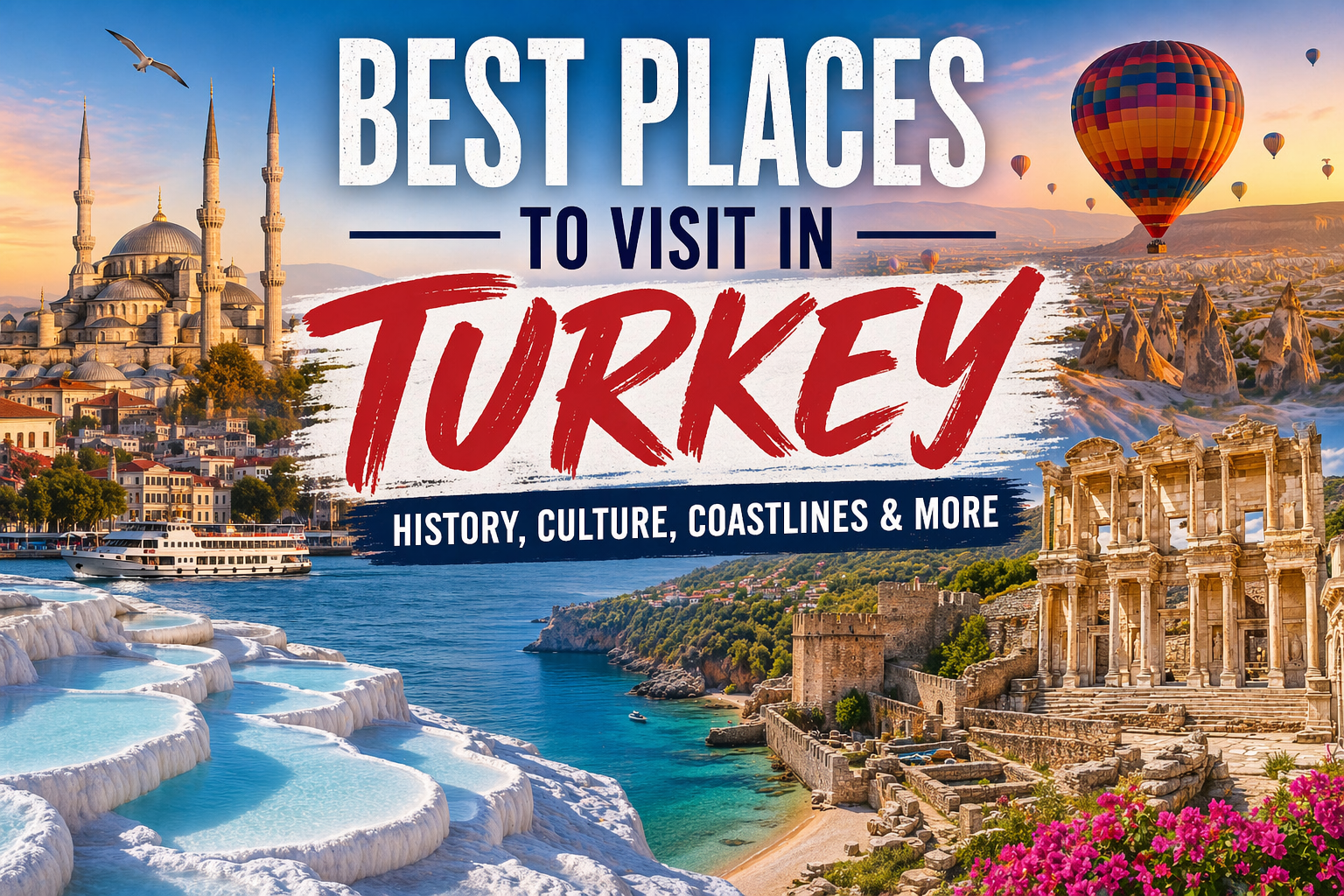
Turkey is one of those countries that feels bigger than a single trip. You can picture Istanbul’s skyline of domes and minarets, hot air balloons floating over Cappadocia, ancient ruins glowing in the sun, turquoise water along the coast, white terraces at Pamukkale, and bazaars filled with color, tea, spices, lamps, and movement. Then you start looking closer and realize Turkey is not just beautiful. It is layered.
One part of Turkey feels grand and imperial, with palaces, mosques, old neighborhoods, and water views that make the whole trip feel cinematic. Another part feels ancient, with ruins that connect you to Greek, Roman, Byzantine, and Ottoman history in ways that are hard to fully absorb until you are standing there. Another part feels dreamlike and natural, with strange rock formations, thermal terraces, beaches, mountains, and landscapes that do not look like they should all belong to the same country.
That range is exactly why Turkey works so well as a travel destination. It can feel romantic, historic, adventurous, relaxing, coastal, spiritual, luxurious, rugged, or completely surreal depending on where you go. Some places are obvious first-trip anchors. Some are better for beach time or ancient history. Some are there for atmosphere, food, views, or the sense of being somewhere very old and very alive at the same time. If you are trying to figure out where to focus your time, these are my picks for the best places to visit in Turkey.
1. Istanbul

Country / Turkey region: Northwestern Turkey, straddling Europe and Asia
What kind of place it is: A massive, layered city where imperial history, water views, food, shopping, and everyday life all collide
Best for: First-time Turkey trips, history lovers, food lovers, couples, city travelers, shoppers, photographers, and anyone who wants the most iconic introduction to Turkey
Why travelers should care
Istanbul is the kind of city that makes Turkey feel unforgettable almost immediately. It has that rare ability to feel ancient, grand, chaotic, romantic, exhausting, and completely alive all at once. You are not just visiting a pretty city. You are stepping into a place that has been a crossroads for empires, religions, trade routes, cultures, and ideas for centuries.
What makes Istanbul so powerful is the layering. One moment you are looking at domes and minarets. The next you are walking through a market, crossing the Bosphorus, eating something wonderful, or watching ferry traffic move between Europe and Asia. It is the kind of city where the setting matters as much as the monuments. The water, hills, skyline, neighborhoods, food, and movement all work together.
Main highlights
Istanbul gives you the imperial-city layer, the Bosphorus layer, the mosque-and-palace layer, the bazaar layer, the food-lover layer, and the Europe-meets-Asia layer all at once. It is the strongest possible opening destination for Turkey because it immediately shows you how much history and personality the country has.
Historical points of interest
Istanbul carries enormous historical weight because it was once Constantinople and later became one of the great centers of the Ottoman world. Its historic areas give the city a depth that goes far beyond sightseeing. This is one of those places where the past is not tucked away in one district. It is everywhere.
Don’t miss
- the Hagia Sophia area, because it is one of the most powerful historic settings in the city
- the Blue Mosque and surrounding historic core for that classic Istanbul atmosphere
- Topkapı Palace if you want imperial history, courtyards, views, and a stronger sense of Ottoman Istanbul
- the Grand Bazaar and Spice Bazaar for shopping, color, and old trade-route energy
- a Bosphorus cruise or ferry ride, because the city makes more sense from the water
Why I recommend it
I recommend Istanbul because it is the emotional and historical gateway to Turkey. It is not always simple, but it is unforgettable, and it gives the whole trip a sense of scale.
Side notes / good to know
- Istanbul deserves more than a rushed one-night stop.
- It works well at the beginning or end of a Turkey itinerary.
- This is one of the best places in Turkey to balance major sights with food, shopping, wandering, and atmosphere.
- You can easily book the best hotels in Istanbul in my guide here.
2. Cappadocia

Country / Turkey region: Central Anatolia
What kind of place it is: A surreal rock landscape of fairy chimneys, cave hotels, valleys, underground cities, and hot air balloons
Best for: Couples, photographers, bucket-list travelers, soft adventure travelers, cave hotel stays, and anyone who wants Turkey to feel dreamlike and completely different
Why travelers should care
Cappadocia is one of those places that almost seems unreal before you arrive. The landscape is strange in the best way, with soft volcanic rock formations, valleys, cave dwellings, and villages that feel shaped by the land itself. It is not just scenic. It is distinctive. You know when you are in Cappadocia.
The hot air balloons are the image everyone knows, but Cappadocia is not only about balloons. The real appeal is the whole atmosphere: waking up in a cave hotel, watching the light change over the rocks, walking through valleys, exploring underground cities, and seeing how people carved homes, churches, and shelters into the landscape. It feels ancient, earthy, romantic, and otherworldly.
Main highlights
Cappadocia gives you the fairy-chimney layer, the cave-hotel layer, the balloon-sunrise layer, the underground-city layer, the valley-walking layer, and the surreal-landscape layer all at once. It is one of the most visually memorable places in Turkey.
Historical points of interest
Cappadocia has deep historical and religious importance, especially because of its rock-cut churches, underground cities, and long human relationship with the soft volcanic landscape. The setting is dramatic, but the human history is what gives it real weight.
Don’t miss
- seeing the landscape at sunrise, whether or not you personally take a balloon ride
- staying in a cave hotel if it fits your budget and travel style
- exploring at least one underground city to understand the defensive side of the region’s history
- walking through valleys rather than only seeing the scenery from viewpoints
- giving yourself enough time, because weather can affect balloon flights
Why I recommend it
I recommend Cappadocia because it is one of Turkey’s most distinctive destinations. It gives the trip a magical, almost impossible-looking chapter that feels completely different from Istanbul or the coast.
Side notes / good to know
- Balloon flights are weather-dependent, so do not plan Cappadocia too tightly.
- Cappadocia is especially strong for couples and special trips.
- This is one of the places where the hotel experience can be part of the destination.
3. Ephesus and Selçuk

Country / Turkey region: Aegean Turkey, near Izmir
What kind of place it is: One of Turkey’s most important ancient ruin sites, paired with a small-town base and easy Aegean access
Best for: Ancient history lovers, cruise travelers, first-time Turkey itineraries, families with older kids, and anyone who wants a powerful ruins experience without making logistics too difficult
Why travelers should care
Ephesus is one of the places that makes Turkey’s ancient history feel immediate. This is not a tiny ruin where you have to work hard to imagine the past. Ephesus still has scale. You can walk through streets, look at the Library of Celsus, see the theater, and get a much clearer sense of a major ancient city.
That is why it works so well in a Turkey itinerary. Istanbul gives you imperial and city history. Cappadocia gives you surreal landscape and carved rock. Ephesus gives you the ancient-world layer in a way that is visually satisfying and easy to understand. It helps Turkey feel even bigger historically.
Main highlights
Ephesus gives you the ancient-city layer, the Roman-ruins layer, the Library-of-Celsus layer, the theater layer, the cruise-port-excursion layer, and the Aegean-history layer all at once. It is one of the strongest history stops in western Turkey.
Historical points of interest
Ephesus was one of the major cities of the ancient Mediterranean world, and the surviving ruins help show why the area mattered so much. Its streets, public buildings, and monuments make it easier to imagine the scale and sophistication of the city.
Don’t miss
- the Library of Celsus, because it is one of the most memorable images of Ephesus
- the Great Theater for scale and atmosphere
- walking slowly through the site instead of treating it as a quick photo stop
- using Selçuk as a practical base if you want a calmer stay than a busier coastal resort
- pairing the ruins with nearby Aegean towns if your itinerary allows
Why I recommend it
I recommend Ephesus because it gives Turkey a major ancient-history anchor. It is impressive, accessible, and strong enough to justify building part of an itinerary around it.
Side notes / good to know
- Ephesus can get hot and exposed, so timing matters.
- This is one of Turkey’s best cruise-friendly ancient sites.
- It pairs especially well with Izmir, Kuşadası, or a broader Aegean route.
4. Pamukkale and Hierapolis

Country / Turkey region: Southwestern inland Turkey, Denizli province
What kind of place it is: A natural white-terrace landscape paired with the ruins of an ancient spa city
Best for: First-time Turkey travelers, photographers, ancient history lovers, road-trip itineraries, and travelers who want a very unusual natural stop
Why travelers should care
Pamukkale is one of Turkey’s most recognizable landscapes because it looks so unusual. The white terraces have that bright, almost snowy appearance, even though the whole setting is connected to thermal water and mineral deposits. It is the kind of place that instantly adds visual variety to a Turkey trip.
What makes Pamukkale more interesting is that it is not only a natural stop. Hierapolis sits right with it, which gives the destination a historical layer too. That combination matters. You are not just going to look at white terraces. You are seeing a place where nature, water, ancient spa culture, ruins, and landscape all connect.
Main highlights
Pamukkale gives you the white-terrace layer, the thermal-water layer, the ancient-spa-city layer, the ruins-with-a-view layer, and the unusual-natural-wonder layer all at once. It breaks up a Turkey itinerary beautifully because it feels so different from the cities, coast, and Cappadocia.
Historical points of interest
Hierapolis gives Pamukkale much of its historical depth. The ancient city developed around the thermal waters, and that connection between wellness, water, and settlement makes the site more meaningful than a simple viewpoint stop.
Don’t miss
- the white travertine terraces, because they are the visual heart of Pamukkale
- Hierapolis, because the ruins make the stop much richer
- arriving with realistic expectations, since this is a popular and managed site
- protecting your feet and planning for bright light, heat, and glare
- building it into a route rather than forcing it as an awkward one-off if your timing is tight
Why I recommend it
I recommend Pamukkale because it adds a completely different texture to a Turkey trip. It is strange, bright, historic, and memorable.
Side notes / good to know
- Pamukkale is best appreciated when you understand both the natural and ancient-history layers.
- The bright white landscape can be intense in strong sun.
- This is a good itinerary bridge between the Aegean ruins and other inland or southern stops.
5. Antalya

Country / Turkey region: Mediterranean coast, southern Turkey
What kind of place it is: A coastal city and resort gateway with beaches, an old town, cliffs, ruins, and easy access to the Turkish Riviera
Best for: Beach lovers, families, couples, resort travelers, history lovers, and travelers who want sun and scenery without giving up culture
Why travelers should care
Antalya is one of the easiest places to understand why Turkey’s coast is such a big deal. You get blue Mediterranean water, dramatic coastline, resort energy, an atmospheric old town, and ancient sites within reach. It is not just a beach stop. It is a beach stop with layers.
That is what makes Antalya so useful. It can work as a relaxing base, a family-friendly resort destination, a sightseeing hub, or a bridge into the wider Turkish Riviera. Some travelers will use it for pure sun and sea. Others will use it for ruins, boat days, old town wandering, and day trips. Either way, it gives Turkey a warmer, more relaxed coastal chapter.
Main highlights
Antalya gives you the Mediterranean-coast layer, the resort-base layer, the old-town layer, the cliff-and-sea layer, the ancient-ruins-nearby layer, and the sunny-southern-Turkey layer all at once.
Historical points of interest
Antalya’s old town and surrounding region help connect the city to a long Mediterranean history. Nearby ancient sites add another layer, making this area much more than a simple beach destination.
Don’t miss
- Kaleiçi, the old town, for atmosphere, lanes, restaurants, and historic texture
- the coastline and viewpoints, because Antalya’s setting is a huge part of the appeal
- nearby ancient ruins if you want more than resort time
- boat or coastal outings if your trip has room for slower scenic days
- using Antalya as a base if you want a practical southern Turkey anchor
Why I recommend it
I recommend Antalya because it balances sunshine, scenery, history, and logistics very well. It is one of Turkey’s strongest all-around coastal destinations.
Side notes / good to know
- Antalya can be very hot in summer.
- It works well for travelers who want beach time without making the trip feel thin.
- This is one of the best choices if you want a coastal base with multiple day-trip options.
6. Bodrum

Country / Turkey region: Southwestern Aegean coast
What kind of place it is: A stylish Aegean coastal destination with marina life, beaches, whitewashed charm, nightlife, and a more polished vacation feel
Best for: Couples, friend trips, luxury travelers, beach lovers, nightlife travelers, and anyone who wants Turkey’s coast with style
Why travelers should care
Bodrum brings a different kind of coastal energy to Turkey. It feels more polished, more social, and more resort-minded than some of the quieter coastal towns. This is the Turkey stop for marinas, beach clubs, whitewashed streets, summer evenings, seafood, shopping, and a slightly glamorous Aegean mood.
That matters because Turkey’s coast is not all one thing. Antalya feels like a larger Mediterranean gateway. Fethiye feels scenic and outdoorsy. Bodrum feels stylish. It gives the country’s beach story a more fashionable edge, which can be perfect if you want your trip to include a little luxury or nightlife.
Main highlights
Bodrum gives you the Aegean-coast layer, the marina layer, the whitewashed-town layer, the beach-club layer, the nightlife layer, and the polished-summer-vacation layer all at once.
Historical points of interest
Bodrum also has historical depth beyond its vacation image. Its ancient and medieval layers help keep it from feeling like a purely modern resort town, even though many travelers come mainly for the coast.
Don’t miss
- the marina atmosphere, especially in the evening
- the coastal views and beach areas that define the Bodrum vacation mood
- wandering the town itself rather than only staying inside a resort
- using Bodrum if you want a more stylish Aegean base
- pairing it with slower coastal time so the trip does not feel too rushed
Why I recommend it
I recommend Bodrum because it gives Turkey’s coast a more glamorous and social personality. It is a great choice when you want beauty, comfort, and energy.
Side notes / good to know
- Bodrum is especially strong for couples and friend trips.
- It can feel very seasonal, with summer bringing the most energy.
- This is a better fit for travelers who want a polished coastal stay than for those chasing quiet solitude.
7. Fethiye and Ölüdeniz

Country / Turkey region: Southwestern Mediterranean coast
What kind of place it is: A scenic coastal area known for blue water, boat trips, mountain-meets-sea views, and the famous Blue Lagoon
Best for: Beach lovers, outdoor travelers, boat-day travelers, couples, families, and anyone who wants a softer, scenic Turkish Riviera experience
Why travelers should care
Fethiye and Ölüdeniz give Turkey one of its most beautiful coastal combinations: mountains, blue water, coves, boat trips, beaches, and that dreamy Mediterranean feeling people often want from a summer trip. This is not only about lying on the sand. It is about the whole shape of the coast.
The setting is the big appeal. The water is bright, the coastline feels dramatic, and the area makes it easy to build a trip around slower scenic days. If Istanbul is intense and Cappadocia is surreal, this part of Turkey lets the itinerary breathe. It gives you warmth, color, and time on the water.
Main highlights
Fethiye and Ölüdeniz give you the turquoise-water layer, the Blue-Lagoon layer, the boat-trip layer, the mountain-coast layer, the beach-day layer, and the relaxed-Riviera layer all at once.
Historical points of interest
The region also sits within a wider area rich in Lycian history, which gives the coast more depth than a simple beach destination. Ancient tombs, ruins, and coastal routes help connect the scenery to a much older story.
Don’t miss
- Ölüdeniz and the Blue Lagoon for the classic scenery
- a boat day, because this coastline is best appreciated from the water
- the mountain-and-sea views that make the area feel so dramatic
- slowing down long enough to enjoy the coast instead of treating it as a quick stop
- nearby historical or scenic side trips if you want more variety
Why I recommend it
I recommend Fethiye and Ölüdeniz because they give Turkey one of its most satisfying coastal chapters. The scenery is beautiful, the mood is relaxed, and the area adds real vacation pleasure to the itinerary.
Side notes / good to know
- This area works especially well for travelers who want beach time plus scenery.
- Summer is popular, so planning ahead matters.
- It pairs well with other southwestern Turkey stops if you are building a coastal route.
8. Izmir, Alaçatı, and Çeşme

Country / Turkey region: Western Aegean Turkey
What kind of place it is: A stylish Aegean region with city life, beach towns, food, coastal scenery, and a more relaxed western Turkey feel
Best for: Food lovers, beach-town travelers, couples, friend trips, travelers using Izmir as a base, and anyone who wants a softer Aegean alternative to bigger resort centers
Why travelers should care
Izmir and the surrounding Aegean towns give Turkey a different rhythm. This part of the country can feel open, sunny, relaxed, and food-focused, with coastal towns that are beautiful without always feeling as overwhelming as the biggest headline destinations. It is a wonderful way to add ease to a Turkey trip.
Alaçatı and Çeşme are especially appealing if you like pretty streets, beach-town energy, cafes, summer evenings, and that slightly breezy Aegean mood. Izmir itself can also be useful as a base, especially if you are connecting to Ephesus or exploring the wider region.
Main highlights
Izmir, Alaçatı, and Çeşme give you the Aegean-city layer, the beach-town layer, the food-lover layer, the stylish-summer layer, the Ephesus-access layer, and the relaxed-western-Turkey layer all at once.
Historical points of interest
This region sits in one of Turkey’s historically rich western areas, with access to ancient sites, old settlements, and long-standing Aegean cultural connections. It helps balance city convenience with regional history.
Don’t miss
- using Izmir as a practical base if your itinerary needs one
- Alaçatı for pretty streets, cafes, and that stylish Aegean feel
- Çeşme for beach and resort energy
- pairing the region with Ephesus if you want ancient history nearby
- leaving room for food, markets, and relaxed wandering
Why I recommend it
I recommend Izmir, Alaçatı, and Çeşme because they add a sunny, stylish, and food-friendly Aegean chapter to Turkey. This region helps the country feel more relaxed and varied.
Side notes / good to know
- This area is especially appealing in warmer months.
- Alaçatı can be very popular and stylish, so it may not feel sleepy in high season.
- This is a good choice if you want western Turkey to feel less like a checklist and more like a stay.
9. Gallipoli and Troy

Country / Turkey region: Northwestern Turkey, Çanakkale region
What kind of place it is: A historically heavy region combining World War I memory, ancient legend, coastal geography, and strategic crossings
Best for: History lovers, battlefield travelers, ancient-world travelers, road-trippers, and anyone who wants Turkey’s northwest to feel more meaningful
Why travelers should care
Gallipoli and Troy bring a very different emotional tone to a Turkey itinerary. This is not the dreamy coast or the surreal landscape chapter. This is a place where history feels weighty, layered, and complicated. The region connects ancient legend, war memory, geography, and the long importance of controlling movement between seas and continents.
That makes it especially valuable for travelers who want Turkey to feel deeper than its most photographed destinations. Gallipoli carries solemn World War I significance, while Troy adds myth, archaeology, and ancient-world imagination. Together, they make northwestern Turkey feel important in a way that is very different from Istanbul or Cappadocia.
Main highlights
Gallipoli and Troy give you the battlefield-history layer, the ancient-legend layer, the Dardanelles layer, the northwest-Turkey layer, and the reflective-history-travel layer all at once.
Historical points of interest
Gallipoli is deeply tied to World War I memory, while Troy connects the region to one of the most famous ancient stories in the world. The combination gives this part of Turkey a very unusual historical range.
Don’t miss
- Gallipoli if you want a more solemn and reflective historical stop
- Troy if ancient stories and archaeology interest you
- understanding the geography of the Dardanelles, because the location is part of why the region mattered
- using Çanakkale as a practical base if needed
- giving these stops enough context so they do not feel like random add-ons
Why I recommend it
I recommend Gallipoli and Troy because they give Turkey a more serious and historically layered dimension. They are not the lightest stops, but they make the country feel much richer.
Side notes / good to know
- This region is best for travelers who actively enjoy history.
- Gallipoli can feel emotional and should not be treated like a casual photo stop.
- Troy is more meaningful if you arrive with some interest in the ancient story and archaeology.
10. Konya

Country / Turkey region: Central Anatolia
What kind of place it is: A spiritually important inland city strongly associated with Rumi, Sufi heritage, and a quieter cultural side of Turkey
Best for: Spiritual travelers, culture lovers, slower travelers, repeat visitors, and anyone who wants a less obvious but meaningful Turkey stop
Why travelers should care
Konya gives Turkey a quieter and more contemplative layer. It is not trying to compete with Istanbul’s scale, Cappadocia’s visual drama, or the coast’s vacation appeal. Its strength is different. Konya is about spiritual heritage, cultural identity, and a more inward-feeling kind of travel.
That can be exactly what makes it valuable. A Turkey itinerary can easily become very sight-heavy, moving from famous landmark to famous landmark. Konya slows that rhythm down. It gives the trip a sense of depth and reflection, especially for travelers interested in Rumi, Sufi history, or the more spiritual side of Turkish culture.
Main highlights
Konya gives you the spiritual-history layer, the Rumi layer, the Central-Anatolia layer, the quieter-cultural-city layer, and the reflective-travel layer all at once.
Historical points of interest
Konya has deep historical and spiritual significance, especially through its connection to Rumi and the Mevlevi tradition. That association gives the city a cultural importance that reaches far beyond its immediate geography.
Don’t miss
- the Rumi-related sites that define much of Konya’s identity for visitors
- approaching the city with a slower mindset rather than expecting high-energy sightseeing
- using Konya to add cultural balance to a Turkey itinerary
- appreciating the inland setting, which feels different from coastal and city Turkey
- pairing it thoughtfully with Cappadocia or other central routes if the logistics work
Why I recommend it
I recommend Konya because it gives Turkey a spiritual and cultural layer that many first-time itineraries skip. It helps the trip feel more thoughtful and less predictable.
Side notes / good to know
- Konya is best for travelers who want meaning and cultural depth.
- It may not be the strongest pick for travelers who only want scenery or nightlife.
- This is one of the places that helps a Turkey trip feel more thoughtful and culturally complete.
11. Mount Nemrut

Country / Turkey region: Southeastern Anatolia
What kind of place it is: A remote mountain-top archaeological site known for giant stone heads, sunrise views, and a dramatic sense of ancient mystery
Best for: Adventurous travelers, history lovers, photographers, sunrise chasers, repeat visitors, and anyone who wants a more unusual Turkey experience
Why travelers should care
Mount Nemrut gives Turkey one of its most dramatic and strange historical landscapes. The giant stone heads, mountain setting, and sunrise reputation create a very different kind of travel memory. This is not an easy, casual city stop. That is part of the appeal.
The destination feels remote and atmospheric, which makes it powerful for the right traveler. It adds a sense of mystery and scale that helps Turkey feel even more expansive. If your trip has room for something less obvious and more adventurous, Mount Nemrut can be one of the most memorable stops.
Main highlights
Mount Nemrut gives you the mountain-archaeology layer, the giant-stone-heads layer, the sunrise-view layer, the remote-Turkey layer, and the ancient-mystery layer all at once.
Historical points of interest
Mount Nemrut is tied to the ancient Kingdom of Commagene and is known for its monumental statues and mountain-top funerary sanctuary. The combination of archaeology and setting gives it a rare sense of drama.
Don’t miss
- sunrise if your schedule and conditions make it possible
- the giant stone heads and monumental remains that define the site
- understanding the remoteness before you commit to adding it
- planning logistics carefully, because this is not as simple as visiting a major city attraction
- letting it be a special detour rather than forcing it into a rushed first trip
Why I recommend it
I recommend Mount Nemrut because it gives Turkey a more adventurous and mysterious edge. It is one of the places that proves the country’s history is not limited to the obvious western route.
Side notes / good to know
- Mount Nemrut is best for travelers who are comfortable with extra logistics.
- Weather, timing, and access matter here.
- This is a stronger fit for a longer or return trip than a very short first Turkey itinerary.
12. Mardin

Country / Turkey region: Southeastern Turkey
What kind of place it is: A golden-stone hill city with layered cultures, dramatic views, old streets, and a very different regional atmosphere
Best for: Culture lovers, photographers, architecture lovers, repeat visitors, slow travelers, and anyone who wants Turkey beyond the classic western route
Why travelers should care
Mardin is one of the places that shows how culturally layered Turkey can be. The city looks and feels different from the more familiar Istanbul-Cappadocia-coast circuit. Its stone architecture, hilltop setting, old streets, and southeastern atmosphere give it a strong identity.
That is why Mardin matters for travelers who want to understand Turkey beyond the classic western route. It helps prevent the country from being reduced to only the most famous first-trip stops. Mardin feels rooted, atmospheric, and regionally distinct. It is the kind of place that adds depth, texture, and surprise to the larger picture of Turkey.
Main highlights
Mardin gives you the golden-stone-city layer, the southeastern-Turkey layer, the layered-culture layer, the old-streets layer, and the atmospheric-viewpoint layer all at once.
Historical points of interest
Mardin’s importance comes from its long cultural and architectural layering. Its streets, buildings, religious heritage, and regional position help make it one of Turkey’s most distinctive historic cities.
Don’t miss
- the old city atmosphere, because that is the heart of Mardin’s appeal
- the views across the plains, which give the city much of its drama
- the stone architecture that makes Mardin feel so visually specific
- slowing down enough to notice the cultural layering
- considering it for a longer or more adventurous Turkey itinerary
Why I recommend it
I recommend Mardin because it gives Turkey a completely different mood. It is atmospheric, beautiful, culturally rich, and far less generic than a typical first-trip checklist.
Side notes / good to know
- Mardin is best for travelers who want cultural depth and atmosphere.
- It is not the easiest add-on to a short western Turkey trip.
- This is one of the strongest choices for making a Turkey itinerary feel more original.
13. Ankara

Country / Turkey region: Central Anatolia
What kind of place it is: Turkey’s capital city, with republican history, museums, government institutions, and a more serious urban identity
Best for: History lovers, museum travelers, travelers interested in modern Turkey, long itineraries, and anyone who wants to understand the country beyond its tourist icons
Why travelers should care
Ankara is not usually the dreamy Turkey stop people picture first, but that is exactly why it has value. It gives the country a different kind of context. Istanbul may be the city of empires, but Ankara helps tell the story of modern Turkey. That distinction matters.
For travelers who want more than scenery and famous monuments, Ankara can add a grounding layer. It is more administrative, more modern, and less immediately romantic than Istanbul or Cappadocia, but it helps round out the country’s identity. Not every important stop has to be the prettiest one.
Main highlights
Ankara gives you the capital-city layer, the modern-Turkey layer, the museum layer, the republican-history layer, and the central-Anatolia urban layer all at once.
Historical points of interest
Ankara is especially important for understanding modern Turkish history and the formation of the republic. Its museums and monuments give travelers a different perspective from the ancient and Ottoman layers found elsewhere.
Don’t miss
- Anıtkabir, if you want to understand Ankara’s national significance
- the city’s museum layer, especially if you enjoy history-heavy travel
- treating Ankara as context rather than comparing it directly to Istanbul
- using it thoughtfully in a longer inland route
- appreciating that it adds a modern political and cultural layer to the trip
Why I recommend it
I recommend Ankara because it helps Turkey feel more complete. It may not be the most romantic destination on the list, but it adds important modern context.
Side notes / good to know
- Ankara is best for travelers who enjoy museums, history, and national context.
- It is not usually the top pick for a short first Turkey trip.
- This is a useful stop if your itinerary already moves through central Turkey.
14. Kaş

Country / Turkey region: Mediterranean coast, southwestern Turkey
What kind of place it is: A smaller coastal town with clear water, boat trips, diving, relaxed charm, and access to beautiful nearby ruins and beaches
Best for: Couples, slower travelers, swimmers, divers, boat-day travelers, and anyone who wants the Turkish coast to feel scenic but less resort-heavy
Why travelers should care
Kaş gives Turkey’s coast a more intimate and atmospheric feeling. It is not as big as Antalya and not as polished as Bodrum. That is the point. Kaş feels more like a place to slow down, swim, take boat trips, enjoy the water, and let the coast become the trip.
The beauty here is not only in one famous sight. It is in the rhythm of the place. Clear water, harbor views, relaxed evenings, nearby ruins, and coastal day trips all make Kaş feel like a rewarding choice for travelers who want something scenic but not too oversized.
Main highlights
Kaş gives you the clear-water layer, the small-coastal-town layer, the boat-trip layer, the diving layer, the relaxed-Mediterranean layer, and the ruins-nearby layer all at once.
Historical points of interest
Kaş sits in a region with deep Lycian history, and nearby ancient sites and tombs help give the coast a historical layer. That mix of sea and antiquity makes the area feel richer than a simple beach town.
Don’t miss
- boat trips, because the coastline is a major part of the experience
- swimming and water time if the season is right
- the harbor-town atmosphere in the evening
- nearby ancient ruins or Lycian sites if you want history with your coast
- using Kaş when you want a slower and more personal-feeling coastal stay
Why I recommend it
I recommend Kaş because it gives Turkey a gentler and more intimate Mediterranean chapter. It is scenic, relaxed, and very appealing if you want coastal beauty without a huge resort feel.
Side notes / good to know
- Kaş is especially good for travelers who like smaller towns.
- It can still be busy in high season, so do not assume it will feel empty.
- This is a strong choice for pairing water, scenery, and slower travel.
15. Trabzon and the Black Sea Region

Country / Turkey region: Northeastern Turkey, Black Sea coast
What kind of place it is: A greener, moodier side of Turkey with mountains, monasteries, tea country, coastal cities, and a very different climate and landscape
Best for: Repeat visitors, nature lovers, road-trippers, photographers, travelers who like cooler green landscapes, and anyone who wants Turkey to feel completely different from the Aegean and Mediterranean coast
Why travelers should care
Trabzon and the wider Black Sea region show another side of Turkey entirely. This is not the dry, sun-baked ancient ruins version of the country, and it is not the turquoise resort coast either. It is greener, mistier, more mountainous, and in many ways more surprising if your mental image of Turkey is mostly Istanbul, Cappadocia, and beaches.
That contrast is exactly why it belongs on the list. The Black Sea region helps Turkey feel bigger and more geographically varied. It brings in tea country, mountain scenery, monasteries, cooler weather, and a landscape that can feel almost unexpected. For travelers who like going beyond the obvious, this region can be very rewarding.
Main highlights
Trabzon and the Black Sea region give you the green-mountain layer, the Black-Sea-coast layer, the monastery layer, the tea-country layer, the cooler-climate layer, and the off-the-usual-route layer all at once.
Historical points of interest
Trabzon has long-standing historical importance due to its position on the Black Sea and its regional connections. The area’s monasteries, trade history, and cultural layering give it a distinct identity within Turkey.
Don’t miss
- Sumela Monastery if your itinerary and access allow
- the greener mountain scenery that makes the region feel so different
- tea-country landscapes and local food experiences
- using this region for a second or longer Turkey trip rather than forcing it into a short classic route
- preparing for a different climate and mood than the southern coast
Why I recommend it
I recommend Trabzon and the Black Sea region because they show how varied Turkey really is. This region adds greenery, mountains, culture, and a completely different atmosphere.
Side notes / good to know
- The Black Sea region is best for travelers who want something less obvious.
- Weather can feel very different from western and southern Turkey.
- This is a strong choice for repeat visitors or longer itineraries.
Things not to forget for Turkey
If you are heading to Turkey, these are the items I would be especially careful not to forget:
- A compact power bank
Turkey sightseeing can turn into very long days of maps, photos, ferries, ruins, bazaars, beach time, and transfers. Your phone can get drained fast. - High-SPF sunscreen
Turkey can be very bright and hot, especially in Cappadocia, Pamukkale, Ephesus, and the coastal regions. - Good sunglasses
Between white stone, water glare, ruins, terraces, and open landscapes, sunglasses are not just a style item here. - A lightweight scarf or wrap
This is useful for mosque visits, sun protection, air-conditioned interiors, breezy ferry rides, and general travel comfort. - A crossbody or anti-theft day bag
Busy markets, transit areas, and crowded sightseeing zones are easier to manage when your essentials are secure and close to you. - A refillable filtered water bottle
Turkey can involve long sightseeing days, hot ruins, and plenty of walking, so keeping water with you makes the trip easier.
You can check out my full no brainer packing list for Turkey in the summer for easy packing and my Turkey Outlet, Plug & Voltage Guide to make sure you pack the right plug adapter and converter for a safe trip for your necessary electronics.
Final Thoughts
Turkey works so well because it is not one-note. You can build a trip around Istanbul’s grand city energy, Cappadocia’s surreal landscapes, ancient ruins like Ephesus, beach time on the Turquoise Coast, white terraces at Pamukkale, spiritual stops like Konya, or deeper regional experiences in places like Mardin and the Black Sea region. All of those trips would feel like Turkey, but they would not feel the same.
Some travelers will want the classic first trip: Istanbul, Cappadocia, Ephesus, Pamukkale, and a coastal stop. Some will care more about beaches, food, history, or dramatic landscapes. Others will want to push farther into southeastern Turkey or the Black Sea region for places that feel less obvious. The good news is that Turkey gives you all of that. The key is choosing the mix that fits the kind of trip you actually want.
If I were building a first Turkey trip, I would think in layers: one major city, one surreal landscape, one ancient-history stop, one coastal base, and one place with a different regional personality. That combination tends to make Turkey feel richer, more memorable, and much less like a rushed checklist.