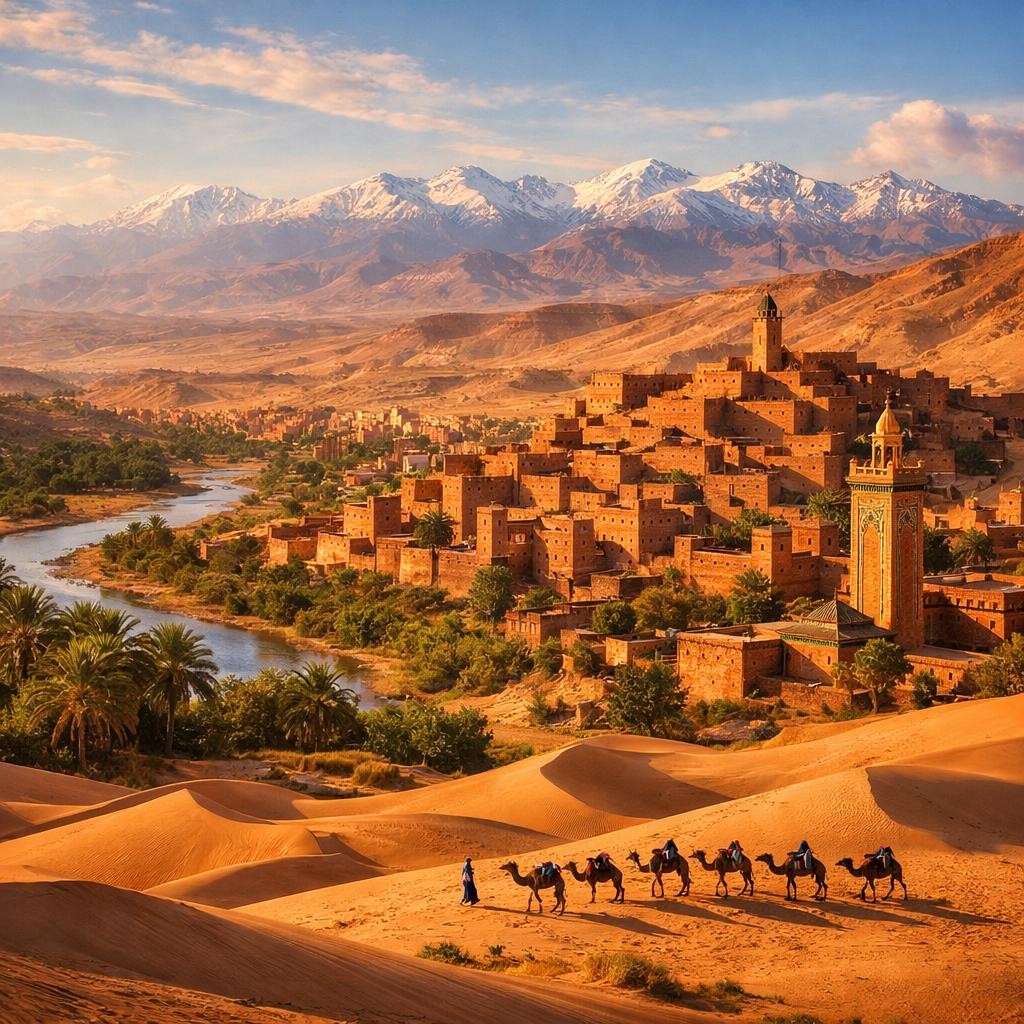
Morocco is one of those countries that can give you a completely different mood from one stop to the next. You can have tiled riads and dense old medinas, Atlantic surf towns, blue mountain lanes, dramatic kasbah country, modern city energy, cedar forests, and Sahara-edge landscapes that feel almost unreal. That range is what makes Morocco such a compelling place to build a trip around. It is not a one-note destination, and it should not be treated like one.
The list below mixes the obvious icons with places that widen the picture and make the whole country feel richer. Yes, the classic names are here, because leaving them out would be ridiculous. But there are also places that show you Morocco is bigger than the usual medina-and-desert postcard version people carry around in their heads.
Marrakech

Country / Morocco region: central-western Morocco, inland, at the foothills of the High Atlas
What kind of place it is: Morocco’s most famous imperial city and one of its biggest sensory hits
Best for: first-time Morocco trips, riad stays, iconic sights, atmosphere, food, shopping, and travelers who want a bold unforgettable stop
Why travelers should care
Marrakech is one of those places that makes an impression almost immediately. The city has heat, color, noise, beauty, and that slightly overwhelming energy that makes people feel like they have truly arrived somewhere different. If you want one stop in Morocco that feels unmistakably iconic, this is one of the clearest choices. It is dramatic, visually rich, and packed with the kind of details that stay in your head after the trip is over.
Main highlights
The heartbeat of Marrakech is the medina and Jemaa el-Fna, which is not just a square but more like a giant shifting public stage. Around it, you have souks, courtyards, tiled interiors, and some of the city’s most beautiful heritage sites. Bahia Palace stands out for its ornate rooms, carved details, and quiet courtyards, while Ben Youssef Madrasa is one of those places where the geometric tilework, carved wood, and symmetry make you want to stop and stare for a while instead of rushing through. The Koutoubia also gives Marrakech one of the most recognizable skylines in the country.
Historical points of interest
Marrakech is one of Morocco’s great imperial cities, and that history gives the place real weight beneath all the visual appeal. The city’s mosque, palaces, madrasa traditions, and old-city layout are a huge part of why Marrakech feels so substantial rather than simply photogenic. It is a place where the architecture and urban texture do a lot of the storytelling for you.
Don’t miss
- Jemaa el-Fna, because it is one of the clearest expressions of Marrakech’s energy and atmosphere
- Bahia Palace, because the painted ceilings, courtyards, and decorative work are part of what make Marrakech feel visually special
- Ben Youssef Madrasa, because it is one of the city’s most beautiful interiors and a great reminder that this is not just a market destination
- The souks, because wandering them is part of the Marrakech experience whether or not you buy anything
- Time on a rooftop or in a riad courtyard, because Marrakech is one of those cities where atmosphere matters as much as sightseeing
Why I recommend it
Because if someone is going to Morocco and wants one place that feels like a major headline stop, Marrakech earns that role very easily. It is high-impact, beautiful, memorable, and loaded with trip-defining moments.
Side notes / good to know
- This is one of the strongest first-time Morocco picks
- It can be intense, so it is not the place I would choose for a super low-key trip
- If you love beautiful interiors and decorative detail, Marrakech gives a lot back
- This is one of the clearest “you’re really in Morocco now” destinations in the country
Fez

Country / Morocco region: northern inland Morocco, northeastern side of the country
What kind of place it is: a deeply historic imperial city with one of the most famous old medinas in the country
Best for: history lovers, craft traditions, old-city atmosphere, cultural depth, and travelers who want a more layered and traditional-feeling stop
Why travelers should care
Fez feels older, denser, and more inward than Marrakech. If Marrakech is the big theatrical entrance, Fez is the place that pulls you further into Morocco’s historical and cultural depth. This is a city for travelers who like texture, layers, craftsmanship, and the feeling that history is still built into the rhythm of everyday life.
Main highlights
The medina is the star here, and the point is not just that it is old, but that it still feels alive and intricate. Fez is known for its tanneries, madrasas, artisan culture, and maze-like urban fabric. Al Quaraouiyine is one of the city’s most famous historical institutions, Bou Inania Madrasa is one of those places where the craftsmanship gives you a reason to slow down, and the tannery views give you one of the most recognizable visuals in Morocco.
Historical points of interest
Fez has enormous historical importance in Morocco, and it feels that way on the ground. The city’s religious, educational, and craft traditions give it more than just visual appeal. It has intellectual and cultural heft, which is part of why it appeals so strongly to travelers who want a stop that feels deeply rooted rather than merely scenic.
Don’t miss
- The medina itself, because this is the kind of place where wandering is a major part of the experience
- A tannery overlook, because it is one of Fez’s most famous and most visually distinctive sights
- Bou Inania Madrasa, because the architecture and detail help explain why Fez matters
- Time in the artisan quarters, because craft heritage is part of the city’s identity
- Quiet moments in courtyards and narrower lanes, because Fez rewards travelers who look past the obvious photo stops
Why I recommend it
Because if you want Morocco with historical weight, traditional atmosphere, and a stronger sense of cultural depth, Fez is one of the country’s best answers.
Side notes / good to know
- Fez can feel more intense and less polished than some travelers expect
- This is a great pick for travelers who care about history and heritage more than nightlife or modern gloss
- It pairs well with a calmer stop later in the trip
- Fez is a strong choice when you want Morocco to feel old, textured, and substantial
Chefchaouen

Country / Morocco region: northwestern Morocco, Rif Mountains, inland mountain north
What kind of place it is: a blue-painted mountain town with a slower pace and a very photogenic old core
Best for: scenic beauty, slower-paced trips, photography, mountain atmosphere, and travelers who want one stop that feels gentler
Why travelers should care
Chefchaouen has a softer, calmer appeal than Morocco’s major imperial cities. People know it for the blue-painted streets, but what makes it work is the whole mood: the mountain setting, the slower rhythm, the walkability, and the way the town feels like a breather in a bigger itinerary. It is pretty, yes, but it also changes the emotional tone of a trip.
Main highlights
The medina is the obvious draw, but Chefchaouen is not just a photo backdrop. Its lanes, steps, doorways, and little squares make wandering feel easy and satisfying. The kasbah and museum area add heritage, Ras El Maa gives you one of those simple refreshing edge-of-town moments, and the hill near the Spanish Mosque gives you one of the best wider views over the blue town and surrounding mountains.
Historical points of interest
Chefchaouen has a more compact historical feel than Marrakech or Fez, but it still has strong heritage value through its medina, kasbah, craft traditions, and mountain-town identity. It feels distinct within Morocco because it blends old-town character with a more relaxed and scenic setting.
Don’t miss
- Wandering the blue lanes without rushing, because Chefchaouen works best when you let it unfold slowly
- The kasbah area, because it gives the town more than just “pretty walls” appeal
- Ras El Maa, because it adds a small natural pause near the edge of the medina
- The Spanish Mosque viewpoint, because seeing the town from above helps the whole setting make sense
- Time in the main square, because the social energy there is part of what makes the town feel lived in
Why I recommend it
Because it gives Morocco a different mood. It is scenic, slower, mountain-set, and easier to breathe in after some of the country’s bigger, denser stops.
Side notes / good to know
- This is one of the easiest Morocco picks to love visually
- It is especially strong when paired with more intense cities
- Chefchaouen is not the biggest headline-history stop, but it is one of the most charming
- It is a good reminder that Morocco is not all desert and medinas
Essaouira

Country / Morocco region: western Morocco, Atlantic coast, west coastal Morocco
What kind of place it is: a historic fortified coastal town with a breezy, artsy, seafood-and-sea-air kind of feel
Best for: coastal breaks, seafood, a calmer medina, creative energy, and travelers who want Morocco with breathing room
Why travelers should care
Essaouira is one of the easiest places in Morocco to enjoy. It gives you a medina and heritage, but with Atlantic light, sea views, blue boats in the port, and a pace that feels much gentler than Marrakech or Fez. This is a very good stop for people who want Morocco without constant intensity.
Main highlights
The fortified ramparts and medina are the backbone of Essaouira, but the fishing-port atmosphere is part of the charm too. The Skala areas give you dramatic ocean views and that windswept fortified look that makes the city feel distinct. The port, the boats, the seafood, the artisan culture, and the Atlantic weather all work together to give Essaouira real personality instead of generic “cute seaside town” energy.
Historical points of interest
Essaouira’s medina and fortifications matter because they give the town a real historic backbone. This is not just a beach stop. The ramparts, gates, and defensive structures help explain why the place feels so distinctive visually and why it holds its own against Morocco’s inland heritage cities.
Don’t miss
- The ramparts and Skala viewpoints, because the sea-and-stone contrast is one of Essaouira’s biggest visual payoffs
- The port, because the blue boats and working-harbor atmosphere are part of the city’s identity
- Fresh seafood, because this is one of the Morocco stops where the coastal setting really shows up on the plate
- Wandering the medina, because it feels calmer and easier than some of Morocco’s bigger old cities
- Time by the water, because the Atlantic side of Morocco deserves its own space in the itinerary
Why I recommend it
Because it gives a Morocco trip contrast. It is breezy, attractive, historic, and relaxed in a way that many travelers end up being very grateful for.
Side notes / good to know
- This is a great counterbalance to Marrakech or Fez
- Wind is part of the experience here, not a fluke
- Essaouira is a good choice for travelers who want atmosphere without as much chaos
- It is one of the best coast-with-character stops in Morocco
Casablanca

Country / Morocco region: west-central Morocco, Atlantic coast, central western coastal Morocco
What kind of place it is: Morocco’s biggest city and economic hub, with modern energy, oceanfront scale, and standout architecture
Best for: city lovers, architecture, shorter stopovers, business travel, smoother arrivals or departures, and travelers who want a more modern urban Morocco
Why travelers should care
Casablanca is not trying to be Fez or Marrakech, and that is exactly why it can be worth including in a broader Morocco trip. This is the Morocco stop for travelers who want to see the country’s modern urban face alongside its older icons. It is bigger, busier, and more contemporary, but it still has major sights and a distinct role in how many travelers actually experience Morocco.
Main highlights
The Hassan II Mosque is the major headline here, and it earns that status. Its position over the Atlantic, its scale, and its detailing make it one of the most dramatic urban sights in the country. Beyond that, Casablanca gives you the Ain Diab Corniche, the Habous neighborhood, the old medina, and a broader big-city feel that helps round out a Morocco itinerary.
Historical points of interest
Casablanca is more modern in feel than many stops on this list, but it still has historic layers through the old medina, traditional quarters, and the way older and newer city identities overlap. It is not the place I would choose for Morocco’s deepest historical immersion, but it matters because it shows a different chapter of the country.
Don’t miss
- Hassan II Mosque, because this is the city’s true must-see and one of the most dramatic sights in Morocco
- Ain Diab Corniche, because it adds oceanfront city energy to the experience
- Habous, because it gives you a more traditional-feeling side of Casablanca
- The old medina, because it helps connect the modern city back to older layers
- Time just observing the city’s rhythm, because Casablanca is strongest when you let it be itself instead of comparing it to everywhere else
Why I recommend it
Because it broadens the trip. Morocco is not only old cities and desert romance, and Casablanca helps make that point in a useful, grounded way.
Side notes / good to know
- This is not the most romantic Morocco stop, but it is an important one
- It works especially well as a first or last stop
- Casablanca is a better pick than some travelers expect if they enjoy architecture and modern city energy
- This is the place to see Morocco’s bigger urban scale
Merzouga / Sahara edge

Country / Morocco region: southeastern Morocco, deep inland, Sahara-edge southeast
What kind of place it is: one of Morocco’s classic desert gateways, with dunes, camps, camel routes, and huge open landscapes
Best for: bucket-list desert trips, dramatic scenery, sunrise and sunset lovers, and travelers who want Morocco’s most cinematic landscape experience
Why travelers should care
If the dream is dunes, golden light, and that expansive Sahara-edge atmosphere people imagine when they picture desert Morocco, Merzouga is one of the clearest answers. This is where the country shifts into a much more open, elemental kind of beauty. It feels less about monuments and more about scale, silence, and landscape.
Main highlights
Erg Chebbi is the star. These are the big dunes people come for, and they deliver the kind of dramatic light-and-shadow landscape that can make even a simple sunrise feel like a major event. Camel rides, desert camps, sand-based excursions, and the general visual payoff of the dunes are what make this part of Morocco so memorable. Dayet Srij and the wider area also add more than just “sand and go home” energy if you want a fuller desert-edge experience.
Historical points of interest
The draw here is less monumental history and more long-standing desert culture, routes, and landscapes tied to the wider Saharan world. This part of Morocco feels significant because it connects the country to a very different kind of environment and travel tradition than the imperial cities do.
Don’t miss
- Erg Chebbi at sunrise or sunset, because the light is part of what makes the dunes unforgettable
- A desert camp night, because this is one of the experiences people actually remember years later
- A camel or 4×4 excursion if that suits your style, because the wider landscape is the point
- Time simply looking and listening, because desert places lose something when they are rushed too hard
- Packing for temperature swings, because desert does not mean one flat temperature all day and night
Why I recommend it
Because if the desert is part of your Morocco dream, this is one of the strongest ways to make that dream feel real rather than symbolic.
Side notes / good to know
- This is best when you actually give it time
- Merzouga is more about atmosphere and landscape than urban sightseeing
- It works beautifully as an emotional high point in a trip
- Do not squeeze this into an itinerary that is already too packed
Ouarzazate, Zagora, and Tinghir

Country / Morocco region: south-central to southeastern Morocco, deep interior, gateway-to-Sahara route country
What kind of place it is: dramatic kasbah-and-valley road-trip territory with desert-edge scenery, oases, and some of Morocco’s most cinematic inland landscapes
Best for: road trips, kasbah lovers, dramatic scenery, travelers who like the journey as much as the destination, and people who want southern Morocco beyond one dune stop
Why travelers should care
This region is one of the best answers for travelers who want the route itself to be part of the trip. Ouarzazate, Zagora, and Tinghir are not interchangeable city breaks. They are pieces of a broader inland Morocco that includes valleys, palm groves, oasis landscapes, kasbahs, and those long views that make a road day feel worth it.
Main highlights
This is the Morocco of the Draa Valley, Skoura palms, desert-edge tracks, and striking southern scenery. Ouarzazate’s film-world reputation adds one angle, but the bigger draw is the landscape itself and the way the region opens up into oases, old kasbah country, and dramatic routes. Tinghir gives you access to that spectacular southern mountain-and-valley look, while Zagora pushes the whole experience further toward the desert side.
Historical points of interest
Southern Morocco’s kasbah culture is a huge part of the historical appeal here. This is where fortified settlements, earthen architecture, and long-established oasis and caravan landscapes help explain why the region feels so visually distinct from the north and coast.
Don’t miss
- Kasbah-country scenery, because it is one of the most distinctive visual identities in Morocco
- Palm-grove and valley routes, because the landscape variety is part of what makes this region special
- Ouarzazate’s film connection, because it adds an extra layer of fun to the destination
- Time on the road through the region, because this is not somewhere to treat as a quick checklist stop
- A slower pace, because the south rewards travelers who let the landscapes do some of the work
Why I recommend it
Because this is one of the strongest parts of Morocco for travelers who love scenic routes, changing landscapes, and destinations that feel epic rather than tidy.
Side notes / good to know
- This is more road-trip Morocco than city-break Morocco
- It is a strong complement to Marrakech or the Sahara
- The scenery is a major part of the reason to come
- This region helps the country feel bigger and more varied
Tangier

Country / Morocco region: far northern Morocco, coastal north, where the Mediterranean and Atlantic meet near the Strait of Gibraltar
What kind of place it is: a northern port city with layered identity, sea views, old-city atmosphere, and strong crossover energy between worlds
Best for: northern Morocco itineraries, travelers arriving from Spain, sea views, shorter Morocco trips, and people who like coastal cities with mixed influences
Why travelers should care
Tangier feels different from Morocco’s more classic interior circuit, and that is part of the appeal. It has long been a city of crossings, coastlines, and layered identities. If you want Morocco with sea air, old-city texture, and a stronger north-facing feeling, Tangier is a very smart addition.
Main highlights
The kasbah, great mosque, Mendoubia gardens, Cape Spartel, and the Caves of Hercules give Tangier more range than people sometimes expect. This is a place where you can mix city streets with Atlantic views, old-town wandering with coastal landmarks, and that whole “edge of continents” feeling that makes Tangier feel symbolically bigger than just another urban stop.
Historical points of interest
Tangier’s historical importance is tied to trade, geography, and its long-standing role as a contact point. You feel that in the medina, kasbah, and broader city atmosphere. It is one of Morocco’s more outward-looking destinations, and that gives it a character all its own.
Don’t miss
- The kasbah, because it is one of the city’s clearest historic anchors
- Cape Spartel, because the coastal setting there adds drama and geographic significance
- The Caves of Hercules, because they are one of Tangier’s best-known landmarks and give the city a more mythic side
- A walk through the medina, because Tangier’s old core still matters to the experience
- Time looking out at the sea, because the city’s position is part of what makes it memorable
Why I recommend it
Because Tangier brings in a different Morocco: coastal, northern, layered, and visibly shaped by where it sits.
Side notes / good to know
- This is a very logical addition if your trip includes Spain
- Tangier is not the same kind of experience as Marrakech or Fez, and that is a strength
- It helps widen the picture of Morocco beyond the usual circuit
- The coastline matters here as much as the city itself
Agadir / Taghazout

Country / Morocco region: southwestern Morocco, Atlantic coast, south-west coastal Morocco
What kind of place it is: Morocco’s easier-going beach-and-surf coast, with a resort side in Agadir and a stronger surf identity around Taghazout
Best for: beach time, surf culture, sunshine, resort stays, and travelers who want some actual downtime in the itinerary
Why travelers should care
Not everyone goes to Morocco wanting medinas all day. Agadir and Taghazout matter because they show another side of the country: beach, surf, sea air, and a more relaxed coastal holiday rhythm. If you want your Morocco trip to include a stretch that feels easier and lighter, this region earns a real place in the conversation.
Main highlights
Agadir gives you the broader resort and beach setup, while Taghazout brings in the surf-town pull. Anchor Point and the wider coastline are part of why the area has such a strong board-sports reputation. The beaches, promenades, ocean views, and generally more relaxed pace make this one of the best places in Morocco to reset a little after busier inland stops.
Historical points of interest
This area is less about monumental old-city history and more about Morocco’s Atlantic identity, coastal life, and contemporary leisure side. It matters because it rounds out the country rather than repeating what inland heritage cities already do.
Don’t miss
- Taghazout’s surf atmosphere, because it gives the region a distinct identity beyond generic beach time
- Atlantic beach time, because the coastline is the whole reason this area is worth considering
- A slower pace, because this is one of the best places in Morocco to deliberately downshift
- Oceanfront meals or sunset time, because the sea is part of the point here
- Picking the right base for your style, because Agadir and Taghazout do not feel exactly the same
Why I recommend it
Because Morocco should not be reduced to one mood, and this stretch of coast shows how well the country can also do beach-and-surf travel.
Side notes / good to know
- This is stronger for travelers who want downtime
- It pairs well with a heavier city itinerary
- If you surf or want to learn, this region becomes even more appealing
- This is one of the easiest “beach break” answers in Morocco.
Ifrane

Country / Morocco region: central-northern Morocco, Middle Atlas, inland mountain Morocco
What kind of place it is: a high-altitude mountain town known for cool air, forests, lakes, and a side of Morocco many travelers do not expect
Best for: nature lovers, cooler-weather escapes, mountain scenery, travelers who want a curveball, and people who like greener landscapes
Why travelers should care
Ifrane is one of the best reminders that Morocco is not just medinas, dunes, and Atlantic coast. This is mountain Morocco: cleaner air, cooler temperatures, cedar forests, lakes, and a much greener, calmer mood. It is a genuinely different face of the country, which is exactly why it can be such a memorable stop.
Main highlights
The lakes, springs, waterfalls, cedar forests, and mountain setting are the draw. This is not the kind of place where one giant monument does all the work. It is more about the atmosphere, the altitude, the natural scenery, and the surprise factor of seeing Morocco do this kind of landscape at all. In colder months, the ski-and-snow side makes the contrast even stronger.
Historical points of interest
Ifrane is less about imperial-city history and more about Morocco’s geographic and cultural variety. Its value is that it changes how Morocco can look and feel within one trip.
Don’t miss
- Cedar forest scenery, because it is one of the clearest reasons Ifrane feels so different
- Lakes and natural sites, because the outdoor setting is the whole point here
- Cool-air downtime, because this is one of the most refreshing contrast stops in the lineup
- A slower nature-based pace, because Ifrane works best when you let it feel different
- The surprise of mountain Morocco itself, because that is part of what makes it memorable
Why I recommend it
Because it widens the whole trip. It proves Morocco can do mountain calm and green scenery just as convincingly as it does medinas and desert drama.
Side notes / good to know
- This is one of the most surprising Morocco stops in the country.
- It works especially well if you want variety within one trip
- Ifrane is less about famous monuments and more about feel
- It is a great antidote to the stereotype that Morocco is all heat and sand
Aït Ben Haddou

Country / Morocco region: southern Morocco, near Ouarzazate, deep interior along the kasbah route
What kind of place it is: one of Morocco’s most visually striking historic sites, a fortified earthen ksar that feels almost cinematic in person
Best for: architecture lovers, road trips, southern Morocco routes, UNESCO-minded travelers, and people who want a truly memorable historic stop
Why travelers should care
Aït Ben Haddou is not just “another stop near the desert.” It is one of the most distinctive places in Morocco, full stop. The earthen architecture, the hilltop layering, and the overall silhouette of the site make it visually unforgettable. This is exactly the kind of place that sticks in people’s heads because it looks and feels unlike almost anywhere else on a standard trip.
Main highlights
The ksar itself is the whole headline, and it deserves to be. The stacked earthen buildings, defensive feel, and setting near Ouarzazate give Aït Ben Haddou a powerful visual identity. It is one of those places where simply looking at the site from a good angle is part of the experience, then walking through it lets you appreciate the textures, layout, and old-world atmosphere more closely. UNESCO recognizes it as an eminent example of southern Moroccan earthen architecture, which tracks completely once you see it.
Historical points of interest
This is one of the clearest places in Morocco to understand traditional southern earthen settlement architecture. Aït Ben Haddou matters historically because it preserves a form of built environment that helps explain the broader kasbah-country identity of the region.
Don’t miss
- A full look at the ksar from outside first, because the overall silhouette is part of what makes it so impressive
- Time walking through the site, because the textures and layout are a huge part of the experience
- Pairing it with the wider Ouarzazate route, because this place works beautifully as part of southern Morocco
- Good light if you can manage it, because this is a site that photographs and feels especially strong at the right time of day
- Taking it seriously as more than a photo stop, because it has real historical and architectural value
Why I recommend it
Because it is one of the strongest “wow, this place is special” stops in Morocco and adds a very different kind of historical beauty to the trip.
Side notes / good to know
- This is one of the most visually distinctive places in Morocco.
- It works best on a southern Morocco route rather than as an isolated detour
- Aït Ben Haddou is absolutely worth treating as a major Morocco stop.
- If you like architecture and atmosphere, this one punches above its size
Things to know before you go to Morocco

Morocco is very travelable, but it is not a destination where I would tell people to turn their brain off. Exercise increased caution due to terrorism risk, especially in tourist locations, transportation hubs, markets, and shopping areas. That does not mean panic. It means move through the country like a switched-on adult and do not confuse being on vacation with needing to be oblivious.
Water is one of those things to take seriously instead of casually hoping for the best. In many areas tap water is not potable, bottled drinks are generally safer, and ice may be made from tap water. In practical terms: sealed bottled water is the easy answer, especially early in the trip or if your stomach is easily thrown off.
Bathroom conditions can vary more than some travelers expect. Nice hotels and polished restaurants may be perfectly fine, but public or transit bathrooms can be much more basic. I would not assume toilet paper, soap, or the exact setup you are used to. Morocco is a place where tissues and hand sanitizer earn their bag space.
Language-wise, Morocco is not an English-only autopilot destination. Arabic and Amazigh are the official languages, French is widely spoken and understood, and Spanish is also common in parts of the country, especially in the north and south. In tourist zones you can often manage with English, but French is often the more useful bridge language on the ground.
Distances can also be more tiring than they look on the map. Morocco does have useful rail infrastructure, and Al Boraq connects Tangier, Rabat, and Casablanca on the high-speed line, but once you move beyond the easier northern corridor, road travel becomes a much bigger part of the equation. This is not the place to build a fantasy itinerary with twelve major stops and assume it will all feel breezy.
Morocco is also not a one-weather country. The Atlantic coast, mountain towns, imperial cities, and Sahara-edge routes do not all feel the same, and packing like they do is how people end up annoyed. Windy coast, cooler mountains, hot inland stretches, and chilly desert mornings can all show up in one trip if you move around enough.
What to pack for Morocco: short practical list
- A light scarf or modest extra layer for sun, wind, dust, coverage, or extra warmth
- A crossbody or anti-theft day bag you can keep close in crowds
- Bathroom sanitation kit with toilet covers, wet wipes, and tissues
- Portable charger
- Sunglasses, sunscreen, and a sun hat
- Reusable filtered water bottle
Final thoughts
Morocco is one of the best kinds of trip-building countries because it gives you contrast. Marrakech gives you the sensory hit. Fez gives you depth. Chefchaouen gives you softness. Essaouira gives you sea air. Casablanca gives you modern city scale. Merzouga gives you the Sahara edge. The Ouarzazate-Zagora-Tinghir route gives you dramatic inland landscapes. Tangier gives you a northern coastal crossroads. Agadir and Taghazout give you surf-and-beach breathing room. Ifrane gives you mountain surprise. Aït Ben Haddou gives you one of the most visually distinctive historic sites in the country. Morocco works so well because it can hold all of those moods at once.