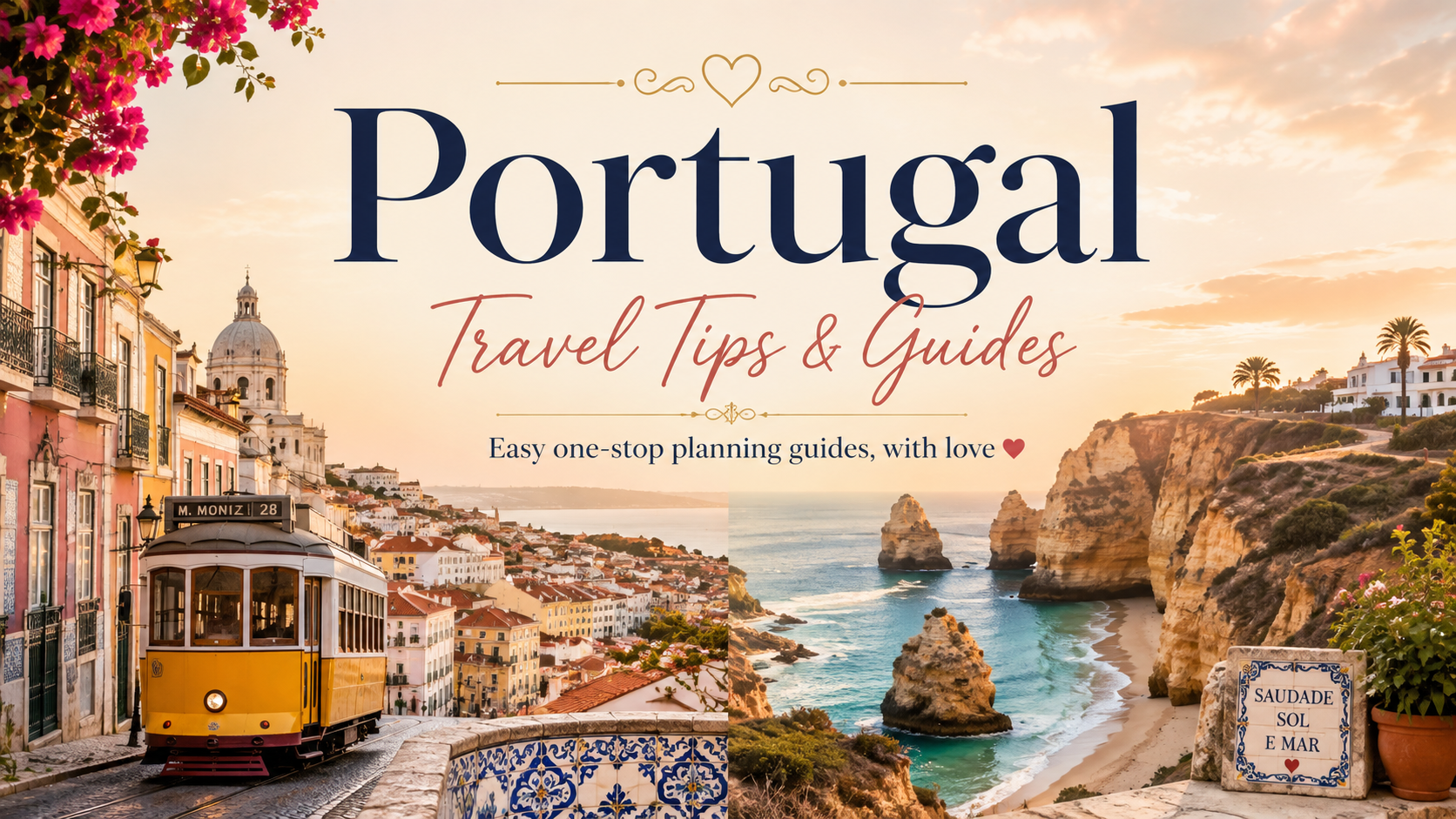
Easy One-Stop Planning Guides for Portugal
Planning a trip to Portugal can get overwhelming surprisingly fast. Lisbon or Porto? The Algarve or Madeira? Should you add Sintra, the Douro Valley, Coimbra or the Azores? When should you go? Where should you stay? What should you pack? Do you need a plug adapter? Which experiences are actually worth booking?
This page brings all of our Portugal travel planning resources together in one place so you can find what you need without digging through the entire site.
Last updated: November 21, 2026
🇵🇹 Portugal at a Glance
⚠️ Current Travel Considerations
🌦️ Weather & Best Time to Visit
🗺️ Portugal Travel Map
📍 Where to Go in Portugal
🚢 Cruises Around Portugal
🏨 Where to Stay
🧳 What to Pack
🔌 Plugs & Voltage
🎟️ Things to Do
🇵🇹 Portugal at a Glance
| Basics | Details |
|---|---|
| Capital | Lisbon |
| Language | Portuguese |
| Currency | Euro (€ / EUR) |
| Time Zone | Mainland Portugal and Madeira: Western European Time (WET); Western European Summer Time (WEST) during daylight saving time. The Azores are one hour behind mainland Portugal. |
| Driving Side | Right |
| Emergency Number | 112 |
| Plug Types | Type C and F |
| Electricity | 230V, 50Hz |
| Peak Travel Months | June through August, with July and August especially busy in Lisbon, Porto, the Algarve and popular coastal destinations |
| Popular Shoulder Seasons | April–May and September–October |
| Entry Requirements | Depend on your nationality, passport and length/purpose of stay. Always check the requirements that apply to you before traveling. |
Portugal may look small on a map, but the experience changes considerably between the cooler north, sunny Algarve, inland regions and Atlantic islands of Madeira and the Azores.
⚠️ Current Travel Considerations
Last reviewed: November 21, 2026
Current Civil Unrest & Demonstrations
Portugal is experiencing a growing wave of demonstrations over housing affordability, rising rents, wages, and the cost of living, with particularly significant protests in Lisbon and Porto.
The demonstrations have centered on Portugal’s housing crisis, with protesters calling for stronger tenant protections and more affordable housing. Many participants have established temporary protest camps in prominent city squares, bringing the demonstrations directly into areas frequently visited by tourists.
On October 20, 2026, Portuguese police moved to dismantle protest encampments in Lisbon’s Rossio Square and Porto’s Praça D. João I.
In Lisbon, the operation led to confrontations between demonstrators and police, with 55 people arrested and reports of injuries. Protesters subsequently returned to central Lisbon, pledging to continue their demonstrations.
In Porto, the removal of the encampment was considerably calmer, with demonstrators largely complying with police instructions.
The demonstrations remain ongoing, and additional gatherings, police operations, and localized disruptions are possible.
For travelers, the immediate concerns include crowded demonstration areas, temporary restrictions around public squares, transportation interruptions, and the possibility of confrontations developing unexpectedly.
Although the situation deserves attention, the disturbances have not affected every Portuguese destination equally.
Should You Travel to Portugal Right Now?
My recommendation is to avoid areas experiencing active demonstrations or confrontations with police, particularly in central Lisbon and Porto.
Portugal remains a wonderful destination for leisure travel, and the current situation doesn’t necessarily mean you should cancel an entire vacation.
However, if your plans include sightseeing around Rossio Square in Lisbon or Praça D. João I in Porto while demonstrations are taking place, I recommend changing those plans.
You don’t need to participate in a protest to find yourself caught in an uncomfortable or dangerous situation. A peaceful gathering can become tense when police begin clearing an area, streets are blocked, or crowds move unexpectedly.
This is particularly concerning when you’re visiting a foreign country where you may not know the surrounding streets or immediately understand what’s happening.
If your reservations are flexible and you would prefer a quieter vacation, consider spending your time outside the affected city centers until the situation settles down.
I wouldn’t recommend avoiding Portugal altogether at this stage. The reported confrontations have been relatively localized, and there are many other destinations where travelers can enjoy the country’s history, coastline, countryside, and beautiful smaller towns.
Conditions can change quickly, so pay attention to developments in the specific places you intend to visit, particularly if your trip is approaching.
Consider Alternative Destinations
If you were planning to spend several days in Lisbon or Porto but would prefer to avoid the current demonstrations, Portugal offers some excellent alternatives.
You may be able to enjoy much of what attracted you to Portugal in the first place without centering your vacation around the affected urban areas.
Instead of central Lisbon, consider Cascais.
Located along the coast west of Lisbon, Cascais offers beautiful beaches, a charming historic center, waterfront restaurants, scenic coastal walks, and a relaxed seaside atmosphere.
It’s an especially appealing choice for travelers who enjoy historic streets, cafés, ocean views, and easy access to coastal scenery.
Another alternative to Lisbon is Ericeira.
This picturesque coastal town is known for its traditional whitewashed buildings, dramatic Atlantic scenery, beaches, and welcoming restaurants.
Ericeira is particularly appealing for travelers seeking a slower-paced coastal getaway, whether or not they intend to surf.
Instead of central Porto, consider Guimarães.
Known for its remarkable medieval architecture, historic squares, impressive castle, and beautifully preserved old town, Guimarães offers an extraordinary introduction to Portuguese history.
It’s a wonderful destination for travelers who enjoy exploring historic streets and atmospheric smaller cities.
Another alternative to Porto is Aveiro.
With colorful boats, canals, Art Nouveau architecture, waterfront cafés, and nearby coastal communities, Aveiro offers a delightful change of scenery.
Visitors can explore the city’s canals, enjoy traditional Portuguese sweets, and venture to the colorful striped houses of Costa Nova.
For a longer coastal escape, consider the Algarve.
Southern Portugal offers beautiful beaches, spectacular cliffs, charming towns, and scenic coastal walks.
Destinations such as Lagos, Tavira, and Carvoeiro can be wonderful alternatives for travelers who would rather spend their vacation enjoying Portugal’s coastline than navigating demonstrations in larger cities.
Keep in mind that coastal destinations may have fewer services or reduced operating hours outside peak summer months.
Before changing reservations, check local conditions and transportation arrangements in your chosen destination.
My recommendation is to enjoy these places as destinations in their own right, rather than planning frequent sightseeing trips back into areas experiencing active demonstrations.
Portugal offers far too many beautiful places to feel that a vacation must revolve around Lisbon or Porto.
If You’re Already Committed to Traveling
If you have non-refundable flights, hotels, or other reservations, begin by checking whether your accommodation or travel provider will allow you to adjust your plans.
Even when reservations are described as non-refundable, it may be worth asking whether alternative dates, properties, or destinations are available.
If you’re continuing with your trip, I recommend considering experienced local or private guides for sightseeing, particularly in Lisbon or Porto while demonstrations continue.
A knowledgeable local guide can provide valuable insight into neighborhoods, public transportation, alternative routes, and changing conditions.
Local professionals familiar with the city may recognize developing problems earlier than visitors and help adjust sightseeing plans before a disruption becomes more serious.
For travelers visiting Portugal during this period:
- Avoid demonstrations, protest encampments, and large gatherings, even when they appear peaceful.
- Stay away from areas where police are dispersing crowds or restricting access.
- Check local conditions before visiting prominent public squares and busy central districts.
- Ask hotel staff or experienced local guides about demonstrations and possible road closures.
- Keep your phone charged and maintain reliable mobile data.
- Allow extra time for transportation connections and scheduled sightseeing.
- Consider taxis or private transportation when public services are disrupted and roads remain accessible.
- Choose flexible or refundable reservations for new bookings whenever possible.
- Be prepared to change sightseeing plans if demonstrations affect your intended route.
If you unexpectedly encounter a confrontation, leave the area rather than stopping to watch or photograph what is happening.
And don’t let a prepaid tour or restaurant reservation pressure you into entering an area experiencing active disturbances.
Your safety should always come before your itinerary.
Transportation Strikes & Travel Disruptions
Portugal periodically experiences transportation strikes and industrial action affecting trains, buses, metro systems, airports, and other services.
The current demonstrations have introduced additional complications, particularly around public squares and transportation hubs in Lisbon and Porto.
During the October 20 police operation in Lisbon, access to Rossio metro station was temporarily restricted before reopening later that morning.
Even when public transportation services are operating normally, demonstrations or security operations can affect surrounding streets, station entrances, and pedestrian access.
Travelers staying in central Lisbon or Porto should check whether planned demonstrations may interfere with their routes, particularly when traveling with luggage or making time-sensitive connections.
If you’re traveling between cities or connecting to an international flight, allow additional time for unexpected delays.
Reliable door-to-door transportation may be worthwhile when public services are disrupted, although private vehicles can also be affected by road closures and traffic restrictions.
Check transportation schedules, station access, and local road conditions shortly before setting out, even if everything appeared normal the previous day.
Petty Theft & Tourist Scams
Petty theft remains one of the more common concerns for visitors to Portugal, particularly in heavily visited urban areas and crowded transportation systems.
Pickpocketing, bag theft, phone theft, and distraction scams are especially worth watching for around popular attractions, public transportation, busy shopping streets, and major transportation hubs.
In Lisbon, crowded trams, metro services, and prominent sightseeing districts deserve additional awareness. Similar precautions apply around busy tourist areas in Porto.
Keep valuables secured, avoid leaving belongings unattended at cafés or restaurants, and remain cautious when strangers approach with unsolicited assistance.
During demonstrations or unexpected transportation disruptions, crowds and confusion can create additional opportunities for opportunistic theft.
Public Security & Emergency Assistance
Portugal generally offers a welcoming environment for international visitors, but travelers should remain aware of their surroundings and follow local security instructions.
Police may introduce temporary barriers, restrict access to public spaces, or divert pedestrian and vehicle traffic during demonstrations and major events.
Visitors should respect these restrictions and avoid entering areas where confrontations are developing.
The emergency number throughout Portugal is 112, which can be used to request police, ambulance, or fire assistance.
Travelers should also keep their accommodation details and important contact information accessible in case plans change unexpectedly.
Weather & Natural Hazards
Portugal’s climate varies considerably between its northern regions, central cities, southern coastline, and Atlantic islands.
Summer heatwaves can make sightseeing uncomfortable, particularly in inland areas, while hot and dry conditions increase wildfire risks in parts of the country.
Heavy rainfall may cause localized flooding, landslides, and transportation disruptions, especially during wetter months.
Coastal travelers should pay attention to strong Atlantic currents, rough surf, and changing sea conditions, particularly along exposed beaches.
Portugal is also an earthquake-prone country, and the Azores experience additional volcanic and seismic activity.
Travelers visiting Madeira, the Azores, mountain regions, or remote coastal areas should account for seasonal weather conditions and possible disruptions to outdoor activities.
Final Thoughts
Portugal remains a beautiful and rewarding destination, with historic cities, charming towns, spectacular coastline, excellent food, and wonderful places to explore.
The current housing demonstrations deserve attention, particularly in central Lisbon and Porto, but they are not affecting every part of the country in the same way.
My recommendation is to avoid active demonstration areas and police confrontations, and consider changing your sightseeing plans or accommodation if protests are affecting the neighborhoods you intended to explore.
For travelers who prefer a quieter experience, Cascais, Ericeira, Guimarães, Aveiro, and the Algarve offer appealing alternatives worth considering.
If you’re already committed to traveling, experienced local guides, flexible reservations, and careful attention to local conditions can make a meaningful difference.
There is no reason to put yourself in the middle of an avoidable confrontation simply because a famous square or attraction happens to be on your itinerary.
Conditions may improve quickly, so keep a close eye on developments before departure and throughout your visit.
Portugal has far too much to offer to let a few disrupted city squares define your entire vacation. With thoughtful planning and a little flexibility, you may discover an entirely different side of the country.
🌦️ Portugal Weather by Month
Portugal does not have one single climate.
Northern Portugal is generally cooler and wetter than Lisbon and the south, while the Algarve tends to be warmer and sunnier. Madeira remains relatively mild throughout the year, and the Azores have their own wetter, changeable Atlantic climate.
Use this as a quick planning overview rather than a forecast for your specific trip.
| Month | What to Generally Expect |
|---|---|
| January | Mild compared with much of Europe, but cool and wetter. Northern Portugal sees more rain, while Lisbon and the Algarve are generally milder. |
| February | Still cool and changeable with periodic rain. Southern Portugal tends to be more comfortable than the north. |
| March | Transitional spring weather with increasingly mild days, longer daylight and a mix of sunshine and rain. |
| April | Pleasant spring conditions across much of the country. Rain is still possible, but temperatures become increasingly comfortable for sightseeing. |
| May | Warm, sunny and one of the easiest months for combining cities, countryside and coast before peak summer crowds arrive. |
| June | Warm to hot, generally dry and sunny. Beach season is well underway and visitor numbers begin climbing. |
| July | Hot, dry and very busy in many popular destinations. Inland areas can become particularly hot. |
| August | Hot, sunny and peak season, especially along the Algarve and other coastal areas. Heat can make intensive sightseeing harder. |
| September | Often still warm and summery, particularly early in the month, with excellent conditions for cities, coast and wine regions. |
| October | Mild to warm early in the month, gradually cooler and wetter later. Often excellent for sightseeing and food- or wine-focused trips. |
| November | Cooler and wetter, especially in northern Portugal. Lisbon and the south remain relatively mild but become less predictable. |
| December | Mild winter conditions overall, with more rain and cooler evenings. Northern and inland areas can feel considerably colder than the Algarve. |
⭐ Best Time to Visit Portugal
For the best overall combination of comfortable weather, sightseeing conditions and manageable crowds, April through May and September through October are generally the sweet spots for visiting Portugal.
May and September are especially strong all-around choices. You can usually combine cities, coastal areas, day trips and outdoor sightseeing without dealing with the biggest summer crowds or the most intense heat.
There are plenty of exceptions depending on the trip you want. July and August are ideal for travelers prioritizing beaches and classic summer weather, while Madeira can work beautifully throughout much of the year.
🥵 Most Challenging Time to Visit Portugal
For sightseeing-focused travelers, July and August can be the most challenging months.
Popular destinations become much busier, accommodations can cost more, and heat can make steep streets and long walking days in places such as Lisbon, Porto and inland Portugal more tiring.
Hot, dry periods can also increase wildfire risk.
That does not make summer a bad time to visit — especially if the Algarve or another beach destination is the priority — but spring and fall are usually easier for travelers planning a broader sightseeing trip.
Important: Always check the actual forecast for the cities and regions you are visiting shortly before departure. Porto, Lisbon, the Algarve, Madeira and the Azores can require very different packing on the same date.
🗺️ Get Oriented: Portugal’s Main Travel Areas

These are the places travelers are most likely to encounter while planning:
Porto & Northern Portugal: Porto, Braga, Guimarães, Viana do Castelo and the Douro Valley
Central Portugal: Coimbra, Aveiro, Nazaré, Óbidos and Serra da Estrela
Lisbon Region: Lisbon, Sintra and Cascais
Alentejo: Évora, Monsaraz, inland wine country, Comporta and the Alentejo Coast
Algarve: Lagos, Faro, Tavira, Albufeira, Sagres and Portugal’s famous southern beaches and cliffs
Atlantic Islands: Madeira and the Azores
You do not need to fit all of these into one trip.
Portugal rewards travelers who choose a few places that work naturally together instead of trying to cover the mainland, Algarve and islands in one rushed itinerary.
📍 Start Here: Where Should You Go in Portugal?
If you haven’t decided exactly where you’re going yet, start with our complete Portugal destination guide.
Best Places to Visit in Portugal: Lisbon, Porto, Madeira, the Algarve, Sintra & More
From Lisbon, Porto and Sintra to the Algarve, Douro Valley, Madeira, Azores and smaller historic towns, this is the best starting point for deciding which parts of Portugal actually belong on your trip.
→ Read: Best Places to Visit in Portugal
🍷 Festivals & Seasonal Experiences
Your dates can completely change the kind of Portugal trip you experience.
Wine harvest season transforms the Douro Valley in early fall, summer brings festivals and celebrations across the country, winter adds Christmas markets and holiday lights, and Portugal’s religious and cultural calendar creates events throughout the year.
Lisbon’s Santo António celebrations, Porto’s São João festivities, Madeira’s Flower Festival, Carnival, wine harvest season and Christmas events are all worth checking before you finalize your dates.
Portugal festivals & seasonal experiences guide coming soon.
🚢 Cruises Around Portugal
Portugal appears on a wide range of Atlantic, Mediterranean, Canary Islands, transatlantic and repositioning cruise itineraries.
Lisbon is the country’s biggest cruise gateway, while Porto / Leixões, Madeira and the Azores can also appear on itineraries depending on the route.
Cruises can be especially useful for travelers who want to combine Portugal with Spain, the Canary Islands or other Atlantic destinations without building a longer land itinerary.
Portugal cruise guide coming soon.
🏨 Where to Stay in Portugal
Once you know where you’re going, choosing the right area and hotel can make a major difference — especially in Portugal’s hillier cities.
Our hotel guides are designed for different traveler types and budgets rather than assuming everybody wants the same kind of stay.
Lisbon
Porto
More Portugal hotel guides will be added here as we build them.
🧳 What to Pack for Portugal
What you need depends heavily on when you visit and which parts of Portugal are on your itinerary.
Lisbon and Porto require comfortable walking shoes for hills and stone streets, the Algarve adds beach gear and stronger sun protection, and Madeira or the Azores can require more outdoor layers and weather flexibility.
🌸 Spring
→ No-Brainer Carry-On Only Packing List for Portugal in Spring
A practical carry-on packing list for Portugal’s changing spring temperatures, lots of walking, coastal breezes and city sightseeing.
☀️ Summer
→ Exactly What to Pack for Portugal in Summer: June, July & August
A realistic summer packing list for Portugal’s heat, sunshine, beaches, hills, long sightseeing days and breezier coastal evenings.
🍂 Fall
→ Exactly What to Pack for Portugal in Fall: September, October & November — Carry-On Only
September can still feel distinctly summery while November becomes cooler and wetter, particularly in northern Portugal. This guide breaks down what actually makes sense for all three fall months.
❄️ Winter
→ What to Pack for Portugal in Winter (December–February) — Complete Packing List
Portugal’s winters can bring mild sunshine, chilly evenings, Atlantic winds, and plenty of rain, depending on where you’re visiting. This complete packing guide covers practical layers, rain protection, comfortable walking shoes, and travel essentials for Lisbon, Porto, the Algarve, Madeira, the Azores, and beyond — with realistic quantities for two-week holidays through month-long adventures.
🔌 Portugal Plugs, Outlets & Voltage
Portugal uses 230V electricity at 50Hz, with Type C and Type F outlets.
Whether you need only a plug adapter or need to think about voltage compatibility depends on where you are traveling from and what devices you are bringing.
→ Read: 🇵🇹 Portugal Outlet, Plug & Voltage Guide for Travelers — Complete Guide
The full guide explains adapters, voltage, converters and what travelers from different electrical systems need to know.
🎟️ Things to Do in Portugal
Already know where you’re going — or already there?
These guides are designed to help you find experiences worth adding to your trip, including food, culture, day trips, unusual activities, scenic experiences and major attractions.
Lisbon
More city and regional activity guides will be added as we continue exploring Portugal.
❤️ Helpful Travel Guides for Any Trip
Some travel questions aren’t specific to Portugal. These Travel Tips With Love guides can help wherever you’re going.
🧳 Choosing & Packing Your Luggage
✈️ Surviving a Long Flight
🎒 Check Your Airline’s Carry-On Limits
Airline rules vary enormously, especially when you’re connecting between different carriers.
→ Global Carry-On & Personal Item Size Limits by Airline A–Z
🤒 What If You Get Sick While Traveling?
→ What to Do If You Get Sick While Traveling
🎟️ Should You Book Activities Ahead?
Some experiences sell out weeks ahead. Others are perfectly fine to book after you arrive.
→ Should I Book Tours & Activities Ahead of Time?
💆♀️ Make Any Vacation Feel More Relaxing
You don’t have to book an expensive wellness resort to work a little spa time into your trip.
→ How to Make Any Vacation a Spa Vacation
🌍 Explore More Countries
Not sure Portugal is the trip this time?
Explore our All Countries Travel Tips & Guides to find destination planning hubs around the world.
Each country hub brings together practical planning information, current travel considerations, weather basics and all of our available destination guides in one easy place.
→ Explore All Countries & Destinations
This Portugal hub is a living travel-planning resource. I update it as new Travel Tips With Love Portugal guides are published and as important planning or safety information changes.
From Tracy, With Love ♥