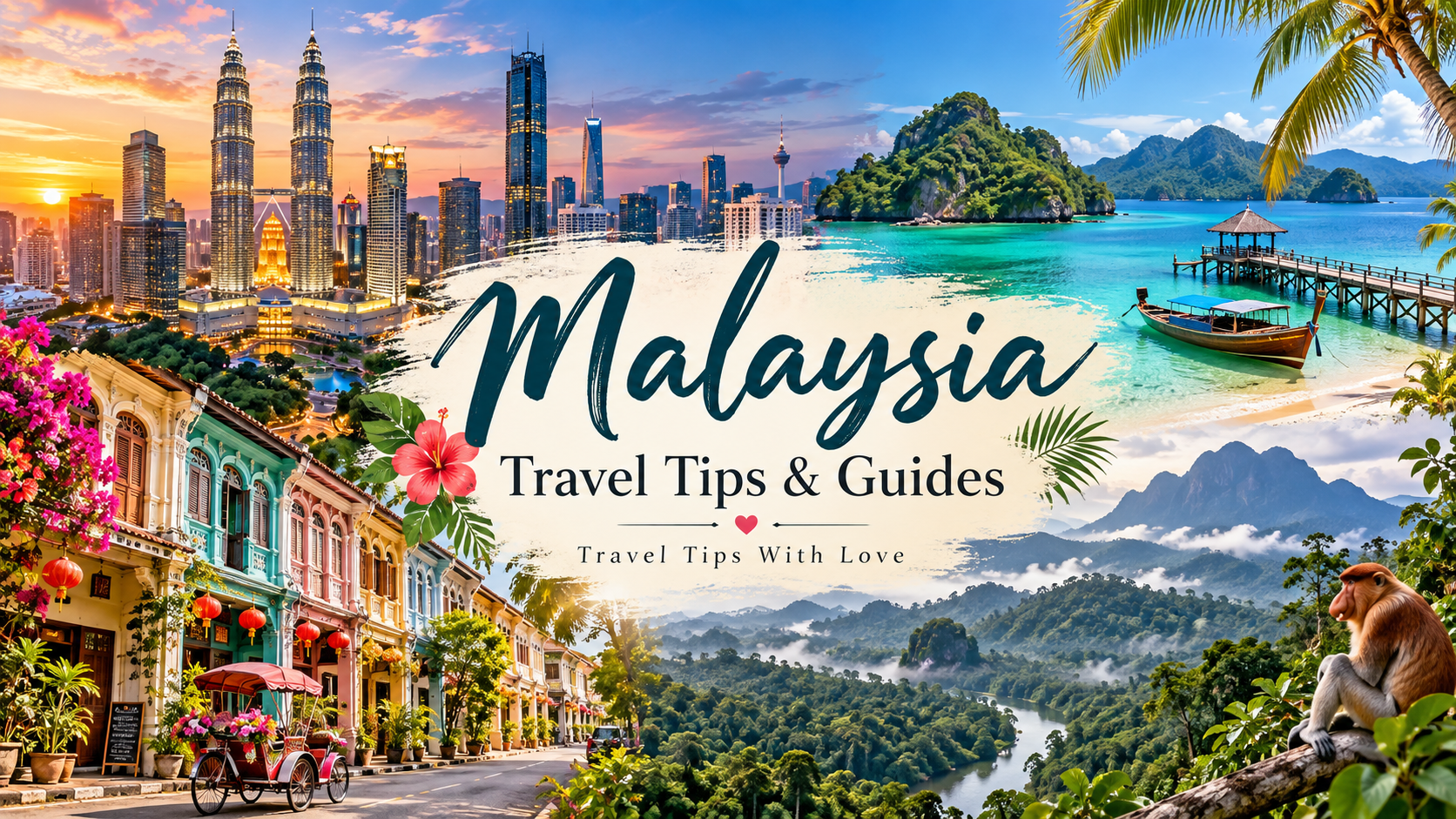
Malaysia easy travel tips and planning guides, with love
Easy One-Stop Planning Guides for Malaysia
Planning a trip to Malaysia can get overwhelming surprisingly fast. Kuala Lumpur or Penang? Langkawi or the east coast islands? Peninsular Malaysia or Borneo? City food trip, rainforest adventure or beach vacation? When should you go? Where should you stay? What should you pack? Do you need a plug adapter?
Malaysia can feel like several completely different trips folded into one country. You can wander beneath Kuala Lumpur’s skyscrapers, eat your way through George Town, relax on Langkawi, cool off in the Cameron Highlands, explore historic Melaka, look for wildlife in Borneo or disappear onto tropical islands surrounded by clear blue water.
This page brings all of our Malaysia travel planning resources together in one place so you can find what you need without digging through the entire site.
Last updated: September 30, 2026
🇲🇾 Malaysia at a Glance
⚠️ Current Travel Considerations
🌦️ Weather & Best Time to Visit
🗺️ Malaysia Travel Map
📍 Where to Go in Malaysia
✈️ Malaysia Airport Guides
🚢 Cruises Around Malaysia
🏨 Where to Stay
🧳 What to Pack
🔌 Plugs & Voltage
🎟️ Things to Do
🇲🇾 Malaysia at a Glance
| Basics | Details |
|---|---|
| Capital | Kuala Lumpur |
| Official Language | Malay |
| Currency | Malaysian Ringgit (RM / MYR) |
| Time Zone | Malaysia Time (MYT), UTC+8 |
| Driving Side | Left |
| Emergency Number | 999 |
| Plug Type | Type G |
| Electricity | 230V, 50Hz |
| Peak Travel Months | Vary by region; December–February are especially popular on the west coast, while March–October is better for many east coast islands |
| Popular Shoulder Seasons | Depend heavily on which coast or region you are visiting |
| Entry Requirements | Depend on your nationality, passport and length/purpose of stay. Foreign visitors should also check whether they need to complete Malaysia’s Digital Arrival Card before traveling. |
Malaysia sits close to the equator, so it stays warm and humid throughout the year. The bigger seasonal difference is often rainfall rather than temperature, and the best month can change dramatically depending on whether you are visiting Kuala Lumpur, Langkawi, Penang, the east coast islands or Malaysian Borneo.
⚠️ Current Travel Considerations
Last reviewed: September 30, 2026
Malaysia remains a destination I am comfortable recommending for ordinary leisure travel.
Most popular visitor destinations — including Kuala Lumpur, Penang, Langkawi, Melaka, the Cameron Highlands and much of Malaysian Borneo — can be visited with normal travel precautions.
There are, however, a few things worth knowing before you finalize an itinerary.
Eastern Sabah Offshore Islands
The biggest geographic exception involves islands and maritime areas off the eastern coast of Sabah.
There is a longstanding kidnapping risk in waters and islands off parts of eastern Sabah, particularly between the Kudat/Sandakan area and Tawau.
Current travel guidance treats these offshore areas more cautiously than Malaysia as a whole, and some islands and dive sites carry particularly strong warnings.
This does not mean travelers need to avoid Sabah entirely. Kota Kinabalu and mainland Sabah are not covered by the same broad offshore warning.
If your trip involves remote dive resorts, islands or boat travel off eastern Sabah, check the exact location before booking rather than assuming that all Sabah destinations have the same risk level.
Petty Theft & Tourist Scams
Malaysia is generally comfortable for tourists, but ordinary city precautions still make sense.
Keep an eye on phones, bags and wallets in crowded markets, transportation hubs and busy tourist areas, and be cautious about unfamiliar payment requests, unofficial transportation offers or deals that seem unusually good.
Tropical Weather & Flooding
Heavy tropical rain can cause localized flooding and transportation disruption.
This matters particularly during monsoon periods, and it can affect ferries, island transfers, road travel and outdoor activities even when your hotel destination itself remains perfectly usable.
If your itinerary depends on boats or small islands, build in some flexibility.
Malaysia Digital Arrival Card
Many foreign visitors use the Malaysia Digital Arrival Card (MDAC) as part of the arrival process.
Requirements and exemptions depend on the traveler, so check the current rules shortly before departure and use Malaysia’s official immigration system rather than third-party websites offering paid submission services.
🌦️ Malaysia Weather by Month
Malaysia is tropical year-round, so temperatures do not change as dramatically as they do in four-season destinations.
What changes more noticeably is where the heaviest rain falls.
The west coast, east coast and Malaysian Borneo do not follow exactly the same weather pattern.
Use this as a broad planning overview rather than a forecast for your specific trip.
| Month | What to Generally Expect |
|---|---|
| January | Hot and humid. Generally one of the better periods for Kuala Lumpur, Penang and Langkawi, while the northeast monsoon can bring heavy rain and rough seas to east coast islands. |
| February | Warm and tropical with relatively favorable conditions on much of the west coast. East coast island conditions may still be affected by monsoon weather. |
| March | Hot, humid and increasingly workable across more of the country. East coast island seasons begin improving as the northeast monsoon eases. |
| April | Hot with frequent showers and thunderstorms. Inter-monsoon weather can bring sudden heavy rain, but travel remains very possible. |
| May | Hot and humid with regular tropical showers. East coast beaches and islands are becoming increasingly attractive. |
| June | Warm, humid and generally excellent for many east coast islands. Kuala Lumpur, Penang, Langkawi and Borneo remain very possible with periodic rain. |
| July | Hot and humid with strong island conditions in many east coast destinations. A popular month for broader Malaysia itineraries. |
| August | Similar to July — tropical heat, humidity and rain showers, with many east coast islands still in their best season. |
| September | Rain begins increasing on parts of the west coast while many east coast islands remain accessible earlier in the month. |
| October | Transitional and increasingly rainy in several regions. Heavy downpours can occur, particularly around the west coast and during inter-monsoon periods. |
| November | Northeast monsoon conditions begin affecting the east coast more strongly. Some island resorts and boat services reduce operations or close for the season. |
| December | Popular on the west coast around Langkawi and Penang, while the east coast can experience heavy rain, rough seas and seasonal resort closures. |
⭐ Best Time to Visit Malaysia
There is no single best month for every Malaysia trip.
If your itinerary centers on Kuala Lumpur, Penang and Langkawi, the drier part of the west-coast season — particularly around December through February — can be especially appealing.
If your priority is the Perhentian Islands, Redang, Tioman or other east coast beach destinations, March through October is generally the more practical season.
June, July and August can also work wonderfully for travelers combining Kuala Lumpur, Penang, Borneo and islands, provided you are comfortable with tropical heat, humidity and occasional heavy rain.
Malaysia is not a destination where a rain symbol in the forecast automatically means a ruined day. Tropical showers can be intense and then disappear surprisingly quickly.
🌧️ Most Challenging Time to Visit Malaysia
The hardest period depends on your itinerary.
For the east coast islands, roughly November through February can be particularly challenging because the northeast monsoon brings heavier rain, rougher seas and seasonal closures.
On the west coast, September through December tends to bring heavier rainfall.
That does not make Malaysia unusable during those months. Kuala Lumpur, Penang, Melaka and other city destinations remain active year-round.
The main lesson is to choose your coast and islands according to the season, rather than treating Malaysia as one single weather zone.
Important: Always check the actual forecast and ferry conditions for the destinations you are visiting shortly before departure.
🗺️ Get Oriented: Malaysia’s Main Travel Areas

Malaysia is divided into two major geographic sections separated by the South China Sea.
Peninsular Malaysia
Kuala Lumpur & Klang Valley: Kuala Lumpur, Batu Caves, Putrajaya and Malaysia’s main international gateway
Northwest Malaysia: Penang / George Town, Langkawi and nearby northern destinations
Central Highlands: Cameron Highlands and cooler mountain landscapes
Historic Southwest: Melaka and its old trading-port neighborhoods
East Coast: Kuantan, the Perhentian Islands, Redang, Tioman and other seasonal beach destinations
Rainforest Interior: Taman Negara and jungle-focused trips
Malaysian Borneo
Sabah: Kota Kinabalu, Mount Kinabalu, Kinabalu Park, wildlife areas, islands and marine destinations
Sarawak: Kuching, national parks, caves, rainforest landscapes and cultural experiences
Malaysia rewards travelers who choose a few regions instead of trying to see everything at once.
Flying between Peninsular Malaysia and Borneo is easy enough to build into a longer trip, but Kuala Lumpur, Penang, Langkawi, the Cameron Highlands, the east coast islands, Sabah and Sarawak can quickly turn one vacation into several completely different itineraries.
📍 Start Here: Where Should You Go in Malaysia?
If you haven’t decided exactly where you’re going yet, start with our complete Malaysia destination guide.
Best Places to Visit in Malaysia: Kuala Lumpur, Penang, Langkawi, Borneo, Islands & Rainforest Escapes
Malaysia can give you skyline cities, food-focused historic neighborhoods, tropical islands, cool tea-growing highlands, rainforest, wildlife and Borneo adventures all in the same country.
This guide breaks down the major destinations and helps you figure out which ones actually belong on your trip.
→ Read: Best Places to Visit in Malaysia
✈️ Malaysia Airport Guides
Malaysia has an extensive aviation network, and domestic flights are particularly useful when combining Peninsular Malaysia with Borneo or covering larger distances without spending entire days on the road.
Our airport guides are designed to explain what actually happens when you use each airport — terminals, security, baggage, food, lounges, transportation, accessibility, hotels, layovers and the little quirks that can otherwise catch you by surprise.
Kuala Lumpur
Kuala Lumpur International Airport (KUL / KLIA) is Malaysia’s primary international gateway.
KLIA operates Terminal 1 and Terminal 2, and knowing which terminal your airline uses matters because they are separate facilities.
Penang
Penang International Airport (PEN) is the main gateway for Penang Island and George Town and also handles a growing number of international routes.
Langkawi
Langkawi International Airport (LGK) makes Langkawi one of Malaysia’s easiest islands to add to an itinerary without relying on a long ferry journey.
Kota Kinabalu
Kota Kinabalu International Airport (BKI) is one of the most useful gateways into Sabah and Malaysian Borneo.
Kuching
Kuching International Airport (KCH) is the primary aviation gateway for Kuching and much of Sarawak.
Individual Malaysia airport guides will be added as we build them.
→ Explore All Flights & Airport Guides
🚢 Cruises Around Malaysia
Malaysia is one of Southeast Asia’s most interesting cruise destinations because the ports can give you completely different experiences.
Port Klang provides access to Kuala Lumpur. Penang gives you George Town’s food, heritage streets and temples. Langkawi brings beaches, mangroves and island scenery. Some routes also include Melaka or Malaysian Borneo.
Malaysia Cruises: Where They Go, Where to Stay & What to Do in Port
Our full Malaysia cruise guide covers the major ports, shore excursion ideas, where ships actually dock, pre- and post-cruise hotel bases and what to look for when comparing itineraries.
→ Read: Malaysia Cruises — Where They Go, Where to Stay and What to Do in Port
🏨 Where to Stay in Malaysia
Choosing the right base makes an enormous difference in Malaysia because different destinations suit very different kinds of trips.
Kuala Lumpur works beautifully as an arrival base and city stay. George Town is ideal for food and walkable cultural sightseeing. Langkawi is much better when beaches and resorts are the priority. Borneo trips may require choosing between city hotels, rainforest lodges and activity-based stays.
Our Malaysia hotel guides will be added here as we build them.
🧳 What to Pack for Malaysia
Malaysia is warm, humid and tropical year-round, but packing still changes depending on whether your itinerary includes cities, religious sites, beaches, rainforest, boats, highlands or Borneo.
Lightweight, breathable pieces, rain protection, sun protection and comfortable walking gear matter much more than heavy layers.
☀️ Summer
→ Exactly What to Pack for Malaysia in Summer: June, July & August
This carry-on-only guide covers tropical heat, humidity, sudden rain, strong air conditioning, mosque and temple visits, islands, city sightseeing, rainforest activities and the little things that make Malaysia easier.
More seasonal Malaysia packing guides will be added here as we build them.
🔌 Malaysia Plugs, Outlets & Voltage
Malaysia uses Type G outlets with 240V electricity at 50Hz.
Type G is the same three-rectangular-pin plug system used in the United Kingdom, Ireland, Singapore, Hong Kong and several other destinations.
Whether you need only a plug adapter or also need to think about voltage compatibility depends on where you’re traveling from and which devices you’re bringing.
→ Read: 🇲🇾 Malaysia Outlet, Plug & Voltage Guide for Travelers — Complete Guide ⚡
The full guide explains adapters, Malaysia’s 240V electrical system, voltage compatibility, converters and what travelers from different electrical systems need to know.
🎟️ Things to Do in Malaysia
Already know where you’re going — or already there?
Malaysia has an enormous range of experiences, and the best activities depend almost entirely on which region you choose.
In Kuala Lumpur, that might mean Batu Caves, food tours, skyline views and markets.
In Penang, it could be hawker food, George Town walking tours, street art, temples and Penang Hill.
Langkawi brings mangrove tours, island hopping, the SkyCab, beaches and sunset cruises.
Borneo opens the door to wildlife, rainforest, national parks, caves, mountains and marine adventures.
Our dedicated Malaysia things-to-do guides will be added here as we build them.
❤️ Helpful Travel Guides for Any Trip
Some travel questions aren’t specific to Malaysia. These Travel Tips With Love guides can help wherever you’re going.
🧳 Choosing & Packing Your Luggage
✈️ Surviving a Long Flight
🎒 Check Your Airline’s Carry-On Limits
Airline rules vary enormously, especially when you’re connecting between different carriers.
→ Global Carry-On & Personal Item Size Limits by Airline A–Z
🤒 What If You Get Sick While Traveling?
→ What to Do If You Get Sick While Traveling
🎟️ Should You Book Activities Ahead?
Some experiences sell out weeks ahead. Others are perfectly fine to book after you arrive.
For Malaysia, booking ahead can be particularly useful for popular Borneo wildlife experiences, limited-capacity island activities, diving, private guides and cruise-port excursions.
→ Should I Book Tours & Activities Ahead of Time?
💆♀️ Make Any Vacation Feel More Relaxing
You don’t have to book an expensive wellness resort to work a little spa time into your trip.
→ How to Make Any Vacation a Spa Vacation
🌍 Explore More Countries
Not sure Malaysia is the trip this time?
Explore our All Countries Travel Tips & Guides to find destination planning hubs around the world.
Each country hub brings together practical planning information, current travel considerations, weather basics and all of our available destination guides in one easy place.
→ Explore All Countries & Destinations
This Malaysia hub is a living travel-planning resource. I update it as new Travel Tips With Love Malaysia guides are published and as important planning or safety information changes.
From Tracy, With Love ♥