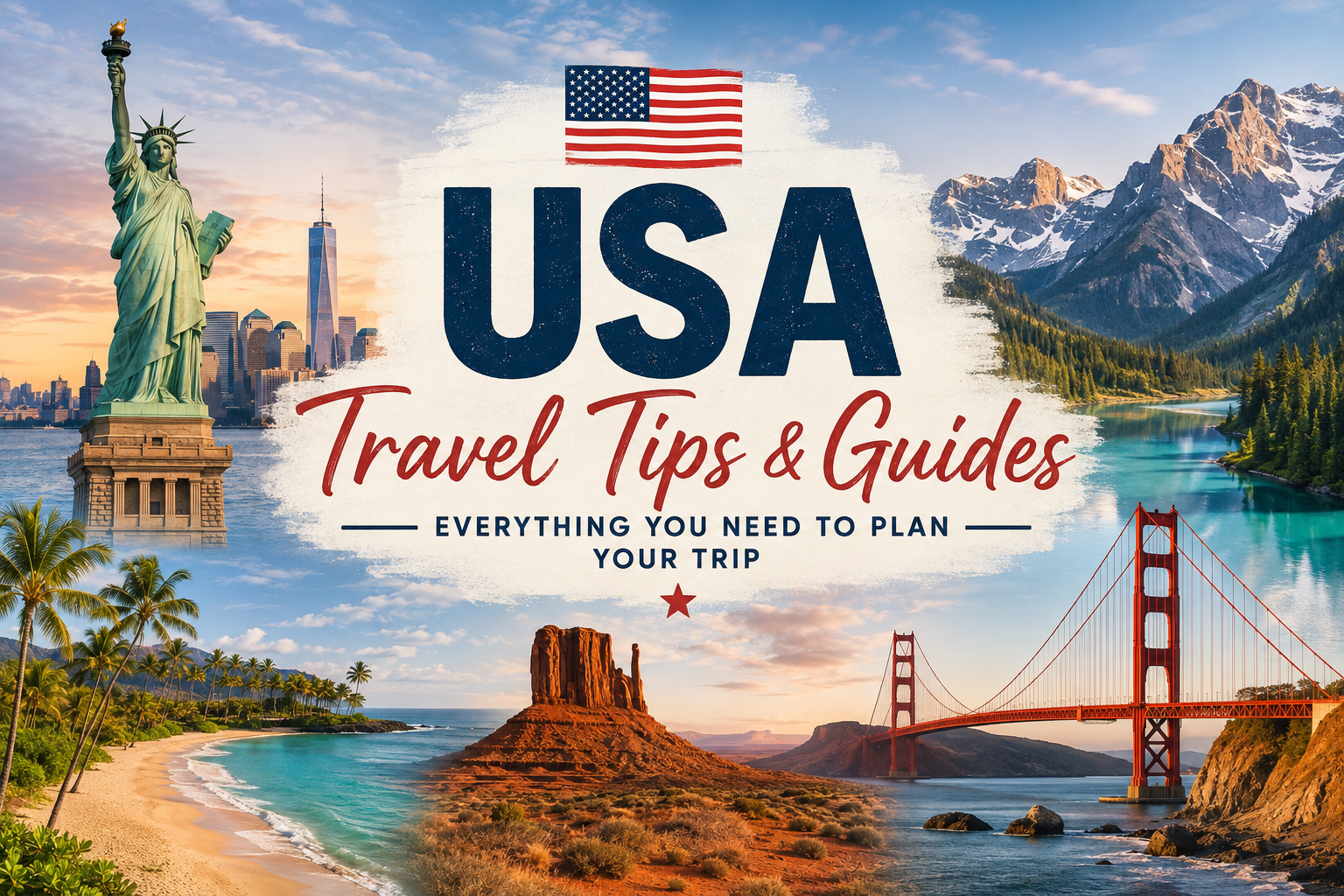
Easy One-Stop Planning Guides for the United States
Planning a trip to the United States can get overwhelming surprisingly fast. New York or California? Florida or Hawaii? National parks or big cities? Road trip or cruise? When should you go? Where should you stay? What should you pack? Do you need a plug adapter?
The USA is enormous, and different parts of the country can feel like completely different trips. This page brings all of our USA travel planning resources together in one place so you can find what you need without digging through the entire site.
Last updated: August 29, 2026
🇺🇸 USA at a Glance
⚠️ Current Travel Considerations
🌦️ Weather & Best Time to Visit
🗺️ USA Travel Map
📍 Where to Go in the USA
🚢 Cruises Around the USA
🏨 Where to Stay
🧳 What to Pack
🔌 Plugs & Voltage
🎟️ Things to Do
🇺🇸 USA at a Glance
| Basics | Details |
|---|---|
| Capital | Washington, D.C. |
| Language | English is the primary language used nationally; Spanish is also widely spoken |
| Currency | U.S. dollar ($ / USD) |
| Time Zones | Multiple time zones across the continental USA, Alaska and Hawaii |
| Driving Side | Right |
| Emergency Number | 911 |
| Plug Types | Type A and B |
| Electricity | 120V, 60Hz |
| Peak Travel Months | June–August, with additional peaks around major holidays and destination-specific seasons |
| Popular Shoulder Seasons | April–May and September–October in many parts of the country |
| Entry Requirements | Depend on your nationality, passport and length/purpose of stay. Always check the requirements that apply to you before traveling. |
The United States stretches from Arctic Alaska to tropical Hawaii and Florida, with deserts, mountains, beaches, forests, major cities and enormous differences in climate between regions.
⚠️ Current Travel Considerations
Last reviewed: August 29, 2026
The United States remains a destination I am comfortable recommending for leisure travel.
Safety varies considerably by city, neighborhood and region. Most visitors travel without serious problems, but theft, violent crime and gun crime do occur. Research the specific places you plan to visit rather than treating the entire country as having one safety profile, and use normal awareness in unfamiliar areas, particularly at night.
Demonstrations and large public gatherings occasionally cause road closures, transportation disruption or localized unrest. Avoid situations that appear to be escalating and follow local instructions if restrictions or emergency measures are introduced.
Weather and natural hazards are often a bigger practical concern. Depending on where and when you travel, this can include extreme heat, hurricanes, tornadoes, wildfires, flooding, winter storms, earthquakes and other regional hazards.
Medical care can also be extremely expensive for visitors without appropriate coverage, so international travelers should make sure their travel insurance adequately covers healthcare and emergencies in the United States.
There are currently no broad safety concerns that would make me recommend postponing an ordinary trip to the USA, but conditions vary enormously across such a large country. I review current travel conditions when updating this page.
🌦️ USA Weather by Month
There is no single “USA climate.” January can mean tropical beach weather in Hawaii, snowstorms in the Northeast, skiing in Colorado and mild desert sunshine in parts of the Southwest—all at the same time.
Use this as a broad planning overview rather than a forecast for your specific destination.
| Month | What to Generally Expect |
|---|---|
| January | Winter across much of the continental USA, with snow and cold in northern and mountain regions. Florida, Hawaii and parts of the Southwest remain considerably warmer. |
| February | Winter continues across much of the north. Ski season is strong in mountain destinations, while warmer southern destinations remain popular escapes. |
| March | Spring begins arriving in southern and lower-elevation areas while northern states and mountains can remain wintry. Spring-break travel increases in warmer destinations. |
| April | Mild spring weather spreads across much of the country. Flowers, parks and city sightseeing can be excellent, although severe thunderstorms and tornadoes become more common in parts of the central and southern USA. |
| May | Warm weather becomes widespread. A strong month for road trips, national parks and city travel before the busiest part of summer. |
| June | Summer begins, with long daylight hours and school-holiday travel. Heat and humidity build in many regions while northern coasts and mountain areas can remain pleasantly cool. |
| July | Peak summer travel and often intense heat. Beaches, national parks and mountain destinations are busy, while some southern and desert locations can become extremely hot. |
| August | Hot across much of the country. Hurricane season becomes increasingly relevant along the Atlantic and Gulf coasts, while wildfire concerns may affect parts of the West. |
| September | Summer heat often lingers early in the month. Fall weather begins arriving in northern and mountain regions while hurricane risk continues along vulnerable coasts. |
| October | One of the best months for many USA trips, with cooler temperatures, fall foliage and excellent road-trip weather across large parts of the country. |
| November | Cooler weather spreads south. Early snow becomes more common in northern and mountain areas, while Thanksgiving creates one of the busiest domestic travel periods of the year. |
| December | Winter travel, holiday lights, Christmas markets and ski trips dominate many northern destinations, while Florida, Hawaii and parts of the Southwest attract travelers looking for warmer weather. |
⭐ Best Time to Visit the USA
There is no single best time to visit the United States because the country is simply too large and climatically diverse.
For a broad city-and-road-trip itinerary through much of the continental USA, May and September through October often provide an excellent balance of comfortable weather and fewer peak-summer crowds.
But the best time depends entirely on the trip.
For beaches → summer in many northern destinations, with longer warm seasons farther south
For fall foliage → September through October depending on latitude and elevation
For skiing → winter
For Alaska → generally late spring through early fall
For Hawaii → year-round, with seasonal differences depending on the island and activity
For Florida → fall through spring is often considerably more comfortable than midsummer
🥵 Most Challenging Time to Visit the USA
There isn’t one universally difficult month either.
July and August can be challenging across large parts of the continental USA because of heat, humidity, crowds and higher summer demand. Desert areas can become dangerously hot, while southern and eastern destinations may combine high temperatures with intense humidity.
Late summer and early fall also overlap with Atlantic hurricane season, while wildfire smoke or closures can affect some western destinations.
Winter creates the opposite problem in northern and mountain areas, where snowstorms and extreme cold can disrupt flights and road travel.
Important: Always check the actual forecast and current conditions for the specific places you’re visiting shortly before departure. Weather in Miami, Seattle, Las Vegas, Anchorage and Honolulu may have almost nothing in common on the same date.
🗺️ Get Oriented: The USA’s Main Travel Areas

These are broad travel areas rather than strict political divisions:
Northeast: New York City, Boston, Philadelphia, New England and some of the country’s best-known fall foliage
South & Southeast: Florida, Georgia, the Carolinas, Tennessee, Louisiana and destinations along the Gulf and Atlantic coasts
Midwest & Great Lakes: Chicago, Michigan, Wisconsin, Minnesota and lake-focused summer destinations
Southwest: Arizona, New Mexico, Nevada and dramatic desert landscapes
West Coast: California, Oregon and Washington, including major cities, coastline and national parks
Mountain West: Colorado, Utah, Montana, Wyoming and many of the USA’s most famous mountain and national-park landscapes
Alaska: Vast wilderness, glaciers, wildlife and some of North America’s most spectacular cruise routes
Hawaii: Tropical Pacific islands with beaches, volcanoes, hiking, surfing, snorkeling and a completely different climate and culture from the continental USA
The United States is too large to treat like one normal country itinerary. Most trips work better when you choose one city, state or region and explore it properly rather than trying to cross enormous distances just to check places off a list.
🗺️ Start Here: Where Should You Go in the USA?
We don’t have one giant “best places in the USA” guide yet—and honestly, the country is big enough that destination-specific and seasonal guides can often be more useful.
☀️ Best Places to Visit in the USA in Summer to Escape the Heat
Not every USA summer vacation needs to involve brutal heat. This guide focuses on genuinely cooler summer destinations, including foggy coastlines, mountain towns, islands and northern escapes.
→ Read: Best Places to Visit in the USA in Summer to Escape the Heat
🍂 Festivals & Seasonal Experiences
The USA changes dramatically with the seasons, and festivals, holiday weekends, foliage and regional events can easily become the reason for an entire trip.
🍎 Best Fall Festivals in the USA in 2026: Apple Festivals, Pumpkins, Oktoberfest & More
From hot-air balloons and apple festivals to cranberry celebrations, Oktoberfest events, pumpkins and unusual regional traditions, these are some of the most memorable fall festivals around the country.
→ Read: Best Fall Festivals in the USA in 2026
🍁 Fall Foliage Road Trip: Best U.S. Destinations for Families
A road-trip-focused look at destinations for colorful autumn scenery around the United States.
→ Read: Fall Foliage Road Trip
🇺🇸 Best Memorial Day Weekend Trips for Beach Lovers, Boaters & Sun Seekers
Memorial Day weekend is the unofficial beginning of summer in much of the USA, making it a natural time for beaches, boating and waterfront getaways.
→ Read: Best Memorial Day Weekend Trips
🚢 Cruises Around the USA
The United States is a major cruise destination and departure point, with Alaska offering one of the country’s most distinctive cruise experiences.
🏔️ Which Alaska Cruise Line Is Best?
Cruise line, ship, balcony design, packages and add-ons can make a surprisingly large difference on an Alaska cruise.
More USA cruise guides will be added here as we build them.
🏨 Where to Stay in the USA
Once you know where you’re going, choosing the right location and hotel can completely change the trip—especially in destinations where attractions are spread out or transportation takes time.
Our hotel guides are designed for different types of travelers and budgets rather than assuming everybody wants the same kind of stay.
🎰 Las Vegas, Nevada
🏰 Walt Disney World, Florida
→ Where to Stay for Walt Disney World: Best Hotels for Every Kind of Trip
🌺 Wailea, Maui, Hawaii
More USA hotel guides will be added here as we build them.
🧳 What to Pack for the USA
Packing for the United States depends far more on your specific destination and season than on the country as a whole.
A summer trip to Florida requires a completely different suitcase from an Alaska cruise, Colorado ski trip or October road trip through New England.
☀️ Florida in Summer
→ Exactly What to Pack for Florida in Summer: June, July & August Carry-On Only
A practical carry-on-only guide for Florida’s heat, humidity, sudden rain, strong sunshine, beaches, pools, theme parks and aggressively air-conditioned indoor spaces.
More USA regional and seasonal packing guides will be added here as we publish them.
🔌 USA Plugs, Outlets & Voltage
The United States uses 120V electricity at 60Hz, with Type A and B outlets.
This is particularly important for travelers coming from countries that use 220–240V electricity. A plug adapter changes the shape of the plug—it does not change the voltage.
→ Read: 🇺🇸 USA Outlet, Plug & Voltage Guide for Travelers
The full guide explains adapters, voltage, converters and what travelers from different electrical systems need to know before plugging in their devices.
🎟️ Things to Do in the USA
The USA is enormous, so our Things to Do section will grow city by city and region by region rather than trying to pretend there is one sensible nationwide activity list.
USA Things to Do guides coming soon.
❤️ Helpful Travel Guides for Any Trip
Some travel questions aren’t specific to the USA. These Travel Tips With Love guides can help wherever you’re going.
🧳 Choosing & Packing Your Luggage
✈️ Surviving a Long Flight
🎒 Check Your Airline’s Carry-On Limits
Airline rules vary enormously, especially when you’re connecting between different carriers.
→ Global Carry-On & Personal Item Size Limits by Airline A–Z
🤒 What If You Get Sick While Traveling?
→ What to Do If You Get Sick While Traveling
🎟️ Should You Book Activities Ahead?
Some experiences sell out weeks ahead. Others are perfectly fine to book after you arrive.
→ Should I Book Tours & Activities Ahead of Time?
💆♀️Make Any Vacation Feel More Relaxing
You don’t have to book an expensive wellness resort to work a little spa time into your trip.
→ How to Make Any Vacation a Spa Vacation
🌍 Explore More Countries
Not sure the USA is the trip this time?
Explore our All Countries Travel Tips & Guides to find destination planning hubs around the world.
Each country hub brings together practical planning information, current travel considerations, weather basics and all of our available destination guides in one easy place.
→ Explore All Countries & Destinations
This USA hub is a living travel-planning resource. I update it as new Travel Tips With Love USA guides are published and as important planning or safety information changes.
From Tracy, With Love ♥