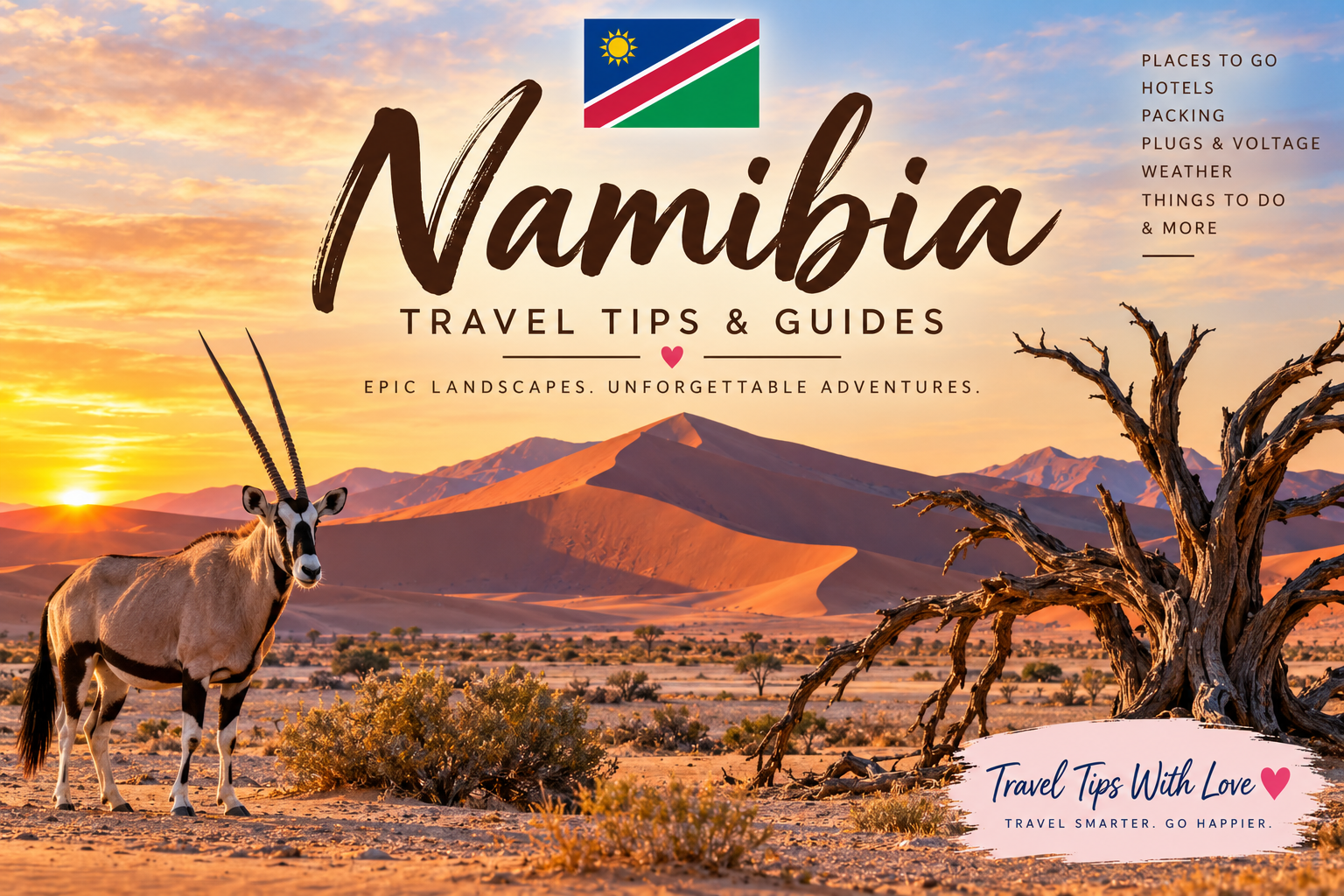
Easy One-Stop Planning Guides for Namibia
Planning a trip to Namibia can get complicated surprisingly fast.
Sossusvlei or Etosha? How many days do you need for a road trip? Should you stay in Swakopmund? Is the Skeleton Coast worth the detour? When is wildlife viewing best? How cold do desert mornings actually get? Do you need a 4×4? And how much driving can you realistically fit into one trip?
This page brings all of our Namibia travel planning resources together in one place so you can find what you need without digging through the entire site.
Last updated: September 5, 2026
🇳🇦 Namibia at a Glance
⚠️ Current Travel Considerations
🌦️ Weather & Best Time to Visit
🗺️ Namibia Travel Map
📍 Where to Go in Namibia
🚢 Cruises Around Namibia
🏨 Where to Stay
🧳 What to Pack
🔌 Plugs & Voltage
🎟️ Things to Do
🇳🇦 Namibia at a Glance
| Basics | Details |
|---|---|
| Capital | Windhoek |
| Official Language | English; Oshiwambo, Afrikaans, German and several other languages are also widely spoken |
| Currency | Namibian dollar (NAD); South African rand is also legal tender |
| Time Zone | Central Africa Time (CAT), UTC+2 year-round |
| Driving Side | Left |
| Emergency Number | 112 from a mobile phone |
| Plug Type | Type M |
| Electricity | 220V, 50Hz |
| Peak Travel Months | June through October, particularly July–September |
| Popular Shoulder Seasons | April–May and November |
| Entry Requirements | Depend on your nationality, passport and length/purpose of stay. Always check the requirements that apply to you before traveling. |
Namibia is enormous, sparsely populated and built for travelers who appreciate wide-open landscapes.
The distances between major attractions are a major part of trip planning, particularly if you are driving yourself.
⚠️ Current Travel Considerations
Last reviewed: September 5, 2026
Namibia remains a destination I am comfortable recommending for leisure travel.
Crime is the main everyday security concern visitors should keep in mind. Opportunistic theft, pickpocketing, vehicle break-ins and robberies can occur, particularly in Windhoek and around places where travelers stop with luggage or valuables in a vehicle. Keep doors locked, valuables out of sight and avoid leaving luggage unattended in parked cars.
For many visitors, road safety deserves just as much attention as crime.
Namibia is a wonderful self-drive destination, but long distances, gravel roads, tire punctures, loose surfaces, wildlife on roads and limited services can make driving much more demanding than the empty roads initially suggest. Serious single-vehicle crashes involving visitors do occur. Avoid unnecessary driving after dark outside towns and give yourself considerably more time than a map may suggest.
Medical care becomes much more limited once you leave the major population centers, and many of Namibia’s best-known landscapes are far from emergency services. Travel insurance that covers your activities and emergency evacuation is particularly important for remote road trips and safari itineraries.
Weather can create additional challenges. Summer can bring extreme heat, thunderstorms and flash flooding, particularly in northern areas, while the dry season can bring bush fires, dust and very cold nights despite warm daytime sunshine.
There are currently no broad safety concerns that would make me recommend postponing an ordinary trip to Namibia, but this is a destination where good route planning, realistic driving times and preparation for remote areas matter.
🌦️ Namibia Weather by Month
Namibia has a dry, sunny climate with enormous differences between daytime and nighttime temperatures.
It also sits in the Southern Hemisphere, so the seasons are opposite those in Europe and North America.
Generally, November through April is the hotter summer and rainfall season, while May through October is the dry winter season.
The Atlantic coast behaves differently again, with places like Swakopmund and Walvis Bay often remaining cool, foggy and windy even when inland Namibia is sunny and warm.
Use this as a quick planning overview rather than a forecast for your specific trip.
| Month | What to Generally Expect |
|---|---|
| January | Hot summer conditions with thunderstorms and rain more likely across northern and central Namibia. Desert regions remain very warm and flash flooding can affect some routes. |
| February | Hot, humid by Namibian standards and within the main rainy period. Landscapes can become surprisingly green, particularly farther north. |
| March | Still warm with possible thunderstorms and rain. Green-season wildlife and dramatic skies can be beautiful, but road conditions may be more variable. |
| April | Rain usually begins tapering off. Warm days, increasingly comfortable nights and greener landscapes make this an appealing shoulder-season month. |
| May | The dry season settles in. Days are generally sunny and comfortable while nights become noticeably cooler. Excellent road-trip weather. |
| June | Dry and sunny with cold mornings and nights, especially in desert and inland areas. Wildlife viewing begins becoming increasingly rewarding around water sources. |
| July | One of the driest and coolest months. Excellent safari and road-trip conditions, but early mornings can be genuinely cold. |
| August | Dry, clear and popular. Cool mornings gradually give way to warmer afternoons, while wildlife continues concentrating around waterholes. |
| September | Increasingly hot and extremely dry. Excellent wildlife viewing, strong road-trip conditions and plenty of dust. |
| October | Hot and very dry across much of the interior. Wildlife can be concentrated around limited water, but daytime heat becomes increasingly intense. |
| November | Hot summer conditions return and the first thunderstorms may begin. Rainfall is still unpredictable and landscapes start changing rapidly when rain arrives. |
| December | Hot with increasingly frequent summer storms, particularly farther north and inland. Coastal Namibia generally remains much cooler. |
⭐ Best Time to Visit Namibia
For the best overall combination of dry weather, reliable roads, wildlife viewing and comfortable daytime conditions, May through October is generally the easiest time to visit Namibia.
June through September are especially strong choices.
This is prime road-trip and safari season.
Etosha’s dry conditions encourage animals to gather around waterholes, desert skies are usually clear, rain disruption is limited and the country is particularly well suited to long overland itineraries.
There is one packing surprise.
Winter mornings and nights can be cold.
June, July and August can bring temperatures near freezing in some inland areas overnight, even when afternoons become beautifully sunny.
🌧️ Most Challenging Time to Visit Namibia
For a long self-drive itinerary, January through March can be the most challenging period.
This is the hotter and wetter part of the year.
Summer thunderstorms can cause flash flooding, some gravel roads become more difficult, wildlife may disperse when water becomes widely available and high daytime temperatures can make desert sightseeing more tiring.
That does not make the green season a bad time to visit.
The landscape can look completely different after rain, crowds are generally lower and photographers may love the dramatic skies.
But travelers prioritizing straightforward road conditions and classic dry-season wildlife viewing will usually find winter easier.
Important: Always check the actual forecast and current road conditions shortly before departure. Namibia is too large for conditions in Windhoek, Etosha, Sossusvlei and the Atlantic coast to be treated as interchangeable.
🗺️ Get Oriented: Namibia’s Main Travel Areas

Namibia is one of those countries where understanding geography before choosing hotels can save you a huge amount of unnecessary driving.
These are the main areas travelers are most likely to encounter:
Central Namibia: Windhoek and the surrounding highlands, where most first-time road trips begin or end.
Namib Desert: Sossusvlei, Deadvlei, Sesriem Canyon and some of Namibia’s most iconic red-dune landscapes.
Central Atlantic Coast: Swakopmund, Walvis Bay and Sandwich Harbour — where desert dunes meet cold Atlantic water.
Northwestern Namibia: Skeleton Coast and Damaraland, with rugged landscapes, remote lodges, desert-adapted wildlife and ancient rock art.
Northern Namibia: Etosha National Park, Namibia’s major wildlife destination.
Southern Namibia: Fish River Canyon, Lüderitz, Kolmanskop and vast desert road-trip scenery.
Far Northeast: The Zambezi Region, where Namibia becomes greener, wetter and much more river-oriented.
The classic Namibia trip often works as a large loop, rather than a series of short day trips from one base.
🗺️ Start Here: Where Should You Go in Namibia?
If you haven’t decided exactly where you’re going yet, start with our complete Namibia destination guide.
Best Places to Visit in Namibia: Sossusvlei, Etosha, Swakopmund, Skeleton Coast & Desert-Ocean Escapes
From the red dunes of Sossusvlei and wildlife-filled waterholes of Etosha to Swakopmund, Sandwich Harbour, Damaraland, Skeleton Coast and southern desert landscapes, this is the best starting point for deciding which parts of Namibia belong on your trip.
→ Read: Best Places to Visit in Namibia
🌺 Festivals & Seasonal Experiences
Namibia’s cultural festivals, wildlife seasons and changing desert landscapes can add another layer to trip planning.
A dedicated Namibia festivals and seasonal experiences guide will be added here.
🚢 Cruises Around Namibia
Namibia can also appear on southern Africa and Atlantic cruise itineraries, with the coast giving cruise travelers access to a completely different side of the country from inland safari and desert trips.
Namibia cruise guide coming soon.
🏨 Where to Stay in Namibia
Accommodation is part of the experience in Namibia.
You may stay in a city hotel one night, a remote desert lodge the next, then continue to a safari camp, Atlantic coastal hotel or wilderness property several hours down a gravel road.
Where you sleep often determines how early you can reach major sights and how much driving you need to do each day.
Swakopmund
From beachfront splurges to practical central hotels, this guide breaks down the best Swakopmund stays by traveler type and budget.
More Namibia hotel guides will be added here.
🧳 What to Pack for Namibia
Packing for Namibia is less about bringing a huge wardrobe and more about preparing for temperature swings, sun, dust, long drives and changing regions.
The desert can be cold before sunrise and warm by afternoon.
Safari drives can start freezing.
Swakopmund can be foggy and chilly.
And even during Namibia’s dry winter, sun protection remains essential.
❄️ Winter — June, July & August
→ Exactly What to Pack for Namibia in Winter: June, July & August
A practical carry-on-only packing guide for safari drives, desert mornings, cold nights, dusty roads, Swakopmund’s cooler coast and long Namibia road trips.
Spring Namibia packing guide coming soon.
Summer Namibia packing guide coming soon.
Fall Namibia packing guide coming soon.
🔌 Namibia Plugs, Outlets & Voltage
Namibia uses 220V electricity at 50Hz, with Type M outlets.
That large three-round-pin plug is different from the outlets many international travelers use at home, so a compatible adapter is important.
Travelers coming from 110–120V countries also need to check the voltage labels on any appliances they plan to bring. Phones, laptops, tablets and most modern chargers are usually dual voltage, while single-voltage heated appliances require more attention.
→ Read: Namibia Outlet, Plug & Voltage Guide for Travelers: Complete Guide ⚡
The full guide explains plug adapters, voltage compatibility, converters and what travelers from different electrical systems need to know. TTWL’s current electrical reference uses 220V, 50Hz and Type M for Namibia.
🎟️ Things to Do in Namibia
Already know where you’re going — or already there?
Namibia’s best experiences are overwhelmingly tied to its landscapes and wildlife.
Think sunrise dune climbs, game drives, waterhole watching, Sandwich Harbour 4×4 trips, kayaking near the coast, scenic flights, desert walks, stargazing, rock-art sites and long drives through landscapes where the journey itself becomes part of the trip.
Namibia Things to Do guides coming soon.
❤️ Helpful Travel Guides for Any Trip
Some travel questions aren’t specific to Namibia. These Travel Tips With Love guides can help wherever you’re going.
🧳 Choosing & Packing Your Luggage
✈️ Surviving a Long Flight
🎒 Check Your Airline’s Carry-On Limits
Airline rules vary enormously, especially when you are connecting between different carriers.
→ Global Carry-On & Personal Item Size Limits by Airline A–Z
🤒 What If You Get Sick While Traveling?
This is particularly worth thinking about before a trip involving remote lodges, national parks and long distances from major medical facilities.
→ What to Do If You Get Sick While Traveling
🎟️ Should You Book Activities Ahead?
Safari stays, guided desert experiences, scenic flights and specialized excursions can be worth arranging before arrival, particularly during Namibia’s busiest dry-season months.
→ Should I Book Tours & Activities Ahead of Time?
💆♀️ Make Any Vacation Feel More Relaxing
A beautiful desert or safari lodge is a very good place to deliberately build a slower day into a long Namibia road trip.
→ How to Make Any Vacation a Spa Vacation
🌍 Explore More Countries
Not sure Namibia is the trip this time?
Explore our All Countries Travel Tips & Guides to find destination planning hubs around the world.
Each country hub brings together practical planning information, current travel considerations, weather basics and all of our available destination guides in one easy place.
→ Explore All Countries & Destinations
This Namibia hub is a living travel-planning resource. I update it as new Travel Tips With Love Namibia guides are published and as important planning or safety information changes.
From Tracy, With Love ♥