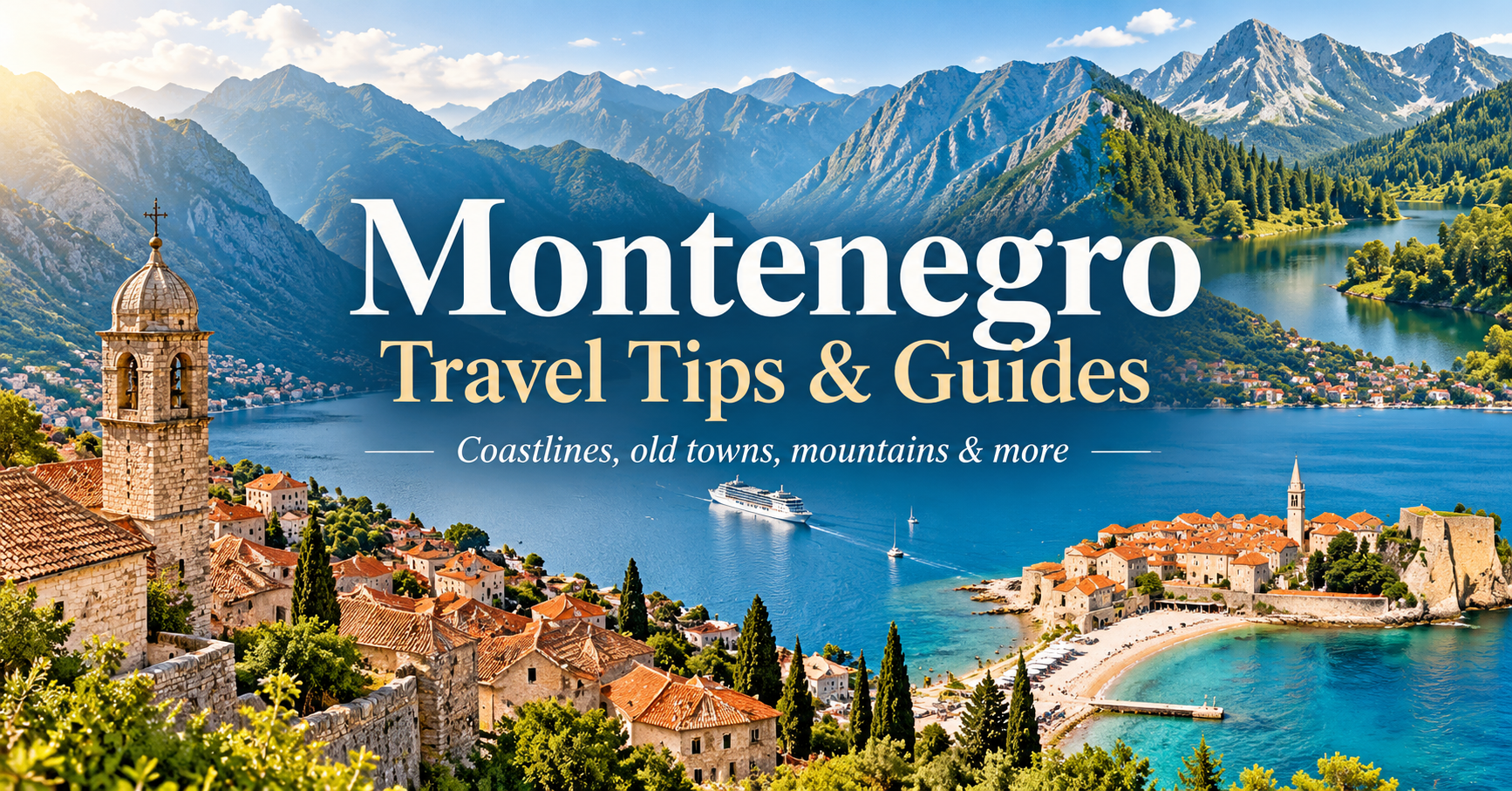
Montenegro easy travel tips and planning guides, with love
Easy One-Stop Planning Guides for Montenegro
Planning a trip to Montenegro can get overwhelming surprisingly fast. Kotor or Budva? Perast or Tivat? Beaches or mountains? Durmitor or Lake Skadar? A relaxing Adriatic escape, scenic road trip, cruise stop — or somehow all of them? When should you go? Where should you stay? What should you pack? Do you need a plug adapter?
Montenegro may be small, but it can feel surprisingly varied. The Bay of Kotor gives you steep mountains dropping almost directly into blue water, Venetian-style old towns and little waterfront villages. Budva brings beaches and summer energy. Durmitor National Park feels completely different again, with high mountains, glacial lakes and the dramatic Tara River Canyon.
That combination makes Montenegro especially appealing for travelers who want coast, history, scenery and outdoor experiences without crossing huge distances.
This page brings all of our Montenegro travel planning resources together in one place so you can find what you need without digging through the entire site.
Last updated: October 11, 2026
🇲🇪 Montenegro at a Glance
⚠️ Current Travel Considerations
🌦️ Weather & Best Time to Visit
🗺️ Montenegro Travel Map
📍 Where to Go in Montenegro
✈️ Montenegro Airport Guides
🚢 Cruises Around Montenegro
🏨 Where to Stay
🧳 What to Pack
🔌 Plugs & Voltage
🎟️ Things to Do
🇲🇪 Montenegro at a Glance
| Basics | Details |
|---|---|
| Capital | Podgorica |
| Official Language | Montenegrin |
| Currency | Euro (€ / EUR) |
| Time Zone | Central European Time (CET); Central European Summer Time (CEST) during daylight saving time |
| Driving Side | Right |
| Emergency Number | 112 |
| Plug Types | Type C and F |
| Electricity | 230V, 50Hz |
| Peak Travel Months | June through August, especially along the Adriatic coast |
| Popular Shoulder Seasons | May and September–October |
| Entry Requirements | Depend on your nationality, passport and length or purpose of stay. Always check the requirements that apply to you before traveling. |
Montenegro is one of those destinations where the map can be misleading.
Distances are not enormous, but narrow coastal roads, mountain routes, summer traffic and endless scenic stops can make drives take considerably longer than expected.
⚠️ Current Travel Considerations
Last reviewed: October 11, 2026
Montenegro remains a destination I am comfortable recommending for ordinary leisure travel.
The country is currently considered appropriate for normal travel precautions, and most travelers visit without major problems. The main practical concerns are petty theft, road conditions, summer congestion, swimming safety and rapidly changing mountain weather.
Petty Theft
Street crime is not usually the defining concern on a Montenegro trip, but pickpocketing and opportunistic theft can happen in busy tourist areas, beaches, airports and public transportation.
Keep bags closed, do not leave valuables unattended and avoid leaving luggage visible inside a parked car.
This matters particularly during the busy summer season when Kotor, Budva and the coast become much more crowded.
Road Travel
Driving is one of the best ways to experience Montenegro, but some roads are narrow, winding and dramatically mountainous.
The Bay of Kotor is particularly beautiful by road, but summer traffic can become heavy.
Mountain routes may involve sharp curves, steep drops and slower travel than the distance suggests.
Allow more time than you think you need and avoid building an itinerary that depends on driving long distances every single day.
Summer Border & Airport Delays
Montenegro becomes much busier during summer.
Airports, roads and border crossings can experience delays, especially when travelers are moving between Montenegro and neighboring Croatia or other Schengen countries.
If you have an international flight, cruise departure or other fixed connection, build in extra time rather than relying on an optimistic driving estimate.
Swimming & Coastal Safety
Montenegro’s Adriatic water can look calm and inviting, but conditions vary between beaches and rocky swimming areas.
Follow lifeguard warnings where available, be careful around rocks and boat traffic and do not assume every beautiful stretch of coastline is an easy swimming beach.
Mountain Weather
Durmitor, Žabljak and other mountain areas can feel completely different from the coast.
Weather can change quickly at elevation, even when Kotor or Budva is warm and sunny.
If you are hiking or spending the day in the mountains, check the local forecast and carry appropriate layers rather than packing only for Adriatic beach weather.
🌦️ Montenegro Weather by Month
Montenegro has a Mediterranean climate along much of the coast and a much more continental or alpine climate inland and at higher elevations.
Kotor, Budva, Podgorica and Žabljak can have noticeably different conditions on the same date.
| Month | What to Generally Expect |
|---|---|
| January | Winter. The coast is cool and often wet, while mountain areas can have deep snow and full winter conditions. |
| February | Still wintery inland and in the mountains. Coastal areas remain relatively mild but rainy periods are common. |
| March | Transitional. Coastal spring begins appearing while higher elevations can remain cold and snowy. |
| April | Increasingly mild along the coast, with greener landscapes and comfortable sightseeing weather between rainy spells. |
| May | One of the loveliest months for road trips and sightseeing. Coastal temperatures warm while the mountains become increasingly accessible. |
| June | Summer begins. Warm beach weather arrives and the coast becomes busier, while inland and mountain areas remain somewhat cooler. |
| July | Hot and busy along the Adriatic. Beaches, boat trips and coastal towns are firmly in peak season. |
| August | Another hot peak-season month, with warm water, busy resort areas and heavy coastal traffic. |
| September | Often excellent. Summer warmth can linger along the coast while crowds gradually ease and evenings become cooler. |
| October | More changeable but still beautiful. Early October can remain mild along the coast while rain and cooler temperatures become increasingly likely later in the month. |
| November | Cooler, wetter and much quieter. Mountain regions move increasingly toward winter conditions. |
| December | Winter returns, with cool rainy coastal weather and snow in higher mountain areas. |
⭐ Best Time to Visit Montenegro
For the easiest combination of coastal sightseeing, warm weather, mountain access and manageable crowds, May, June and September are particularly strong choices.
🌸 Spring
May is excellent for road trips, Kotor sightseeing, Perast, Lake Skadar and mountain scenery.
The coast is warm without the intense heat and crowds of July and August.
☀️ Summer
June through August is best if your priorities are beaches, swimming, boat trips and long sunny days.
July and August are the busiest months, especially around Budva, Kotor and the Bay of Kotor.
🍂 Fall
September can still feel almost summery along the coast.
October becomes more transitional but is wonderful for old towns, scenic drives and quieter travel.
November is considerably cooler and wetter.
❄️ Winter
Winter is much quieter along the coast.
Mountain destinations such as Žabljak shift into snow season, creating a completely different type of Montenegro trip.
🌧️ Most Challenging Time to Visit Montenegro
For travelers imagining a classic coast + mountains + road trip itinerary, late fall through early spring can be the most limiting because of wetter coastal conditions and snow or road complications inland.
For travelers who dislike crowds and extreme heat, late July and August can also be challenging along the most popular coastal routes.
Important: Always check the actual forecast for the destinations you plan to visit. Montenegro’s coast and mountains can feel like two completely different trips on the same day.
🗺️ Get Oriented: Montenegro’s Main Travel Areas

These are the places travelers are most likely to encounter while planning:
Bay of Kotor: Kotor, Perast, Tivat, Herceg Novi and some of Montenegro’s most dramatic mountain-and-water scenery
Kotor: Walled Old Town, fortress views, historic stone streets, bay scenery, boat trips and one of the country’s most iconic bases
Budva & Central Coast: Budva Old Town, beaches, nightlife, coastal resorts and easy access toward Sveti Stefan
Sveti Stefan & Petrovac: Famous coastal views, quieter beach areas and scenic stretches of the Adriatic
Ulcinj & Southern Coast: Long beaches, a different cultural atmosphere and access toward the Albanian border
Lake Skadar: Wetlands, boat trips, birds, villages, vineyards and some of the country’s most peaceful inland scenery
Cetinje & Lovćen: Historic Montenegro, mountain roads, viewpoints and easy access between the coast and interior
Podgorica: Montenegro’s capital and one of its main transportation gateways
Durmitor & Žabljak: Mountains, Black Lake, hiking, winter sports and some of Montenegro’s most dramatic inland landscapes
Tara River Canyon: Rafting, bridges, canyon scenery and outdoor adventure
Prokletije: Rugged mountain landscapes near the Albanian border for travelers looking for a quieter and more adventurous side of Montenegro
Montenegro is small enough that coast and mountains can fit into the same trip.
A strong first itinerary might combine Kotor or Perast + Budva or the southern coast + Durmitor or Lake Skadar rather than spending the entire trip in one beach town.
📍 Start Here: Where Should You Go in Montenegro?
If you haven’t decided exactly where you’re going yet, start with our complete Montenegro destination guide.
Best Places to Visit in Montenegro: Kotor, Budva, Durmitor, Lake Skadar, Beaches & Mountain Towns
Montenegro packs an extraordinary amount into a small country.
This guide covers Kotor, Budva, Perast, Durmitor, Lake Skadar, coastal towns, beaches, mountain scenery and the destinations that help you decide whether your trip should lean toward the Adriatic, adventure, history — or a mix of all three.
→ Read: Best Places to Visit in Montenegro
✈️ Montenegro Airport Guides
Montenegro has two primary international airports, and the best one depends heavily on where you are staying.
Tivat
Tivat Airport (TIV) is the most convenient airport for many travelers visiting the Bay of Kotor, Kotor, Tivat, Perast and parts of the northern coast.
It can save substantial driving time compared with arriving in Podgorica.
The airport becomes extremely busy during the summer season, so allow extra time for departure procedures.
Podgorica
Podgorica Airport (TGD) serves the capital and is useful for travelers heading toward Lake Skadar, central Montenegro, southern destinations and some inland routes.
It can also work for coastal trips depending on flight availability and rental-car plans.
Dubrovnik
Some Montenegro travelers also use Dubrovnik Airport (DBV) in Croatia, especially when visiting the Bay of Kotor.
That can work well geographically, but it involves an international border crossing, and summer traffic or immigration queues can add significant time.
Individual Montenegro airport guides will be added as we build them.
→ Explore All Flights & Airport Guides
🚢 Cruises Around Montenegro
Montenegro is an important Adriatic and Eastern Mediterranean cruise destination, largely because of Kotor.
Kotor
Kotor is Montenegro’s standout cruise port.
The approach through the Bay of Kotor is part of the experience, with steep mountains surrounding the water as ships travel toward the historic town.
Once ashore, travelers can explore Kotor Old Town, climb toward panoramic viewpoints, take boat trips around the bay or continue to nearby Perast.
Bar
Bar is another Montenegrin port that may appear on selected itineraries.
It gives travelers access to the southern coast, Old Bar and destinations around Lake Skadar.
Montenegro often appears on itineraries combining Croatia, Greece, Italy and other Adriatic or Eastern Mediterranean ports.
A dedicated Montenegro cruise guide will be added as we continue building our coverage.
🏨 Where to Stay in Montenegro
Montenegro’s hotel experience depends heavily on whether you want historic atmosphere, beaches, resort amenities or mountain scenery.
Our hotel guides focus on individual destinations rather than trying to recommend one property for the entire country.
Kotor
→ Where to Stay in Kotor, Montenegro: Best Hotels for Every Kind of Trip
Kotor is one of the most memorable places to base yourself in Montenegro, but location matters.
Staying inside the Old Town gives you medieval streets, restaurants and atmosphere right outside the door, while bay-side properties can offer quieter surroundings, water views and easier relaxation.
Our guide includes options for couples, solo travelers, friend trips, families, older travelers / lower mobility, luxury travelers, mid-range travelers and budget travelers.
More Montenegro hotel guides will be added here as we build them.
🧳 What to Pack for Montenegro
Montenegro is a destination where you should pack for more than the beach.
Old stone towns, boat days, rocky swimming areas, coastal heat, mountain drives and cooler inland conditions can all be part of the same trip.
☀️ Summer
→ What to Pack for Montenegro in Summer: Carry-On Only, No Guesswork
Summer means hot coastal afternoons, strong sun, boat trips, beaches, stone streets and long sightseeing days.
This carry-on-only guide also accounts for cooler mountain areas, Lake Skadar and inland day trips rather than packing as though Montenegro is only a beach resort.
🍂 Fall
→ Exactly What to Pack for Montenegro in Fall: September, October & November — Carry-On Only
Montenegro changes considerably across fall.
September can still feel summery along the Adriatic, October becomes more transitional and November brings cooler temperatures, increasing rain and a much less beach-focused trip.
This carry-on-only guide helps you build one flexible setup for coastal towns, scenic drives, changing weather and mountain day trips without overpacking.
More seasonal Montenegro packing guides will be added here as we build them.
🔌 Montenegro Plugs, Outlets & Voltage
Montenegro uses Type C and Type F outlets, with 230V electricity at 50Hz.
Whether you need only a plug adapter or also need to think about voltage compatibility depends on where you are traveling from and which devices you are bringing.
Travelers from countries using 100–127V electricity should pay particular attention to single-voltage heating appliances, hair tools and other devices.
→ Read: 🇲🇪 Montenegro Outlet, Plug & Voltage Guide for Travelers — Complete Edition ⚡
The full guide explains adapters, Montenegro’s 230V electrical system, converters and what travelers from different electrical systems need to know.
🎟️ Things to Do in Montenegro
Already know where you’re going — or already there?
Montenegro is especially good for travelers who want scenery and experiences woven into the trip rather than a long checklist of conventional attractions.
Around Kotor, boat trips through the bay, Perast, Our Lady of the Rocks, fortress views and Old Town wandering are natural highlights.
Budva brings beaches, coastal walks, Old Town streets and a livelier evening atmosphere.
Lake Skadar offers boat trips, birds, villages, vineyards and peaceful inland scenery.
Farther north, Durmitor opens up hiking, Black Lake, scenic driving and access toward the Tara River Canyon.
Adventure-focused travelers can add rafting, mountain excursions, canyon scenery or longer hiking routes.
Dedicated Montenegro Things to Do guides will be added here as we build them.
❤️ Helpful Travel Guides for Any Trip
Some travel questions aren’t specific to Montenegro. These Travel Tips With Love guides can help wherever you’re going.
🧳 Choosing & Packing Your Luggage
✈️ Surviving a Long Flight
🎒 Check Your Airline’s Carry-On Limits
Airline rules vary enormously, especially when connecting from a long-haul flight onto a smaller European or regional carrier.
→ Global Carry-On & Personal Item Size Limits by Airline A–Z
🤒 What If You Get Sick While Traveling?
→ What to Do If You Get Sick While Traveling
🎟️ Should You Book Activities Ahead?
Some experiences sell out weeks ahead. Others are perfectly fine to book after you arrive.
For Montenegro, advance booking can be particularly useful for popular Bay of Kotor boat trips, summer excursions, rafting, private drivers and activities tied to cruise-ship days or peak-season dates.
→ Should I Book Tours & Activities Ahead of Time?
💆♀️ Make Any Vacation Feel More Relaxing
You don’t have to book an expensive wellness resort to work a little spa time into your trip.
→ How to Make Any Vacation a Spa Vacation
🌍 Explore More Countries
Not sure Montenegro is the trip this time?
Explore our All Countries Travel Tips & Guides to find destination planning hubs around the world.
Each country hub brings together practical planning information, current travel considerations, weather basics and all of our available destination guides in one easy place.
→ Explore All Countries & Destinations
This Montenegro hub is a living travel-planning resource. I update it as new Travel Tips With Love Montenegro guides are published and as important planning or safety information changes.
From Tracy, With Love ♥