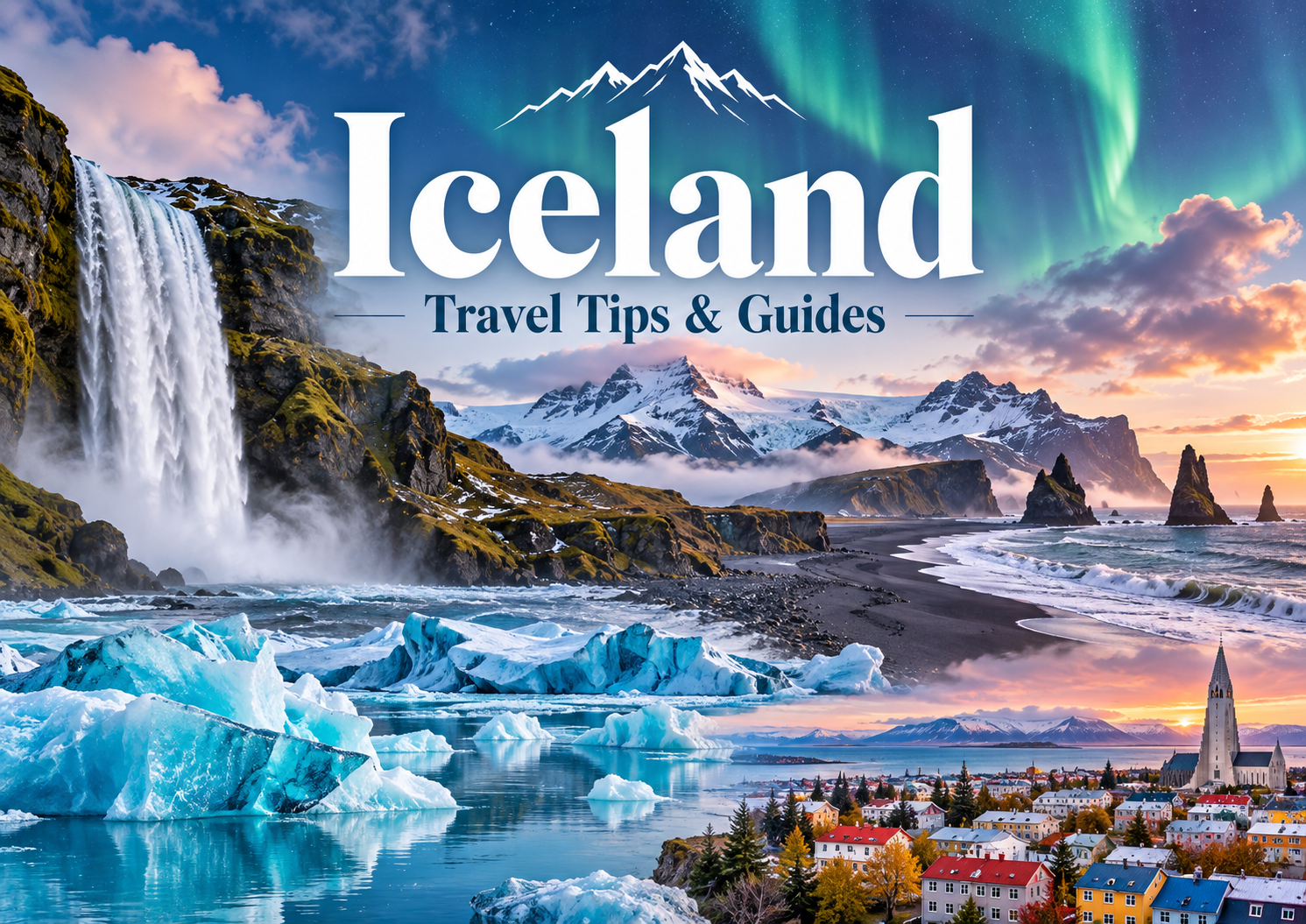
Iceland easy travel tips and planning guides, with love
Easy One-Stop Planning Guides for Iceland
Planning a trip to Iceland can get overwhelming surprisingly fast. Reykjavík or a full Ring Road trip? Golden Circle or South Coast? Snæfellsnes or the Westfjords? Northern Lights or midnight sun? Glacier lagoons, waterfalls, hot springs, black sand beaches — or somehow all of them? When should you go? Where should you stay? What should you pack? Do you need a plug adapter?
Iceland is one of those destinations where the landscape changes almost constantly. A single road trip can take you past waterfalls, lava fields, glaciers, geothermal areas, black sand beaches, fishing villages, enormous mountains and stretches of scenery that barely look real.
It is also a country where weather and road conditions matter enormously, so good planning can make the difference between an unforgettable Iceland trip and an itinerary that simply asks too much of the conditions.
This page brings all of our Iceland travel planning resources together in one place so you can find what you need without digging through the entire site.
Last updated: October 7, 2026
🇮🇸 Iceland at a Glance
⚠️ Current Travel Considerations
🌦️ Weather & Best Time to Visit
🗺️ Iceland Travel Map
📍 Where to Go in Iceland
✈️ Iceland Airport Guides
🚢 Cruises Around Iceland
🏨 Where to Stay
🧳 What to Pack
🔌 Plugs & Voltage
🎟️ Things to Do
🇮🇸 Iceland at a Glance
| Basics | Details |
|---|---|
| Capital | Reykjavík |
| Official Language | Icelandic |
| Currency | Icelandic Króna (ISK) |
| Time Zone | Greenwich Mean Time (GMT / UTC+0) year-round |
| Driving Side | Right |
| Emergency Number | 112 |
| Plug Types | Type C and F |
| Electricity | 230V, 50Hz |
| Peak Travel Months | June through August |
| Northern Lights Season | Generally September through early April when skies are dark enough |
| Entry Requirements | Depend on your nationality, passport and length or purpose of stay. Iceland is part of the Schengen Area, so check the requirements that apply to you before traveling. |
Iceland looks relatively small on a world map, but driving distances can be deceptive.
Weather, road conditions, one-lane bridges, sightseeing stops and the temptation to pull over every twenty minutes for another impossible-looking landscape can make journeys take much longer than the mileage suggests.
⚠️ Current Travel Considerations
Last reviewed: October 7, 2026
Iceland remains a destination I am comfortable recommending for ordinary leisure travel.
It is currently suitable for normal tourism precautions, but Iceland’s biggest risks are often natural rather than crime-related.
Rapid weather changes, strong wind, rough seas, volcanic activity, earthquakes, icy roads and remote terrain deserve much more attention here than ordinary big-city safety concerns.
Reykjanes Peninsula & Volcanic Activity
The Reykjanes Peninsula remains volcanically active, including areas around Grindavík and previous eruption sites.
Conditions, road access and closures can change as seismic and volcanic activity develops.
This does not mean all of Iceland is unsafe or that ordinary trips to Reykjavík, the Golden Circle, South Coast or other regions need to be canceled whenever volcanic activity appears in the news.
It does mean you should check current local conditions before entering affected parts of Reykjanes and never cross an official closure because an eruption site looks quiet.
Weather Can Change Extremely Fast
Iceland’s weather deserves to be treated as part of the itinerary rather than background information.
Strong wind, rain, snow and poor visibility can appear quickly, and conditions can differ dramatically between Reykjavík and the road you planned to drive several hours later.
If local warnings say not to drive or hike, change the plan.
Trying to force an itinerary through dangerous weather is never worth it.
Road Conditions
Road conditions can change quickly during fall, winter and spring.
Mountain roads and highland routes may close completely, and even parts of the Ring Road can occasionally be affected by storms, snow or strong wind.
Never assume that because a road appears on a map it will be appropriate for your rental vehicle or open during your trip.
Reynisfjara & Coastal Waves
Iceland’s ocean can be extremely dangerous.
Reynisfjara Black Sand Beach is especially known for powerful sneaker waves that can surge much farther up the beach than visitors expect.
Stay well back from the water and never turn your back on the ocean while standing close to the surf.
The beach is spectacular, but it is not a place to casually approach the waves for a photograph.
Glaciers & Ice Caves
Glaciers should only be explored in appropriate areas and with qualified guides when an activity requires it.
Crevasses, unstable ice and changing conditions can make apparently accessible ice extremely dangerous.
Natural ice caves are also seasonal and can change from year to year.
Emergency Calling & Older Mobile Networks
Iceland is phasing out older 2G and 3G mobile networks, which can affect emergency calling on some older phones.
The main emergency number remains 112.
If your phone has difficulty connecting to 112, the current backup emergency number is +354 599 0112.
Make sure your phone is compatible, keep it charged and carry a power bank when driving or spending long days outdoors.
🌦️ Iceland Weather by Month
Iceland has a cool maritime climate, and the weather is famously changeable.
Temperatures are often less extreme than travelers imagine, but wind, rain, snow, daylight and rapidly shifting conditions can make the weather feel much more dramatic than the thermometer suggests.
| Month | What to Generally Expect |
|---|---|
| January | Cold, dark and wintry. Snow, ice, wind and storms are possible, with very limited daylight but excellent darkness for Northern Lights trips. |
| February | Still winter, but daylight increases noticeably. Snow, icy roads, wind and changing conditions remain common. |
| March | Transitional and unpredictable. Longer days arrive, but winter conditions can return quickly and snow remains completely possible. |
| April | Spring begins slowly. Daylight increases dramatically, temperatures become somewhat milder and weather can swing between sun, rain, wind and snow. |
| May | Long daylight, greener landscapes and increasingly manageable road conditions. Still cool, windy and capable of producing wet weather. |
| June | Midnight-sun season with extremely long daylight, green landscapes and excellent access around much of the country. Still much cooler than many travelers expect from “summer.” |
| July | Generally one of the mildest months and firmly within peak season. Long daylight continues, although rain, wind and chilly days remain completely normal. |
| August | Mild by Icelandic standards, with shortening daylight later in the month and gradually increasing chances for darker evenings. |
| September | Fall arrives quickly. Days become shorter, temperatures cool and Northern Lights darkness returns. Wind and rain become increasingly important. |
| October | Cool, darkening and highly changeable. Rain, wind, early snow and icy roads become increasingly possible. |
| November | Winter conditions return more firmly, with short daylight, colder temperatures and a much greater chance of snow or ice. |
| December | Deep winter with extremely limited daylight, holiday atmosphere in Reykjavík and excellent darkness for aurora hunting when skies are clear. |
⭐ Best Time to Visit Iceland
There is no single best month because summer Iceland and winter Iceland are almost two different destinations.
☀️ Summer
June through August is easiest for first-time road trips.
Road access is generally at its best, daylight is extraordinarily long, highland areas become more accessible and nearly every major sightseeing region can fit into the itinerary.
This is the best period for travelers whose priorities include the Ring Road, Highlands, Westfjords, waterfalls, hiking and long driving days.
It is also the busiest and usually most expensive period.
🌌 Fall & Northern Lights
September can be an especially attractive compromise.
You regain enough darkness for possible Northern Lights viewing while still having considerably more daylight and generally easier driving conditions than deep winter.
October becomes more weather-dependent but can still be beautiful for travelers comfortable with flexible plans.
❄️ Winter
Winter gives you Iceland’s darker, moodier side: Northern Lights, snowy landscapes, ice caves, geothermal pools and short atmospheric days.
It also requires much more flexibility.
A winter itinerary should never depend on driving huge distances every single day with no room for weather disruption.
🌸 Spring
April and May bring rapidly increasing daylight, waterfalls fed by melting snow and gradually improving driving conditions.
May can be particularly appealing for travelers who want long days without full peak-summer crowds.
🌬️ Most Challenging Time to Visit Iceland
For a road-trip-heavy first visit, November through February is usually the most challenging period.
Short daylight, storms, snow, ice and road closures can dramatically alter an itinerary.
That does not make winter a bad time to visit — it simply requires a different travel style from a summer Ring Road trip.
Important: In Iceland, always check the actual weather and road conditions shortly before setting out. A beautifully planned itinerary should still be flexible enough to change.
🗺️ Get Oriented: Iceland’s Main Travel Areas

These are the places travelers are most likely to encounter while planning:
Reykjavík & Capital Region: Reykjavík, museums, harbor experiences, restaurants, food tours and the easiest base for organized day trips
Reykjanes Peninsula: Keflavík, geothermal landscapes, lava fields, coastal scenery and the wider Grindavík / volcanic region
Golden Circle: Þingvellir National Park, Geysir geothermal area, Gullfoss and some of Iceland’s most accessible major natural attractions
South Coast: Seljalandsfoss, Skógafoss, Sólheimajökull, Reynisfjara, Vík and dramatic coastal scenery
Southeast & Glacier Country: Skaftafell, Vatnajökull, Jökulsárlón Glacier Lagoon and Diamond Beach
Snæfellsnes Peninsula: Snæfellsjökull, Kirkjufell, dramatic coastlines, fishing villages and a compact sampler of classic Iceland scenery
North Iceland: Akureyri, Lake Mývatn, Goðafoss, geothermal landscapes and whale-watching areas
Eastfjords: Small fishing villages, mountains, fjords, winding roads and quieter Ring Road scenery
Westfjords: Ísafjörður, enormous cliffs, remote beaches, waterfalls and some of Iceland’s wildest road-trip landscapes
The Highlands: Kerlingarfjöll, Landmannalaugar and remote interior landscapes accessible only when roads and vehicle requirements allow
Iceland rewards slower driving.
A five-day trip does not need to become a rushed Ring Road marathon.
Reykjavík + Golden Circle + South Coast can already create an incredible first trip.
📍 Start Here: Where Should You Go in Iceland?
If you haven’t decided exactly where you’re going yet, start with our complete Iceland destination guide.
Best Places to Visit in Iceland: Waterfalls, Glaciers, Black Sand Beaches, Hot Springs & More
Iceland changes constantly as you travel.
This guide covers Reykjavík, the Golden Circle, South Coast, waterfalls, glaciers, black sand beaches, geothermal landscapes, dramatic peninsulas and some of the less-obvious places worth adding when you have more time.
→ Read: Best Places to Visit in Iceland
✈️ Iceland Airport Guides
Iceland’s airports are relatively simple compared with some major international hubs, but understanding the difference between Keflavík and Reykjavík airports is extremely important.
Keflavík
Keflavík International Airport (KEF) is Iceland’s primary international gateway.
It sits on the Reykjanes Peninsula, roughly 50 kilometers from central Reykjavík.
Most international visitors arrive here.
Reykjavík
Reykjavík Airport (RKV) is a separate airport close to central Reykjavík.
It primarily handles domestic flights and should not be confused with Keflavík International Airport when booking flights, transfers or hotels.
Akureyri
Akureyri Airport (AEY) serves North Iceland and can save significant driving time for travelers focusing on the northern part of the country.
Egilsstaðir
Egilsstaðir Airport (EGS) serves East Iceland and can be useful for travelers concentrating on the Eastfjords and eastern regions.
Individual Iceland airport guides will be added as we build them.
→ Explore All Flights & Airport Guides
🚢 Cruises Around Iceland
Iceland is a major Northern Europe and North Atlantic cruise destination.
Cruise itineraries can range from a Reykjavík-focused stop to sailings that travel almost completely around the island.
Reykjavík
Reykjavík is Iceland’s main cruise gateway and may serve as a port of call, embarkation point or ending point for a longer sailing.
Akureyri
Akureyri is one of the most popular northern cruise stops and provides access toward Lake Mývatn, Goðafoss and other North Iceland attractions.
Ísafjörður
Ísafjörður gives cruise travelers access to the remote landscapes and small communities of the Westfjords.
Seyðisfjörður & East Iceland
East Iceland cruise calls can offer fjords, waterfalls, small towns and a much quieter side of the country.
Grundarfjörður
Some itineraries include Grundarfjörður on the Snæfellsnes Peninsula, known for dramatic coastal scenery and nearby Kirkjufell.
Iceland cruises frequently combine the country with Norway, Greenland, Scotland, the Faroe Islands or other North Atlantic destinations.
A dedicated Iceland cruise guide will be added as we build our coverage.
🏨 Where to Stay in Iceland
Where you stay depends heavily on whether you are using Reykjavík as a base or building a multi-night road trip around the country.
Reykjavík
Reykjavík works beautifully as a base for city experiences, food, museums, lagoons and organized day trips.
Where you stay matters because the city may be compact, but proximity to tour pickup points, dining, the harbor and walkable sightseeing can make your trip considerably easier.
Our guide helps you choose the right hotel based on your travel style, comfort needs and budget.
More Iceland hotel guides will be added here as we build them.
🧳 What to Pack for Iceland
Iceland is one of those destinations where weather protection matters more than dressing for the name of the season.
Wind, rain and rapid weather changes can turn a mild-looking forecast into a very different day outdoors.
Waterproofing, layers and practical accessories matter year-round.
☀️ Summer
→ Exactly What to Pack for Iceland in Summer: June, July & August
Summer in Iceland does not mean hot.
Expect cool temperatures, wind, rain, waterfall spray, long daylight and conditions that can change dramatically during a single sightseeing day.
This carry-on-only guide covers the practical layers, rain protection and everyday travel essentials that make summer Iceland considerably more comfortable.
🍂 Fall
→ Exactly What to Pack for Iceland in Fall: September, October & November — Carry-On Only
Iceland’s September, October and November weather changes quickly from early fall toward genuine winter conditions.
September can still support long sightseeing days and early Northern Lights opportunities, while October becomes colder, wetter and windier. By November, snow, ice and shorter daylight become much more realistic concerns.
This carry-on-only guide covers practical layering, waterproofing, wind protection and the everyday essentials that make an Iceland fall trip much more comfortable.
🔌 Iceland Plugs, Outlets & Voltage
Iceland uses 230V electricity at 50Hz, with Type C and Type F outlets.
Whether you need only a plug adapter or also need to think about voltage compatibility depends on where you are traveling from and which devices you are bringing.
Travelers from 100–127V countries should pay particular attention to single-voltage hair tools, heating devices and other appliances.
→ Read: 🇮🇸 Iceland Outlet, Plug & Voltage Guide for Travelers — Complete Guide ⚡
The full guide explains adapters, Iceland’s 230V electrical system, voltage compatibility, converters and what travelers from different electrical systems need to know.
🎟️ Things to Do in Iceland
Iceland already has a full Reykjavík Things to Do guide — and Reykjavík is useful because so many of the country’s biggest experiences can begin there.
Best Things to Do in Reykjavík, Iceland: Food Tours, Lagoons, Whale Watching, Volcanoes, Golden Circle & Day Trips
The guide covers both Reykjavík itself and the experiences travelers can use the capital as a launching point for: food tours, museums, geothermal lagoons, whale watching, volcano experiences, Golden Circle trips, South Coast tours, glaciers, lava fields and more.
→ Read: Best Things to Do in Reykjavík
❤️ Helpful Travel Guides for Any Trip
Some travel questions aren’t specific to Iceland. These Travel Tips With Love guides can help wherever you’re going.
🧳 Choosing & Packing Your Luggage
✈️ Surviving a Long Flight
🎒 Check Your Airline’s Carry-On Limits
Airline rules vary enormously, especially when you are connecting from an international flight onto a smaller regional carrier.
→ Global Carry-On & Personal Item Size Limits by Airline A–Z
🤒 What If You Get Sick While Traveling?
→ What to Do If You Get Sick While Traveling
🎟️ Should You Book Activities Ahead?
Some experiences sell out weeks ahead. Others are perfectly fine to book after you arrive.
For Iceland, booking ahead can be especially helpful for glacier experiences, natural ice caves, popular geothermal lagoons, limited-capacity tours, whale watching and activities tied to a specific day of your itinerary.
→ Should I Book Tours & Activities Ahead of Time?
💆♀️ Make Any Vacation Feel More Relaxing
Iceland makes this particularly easy thanks to geothermal water and spa-style bathing culture.
→ How to Make Any Vacation a Spa Vacation
🌍 Explore More Countries
Not sure Iceland is the trip this time?
Explore our All Countries Travel Tips & Guides to find destination planning hubs around the world.
Each country hub brings together practical planning information, current travel considerations, weather basics and all of our available destination guides in one easy place.
→ Explore All Countries & Destinations
This Iceland hub is a living travel-planning resource. I update it as new Travel Tips With Love Iceland guides are published and as important planning or safety information changes.
From Tracy, With Love ♥